ENGINEERING & GINNING
Analysis and Design of a Drying Model for Use
in the Design of Starch-Coated Cottonseed Dryers
Mathew G. Pelletier,* Joseph W. Laird, Gary L. Barker, and Suhas V. Patankar
INTERPRETIVE SUMMARY
An innovative process developed to coat cottonseed with starch has led to new markets for cottonseed. Unlike fuzzy cottonseed, the coated cottonseed requires no special handling and can be transported in the same manner as any other grain. This feature significantly reduces transportation costs and makes coated cottonseed much more competitive than fuzzy cottonseed. This research concentrates on reducing the processing costs associated with the cottonseed coating process.
The most expensive portion of the cottonseed coating process is the drying process. Little work has been done to improve the dryer design to optimize its drying capacity and energy efficiency. Such improvements could help lower operating costs, thereby improving the end product’s marketability.
New techniques in computational fluid dynamics have allowed complex processes, such as starch-coated cottonseed drying, to be modeled more accurately. This research presents the analysis, development, and testing of a model for a high-temperature tunnel dryer design. The model will be used to redesign the two experimental commercial test-bed facilities producing starch-coated cottonseed and to improve the state of the art for the next generation of plants becoming operational.
ABSTRACT
A model was developed for the design and analysis of a high-temperature tunnel dryer used in the production of a new cotton ginning product,
EASIflo cottonseed (starch-coated cottonseed). This form of cottonseed has emerged as a viable, value-added product for the cotton ginning industry. Currently, little information exists on dryer engineering, an essential component and major expense for the starch-coating cottonseed process. In this study, a mathematical computational fluid dynamic model is presented that models the drying process. This model is being used as a tool to optimize the design of commercial dryers in place today and in future facilities.
R
ecent technological developments allow ginners and cottonseed processors to coat fuzzy (gin-run) cottonseed with starch or other economical coating products (Laird et al., 1998). The resulting product, EASIflo cottonseed (Cotton Incorporated, Cary, NC), handles similarly to grain, thereby reducing transportation and handling costs. Due to these improvements, the market for cottonseed has expanded beyond the oil mills (Wedegaertner and Lalor, 1997). An additional benefit of this process is that it is an environmentally sound alternative to flame and acid delinting of planting seeds.The cottonseed coating technology has been transferred successfully to two commercial plants, along with others in various stages of planning or construction. Additional research at these plants is being conducted to improve the starch-coating process. By far, the most expensive part of this process is the rapid drying of the starch coating on the seeds. Therefore, the objective of this study was to develop and incorporate mathematical models created through computational fluid dynamic techniques that can be used to rapidly investigate many types of dryer designs. These models could be used to improve dryer design and reduce fuel costs associated with belt-conveyor dryers being used for coating cottonseed. The models also could be used to improve efficiency of seed cotton and gin dryers.
Double-deck drying conveyors are standard in several industries, ranging from food processing to
layer is exposed to the hot, dry air first. By the time the air reaches the upper belts, it becomes saturated with moisture and is less effective at drying the product. The counter-flow design has been shown to have the highest drying efficiencies. Unfortunately, initial research into using the counter-flow design has indicated that the cottonseed actually dries slower. This fact is thought to be due to the air forming small pipes and bypassing the majority of the product, thereby reducing drying efficiency. When the air is directed down onto the cottonseed, the air forces the cottonseed against the wire conveyor mesh. In this configuration, the air passes more uniformly through the bed, thereby resulting in higher drying efficiencies, even though the design itself is suboptimal.
To further improve upon the efficiencies and to better observe the characteristics of the forward-flow drying process, a computational model was developed.
Governing Equations
The fluid motion of air is governed by the time-dependant Navier-Stokes equations for an ideal gas, which embody the conservation of mass, momentum, and energy. For this low-speed application (mach number <0.3), the incompressible form of the Navier-Stokes equations can be used (Anderson, 1995).
Distributed Resistance
The pressure drop across the cottonseed bed is modeled as a distributed resistance in the momentum equations (Idelchik, 1994). The equation for /p//x
(pressure drop across the bed for a given airflow rate) can be characterized by the ASAE D272.3 standard (ASAE, 2000c) equation, “Resistance of airflow through grains, seeds, and perforated metal sheets.”
necessary pressure-drop-velocity relations for the cottonseed dryer bed depth of 6.67 cm at a bed packing density of 0.38 g cm-3 (depths currently
used). The results were used to develop the coefficients for use with the ASAE D272.3 (ASAE, 2000c) equation.
Equipment and Test Procedure
The experiment was designed as a split-plot factorial investigation, which was blocked by the bed depth for experimental convenience. Three replicates were taken at five bed depths of 6.1, 10.2, 12.7, 16.8, 17.8 cm (2.5, 4.0, 5.0, 6.625, 7.0 in) and at eight different velocities, ranging from 0.014 to 0.051 m s-1 (2.7-10 ft min-1) for 120 observations.
The experiment revealed that for a single-bed depth, the calibration developed for this experiment resulted in a coefficient of determination r2 = 0.9976,
with an RMS residual error = 0.181 kPa (0.728 in water). When the experiment was repeated over a range of bed depths, it became apparent that the slope was dependant upon the bed depth. The analysis revealed that the coefficient of determination dropped to 0.947, with a corresponding increase in RMS residual error = 0.348 kPa (1.4 in water). This increased spread in the prediction data is shown in Fig. 1, with each bed depth detailed with its own slope. Given this situation, it was felt that a new equation was needed that would provide more accurate predictions for bed depths ranging from 2.5 to 12.7 cm (1-5 in.), which falls within the expected bed-depth range encountered in this process.
Fig. 1. The prediction of pressure drop for various bed depths of starch-coated cottonseed (h) was calculated by the ASAE D272.3 Standard (ASAE, 2000c), “Resistance of airflow through grains, seeds, and perforated metal sheets” (Eq. [4]). This figure shows the effect of the bed depth on the slope of the prediction. The global coefficient of determination for the group produced an r2
= 0.974 with an overall RMS error = 0.113 kPa (0.45 in water).
Fig. 2. The calibration set that predicts the pressure drop in airflow through a porous cottonseed bed of varying depths, using Eq. [1].
Fig. 3. The validation set that predicts the pressure drop in airflow through a porous cottonseed bed of varying depths, using Eq. [1].
( ) ( )
(
)
δ ρ
δ
ρ
δ
δ
µ
δ
δ
δ
δ
δ
δ
u
t
u V
p
x
u
x
u
y
p u
x
+ •
=
−
+
+
−
2
2 2
2
,
[2]
( ) ( )
( )
δ ρυ
δ
ρυ
δ
δ
µ
δ υ
δ
δ υ
δ
δ
δ
t
V
p
y
x
y
p v
y
+ •
=
−
+
+
−
2 2
2 2
,
[3]determination for the new equation resulted in a coefficient of determination for the validation set of
r2 = 0.981, with a residual RMS error = 0.158 kPa
(0.363 in water). Given the better performance of this equation over the ASAE D272.3 standard (ASAE, 2000c) equation, the new equation was used in the model (Eq. [1]):
dP = 0.07185 + 0.0842 Vh
n+ 0.0147
(Vhn)2 [1]Where:
n = calibration constant = 0.385 V = velocity
h = bed depth
dP = pressure drop across the bed
Next, this pressure drop term is brought into the incompressible Navier Stokes momentum equations as a momentum sink term (Eqs. [2], [3], and [4]):
/
p(u, dx) = 0.07185 + 0.0842 u
/
x
n+ 0.0147 (u
/
x
n)
2/
p(u, dy) = 0.07185 + 0.0842 v
/
y
n+ 0.0147 (v
/
y
n)
2 [4]Where:
/p (u,h) = pressure drop as a function of x
velocity and control volume size
/p (v,h) = pressure drop as a function of y
velocity and control volume size
u = velocity of the fluid (air) in the x direction v = velocity of the fluid (air) in the y direction
/x = control volume in horizontal x direction
Fig. 4. The constant-rate drying model used to predict the initial drying rate for the starch-coated cottonseeds.
d M
d t
f
T
T
h
a s
fg
=
−
[5]the dryer at 65% moisture content (wet basis). Most of this moisture evaporates not from the cottonseed - which still largely retains its own previous levels of internal moisture - but from the starch solution.
With this large source of free moisture at the entrance of the dryer, the air becomes saturated with water. This condition can result in undesirable moisture condensation within the dryer and a readsorption of moisture further on in the drying process. To correctly model the physics involved in the dryer, the model must consider both the specific and latent heat of the product, thereby taking into account the effects of both evaporation and condensation.
Mass Transport
In the starch-coated seed process, the seeds are introduced at a standard storage equilibrium moisture content, which ranges from 8 to 12% moisture content (dry basis) (Smith, 1975). These seeds are then spray-coated with a starch/water mixture, which raises the total moisture content of the starch-coated seeds to above 65% (dry basis).
To understand and characterize the drying process, a sample of the wet, starch-coated cottonseeds was placed in an experimental environmental system (previously constructed by Barker and Laird, 1997). This system continuously weighed the sample while the seeds were subjected to dry airflow, maintained at a constant temperature of 100(C (dew point of -20(C). This experiment provided a continuous history of the steady-state drying process for the starch-coated cottonseeds. These data were then used to evaluate the drying models.
Henderson and Perry (1976) reported that very wet samples exhibit an initial constant-rate drying period similar to water pan evaporation. This constant-rate drying period is thought to be due to the large amount of free water on the particle’s
Where:
dM/dt = drying rate
f = thermal conductance of the air film at the water interface
A = surface area Ta = air temperature
Ts = air temperature at saturation (wet bulb
temperature)
hfg = latent heat of water at Ts.
To test this model, the true moisture content was calculated using the experimental data. A graph was generated that plotted the true moisture content of the product to the predicted moisture content. The slope was adjusted to the best fit, on a least squares basis, using the constant-rate drying model (Fig. 4).
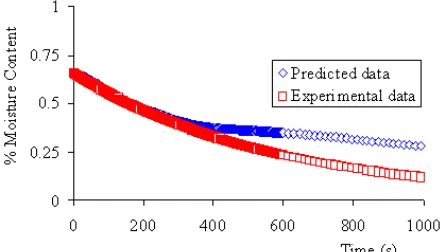
Fig. 5. The experimental cottonseed drying curve with the predicted drying curve provides the diffusivity for the model.
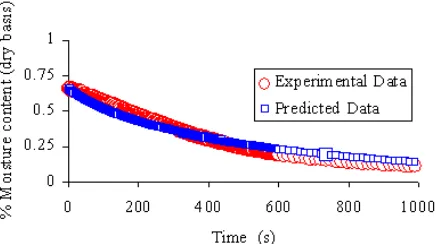
Fig. 6. Recursive version of the classic Newman (1932) equation for the prediction of a thin-layer drying curve.
(
)
(
)
(
)
(
)
[
M
e
M
e
M
M
e
]
c n
e n
o n
e n
D kv t D kv t D kv t
+
− − −
=
+
−
+
+
+
1
1∆ 2∆ 3∆
...
[6] gin-run cottonseed, albeit with a much faster
response indicating that the seeds themselves were not involved in the bulk of the moisture transport.
Given these similarities, a model generated for the same style of drying was investigated. To characterize the mass transport, the classical infinite series solution to the three-dimensional diffusion equation was used (Newman, 1932).
The value used in this model for the diffusivity coefficient (Dv) for starch-coated cottonseed
originated from experimental data obtained in a constant-temperature drying apparatus developed by Barker and Laird (1997). The results of the curve fit are shown in Fig. 5.
In Barker and Laird’s apparatus, the equilibrium moisture content of the incoming air is equal to zero (-20(C dew point) throughout the entire test. In the dryer, however, as the air moves throughout the wet seedbed, its equilibrium moisture content constantly changes within the cottonseed dryer. Because of this, the model needs to use a recursive form of the moisture content prediction equation that will allow the equation to adapt from the experimentally tested steady-state conditions to the dryer’s continuously varying conditions. Equation [6] provides the recursive form of this equation that uses a three-term approximation. The three-term approximation was chosen because Barker and Laird (1997) demonstrated that it corresponded well for cottonseed. When used to predict moisture content, Eq. [6] depends upon the same diffusivity found in the non-recursive version of this equation. Figure 6 provides the results of this prediction. It should be noted that the recursive form of the equation predicted the moisture content of the cottonseed better than the normal form of the solution.
Where:
n = previous time step n + 1 = current time step.
As shown in Eq. [6], to find the moisture content of the cottonseed, the equilibrium moisture content of the air used in the drying process needs to be found. Currently, several equations have been formulated to provide the equilibrium moisture content (Abernathy et al., 1994), including the Henderson equation (Henderson and Perry, 1976), the modified Henderson equation, the Chung-Pfost equation, and others (Casada et al., 1997).
Me = equilibrium moisture content Pv = vapor pressure of the air
Ps = saturated vapor pressure of the air
rh = Pv/Ps = relative humidity
Ro = universal gas constant.
From Kradangnga (1994) (30(C curve fit):
c = 4.13896 × 10⁻⁵ n = 1.78224 A = 9601.331 B = 0.18409
One problem associated with the current equilibrium moisture models occurs when the relative humidity approaches 100%. In this situation, both models return a value of infinity for the equilibrium moisture content. However, because this model must include situations with 100% relative humidity, a two-piece model needs to be considered. Otherwise, when the relative humidity exceeds 95%, Eq. [7] and [8] will both return unrealistic values that eventually reach infinity at 100% relative humidity. The two-piece model was set up to clip the equilibrium moisture content to a value no greater than the saturated equilibrium moisture content, which occurs at approximately 100% relative humidity.
Equation [6], in conjunction with either Eq. [7] or [8], can be used to quantify the moisture lost from the seeds that then vaporizes into the air. Equation [9] quantifies the change in humidity due to the evaporation process:
∆
H
V o l
c
t
V
V A
s
sa
=
ρ
δ
δ
[9]Where:
ûH = change in humidity (kg moisture kg-1 dry
air)
!s = density of the cottonseed
To use this model, the relative humidity of the air must be calculated. This can be calculated using standard psychometric equations that incorporate the original relative humidity, the mass flow of the air stream, and the change in the absolute humidity that occurs from either moisture vaporization or adsorption of the drying cottonseed.
Energy Equations
The heat and mass transfer to and from the fluid stream can be characterized through the use of energy conservation equations for both the air and the cottonseed. An additional energy source term, q¢, takes into account the energy added and lost in the air, specifically from moisture gain and removal.
Equation [10] quantifies the change in enthalpy due to the added or lost heat from evaporation and condensation. Equation [11] requires a value for the latent heat for water lost and gained, which can be found from the standard ASAE psychrometric equations (ASAE Standard D271.2 in ASAE, 2000b) at saturation temperature, as well as the latent heat of vaporization at saturation.
û
h = h
fgû
H’
[10]û
H’ =
û
H
e-
û
H
c [11]Where:
ûh = enthalpy; heat gained by the air that is
lost by the seeds
ûHe = water content lost from the cottonseed to
the air through evaporation
ûHc = water content gained by the cottonseed
from the air by condensation
ûH' = total water content gained by the air that
is lost from the seeds.
Fig. 7. A downflow belt dryer illustrating both the cottonseed and airflow.
ρ
δ
δ
ρ
δ
δ
ρ
δ
δ
δ
δ
δ
δ
δ
δ
δ
δ
ρ
c
T
t
c u
T
x
c v
T
y
x
k
T
x
x
k
T
y
h
H
V c
T
p p p
fg a p a a s
+
+
=
+
+
∆
'+
∆
, [13]
heat transfer. Equation [12] provides the equation for the energy source/sink term in the model.
q’ = q
conv+ q
evap= h
fgû
H’ +
!
aV
cpaû
T
a,s [12]Where:
!a = density of air vapor mixture
V = mean velocity of the air vapor mixture cpa = specific heat of the air vapor mixture
ûTa,s = temperature difference between the
cottonseed and the air stream.
By substituting Eq. [12] into the standard Navier Stokes Energy equation, the final form of the energy equation for the air is derived in Eq. [13], shown below.
Finally, to provide energy balance, Eq. [14] considers that the energy added to the air is equal to the energy lost by the cottonseed:
q’
s= - q’
a= m
sk
sû
T
a,s [14]Where:
q's = energy gained by the cottonseed
q'a = energy gained by the air vapor mixture
ms = mass of the cottonseed
ks = thermal conductivity of cottonseed. Thermal Conductivity
The thermal conductivity properties of starch-coated cottonseed are not readily available in the literature. However, because most small grains provide a typical thermal conductivity of 0.15 W m-1
K-1 (ASAE Standard D243.3 in ASAE, 2000a), this model will use this value unless refinement is deemed necessary to improve the model.
Model Solution
The numeric solution was based upon a finite-volume solution to the previously outlined modified Navier Stoke’s equations. The semi-implicit pressure-smoothing algorithm (Patankar, 1980) was used for the inner and outer loop within the structure of a full multi-grid algorithm along with a Gauss-Seidel smoothing pass occurring between the grid transitions (Ferziger and Peric, 1996). The solution topology was to utilize both the velocity and pressure terms on a collocated grid with fourth-order diffusive smoothing to ensure stability of the collocated pressure-velocity terms (Tannehill et al., 1997).
Prediction of Product Moisture Content, Air Temperature, and Relative Humidity
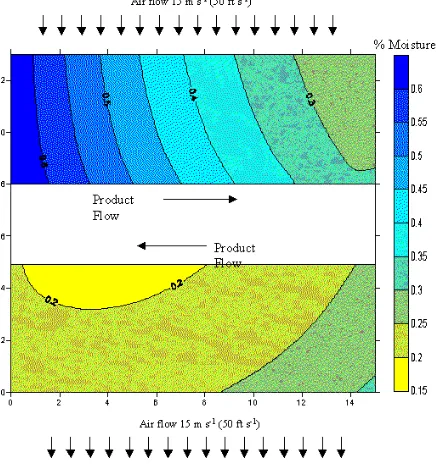
Fig. 8. The moisture content prediction by a computational model of the starch-coated cottonseed.
Fig. 9. Air temperature prediction by a computational model of the starch-coated cottonseed.
Fig. 10. A prediction of the air’s relative humidity by a computational model of the starch-coated cottonseed.
(Fig. 10). This model suggests that the efficiency of the dryer could be improved by exhausting the first 1 to 2 m (4 ft) of air before it passes through to the lower levels. These and other alternatives are being explored with this model.
SUMMARY
The mathematical modeling of the cottonseed drying process will allow many experimental designs to be considered without having to build prototype dryers. This tool provides a streamlined method that can improve existing and future starch-coated cottonseed dryers. To accurately model these dryers, several key engineering design parameters needed to be found, including the diffusivity and equilibrium moisture content. These parameters are used to predict cottonseed evaporation and drying rate.
The requisite data not available in the literature were obtained experimentally to provide the necessary engineering design parameters. These data provided a solid foundation for use in the mathematical model. The diffusivity information used to predict the time-temperature moisture content fit well with the classical solution, which was first proposed by Newman (1932) and extended into cottonseed by Barker and Laird (1997). This model required the transformation of this equation to a recursive form that would be usable in non-steady-state situations, such as those found in this drying process.
research provide the framework to model the moisture mass transport from the cottonseed into and out of the air. In addition, the mass convection-diffusion within the air stream was considered, including the humidity gradients present within the cottonseed dryer.
REFERENCES
Abernathy, G.H., S.E. Hughs, and M.N. Gillum. 1994. Improvements of equilibrium moisture content models for cotton. Trans. ASAE 37:561-569.
American Society of Agricultural Engineers. 2000a. ASAE Standard D243.3. Am. Soc. Agric. Eng., St. Joseph, MI. American Society of Agricultural Engineers. 2000b. ASAE Standard D271.2. Am. Soc. Agric. Eng., St. Joseph, MI. American Society of Agricultural Engineers. 2000c. ASAE Standard D272.3. Am. Soc. Agric. Eng., St. Joseph, MI. Anderson, J.D. Jr. 1995. Computational fluid dynamics: The basics with applications. McGraw Hill. New York, NY. Barker, G.L., and J.W. Laird. 1997. Effect of temperature on
the drying rate of gin run cottonseed. Trans. ASAE 40:891-896.
Casada, M.E., A. Alghannam, and R.C. Dekker. 1997. A seed corn drying model. Am. Soc. Agric. Eng. Int. Summer Mtg., Minneapolis, MN. August 1997. ASAE Pap. no. 97-6099. Am. Soc. Am. Eng., St. Joseph, MI.
Ferziger, J.H., and M. Peric. 1996. Computational methods for fluid dynamics. Springer-Verlag, Berlin and Heidelberg, Germany.
Henderson, S.M., and R.L. Perry. 1976. Agricultural process engineering. AVI Publishing, Westport, CT.
Idelchik, I.E. 1994. Handbook of hydraulic resistance. 3rd ed. CRC Press, Boca Raton, FL.
Kradangnga, P. 1994. Storage parameters determination for cottonseed. M.S. thesis. Mississippi State Univ., Mississippi State, MS.
Laird, J.W., T.C. Wedegaertner, and G.L. Barker. 1998. Water and starch rates for coating cottonseed. p. 1718-1720. In Proc. Beltwide Cotton Conf., San Diego, CA. 5-9 Jan. 1998. Natl. Cotton Counc. Am., Memphis, TN. Newman, A.B. 1932. The drying of porous solids: Diffusion
calculations. Trans. Am. Inst. Chem. Eng. 27:310-333. Patankar, S.V. 1980. Numerical heat transfer and fluid flow.
Taylor & Francis, Washington, DC.
Smith, L. 1975. Aeration of cottonseed in storage. USDA Marketing Res. Rep. 1020. U.S. Gov. Print. Office, Washington, DC.
Tannehill, J.C., D.A. Anderson, and R.H. Pletcher. 1997. Computational fluid mechanics and heat transfer. 2nd ed. Taylor & Francis, Washington, DC.
Wedegaertner, T.C., and W.F. Lalor. 1997. Whole cottonseed research & promotion program at Cotton Incorporated. p. 398-399. In Proc. Beltwide Cotton Conf., New Orleans, LA. 7-10 Jan. 1997. Natl. Cotton Counc. Am., Memphis, TN.