JEMT 6 (2018) 16-20 ISSN 2053-3535
Possible method of destruction of cyclone by
microwave electromagnetic radiation
Kaganov William Ilich
Moscow Technological University (MIREA), Russia. E-mail: [email protected]. Tel: +7 9175097166.
Article History ABSTRACT
Received 06 February, 2018 Received in revisedform 13 March, 2018
Accepted 19 March, 2018
Keywords: Mnemonic model, Tropical cyclone, Heat energy.
Article Type:
Preliminary report
A mnemonic model of a tropical cyclone was considered, which makes it possible to formulate a possible method of its destruction at the stage of nucleation - by introducing into it additional electromagnetic energy that is converted into heat. The results of a laboratory experiment on the remote heating of fine graphite and special ceramics particles, which should be sprayed inside a column of rotating air, are presented. The main parameters of the system implementing this principle of cyclone destruction are determined.
©2018 BluePen Journals Ltd. All rights reserved
INTRODUCTION
Cyclones, periodically nascent in the tropical zone of the Earth, have tremendous energy (Figure 1). The action of the cyclone leads to numerous human casualties and huge destruction. For example, the cyclone Katrina, operating in the North Atlantic basin in 2005, caused the US economic losses of more $100 billion (personal communication). All attempts to curb or at least reduce the destructive power of cyclones have not yet been crowned with success.
In this report, an attempt of a possible solution to solve this global problem; which describes a way to destroy any cyclone at the initial stage of its nucleation, with the help of powerful microwave electromagnetic radiation was made.
Phases of cyclone development
There are three phases of cyclone development. The first phase is associated with the nucleation of a cyclone, which is an atmospheric formation with a reduced air pressure in the center and spiraled airflows, with a wind speed of more than 17 m/s (Pogosyan and Cyclones, 1976; Philips, 1977). Such a cyclonic vortex appears above the tropical aquatorium of the ocean at a latitude of
5° and 20°. The heated air, saturated with moisture, rises from the ocean surface to a high altitude and is cooled, resulting in condensation of water vapour and the release of heat that energizes the nascent cyclone.
In the lower part of the cyclone, air can move to the center of the axis. But the bulk of the air, born of cyclonic formation, under the influence of the Coriolis force, associated with the rotation of the Earth, begins to rotate around the quasi-vertical axis counterclockwise in the northern hemisphere and clockwise - in the southern hemisphere.
The second phase includes the gradual development of a cyclone - a rotating column of air at a speed of up to 40-50 m/s, a height of 2-20 km and a radius of up to 150 km. The process of cyclone development is completed by establishing a state of dynamic equilibrium between the thermal energy of evaporation feeding the cyclone and cooling the ocean by virtue of the mixing of its waters.
The third phase is associated with the destruction of the cyclone, when the total energy of all losses (cooling from overseas, friction on the earth's surface, overcoming obstacles) begins to exceed the thermal energy that feeds the cyclone.
Figure 1. A typical cyclone.
Figure 2. The model of cyclone.
decreases with height according to the law:
(1)
h is the current height of the cyclone in km.
Then the kinetic energy of the rotating column of air:
(2)
Where: R is the radius of the cyclone, km; H is the height of the cyclone, km; V (m/s) is the wind speed at the periphery of the cyclone; (h) is the density of air, determined according to Equation 1. Assuming V = 13 m/s, H = 1 km and R = 1 km for the incipient cyclone, we
obtain according to Equation 2 for the energy:
W=1.5×10¹¹ J.
For the cyclone formed, we take: V = 27 m/s, H = 10 km and R = 150 km. In this case we get: W = 1017 J. For comparison, we point out that the energy released by the explosion of a hydrogen bomb in 20 Mt is 1017 J, which is quite comparable to the energy of the formed cyclone. From the point of view of physics, a cyclone is a kind of heat engine in which heat taken from the ocean turns into kinetic energy of a rotating air vortex. Such a conversion is possible due to a decrease in air temperature with altitude.
Mnemonic model of a tropical cyclone
Let's make a mnemonic model of a tropical cyclone, considered as a self-oscillating system of a volumetric
R
H
Ocean
Warmwater
0
,
25
10
,
02 2 9
H
dh
h
V
R
h
W
ρ (h) [kg/m
3Ilich 18
Figure 3. Example 1 of the solution of Equations 5.
Figure 4. Example 2 of the solution of Equation 5.
type. Such a model only externally, conditionally describes the processes occurring in it. We use as a basis the modified van der Pol equation used in the description of self-oscillating systems (Kaganov, 2008), in a rectangular coordinate system:
(3)
Where
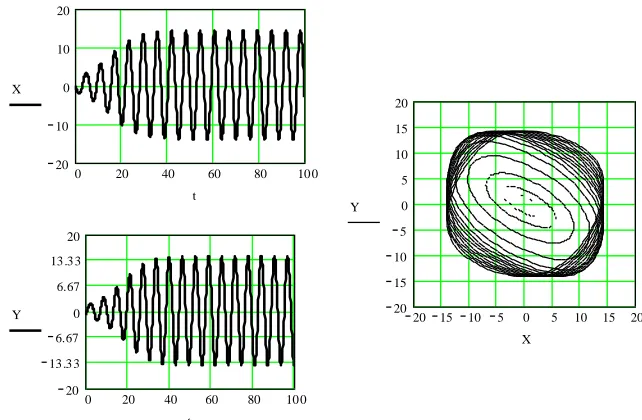
Function describing the damping in a rotating column of air, associated with the introduction of additional energy into it. Equations 3 reflects the dynamic process for each of the particles in the investigated medium in the x-y plane. An example of solving Equations 3 numerically using a computer program in the form of three graphs for the function Φ (t) = 0 is shown in Figure 3, and when Φ (t) is taken into account in Figure 4 (the process decays).
Possible method of cyclone destruction
So, according to the mnemonic model in the cyclone - the self-oscillating system of the volumetric form - it is
0 20 40 60 80 10 0
20 10 0 10 20 X t
20 15 10 5 0 5 10 15 20 20 15 10 5 0 5 10 15 20 Y X
0 20 40 60 80 10 0
20 13 .3 3 6.67 0 6.67 13 .3 3 20
Y
t
0 20 40 60 80 10 0 12 0 14 0 16 0 18 0 20 0 15 10 5 0 5 10 15 X t
20 15 10 5 0 5 10 15 20
20 15 10 5 0 5 10 15 20 Y X
0 20 40 60 80 10 0 12 0 14 0 16 0 18 0 20 0 15 10 5 0 5 10 15 Y t
1
exp
β
0 , , 0 Ω ) ( 1 2 4 3 2 2 2 2 1 2 2 y dt dy t y a a dt y d x dt dx еt x a a dt x d
(t) A1 exp αt (3)
where
1
exp
β
0 ,, 0 Ω ) ( 1 2 4 3 2 2 2 2 1 2 2 y dt dy t y a a dt y d x dt dx еt x a a dt x d
(t) A1 exp αt (3)
Figure 5.The model of cyclone destruction.
necessary to "inject" additional energy and thereby disrupt the steady-state balance in it between the thermal energy supplying the cyclone and the kinetic energy of the rotating column of air.
We propose a method: spray inside the cyclone - the column of the incipient vortex formation (Figure 2) - small pieces of graphite with thin pieces of wire (antennas) (Figure 5). Then direct an electromagnetic radiation to this column of air, due to which the temperature of the ceramics particle will increase substantially. As a result, the balance of energies in the system under consideration will change, which will lead to an increasing self-oscillatory process.
THE LABORATORY EXPERIMENT
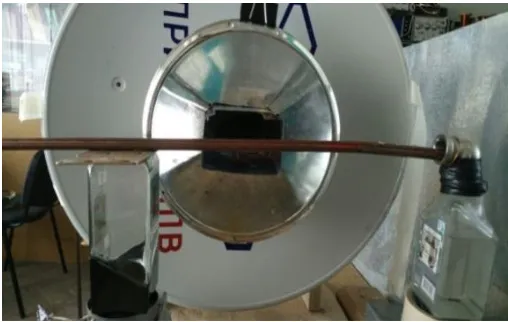
In order to test the idea of remote heating of graphite particles by electromagnetic radiation, the following laboratory experiment was set up. At a distance of 5 cm from a horn antenna with a magnetron (frequency 2.45 GHz, power 800 W), graphic thin rods and ceramic balls were placed on which thin wires of length l = λ / 4 = 3 cm were attached to quarter-wave antenna vibrators (Figure 6).
The main results of the experiment
A graphite rod at a mass of 1 g to a temperature of 100°C heats in 60 s. This requires a microwave power signal of 0.8 W and an energy consumption of 50 J. A similar result was obtained by replacing graphite with ceramic
balls with the same thermo-physical properties.
About the industrial installation of destruction of a cyclone
After detection of the incipient cyclone with the help of a satellite system for monitoring the state of the ocean in the appropriate area, a group of ships with powerful microwave generators and parabolic antennas equipped with them is sent. The bases of microwave generators are magnetrons or rectilinear klystrons. Graphite or ceramic balls with mini-antennas are dumped into the nascent cyclone with the help of unmanned aerial vehicles.
Here are the main results of the energy calculation for irradiating the column of the incipient cyclone with microwave electromagnetic waves (Figure 5): the distance between the microwave generator installed on the ship and the cyclone is 10 km, the frequency of the signal is 2.45 GHz, the power -100 kW, the mirror diameter of the parabolic antenna D = 7.3 m.
The density of the energy flux of an electromagnetic wave per unit time in a cyclone column with graphite or ceramic beads is 4.2 W/m2, the amount of graphite or ceramic beads ejected into a cyclone is 10 million with a total mass of 10 tons, the irradiation time is 10 h, the total value of the microwave energy pumped into the cyclone is 109 J.
As a result of heating the particles of graphite to a temperature of 100°C, the process of rapid evaporation of moisture in the rotating column of air will begin, which will lead to the destruction of the cyclone. The cyclone can be
l
graphite
Ilich 20
Figure 6. Laboratory installation.
irradiated simultaneously with the help of several microwave generators.
Conclusion
A physical principle is considered that can be used as a basis for a possible method of destruction of a cyclone at the stage of its nucleation - by heating particles of graphite or ceramics with the help of microwave electromagnetic radiation. The main parameters of the system realizing this principle are determined.
Once again, we draw attention to the fact that first we need to conduct an extensive experiment in a specially
equipped basin to fix the process of destroying the air column, an artificial one created with the help of a powerful fan, and to more accurately determine the parameters of the proposed system.
REFERENCES
Pogosyan H. P. & Cyclones L. (1976). Gidrometeoizdat.
Philips O. M. (1977). The dynamics of the upon ocean. London: Combridge University Press.