Harpenden, Herts, AL5 2JQ Telephone: +44 (0)1582 763133 Web: http://www.rothamsted.ac.uk/
Rothamsted Repository Download
A - Papers appearing in refereed journals
Cashen, R. O. 1947. The influence of rainfall on the yield and botanical
composition of permanent grass at Rothamsted . The Journal of
Agricultural Science. 37 (1), pp. 1-10.
The publisher's version can be accessed at:
•
https://dx.doi.org/10.1017/S0021859600012971
The output can be accessed at:
https://repository.rothamsted.ac.uk/item/96xqq/the-
influence-of-rainfall-on-the-yield-and-botanical-composition-of-permanent-grass-at-rothamsted
.
© Please contact [email protected] for copyright queries.
VOLUME 37
JANUARY 1947
PABT 1THE INFLUENCE OF RAINFALL ON THE YIELD AND BOTANICAL
COMPOSITION OF PERMANENT GRASS AT ROTHAMSTED
BY ROSE 0. CASHEN, Rothamsted Experimental Station, Harpenden, Herts
(With Four Text-figures)
1. DESCRIPTION OF THE EXPERIMENT The manurial experiment on the Rothamsted Park Grass Plots, which was commenced in 1856 and has been carried out without interruption since, is the oldest grass experiment in the world. It provides a considerable quantity of material for a statistical investigation into the influence of weather on the yields and botanical composition of manured grass-land.
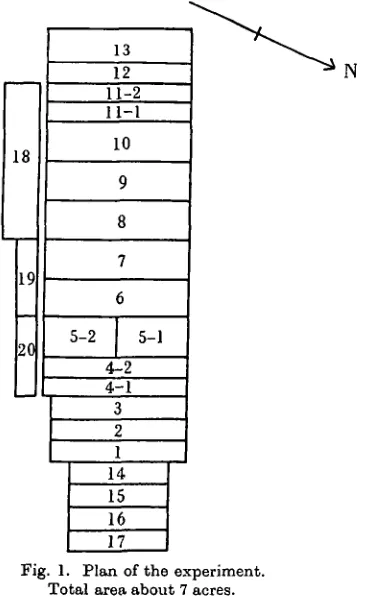
The plots were laid out on a part of Rothamsted Park where the land had probably been under grass for some centuries. In all about 7 acres were divided into plots, of which there are at present twenty-three. The plan is shown in Fig. 1. The area allotted to the experiment is very level. The soil is a fairly heavy loam derived from Clay-with-flints overlying Chalk, and has good natural drainage.
18
19
20
13 12
11-2 11-1
10
9
8
7
6
5-2 5-1
4-2 4-1 3 2 1 14 15 16 17
Fig. 1. Plan of the experiment. Total area about 7 acres. Journ. Agrio. Sci. 37
Lawes & Gilbert (1880) record that for many years prior to 1851 this grassland was occasionally manured with dung and road scrapings. Each year the field was cut for hay, and the aftermath grazed by sheep. When the area was divided up into experimental plots, this system continued for some years, the sheep, when allowed on the field for grazing aftermath, being penned on to each plot and receiving no other food, so as not to interfere with the manurial scheme. From 1875 onwards the aftermath was practically always cut as a second crop and carted away, but in a few cases—when it was very sparse—it was left to rot on the plots.
The scheme of manuring was designed by Lawes & Gilbert to yield scientific data from which practical deductions might be made, rather than to secure results which should serve as direct models for practical agriculture. In fact, to quote Lawes & Gilbert (1880), ' . . .in some of the experiments conditions have been maintained which, though yielding very large amounts of produce, have done so not only at a great sacrifice of the quality of the hay but at an entirely unremunerative cost; whilst, on the other hand, in some cases very high quality has been obtained, but again at far too high a pecuniary cost.'
Lawes & Gilbert (1880, 1882, 1899), in their reports on the agricultural, botanical and chemical results of the experiments, gave an exhaustive analysis of the first 20 years' data 1856-75. Brenchley (1924), in her monograph Manuring of Grass Land for Hay, made a further examination of the results up to 1919; her object was to study the effect of the various manures on the yields and the botanical composition of sward. The present paper gives the results of a statistical analysis of the effect of rainfall on the yields and the botanical composi-tion. The effects, as evaluated, necessarily include influences of other weather phenomena in so far as these are associated with rain.
A number of changes in manurial policy occurred during the period of the experiment, the chief one taking place in 1903 when the southern half of most plots began to receive lime periodically, and the harvests from then onwards were gathered separ-ately from each half. This and many other changes have caused considerable difficulty in selecting a series of years during which a sufficient number of
plots had had continuous treatment, the final choice being limited to thirteen plots for 45 years from 1858 to 1902. The plots selected were: 3, 12, 4 (1), 8, 7, 17, 16, 4 (2), 10, 9, 14, 11 (1) and 11 (2)." A description of the manurial treatments is given at the end of this paper.
The data used are the yields of the first crop in cwt./acre and the daily rainfall records in inches from the Rothamsted 1/1000th acre gauge.
2. METHOD OF ANALYSIS
The analysis was conducted mainly on the lines of investigation developed by Fisher (1924).
In the first instance consideration was confined to the rainfall falling during the active period of growth of the grass. The average time of cutting the plots is the last week in June, and the period from 5 March to 8 July was therefore chosen. The amount and distribution of the rain in each period was expressed in terms of the coefficients of orthogonal polynomials to the fifth degree fitted to the twenty-one 6-day rainfall totals (Fisher, 1944; Fisher & Yates, 1943), the effects of slow changes being eliminated by fitting fifth degree polynomials to the yields and to the rainfall polynomial coefficients. For each plot the regression of the yield residuals on the residuals of the rainfall polynomial coefficients was calculated. The regression coefficients so obtained were used to calculate polynomials of the form
b0 + h (/ + 62 f,' + b3 £,' + 64 U + h (,',
expressing the average effect on yield of an addi-tional inch of rain (above the mean rainfall) at any time during the period under consideration. £x', f 2', etc., represent the values of the orthogonal poly-nomials of degree 1, 2, etc., for w=21 tabulated in Statistical Tables (Fisher & Yates, 1943). Thus the values of b0 give the average increase in yield due to an inch of rain, irrespective of the time of precipita-tion, and bj, 62, etc., represent variations in this average effect depending on the actual time at which the rain falls, variations which can best be expressed by actually plotting the polynomial curves. These curves are illustrated later in the report.
The differences between the regression coefficients were tested by the method described by Yates
(1939).
3. TREND OF YIELDS
The main trend of the yields in 1858-1902 is adequately represented by the linear term of the regression, which is negative and which accounts for the bulk of the sum of squares for the 5 degrees of freedom representing slow changes. This falling off in yields is significant for all plots with the
exception of 11 (1) and 11 (2). It may be noted that the 5 March to 8 July rainfall also decreased during this time at the rate of 0-05 + 0-03 in./annum; the mean for the 45 years is 8-4 in. The average yield and deterioration per annum for each plot are given in Table 1. The average benefit from rainfall represented by the regression coefficient b0 and referred to in § 4, is also included in this table. The plots are grouped according to the absence or presence of nitrogen.
The relatively high deterioration on plots 8 and 10 can be explained by the fact that these plots received potash from 1856 to 1861 but none from then onwards; instead, a somewhat increased supply of sulphate of soda was given. Lawes & Gilbert (1880) reported that the withdrawal of potash from plot 8 was completely changing the character of the herbage and the quantity of yield, as compared, for instance, with plot 7 which con-tinued to receive potash.
4. THE INFLUENCE OF RAINFALL ON THE YIELDS
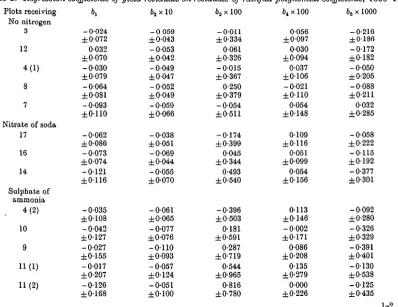
The regression coefficients, bx to 66, of yield residuals on the residuals of the first to fifth degree rainfall polynomial coefficients, with their standard errors, are given in Table 2. For these, as well as for the values of 60 (Table 1), the rainfall is measured in inches, and the crop in cwt./acre.
For all plots, with the exception of 14, the re-gression b0, which is the regression on the total rainfall, is significantly greater than zero, but none of the regressions on the linear or higher order rain-fall polynomial coefficients reaches significance. This indicates that the effect of total rainfall in the period 5 March-8 July on the yield of hay is significant, but that its distribution is not apparently of great importance.
On all plots the average benefit is very substantial. The differences between the values of b0 for the different plots cannot be tested by means of the standard errors shown in Table 1, because of correla-tions between the plots. The standard errors of the differences of six pairs, 12-4 (2), 4 (l)-4 (2), 4 (2)-14, 7-14, 3-9 and 7-9 were calculated, and the first four of these differences were found to be significant. Apart from the apparently anomalous value of plot 14, therefore, there is some evidence that the benefit is greater on the plots giving the higher yields. As regards the yield of plot 14, its relative inde-pendence of the rainfall was also observed by Lawes 6 Gilbert (1880), who expressed the opinion that the manurial conditions on that plot were notice-ably encouraging the growth of deeply rooting plants which were able to draw moisture from the lower levels of the soil.
ROSE 0. CASHED
Table 1. Average yield, annual deterioration and benefit from rainfall in cwt./acre, 1858-1902
Plots receiving No nitrogen 3 12 4(1) 8 7
Nitrate of soda 17 16 14 Sulphate of ammonia 4(2) 10 9 11(1) 11(2) Manure* 0 0 P pm pkm
V
i\'pkm n2'pkm n sV n2pm nxpkm n,pkm n,pkms Average yield 17-9 19-8 19-2 23-3 32-2 30-3 42-2 52-8 30-3 39-9 46-9 53-6 60-7 Average annual deterioration 0-27 ±0-06 0-31±006 0-27 ±0-07 0-47 ±0-07 0-24±0-09 0-25 ±0-07 0-30±006 0-28±0-100-31 ± 0 0 9 0-44 ±0-11 0-34±0-13 0-19±0-17 0-16±0-14
Average benefit per additional inch
of rainfall (60)
l-44±0-38 l-07±0-37 1-60 ±0-42 1-51 ±0-43 l-97±0-58 l-64±0-45 l-62±0-39 0-68±0-61 2-44±0-57 l-97±0-67 2-26±0-82 2-38±109 1-95 ±0-88 o =unmanured.
p = superphosphate =65 lb. P2O5/acre.
k = sulphate of potash=150-250 lb. KaO/acre.
m = sulphate of soda and sulphate of magnesia. s =silicate of soda.
nj' = nitrate of sodas43 lb. N. n2' = nitrate of soda=.86 lb. N. n2 =sulphate of ammonia= 86 lb. N. ra3 =sulphate of ammonia=129 lb. N.
Table 2. Regression coefficients of Plots receiving No nitrogen 3 12 4(1) 8 7
Nitrate of soda
17 16 14 Sulphate of ammonia 4(2) 10 9 11(1) 11(2) * i - 0024 ±0-072 0032 ±0-070 -0030 ±0079 -0064 ±0-081 -0093 ±0-110 -0062 ±0-086 -0-073 ±0074 -0121 ±0116 -0035 ±0-108 -0042 ±0-127 -0-027 ±0-155 -0017 ±0-207 -0126 ±0-168 yield residuals JjxlO
- 0 059 ±0-043 -0053 ±0-042 -0049 ±0-047 -0052 ±0-049 -0059 ±0-066 -0038 ±0051 -0069 ±0-044 -0055 ±0-070
- 0 0 6 1 ±0-065 -0-077 ±0-076 - 0 1 1 0
±0093
-0057
±0124
-0-051
±0-100
on residuals of rainfall polynomial coefficients, 18
63 x 100
-0011
±0-334 0061 ±0-326 - 0 0 1 5 ±0-367 0-250 ±0-379 -0-054 ±0-511 -0-174 ±0-399 0-045 ±0-344 0-493 ±0-540 -0-396 ±0-503 0-181 ±0-591 0-287 ±0-719 0-544 ±0-965 0-816 ±0-780
64 x 100
0056 ±0-097 0-030 ±0-094 0-037 ±0-106 -0021 ±0110 0-054 ±0-148 0-109 ±0-116 0-051 ±0099 0054 ±0-156 0113 ±0-146 -0002 ±0-171 0086 ±0-208 0135 ±0-279 0-000 ±0-226
66 x 1000
(60) and soil pS. has also been examined. It is well known that the effects of acidity on crops are most marked in dry spells and that, while in the drier counties of Eastern England some arable crops will fail where the pii value falls to 5-0, the same crops will grow satisfactorily at this level of acidity in the wetter districts of Wales and western England. pH. determinations on Park Grass were made in 1923 (Crowther, 1925). Table 3 gives, for each of the manurial groups of plots, the mean of these pTL values, and of the 60 values in the period 1858-1902. The benefit from rain was clearly greater on
Table 3. Means per plot of pS. in 1923, and of average benefit per additional inch of rain (b0), in cwt./acre, 1858-1902
unlimed' 1858^1902 5-6
6-2 3-9
1-52 1-31 2-20 Plots receiving
No nitrogen Nitrate of soda Sulphate of ammonia
the acid plots. It was noted above that the effect of rain is greater on the higher yielding plots, but a joint regression on p H and mean yield of plots indicated that this effect is ascribable to the associa-tion between b0 and pH.
It may be noted that, according to W. G. Cochran (1935), the only significant results in investigations on similar lines on other crops at Rothamsted and at Woburn were those obtained by Fisher (1924) on Broadbalk wheat. The other examinations in connexion with Hoosfield barley (Wishart & Mackenzie, 1930), Woburn wheat and barley (Cochran, 1936) and mangolds at Roth-amsted (Kalamkar, 1933) failed to show significance, though the effect on mangolds was not far short of it. Cochran, however, found that, taking into account March-April rainfall, its square and cube, and rainfall 60-90 days after sowing and its square, significant effects were obtained on Woburn barley. At a later date, in an examination of a four-course rotation of wheat, mangolds, barley and beans at Saxmundham, Boyd (1940) obtained some signifi-cant results in testing the effect of total rainfall in the year of harvest, and in the two years previous to it, though the distribution of rainfall in the year of harvest failed to show any significant effects.
In view of these latter results the effect of the total rainfall for the period November-February was also tested for a number of the Park-Grass plots, but no significant effects were obtained.
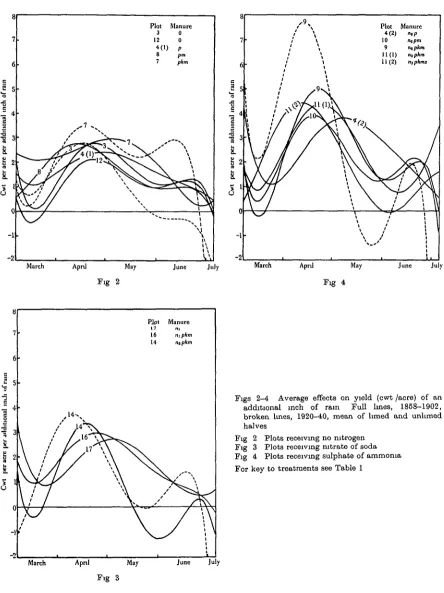
The curves representing the estimated effect on yield of an additional inch of rain falling in different parts of the growing season are shown in Figs. 2-4. They are presented in manurial groups into which, as in the case of Broadbalk wheat and subsequent similar investigations, they appear to fall. The
broken lines in these figures show the corresponding curves of plots 3, 7, 9 and 14 (mean of limed and unlimed halves) for the period 1920-40 which were calculated in the course of the investigation into the effect of liming described in § 6.
In view of the fact that the statistical tests have shown that little significance can be attached to the form of these curves there is no need to discuss them in detail, but it may be noted that the rainfall effects appear to reach a maximum in the latter part of April and early May, thus confirming Hooker's (1922) finding.
It should be pointed out, however, that similarity between the curves of a group of plots receiving similar manurial treatments, even if pronounced, does not necessarily indicate that the effects shown are genuine. Cochran (1935), for example, found that the curves for Woburn wheat and barley fell into two well-marked groups, depending on whether or not they received nitrogen, but concluded that this was due to factors other than those expressible in terms of the rainfall coefficients included in his investigation. On the other hand, the curves for the same plots in the two periods can be regarded as completely independent, and it is satisfactory to observe that these are of generally similar form.
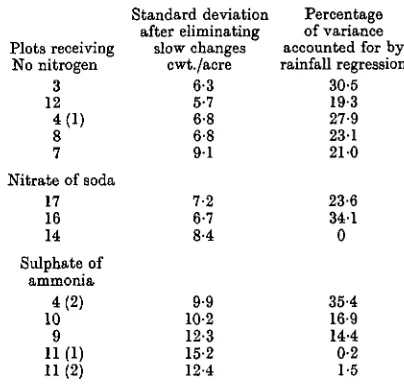
The percentage of the variance about the poly-nomials representing the slow changes in yield, which is accounted for by the regression on rainfall is given in Table 4 for each of the plots, i.e. (A-B) as a percentage of A, where A and B are respectively the mean squares before and after allowing for the rainfall regression. The values range from zero to 35 %. The rainfall regressions would not therefore by themselves form any very useful basis for the prediction of yields.
Table 4. Percentage of the variance accounted for by the regression on rainfall
Plots receiving No nitrogen
3 12
4(1) 8 7 Nitrate of soda
17 16 14 Sulphate of
ammonia 4(2) 10
9 11(1) 11(2)
Standard deviation after eliminating
slow changes cwt./acre
6-3 5-7 6-8 6-8 9 1
7-2 6-7 8-4
9-9 10-2 12-3 15-2 12-4
Percentage of variance accounted for by rainfall regression
30-5 19-3 27-9 23-1 210
23-6 341 0
ROSE 0. CASHEN
8
7
6
c J2 5
O
•s
j? 4
lio
n
1 3
pe
r
I
2pe
r
~ 1
0
-1
-2
_
• a
Plot 3 12 4(1) 8 7
X
Manure 0 0
p pm pkm
\ \\
\
\ i
•
\
V A
1 V i ' i
v i
\ IV
s\
March April May June July
Plot Manure
4(2) /i,p 9 nap/cm 11(1) n,pkm 11(2) n,pkmi
F i g 2
PJot 17
16 14
Manure
nj pkm ntpkm
Figs 2-4 Average effects on yield (cwt /acre) of an additional inch of ram Full lines, 1858-1902, broken lines, 1920-40, mean of limed and unlimed halves
Fig 2 Plots receiving no nitrogen Fig 3 Plots receiving nitrate of soda Fig 4 Plots receiving sulphate of ammonia For key to treatments see Table 1
March
5. THE INFLUENCE OF RAINFALL ON THE BOTANICAL COMPOSITION Brenchley (1935) has discussed the influence of season and of the application of lime on botanical composition in the period 1919-33 and concluded that, with long-established manurial treatment, the percentages of the three main groups of species— grasses, leguminous and miscellaneous plants—are not usually much affected either by season or by the application of lime on plots receiving complete fertilizers, though the response of individual species does vary; with unbalanced fertilizers the pro-portions both of the main groups and of individual species are affected.
The present study deals with the effect of rainfall on the three main, groups of plants only. Botanical separations of the herbage from many of the plots have been carried out at intervals from early on in the experiment. After examination of the data the most appropriate sequences of years permitting a comparison of several plots appeared to be:
1874-95 192CM0
Plot 3 8 7 6
Manure* 0
pm pkm
pkm, after re2
• See footnote Plot
3 7 9 14 to Table 1.
Manure" 0 pkm n^pkm n^'pkm
For 1920-40 the limed and unlimed portions are treated separately (the southern halves of the plots had periodically received lime from 1903 onwards). The data are in percentages by weight of the three groups of plants. Averages for each group in the two periods are shown in Table 5, but it should be
part of this investigation and for the same season of the year. To eliminate slow changes second degree polynomials were fitted to all the data in this section, as well as in § 6.
The linear coefficients (not reproduced here) giving the changes of botanical composition with time show that, in the period 1874—95, the propor-tion of leguminous plants on plots 6 and 7, and that of ' other orders' on plots 3 and 8 were significantly on the increase, while the proportion of grasses on all the four plots was decreasing. In 1920-40, both the limed and unlimed parts of plot 3 were still losing grasses at a significant rate.
Of all the plots examined in both periods, plot 3 (unmanured, 1874-95) was the only one in which rainfall appeared to have an effect on the botanical grouping, an additional inch increasing the leguminous group by an average of about 0-5%.
The effect of total November to February rainfall was tested for the period 1874-95; no significant influence on botanical composition was found. An exploratory test on the effect of the •previous year's rainfall on botanical composition was also made by plotting dot diagrams. For the period 1920-40 no evidence of association could be found here either, but in the earlier period 1874-95 there is evidence on the complete mineral manure plots 6 and 7 (and, in a lesser degree, mineral manure without potash plot 8) that low rainfall in the season considered is associated with a higher percentage of leguminous plants in the following year. In fact, the lowest 5 March to 8 July rainfall for the 22 years, namely 3-2 in. in 1893, is followed by the highest leguminous percentage in 1894, namely 67-4 for plot 6 and 57-5 for plot 7. The opposite tendency is displayed by the
Table 5. Percentage botanical composition—average over period
1874-95 1920-40
Plot 3U 3 L 8 7U 7L 6 9 U 9 L 14 U 14 L
Gramineae
65
73
65
71
Leguminosae
9
5
21
15
Other orders
26
22
14
14
Gramineae 54 56 — 55 59 — 99 98 95 92
Leguminosae 7 11 — 24 28 — 0 0 1 4
Other orders 39 33 — 21 13
1 2 4 4 U = unlimed; L=limed.
noted t h a t , owing to the considerable fluctuations which occur in the data, these averages serve only as a rough guide to the relative proportions of the botanical groups for each plot.
Regressions of the percentages of the grasses and of t h e leguminous plants on rainfall polynomial coefficients were calculated for each plot, the method of analysis being the same as in the first
ROSE 0. CASHEN
With these exceptions no clear evidence has been found that the balance between the three groups of plants is affected by the rainfall of the season or that of the previous season. I t should be re-membered, however, that the two sequences of years considered 1874-95 and 1920-40, are rather short for the purpose of observing long-period changes or trends, and that rainfall in the period July-October has not been included in the investigation. Furthermore, separate species have not been examined.
6. THE EFFECT OF LIME ON THE INFLUENCE OF RAINFALL ON THE YIELD
As a by-product of the investigation into botanical composition, it was possible to evaluate the effect of lime on the influence of rainfall on the yield for the period 1920-40. The same thirteen plots were con-sidered as in the earlier period, but only the regres-sions b0 were estimated for all plots. Regresregres-sions bt to 65 were estimated for plots 3 (o)*, 7 (pkm),
9 (n^pkm) and 14 (n^pkm).
Part of the limed half of plot 14 is overshadowed by a large oak tree, and for the period under con-sideration separate yields have been measured for the sunny and the shaded part. The analysis for the limed half of plot 14 was therefore made in two parts:
(a) Average of yields from sunny and shaded portions.
(b) Sunny portion only; here four yields for the years 1921—24 had to be estimated as total yields only were available. The estimates were made from these total yields and the complete data in adjacent years.
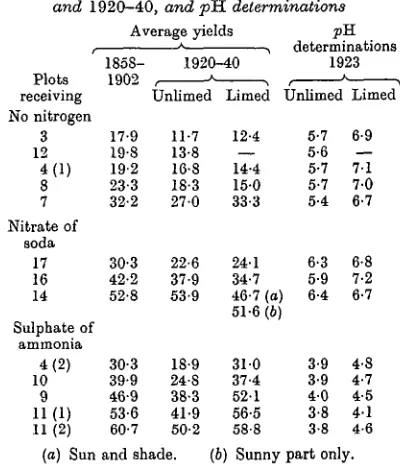
In order to give some indication of the general effect of lime, mean yields for 1920-40 are shown in Table 6 for all the plots, together with the means for the earlier period repeated from Table 1. pTS. determinations made in 1923 (Crowther, 1925) are also given. Later determinations have been made but are substantially similar and have not been reproduced here. According to Crowther (1925) the Park Grass soil was devoid of calcium carbonate at the commencement of the experiment.
The effect of the application of lime on the yield of Park Grass has been discussed by Brenchley (1925, 1930). As may be expected, Table 6 shows that the addition of lime has been clearly beneficial only to the five plots receiving sulphate of ammonia, for which the unlimed halves, as the pS. figures show, are suffering from acute acidity. On the first four of these plots, the yield in 1929, following the frost of that season, was from 1 to 2 cwt., and it is of interest that during the period 1920-40 there was a great increase in the proportion of Yorkshire Fog on
* See footnote, Table 1.
all these plots. The mean yields on the limed halves have maintained their original level.
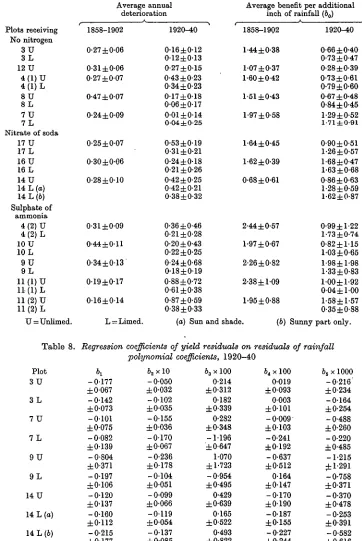
Average deterioration in yields and the average benefit from rainfall (60) in 1920-40 are shown in
Table 7, together with the values for the correspond-ing plots in 1858-1902, taken from Table 1.
Table 6. Average yields in cwt./acre forl858-1902 and 1920-40, and pH determinations
Average yields y H
lots receiving No nitrogen
3 12
4(1) 8 7 Nitrate of
soda 17 16 14
Sulphate of ammonia
4(2) 10
9 11(1) 11(2)
185S-17-9 19-8 19-2 23-3 32-2
30-3 42-2 52-8
30-3 39-9 46-9 53-6 60-7
1920-40
Unlimed
11-7 13-8 16-8 18-3 27-0
22-6 37-9 53-9
18-9 24-8 38-3 41-9 50-2
Limed
12-4
14-4 150 33-3
241 34-7 46-7 (a) 51-6 (6)
310 37-4 5 2 1 56-5 58-8
Lie LCi ixiiiiciiuiuiia
1923
Unlimec
5-7 5-6 5-7 5-7 5-4
6-3 5-9 6-4
3-9 3-9 4-0 3-8 3-8
I Limed
6-9 — 7-1 7-0 6-7
6-8 7-2 6-7
4-8 4-7 4-5 4-1 4-6
(a) Sun and shade. (b) Sunny part only.
The regression coefficients b1 to 65 of yield residuals
on the residuals of the first to fifth degree rainfall polynomial coefficients with their standard errors, are given in Table 8 for four plots. The rainfall is measured in inches, and the crop in cwt./acre.
The average annual deterioration for any one plot does not differ appreciably from that of the earlier period, though there is some indication of greater deterioration on the unlimed halves, especially on the most acid plots.
The regression coefficients b0, and 6X to 65, are
similar to those obtained for the same plots in the earlier period, though only a few of the coefficients b0 are significantly greater than zero, and the values are generally lower than in the earlier period. The values &! are in two cases (plots 3 and 9 unlimed) significant. Moreover, the values for 62 which, as in
the previous period, are negative for all plots, reach significance in the case of plots 3 limed, 7 limed and unlimed and 14 limed. The existence of a maximum benefit, already commented on in the discussion of the curves for the earlier period, is therefore confirmed.
Table 7. Average annual deterioration of yields and benefit from rainfall, in cwt./acre, 1858-1902 and 1920-40
Plots receiving No nitrogen 3 U 3 L 12 U 4(1) U 4(1)L 8 U 8 L 7 U 7 L
Nitrate of soda 17 U 17 L 16 U 16 L 14 U 14 L (a) 14 L (b) Sulphate of ammonia 4(2)U 4(2) L 10 U 10 L 9 U 9 L 11(1)U 11(1)L 11 (2) U 11 (2) L
U=Unlimed. Average annual deterioration 1858-1902 0-27±0-06 0-31 ±006 0-27 ±007 0-47 ±007 0-24±0-09 0-25±0-07 0-30±0-06 0-28±0-10 0-31 ±009 0-44 ±0-11 0-34±0-13 019±017 0-16±0-14
L = Limed.
1920-40 0-16±0-12 012±013 0-27±0-15 0-43 ±0-23 0-34±0-23 017±018 0-06±0-17 0-01 ±0-14 0-04±0-25 0-53 ±0-19 0-31±0-21 0-24±0-18 0-21±0-26 0-42 ±0-25 0-42±0-21 0-38±0-32 0-36 ±0-46 0-21 ±0-28 0-20±0-43 0-22 ±0-25 0-24±0-68 0-18±0-19 0-88±0-72 0-61 ±0-38 0-87±0-59 0-38±0-33 (a) Sun
Average benefit per additional inch of rainfall (60)
1858-1902 l-44±0-38 107 ±0-37 l-60±0-42 1-51 ±0-43 l-97±0-58 l-64±0-45 l-62±0-39 0-68±0-61 2-44±0-57 l-97±0-67 2-26±0-82 2-38±l-09 l-95±0-88
and shade. (6) Sunnj
1920-40 0-66 ±0-40 0-73 ±0-47 0-28±0-39 0-73±0-61 0-79 ±0-60 0-67 ±0-48 0-84 ±0-45 1-29 ±0-52 l-71±0-91 0-90±0-51 1-26 ±0-57 l-68±0-47 l-63±0-68 0-86 ±0-63 1-28 ±0-59 1-62 ±0-87 0-99±l-22 l-73±0-74 0-82±l-15 l-03±0-65 1-98 ±1-98 l-33±0-83 l-00±l-92 004±100 l-58±l-57 0-35±0-88 ' part only.
Table 8. Regression coefficients of yield residuals on residuals of rainfall polynomial coefficients, 1920-40
Plot 3 U 3 L 7 U 7 L 9 U 9 L 14 U
14 L (a)
14 L (i)
U=Unlimed. -0-177 ±0-067 -0-142 ±0-073 -0-101 ±0-075 -0-082 ±0-139 -0-804 ±0-371 -0-197 ±0-106 -0-120 ±0-137 -0-160 ±0-112 -0-215 ±0-177
L = Limed. 62xl0
-0050 ±0032 -0-102 ±0-035 -0155 ±0036 -0170 ±0-067 -0-236 ±0-178 -0104 ±0-051 -0099 ±0-066 -0119 ±0054 -0-137 ±0-085
63 x 100
0-214 ±0-312 0-182 ±0-339 0-282 ±0-348 - 1 1 9 6 ±0-647 1-070 ±1-723 -0-954 ±0-495 0-429 ±0-639 0-165 ±0-522 0-493 ±0-822
(a) Sun and shade.
bt x 100 0-019 ±0093 0003 ±0-101 -0-009 ±0-103 -0-241 ±0192 -0-637 ±0-512 0-164 ±0-147 -0-170 ±0190 -0-187 ±0-155 -0-227 ±0-244
65 x 100C
ROSE 0. CASHEN
9
level for significance. The differences between theeffects of rainfall on the limed and unlimed portions do not appear to be significant, though exact tests have not been made, and the results in general are not consistent enough to test the relationship between soil acidity and benefit from extra total rain, established over the earlier period.
SUMMARY
The influence of rainfall during the growing season on the yield of the Park Grass plots at Rothamsted, which are cut for hay every year, has been in-vestigated.
The average yields in the period 1858-1902 on the thirteen plots examined were from 18 cwt./acre on an unmanured plot to 61 cwt./acre on a plot receiving a complete fertilizer including a heavy dressing of nitrogen. All the plots showed some deterioration in yield. The effect of the total amount of rainfall from 5 March to 8 July was very substantial on all plots, the average increase in yield for each additional inch of rain varying between 0-7 and 2-4 cwt./acre; the benefit was greatest on the plots dressed with sulphate of ammonia. The rainfall effects reached a maximum in the latter part of April and early May, but the distribution of the rain appeared to be of relatively small importance.
The influence of seasonal rainfall on the propor-tions of grasses, leguminous plants and weeds has also been examined. This has been possible for only four plots for each of two periods 1874-95 and 1920-40 (unfortunately not all of them the same plots). In the main, the effect of rainfall was not significant, though for the period 1874-95 there was some evidence of additional rainfall increasing the pro-portion of leguminous plants on the unmanured plot; there was also an indication, on plots re-ceiving mineral manures, of a greater proportion of leguminous plants following a dry year.
The effect of lime on the response of yield to rain-fall has been evaluated for the period 1920-40. There appeared to be no significant differences between the responses to rainfall on the limed and unlimed portions of the plots examined; the apparent effects of rainfall on the yields were similar to those obtained in the earlier period.
This research was carried out under a grant of the Agricultural Research Council. The writer wishes to thank Sir John Russell who arranged for the investigation to be undertaken; Prof. R. A. Fisher who directed it; Dr W. E. Brenchley for her assistance and for the botanical data; and Dr F. Yates and members of his department for help in the concluding stages of this paper.
REFERENCES
BOYD, D. A. (1940). The influence of meteorological factors on arable crop yields, Saxmundham. Ph.D. Thesis, London.
BRENCHLEY, W. E. (1924). Manuring of Grassland for Hay. Longmans, Green and Co.
BRENCHLEY, W. E. (1925). J. Minisl. Agric. 32, 504. BRENCHLEY, W. E. (1930). J. Minist. Agric. 37, 663. BRENCHLEY, W. E. (1935). Ann. Appl. Bid: 22, 183. COCHRAU, W. G. (1935). J. Agric. Sci. 25, 510. COCHRAN, W. G. (1936). Fifty Years of Field
Experi-ments at Woburn, Chap. xi. Longmans, Green and Co. CBOWTHEB, E. M. (1925). J. Agric. Sci. 15, 222. FISHER, R. A. (1924). Philos. Trans. B, 213, 89. FISHER, R. A. (1944). Statistical Methods for Research
Workers, 9th ed. Oliver and Boyd.
FISHER, R. A. & YATES, F . (1943). Statistical Tables
for Biological, Agricultural and JkCedical Research, 2nd ed. Oliver and Boyd.
HOOKER, R. H. (1922). Quart. J. R. Met. Soc. 48, 115. KALAMKAJR, R. J. (1933). J. Agric. Sci. 23, 571. LAWES, J. B. & GILBERT, J. H. (18S0). Philos. Trans.
171, 289.
LAWES, J. B. & GILBERT, J. H. (1899). Philos. Trans. 192, 139.
LAWES, J . B., GILBERT, J. H. & MASTERS, M. T. (1882). Philos. Trans. 173, 1181.
WISHAET, J. & MACKENZIE, W. A. (1930). J. Agric. Sci. 20, 417.
APPENDIX
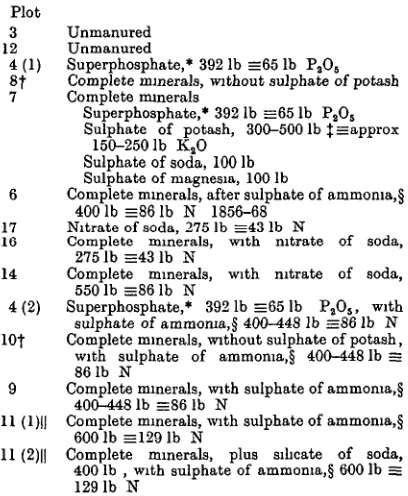
Table of manures (weights in lb /acre) Plot
3
12
4(1) 8t
17 16
14
4(2) 10t
Unmanured Unmauured
Superphosphate,* 392 lb =65 lb Pa05
Complete minerals, without sulphate of potash Complete minerals
Superphosphate,* 392 lb =65 lb Pt0s Sulphate of potash, 300-500 lb J=approx
150-250lb K2O
Sulphate of soda, 100 lb Sulphate of magnesia, 100 lb
Complete minerals, after sulphate of ammonia,§ 400 lb =86 lb N 1856-68
Nitrate of soda, 275 lb =43 lb N
Complete minerals, with nitrate of soda, 275 lb =43 lb N
Complete minerals, with nitrate of soda, 550 lb =86 lb N
Superphosphate,* 392 lb =65 lb PJOJ, with sulphate of ammonia,§ 400-448 lb =86 lb N Complete minerals, without sulphate of potash,
with sulphate of ammonia,§ 400-448 lb = 861b N
Complete minerals, with sulphate of ammoma,§ 400-448 lb =86 lb N
Complete minerals, with sulphate of ammonia,§ 6001b =129 lb N
Complete minerals, plus silicate of soda, 400 lb , with sulphate of ammoma,§ 600 lb = 1291b N
In the period 1883-7 all the plots were limed at the rate of 20001b per acre, excepting plots 11 (1) and 11 (2) which received 4000 lb From 1903 onwards lime has been applied about every fourth year to the southern half of the plots only at the rate of 2000 lb per acre (plot 14 from 1920 onwards)
All the manures were applied early in the calendar years
* Superphosphate—before 1889 the dressing consisted of 200 lb bone ash and 150 lb sulphuric acid From 1889 onwards 392 lb superphosphate were applied This was estimated to contain the same quantity of soluble Pa05
(16-17%) From 1897 to 1902, 4001b basic slag were applied instead of the superphosphate
t Part of the treatment of plots 8 and 10 has varied as follows
1856- 1864-61 1862-3 1904 1905-Sulphate of potash (lb) 300 — — — Sulphate of soda (lb) 200 500 250 100
X Sulphate of potash—in 1879 the dressing was increased from 300 to 500 lb The Ks0 content has been throughout
approximately 50 %
§ Sulphate of ammonia—before 1919 equal quantities of sulphate of ammonia and muriate of ammonia were applied containing together the specified quantity of nitrogen
|| Prior to 1882 plots 11 (1) and 11 (2) received sulphate of ammonia at the rate of 800 lb