Research Paper:
Recognition and Analysis of Network
Relations in Rural Tourism Through Grounded Theory:
A Case Study on Mountainous Valley Route of Haraz, Iran
Mehdi Hesam1*, Mohammad Reza Rezvani2
1. Assistant Professor, Department of Management, Faculty of Literature and Humanities, University of Guilan, Rasht, Iran. 2. Professor, Department of Human Geography, Faculty of Geography, University of Tehran, Tehran, Iran.
* Corresponding Author:
Mehdi Hesam, PhD
Address: Department of Management, Faculty of Literature and Humanities, University of Guilan, Khalij Fars Highway, Rasht, Iran. Tel: +98 (13) 33690485
E-mail: [email protected]
Purpose: One of the strategies to develop rural regions in most countries is to promote rural tourism. One of the features of rural tourism is its fragmented physical nature; therefore, in recent years, the rural tourism networks are of great concern in this regard. In most countries, the importance of rural tourism networks concept is rising. In the economy of many countries, this concept works better in tourism than other sectors. An analytic approach on rural tourism networks and its application in the development of tourism is essential. One of the most important contributions of tourism is flourishing related and marginal businesses. In the current study and based on ground theory, we attempted to analyze rural tourism networks in mountainous-valley route of Haraz rural areas.
Methods: In-depth interviews and group discussions were conducted to collect data. The statistical population consisted of the tourism and related businesses and the samples were selected through the snowball effect sampling method among 216 local businesses. About 35.5 hours were spent to conduct interviews with 40 tourism businesses.\
Results: The most important network cooperation is found among the borrowing, manpower, information, consulting, revising, and trade.
Conclusion: In general, the obtained results indicated that regarding business network cooperation, the conditions were not in good condition.
A B S T R A C T
Article info:
Received: 05 Jan. 2017 Accepted:31 Mar. 2017
Keywords:
Rural tourism, Network relations, Ground theory, Qualify search, Haraz rural areas route
Citation: Hesam, M., & Rezvani, M. R. (2017). Recognition and Analysis of Network Relations in Rural Tourism Through Grounded Theory: A Case Study on Mountainous Valley Route of Haraz, Iran. Journal of Sustainable Rural Development, 1(1), 39-52. https://doi.org/10.18869/nrip.jsrd.1.1.37
:
: https://doi.org/10.18869/nrip.jsrd.1.1.37 Use your device to scan
and read the article online
1. Introduction
n most rural areas, the economy has declined to a point where the income from traditional agri-cultural activities has reached below the average per capita point income. Moreover, the Tourism is considered as one of the major factors in the develop-ment of countries; and the rural tourism in its specific sense would satisfy the tourist’s need and relive the above
mentioned problems, if planed and organized properly, by considering the domestic, economic, social, and cultural features (Ghanian, Khani, & Baghai, 2011).
Tourism is one of the major factors in the development of countries. The rural tourism in its specific sense would satisfy the tourist’s need and resolve the above-mentioned problems, if properly planed and organized, i.e., by consid-ering the domestic, economic, social, and cultural features
I
(Ghanian et al, 2011). Accordingly, rural societies seek measures to create variety in the rural economy. Tourism is one of the major industries with the ability to assist the lo-cal economy by creating job varieties in the given area (Al-len, Hafer, Long, & Perdue, 1993; Davis & Morais, 2004; Hassan, 2000; Long, Perdue, & Allen, 1990; McGehee & Andereck, 2004). Employment of the network conception in the tourism literature makes sense and leads to analytic conclusion with respect to objectivity and systemization. Fragmentation in the tourism concept is an old subject of discussion in academic literature (Leiper, 1990; Palmer & Bejou, 1995; Wang & Fesenmaier, 2007).
Geographically speaking, tourism attractions are located in regions faraway, where the main markets are small and independent businesses are active in an unorganized work-ing environment. In such regions the survival of the new-comers depends on the group work (Dollinger, 1990). In fact, tourism is a defined system where the interrelations are necessary (Bjork & Virtanen, 2005). Hence, coop-eration among the different tourism goods producers and service providers and institutions is fundamental (Tinsley & Lynch, 2001). In a sense, the small size of tourism busi-nesses and their segregation force them to join for greater sustainability. Their coexistence contributes to the local economic welfare. Some developed regions due to rural tourism in recent years are located in the Larijan District of Amol City in Mazandaran Province, Iran. The current case study was conducted on the regions where rural tourism is totally evolved. This region is not far from the capital city, Tehran, Mazandaran, Alborz etc., running along the Haraz road with many natural attractive sceneries and numerous visitors. This area was selected with respect to the essence of the tourism business cooperation. In this study, various relations among the local restaurants and influencing fac -tors on them were identified and analyzed.
2. Literature Review
Today, tourism is one of the most important endeavors accompanied with changes in the perception of the land-scape, manmade/artificial features, sociopolitical and cul -tural aspects, and lifestyle in general. According to tour-ism 2020 vision, 604 million tourists all over the world, in 2005 generated more than $ 800 million (transportaion costs not included). The World Trade Organization (WTO) predicts a total of 1561 million travels in 2020. According to the same researchers, tourism can be considered as a new revenue source in enhancing the local economies by creating job opportunities, which can save the rural areas from poverty (Fossati & Panella, 2000; Giaoutzi & Ni-jkamp, 2006; Lee & Chang, 2008).
In the current study, the restaurants of the study area with their attractive features and year-round operation are of concern. They have high potential to attract tourists, as they are close to big cities and located on the main routes. In this regard, the out-ward aspects and the positive influence of tourism can be formed in the progression of the related businesses by the network and cooperation. The concepts of network and network analysis technology are tools to vi-sualize and analyze the nature of the relationships involved in this realm. These tools provide the method to simplify and make these relationships consistent with one another to achieve effective objectives. Since secluded small en-tities cannot last long, the network approach would keep them up running (Halme, 2001). The networks, either lo-cal, unofficial, or established based on formal agreements, are beneficial for the national regular local tourism organi -zations, and compensate to the segregated nature of this in-dustry. These network structures satisfy the needs of active sectors in rural tourism and a lot more.
The presented definition of network and network analy -eses (social network analysis) consists of an approach and a set of techniques to find sources among the active entities, individual groups, or organizations (Haythorn-thwaite, 1996). The techniques applied in the network analysis are significantly different from those of the sta -tistical ones which need independent analytical units. Collective network analysis is applied in drawing cor-relative patterns among the active entities and their struc-tures. The analyses are made by collecting the relevant data, systemizing them in a matrix, and calculating their diversified features such as congestion or centrality. This analysis is beyond a set of analytical strategies and as it deals with the structure, it can be a tool to fit the emo -tional structures as well. Hence, the network analysis is synonymous for structuralism. The structure among the nodes (the analytical unit in network literature) and the stance of the nodes in the network incorporate judgmen-tal, cognitive, and behavioral consequence for the single units, and the collective ones as a whole. Schmettman et al. (2011) reported that the associations modeling can be used to describe some aspects of the behaviors involved in individuals. Therefore, the network analysis can be considered similar to the theoretical approaches.
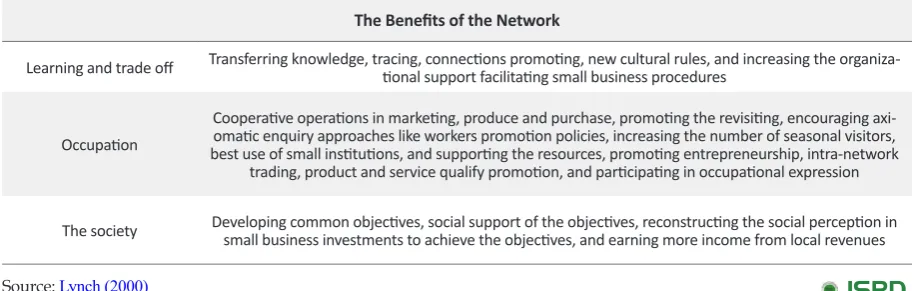
of the data. The perception of network is of 2 widely ex-panded conceptual schools: the mathematical and social sciences, which somewhat integrated in the mid-20th century. Network analysis in business and economics introduced a new systematic paradigm based on the mer-its of axiomatic rows. The ongoing studies regarding the networks follow 4 major objectives: 1) recognition of the integration and cohesion of societies or the phenomenon subject to study, 2) recognition of the nodes acting as hinges, 3) recognition of the specific and weird network structures, and 4) finding the answer to how the data are modeled and analyzed (Dooremalen & Borsboom, 2010). The history of general management and business network is always the center of attention, but in tourism realm it is almost a new concept. Lynch (2000) made an analysis regarding the literature of tourism network and identified some measures beneficial to tourism. They cat -egorized these advantages in learning, trade off, and oc-cupational and associative frameworks (Table 1).
The tourism network constitutes certain groups with common interests and active entities operating at local or regional levels. It is assumed that the thriving network fits the content of Table 1. This can occur at a specific time or period, with respect to the network objectives. The researchers in tourism note that the network analysis is appropriate in this field and also tourism is an excel -lent networking industry. Tourism is defined as a system where inter-affiliations are necessary (Bjork & Virtanen, 2005), also cooperation among different institutions and organizations involved in any aspect of tourism on a co-operative business is essential to serve the purpose (Tins-ley & Lynch, 2001). Presence of the network structure is vital in group activities with respect to rural tourism. This almost new phenomenon could improve the tourism busi-ness and provide inter-organizational trading, exchange of knowledge, and quality improvement at social level.
3. Methodology
The current study adopted the grounded theory meth-odology, an analytic method to construct the hypothesis through inductive qualitative data (Charmaz & Bryant, 2010). This method is concerned with constructing the concept in addition to providing a collection of prin-ciples for the study process known as total methodol-ogy. In the last 4 decades, this method gained a vast popularity as a valuable systematic method to collect and analyze data. It is vastly adopted in business and marketing. The features that distinguish the grounded theory method are as follows: generation of a concep-tual framework based on the available data, revealing the main processes in the social realm instead of describ-ing the unit under observation, compardescrib-ing each datum with whole data, making the data accumulation pattern change possible in the field of study, and promoting the expression of the thoughts about the report as the data collection begins (Papzan, Ghobadi, & Gravandi, 2010).
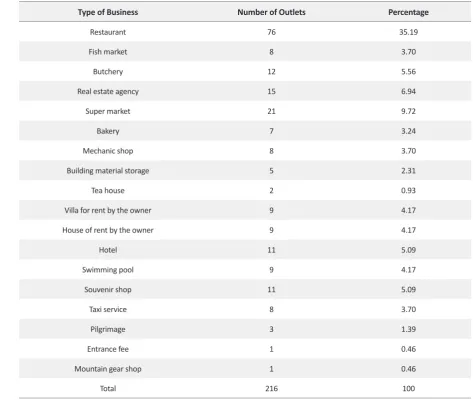
This method consists of 5 stages: 1) study design (as-sessing the technical literature and selecting issues), 2) data accumulation, 3) controlling the data, and drafting the terms and concepts, 4) data analysis, and 5) design-ing and verifydesign-ing the model (Ghobadi, Papzan, Zaraf-shani, & Geravandi, 2012). The data analysis consists of the open, axiomatic, and selective coding stages (Gho-badi et al., 2012). In the current study, in-depth inter-views with centralized groups were done to collect data. The statistical population consisted of 216 potential investors (Table 2) in the study area and the sampling followed the snowball effect method, resulting in the se-lection of 40 candidates. At least 35.5 hours were spent on interviewing with 40 local businesses to obtain the theoretical notions. The interviews were continued until the data saturation. During the interviews, in addition to
Table 1. The Advantages of a network to establish the objectives of a beneficial tourism
The Benefits of the Network
Learning and trade off Transferring knowledge, tracing, connections promoting, new cultural rules, and increasing the organizational support facilitating small business procedures
-Occupation
Cooperative operations in marketing, produce and purchase, promoting the revisiting, encouraging axi -omatic enquiry approaches like workers promotion policies, increasing the number of seasonal visitors, best use of small institutions, and supporting the resources, promoting entrepreneurship, intra-network
trading, product and service qualify promotion, and participating in occupational expression
The society Developing common objectives, social support of the objectives, reconstructing the social perception in small business investments to achieve the objectives, and earning more income from local revenues
taking notes, the interviews were recorded, which were very helpful in producing the final manuscript.
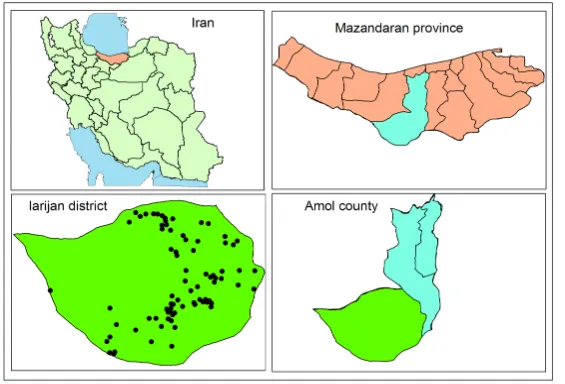
The study area consisted of the rural district of Larijan with an area of 1766 km². Larijan is located in the South-ern part of Mazandaran Province (Figure 1). In spring and summer the area population is 70000, but due to lack of work and proper accommodation and other facilities, in winter time the population reduces to 10000. The mountainous rural areas are close to the populated urban centers and the main roads; hence, this area has promis-ing potential for expansion of tourism. In recent years, some people of this region built their second homes to accommodate tourists. Moreover, some wealthy people from Tehran built their resort houses in this region. The connecting roads are in good shape; therefore, travels to the northern part of Iran have increased. The tourist related businesses have significantly flourished as well.
In other words, the main constituents of tourist attrac-tion are present here. Mazandaran Province, among the Northern provinces has always had the greatest share in tourism due to its closeness to Tehran, and Alborz region (populated centers) has crowded routes (Haraz, Chaloos, and Firoozkooh highways), and pleasant climate and natural sceneries. The coastal line of this province, the south-western part of the Caspian Sea, used to be the major tourist attraction region, but now its mountainous features are more attractive. Haraz Valley attracts many domestic tourists categorized in 3 major groups:
1. Transit travelers who enjoy the scenery, weather, and all served in a maximum 24 hours. In fact, they cannot be considered as visitors. Most of the villages under study were on Haraz Highway with their shops open to sell domestic farm and dairy products. Restaurants and a va-riety of service centers are open for travelers, too. The
Table 2. Number and the percentage of businesses in the study zone
Type of Business Number of Outlets Percentage
Restaurant 76 35.19
Fish market 8 3.70
Butchery 12 5.56
Real estate agency 15 6.94
Super market 21 9.72
Bakery 7 3.24
Mechanic shop 8 3.70
Building material storage 5 2.31
Tea house 2 0.93
Villa for rent by the owner 9 4.17
House of rent by the owner 9 4.17
Hotel 11 5.09
Swimming pool 9 4.17
Souvenir shop 11 5.09
Taxi service 8 3.70
Pilgrimage 3 1.39
Entrance fee 1 0.46
Mountain gear shop 1 0.46
Total 216 100
transit traveler/tourist has less effect on their business; i.e., no significant impact on rural wellbeing. Of course, there are some authentic restaurants on this route and in the villages, which attract customers from far away for their quality food and beautiful scenery.
2. The non-transit travelers with their own accommoda-tion in the rural areas. Naturally, their stay is long and they have to pay for the services provided by the villagers.
3. The ones who come to enjoy the natural beauty of the region and of course pay for the services provided by the villagers. The major services they pay for are accommoda-tion, mineral water treatment centers, retail shops, etc.
The number of business units here is 216 while 10.45% of which were founded by non-local and the rest by local investors.
4. Findings
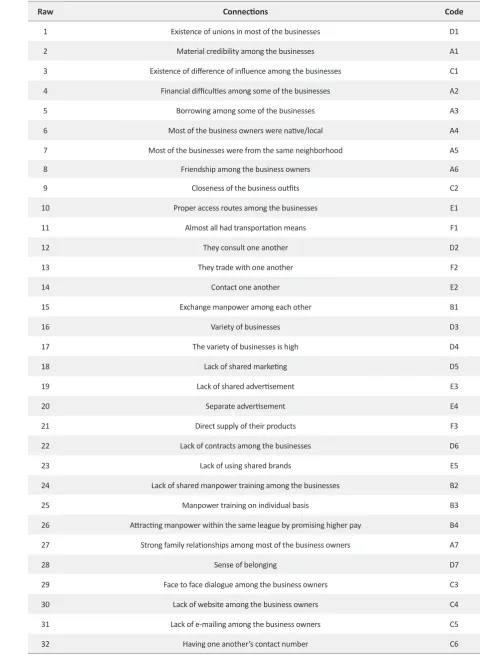
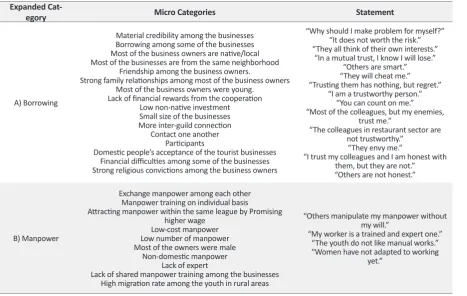
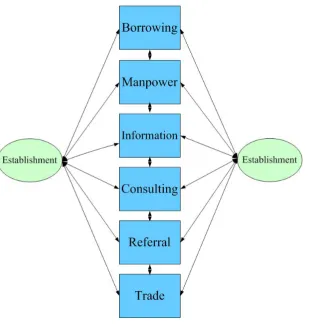
The collected data were reviewed several times. The issues not related to the subject were eliminated; the main conversations were set in the tables with no cat-egorization, and then, coded through categorized axi-omatic manner. In open coding, the statements or the concepts regarding the attractive factors on investment were extracted and coded in 106 items (Table 3). Next, the related concepts were coded in similar frames. The results obtained from open coding based on the concepts were categorized and presented in Table 4 on an axiom-atic manner. Based on the findings at open and axiomaxiom-atic coding stages, the connection among the sections were determined and modeled conceptually (Figure 2).
5. Discussion
In tourism industry and in particular the rural tourism, most businesses are small or medium (SMEs) and family oriented with their considerable contributions to the re-gional economy in all respects. Globalization has put the tourism business under pressure; however, it can provide opportunities for the world free market manipulation. Ac-cordingly, the rural tourism destinations should establish strong networks of cooperation among the tourism busi-ness based on the developed strategies to resist the com-petition on international basis. These networks should operate as a collection of establishments with a common goal. The segregated nature and the variety of the content of this industry are well known that entails the interac-tion among the beneficiaries with respect to planning and management towards development of this industry.
The initial scientific perception regarding networks in -dicates cooperation and trust. According to Gray (1989), “cooperation is a joint decision making among the prin-ciple beneficiaries regarding a specific issue with respect to the future.” For example, the issue here could be plan-ning, marketing and or other activities regarding tour-ism. Kotler et al. (1993) stated that one of the key fac-tors in establishing a relationship between cooperation and network in promoting and achieving the objectives is what is gained from combining data, expertise, and other resources of the beneficiaries. This cannot be ac -complished if there is no trust. Trust can be the basis for individuals’ risk-taking, and cooperation with respect to the social order and investment in common (Sztomaka, 1999). Relationships, development, and information
Table 3. Conceptualization of the available types of connection among the tourism businesses in the study zone
Raw Connections Code
1 Existence of unions in most of the businesses D1
2 Material credibility among the businesses A1
3 Existence of difference of influence among the businesses C1
4 Financial difficulties among some of the businesses A2
5 Borrowing among some of the businesses A3
6 Most of the business owners were native/local A4
7 Most of the businesses were from the same neighborhood A5
8 Friendship among the business owners A6
9 Closeness of the business outfits C2
10 Proper access routes among the businesses E1
11 Almost all had transportation means F1
12 They consult one another D2
13 They trade with one another F2
14 Contact one another E2
15 Exchange manpower among each other B1
16 Variety of businesses D3
17 The variety of businesses is high D4
18 Lack of shared marketing D5
19 Lack of shared advertisement E3
20 Separate advertisement E4
21 Direct supply of their products F3
22 Lack of contracts among the businesses D6
23 Lack of using shared brands E5
24 Lack of shared manpower training among the businesses B2
25 Manpower training on individual basis B3
26 Attracting manpower within the same league by promising higher pay B4
27 Strong family relationships among most of the business owners A7
28 Sense of belonging D7
29 Face to face dialogue among the business owners C3
30 Lack of website among the business owners C4
31 Lack of e-mailing among the business owners C5
Raw Connections Code
33 Phone contacts C7
34 Domestic youth inclination toward development of infrastructures in tourism D8
35 Proper tourism business outlook D9
36 Possibility to promote non-native investments D10
37 Lack of faculties exchange among the businesses F4
38 Information exchange among the businesses C8
39 Lack of knowledge exchange among the business owners C9
40 Common providers C10
41 Brand variety E6
42 Participants A8
43 Innovations among the businesses E7
44 Existence of proper regulations regarding tourism C11
45 Most of the business owners are young A9
46 Domestic institutions’ support D11
47 Low-cost manpower B5
48 Tax exemption D12
49 No tariff for the services E8
50 Low fluctuation in the influx tourists E9
51 Domestic people’s acceptance of the tourist businesses A10
52 Row material production by some of the tourist businesses F5
53 Entrepreneurship concept prevails in the region C12
54 Providing row material for tourist businesses by one another’s assistance F6
55 The age of connecting roads in the region F7
56 High rate of tourist attraction E10
57 Infrastructure services F8
58 Low number of manpower B6
59 High number of visitors during the day E11
60 Most of the owners were male B7
61 Most of the owners had adequate education C13
62 Lack of financial rewards from the cooperation A11
63 Most of the businesses were private F9
Raw Connections Code
65 Low non-native investment A12
66 Small size businesses A13
67 Proper approach by the foundations and organizations on investment D13
68 Properly cultured working and producing atmosphere in the region D14
69 The appreciation of investment concept by the business owners D15
70 Strong religious convictions among the business owners A14
71 Regional strategy to assist investments D16
72 The possibility of becoming up to date through new technologies C14
73 Organizing festivals regarding tourism business C15
74 Non-domestic manpower B8
75 High number of tourist groups B9
76 Sudden influx of the tourist groups B10
77 Ranking the businesses of one sector D17
78 Historical attractions E12
79 National attractions E13
80 Lack of expert B11
81 Low number of tourism educated staff D18
82 Lack of study on the interactions among the businesses D19
83 High advertisement fees on domestic TV channels E14
84 Cultural richness of the region E15
85 Natives welcoming visitors E16
86 Strangeness of the visiting parts by the tourists E17
87 High education level of the domestic authorities C16
88 High concern of the authorities towards the study zone D20
89 Discounts on big purchases F11
90 Lack of people-support as institution regarding tourism C17
91 State operated service units for tourists E18
92 Continuous expansion of the connecting roads F12
93 Holy shrine for pilgrimage E19
94 Successful record of the investment experiences D21
95 More inter-guild connection A15
technology are the main subjects discussed and ana-lyzed in the network context.
The resultant of networking includes making necessary data provision and supply, and finding legitimate routes for the information flow (Haythornthwaite, 1996). Tour-ism is an industry with high interdependencies where
evolution is a necessity. Cooperation and correspon-dence are vital in this industry (Novelli, chmitz, & Spen-cer, 2006). The business networks find the essence of these activities in social relationships. Mitchell (1969), the classic sociologist, identified 3 different manners re -garding the content of social networks connections:
re-Table 4. Conceptualization of the connections derived from open axiomatic coding
Expanded
Cat-egory Micro Categories Statement
A) Borrowing
Material credibility among the businesses Borrowing among some of the businesses Most of the business owners are native/local Most of the businesses are from the same neighborhood
Friendship among the business owners.
Strong family relationships among most of the business owners Most of the business owners were young.
Lack of financial rewards from the cooperation Low non-native investment Small size of the businesses More inter-guild connection
Contact one another Participants
Domestic people’s acceptance of the tourist businesses Financial difficulties among some of the businesses Strong religious convictions among the business owners
“Why should I make problem for myself?” “It does not worth the risk.” “They all think of their own interests.”
“In a mutual trust, I know I will lose.” “Others are smart.” “They will cheat me.” “Trusting them has nothing, but regret.”
“I am a trustworthy person.” “You can count on me.” “Most of the colleagues, but my enemies,
trust me.”
“The colleagues in restaurant sector are not trustworthy.”
“They envy me.”
“I trust my colleagues and I am honest with them, but they are not.”
“Others are not honest.”
B) Manpower
Exchange manpower among each other Manpower training on individual basis
Attracting manpower within the same league by Promising higher wage
Low-cost manpower Low number of manpower Most of the owners were male
Non-domestic manpower Lack of expert
Lack of shared manpower training among the businesses High migration rate among the youth in rural areas
“Others manipulate my manpower without my will.”
“My worker is a trained and expert one.” “The youth do not like manual works.” “Women have not adapted to working
yet.”
Raw Connections Code
97 Lack of academic knowledge regarding tourism like hotel management, etc., among the tourist business owners D22
98 Low inter-tribal conflicts C18
99 The young age of the business owners C19
100 High migration rate among the youth in rural areas B12
101 Closeness in interaction A16
102 Public services E21
103 Public access tourism services E22
104 Safe roads in the region F13
105 New investors entering the market F14
106 Constant mutual need among the business owners F15
Expanded
Cat-egory Micro Categories Statement
C) Information
Closeness of the business outfits Face to face dialogue among the business owners
Lack of website among the business owners Lack of e-mailing among the business owners
Having one another’s contact number Phone contacts
Information exchange among the businesses Information exchange among the businesses
Innovations among the businesses Most of the owners had adequate education. The possibility of becoming up to date through new technologies
High education level of the domestic authorities Lack of people-support as institution regarding tourism
Low inter-tribal conflicts Most of the business owners were young.
Common providers
Existence of proper regulations regarding tourism Organizing festivals regarding tourism business Existence of difference of influence among the businesses
“I share my information with my col -leagues”.
“I do not keep any information”. “Others do not share their information”.
D) Consulting
Low number of tourism educated staff Variety of businesses The variety of businesses was high
Lack of shared marketing Lack of contracts among the businesses
Properly cultured working and producing atmosphere in the region
The appreciation of investment concept by the business owners Regional strategy for guiding investments
Ranking the businesses of one sector They consult one another.
Lack of scientific studies on the interactions among the busi -nesses
Successful record of the investment experiences Lack of individuals educated on tourism fields such as hotel man
-agement, etc. among the tourist business owners High concern of the authorities towards the study zone
Sense of belonging
Domestic youth inclination toward development of infrastruc -tures in tourism
Proper tourism business outlook Possibility to promote non-native investments Proper approach by the foundations and organizations on invest
-ment
Domestic institutions’ support Tax exemption
Existence of unions in most of the businesses
“Others do not want to see my progress”. “Most often they lie to me”. “Do they know more than I?” “Others wish my retrogression”.
E) Referral
Internationally registered moments Closeness in interaction Lack of using shared brands
Financial difficulties among some of the businesses Entrepreneurship concept prevails in the region
No tariff for the services Low fluctuation in the tourists influx
High rate of tourist attraction High number of visitors during the day State operated service units for tourists
Holy shrine for pilgrimage Lack of shared advertisement
Separate advertisement Public access tourism services Strangeness of the visiting parts by the tourists High advertisement fees on the domestic TV channels
Cultural richness of the region Natives welcoming visitors
Historical attractions National attractions
Proper access routes among the businesses
“I do not have anything to do with him”. “My services are unique in this region”. “Jealousy cause colleagues to do not send
customers to each other”. “We make our bread based on our stan
-dards”.
alization of the exchange, correspondence, and the social issues. Ndou and Passiante (2005) expressed that the in-stitutions, when member of a network, can achieve bet-ter performance through betbet-ter opportunities, advances in quality, flexibility, and innovation.
Novelli et al. (2006) believed that expansion of the net-works should not be considered as self-sufficient process -es, but complex ones where the strong cooperation of the beneficiaries is a must. Scott et al. (2008) evaluated
net-work structures in 4 destinations in Australia and found that the information flow among the involved activities constitute the basis to analyze the network for determing its consistency. Isabel-Polo and Dolores (2010) in-troduced a tourism network in Adolos region, Spain, and distinguished the advantages of such an attempt as better performance of the establishments, improvement of so-cioeconomic status, and promotion of the general image of the region in the visitors’ views. Morrison and Thomas (1999) stated that small businesses face problems such
JSRD
Figure 2. The conceptual model of the study
Expanded
Cat-egory Micro Categories Statement
F) Trade
Constant mutual need among the business owners Lack of faculties exchange among the businesses
Separation of the businesses Continuous expansion of the connecting roads
Safe roads in the region New investors entering the market Almost all had transportation means. Interdependency of many of the businesses Providing row material for tourist businesses by one another’s
assistance
Row material production by some of the tourist businesses Direct supply of their products
Discounts on big purchases They trade with one another.
“If he decides not to deal with me, it does not matter at all, as I do not need him”. “Keep the distance, hold the friendship”.
as low budget and lack of expert management and mar-keting. According to Andriotis, lack of knowledge about other occupations, cooperation, and connections in this sector expose small businesses to difficulties.
The current study attempted to evaluate the cooperative state of the restaurants in the study area through network analysis approach and semi-structured interviews dur-ing 40 direct interviews lasted at least 35.5 hours which took place in 8 months. We tried to concentrate on major issues such as borrowing, manpower, information, con-sulting, referral, and trade, as well as the most effective factors such as family relationships, friendship, neigh-borhood, nativity, membership in cooperatives, trust and hate, accompanied with the connecting channels such as face to face talks, telephone, website, virtual social networks, etc. The first subject of discussion was “bor -rowing” and the results indicated a sound relationship between the business and the members of their tribes who provided financial support, living more than 100 km away from the business point. Trust was the most ef-fective factor in “borrowing,” in general. In this region, this factor ranked the worst, especially when it came to nonlocal borrowers.
Most business owners said that they did not trust oth-ers and preferred to operate alone. More such statements were quoted in the statement column of Table 4. Man-power displacement was the other major factor, especially when they were not native. In these businesses, 24.28% of the manpower were the members of the same family/ tribe whether from the same local area or city or provinces close by. One of the major drawbacks was their training. For example, when one is trained at the expense of one and then leaves and works for the other for presumably a better pay. It mostly occurs in restaurant industry.
In top rated restaurants, the labor issue is more orga-nized, i.e., there were contracts, insurance coverage, etc. In medium and low rated restaurants, the manpower fluc -tuates according to the service demand. One of the other major connecting factors is the data exchange among the businesses in areas such as economic (bank inspections), social (public non-material support), political (conven-tions and cooperative meetings), and so on. This factor prevails at the lower rate businesses. In the association of restaurant owners, the famous ones have the last word regarding their guild. The first grade restaurants, due to their strong management and relationships with the au-thorities get the first hand information and then pass it down to lower levels. The family ties have an important role in the overall structure of these guild networks.
The obtained results here indicated that work-referral among the businesses was usually a common practice in the low rated restaurants. Food-referral among these restaurants was common as well as satisfying the cos-tumers’ needs regarding the type of food. It was the case with top rated restaurants; of course here the high price was the reason for this referral. Consultation on differ-ent issues among the businesses was limited, and if there was, it took place within the family circle of the business owners. According to the interviewed subjects, this fac-tor did not progress as there was not enough trust among the business owners. This distrust cannot last long, since as the sense of networking is being promoted, the trust has to prevail. In general, the obtained results indicated that regarding business network cooperation, the condi-tions were not at average level.
Acknowledgements
The current research has not received any financial support.
Conflict of Interest
The authors declared no conflict of interests.
References
Allen, L. R., Hafer, H. R., Long, P. T., & Perdue, R. P. (1993). Rural residents’ attitudes toward recreation and tourism development. Journal of Travel Research, 31(4), 27–33. doi: 10.1177/004728759303100405
Andriotis, K. (2002). Scale of hospitality firms and local econom-ic development—evidence from Crete. Tourism Management, 23(4), 333–341. doi: 10.1016/s0261-5177(01)00094-2
Björk, P., & Virtanen, H. (2005). What tourism project manag-ers need to know about co-operation facilitators. Scandi-navian Journal of Hospitality and Tourism, 5(3), 212–230. doi: 10.1080/15022250510014354
Charmaz, K., & Bryant, A. (2010). Grounded theory. In P. Peter-son, E. Baker, & B. McGaw (Eds.). International Encyclopedia of Education (3rd ed.) (pp. 406–412). New York: Elsevier Science. Davis, J. S., & Morais, D. B. (2004). Factions and enclaves:
small towns and socially unsustainable tourism de-velopment. Journal of Travel Research, 43(1), 3–10. doi: 10.1177/0047287504265501
Dollinger, M. J. (1990). The evolution of collective strategies in fragmented industries. The Academy of Management Review, 15(2), 266. doi: 10.2307/258157
Toomela & J. Valsiner (Eds.), Methodological Thinking in Psy-chology: 60 Years Gone Astray? Charlotte: Information Age Publishers.
Fossati, A., & Panella, G. (2000). Tourism and sustainable devel-opment: A theoretical framework. In A. Fossati, & G. Panella (Eds.), Tourism and Sustainable Economic development (pp. 3-36). Boston: Kluwer Academic Publishers.
Ghanian, M., Khani, F., & Baghai, L. (2011). [Evaluation of en-trepreneurship climate in rural tourism (Case study: Oraman region) (Persian)]. Journal of Rural Research, 2(3), 99-123. Ghobadi, P., Papzan, A., Zarafshani K., Geravandi S. H. (2012).
[The study of rural tourism in Khangha village as perceived by rural villagers: A grounded theory approach (Persian)].
Journal of Housing & Rural Environment, 31(137), 71-82. Giaoutzi, M., & Nijkamp, P. (2006). Emerging trends in tourism
development in an open world. Aldershot: Ashgate.
Granovetter, M. (1985) Economic action and social structure: The problem of embeddedness. American Journal of Sociology 91(3), 481–510.
Gravandi, S., Papzan, A., & Afsharzadeh, N. (2012). Modelling sustainable environmental development using grounded the-ory (Case-study: Sharveineh Village, Javanroud Township).
Journal of Housing & Rural Environment, 30(136), 67-78. Gray, B. (1989). Collaborating: Finding common ground for
multi-party problems. San Francisco: Jossey-Bass.
Halme, M. (2001). Learning for sustainable development in tour-ism networks. Business Strategy and the Environment, 10(2), 100–114. doi: 10.1002/bse.278
Hassan,S.S.(2000).Determinantsofmarketcompetitivenessinan environmentally sustainable tourism industry. Journal of Trav-el Research, 38(3), 239–245. doi: 10.1177/004728750003800305 Haythornthwaite, C. (1996). Social network analysis: An
ap-proach and technique for the study of information exchange.
Library & Information Science Research, 18(4), 323–342. doi: 10.1016/s0740-8188(96)90003-1
Isabel Polo, A., & Dolores, F. (2010). Collective strategies for ru-ral tourism: The experience of networks in Spain. Journal of Tourism Consumption and Practice, 2(1), 25-45.
Kotler, P., Haider, D. H., & Rein, I. (1993). Marketing places: At-tracting investments, industry, and tourism to cities, states and na-tions. New York: Free Press.
Lechner, C., & Dowling, M. (1999). The evolution of industrial districts and regional networks: The case of the biotechnology region Munich/Martinried. Journal of Management and Gov-ernance, 3(4), 309–338. doi: 10.1023/a:1009928810007 Lee, C. C., & Chang, C. P. (2008). Tourism development and
eco-nomic growth: A closer look at panels. Tourism Management, 29(1), 180–192. doi: 10.1016/j.tourman.2007.02.013
Leiper, N. (1990). Partial industrialization of tourism systems.
Annals of Tourism Research, 17(4), 600–605. doi: 10.1016/0160-7383(90)90030-u
Long, P. T., Perdue, R. R., & Allen, L. (1990). Rural resi-dent tourism perceptions and attitudes by community level of tourism. Journal of Travel Research, 28(3), 3–9. doi: 10.1177/004728759002800301
Lynch, P. A. (2000). Networking in the Homestay
Sec-tor. The Service Industries Journal, 20(3), 95–116. doi:
10.1080/02642060000000034
McGehee, N. G. & Andereck, K. L. (2004). Factors predicting rural residents' support of tourism. Journal of Travel Research, 43(2):131-140. doi: 10.1177/0047287504268234
Ndou, V., & Passiante, G. (2005). Value Creation in Tourism Network Systems. Information and Communication Technol-ogies in Tourism 2005, 440–451. In A. J. Frew (ed), Information and Communication Technologies in Tourism. Vienna: Springer. Novelli, M., Schmitz, B., & Spencer, T. (2006). Networks, clusters
and innovation in tourism: A UK experience. Tourism Man-agement, 27(6), 1141–1152. doi: 10.1016/j.tourman.2005.11.011 Palmer, A., & Bejou, D. (1995). Tourism destination
market-ing alliances. Annals of Tourism Research, 22(3), 616–629. doi:
10.1016/0160-7383(95)00010-4
Papzan, A., & Ghobadi, K., & Gravandi, S. (2010). Study prob-lems and limitations of rural tourism using grounded theory; The case Harir village. Journal of Rural Research, 1(3), 25-52. Scott, N., Cooper, C., & Baggio, R. (2008). Destination networks.
Annals of Tourism Research, 35(1), 169–188. doi: 10.1016/j.an-nals.2007.07.004
Sharpley, R. (2002). Rural tourism and the challenge of tour-ism diversification: the case of Cyprus. Tourism Management, 23(3), 233–244. doi: 10.1016/s0261-5177(01)00078-4
Sztompka, P. (1999). Trust: A sociological theory. Cambridge: Cambridge University Press.
Tinsley, R., & Lynch, P. (2001). Small tourism business net-works and destination development. International Journal of Hospitality Management, 20(4), 367–378. doi:10.1016/s0278-4319(01)00024-x
World Tourism Organization. (1999). Tourism 2020 vision (Execu-tive summary). New York: World Tourism Organization. Wang, Y., & Fesenmaier, D. R. (2007). Collaborative
destina-tion marketing: A case study of Elkhart county, Indiana.