The Dynamic Effects of Export and Technological Changes
on Relative Wages
Saeed Rasekhi*1, Iman Cheratian2
Received: 2018, March 4 Accepted: 2018, September 18
Abstract
he links among trade, technological changes, and worker earnings have been the subject of intense research during the past few decades. The current literature on this subject shows that trade liberalization and technological changes are the main drivers of demand for skilled workers and a rise in the wage premium. In the present article, a panel of 134 Iranian manufacturing industries over the period 2004-2013 and System GMM estimator was used to examine the effect of export(as a proxy for trade) and technological changes on relative wages in high-tech and non-high-tech industries. Our findings show that the estimates are affected by a strong path-dependency in relative wages of both subgroups. Moreover, the education, capital-labor ratio, and total factor productivity (TFP) have a positive and significant impact on relative wages in both groups of the industries. Nevertheless, these variables are more effective in high-tech industries rather than non-high-tech ones. Finally, firms’ decision for entering into international markets puts a positive effect on labors’ earning. While to increase the market share, firms have to cover the trade costs by adjusting the cost of production factors such as labor force or capital.
Keywords: Relative Wages, Export, Technological Changes, High-tech Industry, Non-high-tech Industry.
JEL Classification: F66, J31, O33. 1. Introduction
In recent decades, numerous efforts have been devoted to investigating the links among trade, technological changes, and relative wages. Most of these studies indicate that both trade liberalization and technological
1. Department of Economics, Faculty of Economics and Administrative Sciences, University of Mazandaran, Babolsar, Iran (Corresponding Author: [email protected]).
2. Department of Economics, Faculty of Economics and Administrative Sciences, University of Mazandaran, Babolsar, Iran ([email protected]).
has been harshly criticized by some trade economists such as Leamer (2000). The critiques are summarized in three major issues: 1) the observation that the amount of trade between low and high-wage countries is small and rather irrelevant because prices are more important than quantities and are determined marginally, 2) the attempts to estimate the effect of trade by concerning to its factor content is an unreasonable exercise, leading to a failure to understand basic trade theory, and 3) the factor bias of technological changes, which is also irrelevant. Trade theory indicates that what matters for the sector in which technical progress occurs, not the factor bias of that change(Krugman, 2000).
The second explanation for the rising wage inequality is skill-biased
technological change (SBTC hereafter). Since the beginning of the
1980s, a series of studies have documented the rise in wage inequality between skilled and unskilled workers in various countries. Most of the studies hinted at technological progress –the development of computers and new technologies, especially in the manufacturing sector– as a key factor for growing wage inequality. Highly skilled workers, especially those with a higher academic degree, who are more likely to use computers on the job, are another reason for the wage inequality. Therefore, since a diffusion of new technology caused a rise in the demand for skilled workers, which in turn leads to an increase in wage inequality, this phenomenon has become known as the SBTC hypothesis (Card & DiNardo, 2002). Although many of the earlier studies focused on the determinants of wage inequality in OECD and other developed economies, recent contributions have started to examine the effects of same determinants (trade liberalization and technological progress) on inequality of wage in low and middle-income economies.1Indeed, both trade-based and technology-based explanations suggest a rise in within-country inequality for the case of high-income countries. Meanwhile, they imply an adverse prediction in low- and middle-income countries since trade liberalization should favor an increase in the relative demand for unskilled labor and, therefore, reduce within-country inequality (Conte & Vivarelli, 2011).
Considering that the economic theory does not have a clear-cut answer about the wage effect of trade and technological changes, there is a need for empirical analyses able to test the determinants of workers’ wage by a focus on related theories. This paper aims to provide further evidence within this strand of literature. More specifically, we assess the impact of technological changes and export (as a proxy for trade) on the relative wage of the labor force in the Iranian manufacturing industries over the period 2004-2013. The empirical analysis presented in this work is different from the previous studies in two ways: 1) this work is one of the first attempts to investigate the impact of export and technological changes on relative wages for the case of Iranian manufacturing industries. 2) In this work, we present evidence for two different subgroups of manufacturing industries (high-tech and non-high tech) to analyze the existence (or absence) of wage effects across the industries. The main findings of the paper can be summarized as follows. First, the findings show that the estimates are affected by a strong path-dependency in relative wages in both subgroups. Second, the results suggest that the education, capital-labor ratio, and total factor productivity (TFP) have positive and significant impacts on relative wages in both groups of the industries. Nevertheless, these variables are more effective in high-tech industries rather than non-high-tech ones. Third, we find an inverted U-shape relationship between education and earning which supports the Mincer (1974) theorem. Finally, firms’ decision for entering into international markets puts a positive effect on earnings. While to increase the market share, firms have to cover the trade costs by adjusting the cost of production factors such as labor force or capital.
The remainder of the paper is organized as follows: Section 2 presents and discusses previous studies about the consequences of trade and technological changes on wage. Section 3 describes the data source and sample frame. Section 4 provides theoretical background and empirical model. Section 5 discusses the empirical results obtained from the econometric estimations. Finally, Section 6 concludes the paper by summarizing the main findings.
2. Review of Literature and Gaps
cross-national, cross-national, and sectoral levels. In general, empirical evidence considers two leading causes of rising in the relative wages. The first strand of research, which focuses on the trade-related factors, shows that the S-S theorem fits better for the developed countries rather than developing ones. For example, in the case of U.S,Borjas and Ramey (1994) and Feenstra and Hanson (1999)have found that an increase in international trade explains the main changes in relative wages. This finding is verified in some other studies such as (Bernard & Jensen, 1999, 2004) for the U.S.; Greenaway and Yu (2004) for U.K.; Schank, Schnabel, and Wagner (2007) for Germany; Hansson and Lundin (2004) for Sweden; Farinas and Martín‐Marcos (2007) for Spain; Martins and Opromolla (2009) for Portugal;Hahn (2005), Jeon, Kwon, and Lee (2013) and S. Lee (2017)for Korea. Overall, these studies argue that there is an exporter-wage premium in the industrial countries. The central theme of major studies in developed countries suggests that exporting firms compared to non-exporting ones employ workers that are more skilled and have a higher share of non-production to production-line workers. Thus, it causes a difference in the demand for skilled workers between exporting and non-exporting firms and wage premium across skill levels subsequently. In this connection, Munch and Skaksen (2008) used Danish matched employer-employee data to examine the links among educational attainment, export performance, and wages. Their findings show that wage level in high export intensity firms with a large number of educated workers is greater than other firms. In contrast, there is a lower wage premium for high export intensity firms with a lower level of educated workers. In another study for Danish private sector enterprises, Hummels, Jørgensen, Munch, and Xiang (2014)analyzed the relationship between offshoring, exporting, and workers’ wage. They find that exporting and offshoring are positively associated with the firms’ sale and average wage bill. At the industry level, offshoring leads to an increase in the skill premium, which is in line with the results of Feenstra and Hanson (1999).
increased exposure to international trade. In this connection,Dix-Carneiro and Kovak (2015) show that trade liberalization declines the skill premium during 1991 to 2010 in the Brazilian economy. A paper by Dollar and Kraay (2004) for the case of developing nations also concludes that international trade does not affect the income inequality significantly, and the relationship between trade and wages is neutral. A similar result was reported byKrishna, Poole, and Senses (2014) for the case of Brazil. On the other hand, the findings of some related studies show an adverse effect of international trade on wage distribution in developing countries. Hanson and Harrison (1999) and Bouillon, Legovini, and Lustig (1999) found that a reduction in tariffs and international trade expansion increased the relative wages of Mexican skilled workers during the two decades. Other studies in countries such as Chile, Brazil, Venezuela, and Colombia also show that skilled workers receive more premiums after liberalization compared to unskilled ones (Summit, 2001). Therefore, it can be concluded that in developing countries, international trade is likely to have different effects on the distribution of relative wages.
Rodrıguez-López (2003) indicated, a rapid independent technological progress and a diffusion of skill-biased technology from industrial countries contributed to an increasing wage disparity in developing countries. Pavcnik (2003) examined whether investment and adoption of skill-biased technology have contributed to within-industry upgrading in Chile. By using semiparametric and parametric approaches, he found that some of the increased relative demand for skilled workers could be attributed to capital deepening. Conte and Vivarelli (2011), using an original panel dataset comprising 28 manufacturing sectors for 23 countries, analyzed the relationship between imports of embodied technology and widening skill-based employment differentials. The empirical evidence introduces capital-skill complementarity as a leading source of skill bias. Meanwhile, the imported skill-enhancing technology emerges as an additional cause of a growing demand for skilled workers in these countries. Recently, J.-W. Lee and Wie (2015) examined the effects of technological changes on wages inequality in the Indonesian economy from 1990 to 2009. The evidence from firm-level data shows that the diffusion of foreign technology through imports and FDI leads to a shift in demand toward more skilled labors and increased wage inequality. In a more recent paper, Barua and Ghosh (2017), using of a general equilibrium framework, analyzed the reasons of wage inequality between skilled and unskilled labors in India over the period 1980 to 2007. They identified that both the productivities of skilled and unskilled labors are responsive to the technological changes. Furthermore, if the productivity of skilled labors increases at a faster rate than the unskilled ones, then the gap between two wages should increase.
two major strands of literature) are listed by author(s), year, sample size, and main findings in Table 1.
Table 1: Review of Related Literature Reference Sample size Findings
The first strand of literature
Verhoogen (2008) Mexican
manufacturing plants
Plants that are more productive increase the export share of sales and the relative wage of skilled workers, more than less productive plants.
Falzoni, Venturini, and Villosio (2011)
Italian manufacturing firms with more than 20 employees
International integration plays a significant role in determining the wages of skilled and unskilled workers. Xu and Ouyang
(2015)
Chinese 28 manufacturing industries
International trade significantly reduces relative wages of skilled versus unskilled workers in China’s manufacturing sector.
Harrigan and Reshef (2011)
Chilean firm-level data A drop in trade costs leads to both greater trade volumes and a rise in the relative demand for skilled workers.
The second strand of literature
Baldwin and Cain (2000)
79 two-digit sectors of the U.S. input-output tables
The education-based technical progress that was greater in industries (as they use more-educated labor) and enhanced import competition in industries (used less educated labor) play significant roles in the growth of wage inequality. Abdi (2007) Industrial sectors in
developing countries
The study finds a significant negative link between the relative wage of unskilled workers and the technology index.
Stojanovska and Cuyvers (2012)
13 manufacturing industries in OECD countries
Technological competition does not have a strong effect on the increase in the wage differential between the different types of labor in the analyzed sample of OECD countries.
Sandulli, Baker, and López-Sánchez (2013)
A large sample of Spanish SMEs
The results indicate that the effects of the workforce structure on efficiency are the function of the level of technological change.
Caselli (2014) Mexican plant level of manufacturing
The results show that decreases in the price of machinery and equipment positively and significantly affect the relative wage of skilled workers.
3. Data Source and Sample Frame
comprehensive data center for information about manufacturing industries in Iran. The SCI database contains a broad range of information about the industries with at least 10 employees and more, such as the type of activity, export situation, sale, wages, output volumes, and physical assets, value-added, type of ownership, total assets, and employment. Furthermore, it reports detailed information about the number of the workforce through education and experience levels, which enables us to analyze the role of education and skill structure on worker earnings. To analyze the effects of labor characteristics on the earnings, it is important to distinguish between the level of labors’ education and experience. As Feizpour, Hajikhodazadeh, and Shahmohammadi Mehrjardi (2014) argue, experienced labors can use tools, equipment, and machines that may not be related to the education level. Therefore, the effects of experience may be different from the effects of education at the same time due to the differences in labor productivity.1To separate the manufacturing industries into high-tech and non-high-tech, we used the OECD2 classification of manufacturing industries based on R&D intensities. OECD classification sorts industries into four categories based on their technological effort (as a critical determinant of productivity growth) and international competitiveness.3Table (2) provides information about the data used in this paper.
Table 2: Data Definition and Sources in two Groups of High-tech and Non-high Tech Industries
Variables Definition Sources
Dependent variable
Wage i,t The ratio of real annual wage to total employment b
1. For more details about the role of workforce composition (education and occupation) on the wage premium, see Dai and Xu (2017).
2. The Organization for Economic Co-operation and Development (OECD)
Independent variable
Wage i,t-1 The ratio of real annual wage to total employment
with one lag b
Education i,t The ratio of workers with a complementary
university degree to total employment b
Education2
i,t The square of education b
Experience i,t The ratio of experienced workers to total
employment a
Experience2
i,t The square of experience b
Export dummy =1 if the export of industry i at the period t is
positive; =0 if otherwise a
Export intensity i,t The ratio of real export to the total sale b
R&D intensity i,t The ratio of real R&D expenditures to the total sale b
Capital intensity i,t The ratio of real physical capital to total
employment b
Sale i,t The ratio of real total sale to value added b
TFP i,t Total factor productivity (base on Kendrick index) b
Notes: a means Statistical Center of Iran and b denotes authors’ calculation.
All variables (except dummy ones) are in natural logarithm form.
4. Theory and Empirical Model
in line with the empirical findings of Verhoogen (2008). The second channel refers to the market access effect. According to this channel, firms with exporting behavior are generally larger and pay higher wages compared with their non-exporting counterparts. In fact, export revenues give the firms further incentives to apply rigorous screening methods and hire workers with more skill and ability. On the other hand, high-quality workers have an improved bargaining position and replacing them is costly for the firm ownership. Thus, they can benefit from an export-wage premium. The higher wages for exporters due to the greater labor market selectively are driven by the complementarity between a larger scale of operation and a worker higher ability (Helpman et al., 2010). Therefore, the wage difference between exporters and non-exporters are accompanied by differences in workforce composition. This result is in line with those of Schank et al. (2007), Munch and Skaksen (2008) or Farinas and Martín‐Marcos (2007).
Consistent with current literature and theoretical discussion cited above, we construct the dynamic wage model as follows:
𝑊𝑖,𝑗,𝑡= 𝛽1𝑊𝑖,𝑗,𝑡−1+ 𝛽2𝐷_𝐸𝑋𝑃𝑖,𝑗,𝑡+ ∑6𝑧=3𝛽𝑧𝐻𝐶𝑖,𝑗,𝑡+ ∑11𝑘=7𝛽𝑘𝐼𝐶𝑖,𝑗,𝑡+ 𝜀𝑖,𝑗,𝑡 (1)
𝑖 = 1,2, … ,134; 𝑗 = ℎ𝑖𝑔ℎ 𝑡𝑒𝑐ℎ, 𝑛𝑜𝑛 ℎ𝑖𝑔ℎ 𝑡𝑒𝑐ℎ, 𝑡 = 2004, 2005, … ,2013
evaluate their earnings relative to a reference point in the form of an implicit wage norm (Jaques, 1961, 2013) or past earning1. The next explanatory variable is the Export dummy that is equal to 1 if the export of industry iat the period t is positive, and 0 if otherwise. HCi,j,tis a vector of human capital variables. As noted before, the SCI database provides rich information about the workforce composition according to their education level. It also records the information of workers in different level of experience such as unskilled workers, skilled workers, technicians, and engineers. Here, to get the more detailed and comprehensive results, we use education as the ratio of workers with an equivalent university degree (sum of the workers with B.S., M.S., and Ph.D. degrees) to total employment, and experience. This ratio is indeed measured by the ratio of the sum of skilled workers, technicians, and engineers to total employment in industry i at the period t.In line with the seminal work of Mincer (1974), the quadratic term of education and experience variables are included in the model to examine the existence or absence of the nonlinearity between labor characteristics and earnings. According to the Mincer (1974) theory, the earning is a function of education and experience in their linear and quadratic terms which the rate of earnings growth is a positive function of the amount invested in workers' education and experience. However, it rises at a diminishing rate and makes an inverted U-shape (concave) relationship between earning and the level of mentioned variables. ICi,j,tis a vector of industry characteristics. The following variables were used for this purpose: The first one is industries ‘capital intensity (C/L) that refers to the ratio of industries’ fixed capital including machinery, durable equipment, vehicles, buildings, land, and software (in million Rials) to their employment and is included to test the capital-skill complementarity hypothesis. We applied Producer Price Index (PPI) to convert the fixed capital amount to real value. The second variable is
R&D intensity, which is measured by the ratio of R&D expenditures to
total sale in industry i at period t(both variables deflated to real term by PPI).We included the export intensity variable in the model as the next explanatory variable thatexpressed the ratio of export to total sale in industry i at period t. The next variable issale intensity measured by the
ratio of real annual total sale(in million Rials) to the real value added. Finally, we used the total factor of productivity (TFP) and measured this variable according to the Kendrick index. The Kendrick measure of TFP is an arithmetic measure that is expressed by 𝑇𝐹𝑃𝐾𝑡=
𝑉𝑡
𝛼𝐿𝑡+𝛽𝐾𝑡where Vt is an index of output and Lt and Kt are indices of capital and labor in year t, respectively(Narayan, 2003).
A common problem with this type of dynamic specification relates to the endogeneity of the dependent variable with one lag (the correlation between Wi,j,t, Wi,j,t-1and the error term in the current issue). To solve the problem, it is needed toapply instrumental variable techniques. In this connection, Arellano and Bond (1991) proposed the difference GMM technique as a suitable technique to solve the endogeneity problem. In the difference GMM technique, standard deviations and t-statistics are based on the Heteroskedasticity-robust covariance matrix, and each instrument depends on the particular assumption made about predetermination, endogeneity, and exogeneity of the corresponding instrumented variable (Conte & Vivarelli, 2011). However, two conditions weaken the efficiency of the difference GMM estimator. Thus, Blundell and Bond (1998) improved the difference GMM technique and introduced the system GMM estimator, which is more appropriate in the case of high persistence of the dependent variable(Bogliacino, Piva, & Vivarelli, 2012). Indeed, Blundell and Bond (1998) argue that the system GMM estimator is more efficient than difference GMM in short panel data and includes persistent time series. An additional advantage of using the system GMM estimator is that it exploits all information in the levels and difference equations (Piva & Vivarelli, 2005).
5. Analysis and Results
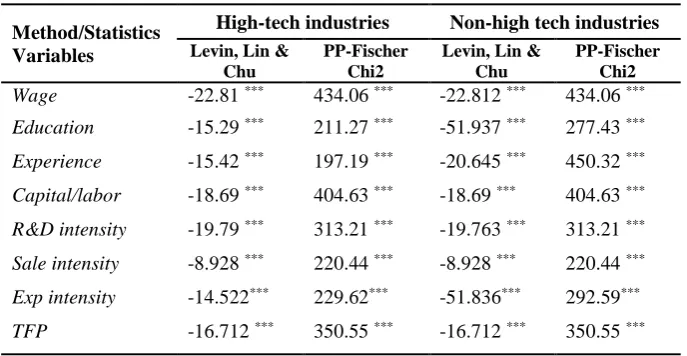
This section reports the results of panel unit root tests to examine the stationary of model variables (Table 3). The basic panel unit root test regression can be written as follows:
where i= 1,2,…,N is the cross-section units of series that are observed over periods t= 1,2,…,T; Xitis the exogenous variables in the model, including any fixed effects or individual trend;ρiis the autoregressive coefficient, and εit is the error term, which is assumed to be mutually independent of individual disturbance. In this section, we apply the Levin, Lin &Chu, and PP-Fisher Chi2 tests to examine the stationary situation of model variables. The null hypothesis is that each series in the panel contains a unit root, while the alternative hypothesis allows for some of the individual time series to have unit roots. The results of the panel unit root test in Table 3 provide evidence that the entire variables are stationary at level.
Table 3: Panel Unit Root Test (at level) Method/Statistics
Variables
High-tech industries Non-high tech industries Levin, Lin &
Chu
PP-Fischer Chi2
Levin, Lin & Chu
PP-Fischer Chi2
Wage -22.81 *** 434.06 *** -22.812 *** 434.06 ***
Education -15.29 *** 211.27 *** -51.937 *** 277.43 ***
Experience -15.42 *** 197.19 *** -20.645 *** 450.32 ***
Capital/labor -18.69 *** 404.63 *** -18.69 *** 404.63 ***
R&D intensity -19.79 *** 313.21 *** -19.763 *** 313.21 ***
Sale intensity -8.928 *** 220.44 *** -8.928 *** 220.44 ***
Exp intensity -14.522*** 229.62*** -51.836*** 292.59***
TFP -16.712 *** 350.55 *** -16.712 *** 350.55 ***
Notes: Null denotes unit root (assumes common unit root process).
*** Significant at 1%.Note 3: All variables are tested with intercept and trend in level. Automatically lag length selection based on the Schwarz Information Criterion (SIC).
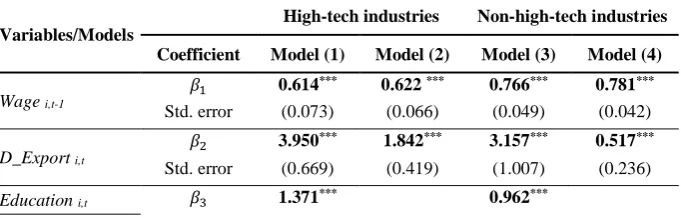
variable are shown in columns 2 and 4.1Looking at the results presented in Table 4, it is evident that the relative wages turn out to be highly auto-correlated, while the path-dependency of the dependent variable observed in both high-tech and non-high-tech industries. This finding is in line with the theory of nominal wage adjustment (Kahneman & Tversky, 2013). In other words, it can be stated that workers evaluate nominal wage changes relative to an endogenous reference point depending on their rational expectations from the recent past (Ahrens, Pirschel, & Snower, 2015). Therefore, the result is consistent with the empirical evidence suggesting that nominal wages are downward rigid, while they are upward flexible (McDonald and Scully (2001); Kőszegi and Rabin (2006); Eliaz and Spiegler (2014)).
In the next step, we included the export dummy variable into the model to analyze the effect of exporting on wages in our sample. It can be seen that the export variable puts a positive and significant impact on relative wages in high-tech industries (3.95% and 1.84% in columns 1 and 2, respectively). Similarly, the results show the positive effect of exporting on relative wages in industries with a lower level of technology (3.16%and 0.52% in columns 3 and 4).This finding shows that although the firms’ decision to export has a positive and significant effect on wages, the export intensity has a weak negative impact. In details, the estimated coefficients imply that 1 percentage increase in the export intensity corresponds to about 0.019% to 0.03% lower wages in manufacturing industries. In line with the current literature, our findings reveal thatincreasing the share of international markets puts the firm into the fierce competition with the foreigner counterparts. In this situation, only the more productive firms can bear the extra costs of export activities(Schank, Schnabel, & Wagner, 2010) and the firms with the lower level of productivity have to stop their international activities or cover the trade costs by adjusting the cost of production factors such as labor force or capital.
Columns 1 and 3 present the results when the education variable is included in the model as a measurement for the human capital indicator. The estimated coefficients have the expected sign and are statistically
significant at 1% for both subgroups. The results also indicate that in high-tech industries, the effect of educated workers on relative wages is stronger than non-high-tech industries (1.371% in high-tech industries rather than 0.962% in non-high-tech ones). Due to higher innovation performance, high technology industries usually require a disproportionately high share of workers with more skills and academic knowledge. Thus, comparing high-tech and non-high-tech industries shows that wage differential could result from sorting due to specific types of jobs and working environments(Roach & Sauermann, 2010). In this line, Dorner, Fryges, and Schopen (2017) argue that high-tech firms have to pay a wage premium to their employees because specific human capital can hardly be substituted. The coefficients of the quadratic term of education and experience are positive and significant, although the magnitudes are smaller than the linear ones. This finding verifies the Mincer (1974) theorem on the convexity of the earnings-education relationship.
In the second step, the wage function was estimated by experience variable as a measurement of human capital in the models (2) and (4). As can be seen, in the model (2) the coefficients are positive and significant with high degrees of confidence for both linear and quadratic terms. This result verifies the concavity between labor earning and experience which is in line with the Mincer (1974) theorem. The coefficient of the linear term of experience is negative and insignificant for non-high-tech industries. While the coefficient of the over experience shows that a 1%rise of experience square is accompanied by0.167% decreases in the growth of relative wages in non-high-tech industries. This finding is in line with the Nieto and Ramos (2017) who identify the negative effect of over skills on labors’ earning in OECD countries.
Table 4: Model Estimation (Dependent Variable: Ln (Wage)) Variables/Models
High-tech industries Non-high-tech industries
Coefficient Model (1) Model (2) Model (3) Model (4)
Wage i,t-1
𝛽1 0.614*** 0.622 *** 0.766*** 0.781***
Std. error (0.073) (0.066) (0.049) (0.042)
D_Export i,t
𝛽2 3.950*** 1.842*** 3.157*** 0.517***
Std. error (0.669) (0.419) (1.007) (0.236)
Variables/Models
High-tech industries Non-high-tech industries
Coefficient Model (1) Model (2) Model (3) Model (4)
Std. error (0.369) (0.347)
Education2
i,t
𝛽4 0.167 *** 0.094***
Std. error (0.056) (0.032)
Experience i,t
𝛽5 1.291*** -0.319
Std. error (0.614) (0.264)
Experience2
i,t
𝛽6 0.777** -0.167*
Std. error (0.409) (0.099)
Capital/labor i,t
𝛽7 0.100*** 0.089*** 0.064*** 0.059***
Std. error (0.044) (0.024) (0.016) (0.013)
R&D intensityi,t
𝛽8 0.024 0.039* -0.002 -0.011
Std. error (0.018) (0.023) (0.014) (0.015)
Sale intensityi,t
𝛽9 0.094 0.100 -0.073*** -0.063*
Std. error (0.118) (0.094) (0.034) (0.038)
Export intensityi,t
𝛽10 -0.039 *** -0.027*** -0.022*** -0.019***
Std. error (0.014) (0.014) (0.008) (0.008)
TFP i,t
𝛽11 0.263*** 0.274*** 0.096*** 0.103***
Std. error (0.089) (0.046) (0.045) (0.044)
Diagnostic tests
AR(1) (0.0003) (0.0004) (0.0001) (0.0001)
AR(2) (0.969) (0.763) (0.160) (0.156)
Wald test 41043.68 93389.2 108810.3 152706.3
P-value (0.000) (0.000) (0.000) (0.000)
Instrument 59 59 59 59
Observations 335 335 552 555
Source: Prepared by the authors.
Notes:
***, **, * denote the Significance at 1%, 5%, and 10%.
Robust standard errors are in brackets. The method in all models is a one-step GMM-SYS. All variables are in logarithmic form and consequently the estimated coefficients are elasticities.
The value reported for AR(1) and AR(2) are the p values for first- and second-order auto-correlated disturbances in the first differences equations, respectively. Note6: Year dummy variable is included in all specifications.
The calculations were carried on using the software STATA15.
that producing more capital-intensiveindustries requires capital that is more human. Moreover, by assuming that a proper rent is paid to human capital, we would expect that high-tech industries that are more capital-intensity use disproportionally more skilled labor and thus pay a higher wage to them. In other words, capital-skill complementarity would have a greater growth in skill demand of high-tech industries than non-high-tech ones. Hence, it leads to a higher wage level in industries with a higher level of capital-labor ratio. In this line, most studies identify a connection between the wages of labor with a capital intensity, implying capital (or technology)-labor complementarity. For instance, Doms, Dunne, and Troske (1997), Bresnahan, Brynjolfsson, and Hitt (2002), Leiponen (2005), Yasar and Paul (2008), and Grund and Sliwka (2007) reported that increasing the capital (or technology) intensity of production enhances productivity directly, suggesting more skilled labor intensity and higher wages.
demand for skilled labor increases, leading to a rise in the relative wage of labors in more technical-intensity firms. This finding is consistent with Machin and Van Reenen (1998),J. Haskel and Heden (1999), and Görg and Strobl (2002).The coefficient of the sale intensity shows a positive and insignificant effect on relative wages in high-industries and negative and significant effect on non-high-tech ones. In Fact, our results indicate that in non-high-tech industries, a 1.0% increase in the sale intensity leads to a 0.06% decrease in labors’ wage subsequently. It can be stated that high-tech firms that tend to be more capital-intensive are able to achieve workers with a higher level of qualification. Therefore, a higher level of human capital leads to paying more wages to the employees. Furthermore, it can be argued that high-tech firms with higher level of high-technology are able and willing to undertake Research and Development (R&D) activities and hence they require labors of higher quality to perform such activities (Chuang & Hsu, 2004). Based on our findings, firms’ decision for entering into international markets puts positive effects on labors’ wage. While to increase the market share, firms have to cover the trade costs by adjusting the cost of production factors such as labor force or capital.
Finally, some diagnostic tests were used to verify the validity of the model and the robustness of the findings. In addition, AR(1) and AR(2) tests reported the p-values for autocorrelation and the results found to support the persistence of the GMM estimators in the models. Therefore, the GMM-system method is consistent in all of the examined scenarios.
6. Summary and Conclusions
equation, system GMM one-step technique was employed.
The bottom line of this paper is that both human and industry components are important in wage determination in Iran. In addition, it was revealed that the differences in skill endowments, technical standards, and exporting lead to wage differences between industries. In detail, we found that the level of education, capital-labor ratio, and TFP have positive and significant impacts on relative wages in both groups of the industries. However, these effects are more pronounced in high-tech industries. We also found that an inverted U-shape relationship between education and earning in both subgroups which supports the Mincer (1974) theorem for the case of Iran. Finally, our results show that firms’ decision for entering into international markets puts a positive effect on earnings. While to increase the market share, firms have to cover the trade costs by adjusting the cost of production factors such as labor force or capital.
To improve worker’s earning, we suggest that the business owners should pay more attention to some industry’s growth-driven factors such as capital intensity, R&D expenditures, and total factor productivity in their policy making. On a broader scale, government policies should also provide tools to help high-tech industries to promote their export-oriented activities and access to foreign markets especially after lifting economic sanctions on Iran. Furthermore, successful education and training policies that increase the skill level may act as an indirect incentive to improve workers’ earning in both sub groups. However, in high-tech industries, it is suggested putting more emphasis on training related to export-oriented production.
References
Abdi, T. (2007). Trade Liberalization, Technology, Relative Factor Supplies and the Relative Wage: Evidence from the South. Applied
Economics, 39(19), 2451-2463.
Acemoglu, D. (1998). Why Do New Technologies Complement Skills? Directed Technical Change and Wage Inequality. The Quarterly
Acemoglu, D. (2001). Good Jobs versus Bad Jobs. Journal of Labor
Economics, 19(1), 1-21.
Ahrens, S., Pirschel, I., & Snower, D. J. (2015). Path-Dependent Wage Responsiveness. Retrieved from
https://www.researchgate.net/profile/Steffen_Ahrens/publication/2836 35506_PathDependent_Wage_Responsiveness/links/5641c81008ae24 cd3e427482.pdf.
Arellano, M., & Bond, S. (1991). Some Tests of Specification for Panel Data: Monte Carlo Evidence and an Application to Employment Equations. The Review of Economic Studies, 58(2), 277-297.
Baldwin, R. E., & Cain, G. G. (2000). Shifts in Relative US Wages: the Role of Trade, Technology, and Factor Endowments. The Review of
Economics and Statistics, 82(4), 580-595.
Barua, A., & Ghosh, P. (2017). Factor Specificity and Wage Inequality in a Developing Economy: The Role of Technology and Trade in Indian Manufacturing. International Review of Economics & Finance, 52, 77-90.
Bernard, A. B., & Jensen, J. B. (1999). Exceptional Exporter Performance: Cause, Effect, or Both? Journal of International
Economics, 47(1), 1-25.
Bernard, A. B., & Jensen, J. B. (2004). Why Some Firms Export. The
Review of Economics and Statistics, 86(2), 561-569.
Blum, B. S. (2008). Trade, Technology, and the Rise of the Service Sector: The Effects on US Wage Inequality. Journal of International
Economics, 74(2), 441-458.
Blundell, R., & Bond, S. (1998). Initial Conditions and Moment Restrictions in Dynamic Panel Data Models. Journal of Econometrics, 87(1), 115-143.
Employment: An Application of the LSDVC Estimator Using European Microdata. Economics Letters, 116(1), 56-59.
Borjas, G. J., & Ramey, V. A. (1994). Chapter 7 - The Relationship between Wage Inequality and International Trade. In T. F. C. J. W. H. Jeffrey H. Bergstrand & G. S. Richard (Eds.), Contributions to
Economic Analysis (217-241). New York: Elsevier.
Bouillon, C., Legovini, A., & Lustig, N. (1999). Can Education Explain Income Inequality Changes in Mexico? Inter-American Development Bank. Retrieved from
https://pdfs.semanticscholar.org/a199/d05219c7c17c6d64535688b148 c937804d88.pdf.
Bresnahan, T. F., Brynjolfsson, E., & Hitt, L. M. (2002). Information Technology, Workplace Organization, and the Demand for Skilled Labor: Firm-level Evidence. The Quarterly Journal of Economics, 117(1), 339-376.
Card, D., & DiNardo, J. E. (2002). Skill-biased Technological Change and Rising Wage Inequality: Some Problems and Puzzles. Journal of
Labor Economics, 20(4), 733-783.
Caselli, M. (2014). Trade, Skill-biased Technical Change and Wages in Mexican Manufacturing. Applied Economics, 46(3), 336-348.
Chuang, Y. C., & Hsu, P. F. (2004). The Employer Size-wage Differentials in Taiwan. Small Business Economics, 23(4), 285-297.
Clark, A. E. (1999). Are Wages Habit-forming? Evidence from Micro Data. Journal of Economic Behavior & Organization, 39(2), 179-200.
Conte, A., & Vivarelli, M. (2011). Imported Skill‐Biased Technological Change In Developing Countries. The Developing Economies, 49(1), 36-65.
Grown in Mexico? Is it the Incidence of Reforms or the Growing Demand for Skills? Journal of Development Economics, 51(1), 99-116.
Dai, M., & Xu, J. (2017). The Skill Structure of Export Wage Premium: Evidence from Chinese Matched Employer–Employee Data. The World
Economy, 40(5), 883-905.
Dix-Carneiro, R., & Kovak, B. K. (2015). Trade Liberalization and the Skill Premium: A Local Labor Markets Approach. American Economic
Review, 105(5), 551-557.
Dollar, D., & Kraay, A. (2004). Trade, Growth, and Poverty. The
Economic Journal, 114(493), 22-49.
Doms, M., Dunne, T., & Troske, K. R. (1997). Workers, Wages, and Technology. The Quarterly Journal of Economics, 112(1), 253-290.
Dorner, M., Fryges, H., & Schopen, K. (2017). Wages in High-tech Start-ups–Do Academic Spin-offs Pay a Wage Premium? Research
Policy, 46(1), 1-18.
Eliaz, K., & Spiegler, R. (2014). Reference Dependence and Labor Market Fluctuations. NBER Macroeconomics Annual, 28(1), 159-200.
Esquivel, G., & Rodrıguez-López, J. A. (2003). Technology, Trade, and Wage Inequality in Mexico before and after NAFTA. Journal of
Development Economics, 72(2), 543-565.
Falzoni, A. M., Venturini, A., & Villosio, C. (2011). Skilled and Unskilled Wage Dynamics in Italy in the 1990s: Changes in Individual Characteristics, Institutions, Trade and Technology. International
Review of Applied Economics, 25(4), 441-463.
Farinas, J. C., & Martín‐Marcos, A. (2007). Exporting and Economic Performance: Firm‐level Evidence of Spanish Manufacturing. The
Feenstra, R. C., & Hanson, G. H. (1999). The Impact of Outsourcing and High-technology Capital on Wages: Estimates for the United States, 1979–1990. The Quarterly Journal of Economics, 114(3), 907-940.
Feizpour, M. A., Hajikhodazadeh, H., & Shahmohammadi Mehrjardi, A. (2014). Life Duration of New Firms in Iranian Manufacturing Industries Using Cox Proportional Hazard Model. Iranian Economic
Review, 18(3), 133-156.
Goldin, C., & Katz, L. F. (1998). The Origins of Technology-skill Complementarity. The Quarterly Journal of Economics, 113(3), 693-732.
Görg, H., & Strobl, E. (2002). Relative Wages, Openness and Skill-biased Technological Change. Retrieved
fromhttps://www.google.com/url?sa=t&rct=j&q=&esrc=s&source=we b&cd=1&ved=2ahUKEwiNotnUidPdAhWrA8AKHRdAMkQFjAAeg QIAhAC&url=http%3A%2F%2Fftp.iza.org%2Fdp596.pdf&usg=AOv Vaw2fA9Otk3yTCFsJiQyd6Pzi.
Greenaway, D., & Yu, Z. (2004). Firm-level Interactions between Exporting and Productivity: Industry-specific Evidence. Review of
World Economics, 140(3), 376-392.
Grund, C., & Sliwka, D. (2007). Reference-dependent Preferences and the Impact of Wage Increases on Job Satisfaction: Theory and Evidence. Journal of Institutional and Theoretical Economics JITE, 163(2), 313-335.
Hahn, C. H. (2005). Exporting and Performance of Plants: Evidence on Korea. International Trade in East Asia, NBER-East Asia Seminar on
Economics, 14, Retrieved from https://www.nber.org/chapters/c0190.
Hansson, P., & Lundin, N. N. (2004). Exports as an Indicator on or Promoter of Successful Swedish Manufacturing Firms in the 1990s.
Review of World Economics/Weltwirtschaftliches Archiv, Retrieved
form https://link.springer.com/article/10.1007/BF02665983.
Harrigan, J., & Reshef, A. (2011). Skill Biased Heterogeneous Firms,
Trade Liberalization, and the Skill Premium. Retrieved from
http://www.nber.org/papers/w17604.
Haskel, J., & Heden, Y. (1999). Computers and the Demand for Skilled Labour: Industry‐and Establishment‐Level Panel Evidence for the UK.
The Economic Journal, 109(454), 68-79.
Haskel, J. E., & Slaughter, M. J. (2002). Does the Sector Bias of skill-biased Technical Change Explain Changing Skill Premia? European
Economic Review, 46(10), 1757-1783.
Helpman, E., Itskhoki, O., & Redding, S. (2010). Inequality and Unemployment in a Global Economy. Econometrica, 78(4), 1239-1283.
Hummels, D., Jørgensen, R., Munch, J., & Xiang, C. (2014). The Wage Effects of Offshoring: Evidence from Danish Matched Worker-Firm Data. American Economic Review, 104(6), 1597-1629.
Huttunen, K. (2005). R&D Activity, Exports, and Changes in Skill Demand in Finland. Finnish Economic Papers, 18(2), 72-85.
Jaques, E. (2013). Measurement of Responsibility: A Study of Work,
Payment, and Individual Capacity (8). New York: Routledge.
Jeon, Y., Kwon, C.-W., & Lee, C. (2013). The Effect of the Material Offshoring and Trade in the Skill Premium. Journal of Korean
Economics Studies, 31(2), 97-132.
Juhn, C., Murphy, K. M., & Pierce, B. (1993). Wage Inequality and the Rise in Returns to Skill. Journal of Political Economy, 101(3), 410-442.
Kahneman, D., & Tversky, A. (2013). Prospect Theory: An Analysis of Decision under Risk. In Handbook of the Fundamentals of Financial
Decision Making: Part I (99-127). New York: World Scientific.
Katz, L. F., & Revenga, A. L. (1989). Changes in the Structure of
Wages: The US versus Japan. Retrieved from
http://www.nber.org/papers/w3021.
Kawaguchi, D., & Ohtake, F. (2007). Testing the Morale Theory of Nominal Wage Rigidity. ILR Review, 61(1), 59-74.
Klein, M. W., Moser, C., & Urban, D. M. (2013). Exporting, Skills and Wage Inequality. Labour Economics, 25, 76-85.
Kőszegi, B., & Rabin, M. (2006). A Model of Reference-dependent Preferences. The Quarterly Journal of Economics, 121(4), 1133-1165.
Krishna, P., Poole, J. P., & Senses, M. Z. (2014). Wage Effects of Trade Reform with Endogenous Worker Mobility. Journal of International
Economics, 93(2), 239-252.
Krugman, P. R. (2000). Technology, Trade and Factor Prices. Journal
of International Economics, 50(1), 51-71.
Krusell, P., Ohanian, L. E., Ríos‐Rull, J. V., & Violante, G. L. (2000). Capital‐skill Complementarity and Inequality: A Macroeconomic Analysis. Econometrica, 68(5), 1029-1053.
Leamer, E. E. (2000). What’s the use of factor contents? Journal of
--- (1996). In Search of Stolper-Samuelson Effects on US Wages. Retrieved from http://www.nber.org/papers/w5427.
Lee, J.-W., & Wie, D. (2015). Technological Change, Skill Demand, and Wage Inequality: Evidence from Indonesia. World Development, 67, 238-250.
Lee, S. (2017). International Trade and Within-sector Wage Inequality: The Case of South Korea. Journal of Asian Economics, 48, 38-47.
Leiponen, A. (2005). Skills and Innovation. International Journal of
Industrial Organization, 23(5), 303-323.
Machin, S. (1996). Wage Inequality in the UK. Oxford Review of
Economic Policy, 12(1), 47-64.
Machin, S., & Van Reenen, J. (1998). Technology and Changes in Skill Structure: Evidence from Seven OECD Countries. The Quarterly
Journal of Economics, 113(4), 1215-1244.
Martins, P. S., & Opromolla, L. D. D. (2009). Exports, Imports and Wages: Evidence from Matched Firm-worker-product Panels. Retrieved from
https://pdfs.semanticscholar.org/3f2c/b77c8ae7be55e07da418df9f0f38 68f00831.pdf.
McDonald, I. M., & Scully, H. (2001). How Monetary Policy Can have Permanent Real Effects with Only Temporary Nominal Rigidity.
Scottish Journal of Political Economy, 48(5), 532-546.
Meschi, E., & Vivarelli, M. (2009). Trade and Income Inequality in Developing Countries. World Development, 37(2), 287-302.
Montgomery, J. D. (1991). Equilibrium Wage Dispersion and Interindustry Wage Differentials. The Quarterly Journal of Economics, 106(1), 163-179.
Munch, J. R., & Skaksen, J. R. (2008). Human Capital and Wages in Exporting Firms. Journal of International Economics, 75(2), 363-372.
Narayan, L. (2003). Productivity and Wages in Indian Industries:
Discovery Publishing House. Retrieved from
https://books.google.com/books?id=LpA7pi9Rs-EC&printsec=frontcover&source=gbs_ge_summary_r&cad=0#v=one page&q&f=false.
Nickell, S., & Bell, B. (1996). Changes in the Distribution of Wages and Unemployment in OECD Countries. The American Economic
Review, 86(2), 302-308.
Nieto, S., & Ramos, R. (2017). Overeducation, Skills and Wage Penalty: Evidence for Spain Using PIAAC Data. Social Indicators
Research, 134(1), 219-236.
Pavcnik, N. (2003). What Explains Skill Upgrading in Less Developed Countries? Journal of Development Economics, 71(2), 311-328.
Pissarides, C. A. (1994). Search Unemployment with On-the-job Search. The Review of Economic Studies, 61(3), 457-475.
Piva, M., & Vivarelli, M. (2005). Innovation and Employment: Evidence from Italian Microdata. Journal of Economics, 86(1), 65-83.
Roach, M., & Sauermann, H. (2010). A Taste for Science? PhD Scientists’ Academic Orientation and Self-selection into Research Careers in Industry. Research Policy, 39(3), 422-434.
Sandulli, F. D., Baker, P. M., & López-Sánchez, J. I. (2013). Can Small and Medium Enterprises Benefit from Skill-biased Technological Change? Journal of Business Research, 66(10), 1976-1982.
Schank, T., Schnabel, C., & Wagner, J. (2007). Do Exporters Really pay Higher Wages? First Evidence from German Linked Employer– employee Data. Journal of International Economics, 72(1), 52-74.
Schank, T., Schnabel, C., & Wagner, J. (2010). Higher Wages in Exporting Firms: Self-selection, Export Effect, or Both? First Evidence from Linked Employer-employee Data. Review of World Economics, 146(2), 303-322.
Stojanovska, N., & Cuyvers, L. (2012). The Interplay between International Trade and Technological Change and the Wage Inequality in the OECD Countries. Macroeconomics and Beyond: Essays in
Honour of Wim Meeusen, Retrieved from
https://ideas.repec.org/p/wsr/wpaper/y2010i043.html.
Summit, G. (2001). A Globalized Market–Opportunities and Risks for the Poor. Global Poverty Report, Retrieved from http://message.worldbank.org/drm/documents_error.htm.
Verhoogen, E. A. (2008). Trade, Quality Upgrading, and Wage Inequality in the Mexican Manufacturing Sector. The Quarterly
Journal of Economics, 123(2), 489-530.
Wood, A. (1997). Openness and Wage Inequality in Developing Countries: the Latin American Challenge to East Asian Conventional Wisdom. The World Bank Economic Review, 11(1), 33-57.
Xu, Y., & Ouyang, A. Y. (2015). China Wage Inequality: The Role of Trade and Technology. Applied Economics, 47(47), 5057-5071.