Summary
ObjectivesMany hypotheses concerning the cognitive functions affected by chronic alcoholism have been advanced. The aim of this study was to test cognitive performance in a sample of alcoholics and to examine results comparing three different models: the fron-tal lobe hypothesis, the lateralisation hypothesis and the diffuse brain hypothesis.
Methods
Fifty-one patients who referred to an alcoholism service were included in this study. Cognitive functions were assessed by a trained psychologist using a specific neuropsychological battery.
Results
Our results show a ranking of degrees of impairment in dif-ferent cognitive functions with dissimilar influence on clinical
features. In our sample, the frontal lobe hypothesis was discon-firmed. The results on right hemisphere seem to require more investigation and the generalized deficit hypothesis was not confirmed.
Conclusion
Cognitive deficits may compromise patients’ utilisation of reha-bilitative information. Increasing attention is being given to the opportunity to integrate specific support for cognitive functions in alcohol detox programmes. The first step in programming clin-ical intervention is to have a complete overview of the cognitive deficits in alcoholics.
Key words
Alcoholism • Cognition • Impairment • Theories • Cerebral lobes • Clinical features
Testing three theories of cognitive dysfunction in alcohol abuse
Analisi dei deficit neuropsicologici alcol-correlati alla luce di tre differenti ipotesi teoriche
C. Smeraldi, S.M. Angelone, M. Movalli, M. Cavicchioli, G. Mazza, A. Notaristefano, C. Maffei
Università di Palermo, Istituto Scientifico Ospedale San Raffaele Turro; Department of Clinical Neurosciences, Milano, Italy
Correspondence
Cecilia Smeraldi, Università di Palermo, piazza Marina 61, 90133 Palermo, Italy • Tel. +39 02 26433229 • Fax +39 02 26433265 • E-mail: [email protected]
Introduction
Alcohol abuse is a maladaptive pattern of drinking, lead-ing to clinically-significant impairment or distress, as man-ifested by at least one of the following occurring within a 12-month period:
• recurrent use of alcohol resulting in a failure to fulfil major role obligations at work, school, or home (e.g., repeated absences or poor work performance related to alcohol use; alcohol-related absences, suspen-sions, or expulsions from school; neglect of children or household);
• recurrent alcohol use in situations in which it is physi-cally hazardous (e.g., driving an automobile or operat-ing a machine when impaired by alcohol use);
• recurrent alcohol-related legal problems (e.g., arrests for alcohol-related disorderly conduct);
• continued alcohol use despite having persistent or recurrent social or interpersonal problems caused or exacerbated by the effects of alcohol (e.g., arguments with spouse about consequences of intoxication) 1.
Research on alcoholism has two important aims: to evalu-ate existing therapies and to increase knowledge about the biology of alcoholism. Heavy alcohol intake is associ-ated with both structural and functional changes in the central nervous system, with long-term neuronal adap-tive changes contributing to the phenomena of tolerance and withdrawal symptoms 2. Considerable progresses has been made in the last 20 years regarding the physical mechanisms of addiction, theories of alcohol action in the human body and psychosocial effects of alcohol abuse 3. Despite these facts, it is still difficult to have a general view of the above knowledge since alcohol dependence is a heterogeneous disorder with many contributing fac-tors that vary from person to person 4. Several studies have shown important variations in the presence and severity of different cognitive deficits. In fact, there is a gap be-tween patients who do not present any kind of disorder and those who develop dementia 5.
neuro-that the observed relationship between alcohol intake and cognition may change when this variable is controlled 18. Moreover, alcoholics achieve significantly lower scores that controls on summery indices of the Wechsler Mem-ory and Adult Intelligence Scales and showed greater de-cline from estimated premorbid intelligence levels than controls 19. High level cognitive processes are also an important field of research. Some theories of mind and deficit in executive functions have been found and could be of relevance in investigating their impact on rehabili-tation programmes 20.
The exact nature of the neuropsychological disorders re-lated to alcoholism is still under discussion and the most recent investigations have proposed different hypotheses. The first hypothesis is known as “frontal lobe” hypoth-esis and states that the frontal lobes are most vulnerable to the effects of alcohol. There is agreement upon the specificity of cognitive functions related to the frontal lobe, called “executive functions” 21. More precisely, these functions include: cognitive flexibility, speed in al-location of attentional resources, shifting ability, speed in information processing, inhibition of perseverative errors, perceptual motor speed, abstractive and plan-ning abilities and suppression of irrelevant information. Findings in alcoholicssuggesting deficits on abstracting and problem solving tests, support this hypothesis. Dif-ficulties in categorising and inflexibility of thinking, as measured by different instruments, could be related to selective frontal lobe dysfunction, even in the absence of severe global impairment 22-23.
In support of the frontal lobe hypothesis, findings from multiple neuropsychological studies have revealed di-minished functioning in problem solving, abstraction, working memory, attention and response inhibition/im-pulsivity 24-29. Different studies have demonstrated a loss of neurons, primarily from the frontal cortex 30-34. These studies suggest that the frontal lobes are more susceptible to ethanol damage than other brain regions. However, other studies have either found a lack of dysfunction in the frontal lobes or have revealed deficits in other regions, negating the hypothesis of frontal lobe exclusivity 35-37. These contrasting findings require further investigation. The second hypothesis is the “lateralisation hypothesis”, which states that right hemisphere functions are more susceptible to the neurotoxic effects of alcoholism 38. The right hemisphere has a role in selective attentional pro-cessing and has the ability to attend to the spatial array. The pattern of results in alcoholics is consistent with the right hemisphere model of alcoholism-related cognitive decline 39.
Comparison between verbal and non-verbal tasks has shown that impairment of visual learning, visual memory and visuospatial abilities are often be found and seem to be more resistant to recovery 40-42.
science techniques have led to an increased understand-ing of alcohol addiction and have permitted studies of the effects of alcohol on the brain. Both animal and human genetics studies are increasingly enabling the identifica-tion of genes that confer vulnerability to alcoholism. Is-sues requiring a great deal of further study include indi-vidual drinking patterns, the role of cognition in alcohol-seeking behaviour and the subjective effects of drinking 6. The causes of cognitive impairment found in alcoholics include direct effects of alcohol toxicity, pre-existing cog-nitive deficits that predispose towards substance abuse, comorbid psychiatric disorders and abuse of substances other than alcohol 7.
Procedures
Measures
The neuropsychological battery included Brief Assess-ment of Cognition in Schizophrenia (BACS) and Milan Overall Dementia Assessment (MODA). BACS includes the following subtests: verbal memory (word recall); working memory (digit sequencing); token motor task (psychomotor speed and coordination); selective atten-tion (symbol coding); semantic fluency; letter fluency; Tower of London. Verbal memory tasks were adapted to Italian by substituting English words with Italian words that were matched for frequency and phonemic charac-teristics. The letter fluency tasks were adapted using let-ters that were already used in common Italian clinical tests for letter fluency. Verbal memory and Tower of Lon-don tasks consist of two alternative forms for repeated measures assessment 46. The BACS scores were analysed by simultaneous multiple regression to assess the influ-ence of age, education and gender. For each score, a lin-ear regression model was applied to adjust original score for age, education and gender. The cut-off score indicates the score below which the probability than an individual belongs to the normal population is less than 0.05, with a confidence level of 0.95. Norms were computed with the equivalent scores method 47 to enable comparison with other neuropsychological tasks commonly used in Italy 48-50, such as Wisconsin card sorting test, Stroop col-our-word tests and Raven’s progressive matrices. Adjust scores were fitted into a 5-point interval scale to obtain equivalent score, that was classified as follows: limit for pathological performance = 0; borderline value = 1; in-termediate value = 2 or 3; equal or better than median value = 4 51.
MODA is a short, neuropsychological oriented test used for assessment of dementia. MODA is a paper and pencil test composed of three sections: a behavioural scale and two testing sections. The three sections are given in the same testing session in the same sequence. The behav-ioural component (autonomy scale) accounts for 15% of the score and comprises a set of items that assess every-day coping skills. Information is provided by a relative and can therefore be collected even in cases of severe de-terioration. The cognitive contribution represents 85% of the total score (orientation enquiry and neuropsychologi-cal testing yield, respectively, 35% and 50% of the over-all score). The MODA total score ranges from the worst of 0 to the best of 100. In all items, a score of zero is given if the patient fails to provide an answer or responds inap-propriately. Instructions may be repeated for each item, so as to elicit the patient’s best possible performance 52. The “diffuse brain dysfunction” hypothesis considers
that alcohol affects all areas of the brain. A review by Parsons 43 described findings from cross-sectional and longitudinal studies; these results revealed verbal, visuospatial and abstracting deficits that support the diffuse brain hypothesis. The cognitive deficits showed by sober alcoholics include impairment in different functions, such as verbal and non-verbal thinking, verbal and non-verbal learning, memory, visuospatial perception and perceptual motor skills 44 45. This pat-tern of deficits is consistent with the hypothesis that chronic alcoholism produces mild generalised brain dysfunction.
While studies frequently make allusion to each of these three hypotheses, inconsistent findings have been re-ported that do not always support the assumptions of one specific theory. The aim of this study was to test cognitive performance in a sample of alcoholics and to examine the results to compare these different models.
Methods
Participants
A total of 110 alcohol-dependent individuals were con-secutively recruited from the alcohol-dependence service of San Raffaele Hospital in Milan, Italy at admission. All subjects were given an assessment, which took ap-proximately three hours and included an anamnestic interview and a neuropsychological battery that was administrated by trained technicians of the psychologi-cal service within the first week after admission, or as soon as the patient was clinically stable enough to un-dergo testing.
Patients who had previously been diagnosed with any disorder from DSM-IV TR Axis 1 (other than substance dependence) were not included. Moreover, patients with concurrent neurological diseases and traumatic brain in-jury were excluded as were those with a MODA score < 89 (30 patients were classified as insufficient).
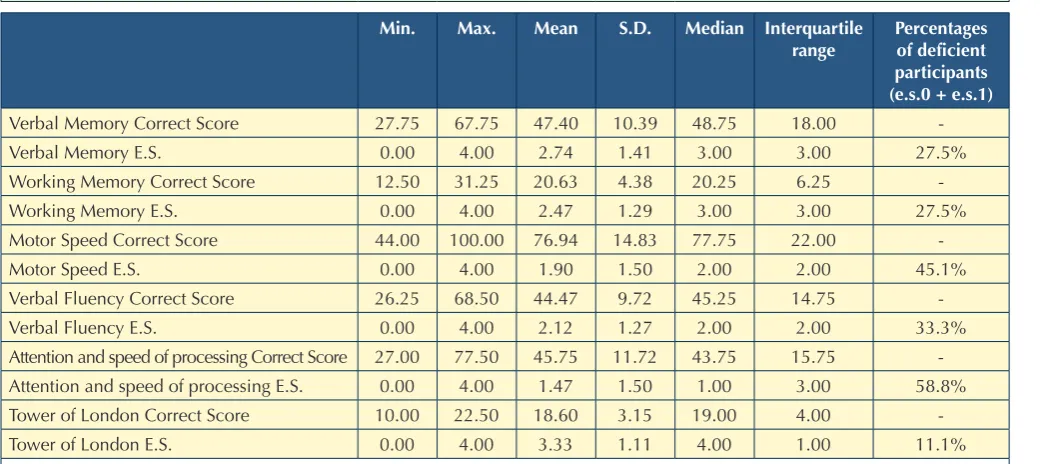
Considering equivalent score it is possible to state that, in our sample, the lowest-scoring functions are attention and speed of information processing, which had mean of 1.47 ± 1.50. Motor speed and coordination had mean of 1.90 ± 1.50; these results appear to confirm the relationship between alcohol abuse and low functioning of the motor system. Verbal fluency showed a mean of 2.12 ± 1.27. Verbal memory and working memory had higher re-sults than other functions with means of 2.74 ± 1.41 and 2.47 ± 1.28, respectively. The Tower of London task showed the highest results and the lowest dispersion with mean of 3.33 ± 1.11.
Table II shows that age had a significant relationship with
Results
Descriptive statistics
Table I shows the descriptive statistics of the subtest score considering the different grade of impairment in cognitive functions. Equivalent scores allow considering scores 0 and 1 as “deficient”. These results demonstrate the dis-similar grades of impairment between the different cogni-tive functions.
In each BACS subtest, correction grids were used to ad-just the performance of each subject in term of education, age and sex. Single subtest scores are shown in Table I.
Table I.
Descriptive statistics. Statistiche descrittive.
Min. Max. Mean S.D. Median Interquartile range
Percentages of deficient participants (e.s.0 + e.s.1)
Verbal Memory Correct Score 27.75 67.75 47.40 10.39 48.75 18.00
-Verbal Memory E.S. 0.00 4.00 2.74 1.41 3.00 3.00 27.5%
Working Memory Correct Score 12.50 31.25 20.63 4.38 20.25 6.25
-Working Memory E.S. 0.00 4.00 2.47 1.29 3.00 3.00 27.5%
Motor Speed Correct Score 44.00 100.00 76.94 14.83 77.75 22.00
-Motor Speed E.S. 0.00 4.00 1.90 1.50 2.00 2.00 45.1%
Verbal Fluency Correct Score 26.25 68.50 44.47 9.72 45.25 14.75
-Verbal Fluency E.S. 0.00 4.00 2.12 1.27 2.00 2.00 33.3%
Attention and speed of processing Correct Score 27.00 77.50 45.75 11.72 43.75 15.75 -Attention and speed of processing E.S. 0.00 4.00 1.47 1.50 1.00 3.00 58.8% Tower of London Correct Score 10.00 22.50 18.60 3.15 19.00 4.00
-Tower of London E.S. 0.00 4.00 3.33 1.11 4.00 1.00 11.1%
Min.: minimum score; Max.: maximum score; S.D.: standard deviation; E.S.: equivalent score.
Table II.
Impact of clinical features. Impatto delle caratteristiche cliniche.
Function age education Other
substances abuse
Sex
Verbal Memory ES n.s. n.s. n.s. n.s.
Working Memory ES n.s. n.s. n.s. n.s.
Motor Speed ES -0.366 (p < 0.01) n.s n.s. n.s.
Verbal Fluency ES n.s. n.s. n.s. n.s.
Attention and speed of information processing ES n.s 0.343 (p < 0.05) n.s. n.s.
Tower of London ES n.s. n.s. n.s. n.s.
Table III shows the that the Tower of London equivalent score was significantly higher than all the other cogni-tive functions Therefore, is possible to conclude that the frontal functions are less impaired in alcohol dependent patients, negating the frontal lobe hypothesis.
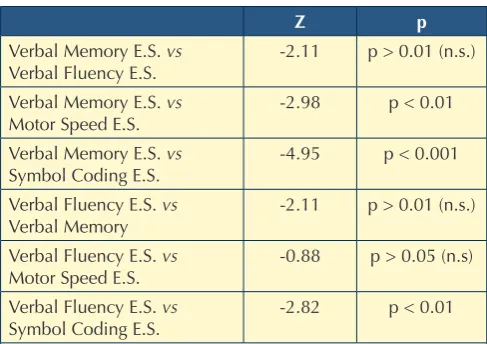
For the lateralisation hypothesis we compared the results of verbal and non-verbal tasks. Verbal tasks were meas-ured by the subtests of Verbal Memory and Verbal Flu-ency, while the non-verbal tasks were represented by the Motor Speed and Symbol Coding subtests. The results only partially confirm the lateralisation hypothesis. Ver-bal memory showed significantly higher results than non-verbal tasks. Verbal fluency had no significant association with motor speed (Tab. IV).
Table IV shows that verbal memory had significantly higher results than non-verbal tasks. Verbal fluency had no significant differences with motor speed.
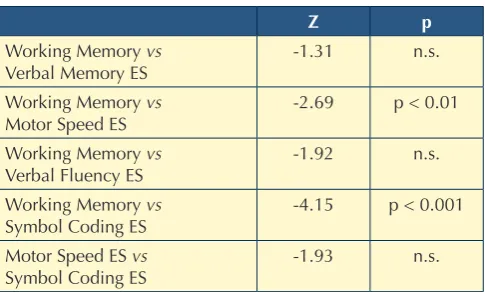
For the diffuse brain dysfunction hypothesis we have compared the results of all tasks in order to determine if all cognitive functions had the same level of impairment according to the above-described hypothesis (Tab. V). While it was possible to rank degree of impairment in dif-ferent cognitive functions, the results are in contrast with the diffuse brain dysfunction hypothesis.
Table V shows that different cognitive functions are af-fected to various degrees by alcohol intake. It is not pos-sible to confirm the diffuse brain dysfunction hypothesis.
Discussion
Cognitive impairment is a core feature of chronic al-coholism. Between 50% and 80% of individuals with alcohol use disorders experience mild to severe neu-motor speed and coordination. Education had a direct
relationship on attention and speed of information pro-cessing. Polyabuse condition did not show any impact on cognitive performance in comparison with only alcohol abuse alone. the was no association of gender with cog-nitive performance.
Correlations were used to assess the effect of age and edu-cation because it was not possible to assume population discontinuity in specific classes. Age had a significant rela-tionship with motor speed and coordination, and the worst performances were found in older patients (correlation: -0.37). Education had a direct relationship on attention and speed of information processing (correlation: 0.34). The Mann-Whitney non-parametric test allows us explore the impact of dicotomic variables as polyabuse and sex on cognitive performance. As there were no significant differences, this suggests that polyabusers do not have worse cognitive performance in comparison with alco-holics alone. Gender had no relationship with cognitive functions.
Comparison of different cognitive functions
To evaluate the differences within the different cogni-tive function, in order to determine which hypothesis is the most reliable, we applied Friedman’s ANOVA on the equivalent score totalised in the assessment session using the BACS battery. To evaluate the post-hoc test, we uti-lised the Wilcoxon test, adjusting the confident interval by Bonferonni’s methodology (α = 0.05/5 = .01).
Frontal Lobe Hypothesis: we have compared the Tower of London equivalent score with other cognitive perfor-mances to determine if the frontal functions were the most deteriorated, according to the hypothesis mentioned earlier. The Tower of London showed an equivalent score that was significantly higher than all other cognitive func-tions (Tab. III). Therefore, is possible to conclude that frontal functions are less impaired in alcohol dependent patients, refuting the frontal lobe hypothesis.
Table III.
Frontal lobe hypothesis. Ipotesi dei lobi frontali.
Tower of london e.S. vs. Z p
Verbal Memory E.S. -3.12 p < 0.01 Working Memory E.S. -3.87 p < 0.001 Motor Speed E.S. -4.92 p < 0.001 Verbal Fluency E.S. -4.34 p < 0.001 Attention and speed of
information proc. E.S. sing. E.S.
-5.56 p < 0.001
E.S.: equivalent score. A negative Z score indicates that it is higher than the score with which it has compared.
Table IV.
Lateralisation hypothesis. Ipotesi della lateralizzazione.
Z p
Verbal Memory E.S. vs
Verbal Fluency E.S. -2.11 p > 0.01 (n.s.) Verbal Memory E.S. vs
Motor Speed E.S.
-2.98 p < 0.01
Verbal Memory E.S. vs
Symbol Coding E.S. -4.95 p < 0.001 Verbal Fluency E.S. vs
Verbal Memory -2.11 p > 0.01 (n.s.) Verbal Fluency E.S. vs
Motor Speed E.S.
-0.88 p > 0.05 (n.s)
Verbal Fluency E.S. vs
Symbol Coding E.S. -2.82 p < 0.01
scores only compared to Tower of London, which showed significantly higher scores than other functions.
This result underlines that frontal functions are the most resil-ient to alcohol damage and do not confirm the frontal lobe hypothesis. These results thus require a further investigation. In order to test the lateralisation hypothesis, we compared verbal and visual-spatial functions. Verbal memory showed a higher score than both psychomotor speed and symbol coding tasks. These results would seem to confirm the later-alisation hypothesis, although verbal fluency had no signifi-cant differences with visual-spatial functions. Therefore, the lateralisation hypothesis cannot be completely confirmed. Our results show significant differences between the BACS subtests. It is possible to rank different degrees of impairment in different cognitive functions, and the re-sults are in contrast with the diffuse brain dysfunction hy-pothesis, which considers the same level of impairment between different functions. Speed of processing, verbal fluency, psychomotor speed and coordination seem to be most impaired functions; these abilities presume the presence of preserved executive speed. These results ap-pear to be in agreement with the hypothesis that alcohol significantly slows total information processing.
The results of the present study must be considered in light of several limitations. The small size of our sample could influence the possibility of generalising our con-clusions. The absence of a control group is due to the aim of this study: in fact, our principal purpose was to compare different hypotheses about the exact nature of neuropsychological disorders related to alcoholism. The small size of our sample makes it difficult to attribute the results to alcohol consumption; otherwise, the equivalent score method assumes that the corrections based on nor-mative sample are applicable to small samples and, in addition the influence of principal clinical features (i.e. age, sex, scholarship and polyabuse) on cognitive perfor-mance must be taken into consideration.
The relationship between cerebral lobes and neuropsy-chological measures shows complex patterns; cerebral lobes are multifunctional structures and a single neu-ropsychological measure could seem inadequate to test their functioning. Nevertheless, our results are supported by findings in the literature. The Tower of London task is thought to depend on planning ability, a capacity requir-ing intact frontal-lobe functionrequir-ing.
Comparing Korsakoff and non-Korsakoff alcoholics, Joyce and Robbins have demonstrated that only Korsakoff pa-tients show impairment in this task. Moreover, the deficit in Korsakoff patients in this task is not due to impairment in visuospatial skills or memory, but to impairment in planning ability 58. Smith and Jonides, using a threshold-independent measure of hemispheric lateralisation, demonstrated that brain activity during verbal working memory showed a more left-hemisphere lateralised pattern of BOLD response, par-rocognitive impairment. Current treatments for alcohol
abuse disorders focus on changing behaviour and de-veloping skills to prevent relapse and promote psycho-social adaptation, activities that clearly require cogni-tive processing 53-56. The relationship between cognitive impairment and alcoholism treatment is still under dis-cussion. Clinical experience suggests that alcohol-re-lated neuropsychological impairment affects treatment outcome, but research on addiction have provided few indications in this direction. Bates, Bowden and Barry have explored this aspect by testing five different models of the relationship between neuropsychological impair-ment and addiction treatimpair-ment outcome 57. Their finding do not support a direct influence of cognitive impair-ment on outcome, but suggest that it could be a mod-erator variable which impacts the action and strength of risk factors.
The principal aim of this study was to investigate the theoretical framework explaining cognitive impairment related to alcohol abuse by testing different hypotheses in a clinical sample.
The descriptive analysis allowed us to compare single sub-test scores and to use them to investigate different hypoth-eses. It was possible to conclude that the scores in execu-tive functions task (Tower of London task) are significantly higher than the one in other functions; Verbal Memory is the second less impaired function, with significant differ-ences in motor speed, attention and speed of information processing. The third most preserved function is Working Memory. In contrast, the most impaired functions include Attention and Speed of information processing, and show significantly lower scores than Tower of London, Verbal Memory and Working Memory tasks. Motor speed showed a significantly lower level than London Tower and Verbal Memory task, and Verbal Fluency had lower significantly
Table V.
Diffuse brain dysfunction hypothesis. Ipotesi di deficit diffuso.
Z p
Working Memory vs
Verbal Memory ES -1.31 n.s.
Working Memory vs Motor Speed ES
-2.69 p < 0.01
Working Memory vs
Verbal Fluency ES -1.92 n.s.
Working Memory vs
Symbol Coding ES -4.15 p < 0.001 Motor Speed ES vs
Symbol Coding ES
-1.93 n.s.
10 Weiss E, Marksteiner J. Alcohol-related cognitive disorders with a focus on neuropsychology. Int J Disabil Hum Dev
2007;6:337-42.
11 Ambrose ML, Bowden SC, Whelan G. Working memory im-pairments in alcohol-dependent participants without amne-sia. Alcohol Clin Exp Res 2001;25:185-91.
12 Hildebrandt H, Brokate B, Eling P, et al. Response shifting and inhibition, but not working memory, are impaired after long-term heavy alcohol consumption. Neuropsychology
2004;18:203-11.
13 Moreno BP, Rivera SV, Guinea SF. Estudio neuropsicologico de alcoholicos cronicos durante la fase inicial de disintoxica-tion datos preliminares. Adicciones 2006;18:149-60. 14 Tedstone D, Coyle K. Cognitive impairment in sober
alco-holics performance on selective and divided attention task.
Drug Alcohol Depen 2004;75:277-86.
15 Eckardt MJ, Stapleton JM, Rawlings RR, et al. Neuropsycho-logical functioning in detoxified alcoholics between 18 and 35 years of age. Am J Psychiat 1995;152:45-52.
16 Mann K, Gunther A, Stetter F, et al. Rapid recovery from cognitive deficits in abstinent alcoholics: a controlled test-retest study. Alcohol Alcoholism 1999;34:567-74.
17 Dingwall KM, Maruff P, Cairney S. Similar profile of cogni-tive impairment and recovery for Aboriginal Australians in treatment for episodic or chronic alcohol use. Addiction
2011;106:1419-26
18 Krahn D, Freese J, Hauser R, et al. Alcohol use and cognition at mid-life: the importance of adjusting for baseline cogni-tive ability and educational attainment. Alcohol Clin Exp
Res 2003;27:1162-6.
19 Rosenbloom MJ, O’Reilly A, Sassoon SA, et al. Persistent cognitive deficits in community-treated alcoholic men and women volunteering for research; limited contribution from psychiatric comorbidity. J Stud Alcohol 2005;66:254-65. 20 Uekermann J, Channon S, Winkel K, et al. Theory of mind,
humour processing and executive functioning in alcoholism.
Addiction 2007;102:232-40.
21 Shallice T. From neuropsychology to mental structure.
Cam-bridge: Cambridge University Press 1988.
22 Tamkin AS. The Weigl Color-Form sorting test as an index of cortical function. J Clin Psychol 1980;36:778-81.
23 Lezak M, Howieson D, Loring D. Neuropsychological As-sessment. New York: Oxford University Press 2004. 24 Ratti MT, Soragna D, Sibilla L, et al. Cognitive impairment
and cerebral atrophy in ‘heavy drinkers’. Prog
Neuropsy-chopharmacol Biol Psychiatry 1999;23:243-58
25 Moriyama Y, Mimura M, Kato M, et al. Executive dysfunc-tion and clinical outcome in chronic alcoholics. Alcohol
Clin Exp Res 2002;26:1239-44.
26 Ratti MT, Bo P, Giardini A, et al. Chronic alcoholism and the frontal lobe: which executive functions are impaired? Acta
Neurol Scand 2002;105:276-81.
27 Uekermann J, Daum I, Schlebusch P, et al. Depression and cog-nitive functioning in alcoholism. Addiction 2003;98:1521-9. ticularly in the frontal and parietal lobes, while spatial
work-ing memory invoked a pattern of more right-hemisphere lat-eralised activity, observed in both frontal and temporal lobe regions. This pattern is consistent with the literature in adults showing this hemispheric distinction 59.
Many authors have recently pointed out the necessity of considering intervenient phenomena during cognitive as-sessment. Cohen and Maunsell underline that it is impos-sible to control a subject’s internal state completely, so that fluctuations in cognitive states, such as attention, must oc-cur in all experiments 60. The experimental evidence sug-gests that mind-wandering may be one of the most ubiq-uitous and pervasive of all cognitive phenomena. Taking into account multiple tasks, verbal reports have indicated that participants seem to spend 15-50% of the time mind-wandering. The possible relationship between mind-wan-dering and our results will be considered in a future study.
Acknowledgement
There is no acknowledgement.
Conflict of interests
There is no conflict of interest.
References
1 American Psychiatric Association. Diagnostic and Statistical Manual of Mental Disorders. 4th ed. - text revision.
Washing-ton, DC: American Psychiatric Association 2000.
2 Tomberg C. Cognitive effects of acute alcohol consumption and addiction. A review of current knowledge. J
Psycho-physiol 2010;24:210-12.
3 Moser RS, Frantz CE. The neuropsychological consequences of alcohol and drug abuse. In: Brick J, editor. Handbook of the medical consequences of alcohol and drug abuse. New
York: Haworth Press 2004, pp. 49-83.
4 Oslin D. Personalized addiction treatment: how close are we? Alcohol Alcoholism 2011;46:231-2.
5 Corral-Varela M, Cadaveira F. Neuropsychological aspects of alcohol dependence: the nature of brain damage and its reversibility. Rev Neurologia 2002;35:682-7.
6 Gordis E. Improving the old, embracing the new: implica-tion of alcohol research for future practice. Soc Work Health
Care 2001;33:17-41.
7 Glass JM, Buu A, Adams KM, et al Effect of alcoholism se-verity and smoking on executive neurocognitive function.
Addiction 2009;104:38-48.
8 Uekermann J, Daum I. The neuropsychology of alcohol-ism. In: Brozner E, editor. New research on alcohol abuse and alcoholism. New York: Nova science publishers 2006,
pp. 1-18.
9 Fama R, Pfefferbaum A, Sullivan EV. Perceptual learning in detoxified alcoholic men: contributions from explicit memory, executive function, and age. Alcohol Clin Exp Res
45 Tivis R, Beatty WW, Nixon SJ, et al. Patterns of cognitive impairment in alcoholics: are there subtypes? Alcohol Clin
Exp Res 1995;19:1496-500.
46 Keefe RS, Goldberg TE, Harvey PD, et al. The Brief Assess-ment of Cognition in Schizophrenia: reliability, sensitivity, and comparison with a standard neurocognitive battery.
Schizophr Res 2004;68:283-97.
47 Capitani E, Laiacona M. Composite neuropsychological bat-teries and demographic correction: standardization based on equivalent scores, with a review of published data. J Clin
Exp Neuropsychol 1997;19:795-809.
48 Laiacona M, Inzaghi MG, De Tanti G, et al. Wisconsin card sorting test: a new global score, with Italian norms, and its relationship with the Weigl Sorting Test. Neurol Sci
2000;21:279-91.
49 Barbarotto R, Laiacona M, Frosio F, et al. A normative study on visual reaction times and two Stroop colour-word tests.
Ital J Neurol Sci 1998;19:161-70.
50 Caffarra P, Vezzadini G, Zonato F et al. A normative study of a shorter version for Raven’s progressive matrices 1938.
Neurol Sci 2003;24:336-9.
51 Anselmetti S, Poletti S, Ermoli E, et al. The Brief Assessment of Cognition in Schizophrenia. Normative data for the Italian population. Neurol Sci 2008;29:85-92.
52 Brazzelli M, Capitani E, Della Sala S, et al. A neuropsycho-logical instrument adding to the description of patients with suspected cortical dementia: the Milan overall dementia as-sessment. J Neurol Neurosurg Psychiatry 1994;57:1510-17. 53 Goldman M. Experience-dependent neuropsychological re-covery and the treatment of chronic alcoholism.
Neuropsy-chol rev 1990;1:75-101.
54 Marlatt GA. Cognitive factors in the relapse process. In: Re-lapse prevention: maintenance strategies in the treatment of addictive behaviors. New York: Guilford Press 1985. 55 Tiffany S. A cognitive model of drugs urges and drug-use
behaviour. Role of automatic and nonautomatic processes.
Psychol Rev 1990;97:147-68.
56 Zywiak WH, Longabaugh R, Wirtz PW. Decomposing the relationship between pre-treatment social network characteristics and alcohol treatment outcome. J Stud Alc
2002;63:114-21.
57 Bates ME, Bowen SC, Barry D. Neurocognitive impairment associated with alcohol use disorders: implication for treat-ment. Exp Clin Psychopharm 2002;93:193-212.
58 Joyce EM, Robbins TW. Frontal lobe function in Korsakoff and non-Korsakoff alcoholics: planning and spatial working memory. Neuropsychologia 1991;29:709-23.
59 Smith EE, Jonides J. Working memory: A view from neuroim-aging. Cognitive Psychology 1997:33;5-42.
60 Cohen MR, Maunsell JHR. When attention wanders: how uncontrolled fluctuations in attention affect performance. J
Neurosci 2011;31:15802-6.
28 Oscar-Berman M, Kirkley SM, Gansler DA, et al. Compari-sons of Korsakoff and non-Korsakoff alcoholics on neuropsy-chological tests of prefrontal brain functioning. Alcohol Clin
Exp Res 2004;28:667-75.
29 Loeber S, Duka T, Welzel HM, et al. Impairment of cognitive abilities and decision making after chronic use of alcohol: the impact of multiple detoxifications. Alcohol 2009;44:372-81. 30 Harper C, Kril J. Brain atrophy in chronic alcoholic patients:
a quantitative pathological study. J Neurol Neurosurg
Psy-chiatry 1985;48:211-7.
31 Harper CG, Kril JJ, Daly JM. The specific gravity of the brains of alcoholic and control patients: a pathological study.Br J
Addict 1987;82:1349-54.
32 Harper CG, Kril JJ, The changing face of the Wernicke-Kor-sakoff syndrome. Drug Alcohol Rev 1990;9:299-301. 33 Hatake K, Wakabayashi I, Kakishita E, et al. Development
of tolerance to inhibitory effect of ethanol on endothelium-dependent vascular relaxation in ethanol-fed rats. Alcohol
Clin Exp Res 1991;15:112-5.
34 Nicolás JM, Catafau AM, Estruch R, et al. Regional cerebral blood flow-SPECT in chronic alcoholism: Relation to neu-ropsychological testing. J Nucl Med 1993;34:1452-9. 35 Beatty WW, Hames KA, Blanco CR, et al. Visuospatial
per-ception, construction and memory in alcoholism. J Stud
Al-cohol 1996;57:136-43.
36 Fama R, Pfefferbaum A, Sullivan EV. Perceptual learning in detoxified alcoholic men: contributions from explicit memory, executive function, and age. Alcohol Clin Exp Res
2004;28:1657-65.
37 Harris GJ, Jaffin SK, Hodge SM, et al. Frontal white matter and cingulum diffusion tensor imaging deficits in alcoholism.
Alcohol Clin Exp Res 2008;32:1001-13.
38 Ratti MT, Bo P, Giardini A et al. Chronic alcoholism and the frontal lobe: which executive functions are impaired? Acta
Neurologica Scandinavica 2002;105:276-81.
39 Evert DL, Oscar-Berman M. Selective attentional processing and the right hemisphere: Effects of aging and alcoholism.
Neuropsychology 2001;15: 452-61.
40 Shelton M, Parsons O, Leber W. Verbal and visuospatial per-formance in male alcoholics: a test of the premature-aging hypothesis. J Consult Clin Psychol 1984;52:200-6.
41 Fein G, Torres J, Price LJ, et al. Cognitive performance in long-term abstinent alcoholics. Alcohol Clin Exp Res
2006;30:1538-44.
42 Harris GJ, Jaffin SK, Hodge SM, et al. Frontal white matter and cingulum diffusion tensor imaging deficits in alcohol-ism. Alcohol Clin Exp Res 2008; 32:1001-13.
43 Parsons O. Neurocognitive deficits in alcoholics and social drinkers: a continuum? Alcohol Clin Exp Res 1998;22:954-61. 44 Parsons O. Impaired neuropsychological cognitive func-tioning in sober alcoholics. In: Hunt WA, Nixon SJ, editors. Research Monograph 22: Alcohol-Induced Brain Damage.