R E S E A R C H
Open Access
Spatial analysis of learning and developmental
disorders in upper Cape Cod, Massachusetts
using generalized additive models
Kate Hoffman
1*, Thomas F Webster
1, Janice M Weinberg
2, Ann Aschengrau
3, Patricia A Janulewicz
3,
Roberta F White
1, Verónica M Vieira
1Abstract
The spatial variability of three indicators of learning and developmental disability (LDD) was assessed for Cape Cod, Massachusetts. Maternal reports of receiving special education services, attention deficit hyperactivity disorder, and educational attainment were available for a birth cohort from 1969-1983. Using generalized additive models and residential history, maps of the odds of LDD were produced that also controlled for known risk factors. While results were not statistically significant, they suggest that children living in certain parts of Cape Cod were more likely to have a LDD. The spatial variation may be due to variation in the physical and social environment.
Background
The prevalence of learning and developmental disabil-ities (LDDs) has increased over the last four decades [1,2]. Current prevalence estimates suggest that 5 to 15% of children in the United States are afflicted with disorders of learning and development, including disor-ders of memory, reduced IQ, attention deficit hyperac-tivity disorder (ADHD), autism spectrum disorders, conduct disorders and developmental delays [2-5]. The increased prevalence of LDDs has largely been attributed to improved diagnosis; however, evidence also suggests that the underlying prevalence of dysfunction is increas-ing [2]. Although the specific mechanisms for learnincreas-ing and developmental disorders remain unclear, much research has been conducted to identify their risk fac-tors. These studies have consistently found that males and children from economic or culturally disadvantaged backgrounds have greater risk of being diagnosed with an LDD [1,6]. Numerous pre-birth risk factors have also been identified including lack of prenatal care; increased maternal age; pre-term delivery; low birth weight and prenatal alcohol, tobacco, and drug use [7-10]. Addi-tional research suggests that the development of learn-ing and developmental disorders is affected by intrinsic
causes such as genetic differences in brain structure or biochemical imbalances [11]. However, it has also been suggested that the increased prevalence is attributable, at least in part, to chronic exposures to environmental toxicants [12-15].
Brain development begins in utero and continues throughout adolescence. This lengthy developmental period, coupled with its extreme complexity, leaves the developing brain particularly susceptible to adverse effects of chemical exposures [16]. Subtle changes in either structure or function can lead to profound neuro-logical consequences that can persist over a lifetime. Prenatal and early childhood exposures to a number of environmental toxicants such as lead, methylmercury and polychlorinated biphenyls (PCBs) have been asso-ciated with damage to children’s developing brains and nervous systems, and have been linked to specific neu-rological deficits and disorders [4,12,13,17-30]. While the neurotoxicological effects of a select few chemicals are fairly well characterized, relatively little is known about the 80,000 chemicals registered for commercial use with the Environmental Protection Agency [20].
The evolution of geographical information systems (GIS) and statistical methods has increased the use of spatial analyses to investigate the association between geographically-based exposures such as environmental contaminants and the risk of LDD. A number of studies * Correspondence: [email protected]
1Department of Environmental Health, Boston University School of Public
Health, Boston, USA
have used residential proximity to a contaminant source to define exposure and assess the risk of neurological impairment associated with potential neurotoxicants [31-33]. Using this method, Dahlgren and colleagues found evidence that exposures to wood processing waste chemicals increase the severity of neurological symp-toms reported in children and adults and was associated with impaired performance on neuropsychological tests [31].
While cluster analysis does not prove causation, it can serve as a useful tool in generating hypotheses about potential exposures that warrant further investigation [34]. In Binghamton, New York, Margai and Henry uti-lized two cluster detection methods, the Morans I Sta-tistic and the Spatial Scan StaSta-tistic, to identify a spatial cluster of learning disability cases associated with his-torically significant sources of lead (i.e. automobile-related facilities and industries that dealt with lead and other byproducts) [35]. Conclusions were limited, how-ever, because analyses were based on census block group prevalence and the investigators were unable to adjust for individual-level confounders.
New methods of spatial epidemiology involving gener-alized additive models (GAMs) permit analysis of point-based data while adjusting for individual-level variables [36,37]. The current research assesses the spatial varia-bility of learning and developmental disorders in a cohort residing in the upper Cape Cod region of Massa-chusetts. Two general indicators of cognitive and beha-vioral function are addressed: receiving special education services for academic or behavioral difficulties and educational attainment. ADHD, a specific neurode-velopmental disorder, is also a focus of this study. Resi-dential history data is used to examine potential differences in susceptibility during the prenatal and early childhood periods.
Materials and methods
Outcome Data
Data were collected as part of a large retrospective cohort study examining the association between expo-sure to tetrachloroethylene (PCE)-contaminated public drinking water and the risk of reproductive and develop-mental disorders in upper Cape Cod, MA [38]. Eligible families had at least one child born while they were liv-ing in the upper Cape Cod towns of Barnstable, Bourne, Falmouth, Mashpee, or Sandwich between 1969 and 1983 (Figure 1a). Birth certificates and questionnaires completed by mothers (or fathers, if mothers were una-vailable) were used to gather information on outcome variables as well as potential confounders.
Children were excluded if they came from a multiple pregnancy; died before the age of 21 years; had a history of lead poisoning, fetal alcohol syndrome, mental
retardation, cerebral palsy; or their mothers reported prenatal exposure to a known teratogen, daily or weekly marijuana use, or seven or more drinks of alcoholic bev-erages per week during the prenatal period. The final population was comprised of 1,574 subjects (Table 1; Figure 1b). To avoid clustering within families, analyses included only the eldest enrolled child in each family.
Several measures of learning and developmental dis-abilities were collected by self-administered question-naires, including maternal report of diagnoses of Attention Deficit Disorder (ADD) and Hyperactive Dis-order (HD), difficulty sitting still or paying attention in school, difficulties or tutoring in reading and math, spe-cial education class placement for academic or develop-mental problems, repeating a grade, having an individualized education plan (IEP), receiving special education class placement, and educational attainment. Three binary outcome measures of learning and devel-opmental disabilities, which were thought to be the least subject to misclassification of the outcome, are exam-ined here.
Special Education Placement
The first objective measure was based on maternal report of children receiving special education services for academic or behavioral difficulties. Since 1975, spe-cial education has been mandated under the Individuals with Disabilities Education Act (IDEA), which requires provisions for specifically designed instruction for indivi-duals with disabilities. Although a number of different conditions are included as disabilities under IDEA, in general, the delivery of special educations services is an indicator of learning and developmental disabilities [39].
All students receiving special education services, even those with mild disabilities, are required by law to have an individualized education plan (IEP) which outlines specific educational goals and special provisions to aid in their education. Special education placement was defined by either maternal report of special classroom placement for academic or developmental difficulties or assignment of an IEP. In most instances, both events were reported by mothers.
Maternal Report of ADHD
biological, reproductive, environmental, and nutritional factors [41].
Until 1994, the Diagnostic Statistical Manual (DSM) listed ADD and HD as separate conditions [42]. Begin-ning with the DSM-IV, both outcomes were included as sub-types of the same condition, Attention Deficit Hyperactivity Disorder (ADHD) [43]. Research suggests that structural abnormalities in the frontal cortex and temporal lobe observed in both ADD and HD are simi-lar [44]. For these reasons, reports from the question-naire of ADD or HD were combined into a single outcome for the purposes of this study.
Educational Attainment
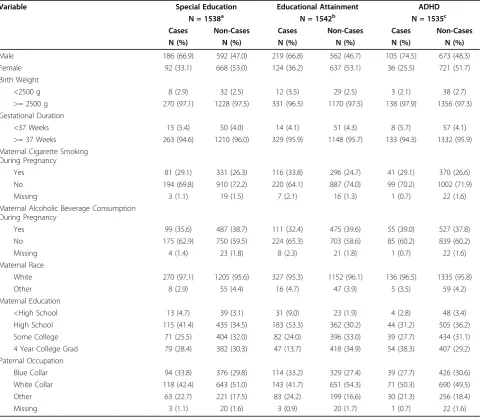
The third outcome measure was highest level of educa-tional attainment. Educaeduca-tional attainment is influenced by a number of factors related to learning and develop-mental disability, including low academic achievement, behavior problems, absenteeism, grade retention, and low parental educational expectations [45,46]. Although edu-cational attainment is not a direct measure of learning or developmental disorder, the two outcomes are highly correlated [47,48]. Educational attainment data were divided into two categories: (1) completing high school or less education and (2) education beyond high school. Table 1 Selected characteristics of case and non-case children.
Variable Special Education Educational Attainment ADHD
N = 1538a N = 1542b N = 1535c
Cases Non-Cases Cases Non-Cases Cases Non-Cases
N (%) N (%) N (%) N (%) N (%) N (%)
Male 186 (66.9) 592 (47.0) 219 (66.8) 562 (46.7) 105 (74.5) 673 (48.3)
Female 92 (33.1) 668 (53.0) 124 (36.2) 637 (53.1) 36 (25.5) 721 (51.7)
Birth Weight
<2500 g 8 (2.9) 32 (2.5) 12 (3.5) 29 (2.5) 3 (2.1) 38 (2.7)
>= 2500 g 270 (97.1) 1228 (97.5) 331 (96.5) 1170 (97.5) 138 (97.9) 1356 (97.3)
Gestational Duration
<37 Weeks 15 (5.4) 50 (4.0) 14 (4.1) 51 (4.3) 8 (5.7) 57 (4.1)
>= 37 Weeks 263 (94.6) 1210 (96.0) 329 (95.9) 1148 (95.7) 133 (94.3) 1332 (95.9)
Maternal Cigarette Smoking During Pregnancy
Yes 81 (29.1) 331 (26.3) 116 (33.8) 296 (24.7) 41 (29.1) 370 (26.6)
No 194 (69.8) 910 (72.2) 220 (64.1) 887 (74.0) 99 (70.2) 1002 (71.9)
Missing 3 (1.1) 19 (1.5) 7 (2.1) 16 (1.3) 1 (0.7) 22 (1.6)
Maternal Alcoholic Beverage Consumption During Pregnancy
Yes 99 (35.6) 487 (38.7) 111 (32.4) 475 (39.6) 55 (39.0) 527 (37.8)
No 175 (62.9) 750 (59.5) 224 (65.3) 703 (58.6) 85 (60.2) 839 (60.2)
Missing 4 (1.4) 23 (1.8) 8 (2.3) 21 (1.8) 1 (0.7) 22 (1.6)
Maternal Race
White 270 (97.1) 1205 (95.6) 327 (95.3) 1152 (96.1) 136 (96.5) 1335 (95.8)
Other 8 (2.9) 55 (4.4) 16 (4.7) 47 (3.9) 5 (3.5) 59 (4.2)
Maternal Education
<High School 13 (4.7) 39 (3.1) 31 (9.0) 23 (1.9) 4 (2.8) 48 (3.4)
High School 115 (41.4) 435 (34.5) 183 (53.3) 362 (30.2) 44 (31.2) 505 (36.2)
Some College 71 (25.5) 404 (32.0) 82 (24.0) 396 (33.0) 39 (27.7) 434 (31.1)
4 Year College Grad 79 (28.4) 382 (30.3) 47 (13.7) 418 (34.9) 54 (38.3) 407 (29.2)
Paternal Occupation
Blue Collar 94 (33.8) 376 (29.8) 114 (33.2) 329 (27.4) 39 (27.7) 426 (30.6)
White Collar 118 (42.4) 643 (51.0) 143 (41.7) 651 (54.3) 71 (50.3) 690 (49.5)
Other 63 (22.7) 221 (17.5) 83 (24.2) 199 (16.6) 30 (21.3) 256 (18.4)
Missing 3 (1.1) 20 (1.6) 3 (0.9) 20 (1.7) 1 (0.7) 22 (1.6)
a
Missing special education information N = 36.
b
Missing educational attainment information N = 32.
c
Residential History Data
Mothers were asked to provide a residential history from before the birth of the child to age 18 years. All eligible addresses in the study area were geocoded using GIS and each residence was assigned corresponding lati-tude and longilati-tude coordinates. The residential history was used to examine location at different developmental stages. To reflect exposures during the prenatal period, analyses were based on the residential location at birth. As early childhood chemical exposures are also thought to impact LDD risk, we conducted a second set of ana-lyses including the residence from birth through age five years. Multiple residences for the same individual, how-ever, may generate an artificial spatial cluster caused by a single case moving within a small area. To avoid potential bias due to the inclusion of multiple residences for the same individual, we used the address with the longest duration of residence from birth to age 5 years [36].
Statistical Analyses
The log odds of each indicator of learning and devel-opmental disability were estimated using generalized additive models, an extension of linear models that can incorporate both nonparametric and parametric model components and can be used to analyze binary out-come data [49]. For non-parametric model compo-nents, GAMs replace the beta coefficients of an ordinary logistic regression with a smooth term. In these analyses, a bivariate smooth was applied to lati-tude and longilati-tude coordinates representing geo-graphic location. Covariates were modeled as parametric terms.
A locally weighted regression smoother (loess), which adapts to differences in population density across the study area was used. The circular region or neighbor-hood from which data are drawn to predict the smooth is based on the percentage of data points in the neigh-borhood (with weighting based on distance from the center) and is referred to as the span size. Choice of span size produces a trade off between bias and variabil-ity. A large span size results in a smoother surface with low variability, but increased bias. Conversely, choosing a small span size results in high variability and compara-tively low bias. To determine the optimal amount of smoothing in each analysis, Akaike’s Information Criter-ion (AIC) was minimized [49].
A rectangular grid covering the study area was gener-ated using the minimum and maximum latitude and longitude coordinates of study participant residences (approximate grid cell size 0.1 km2). Using GIS, a map of the study area was used to clip out points where par-ticipants could not live, such as water bodies or conser-vation land. At each grid point within the study area, an
odds ratio (OR) was calculated using the entire study area as the referent group; the odds at each point was divided by the odds from a reduced model which omitted the latitude and longitude smooth term. Odds ratios were mapped using a continuous color scale (dark blue to dark red). A constant scale range was used for all maps of a particular outcome.
For each outcome, the null hypothesis that learning and developmental disability risk does not depend on location (e.g. the map surface is a horizontal plane) was tested. Locations of individuals were permuted 999 times while preserving their outcome status and covari-ates. For each permutation, the GAM with the optimal span size from the original dataset was run and the deviance statistic computed. If this global statistic indi-cated that location was statistically significant at p-value < 0.05, point-wise departures from the null hypothesis were evaluated using the distribution of the log odds at each point from the same set of permutations used to calculate the global statistic. Areas with significantly increased and decreased log odds were defined to include all observed points ranking in the upper and lower 2.5% of the point-wise distribution respectively.
A detailed discussion of the statistical methods of mapping population-based case control data using GAMs is provided by Webster and colleagues [37]. Sta-tistical analyses were performed in S-Plus using thegam package and a local scoring algorithm GAM estimation procedure [49,50]. All maps were created using ArcGIS 9.2 [51].
Potential confounders were assessed based on the a
Results
Special Education Services
Of the 1,484 children with complete outcome and cov-ariate data, 270 (18.2%) received special education ser-vices. In adjusted models, children receiving special education services were more likely to be male (OR = 2.24; 95% CI 1.71-2.96) and from lower SES families (highest maternal educational attainment compared to lowest OR = 0.79; 95% CI 0.54-1.15). For analyses using either the birth address or early childhood address the optimal span size was 0.95 (Table 2). Maps produced from both sets of analyses were similar. We show results of the adjusted birth address analysis in Figure 2. Each map showed an area of increased risk of needing special education services in the northern area of the town of Bourne but the difference was not statistically significant (birth address p-value = 0.57; early childhood p-value = 0.38). Maps with and without adjustment were similar indicating that spatial confounding was not an issue (data not shown).
ADHD
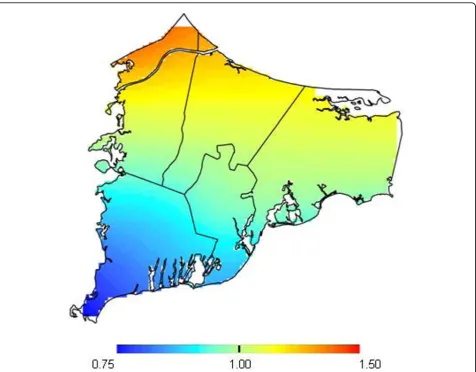
The reported prevalence of ADHD in the study popula-tion was 9.4% (139 cases; 1340 non-cases; Table 3), con-sistent with other United States population estimates during the same time period [40]. As maps of ADHD were similar using birth address and early childhood address, the former is shown (Figure 3). The risk of ADHD appears slightly elevated in the northern region of upper Cape Cod, but the difference was not statisti-cally significant (optimal span size = 0.95; p-value = 0.33). Adjusting for potential spatial confounders made no appreciable difference in the map of ADHD risk, suggesting that spatial confounding was not an issue (data not shown).
Educational Attainment
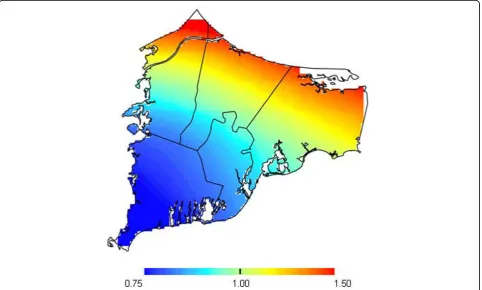
Mothers reported that 22.3% of their children did not receive education beyond high school (Table 4). Boys were more likely to have low educational attainment (OR = 2.18; 95% CI 1.66-2.87) as were children from lower SES families (father employed in blue collar verse white collar occupations OR = 1.64; 95% CI 1.20-2.26). Using early childhood address, the adjusted analysis for the risk of low educational attainment appeared elevated in areas of Bourne and Mashpee (optimal span size = 0.60, p-value = 0.22; Table 4; Figure 4). The pattern of the risk surface was very similar using the birth address when the same span size was used for both analyses (not shown). Changes in the span size between the crude and adjusted models (optimal span sizes of 0.15 and 0.60 respectively) were primarily due to confound-ing by SES variables (mother’s educational attainment).
Discussion
The risk of two indicators of learning and developmen-tal disorders–special education placement and ADHD– was elevated in the Bourne and Falmouth areas of upper Cape Cod; however, the variability was not statistically significant (alpha = 0.05). The risk of low educational attainment was elevated in portions of Mashpee and Bourne, but not statistically significant. Spatial variability of the outcomes was evaluated using two periods of resi-dence, reflecting prenatal residence and early childhood residences (before age 5 years). The similarity of the results–when evaluated using the same span size–was likely related to residential stability; less than one third of subjects moved during this period. Consequently, each analysis was based on many of the same addresses.
The spatial investigation approach used in this study has a number of strengths. Unlike previous spatial ana-lyses of LDD, it was possible to use point-based data and avoid potential biases due to data aggregation within arbitrary political boundaries [35]. Additionally, it was possible to adjust for numerous covariates to assess potential spatial confounding. While it is often assumed that spatial confounding produces disease clusters, adjusting for covariates in these analyses made little dif-ference in maps which we attribute to the relative homogeneity of the upper Cape Cod study population. Lastly, using residential history data enabled the exami-nation of LDD risk during the prenatal and early child-hood periods which are likely more relevant to the etiology of learning and development disorder risk than exposures associated with the address at diagnosis.
This investigation also has several limitations. Indica-tors of learning and developmental disability were obtained through maternal report. However, Faraone and colleagues found that maternal report of ADHD in particular was highly reliable (sensitivity and specificity, Table 2 Summary of special education services models
(270 Cases, 1214 Non-Cases).
Analysis Spana Deviance
p-valueb Figure Number
Adjustedc Birth Residence
0.95 0.57 2
Crude Birth Residence
0.95 0.30 —
Adjustedc
Early Childhood Residence
0.95 0.38 —
Crude
Early Childhood Residence
0.95 0.22 —
a
Optimal span obtained by using the Akaike’Information Criterion (AIC).
b
Null hypothesis is that the map is flat.
c
95 and 97% respectively) [52]. In this cohort, 48 mothers (18% of cases) reported that their child was placed in special education but did not report that their child had an IEP. Because special education placement indicates more severe dysfunction, it is possible that mothers were more likely to remember special education class placement than the presence of an IEP. To reduce the misclassification of individuals with more severe dys-function as non-cases by defining special education ser-vices by an IEP, all children whose mothers reported their child received any form of special education ser-vices were included as cases. Results were similar when we defined special education placement by the report of an IEP (data not shown).
We examined indicators of learning and developmen-tal disability that were readily collected using a retro-spective study design. However, these indicators are not sensitive enough to identify geographic areas where indi-viduals experience more subtle dysfunction. ADHD, for
example, is diagnosed using the number of symptoms and behaviors. A continuous outcome based on the number and severity of symptoms might have identified regions in upper Cape Cod where subclinical symptoms are elevated, even when a significant increase in ADHD diagnosis is not observed.
Residential history data allowed us to take into account location during different periods of develop-ment for individuals. Unfortunately, there were too few cases to perform more data-intensive space-time ana-lyses as we have done previously with breast cancer in Cape Cod [53]. When possible, consideration of both location and time of exposure may generate hypotheses on short term environmental exposures.
The optimal tradeoff between bias and variance of the smooth (e.g. the optimal span size) was determined by minimizing the AIC. Selecting the optimal span for a given dataset, however, may obscure important map fea-tures at smaller scales. Examining different span sizes
may reveal important features of the data. Similarly, p-values were used to evaluate global spatial variation as well as local areas of increased or decreased risk. Confi-dence intervals might be considered more informative, but the information is difficult to show graphically for surfaces. Permutation tests were conducted using the optimal span size of the observed data. Although the optimal span size was generally large for these data,
permuted datasets may have had a larger optimal span size under the null hypothesis that the map is flat. The effect of using the optimal span of the observed data for permuted data could result in a p-value that is too small. This is a topic of future research.
Although results were not statistically significant, spa-tial variation was suggested in the study area. If real, there may be several possible explanations, including residual confounding at the individual level by unmea-sured variables, as well as differences in the social and physical environment. Although the pattern of risk was similar for ADHD and special education placement, maps of the risk of low educational attainment displayed a different pattern. Educational attainment may be a less specific indicator of an LDD than the other outcomes considered, which were based on maternal report of an outcome that required evaluation by school or health care professionals. Differences in the pattern of risk between the outcomes may also be related to differences in educational resources or other school-related factors. There were no school-based data available to test this hypothesis. In upper Cape Cod, town boundaries approximate public school district boundaries. If varia-bility was due solely to school district related factors we would not have expected odds estimates to vary within
Figure 3ADHD results for birth address. Fully adjusted model. The optimal span is 0.95. The map was not significantly different from flat (p = 0.33).
Table 3 Summary of ADHD models (139 Cases, 1340 Non-Cases).
Analysis Spana Deviance
p-valueb Figure Number
Adjustedc
Birth Residence
0.95 0.33 3
Crude Birth Residence
0.95 0.17 —
Adjustedc
Early Childhood Residence
0.95 0.35 —
Crude
Early Childhood Residence
0.95 0.32 —
a
Optimal span obtained by using the Akaike’Information Criterion (AIC).
b
Null hypothesis is that the map is flat.
c
towns. There may be other group-level variables of importance. Statistical methods are needed for com-bined spatial and multilevel analyses; we are currently working on this problem. The suggestive spatial varia-tion in LDDs could also be related to environmental exposure. In the northern part of the study area, several hazardous waste sites as well as a power plant were identified in previous health studies [54]. As data on
environmental exposures from these or other sources in the area were not available, further assessment of expo-sure may be warranted.
Conclusions
These exploratory analyses produced maps of the risk of three indicators of LDD–special education placement, ADHD, and low educational attainment–in upper Cape Cod using GAMs and GIS. Results suggest that children living in certain parts of upper Cape Cod may have been more likely to have an LDD. The addresses used (birth addresses or childhood addresses) did not affect the spatial distribution of observed odds. Adjustment for known risk factors had little effect. Observed variation, although not statistically significant, may be due to local differences in the social or physical environment.
List of Abbreviations
(AIC): Akaike’s Information Criterion; (ADD): attention deficit disorder; (ADHD): attention deficit hyperactivity disorder; (DSM): Diagnostic Statistical Manual; (GAMs): generalized additive models; (GIS): geographical infor-mation systems; (HD): hyperactive disorder; (IEP): indi-vidualized education plan; (LDD): learning and developmental disability; (loess): locally weighted
Figure 4Educational attainment results for early childhood addresses. Fully adjusted model, optimal 0.60 span. The map was not significantly different from flat (p = 0.22).
Table 4 Summary of educational attainment models (331 Cases, 1155 Non-Cases).
Analysis Spana Deviance
p-valueb Figure Number
Adjustedc
Birth Residence
0.95 0.89 —
Crude Birth Residence
0.20 0.002 —
Adjustedc
Early Childhood Residence
0.60 0.22 4
Crude
Early Childhood Residence
0.15 <0.001 —
a
Optimal span obtained by using the Akaike’Information Criterion (AIC).
b
Null hypothesis is that the map is flat.
c
regression smoother; (OR): odds ratio; (PCBs): poly-chlorinated biphenyls; (PCE): tetrachloroethylene.
Acknowledgements
This work was supported by the Boston University Center for
Interdisciplinary Research in Environmental Exposures and Health and by grant P42ES007381 from the National Institute of Environmental Health (NIEHS), National Institutes of Health (NIH). The contents are solely the responsibility of the authors and do not necessarily represent the official views of NIEHS, NIH.
Author details
1Department of Environmental Health, Boston University School of Public
Health, Boston, USA.2Department of Biostatistics, Boston University School of
Public Health, Boston, USA.3Department of Epidemiology, Boston University
School of Public Health, Boston, USA.
Authors’contributions
KH conducted spatial analyses and drafted the manuscript. TW collaborated on all analytic and editorial decisions. JW provided statistical support and consulted on analytic and editorial issues. AA provided the data and assisted in the epidemiologic analysis and editing. PJ and RW provided guidance relevant to the epidemiologic investigation of learning and development disabilities and edited the manuscript. VV collaborated on all analytic and editorial decisions and provided support for spatial analyses. All authors have read and approved the final manuscript.
Competing interests
The authors declare that they have no competing interests.
Received: 2 November 2009
Accepted: 12 February 2010 Published: 12 February 2010
References
1. Lyon GR:Learning disabilities.Future Child1996,6:54-76.
2. Perrin JM, Bloom SR, Gortmaker SL:The increase of childhood chronic conditions in the United States.Jama2007,297:2755-2759.
3. Boyle CA, Decoufle P, Yeargin-Allsopp M:Prevalence and health impact of developmental disabilities in US children.Pediatrics1994,93:399-403. 4. Braun JM, Kahn RS, Froehlich T, Auinger P, Lanphear BP:Exposures to environmental toxicants and attention deficit hyperactivity disorder in U.S. children.Environ Health Perspect2006,114:1904-1909.
5. Landrigan PJ, Schechter CB, Lipton JM, Fahs MC, Schwartz J:Environmental pollutants and disease in American children: estimates of morbidity, mortality, and costs for lead poisoning, asthma, cancer, and developmental disabilities.Environ Health Perspect2002,110:721-728. 6. Duncan GJ, Brooks-Gunn J, Klebanov PK:Economic deprivation and early
childhood development.Child Dev1994,65:296-318.
7. Biederman J, Faraone SV:Attention-deficit hyperactivity disorder.Lancet
2005,366:237-248.
8. Chapman DA, Scott KG, Mason CA:Early risk factors for mental retardation: role of maternal age and maternal education.Am J Ment Retard2002,107:46-59.
9. Cherkes-Julkowski M:Learning disability, attention-deficit disorder, and language impairment as outcomes of prematurity: a longitudinal descriptive study.J Learn Disabil1998,31:294-306.
10. Resnick MB, Gueorguieva RV, Carter RL, Ariet M, Sun Y, Roth J, Bucciarelli RL, Curran JS, Mahan CS:The impact of low birth weight, perinatal conditions, and sociodemographic factors on educational outcome in kindergarten.Pediatrics1999,104:e74.
11. Swanson HL, Harris KR, Graham S:Handbook of learning disabilitiesNew York: Guilford Press 2003.
12. Landrigan PJ, Carlson JE, Bearer CF, Cranmer JS, Bullard RD, Etzel RA, Groopman J, McLachlan JA, Perera FP, Reigart JR, Robison L, Schell L, Suk WA:Children’s health and the environment: a new agenda for prevention research.Environ Health Perspect1998,106(Suppl 3):787-794. 13. Landrigan PJ, Claudio L, Markowitz SB, Berkowitz GS, Brenner BL, Romero H,
Wetmur JG, Matte TD, Gore AC, Godbold JH, Wolff MS:Pesticides and
inner-city children: exposures, risks, and prevention.Environ Health Perspect1999,107(Suppl 3):431-437.
14. Preston BL, Warren RC, Wooten SM, Gragg RD, Walker B:Environmental health and antisocial behavior: implications for public policy.J Environ Health2001,63:9-19.
15. Schneider D, Freeman N:Children’s environmental health risks: a state-of-the-art conference.Arch Environ Health2001,56:103-110.
16. Rice D, Barone S Jr:Critical periods of vulnerability for the developing nervous system: evidence from humans and animal models.Environ Health Perspect2000,108(Suppl 3):511-533.
17. Bellinger DC:Interpreting the literature on lead and child development: the neglected role of the“experimental system”.Neurotoxicol Teratol
1995,17:201-212.
18. Cheuk DK, Wong V:Attention-deficit hyperactivity disorder and blood mercury level: a case-control study in chinese children.Neuropediatrics
2006,37:234-240.
19. Fergusson DM, Fergusson JE, Horwood LJ, Kinzett NG:A longitudinal study of dentine lead levels, intelligence, school performance and behaviour. Part III. Dentine lead levels and attention/activity.J Child Psychol Psychiatry1988,29:811-824.
20. Grandjean P, Landrigan PJ:Developmental neurotoxicity of industrial chemicals.Lancet2006,368:2167-2178.
21. Grandjean P, White RF, Nielsen A, Cleary D, de Oliveira Santos EC: Methylmercury neurotoxicity in Amazonian children downstream from gold mining.Environ Health Perspect1999,107:587-591.
22. Huisman M, Koopman-Esseboom C, Fidler V, Hadders-Algra M, Paauw van der CG, Tuinstra LG, Weisglas-Kuperus N, Sauer PJ, Touwen BC, Boersma ER: Perinatal exposure to polychlorinated biphenyls and dioxins and its effect on neonatal neurological development.Early Hum Dev1995, 41:111-127.
23. Huisman M, Koopman-Esseboom C, Lanting CI, Paauw van der CG, Tuinstra LG, Fidler V, Weisglas-Kuperus N, Sauer PJ, Boersma ER, Touwen BC: Neurological condition in 18-month-old children perinatally exposed to polychlorinated biphenyls and dioxins.Early Hum Dev1995,43:165-176. 24. Jacobson JL, Jacobson SW:Intellectual impairment in children exposed to
polychlorinated biphenyls in utero.N Engl J Med1996,335:783-789. 25. Jacobson JL, Jacobson SW:Teratogen update: polychlorinated biphenyls.
Teratology1997,55:338-347.
26. Lanphear BP, Hornung R, Khoury J, Yolton K, Baghurst P, Bellinger DC, Canfield RL, Dietrich KN, Bornschein R, Greene T, Rothenberg SJ, Needleman HL, Schnaas L, Wasserman G, Graziano J, Roberts R:Low-level environmental lead exposure and children’s intellectual function: an international pooled analysis.Environ Health Perspect2005,113:894-899. 27. Needleman HL, Bellinger D:The health effects of low level exposure to
lead.Annu Rev Public Health1991,12:111-140.
28. Needleman HL, Gunnoe C, Leviton A, Reed R, Peresie H, Maher C, Barrett P: Deficits in psychologic and classroom performance of children with elevated dentine lead levels.N Engl J Med1979,300:689-695. 29. Rice DC:Neurotoxicity of lead, methylmercury, and PCBs in relation to
the Great Lakes.Environ Health Perspect1995,103(Suppl 9):71-87. 30. Rice DC:Behavioral effects of lead: commonalities between experimental
and epidemiologic data.Environ Health Perspect1996,104(Suppl 2):337-351.
31. Dahlgren J, Warshaw R, Thornton J, Anderson-Mahoney CP, Takhar H: Health effects on nearby residents of a wood treatment plant.Environ Res2003,92:92-98.
32. Dayal H, Gupta S, Trieff N, Maierson D, Reich D:Symptom clusters in a community with chronic exposure to chemicals in two superfund sites.
Arch Environ Health1995,50:108-111.
33. Kilburn KH:Neurotoxicity from airborne chemicals around a superfund site.Environ Res1999,81:92-99.
34. Wartenberg D:Investigating disease clusters: why, when and how?.J R Statist Soc A2001,164:13-22.
35. Margai F, Henry N:A community-based assessment of learning disabilities using environmental and contextual risk factors.Soc Sci Med
2003,56:1073-1085.
37. Webster T, Vieira V, Weinberg J, Aschengrau A:Method for mapping population-based case-control studies: an application using generalized additive models.Int J Health Geogr2006,5:26.
38. Janulewicz PA, White RF, Winter MR, Weinberg JM, Gallagher LE, Vieira V, Webster TF, Aschengrau A:Risk of learning and behavioral disorders following prenatal and early postnatal exposure to tetrachloroethylene (PCE)-contaminated drinking water.Neurotoxicol Teratol2008,30:175-185. 39. MacMillan DL, Gresham FM, Bocian KM:Discrepancy between definitions of learning disabilities and school practices: an empirical investigation.J Learn Disabil1998,31:314-326.
40. Faraone SV, Sergeant J, Gillberg C, Biederman J:The worldwide prevalence of ADHD: is it an American condition?.World Psychiatry2003,2:104-113. 41. Rowland AS, Lesesne CA, Abramowitz AJ:The epidemiology of
attention-deficit/hyperactivity disorder (ADHD): a public health view.Ment Retard Dev Disabil Res Rev2002,8:162-170.
42. American Psychiatric Association:Diagnostic criteria from DSM-III-R
Washington, DC: American Psychiatric Association 1987. 43. American Psychiatric Association:Diagnostic criteria from DSM-IV
Washington, D.C.: American Psychiatric Association 1994. 44. Shaw P, Eckstrand K, Sharp W, Blumenthal J, Lerch JP, Greenstein D,
Clasen L, Evans A, Giedd J, Rapoport JL:Attention-deficit/hyperactivity disorder is characterized by a delay in cortical maturation.Proc Natl Acad Sci USA2007,104:19649-19654.
45. Cairns RB, Cairns BD, Neckerman HJ:Early school dropout: configurations and determinants.Child Dev1989,60:1437-1452.
46. Kortering L, Haring N, Klockars A:The identification of high-school dropouts identified as learning disabled: evaluating the utility of a discriminant analysis function.Except Child1992,58:422-435. 47. Kemp SE:Dropout policies and trends for students with and without
disabilities.Adolescence2006,41:235-250.
48. United States Department of Education:A new era: revitalizing special education for children and their families.President’s Commission on Excellence in Special Education. Washington, D.C2002.
49. Hastie T, Tibshirani R:Generalized additive modelsLondon; New York: Chapman and Hall, 1 1990.
50. Insightful:S-Plus.http://spotfire.tibco.com/Products/SPLUS-Client.aspx. 51. ESRI:ArcMap.http://www.esri.com/software/arcgis/index.html.
52. Faraone SV, Biederman J, Milberger S:How reliable are maternal reports of their children’s psychopathology? One-year recall of psychiatric diagnoses of ADHD children.J Am Acad Child Adolesc Psychiatry1995, 34:1001-1008.
53. Vieira V, Webster T, Weinberg J, Aschengrau A:Spatial-temporal analysis of breast cancer in upper Cape Cod, Massachusetts.Int J Health Geo2008, 7:46.
54. Aschengrau A, Ozonoff D:Upper Cape Cancer Incidence Study. Final Report.Boston: Massachusetts Department of Public Health 1991.
doi:10.1186/1476-072X-9-7
Cite this article as:Hoffmanet al.:Spatial analysis of learning and developmental disorders in upper Cape Cod, Massachusetts using generalized additive models.International Journal of Health Geographics 20109:7.
Submit your next manuscript to BioMed Central and take full advantage of:
• Convenient online submission
• Thorough peer review
• No space constraints or color figure charges
• Immediate publication on acceptance
• Inclusion in PubMed, CAS, Scopus and Google Scholar
• Research which is freely available for redistribution