O R I G I N A L A R T I C L E
Open Access
Acquisition of permanent residence by
temporary foreign workers in Canada: a
panel study of labour market outcomes
before and after the status transition
Wen Ci
*, Feng Hou and René Morissette
* Correspondence: [email protected] Social Analysis and Modelling Division, Statistics Canada, 100 Tunney’s Pasture Driveway, Ottawa, ON, Canada
Abstract
Using a unique administrative dataset, this study investigates the employment and earnings trajectories of temporary foreign workers (TFWs) during the years surrounding their acquisition of permanent residence in Canada. If the labour market assimilation of TFWs follows a smooth trajectory in the absence of acquisition of permanent residence, any kinks that occur in employment rates and earnings in or after the year when TFWs become permanent residents might plausibly result from the transition to permanent residence. The main finding of the study is that the labour market outcomes of different groups of TFWs in Canada follow different temporal patterns depending on the TFWs’ skill level and work permit type. Gains in labour market outcomes resulting from the acquisition of permanent residence appear to be greater for holders of an open work permit and for live-in caregivers than for highly skilled TFWs.
Keywords:Temporary foreign workers, Status transition, Employment, Earnings,
Administrative dataset
JEL Classification:J15
1 Introduction
International migration has become increasingly diverse (Vertovec 2007). One major source of diversification is the differentiation of migrant types, such as undocumented migrants versus legal migrants, temporary foreign workers (TFWs) versus permanent residents, international students versus migrant workers, and refugees versus economic immigrants (Meissner and Vertovec 2015). Furthermore, international migrants may switch from one type to another. Since different migration types entail different rights and opportunities in the host country, transitions in status may lead to significant changes in the economic behaviours and outcomes of migrants.
Many previous studies have investigated the effects of two important transitions: naturalization (i.e. the immigrant-to-citizen transition) and legalization. Bratsberg et al. (2002) show that naturalization leads to an acceleration of earnings growth for young male immigrants in the USA. They argue that naturalization boosts wage growth by re-moving employment barriers (access to public sector jobs, union jobs, and white-collar
© The Author(s). 2018Open AccessThis article is distributed under the terms of the Creative Commons Attribution 4.0 International
jobs) and signalling employment stability to employers. In addition, it is possible that immi-grants who naturalize will invest heavily in human capital specific to the host country that will in turn lead to earnings growth. Similar results are found in other European and North Ameri-can studies (DeVoretz and Pivnenko 2005; Fougère and Safi 2009; Zhou and Lee 2013; Ivļevs and King 2012; Steinhardt 2012). In contrast, Bratsberg and Raaum (2011) find no positive impact—and even a negative impact—of citizenship on the labour market outcomes of immi-grants in Norway. Differences in the labour market structure between the USA and Norway and the high temporary absence rate from the host country among immigrants who have become citizens in Norway are provided as potential explanations for the negative results.
Other studies have examined the legalization of previously irregular immigrants in the USA during the mid-1980s. The 1986 Immigration Reform and Control Act granted amnesty to irregular immigrants in the USA and thus provides a natural experiment that has been widely used by researchers to examine the impact of legalization on the labour market outcomes of immigrants. While most studies conclude that legalization led to higher earnings (Steigleder and Sparber 2015; Lozano and Sorensen 2011; Amuedo-Dorantes and Bansak 2011; Kossoudji and Cobb-Clark 2002; Sisk 2012; Hotchkiss and Quispe-Agnoli 2009; Barcellos 2010; Borjas and Tienda 1993), a few studies find no effect (Lofstrom et al. 2010; Orrenius and Zavodny 2006). The benefits of legalization include greater employment opportunities, higher occupational mobility, and, consequently, greater bargaining power and higher wages. However, legalization may also lead to lower employment probabilities. One reason is that the acquisition of legal status provides greater access to unemployment insurance and other social programmes. This in turn may increase the reservation wages of people who were previously working illegally, thereby inducing them to refuse jobs that they would have otherwise accepted (Amuedo-Dorantes and Bansak 2011; Barcellos 2010).
In contrast to the strong attention given to the effects of naturalization and legalization, few studies have examined the transition of TFWs to permanent residence. Many Western, developed countries rely on TFWs to introduce new skills into the economy and to fill local or occupational skill shortages. While receiving countries often have rigid regulations to guard against and constrain TFWs’transition from tempor-ary status to permanent residence, some also actively choose permanent residents from among TFWs (Howe and Owens 2016). For example, in the early 2010s, Australia selected 60% of skilled immigrants from among previously employer-sponsored TFWs or former international students who found work after graduating from Australian educa-tional institutions (Gregory 2014). In the USA, many high-skilled economic immigrants were initially employed on temporary work visas and were subsequently sponsored by their employers for permanent residence (Hao 2013; Lowell and Avato 2014). In Canada, about 17% of TFWs who arrived during the 2000s became permanent residents within 5 years of obtaining their initial work permits (Lu and Hou 2017).
every employer may follow the regulations strictly. It is reasonable to expect that the transition from legal temporary status to permanent residence may not bring as many added economic opportunities to TFWs as legalization does to undocumented migrants.
Conversely, the transition to permanent residence may open up relatively more economic opportunities to TFWs than naturalization does to permanent residents. Compared with permanent residents, many TFWs are allowed to work only for a specific employer or in a specific occupation. The restrictions on their job mobility and the presumed temporary nature of their employment may put them in an unfavourable position in wage bargaining. The removal of such job restrictions would provide former TFWs the possibility of “job shopping” in the broad labour market. Permanent resi-dence also gives potential employers the assurance that they would not lose employees for failing to renew their work permits. However, with permanent residence, holding a job is no longer a condition for being able to stay legally in the receiving country. Thus, some former TFWs may withdraw from the labour market to pursue further education, bear or rear children, or pursue other activities.
More importantly, TFWs are a highly heterogeneous group in terms of skills and restrictions on their work permits. For TFWs who have restricted work permits (i.e. who are tied to a specific employer), a transition to permanent residence widens the set of employers they can consider when searching for jobs and, thus, can increase opportunities for employment and earnings growth. Yet a transition to permanent residence may have little impact on the labour market outcomes of some other TFWs. In particular, highly skilled TFWs employed in high-paying firms may have relatively flat employment and earnings trajectories in the years surrounding their transition to permanent residence simply because they were well paid prior to the transition. Hence, whether the labour market outcomes of TFWs in Canada change substantially or not after they acquire permanent residence is an empirical question. To the knowledge of the authors, this question has remained unanswered to date.
The goal of this study is to fill this gap. Using the newly developed Temporary Residents (TR) file linked with the Immigrant Landing file (ILF) and the Canadian Employer-Employee Dynamics Database (CEEDD) from Statistics Canada, this paper investigates how TFWs in Canada fare before and after acquiring permanent residence. The study proposes several hypotheses regarding the consequences of permanent residence for employment and earnings trajectories. Each of these hypotheses is tested using regression models that control for the time-invariant unobserved heterogeneity of individuals.
for TFWs with open work permits. For other TFWs, there is generally no compelling evidence to support this view.
The paper is organized as follows. Section 2 presents the institutional background of the TFW programme in Canada and three hypotheses that are subsequently tested. Section 3 contains a discussion of the data sources and methods used. Section 4 presents descriptive evidence and regression results. Section 5 concludes the paper.1
2 Diversity among temporary foreign workers and possible differential effects of the transition to permanent residence
TFWs are an important source of labour supply in Canada. From 1995 to 2014, the number of valid work permit holders of foreign nationality present in Canada increased by 52,000, or 0.4% of Canada’s employed workforce, to 353,000, or 2% of the country’s employed workforce (CIC 2014). The Canadian TFW programme was initially designed to fill local labour shortages on a temporary basis. Over the years, the TFW programme has evolved to include individuals who hold different work permits characterized by diverse working conditions, and it is now organized into two distinct programmes: the International Mobility Program (IMP) and the Temporary Foreign Worker Program (TFWP). The TFWP refers to the streams that require a labour market opinion (LMO), renamed to a labour market impact assessment (LMIA) in 2014. The IMP comprises the streams in which foreign nationals are not subject to an LMIA.
For work permits that require an LMO from employers, the employers need to demonstrate that they could not find similar workers from the domestic labour market. In this case, TFWs are generally tied to one specific firm by a restricted work permit. In contrast, an LMO is not necessary for other types of work permits. Work permits without an LMO are designed for international agreements, for exceptional workers who can bring evident benefits to the Canadian labour market, for international students, for the spouses or common-law partners of TFWs, or for charitable and religious work purposes. Some of the TFWs who hold work permits that do not require an LMO are not attached to a specific firm and thus are allowed to work for any Canadian employer.2
For the empirical analysis in this study, TFW streams are divided into five broad groups according to general skill level and restrictiveness of work permits:
1. Skilled TFWs with an LMO (TFW-LMO) 2. Live-in Caregiver Program (LCP)
3. International agreements (IA)
4. Canadian interests and employment benefits (CI-EB) 5. Other Canadian interests (OCI)
Some skilled TFWs are required to have an LMO (i.e. employers need to demon-strate that they could not find similar workers from the domestic labour market). These high-skilled temporary workers are allocated to the group of TFWs with an LMO (TFW-LMO).3
allows participants to apply for permanent residence once they have worked as caregivers in their clients’home in Canada for 2 years.
TFWs in three groups (IA, CI-EB, and OCI) do not require an LMO. The OCI group includes individuals involved in reciprocal employment, spouses and common-law part-ners of applicants, international students, and other workers with no LMO. While workers in the OCI group generally hold an open permit, TFWs in the IA and CI-EB groups hold a restricted permit.
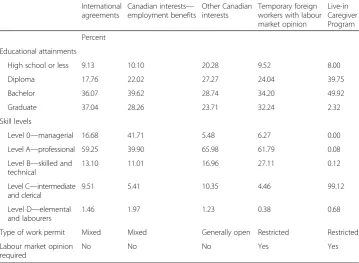
There are important education and skill differences across groups. Of all TFWs considered in this study,4 those in the IA group are the most highly educated: al-most three quarters of them have at least a bachelor’s degree (Table 1). At the other end of the spectrum, about one half of the OCI group and live-in caregivers have at least a bachelor’s degree. About four tenths of individuals in the CI-EB group work in managerial jobs, a proportion that exceeds by far those observed in the other groups. While no more than 40% of individuals in the CI-EB group work in jobs requiring professional skills, about 60% or more of individuals in the IA, OCI, and TFW-LMO groups do so. Almost all live-in caregivers work in jobs re-quiring intermediate and clerical skills (level C in Table 1).
In sum, the different TFW groups have different combinations of work permit types and skill levels: (1) the TFW-LMO group includes highly skilled workers with restricted work permits; (2) live-in caregivers are low-skilled workers with restricted work permits; (3) the OCI group generally includes holders of an open work permit with mixed education and skill levels; and (4) workers in the IA and CI-EB groups are highly skilled workers with work permits that are less restrictive
Table 1Selected characteristics of temporary foreign workers, by streams, 1996 to 2012
International agreements
Canadian interests— employment benefits
Other Canadian interests
Temporary foreign workers with labour market opinion
Live-in Caregiver Program Percent
Educational attainments
High school or less 9.13 10.10 20.28 9.52 8.00
Diploma 17.76 22.02 27.27 24.04 39.75
Bachelor 36.07 39.62 28.74 34.20 49.92
Graduate 37.04 28.26 23.71 32.24 2.32
Skill levels
Level 0—managerial 16.68 41.71 5.48 6.27 0.00
Level A—professional 59.25 39.90 65.98 61.79 0.08
Level B—skilled and technical
13.10 11.01 16.96 27.11 0.12
Level C—intermediate and clerical
9.51 5.41 10.35 4.46 99.12
Level D—elemental and labourers
1.46 1.97 1.23 0.38 0.68
Type of work permit Mixed Mixed Generally open Restricted Restricted
Labour market opinion required
No No No Yes Yes
than those in the TFW-LMO group and less open than those in the OCI group. As discussed below, the type of work permit and skill levels are likely two crucial factors in determining the labour market impact of the transition of TFWs to permanent residence.
2.1 Temporary foreign workers with restricted work permits
Some TFWs would not have entered the Canadian labour market without help from their employer in Canada. These individuals hold restricted work permits that tie them to a specific firm. Their transition to permanent residence may partly depend on a positive recommendation from their employer. This may lead some of their employers to offer them wages lower than the prevailing wages. For these reasons, it is conceivable that once these TFWs acquire permanent residence, some may search for jobs that pay higher wages and may experience greater earnings growth than before obtaining permanent residence.
While TFWs with restricted work permits may experience stronger earnings growth after obtaining permanent residence compared with the period before the transition, their employment rates may not necessarily increase. One reason is that the vast major-ity of them were already employed prior to the transition. If anything, permanent residence allows them to stay in the host country legally regardless of whether they are employed or not and thus enables them to pursue other activities, such as travelling and taking maternity or parental leave. It is also unclear whether their employment rates would fall, since gaining access to social benefits would not necessarily induce them to withdraw from the labour market.
The above discussion leads to the first hypothesis:
H1: In general, the acquisition of permanent residence by TFWs with restricted work permits will be associated with:
(a) No increase in employment rates (b)Stronger earnings growth
2.2 Highly skilled temporary foreign workers
Hypothesis H1 may not be relevant for all TFWs who are attached to a specific firm. As Table 1 shows, highly skilled TFWs in the TFW-LMO group are also at-tached to a specific employer. Yet their economic circumstances likely differ sub-stantially from those of low-skilled TFWs holding restricted work permits. Essentially, the strong demand that firms have for these workers likely increases their bargaining power and thus puts them in a relatively favourable position in terms of wages and working conditions.
that these workers will not switch firms in the middle of a project. For all these reasons, highly skilled TFWs are expected to receive relatively high wages and to be offered fairly good working conditions. A previous Canadian study shows that high-skilled temporary foreign workers earned two-and-half times that of immi-grants who were admitted directly from abroad in the first full year of arrival and their earnings advantages remained large even 15 years after arrival (Hou and Bonikowska 2016). This suggests that high-skill temporary foreign workers received high earnings upon their arrival because their skills match employers’ demand. As a result, their transition to permanent residence may have no impact on their em-ployment rate and their earnings.
However, skilled TFWs’stronger position in the labour market does not necessar-ily eliminate the disadvantage of not having an employment option outside their current employers. This may put downward pressure on their wages prior to attaining PR status. This suggests that in analyses of the outcomes of highly skilled TFWs, including those in the TFW-LMO, IA, and CI-EB streams, hypothesis H1 should be replaced by H2:
H2: For individuals in the TFW-LMO, IA, and CI-EB streams:
(a) The acquisition of permanent residence will be associated with no increase in employment rate.
(b)The effect of obtaining PR status on highly skilled TFWs’earnings is ambiguous: the acquisition of PR status may be associated with no additional increase in earnings if the employer’s monopsony effect is weak for these workers, or a significant increase in earnings if the job restriction reduces these workers’ wage bargaining power.
2.3 Other temporary foreign workers
Hypothesis H1 is relevant for TFWs whose work permits restrict them to specific employers, and hypothesis H2 is relevant for highly skilled TFWs with or without restricted work permits. Other TFWs hold an open work permit and thus face no constraints in their choice of employer. This is the case for TFWs in the OCI group. These individuals are not sought after by Canadian employers and have no prearranged jobs when they first arrive. They may have difficulty finding their first job in the Canadian labour market because of lower-than-average language profi-ciency, unrecognized credentials, or lack of Canadian work experience, among other factors. For these TFWs, the acquisition of permanent residence may signal to employers that they are strongly attached to the Canadian labour market. Also, workers with permanent residence could get access to additional employment opportunities that are available only to permanent residents or Canadian citizens (public sector jobs, white-collar jobs, or union jobs).
For these reasons, the employment rates and earnings of TFWs in the OCI group may rise after they become permanent residents, as described in the follow-ing hypothesis:
(a) Increased employment rates (b)Stronger earnings growth.
The arguments put forward in this section suggest that the changes in employment and earnings trajectories that TFWs may experience as they become permanent resi-dents will likely differ depending on the group they belong to. These hypotheses are tested in Section 4 using a unique Canadian dataset.
3 Data and methods
3.1 Data
The study uses administrative data from the TR file and the ILF linked with the CEEDD, developed at Statistics Canada.
The TR file contains individual-level information about all temporary residents who have arrived in Canada since 1980 with visitor, work, or study permits, or as inland refugee claimants. Variables such as permit category, entry date, country of birth, gender, and birth date are included.
The ILF contains the sociodemographic characteristics of immigrants measured at the time of landing. The linkage of the TR file and the ILF enables TFWs who became permanent residents to be identified.
Information about individuals’ employment and earnings is drawn from the CEEDD, a dataset that combines the annual T4 Statement of Remuneration Paid file, the T1 Personal Master File, and firm-level data from the Longitudinal Employment Analysis Program (LEAP). Observations in the T4 and T1 files are linked using social insurance numbers, while information from the LEAP is attached to individual-level records using the longitudinal Business Register identification number. The T4 file contains earnings reported by employers to the Canada Revenue Agency, and the T1 file includes the basic tax information and demographic characteristics of individuals who file taxes in a given year.
The sample consists of individuals who were aged 25 to 40 at arrival, who were iden-tified as a TFW at least once between 1996 and 2005, and who became permanent resi-dents at some point between 1997 and 2012. The age restrictions ensure that the selected individuals are at the prime working age over the observation period. TFWs are tracked for up to 5 years before their transition to permanent residence and up to 5 years after this transition.6Since the T4 and T1 files cover the 1997-to-2012 period, the selection of TFW cohorts from 1996 to 2005 guarantees that workers in the sample can be tracked for at least 7 years.
Two outcomes are considered: (1) being employed and (2) annual earnings. TFWs are defined as being employed if they earn at least $1000 (in 2012 dollars) in a given year, and as not employed otherwise. Annual earnings are defined as the sum of all paid employment income from the T1 file or the T4 file, other employment income, and self-employment income reported in the T1 file.
3.2 Methods
yit ¼γ0þX b
k¼a
γ1;kTRkitþZitβþδtYEARtþμiþεit; ð1Þ
where yit denotes the two outcomes identified above, namely a binary indicator that equals 1 if worker iearns at least $1000 in year tand 0 otherwise, and the natural log of earnings (for workers who earn at least $1000). In line with Bratsberg and Raaum (2011), Eq. (1) includes a vector of binary indicators, T Rk
it, that equals 1 if workeri be-comes a permanent residentkyears before yeart, 0 otherwise. The parametersaandb
are set to be −5 to−1 and 1 to 5, respectively, with the reference category being the year during which the permanent residence transition occurs. This set of binary indica-tors is very flexible since it does not impose any restrictions on the temporal patterns displayed by the labour market outcomes of TFWs during the 5 years before and after the permanent residence transition. YEARtrepresents a set of dummies for each year
over the study period (from 1998 to 2012). In employment models and earnings models, the vector Zincludes a binary indicator that equals 1 if workerihas been per-manently laid off in year t−1 and 0 otherwise, and the number of months enrolled full time in postsecondary educational institutions. Individual-specific fixed effects and year indicators are included in all models, thereby controlling for individual-specific factors that have a time-invariant influence onyitand for unmeasured factors that affect TFWs in an undifferentiated way. All regression analyses are conducted separately for men and women, as well as for different TFW streams.
It is worth noting that estimates ofγ{1,k}, the coefficients forT Rk
it, may capture both the impact of acquisition of permanent residence by TFWs and the impact of their growing work experience in the Canadian labour market. However, if the natural labour market assimilation process of TFWs follows a smooth trajectory in the absence of acquisition of permanent residence, any kinks that occur in or after the year when TFWs become permanent residents might plausibly result from the transition to permanent residence.
4 Results
4.1 Descriptive evidence
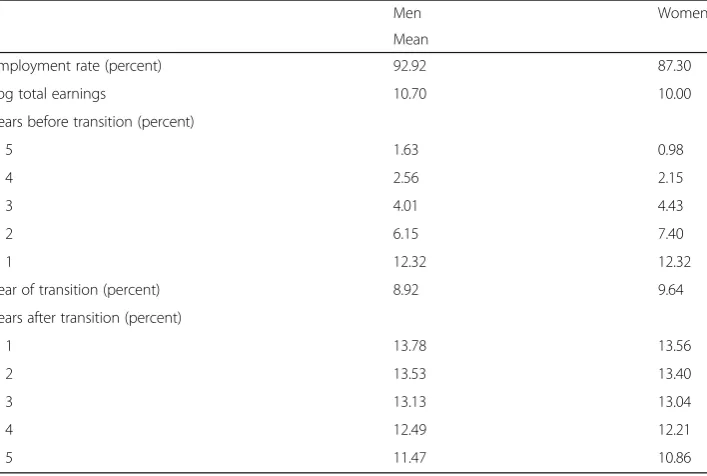
Table 2 shows descriptive statistics for the male and female TFWs considered in this study.7 The employment rates of male and female TFWs are 93 and 87%, re-spectively. Among TFWs who have earnings, men earn more annually than their female counterparts. For male and female TFWs, the sample used to analyse the likelihood of being employed contains more observations after the transition to permanent residence than before it, which highlights the unbalanced nature of the panel used for analysis.
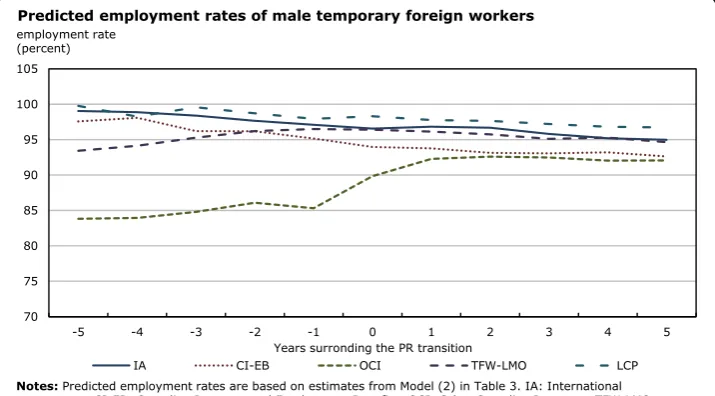
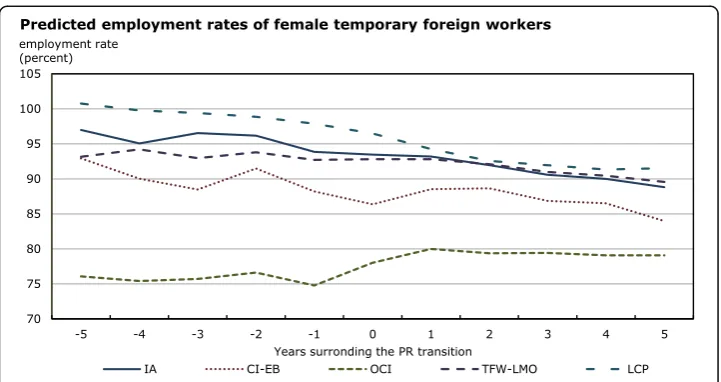
Figures 1 and 2 show how the employment rates of male and female TFWs evolve during the years surrounding the transition to permanent residence. The data support hypotheses H1a, H2a, and H3a. In line with these hypotheses, men and women in the LCP, IA, CI-EB, and TFW-LMO streams experience no increase in employment rates after the permanent residence transition, contrary to those in the OCI stream. Men and women in the OCI stream see their employment rates rise by about 5 percentage points between yeart−2 and yeart+ 1 (yeartreferring to the transition year).
In contrast, the earnings of different groups of TFWs do not diverge: either they are fairly constant or they grow over time (Figs. 3 and 4). Consistent with their overrepre-sentation in managerial positions (Table 1), men and women in the CI-EB group have the highest average earnings. Men and women in the LCP and OCI groups earn less than their counterparts in the three other groups, but their earnings grow at a faster pace. Related to hypothesis H2b, men and women in the TFW-LMO, IA, and CI-EB groups appear to experience no acceleration in earnings growth after becoming permanent residents. However, this is also the case for men and women in the two other groups, contrary to hypotheses H1b and H3b.
Table 2Descriptive statistics and sample distributions, by year of observation, 1996 to 2012
Men Women
Mean
Employment rate (percent) 92.92 87.30
Log total earnings 10.70 10.00
Years before transition (percent)
5 1.63 0.98
4 2.56 2.15
3 4.01 4.43
2 6.15 7.40
1 12.32 12.32
Year of transition (percent) 8.92 9.64
Years after transition (percent)
1 13.78 13.56
2 13.53 13.40
3 13.13 13.04
4 12.49 12.21
5 11.47 10.86
4.2 Regression results
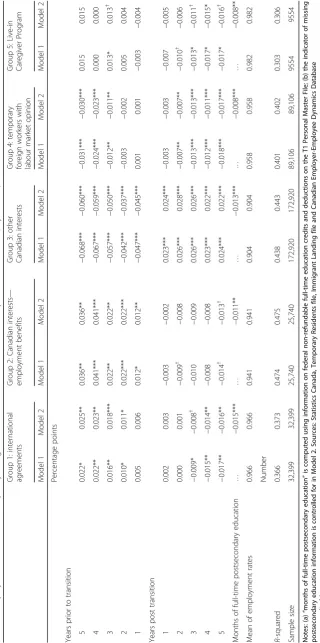
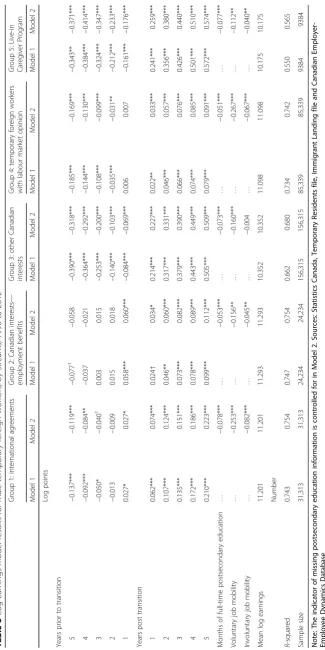
Tables 3 and 4 show how the likelihood of being employed varies for men and women, respectively, during the years surrounding the transition to permanent residence. Since attending school may affect the likelihood of being employed, results are shown with a control variable for the number of months individuals are enrolled full time in postsec-ondary educational institutions in year t (Model 2) and without this control variable (Model 1). As mentioned above, separate regressions are run for each of the five streams outlined in Section 2. For all groups of male and female TFWs, Model 2
Fig. 2Employment rates of female temporary foreign workers. Source: Statistics Canada, Temporary Residents file, Immigrant Landing file and Canadian Employer-Employee Dynamics Database
suggests that attending postsecondary educational institutions on a full-time basis for an additional month is associated with a decrease in the likelihood of being employed that varies between 0.8 and 1.5 percentage points.
A comparison of the T Rk
it estimates for yeart−1 and year t+ 1 indicates that for all TFWs, except those in the OCI group, the probability of being employed displays no sharp increase from year t−1 to year t+ 1. In contrast, men and women in the OCI group see their likelihood of being employed increase by about 7 percentage points and 5 percentage points, respectively, during this period. This can be seen, for instance, by
Fig. 4Average earnings of female temporary foreign workers. Sources: Statistics Canada, Temporary Residents file, Immigrant Landing file and Canadian Employer-Employee Dynamics Database
noting that when school attendance is controlled for, the T Rkit estimates for men increase from−0.045 in yeart−1 to 0.024 in yeart+ 1.8
Figures 5 and 6 plot the predicted employment rates of male and female TFWs resulting from Model 2.9 In line with hypotheses H1a and H2a, Figs. 5 and 6 confirm that men and women with restricted work permits (those in the LCP group) and highly skilled TFWs (those in the TFW-LMO, IA, and CI-EB groups) experience no increase in employment as they acquire permanent residence. However, consistent with hypothesis H3a, men and women in the OCI group see their predicted employment rates increase substantially in the year during which they obtain permanent residence. The kink displayed by employment rates around year t makes it unlikely that rates for this group are rising because of the gradual accumulation of labour market experience. It suggests instead that permanent residence causes an increase in the likelihood of being employed for men and women in this group.
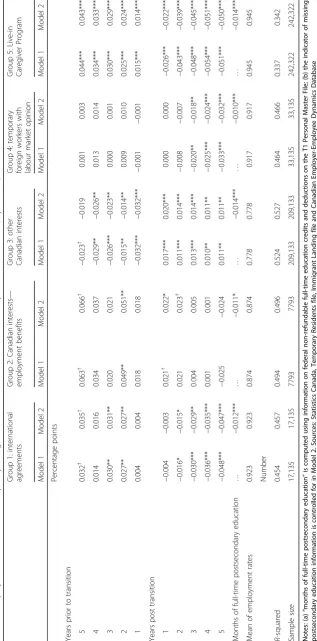
The transition to permanent residence is also associated with a substantial increase in earnings for the OCI group. This is in line with hypothesis H3b. Regardless of the models considered, the estimates of T Rk
it shown in Tables 5 and 6 indicate that the an-nual earnings of men and women in the OCI group increase by at least 0.25 log points (or roughly 25%) from yeart−1 to yeart+ 1. Male live-in caregivers—a relatively small group—are the only others who experience a larger relative increase in earnings during this period. The predicted earnings of men and women in the OCI group exhibit a kink from yeartto yeart+ 1, suggesting that their age–earnings profiles shift upwards as a re-sult of acquiring permanent residence (Figs. 7 and 8). Except for male live-in caregivers, no such upward shift in age–earnings profiles can be detected for other groups of male or female TFWs.10For highly skilled workers in the TFW-LMO, IA, and CI-EB groups, the absence of an upward shift in the age–earnings profile suggests that restriction to specific employers does not put these TFWs in a disadvantageous position. In addition, the
predicted age–earnings profiles shown in Figs. 7 and 8 strengthen the idea that the labour market outcomes of TFWs evolve in a differentiated way across streams.
5 Conclusions
The economic well-being of temporary foreign workers (TFWs) in Canada has attracted considerable attention in recent years. This is true especially for low-skilled TFWs who are attached to a specific employer because of a restricted work permit. Highly skilled TFWs, some of whom may also hold a restricted work permit, likely operate in a different economic environment. As a result of globalization, multinational firms in many devel-oped countries have lobbied governments to admit more of these high-skilled TFWs into the host country, arguing that these TFWs are necessary inputs to keep them competitive in the global market. Drawing on previous research, this study outlined three hypotheses regarding the labour market performance of five groups of TFWs during the years surrounding their transition to permanent residence. These hypotheses were tested using fixed-effects models and a large Canadian administrative dataset.
The main finding of this paper is that it is not appropriate to consider TFWs as a homogeneous group. The reason is that TFWs in different streams have different education and skill levels and they earned markedly different wages and were constrained by different working conditions before the status transition. As a result, there is no reason to expect all of them to experience similar changes in labour market outcomes after they acquire permanent residence. The multivariate analyses performed in this study largely support this argument.
If the accumulation of Canadian labour market experience progressively improves the employment opportunities of TFWs (i.e. if their labour market assimilation follows a smooth trajectory in the absence of acquisition of permanent residence), any kinks that occur in employment rates and earnings in or after the year when TFWs become perman-ent residperman-ents might plausibly result from the transition to permanperman-ent residence. The study
found evidence that is consistent with this view for TFWs with open work permits. For other TFWs, there is generally no compelling evidence to support this view.
Although the earnings of male live-in caregivers increase after their permanent resi-dence transition, it is unclear whether acquiring permanent resiresi-dence leads to higher living standards for them. Their earnings growth may simply be the result of moving into new jobs or occupations with different compensation methods. As expected, male live-in caregivers do not exit the labour market and still maintain a relatively constant labour market participation rate even after permanent residence makes them eligible for social programmes and benefits. The employment rates of their female counterparts
Fig. 8Predicted earnings of female temporary foreign workers. Sources: Statistics Canada, Temporary Residents file, Immigrant Landing file and Canadian Employer-Employee Dynamics Database
seem to decrease after transition, likely because of changes in marital status or the presence of young children.
Because it is not possible to find a control group for TFWs who acquire perman-ent residence status, one needs to be cautious about interpreting any kinks associ-ated with the status change as a causal effect. One argument would be that TFWs who anticipate a large earnings gain in the following period may be the ones who choose to make the PR transition, while those who do not anticipate growth choose to return to their home countries. If so, the status change is endogenous. This possibility is likely small because the length and type of stay of TWFs with various work permits are highly regulated by government policies (Lu and Hou 2017). The formal immigrant selection process favours TFWs who do very well in the labour market before they apply for immigration status. If anything, the lack of kinks in labour market outcomes after the transition could be partly a result of the positive selectivity of the status transition. Nevertheless, the fact that significant improvements in labour market outcomes are observed only among TFWs mostly with open work permits but not among high-skilled TFWs who are restricted to specific employers suggests that the job restriction faced by the latter group does not necessarily put them in a disadvantageous position in Canada.
The study has important implications for the existing literature on TFWs in Canada. Contrary to what most previous studies have suggested, not all TFWs in Canada appear to be equally affected by their attachment to specific employers.11 Under the two assumptions outlined above, the gains resulting from the acquisition of permanent residence appear to be greater for holders of an open work permit and for live-in caregivers than for highly skilled TFWs.
Endnotes 1
In recent years, the government has increased the role that employers play in selecting economic immigrants by introducing the Canadian Experience Class and by promoting provincial and territorial nominee programmes. These immigration programmes generally give more weight to relevant Canadian work experience when considering potential immigrants, thereby facilitating the transition of TFWs to permanent residency. This may have changed the earnings and employment tra-jectories of recent cohorts of TFWs, compared with those of earlier cohorts. The study does not investigate this issue.
2
While all TFWs for whom an LMO is required are tied to a specific firm, not all TFWs for whom an LMO is not required are allowed to work without restrictions.
3
While low-skilled TFWs employed as seasonal agricultural workers or in the Low-skill Pilot programme are also TFWs for whom an LMO is required, they are excluded from the study because of insufficient sample sizes in the study period. The rate of transition to permanent residence among seasonal agricultural workers is very low. The Low-skill Pilot programme was introduced in 2002 and substantially expanded in the late 2000s which is not covered in this study.
4
The study focuses on TFWs who become permanent residents. 5
2012). Kerr et al. (2014) point out that many large firms in the USA call for more high-skilled TFWs to be admitted through the H-1B visa. These employers argue that highly skilled labour is a necessary input for these firms to succeed and that their de-mand for such workers cannot be fulfilled by the domestic labour market.
6
Table 7 in the Appendix shows that 81% of all TFWs in the sample of the earnings model have at least 5 years of positive total employment earnings. Furthermore, the majority of these selected TFWs (roughly 70%) have positive total employment earnings for 5 to 8 years.
7
The employment sample includes individuals who file their T1 personal tax return in a given year. The log earnings sample includes workers who have total earnings of at least $1000 (in 2012 dollars).
8
Since these estimates are relative to yeart, they imply that the likelihood of men in the OCI group being employed is 4.5 percentage points lower 1 year before the per-manent residency transition than it is in yeartand 2.4 percentage points higher 1 year after the transition than in yeart.
9
The predicted outcomes shown in Figs. 5, 6, 7, and 8 are based on the average values of the control variables in Eq. (1).
10
The work environment and compensation methods of live-in caregivers who become permanent residents likely change if they switch occupations. More precisely, live-in caregivers generally work for employers who provide food and accommodation. This is often no longer the case when they change occupations. As a result, an increase in the real earnings of live-in caregivers does not necessarily imply an increase in their living standards.
11
Canadian studies include those by Alboim (2009), Alboim and Cohl (2012), Baglay and Nakache (2013), Baxter (2010), Fudge and MacPhail (2009), Nakache and Dixon-Perera (2015), Nakache and Kinoshita (2010), Reitz (2010), and Vosko (2014).
Appendix
Table 7Distribution of temporary foreign workers by the number of years with positive total employment earnings in the sample, 1996 to 2012
Number of years Distribution
Percent Cumulative percent
1 2.89 2.89
2 3.97 6.86
3 5.12 11.98
4 6.73 18.71
5 14.07 32.78
6 20.46 53.24
7 20.63 73.88
8 14.76 88.64
9 7.23 95.86
10 2.85 98.71
11 1.29 100.00
Acknowledgements
The authors would like to thank Grant Schellenberg and analysts at Immigration, Refugees and Citizenship Canada for advice and comments on an earlier version of this paper. The authors are also thankful to the anonymous referee and the editor for the useful remarks. Any errors are the responsibility of the authors.
Responsible editor: David Lam
Competing interests
The IZA Journal of Development and Migration is committed to the IZA Guiding Principles of Research Integrity. The authors declare that they have observed these principles.
Publisher’s Note
Springer Nature remains neutral with regard to jurisdictional claims in published maps and institutional affiliations.
Received: 14 February 2017 Accepted: 23 May 2017
References
Alboim N. Adjusting the balance: fixing Canada’s economic immigration policies. Toronto: Maytree; 2009. Alboim N, Cohl K. Shaping the future: Canada’s rapidly changing immigration policies. Toronto: Maytree; 2012. Amuedo-Dorantes C, Bansak C. The impact of amnesty on labor market outcomes: a panel study using the Legalized
Population Survey. Ind Relat. 2011;50(3):443–71.
Baglay S, Nakache D. The implications of immigration federalism for non-citizens’rights and immigration opportunities: Canada and Australia compared. Am Rev Can Stud. 2013;43(3):334–57.
Barcellos SH. Legalization and the economic status of immigrants. RAND Labor and Population working paper series. Santa Monica: RAND Corporation; 2010.
Bauer TK, Kunze A. The demand for high-skilled workers and immigration policy. IZA Discussion Paper Series, no. 999. Bonn: Institute for the Study of Labor; 2004.
Baxter J. Precarious pathways: evaluating the provincial nominee programs in Canada. Toronto: Law Commission of Ontario; 2010.
Borjas GJ, Tienda M. The employment and wages of legalized immigrants. Int Migr Rev. 1993;27(4):712–47. Bratsberg B, Raaum O. The labour market outcomes of naturalised citizens in Norway. In: Naturalisation: a passport for
the better integration of immigrants? Paris: OECD Publishing; 2011. Available at: http://dx.doi.org/10.1787/ 9789264099104-10-en.
Bratsberg B, Ragan Jr JF, Nasir ZM. The effect of naturalization on wage growth: a panel study of young male immigrants. J Labor Econ. 2002;20(3):568–97.
Chiswick BR. High skilled immigration in the international arena. IZA Discussion Paper Series, no. 1782. Bonn: Institute for the Study of Labor; 2005.
CIC (Citizenship and Immigration Canada). Facts and figures 2014: immigration overview: temporary residents. 2014. Available at: www.cic.gc.ca/english/resources/statistics/menu-fact.asp.
DeVoretz DJ, Pivnenko S. The economic causes and consequences of Canadian citizenship. J Int Migr Integr. 2005;6(3): 435–68.
Dumont M, Rayp G, Willemé P. The bargaining position of low-skilled and high-skilled workers in a globalising world. Labour Econ. 2012;19(3):312–9.
Fougère D, Safi M. Naturalization and employment of immigrants in France (1968-1999). Int J Manpow. 2009; 30(1/2):83–96.
Fudge J, MacPhail F. The temporary foreign worker program in Canada: low-skilled workers as an extreme form of flexible labor. Comp Labor Law Policy J. 2009;31(1):101–41.
Gregory RG. The two-step Australian immigration policy and its impact on immigrant employment outcomes. IZA Discussion Paper Series, no. 8061. Bonn: Institute for the Study of Labor; 2014.
Hao L. Admission-group salary differentials in the United States: the significance of labor market institutional selection of high-skilled workers. J Ethn Migr Stud. 2013;39(8):1337–60.
Hotchkiss JL, Quispe-Agnoli M. Employer monopsony power in the labor market for undocumented workers. Federal Reserve Bank of Atlanta Working Paper Series, no. 2009-14d. Atlanta: Federal Reserve Bank of Atlanta; 2009. Hou F, Bonikowska A. Selections before the selection: the earnings advantage of host-country work experience before
permanent residence. Int Migr Rev. 2016. https://doi.org/10.1111/imre.12310.
Howe J, Owens R. Part I: Introduction. In: Howe J, Owens R, editors. Temporary labour migration in the global era: the regulatory challenges. Portland: Hart Publishing; 2016. p. 3–43.
Ivļevs A, King RM. From immigrants to (non-)citizens: political economy of naturalisations in Latvia. IZA J Migr. 2012; 1(14):1–23. https://doi.org/10.1186/2193-9039-1-14.
Kapur D, McHale J. Sojourns and software: internationally mobile human capital and high-tech industry development in India, Ireland, and Israel. In: Arora A, Gambardella A, editors. From underdogs to tigers: the rise and growth of the software industry in Brazil, China, India, Ireland, and Israel. Oxford: Oxford University Press; 2005.
Kerr SP, Kerr WR, Lincoln WF. Firms and the economics of skilled immigration. 2014. Revised version of a review prepared for the Innovation Policy and the Economy Forum. April 2014.
Kossoudji SA, Cobb-Clark DA. Coming out of the shadows: learning about legal status and wages from the legalized population. J Labor Econ. 2002;20(3):598–628.
Lofstrom M, Hill L, Hayes J. Did employer sanctions lose their bite? Labor market effects of immigrant legalization. IZA Discussion Paper Series, no. 4972. Bonn: Institute for the Study of Labor; 2010.
Lozano F, Sorensen TA. The labor market value to legal status. IZA Discussion Paper Series, no. 5492. Bonn: Institute for the Study of Labor; 2011.
Lu Y, Hou F. Transition from temporary foreign workers to permanent residents over the 1990s and 2000s. Analytical Studies Branch Research Paper Series no 389. Statistics Canada Catalogue no. 11F0019M. Ottawa: Statistics Canada; 2017. Meissner F, Vertovec S. Comparing super-diversity. Ethn Racial Stud. 2015;38(4):541–55.
Nakache D, Dixon-Perera L. Temporary or transitional? Migrant workers’experiences with permanent Residence in Canada. IRPP Study no. 55. Montréal: Institute for Research on Public Policy; 2015.
Nakache D, Kinoshita PJ. The Canadian Temporary Foreign Worker Program: do short-term economic needs prevail over human rights concerns? IRPP Study no. 5. Montréal: Institute for Research on Public Policy; 2010. Orrenius PM, Zavodny M. Does immigration affect wages? A look at occupation-level evidence. IZA Discussion Paper
Series, no. 2481. Bonn: Institute for the Study of Labor; 2006.
Reitz JG.“Selecting immigrants for the short term: is it smart in the long run?”Policy Options. 2010;31(7):12–16. Saxenian A. Silicon Valley’s new immigrant high-growth entrepreneurs. Econ Dev Q. 2002;16(1):20–31.
Sisk B. Does legalization improve the occupational mobility trajectories of unauthorized Latin American Immigrants? BORDERS Awards in Immigration Research: New Immigrant Survey Final Report. Tucson, Arizona: BORDERS; 2012. Steigleder Q, Sparber C. The effect of legal status on immigrant wages and occupational skills. Economics Faculty
Working Papers, no. 47. Hamilton: Colgate University; 2015. Available at: http://commons.colgate.edu/econ_facschol/47. Steinhardt MF. Does citizenship matter? The economic impact of naturalizations in Germany. Labour Econ. 2012;19(6):813–23. Vertovec S. Super-diversity and its implications. Ethn Racial Stud. 2007;30(6):1024–54.
Vosko LF. Tenuously unionised: temporary migrant workers and the limits of formal mechanisms designed to promote collective bargaining in British Columbia. Ind Law J. 2014;43(4):451–84.
Zhou H, Lee S. Effects of US citizenship on wages of Asian immigrant women. Int J Soc Welf. 2013;22(4):420–30. Zurn P, Dumont J-C. Health workforce and international migration: can New Zealand compete? OECD Health Working