Spatial Ability of a Mathematics Teacher:
The Case of Oya
Berna CANTÜRK-GÜNHAN
Melih TURGUT
Süha YILMAZ
Abstract
The aim of this paper was to examine the performance of a primary mathematics teacher as well as doctorate student on tasks concerning different subcomponents of spatial ability and her views. The data comes from interviews with her and spatial test. As the results of this study, we can say that we should use appropriate geometrical materials in mathematics lessons aiming at developing the students' spatial ability.
Keywords: Geometry, Spatial Ability, Spatial Thinking, Primary Mathematics Education, Spatial Ability Tasks.
M.S.C. 2000: 97C70, 97B20
Berna Cantürk-Günhan is a faculty of Buca Educational Faculty, Department of Mathematics of Dokuz Eylül University, Turkey
Melih Turgut is a faculty of Buca Educational Faculty, Department of Mathematics of Dokuz Eylül University, Turkey
Süha Yılmaz is a faculty of Buca Educational Faculty, Department of Mathematics of Dokuz Eylül University, Turkey
The second author would like to thank Tübitak-Bideb for their financial supports during his Ph.D. studies.
This paper presented as a poster at Sixth Conference of European Research in
Berna CANTÜRK-GÜNHAN & Melih TURGUT & Süha YıLMAZ
1. Introduction
Geometry is an important way to understand the real world. Because, we see the geometrical concepts at everywhere. The National Council of Teachers of Mathematics recommends "the mathematics curriculum for grade 5- 8 should include the study of the geometry of one, two, and three dimensions in a variety of situations, so that students can visualize and represent geometric figures with special attention to developing spatial sense" (NCTM, 1989). In addition to research on spatial ability as a single component has indicated that it has a strong connection with achievement in mathematics (Clements & Battista, 1992).
The aim of this study was to investigate primary mathematics teacher's views about the spatial ability and Turkish Mathematics Program.
2. Theoretical Framework
Definitions of Spatial Ability
“the comprehension of the arrangement of elements within a visual stimulus pattern, the aptitude to remain unconfused by the chancing orientations in which a spatial configuration may be presented, the ability to determine spatial orientation with respect to one's body” (McGee, 1979). Although there exists a vast literature on the components of the spatial ability, review of discussion in terms of psychometric factors and information processing research, reanalysis of major psychometric studies supports the existence of two major spatial factors (Pellegrino et. al., 1984; Odell, 1993; Olkun, 2003). These components are spatial relations and spatial visualization. Researchers define these sub factors according to tasks applied to measure spatial ability.
In the standardized spatial ability tests, spatial relations tasks involve two and three dimensional rotations and cube comparisons (Olkun, 2003). These tests aim to measure ability to mentally rotate objects. Spatial relations seem to tap the ability to engage rapidly and accurately in mental transformation or rotation processes for judgments about the identity of a pair of stimuli (Pellegrino et. al., 1984; Odell, 1993). Spatial visualization tasks require the manipulation in which there is movement among the internal parts of a complex configuration (Odell, 1993). This does not mean that the tests are not timed. In spatial relations tests subjects are required to complete the tasks in certain time, (i.e., speed is important) while visualization test are relatively less speeded, (i.e., power is important) (Olkun, 2003).
Spatial Ability and Mathematics Education
Albert Einstein reported that verbal processes seemed not to play a role in his creative thought; rather he claimed to achieve insights by means of thought experiments on visualized systems of waves and physical bodies in states of relative motion (Lohman, 1993). One of the desired suggestions to develop mathematical skills is to suitably emphasize and develop primary abilities such as spatial ability instead of just teaching mathematics (Kayhan, 2005, Bishop, 1980).
problem solving (Clements and Battista, 1992; Olkun, 2003). It is also required in many intellectual endeavors such as solving problems in engineering, design, physics and mathematics (Pellegrino et. al., 1984, Olkun, 2003). In the light of existing literature, we deeply investigate a mathematics teacher's spatial ability.
3. Method
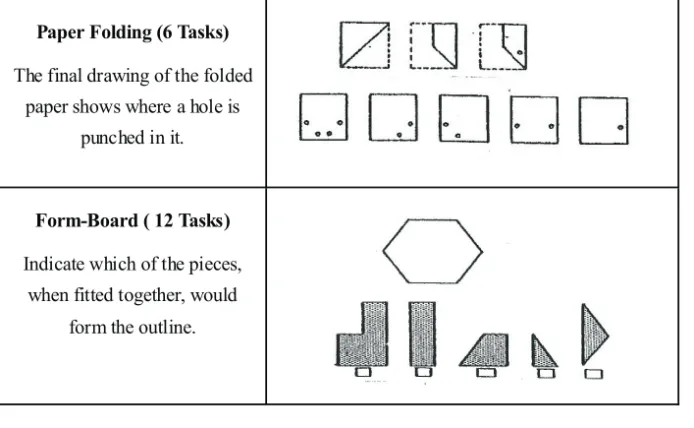
In this paper, case study was used. Data reported in this paper were collected through spatial ability test and semi-structural interview about tasks and spatial ability in learning geometry. The participant was a student on a one two primary teacher education doctorate program. Oya was selected as one of five students, because she works as a mathematics teacher in a primary state school for three years. In the study, the spatial ability test was used. The spatial ability test contained 30 tasks which were adopted from the Paper-Folding, the Form-Board, the Surface-Development, and the Card-Rotation tests, which are included in the ETS kit (Ekstrom et al., 1976). Because of the space limitations, examples of the tasks are presented in Table 1.
Table 1: Examples of Spatial Ability Tasks
Paper Folding (6 Tasks)
The final drawing of the folded paper shows where a hole is
punched in it.
Form-Board ( 12 Tasks)
Indicate which of the pieces, when fitted together, would
form the outline.
She was asked to answer test in one hour. After the spatial ability tasks, interview was realized. Interview took approximately 20-25 minutes and recorded with a tape.
4. Results
In this section, it is presented the analysis of data obtained from spatial ability task and teacher's views.
The Spatial Ability Tasks
She completely made seventeen tasks in spatial ability test. After the spatial ability test was applied, it was discussed with her about tasks and spatial thinking in mathematics program. She found interesting the spatial ability tasks because she had never came across these tasks.
First of all, in the paper folding tasks, she had done five out of six tasks. She said “I think, this section is easy way of doing. When I answer these tasks, I visualized the paper folding in my mind”.
Secondly, in the form board tasks, it was asked that pieces can be together to make a certain figure. She had made correctly ten out of twelve tasks. She told that she done these tasks easily.
Surface Development (6
Tasks)
The numbered edges match the letters.
Rotate (6 Tasks)
In the third tasks, it was wanted that the given shapes can be folded on the dotted lines to form the object figures. The lettered edges on the object are the same as the numbered edges on the piece of paper in this section. These are matched each other. She completely performed one out of six tasks. The other five tasks were partly fulfilled by her. Why the reason is was asked her, she notices:
“I'm difficult for 2D to 3D figures. I can't visualize the figures in my mind and I don't match the lettered edges on the object to the numbered edges”.
Finally, it was asked for that the given shapes rotate the marked center in four tasks and in the other tasks the rotated shapes draw the center of rotation. She completely performed one out of six tasks. She speaks:
“I think, this section is difficult. I really can't rotate the shapes and found the center of rotation. Especially, I can not rotate with degree of 45”.
The Spatial Ability in Learning Geometry
Afterwards the talking about the spatial ability tasks, she believed that these tasks should be use in learning geometry. Oya explained her thinking behind these tasks:
“In my opinion, there are a few lessons' objectives aiming at improving spatial ability in primary mathematics program in my country and primary mathematics teachers have lack of knowledge how the students' spatial abilities were improved. It should be thought the mathematics teachers and these tasks should be given the students in lessons and place to their books”.
After her explanations “What are you doing in order to improve students' spatial abilities?” was asked to her. She replied:
“We don't do like these tasks in our class. In 6th grade, we make the students to do shape patterns such as triangle, square, circle... In 7th grade, we teach how rotate shapes and find center of rotation and symmetry. Then we want the students to find letters' center of symmetry…and in the 8th grade, we give prisms' declination and construct the prism. Briefly, we do not stress as these tasks”.
5. Conclusion and Further Remarks
This study reports the views of the primary mathematics teacher concerning spatial ability and its reflection in mathematics program. As the case of Oya, she said that in Turkish Mathematics Program doesn't completely include learning objectives aiming at improving spatial ability skills and it only content properties of geometric shapes, rotating and pattern shapes, and symmetry. As she interpreted, we applied geometrical tasks in our class. Ben-Chaim et al., (1998) have indicated that it can be improved through training if appropriate materials are provided. How appropriate materials will be prepared or can be investigated in further studies? Besides, as a result of Oya's explanations, we can say that present mathematics teachers and prospective teachers should be educated in order to improve the students' spatial ability.
References
Battista, M.T. (1994) “On Greeno's Environmental/model view of conceptual domains: A spatial/geometric perspective”. Journal for Research in Mathematics Education, 25 (1) 86-99.
Battista, M.T. and Clements, D.H. (1998) “Students' Spatial structuring of 2D arrays of Sqaures”. Journal for Research in Mathematics Education, 29 (5) 503-532.
Ben-Chaim, D., Glenda, L. and Richard, T. H. (1998) “The Effect of Instruction on Spatial Visualization Skills of Middle School Boys and Girls” American EducationalResearch Journal,25, 51-71.
Bishop, A. (1980) “Spatial Abilities and Mathematics Education- A Review”. Educational Studies in Mathematics, 11, 257-269.
Clements, D.H. and Battista, M.T. (1992). Geometry and Spatial Reasoning. In D. Grouws (Ed.), Handbook of Research on Mathematics Teaching and Learning, 420-464. New York: Macmillan Publishing Company.
Ekstrom, R.B., French, J.W. and Harman, H.H., (1976) Manual for kit of factorreferenced cognitive tests, Princeton, NJ: Educational Testing Service.
Kayhan, E.B., (2005). Investigation of High School Students' Spatial Ability. Master of Science Thesis, Middle East Tehnical University.
Linn, M.C. and Petersen, A.C. (1985) “Emergence and Characterization of Sex Differences in Spatial Ability: A-Meta Analysis”. Child Development, Vol. 56, pp. 1479-1498.
McGee, M.G. (1979). Human Spatial Abilities : Sources of Sex Differences. New York: Praeger.
National Council of Teachers of Mathematics (1989) Curriculum and Evaluation Standards for School Mathematics. Reston, Va.: The Council.
Odell, R.L. (1993). Relationship Among Three Dimensional Laboratory Models, Spatial Visualization Ability, Gender and Earth Science Achievement. Doctorate Thesis, School of Education, Indiana University.
Oklun, S., (2003) 'Making Connections: Improving Spatial Abilities with Engineering Drawing Activities'. Int. Journ.of Mathematics Teaching and Learning. <http://www.ex.uk/cimt/ijmt1/ijabout.htm>.
Pellegrino, J.W., Alderton, D.L. and Shute, V.J. (1984) “Understanding Spatial Ability”.
Educational Pyschologist, 19, 239-253.
Tartre, L.A. (1990) “Spatial Orientation Skill and Mathematical Problem Solving”.
Journal for Research in Mathematics Education, 21 (3) 216-229.
Turgut, M. (2007). Investigation 6., 7. and 8. Grade Students' Spatial Ability. Dissertation, Dokuz Eylül University, Izmir.