Open Access
Research article
Effects of
β
-alanine supplementation and high-intensity interval
training on endurance performance and body composition in men;
a double-blind trial
Abbie E Smith
1, Ashley A Walter
2, Jennifer L Graef
1, Kristina L Kendall
1,
Jordan R Moon
1, Christopher M Lockwood
1, David H Fukuda
1,
Travis W Beck
2, Joel T Cramer
2and Jeffrey R Stout*
1Address: 1Metabolic and Body Composition Laboratory, Department of Health and Exercise Science, University of Oklahoma, Norman, OK 73019, USA and 2Biophysics Laboratory; Department of Health and Exercise Science, University of Oklahoma, Norman, OK 73019, USA
Email: Abbie E Smith - [email protected]; Ashley A Walter - [email protected]; Jennifer L Graef - [email protected]; Kristina L Kendall - [email protected]; Jordan R Moon - [email protected];
Christopher M Lockwood - [email protected]; David H Fukuda - [email protected]; Travis W Beck - [email protected]; Joel T Cramer - [email protected]; Jeffrey R Stout* - [email protected]
* Corresponding author
Abstract
Background: Intermittent bouts of high-intensity exercise result in diminished stores of energy substrates, followed by an accumulation of metabolites, promoting chronic physiological adaptations. In addition, β-alanine has been accepted has an effective physiological hydrogen ion (H+) buffer. Concurrent high-intensity interval training (HIIT) and β-alanine supplementation may result in greater adaptations than HIIT alone. The purpose of the current study was to evaluate the effects of combining β-alanine supplementation with high-intensity interval training (HIIT) on endurance performance and aerobic metabolism in recreationally active college-aged men.
Methods: Forty-six men (Age: 22.2 ± 2.7 yrs; Ht: 178.1 ± 7.4 cm; Wt: 78.7 ± 11.9; VO2peak: 3.3 ± 0.59 l·min-1) were assessed for peak O
2 utilization (VO2peak), time to fatigue (VO2TTE), ventilatory threshold (VT), and total work done at 110% of pre-training VO2peak (TWD). In a double-blind fashion, all subjects were randomly assigned into one either a placebo (PL – 16.5 g dextrose powder per packet; n = 18) or β-alanine (BA – 1.5 g β-alanine plus 15 g dextrose powder per packet; n = 18) group. All subjects supplemented four times per day (total of 6 g/day) for the first 21-days, followed by two times per day (3 g/day) for the subsequent 21 days, and engaged in a total of six weeks of HIIT training consisting of 5–6 bouts of a 2:1 minute cycling work to rest ratio.
Results: Significant improvements in VO2peak, VO2TTE, and TWD after three weeks of training were displayed (p < 0.05). Increases in VO2peak, VO2TTE, TWD and lean body mass were only significant for the BA group after the second three weeks of training.
Conclusion: The use of HIIT to induce significant aerobic improvements is effective and efficient. Chronic BA supplementation may further enhance HIIT, improving endurance performance and lean body mass.
Published: 11 February 2009
Journal of the International Society of Sports Nutrition 2009, 6:5 doi:10.1186/1550-2783-6-5
Received: 8 January 2009 Accepted: 11 February 2009
This article is available from: http://www.jissn.com/content/6/1/5
© 2009 Smith et al; licensee BioMed Central Ltd.
Background
High-intensity exercise results in diminished stores of ade-nosine tri-phosphate (ATP), phosphocreatine (PCr) and glycogenic substrates, and the intracellular accumulation of metabolites (adenosine di-phosphate (ADP), inorganic phosphate (Pi), hydrogen ions (H+) and magnesium
(Mg+), each of which has been implicated as a cause of
muscle fatigue [1-3]. Excessive formation of H+ results in
a decrease in intramuscular pH which may contribute to fatigue in some models of exercise [1,4-6]. Enhancing an individual's ability to buffer protons may delay fatigue by improving the use of energy substrates and maintaining muscular contraction [6-9]. When the time and intensity level of exercise is sufficient, the majority of protons that are produced are buffered by the bicarbonate (HCO3-)
buffering system [10,11] in which they are exported from the muscle [12]. Physiological buffering during dynamic exercise is typically controlled by the HCO3- system and is
also supported by direct physico-chemical buffering, pro-vided mainly by phosphate, hisitidine residues of pep-tides and proteins, and the small amount of bicarbonate present in muscle at the start of exercise. However, during short bursts of intense exercise, such as HIIT, physico-chemical buffering will exceed that by HCO3- mediated
dynamic buffering, calling on intramuscular stores of phosphates and peptides.
Specifically, carnosine (β-alanyl-L-histidine), a cytoplasmic dipeptide, constitutes an important non-bicarbonate phys-ico-chemical buffer. By virtue of a pKa of 6.83 and its high concentration in muscle, carnosine is more effective at sequestering protons than either bicarbonate (pKa 6.37) or inorganic phosphate (pKa 7.2), the other two major phys-ico-chemical buffers over the physiological pH range [7,13]. However, as a result of the greater concentration of carnosine in muscle than bicarbonate in the initial stages of muscle contraction, and inorganic phosphate, its buffering contribution may be quantitatively more important.
Mechanisms for increasing muscle carnosine concentra-tion have been somewhat disputed. While carnosine may be increased in chronically trained athletes, the effects of acute training are less clear. In one study, it has been reported that eight weeks of intensive training may increase intramuscular carnosine content [14]. In con-trast, several other studies have shown that intense train-ing, of up to 16 weeks, has been unable to promote a rise in skeletal muscle carnosine levels [6,15-17]. Only when β-alanine supplementation was combined with training did an increase in muscle carnosine occur [16], although the increase (40–60%) was similar to that seen with sup-plementation alone [18].
While carnosine is synthesized in the muscle from its two constituents, β-alanine and histidine [19], synthesis is
limited by the availability of β-alanine [18,20]. β-alanine supplementation alone has been shown to significantly increase the intramuscular carnosine content [6,18]. Ele-vation of intramuscular carnosine content via β-alanine supplementation alone, has been shown to improve per-formance [6,14,21-24]. Recently, Hill and colleagues [6] demonstrated a 13% improvement in total work done (TWD) following four weeks of β-alanine supplementa-tion, and an additional 3.2% increase after 10 weeks. Zoe-ller et al. [24] also reported significant increases in ventilatory threshold (VT) in a sample of untrained men after supplementing with β-alanine (3.2 g·d-1) for 28
days. In agreement, Kim et al. [21] also reported signifi-cant increases in VT and time to exhaustion (TTE) in highly trained male cyclists after 12 weeks of β-alanine (4.8 g·d-1) supplementation and endurance training.
Fur-thermore, Stout et al. [22,23] reported a significant delay in neuromuscular fatigue, measured by physical working capacity at the fatigue threshold (PWCFT), in both men and women after 28 days of β-alanine supplementation (3.2 g·d-1 – 6.4 g·d-1). Despite the improvements in VT,
TTE, TWD, and PWCFT after supplementation, there were no increases in aerobic power, measured by VO2peak
[22-24].
Although HIIT alone does not appear to increase skeletal muscle carnosine content [17], training has been sug-gested to improve muscle buffering capacity [25-27]. When repeated bouts of high-intensity intervals are inter-spersed with short rest periods, subsequent trials are initi-ated at a much lower pH [28]. Training in such a manner subjects the body to an acidic environment, forcing sev-eral physiological adaptations. Notably, HIIT has been shown to improve VO2peak and whole body fat oxidation in only two weeks (7 sessions at 90% VO2peak) [29]. Fur-thermore, over a longer period of time (4–6 weeks), HIIT has been reported to increase high-intensity exercise per-formance (6–21%), muscle buffering capacity, whole body exercise fat oxidation, and aerobic power (VO2peak)
[25-27].
Methods
SubjectsForty-six college-aged men, who were recreationally active one to five hours per week, and had not taken any sports supplement within the six months prior-, volunteered to participate in this study (mean ± SD; Age: 22.2 ± 2.7 yrs, Height: 178.1 ± 7.4 cm, Weight: 78.7 ± 11.9 kg). Subjects were informed of the potential risks, benefits, and time requirements prior to enrolling and giving written con-sent. All study procedures were approved by the Univer-sity's Institutional Review Board.
Study design
This double-blind, randomized study included two three-week periods of HIIT and β-alanine supplementation. All participants completed a series of baseline, mid- and post-testing, including a series of cycling tests and body com-position assessment using air displacement plethysmog-raphy (BodPod®) at all time points. Following baseline
testing subjects were randomly assigned, in a double-blind fashion, to one of two supplementing groups, β -alanine or placebo, both with HIIT. Participant's initial VO2peak power output values were used to establish the
TWD intensity and the training intensity for the six week duration, with no modification to intensity following mid-testing. The first three-week period of training was completed at workloads between 90%–110% of each individual's VO2peak, while the second three-week train-ing peaked at 115%. While traintrain-ing, participants supple-mented with 6 g per day of β-alanine or placebo during the first three weeks and 3 g per day during the second three week phase. Supplementing with 6.4 g per day of β -alanine, for 28 days has demonstrated a 60% increase in carnosine concentration [6,18], supporting the 21 day phase, allowing for an adequate loading period for β -alanine to elicit increases in intramuscular carnosine con-centration. Furthermore, recent literature suggests even greater increases in carnosine levels when combining high-intensity training and β-alanine supplementation [17]. Following the three-week adaptation phase, mid-training and post-mid-training tests were completed in the same order as the pre-testing, allowing at least 48 hours between each testing session. All subjects were instructed to maintain their current diet throughout the duration of the study and were asked to refrain from caffeine and vig-orous activity 24 hours prior to any testing session. Food logs were distributed to all participants and completed (two non-consecutive weekdays and one weekend day) at baseline-testing, mid-testing and post-testing, to evaluate any changes in total kcal and/or protein intake.
Determination of VO2peak
At pre-, mid-, and post-training, all participants per-formed a continuous graded exercise test (GXT) on an electronically braked cycle ergometer (Corval 400,
Gonin-gen, The Netherlands) to determine VO2peak, time to exhaustion (VO2TTE) and ventilatory threshold (VT). Pedal cadence was maintained at 70 rpm, while the power out-put was initially set at 50 W for a five minute warm-up, and increased by 25 W every two minutes, until the partic-ipant could no longer maintain the required power out-put (cadence dropped below 60 rpm). Respiratory gases were monitored breath by breath and analyzed with open-circuit spirometry (True One 2400® Metabolic
Meas-urement System, Parvo-Medics Inc., Provo UT) to deter-mine VO2peak and VT. The data was averaged over 15 second intervals. The highest 15 second VO2 value during
the GXT was recorded as the VO2peak value if it coincided with at least two of the following criteria: (a) a plateau in heart rate (HR) or HR values within 10% of the age-pre-dicted HRmax, (b) a plateau in VO2 (defined by an increase of note more than 150 ml·min-1), and/or (c) an
RER value greater than 1.15 [30]. Heart rate was also mon-itored continuously during exercise by using a heart rate monitor (Polar FS1, Polar Electro Inc. Lake Success, NY). The amount of time to reach exhaustion (VO2TTE) during the VO2peak was also recorded in seconds. Ventilatory threshold (VT) was determined using standard software (True One 2400® Metabolic Measurement System,
Parvo-Medics Inc., Provo UT) by plotting ventilation (VE) against VO2 as described previously [31]. Two linear regression lines were fit to the lower and upper portions of the VE vs. VO2 curve, before and after the break points, respectively. The intersection of these two lines was defined as VT, and was recorded with respect to the corre-sponding power output (W).
Test-retest reliability for the VO2peak protocol at the Uni-versity of Oklahoma using twenty-one men, demonstrate reliable between-day testing with an intraclass correlation coefficient (ICC) of 0.975 (SEM 0.257 l·min-1) and a
per-cent of coefficient of variation (%CV) of 5.18%.
Total Work Done Cycling Test
Each subject performed a constant-load time to exhaus-tion (TTE) test on an electronically braked cycle ergom-eter, at a cadence of ~70 rpm. Participants performed a five minute warm-up at 50 W, followed by a cycle to exhaustion at their individual pre-determined workload, established at 110% of the maximum VO2peak workload (W). The subject's TTE was defined by the time (in sec-onds), that could be maintained without dropping below a cadence of 60 rpm. Total work done (TWD) was further calculated as the primary variable of interest, using the product of time (in seconds) and the power output (W), divided by 1,000, and presented in kilojoules (kJ).
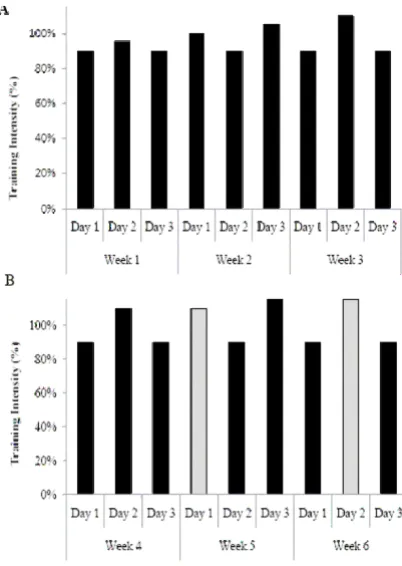
Training intervention and -alanine supplementation Training was performed on an electronically braked cycle ergometer (Corval 400, Groningen, The Netherlands) to maintain testing specificity. Participants began the super-vised training session within two to four days following testing. Following the baseline-testing and group rand-omization, subjects began the first of two, three-week training periods. Training followed a fractal periodized plan to allow for adequate progression and to prevent overtraining [32] and was completed three days per week. The training intensity began at 90% of the maximum power output (W) achieved during the baseline VO2peak
test and progressed in an undulating manner, reaching a maximum of 115% by the end of the second, three-week training period. The first three-week period consisted of five sets of two-minute intervals with one-minute rest periods. The second three-week session followed a similar protocol, modifying the progression by increasing the rep-etitions from five to six, during weeks six and seven and still taking place on three days per week (Figure 1). A training log was completed for each training session. The total time (seconds) completed and workload (watts) was used to compute total training volume (kJ) (Figure 2).
In addition to training, during the first three-week period, the participants also supplemented with 6 g per day β
-alanine (1.5 g β-alanine, 15 g dextrose per dose) or pla-cebo (16.5 g dextrose per dose). Supplements were mixed with water in an orange flavored dextrose powder and were consumed four times throughout the day. On the three days that subjects visited the lab for training, they consumed two pre-mixed doses, one 30 minutes before, and one immediately after completion of the training ses-sion. The remaining two doses were taken that day, ad libi-tum. For the remaining four days of the week, participants were instructed to mix and consume the four doses (6 g per day) of their respective supplement, ad libitum. Throughout the second three-week training period, partic-ipants supplemented in a similar manner for on- and off-training days, for an additional 21 days, at a dose of 3 g per day, taken in two, 16.5 g doses (1.5 g β-alanine, 15 g dextrose). The participants in the placebo group con-sumed an isovolumetric flavored powder (16.5 g dex-trose) identical in appearance and taste to the β-alanine. Participants were asked to record each dose on a desig-nated dosing log for each day and they were asked to bring in the supplement packaging to allow investigators to monitor compliance.
Determination of body composition
Body composition was assessed prior-to, mid-way, and following training and supplementing by using air
dis-Training protocol for the first and second three-week training phases, respectively Figure 1
placement plethysmography (Bod Pod®). The subjects'
weight (kg) and body volume were measured and used to determine percent body fat, fat mass (kg), and lean body mass (kg) using the revised formula of Brozek et al. [33].
Statistical analysis
Separate two-way repeated measures ANOVAs (group [β -alanine vs. placebo] × time [pre- vs. mid- vs. post-supple-mentation]) were used to identify any group by time inter-actions. If a significant interaction occurred, the statistical model was decomposed by examining the simple main effects with separate one-way repeated measures ANOVAs for each group and one-way factorial ANOVAs for each time. An alpha of p ≤ 0.05 was used to determine statisti-cal significance. All data are reported as mean ± standard deviation (SD).
Results
Table 1 presents the mean and standard deviation values for VO2peak (l·min-1), VO
2TTE (seconds), VT (watts) and
TWD (kJ) for both treatment groups at pre-, mid- and post-testing.
VO2peak, VO2TTE, VT during GXT
Significant main effects for time resulted for maximal oxy-gen consumption (VO2peak), time to exhaustion (VO2TTE) and ventilatory threshold (VT) determined dur-ing the graded exercise (p < 0.001). There were significant improvements in VO2peak after three weeks of training and supplementing across both treatment groups (p < 0.001; ES: 0.977). While there were no significant differ-ence for the improvements in VO2peak at any time point between groups, only the BA group demonstrated signifi-cant improvements from mid- to post-training and sup-plementing (p = 0.010) with no significant change from mid- to post- for the PL group (p = 0.118). Similar results for VO2TTE were also revealed with both groups demon-strating significant improvements from pre- to mid-test-ing (p < 0.001; ES: 0.983), with no difference between groups. Significant changes from mid- to post-VO2TTE were only evident in the BA group (p = 0.043).
There were no significant differences among the improve-ments in VT between groups. Improveimprove-ments from pre- to mid VT for both the PL and BA groups did not yield signif-icance. However, the PL group was the only group to
dem-2A Figure 2
onstrate significant improvements from mid- to post (p = 0.001).
Time to exhaustion test-TWD
The improvements in TWD were significant across all time points, with no difference between groups (p > 0.05; ES: 0.898). While not significant, the delta values at both time points were greater for the BA group [pre-mid: 30.6 ± 19.9 sec; mid-post: 42.3 ± 72.1 sec] when compared to the PL group [pre-mid: 27.6 ± 22.1; mid-post: 18.6 ± 28.3].
Body Composition
The physical characteristics of the subjects determined at mid-testing and after six-weeks of HIIT and supplement-ing are presented in Table 2. Body mass did not change significantly with supplementing or training. However, the determination of body composition with the use of air displacement plethysmography (Bod Pod®) revealed a
sig-nificant improvement from pre- to mid-testing in lean body mass in only the BA group (p = 0.011; ES: 0.985) and no change in the PL group (p = 0.138). Furthermore, there were no significant changes in percent body fat (p = 0.287) or fat mass (p = 984) between treatment groups after three and six weeks of HIIT and supplementation.
Dietary Analysis
There was no significant difference between groups for their supplement or training compliance rate, represent-ing a 6.4 -3.2 g per day intake for the BA group, for the three and six weeks, respectively. Analyses of the dietary
recalls demonstrated no significant differences in caloric intake (p > 0.05) between the BA (3120 ± 244 kcal) and placebo (2775 ± 209 kcal) groups. Furthermore, there were no differences in macronutrient daily intake, with both groups consuming 47% of their daily calories from carbohydrates, 34% from fat and 16% from protein.
Training Volume
There was a significant main effect for time (p < 0.01) for both training volume (watts) and training time (seconds). However, there was no significant difference between groups for either volume (Figure 2A) or time (Figure 2B), at any time point (weeks 1–6). Although not significant, the BA group consistently trained at higher workloads and for longer time periods.
Discussion
The current study is the first to examine the effects of con-current high-intensity interval training (HIIT) and β -alanine supplementation on a series of physiological and performance variables. The primary findings support the use of HIIT as an advantageous training tool. Further-more, the current study also proposes the use of β-alanine supplementation to enhance the benefits of HIIT, by pos-sibly improving muscle buffer capacity after six weeks of training and supplementing. The maximal oxygen uptake and time to reach maximum oxygen consumption (VO2peak, VO2TTE) and total work done (TWD) increased significantly in both training groups (β-alanine and pla-cebo) over a six week HIIT protocol (Table 1). However,
Table 1: Mean ± SD values for VO2peak (l·min-1), VO2TTE (s), VT (W) and TWD (kJ) at pre-, mid-, and post-testing.
Maximal Oxygen Consumption (l·min-1) Time to Exhaustion (s) Ventilatory Threshold (W) Total Work Done (kJ)
β-alanine Placebo β-alanine Placebo β-alanine Placebo β-alanine Placebo
Pre-test Mean 3.28 3.25 1168.2 1128.7 140.3 127.3 58.4 55.7
SD 0.57 0.63 163.6 166.9 35.5 42.6 19.2 13.8
Mid-test Mean 3.52* 3.56* 1304.9* 1258.7* 154.2 140.3 89.0* 83.3*
SD 0.49 0.56 153.7 204.5 36.6 52.3 30.1 25.7
Post-test Mean 3.67† 3.66 1386.7† 1299.6 172.2 188.9† 131.3† 102.0†
SD 0.58 0.55 234.9 164.9 65.2 58.3 81.7 36.7
*indicates a significant difference from pre- to mid-testing (p < 0.05) †indicates a significant improvement from mid- to post-testing (p < 0.05)
Table 2: Mean ± SD values for body weight (kg), body fat (%), lean body mass (kg), and fat mass (kg) from pre-, mid-, and post-testing.
β-alanine (n = 18) Placebo (n = 18)
Pre-testing Mid-testing Post-testing Pre-testing Mid-testing Post-testing
Weight (kg) 78.8 ± 12.8 80.1 ± 13.0 79.8 ± 12.4 78.5 ± 11.3 79.3 ± 12.3 79.8 ± 11.9 Body Fat (%) 13.7 ± 6.3 13.7 ± 6.4 13.7 ± 5.6 16.1 ± 7.5 15.9 ± 8.3 16.0 ± 7.9 Lean Body Mass (kg) 67.6 ± 8.9 68.6 ± 8.6* 68.4 ± 8.4 65.5 ± 8.1 66.1 ± 8.5 65.8 ± 8.4 Fat Mass (kg) 11.3 ± 6.5 11.5 ± 6.8 11.3 ± 6.0 13.0 ± 7.1 13.1 ± 8.0 13.0 ± 7.8
β-alanine supplementation appeared to have a greater influence on VO2peak and VO2TTE, resulting in a signifi-cant (p < 0.05) increase during the second three weeks of training, while no change occurred in placebo group. In addition, TWD significantly (p < 0.05) increased during the last three weeks by 32% and 18% for the β-alanine and Placebo groups, respectively. Improvements in VT were also reported for both training groups, however the placebo group demonstrated significant improvements during the last three week training phase (Table 1). Lastly, the present study also identified a significant change in lean body mass for the β-alanine supplementing group after three weeks, with no change in the placebo group.
Enhanced VO2peak, VO2TTE, and VT after training
A series of HIIT interventions have suggested that interval exercise (> 80% VO2max) elicits greater gains in aerobic capacity than moderate-intensity exercise [34-36]. Conse-quently, the improvements reported in cardiorespiratory fitness in the current study were similar to most studies that have employed short-term (2–9 weeks) endurance interval training programs in untrained and recreationally active individuals [25,29,34,37-40]. Specifically, the aver-age reported increases in VO2peak have ranged from 6– 20% in male and female populations. Although the train-ing regimens utilized have varied slightly, all supporttrain-ing studies applied a similar protocol. The use of a 1:1 [37,38,40] and a 2:1 [29,34,39] work-to- rest design (1–4 minutes) have been the most effective for promoting an increase in aerobic capacity. Our data supports previous literature, suggesting a 7–10% increase in VO2peak during
the first three week training phase and a 3–4.5% increase following the second three week session. While both groups significantly improved in VO2peak and VO2TTE from pre- to mid-testing, only the β-alanine group dem-onstrated significant improvements from mid- to post-testing (Table 1).
The use of high-intensity exercise as a training modality has been shown to stimulate acute and chronic physiolog-ical adaptations (cardiovascular, metabolic, respiratory and neural), which ultimately lead to improved perform-ance [34,37,41]. The increases in VO2peak, VO2TTE, and VT reported in the current study are in line with other studies, which have suggested that the improvements in aerobic performance are attributable to a reduction in anaerobic ATP production, resulting from an increased contribution of aerobic energy production at higher inten-sity workloads [42,43]. The greater reliance on aerobic metabolism for energy has been further linked to an up-regulation of various glycolytic enzymes (phosphofruc-tokinase, hexokinase, citrate synthetase, and sodium potassium ATPase) [42,44-47], as well as with increased mitochondrial density and improved blood flow due to increased capillarization [44,45]. These improvements, in
combination with an enhanced ability to buffer H+, may
provide some explanation into the greater improvements in the second three-week training phase, in the BA group only. Although blood pH levels were not measured directly, support from training volume (Figure 2A) and training time (Figure 2B), demonstrate that participants supplementing with β-alanine engaged in longer, more intense training sessions, possibly leading to greater adap-tations.
Improvements in TWD
In addition to augmenting VO2peak, VO2TTE and VT, the
HIIT program utilized in the current study demonstrated significant improvements in TWD (Table 1). Interestingly, the increases in total work performed in the current study were greater than in previously reported improvements in TWD following HIIT alone [48-50], with both groups demonstrating a 50–53% improvement during the first three weeks of training and the β-alanine group showing a 32% increase compared to the 18% increase in the pla-cebo group, after the second three-week training phase. In support, Kim et al. [21] demonstrated significantly greater increases in TWD in highly trained cyclists after a 12-week β-alanine supplementation and endurance training pro-gram, compared to training only. In addition, Hill et al. [6] also demonstrated significant improvements in TWD (13%) on a cycle ergometer following four weeks of β -alanine supplementation, without training. While the data appear to support the use of β-alanine supplementa-tion to augment TWD, with and without training, the pre-viously mentioned studies utilized highly trained participants, compared to an un-trained population in the current study.
Scientists have suggested the use of β-alanine may enhance training adaptations [6,18,23], by increasing ability to train at a higher intensity without fatigue. Recently Harris et al. [18] and Hill et al. [6] have posited that increasing skeletal muscle carnosine concentration with β-alanine supplementation may improve the ability to stabilize the intramuscular pH during intense exercise by buffering accumulating H+. Offsetting the indirect
col-leagues. Additional research examining the effects of concurrent β-alanine supplementation and HIIT in trained versus untrained men and women would provide additional insight toward the current findings.
Augmented Lean Body Mass
Interestingly, the improvements in performance over the six-weeks of training also demonstrated concomitant gains in lean body mass in the β-alanine group only. Recent evidence suggests that intense exercise may elicit intramuscular acidosis, potentially augmenting protein degradation [51], inhibiting protein synthesis [52] and thus hindering training adaptations. Another theory pos-ited suggests that β-alanine supplementation may have allowed for greater training volume thus providing a greater stimulus, resulting in significant gains in lean body mass, as observed in the current study. In support, Hoff-man et al. [53,54] reported significantly higher training volume for athletes consuming β-alanine during resist-ance training sessions, which they hypothesized lead to significant increases in lean body mass. In short, minimiz-ing the acidic response from HITT, and/or increasminimiz-ing training volume with β-alanine supplementation, may help to increase lean body mass and lead to improve-ments in performance.
Conclusion
Our findings support the use of HIIT as an effective train-ing stimulus for improvtrain-ing aerobic performance, in as lit-tle as three weeks. The use of β-alanine supplementation, in combination with HIIT, appeared to result in greater changes in VO2peak and VO2TTE, during the second three weeks of training, while no significant change occurred in placebo group. In addition, TWD significantly (p < 0.05) increased during the last three weeks by 32% and 18% for the β-alanine and Placebo groups, respectively. While more research is needed, the current study suggests that in untrained young men, the use of β-alanine supplementa-tion may enhance the benefits of HIIT and augment endurance performance.
Competing interests
The authors declare that they have no competing interests.
Authors' contributions
All authors contributed equally to this work. All authors have read and approved the final manuscript.
Acknowledgements
A sincere thanks is given to Dr. Roger Harris, University of Chichester, Chichester, UK, for his time and input he contributed to reviewing this manuscript.
The authors would also like to thank FSI Nutrition, 2132 South 156th Cir-cle, Omaha, NE http://www.fsinutrition.com and RunFast Promotions,8790
Wendy Lane South, West Palm Beach FL, 33411http://www.runfastpromo tions.com for supporting and funding this research endeavor.
References
1. Robergs RA, Ghiasvand F, Parker D: Biochemistry of exercise-induced metabolic acidosis. Am J Physiol Regul Integr Comp Physiol
2004, 287(3):R502-516.
2. Spriet LL, Lindinger MI, McKelvie RS, Heigenhauser GJ, Jones NL:
Muscle glycogenolysis and H+ concentration during maximal intermittent cycling. Journal of applied physiology 1989, 66(1):8-13. 3. Allen DG, Lamb GD, Westerblad H: Skeletal muscle fatigue:
cel-lular mechanisms. Physiological reviews 2008, 88(1):287-332. 4. Messonnier L, Kristensen M, Juel C, Denis C: Importance of pH
regulation and lactate/H+ transport capacity for work pro-duction during supramaximal exercise in humans. J Appl Phys-iol 2007, 102(5):1936-1944.
5. Potteiger JA, Webster MJ, Nickel GL, Haub MD, Palmer RJ: The effects of buffer ingestion on metabolic factors related to dis-tance running performance. European journal of applied physiology and occupational physiology 1996, 72(4):365-371.
6. Hill CA, Harris RC, Kim HJ, Harris BD, Sale C, Boobis LH, Kim CK, Wise JA: Influence of beta-alanine supplementation on skele-tal muscle carnosine concentrations and high intensity cycling capacity. Amino acids 2007, 32(2):225-233.
7. Abe H: Role of histidine-related compounds as intracellular proton buffering constituents in vertebrate muscle. Biochem-istry 2000, 65(7):757-765.
8. Suzuki Y, Nakao T, Maemura H, Sato M, Kamahara K, Morimatsu F, Takamatsu K: Carnosine and anserine ingestion enhances con-tribution of nonbicarbonate buffering. Medicine and science in sports and exercise 2006, 38(2):334-338.
9. McNaughton L, Backx K, Palmer G, Strange N: Effects of chronic bicarbonate ingestion on the performance of high-intensity work. European journal of applied physiology and occupational physiology
1999, 80(4):333-336.
10. Beaver WL, Wasserman K, Whipp BJ: Bicarbonate buffering of lactic acid generated during exercise. J Appl Physiol 1986,
60(2):472-478.
11. Juel C: Regulation of pH in human skeletal muscle: adapta-tions to physical activity. Acta physiologica (Oxford, England) 2008,
193(1):17-24.
12. Juel C, Klarskov C, Nielsen JJ, Krustrup P, Mohr M, Bangsbo J: Effect of high-intensity intermittent training on lactate and H+ release from human skeletal muscle. American journal of physiol-ogy 2004, 286(2):E245-251.
13. Bate-Smith EC: The buffering of muscle in rigor: Protein, phos-phate and carnosine. The Journal of physiology 1938, 92:336-343. 14. Suzuki Y, Ito O, Mukai N, Takahashi H, Takamatsu K: High level of
skeletal muscle carnosine contributes to the latter half of exercise performance during 30-s maximal cycle ergometer sprinting. The Japanese journal of physiology 2002, 52(2):199-205. 15. Derave W, Ozdemir MS, Harris RC, Pottier A, Reyngoudt H, Koppo
K, Wise JA, Achten E: beta-Alanine supplementation augments muscle carnosine content and attenuates fatigue during repeated isokinetic contraction bouts in trained sprinters. J Appl Physiol 2007, 103(5):1736-1743.
16. Harris RC, Edge J, Kendrick IP, Bishop D, Goodman C, Wise JA: The Effect of Very High Interval Training on the Carnosine Con-tent and Buffereing Capacity of V Lateralis from Humans.
FASEB J 2007, 21:769.
17. Kendrick IP, Harris RC, Kim HJ, Kim CK, Dang VH, Lam TQ, Bui TT, Smith M, Wise JA: The effects of 10 weeks of resistance training combined with beta-alanine supplementation on whole body strength, force production, muscular endurance and body composition. Amino acids 2008, 34(4):547-554.
18. Harris RC, Tallon MJ, Dunnett M, Boobis L, Coakley J, Kim HJ, Fallow-field JL, Hill CA, Sale C, Wise JA: The absorption of orally sup-plied beta-alanine and its effect on muscle carnosine synthesis in human vastus lateralis. Amino acids 2006,
30(3):279-289.
19. Bakardjiev A, Bauer K: Transport of beta-alanine and biosynthe-sis of carnosine by skeletal muscle cells in primary culture.
European journal of biochemistry/FEBS 1994, 225(2):617-623. 20. Dunnett M, Harris RC, Soliman MZ, Suwar AA: Carnosine,
Publish with BioMed Central and every scientist can read your work free of charge "BioMed Central will be the most significant development for disseminating the results of biomedical researc h in our lifetime."
Sir Paul Nurse, Cancer Research UK
Your research papers will be:
available free of charge to the entire biomedical community
peer reviewed and published immediately upon acceptance
cited in PubMed and archived on PubMed Central
yours — you keep the copyright
Submit your manuscript here:
http://www.biomedcentral.com/info/publishing_adv.asp
BioMedcentral
gluteal muscle of the camel. Research in veterinary science 1997,
62(3):213-216.
21. Kim HJ, Kim CK, Lee YW, Harris RC, Sale C, Harris BD, Wise JA:
The effect of a supplement containing B-alanine on muscle carnosine synthesis and exercise capacity, during 12 week combined endurance and weight training. J Int Soc Sports Nutr
2006, 3:S9.
22. Stout JR, Cramer JT, Mielke M, O'Kroy J, Torok DJ, Zoeller RF:
Effects of twenty-eight days of beta-alanine and creatine monohydrate supplementation on the physical working capacity at neuromuscular fatigue threshold. Journal of strength and conditioning research/National Strength & Conditioning Association
2006, 20(4):928-931.
23. Stout JR, Cramer JT, Zoeller RF, Torok D, Costa P, Hoffman JR, Har-ris RC, O'Kroy J: Effects of beta-alanine supplementation on the onset of neuromuscular fatigue and ventilatory thresh-old in women. Amino acids 2007, 32(3):381-386.
24. Zoeller RF, Stout JR, O'Kroy JA, Torok DJ, Mielke M: Effects of 28 days of beta-alanine and creatine monohydrate supplemen-tation on aerobic power, ventilatory and lactate thresholds, and time to exhaustion. Amino acids 2007, 33(3):505-510. 25. Edge J, Bishop D, Goodman C: The effects of training intensity
on muscle buffer capacity in females. European journal of applied physiology 2006, 96(1):97-105.
26. Laursen PB, Jenkins DG: The scientific basis for high-intensity interval training: optimising training programmes and max-imising performance in highly trained endurance athletes.
Sports medicine (Auckland, NZ) 2002, 32(1):53-73.
27. Weston AR, Myburgh KH, Lindsay FH, Dennis SC, Noakes TD, Haw-ley JA: Skeletal muscle buffering capacity and endurance per-formance after high-intensity interval training by well-trained cyclists. European journal of applied physiology and occupa-tional physiology 1997, 75(1):7-13.
28. Costill DL, Verstappen F, Kuipers H, Janssen E, Fink W: Acid-base balance during repeated bouts of exercise: influence of HCO3. International journal of sports medicine 1984, 5(5):228-231. 29. Talanian JL, Galloway SD, Heigenhauser GJ, Bonen A, Spriet LL: Two
weeks of high-intensity aerobic interval training increases the capacity for fat oxidation during exercise in women. Jour-nal of applied physiology 2007, 102(4):1439-1447.
30. Day JR, Rossiter HB, Coats EM, Skasick A, Whipp BJ: The maxi-mally attainable VO2 during exercise in humans: the peak vs. maximum issue. J Appl Physiol 2003, 95(5):1901-1907.
31. Orr GW, Green HJ, Hughson RL, Bennett GW: A computer linear regression model to determine ventilatory anaerobic threshold. J Appl Physiol 1982, 52(5):1349-1352.
32. Brown L, Greenwood M: Periodization Essentials and Innova-tions in Resistance Training Protocols. JSCR 2005, 27(4):80-85. 33. Brozek J, Grande F, Anderson JT, Keys A: Densitometric Analysis of Body Composition: Revision of Some Quantitative Assumptions. Annals of the New York Academy of Sciences 1963,
110:113-140.
34. Helgerud J, Hoydal K, Wang E, Karlsen T, Berg P, Bjerkaas M, Simonsen T, Helgesen C, Hjorth N, Bach R, et al.: Aerobic high-intensity intervals improve VO2max more than moderate training. Medicine and science in sports and exercise 2007,
39(4):665-671.
35. Rognmo O, Hetland E, Helgerud J, Hoff J, Slordahl SA: High sity aerobic interval exercise is superior to moderate inten-sity exercise for increasing aerobic capacity in patients with coronary artery disease. Eur J Cardiovasc Prev Rehabil 2004,
11(3):216-222.
36. Thomas TR, Adeniran SB, Etheridge GL: Effects of different run-ning programs on VO2 max, percent fat, and plasma lipids.
Canadian journal of applied sport sciences 1984, 9(2):55-62.
37. Berger NJ, Tolfrey K, Williams AG, Jones AM: Influence of contin-uous and interval training on oxygen uptake on-kinetics.
Medicine and science in sports and exercise 2006, 38(3):504-512. 38. Burke J, Thayer R, Belcamino M: Comparison of effects of two
interval-training programmes on lactate and ventilatory thresholds. British journal of sports medicine 1994, 28(1):18-21. 39. Duffield R, Edge J, Bishop D: Effects of high-intensity interval
training on the VO2 response during severe exercise. Journal of science and medicine in sport/Sports Medicine Australia 2006,
9(3):249-255.
40. Eddy DO, Sparks KL, Adelizi DA: The effects of continuous and interval training in women and men. European journal of applied physiology and occupational physiology 1977, 37(2):83-92.
41. Rozenek R, Funato K, Kubo J, Hoshikawa M, Matsuo A: Physiologi-cal responses to interval training sessions at velocities asso-ciated with VO2max. Journal of strength and conditioning research/ National Strength & Conditioning Association 2007, 21(1):188-192. 42. Gaitanos GC, Williams C, Boobis LH, Brooks S: Human muscle
metabolism during intermittent maximal exercise. Journal of applied physiology 1993, 75(2):712-719.
43. Harmer AR, McKenna MJ, Sutton JR, Snow RJ, Ruell PA, Booth J, Thompson MW, Mackay NA, Stathis CG, Crameri RM, et al.: Skele-tal muscle metabolic and ionic adaptations during intense exercise following sprint training in humans. Journal of applied physiology 2000, 89(5):1793-1803.
44. Henriksson J: Effects of physical training on the metabolism of skeletal muscle. Diabetes care 1992, 15(11):1701-1711.
45. Krustrup P, Hellsten Y, Bangsbo J: Intense interval training enhances human skeletal muscle oxygen uptake in the initial phase of dynamic exercise at high but not at low intensities.
The Journal of physiology 2004, 559(Pt 1):335-345.
46. Nordsborg N, Bangsbo J, Pilegaard H: Effect of high-intensity training on exercise-induced gene expression specific to ion homeostasis and metabolism. Journal of applied physiology 2003,
95(3):1201-1206.
47. Rodas G, Ventura JL, Cadefau JA, Cusso R, Parra J: A short training programme for the rapid improvement of both aerobic and anaerobic metabolism. European journal of applied physiology 2000,
82(5–6):480-486.
48. Coggan AR, Kohrt WM, Spina RJ, Kirwan JP, Bier DM, Holloszy JO:
Plasma glucose kinetics during exercise in subjects with high and low lactate thresholds. Journal of applied physiology 1992,
73(5):1873-1880.
49. Demarle AP, Heugas AM, Slawinski JJ, Tricot VM, Koralsztein JP, Billat VL: Whichever the initial training status, any increase in velocity at lactate threshold appears as a major factor in improved time to exhaustion at the same severe velocity after training. Archives of physiology and biochemistry 2003,
111(2):167-176.
50. Gaiga MC, Docherty D: The effect of an aerobic interval train-ing program on intermittent anaerobic performance. Cana-dian journal of applied physiology = Revue canadienne de physiologie appliquee 1995, 20(4):452-464.
51. Caso G, Garlick PJ: Control of muscle protein kinetics by acid-base balance. Current opinion in clinical nutrition and metabolic care
2005, 8(1):73-76.
52. Ballmer PE, Imoberdorf R: Influence of acidosis on protein metabolism. Nutrition (Burbank, Los Angeles County, Calif) 1995,
11(5):462-468. discussion 470.
53. Hoffman J, Ratamess N, Faigenbaum A, Ross R, Kang J, Stout J, Wise JA: Short-duration beta-alanine supplementation increases training volume and reduces subjective feelings of fatigue in college football players. Nutrition Research 2007, 28(1):31-35. 54. Hoffman J, Ratamess N, Kang J, Mangine G, Faigenbaum A, Stout J:
Effect of creatine and beta-alanine supplementation on per-formance and endocrine responses in strength/power ath-letes. International journal of sport nutrition and exercise metabolism