_______________________________________________________________________________
_______________________________________________________________________
Authors
Jon Warwick is currently Professor of Educational Development in the Mathematical Sciences at London South Bank University.
Gary Bell is a Research Fellow at London South Bank University and a co-founder of the Social, Financial & Social Systems (SFSR) centre.
Email: [email protected]
A Framework for Exploring Organisational Learning in the
Academic Library
Jon Warwick, Gary Bell
Abstract
This paper highlights some of the deficiencies with Higher Education (HE) planning paradigms and then describes the Holon Framework as an HE planning approach that overcomes some of the deficiencies. The paper outlines some key features from the literature of organisational learning and explores how the Holon Framework facilitates both single and double loop organisational learning. The paper then describes how the Holon Framework can be used as a strategic and operational planning tool with academic libraries and how the more conventional library operational research models can be included in a structured double loop learning process.
1 Introduction
Education in the United Kingdom has, in recent years, seen many changes as the education reforms of successive governments have impacted on teaching at all levels from primary school to university. Higher Education (HE) institutions have been forced to deal with a dwindling of financial support per student (in real terms) and when one adds to this the additional risks of high levels of competition for students, changing population demographics and general economic conditions (both of which will impact on potential demand for existing courses), and the impact of changing Government policy, then the environment within which universities operate can be clearly seen as unstable.
_______________________________________________________________________________ student support and research with the weightings applied to each adjusted to reflect the nature of the institution concerned.
All of this makes it imperative that adaptive strategic planning processes are in place so that the university can focus limited resources on those activities that support the mission of the institution, set priorities and achieve competitive advantage (Franz and Morrison, 2005). In fact, it is the process of achieving competitive advantage that tests the strategic planning processes of HE institutions since, as Senge (1990 p. 4) states:
The ability to learn faster than your competitors may be the only sustainable competitive advantage.
The ability of organisations to learn is thus seen as a necessary (if not sufficient) condition in establishing competitive advantage but, ironically, although HE institutions develop their reputation on their ability to produce high quality learning environments for their students, there seems to be little attention paid to the manner in which learning is achieved within the organisation itself. This criticism applies not just to universities as individual enterprises, but also to many of their constituent departments as well. University libraries, as major service providers within their institutions, are facing quite extreme forces of change and need to be equipped themselves as flexible, independent learners – just those characteristics that universities seek to develop in their students.
This paper briefly describes the Holon Framework as a process for supporting and enabling planning in HE institutions and departments within organisations. It then reflects on the way in which the framework supports double loop learning within the organisation and finally describes how academic libraries might benefit from the broad planning perspectives offered by the Holon Framework in combining both traditional quantitative library modelling and systems based enquiry.
This paper is an extended version of a paper presented at the World Multi-conference on Systems, Cybernetics and Informatics in 2006.
2 Improving Decision Making Within Academic Libraries
Over the last 50 years or so there has been great interest in the application of Operational Research (OR) methods and models to academic libraries. Many of these applications have been oriented towards improving operational aspects of the library and have focussed on the problem of determining correct loan and duplication policies and predicting the changes in demand for sections of the book stock (Morse, 1968; Chen, 1976). This focus has become evident as funding cuts have forced library staff to try and make restricted book stocks available to growing numbers of students and the reduction of loan periods is one way of increasing book circulation when additional funds are not available for duplication.
_______________________________________________________________________________ make these techniques appropriate. In particular, these characteristics include the reliance of the methods on data availability (including consideration of data credibility and accuracy), de-politicisation and assumed consensus of objectives and the treatment of people as passive objects (Rosenhead and Mingers, 2001). This raises questions about the applicability of such models to those systems perceived as human activity systems, that is to say systems which exist only as a result of the activity of humans within them. As argued by Dahlin (1991) the perception could well be that OR models are seen as having a very narrow focus of application and are not necessarily seen as relevant to helping with any of the “bigger” problems of library management.
A number of papers have reviewed the application of OR techniques to academic libraries (Kantor, 1979; Kraft and Boyce, 1991; Warwick, 1992) and this exercise will not be repeated here. However, as we have already noted the vast majority of the modelling work undertaken has been quantitative in nature and restricted to the building of sometimes complex mathematical models. Furthermore, since the initial burst of modelling activity in the later half of the last century there has been a lessening of this activity reported in the academic OR and information science literatures (Warwick, 2009). This decline has coincided with the growth of the world wide web as a source of information for students and the challenges that the provision of online information now poses for libraries in terms of policy and operations are significant. If the academic library is no longer the primary information source for students, researchers and lecturers then redefining and continually reviewing the services and academic support mechanisms offered to library users becomes strategically important to library (and university)
management.
One further problem that often emerges within organisations is that of linking strategy to action and in particular predicting the effects of strategic interventions. These problems become particularly acute in complex systems. Brookfield and Smith (2006) argue that there is an inherent weakness in the management maxim that “if you can measure it, you can manage it”. Specifically the weakness is concerned with the measurement techniques used which often assume linearity of relationships and a reliance on a priori data as a predictor of future performance. If we couple with this a recognition that we may well only have a partial
understanding of the effects of system intervention (what Simon (1957) referred to as bounded rationality) then predictions of how a system may react to
structural, environmental or policy change may be unreliable and controlling the change process itself becomes difficult.
_______________________________________________________________________________ alternatives thus reducing demand for the texts. Conversely, buying extra copies may initially improve the service and might encourage greater use of the library thus increasing demand and negating the effect of providing extra titles. These types of changes require careful monitoring of system change after policy or operational changes. In general, Brookfield and Smith (2006, p.279) argue that there is:
… a degree of uncertainty associated with intervention outcomes from a managerial perspective because the performance metrics of models of intervention (their motives, logic, organizational scope, timescales, and implementation) cannot capture easily, if at all, emergent system responses.
Many public bodies in the UK (and this applies particularly to education) are subject to high levels of government scrutiny which involves target setting and the measurement of ‘quality standards’. Clearly these issues relating to our ability to measure and predict system change are crucial in understanding how systems will respond to management intervention. It is difficult to predict system responses to change however systematically desirable and culturally feasible they might seem to be. Thus, high level policy formulation may have unpredicted effects at the lower levels relating to operations and interactions with, and between, system users.
These sorts of problem are not amenable to analysis by traditional OR models and so, as universities and their libraries seek to refocus their activities, new
approaches to modelling have come to the fore (Rosenhead and Mingers, 2001) and of particular interest are ideas from the field of systems thinking.
3 The Holon Framework
Trow (1994) commented that hard and soft managerialism concepts were being applied to higher education institutions. Hard managerialism generally involves people from government and business who are resolved to reshaping and redirecting universities through funding formulae and other mechanisms, e.g. criteria to assess teaching quality. Soft managerialism usually revolves around senior administrators and some academics from that university and views managerial effectiveness as an important component in the provision of higher education of quality at its lowest cost. It is focused around the idea of improving the efficiency of the institution.
Galbraith (1998) identified the dominant HE planning approach that is associated with soft managerialism. The key parts of the approach are: a strategic plan; performance indicators (PIs); mathematical models and artificial structures (such as departments and faculties). A strategic plan usually has a mission statement and related strategic aims that assist in achieving it, e.g. excellence in teaching. These strategic aims are treated separately and expressed in terms of goals that are evaluated through the use of PIs. Furthermore, regression models and
spreadsheets use the collected data for forecasting and budgeting purposes.
_______________________________________________________________________________ lack of dialogue about the direction of the university or department concerned), many academics consider the visions to be meaningless.
Typically, university management take the orthodox planning approach which views analytical thinking as key. We adopt an alternative conceptual view of HE planning which takes an holistic systems-based approach more suited to the complex real world situation with which we are dealing (Bell et al, 2005). Systems theory and systems terminology have long been used to describe
organisations (Millett, 1998) and this can provide insights into their structure and operational processes (Robbins and Barnwell, 1998). The Holon Framework emerges from Checkland’s Soft Systems Methodology (Checkland, 1981).
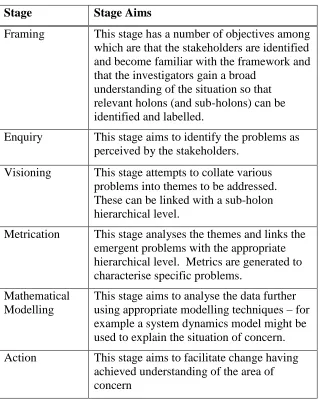
Checkland (1988) argues that researchers who apply systems concepts to investigate social situations face difficulties because these situations are never clearly defined. He prefers to use the word ‘Holon’ rather than ‘system’ as it highlights a distinctive approach to investigating such situations. We consider a Holon to be an abstract representation of a social situation that captures current problems (Bell and Warwick, 2007). The Holon Framework involves six
_______________________________________________________________________________
Stage Stage Aims
Framing This stage has a number of objectives among which are that the stakeholders are identified and become familiar with the framework and that the investigators gain a broad
understanding of the situation so that relevant holons (and sub-holons) can be identified and labelled.
Enquiry This stage aims to identify the problems as perceived by the stakeholders.
Visioning This stage attempts to collate various problems into themes to be addressed. These can be linked with a sub-holon hierarchical level.
Metrication This stage analyses the themes and links the emergent problems with the appropriate hierarchical level. Metrics are generated to characterise specific problems.
Mathematical Modelling
This stage aims to analyse the data further using appropriate modelling techniques – for example a system dynamics model might be used to explain the situation of concern.
Action This stage aims to facilitate change having achieved understanding of the area of concern
Table 1: Aims of Holon Framework Stages
As has been described elsewhere (Bell and Warwick, 2007; Warwick, Bell and Kennedy, 2005) the Holon Framework combines soft elements (Framing,
Enquiry, Visioning) and hard elements (Metrication and Modelling). It addresses ‘the who’, ‘the what’, and ‘the where’ type questions for the current state S0, and
generates a vision of a desired state S1. Additionally, this produces a relevant
metrics programme, and the collected metrics can be used as dynamic behaviour patterns. It is then possible (using quantitative modelling techniques) to tackle ‘the how’, ‘the why’ and ‘the when’ type questions (Bell et al, 2005). The most important traits of this framework may be summarised as:
1. It provides management groups with an holistic view of a situation;
2. The use of a soft methodology to enable the capture of the stakeholders’ point of view;
3. It enables control of the effects of bounded rationality;
_______________________________________________________________________________ 5. The creation of a relevant metrics programme allows progress and the effects
of change to be assessed;
6. By integrating quantitative modelling into the management process emphasis is placed on developing model ownership;
7. It allows discussion of the ‘best solution’ to achieve the vision given the cost constraints;
8. It encourages the use of models for examining various ‘what-if’ scenarios.
The Framing and Enquiry stages are means of exploring issues, drawing out themes, boundaries and experiences that the stakeholders feel are important within the situation of concern. These first two stages encourage a thorough examination of the current state, S0, resulting in its definition. Next we move to Visioning in
which the client group explore a vision of the future that they feel is feasible and desirable. The vision will be expressed in terms of the holon structure used throughout the enquiry and may be expressed formally in terms of root
definitions. It is important though that the discussion of S0 and the vision, S1, are
linked through issues and problems. The stakeholder group should identify the critical issues and problems, which require resolution if movement towards the vision is to be achieved. The issues and problems will generate goals, questions and metrics. The Metrication stage allows the stakeholders to learn more about the problems and issues in S0, and the subsequent Metrics Collection Stage
enables them to measure their progress towards S1. This is followed by the Action
stage in which modelling is undertaken to clarify the processes which can effect movement from S0 to S1.
Naturally, although the stages are denoted sequentially, it is likely that, for a large project, different modes of working may happen simultaneously. For example, the metric collection process could well be undertaken over a long period of time (a year or more) and during this time modelling might be undertaken, further enquiry might take place, and the vision might change as the environment changes.
4 Learning in organisations
The concept of organisational learning has been in the management literature for many years and is now a widely recognised term (Easterby-Smith et al, 1999). Many authors have sought to define the term organisational learning and the classic work of Argyris (1977) considers organisational learning as a process that detects and corrects errors, and is carried out by individuals within the
organisation acting as agents for the organisation. Weick (1991) considers one of the defining properties of learning (of any type) to be a combination of same stimulus and different response and in the same vein Millett (1998) comments that if we are unwilling to reconsider our basic assumptions then we are confined to what he terms a “destination mentality” where the end point is defined and our only concern is how to get there.
_______________________________________________________________________________ learning can be considered as a change in the range of potential behaviours and so may not always be observable.
Easterby-Smith et al (1999) make a useful distinction between the technical view of organisational learning (learning is based around information and how we process, interpret and respond to it) and the social perspective in which learning focuses on experience and the way that people make sense of the world around them. The former view is rather more formal while the latter is embodied more in social interaction and conversations.
The classic example of the technical view is found in the work of Argyris and Schon who describe single and double loop learning (Argyris and Schon, 1978). Their thesis is that in describing the interaction between individuals and
organisations we need to distinguish between those theories (usually tacit
structures) that are implicit in governing our actual behaviour (so-called
theories-in-use) and those that are used to describe to others what we do, or would like
others to think we do (called espoused theory). These two theories of action might be quite different but provided they do not become disconnected the tension between them can create an impetus for reflection and dialogue. As stated above, learning occurs when errors are detected which is to say that we encounter or experience something which does not fit with current knowledge (or our theory-in-use). Single loop learning (or adaptive learning) occurs when the action taken is to
… adjust our operational thinking and behaviour in a way that allows us to accommodate the anomaly without having to make any fundamental changes to our underlying belief or value system.
(Borden, 2005)
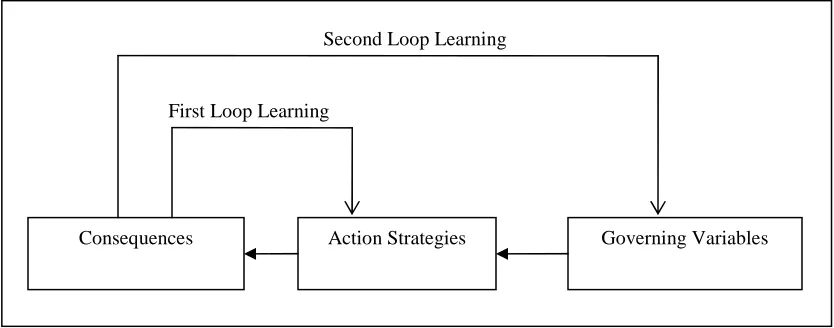
Double loop learning requires a rather more complex response in which the basic beliefs and value systems are called into question and they are examined and possibly altered or disregarded. This is illustrated in Figure 1 below.
Figure 1: Double loop Learning (Argyris and Schon, 1978)
Governing Variables Action Strategies
Consequences
Second Loop Learning
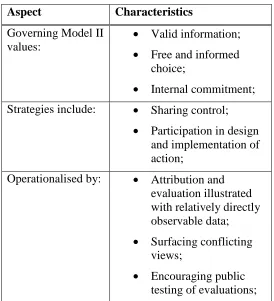
_______________________________________________________________________________ Argyris and Schon distinguish between Model I and Model II organisations so that the former have policies and practices that encourage single loop learning (rules, regulations and structures are paramount and rigid) and the latter have a more fluid structure that allows rapid responses (in terms or rules, regulations structures and beliefs) to changes in circumstances and environmental conditions. Model II behaviour is far less common in organisations and if an organisation is to exhibit Model II behaviour then it would be expected to have the characteristics listed in Table 2.0.
Aspect Characteristics
Governing Model II values:
• Valid information;
• Free and informed choice;
• Internal commitment; Strategies include: • Sharing control;
• Participation in design and implementation of action;
Operationalised by: • Attribution and evaluation illustrated with relatively directly observable data;
• Surfacing conflicting views;
• Encouraging public testing of evaluations;
Table 2: Encouraging Double loop Learning (Anderson, 1997)
In summary, single loop learning is the correction of errors without altering the organisation’s policies or objectives, whilst questioning these policies and objectives themselves involves double loop learning.
5 Learning and the Holon Framework
_______________________________________________________________________________ two learning perspectives of Easterby-Smith et al. (1999) relating to the technical view and the social perspective of organizational learning.
Dealing first with the social perspective, the view here is that learning is something that can emerge from both casual and formal social interactions and conversations through which ideas, feelings, information etc. are communicated. The idea that these conversations within the organization play an important role in helping to define the organization’s culture has been commented on in the
literature where, for example, Seel argues that organisational culture is an emergent property of organisational activity.
“Organisational culture is the emergent result of the continuing negotiations about values, meanings and properties between the members of that organisation and with its environment.”
(Seel, 2000, p.3)
As learning from a social perspective occurs so the organisational culture evolves and gaining an understanding of the culture through these conversations, values, properties etc. provides a window onto the myths and meanings that individuals or groups believe. This can then uncover opportunities for learning from each other or for challenging these beliefs with experimental or observational data. Previous work (Warwick et al, 2005) has shown how application of the Holon Framework can provide just such a window and shed light onto many of the underlying beliefs and views held by individuals or groups.
_______________________________________________________________________________
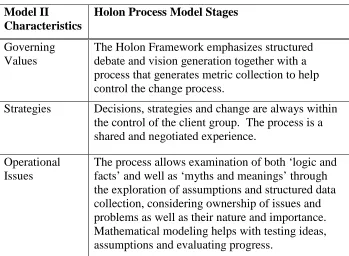
Model II Characteristics
Holon Process Model Stages
Governing Values
The Holon Framework emphasizes structured debate and vision generation together with a process that generates metric collection to help control the change process.
Strategies Decisions, strategies and change are always within the control of the client group. The process is a shared and negotiated experience.
Operational Issues
The process allows examination of both ‘logic and facts’ and well as ‘myths and meanings’ through the exploration of assumptions and structured data collection, considering ownership of issues and problems as well as their nature and importance. Mathematical modeling helps with testing ideas, assumptions and evaluating progress.
Table 3: Addressing Model II Characteristics
_______________________________________________________________________________
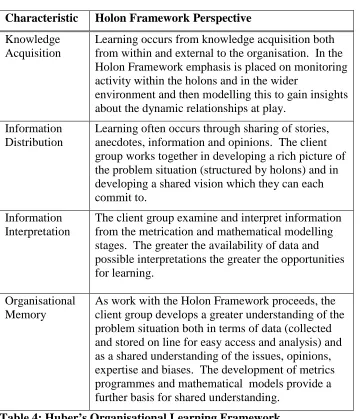
Characteristic Holon Framework Perspective
Knowledge Acquisition
Learning occurs from knowledge acquisition both from within and external to the organisation. In the Holon Framework emphasis is placed on monitoring activity within the holons and in the wider
environment and then modelling this to gain insights about the dynamic relationships at play.
Information Distribution
Learning often occurs through sharing of stories, anecdotes, information and opinions. The client group works together in developing a rich picture of the problem situation (structured by holons) and in developing a shared vision which they can each commit to.
Information Interpretation
The client group examine and interpret information from the metrication and mathematical modelling stages. The greater the availability of data and possible interpretations the greater the opportunities for learning.
Organisational Memory
As work with the Holon Framework proceeds, the client group develops a greater understanding of the problem situation both in terms of data (collected and stored on line for easy access and analysis) and as a shared understanding of the issues, opinions, expertise and biases. The development of metrics programmes and mathematical models provide a further basis for shared understanding.
Table 4: Huber’s Organisational Learning Framework
Double loop learning in organisations is still a rare phenomenon in the sense that many organisations are not structured appropriately and do not have the required organisational culture to allow the characteristics of Model II behaviour to emerge. By using the Holon Framework over an extended period of time we contend that Model II behaviour can be developed so that, at least for the duration of the study, organisational learning can occur.
We now look at how the Holon Framework can assist in structuring the quality management and enhancement cycle for academic library management.
6 Encouraging single and double loop learning in library management
In this paper we have discussed some of the characteristics of double loop learning and indicated how application of the Holon Framework can bring about some of the discussions, explorations and actions necessary for the
_______________________________________________________________________________ mathematical in style. This leads to the conclusion that library OR to date has been almost exclusively related to single loop learning processes as they have not had the capability to assist with policy definition and strategic thinking.
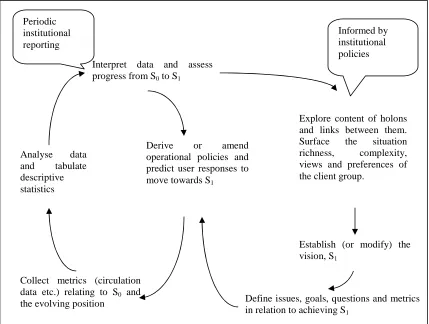
In order to assist with strategic thinking the Holon Framework uses ideas drawn from systems thinking and we now consider how it can assist in bringing about the process of double loop learning within a library management context. Figure 2 shows the double loop learning process reconfigured to incorporate the stages of the Holon Framework.
Figure 2: Double loop Learning Links with the Holon Framework
In Figure 2 the looping process on the left of the diagram corresponds with the single loop learning process. This relates to the optimisation of current
operational policies and strategy and these activities would incorporate the use of the mathematical modelling techniques often described in the library OR
literature. This corresponds to the Modelling and Action stages of the Holon Framework (see Table 1).
The looping process on the right of the diagram represents the second learning loop. These activities correspond to the Holon Framework activities from Framing to Metrication.
Explore content of holons and links between them. Surface the situation richness, complexity, views and preferences of the client group.
Establish (or modify) the vision, S1
Define issues, goals, questions and metrics in relation to achieving S1
Derive or amend operational policies and predict user responses to move towards S1
Collect metrics (circulation data etc.) relating to S0 and the evolving position
Analyse data and tabulate descriptive statistics
Interpret data and assess progress from S0 to S1
Informed by institutional policies Periodic
_______________________________________________________________________________ The single loop learning process involves the continual monitoring of progress towards the vision, S1, and whether we continue around the single learning loop or
need to return to earlier stages of the Framework for second loop learning depends on the extent to which the dynamics of the change we observe in moving from S0
to S1 are consistent with current thinking or not.
7 Conclusion
This paper has described how the application of the Holon Framework can help in promoting opportunities for both single and double loop learning within HE planning processes and in particular for departments within universities. In contrast to more orthodox approaches to planning it is systemic rather than reductionist, participative rather than passive and promotes stakeholder involvement in a shared vision. This combination of attributes allows the emergence of Model II type behaviour which encourages double loop learning within which the client group re-examines their assumptions, strategies and objectives.
Furthermore, the Holon Framework contributes to each of the four processes identified by Huber that contribute to organisational learning so that the library management team can be responsive and fleet-of-foot in dealing with an extremely turbulent educational environment.
By adopting this type of approach library management teams can formalise their planning processes and integrate the traditional library OR models meaningfully into the planning and review cycle. The Framework also promotes reflection on, and re-examination of, assumptions and preferences in defining the future of the library, its policy and its relation with library users. As with many soft systems interventions, the client group would be drawn from all library stakeholders including library users and the process would be managed by someone with experience of working with this framework.
By merging the more traditional library modelling techniques with frameworks such as this that draw on elements from soft systems thinking, a more powerful management tool emerges. Library managers can now broaden the learning opportunities available to them to include both single and double loop learning within the same multi-methodology. Not only can new policies be developed and reviewed on a regular basis but the control of the change process required for movement towards S1 is enabled by a carefully structured metrics collection
programme. In this way, modelling is seen not just as a useful ‘add-on’ to other management techniques, but an integral part of management and control process
References
Anderson, L. (1997) Argyris and Schön's theory on congruence and learning, cited in Chris Argyris, Theories of action, double loop learning and organisational
_______________________________________________________________________________ Argyris, C. (1977) Double loop learning in organisations, Harvard Business
Review, 55 (5), 115-125.
Argyris, C. and Schon, D. (1978) Organisational learning: a theory of action
perspective, Reading, PA: Addison Wesley.
Bell, G. A., Cooper, M. A., Warwick, J. and Kennedy, M. (2000) The development of the Holon and Costing Framework for higher education management, Paper Presented at the 18th International Systems Dynamics Conference, Bergen, Norway.
Bell, G. A., Cooper, M. A., Warwick, J. and Kennedy, M. (2005) The Holon Framework: process improvement and control for higher education, In On
Becoming a Productive University (Eds. Groccia and Miller), Bolton, VT: Ankar
Publishing.
Bell, G. A. and Warwick, J. (2007) Towards establishing the use of holons as an enquiry method, International Transactions in Operational Research, 14 (1), 55-73.
Borden, V. (2005) Taking institutional research to the next level: a learning framework, Keynote Address at the Association for Institutional Research in the
Upper Midwest Forum, Minnesota, USA.
Brookfield, D. and Smith, D. (2006) Managerial intervention and instability in healthcare organizations: the role of complexity in explaining the scope of effective management. Risk Management, 8, 268–293.
Checkland, P. B. (1981) Systems Thinking, Systems Practice. Chichester: John Wiley and Sons.
Checkland, P.B. (1988) The case for “Holon”, Systems Practice,1 (3), 235-. 239.
Chen, C-C. (1976) Applications of operational research models to libraries, Cambridge, MA.: MIT Press.
Dahlin, T. C. (1991), Operations research and organisational decision-making in academic libraries, Collection Management, 14 (3/4), 49-60.
Easterby-Smith, M., Burgoyne, J. and Araujo, L. (1999) Organisational Learning
and the Learning Organisation, London: Sage Publishing.
Franz L. and Morrison, D. (2005) Random acts of progress versus planned
productivity via strategic planning, In On Becoming a Productive University (Eds. Groccia and Miller), Bolton, VT: Ankar Publishing.
Galbraith, P. L. (1998) When strategic plans are not enough, System Dynamics:
An International Journal of Policy Modelling,10 (1 and 2), 55-84.
Guskin, A. and Marcy, M. (2005) Institutional transformation in a climate of reduced resources, In On Becoming a Productive University (Eds. Groccia and Miller), Bolton, VT: Ankar Publishing.
_______________________________________________________________________________ Kantor, P. (1979) Review of library operations research, Library Research, 1, 295-345.
Kraft, D. H. and Boyce, B. R. (1991) Operations Research for libraries and
information agencies, San Diego, CA.: Academic Press.
Millett, B. (1998) Understanding organisations: the dominance of systems theory,
International Journal of Organisational Behaviour, 1 (1), 1998, 1-12.
Morse, P. M. (1968) Library effectiveness: a systems approach, Cambridge, MA.: MIT Press.
Robbins, S. and Barnwell, N. (1998) Organisational Theory: Concepts and Cases, Sydney: Prentice-Hall.
Rosenhead, J. and Mingers, J. (2001) Rational analysis for a problematic world
revisited, Wiley: Chichester.
Seel, R., (2000) Culture and complexity: new insights on organisational change,
Organisations and People, 7, (2), 2-9.
Senge, P. M. (1990) The fifth discipline, New York, NY: Doubleday.
Simon, H. A. (1957) Models of Man, New York, NY: John Wiley and Sons.
Trow, M. (1994) Managerialism and the academic profession: the case of England, Higher Education Policy, 7 (2), 11-18.
Warwick, J., Bell, G. A. and Kennedy, M. (2005) Exploring myths and meanings in higher education planning, Presented at 1st International Conference on
Computing Research Excellence in Developing Countries, Makrere University,
Uganda.
Warwick, J. (1992) A review of some modelling approaches to the loan and duplication of academic texts, Journal of Librarianship and Information Science, 24, (4), 187-194.
Warwick, J. (2009) On the future of library operational research, to appear in
Library Management.
Weick, K.E. (1991) The nontraditional quality of organizational learning,
Organization Science, 2, (1),116-124.