An Evaluation of Natural Frequency, Two-body Loss Rate
Constant and Visibility of Ramsy Frienges as a Function
of Magnetic Field Strength
JITENDRA Kr. SINGH1 , JAWAHAR LAL SINGH2 and L. K. MISHRA
Department of Physics,
Magadh University, Bodh-Gaya-824234, Bihar, INDIA. 1
Department of Physics,
Alma-Iqabal College Bihar-Sharif, Nalanda, Bihar, INDIA. 2
Head, Department of Physics, Maharaja College, Ara, Bihar, INDIA.
(Received on : July 6, 2012) ABSTRACT
Using the theoretical formalism of K. Goral et al.9, we have evaluated the natural frequency, two-body loss rate constant K2 and visibility of Ramsy fringes as a function of magnetic field strength Bevolve (G). Our theoretically evaluated results are in
satisfactorily agreement with the experimental data.
Keywords: Ramsy fringes, two-body loss rate constant, visibility of Ramsy fringes, Feshbach resonance, hyperfine states.
1. INTRODUCTION
The study of ultra cold molecules produced in atomic Bose and Fermi gases is one of the most important development s in cold atom physics1. One of the most successful experimental techniques to produce molecules in atomic Bose-Einstein condensates utilized adiabatic sweeps of a magnetic field tunable Feshbach resonances level across the zero energy threshold of the colliding atoms. In this period a highly excited diatomic vibration bound states can
offers the possibility of precise informatics measurements of the energies of the relevant states through the measurement of bulk properties of the gas.
In recent experiments7,8 the frequency and visibility of atom-molecule Ramsey fringes were observed. In this experiments, a Bose-Einstein condensate of 85
Rb atom in( F=2, mF =-2) hyperfine states was exposed to a sequence of spatially homogeneous magnetic field pulses on the high-field side of the 155G Feshbach resonances. The evolution period of constant magnetic field strength Bevolve separated the pulse by an amount of time tevolve.. In the course of the experiments7,8 the final densities of atoms were recorded after expanding the cloud. The measurements were repeated with variable evolution time and magnetic field strength Bevolve .
Interference between different components of a partially condensed Bose gas was identified. There is a two different components of the final atomic cloud : a remnant Bose-Einstein condensate and a brest of atoms with a comparatively high mean kinetic energy. The magnitude of the brest of atoms and remnant condensate fractions exhibited an oscillatory dependence of the evolution time of the magnetic field pulse sequence. The existence of the third component of missing atoms was inferred from the difference between the initial and total final members of the detectable atoms. It was suggested that the missing atoms indicated molecular production and the oscillations were interpreted in terms of interference between atoms and molecules during the evolution period of the pulse sequence.
In this paper, using the theoretical formalism of K. Goral etal.9 we have theoretically evaluated the natural frequency υ0 of Ramsey fringes, two-body loss rate constant K2 and the visibility of Ramsey fringes as a function of magnetic field strength Bevolve . Our theoretically evaluated results are in good agreement with the experimental data7,8.
2. MATHEMATICAL FORMULAE USED IN THE EVALUATION
One first considers a pair of 85Rb atoms in a spherically symmetric trap exposed to a spatially homogeneous magnetic field 10,11. The degrees of freedom of the center of mass and relative motions of the atom pair are then exactly decoupled. The dynamics of the relative coordinate r is determined by the Hamiltonian of the form
2 2
2
( )
( , )
2
B trap
H
V
r
V B r
m
−
=
h
∇ +
+
(1)Here Vtrap(r) is the potential of the atom trap, m is the atomic mass and V(B,r) is the magnetic field dependent binary potential. In general, H2B depends on all hyperfine states of the atoms which are strongly coupled by the Feshbach resonance state Фres (r) . The analogy of the condensate mode is realized by the lowest energetic state of two atoms above the dissociation threshold of the pair interaction potential V(B,r) whose wave function Ф0(r) obeys the stationary Schrodinger equation
2B 0
( )
0 0( )
H
Φ
r
= Φ
E
r
(2)sequence. The amplitude for the probability to detect the atoms in the state Ф0 at the final time tfinal of the pulse sequence provides the analog of the amplitude for the remnant condensate fraction and is determined by
2B( 0 0) 0/ 2B( final, ) /0 0
T Φ ↔ Φ =〈Φ U t t Φ 〉 (3)
Here
U
2B(
t
final, )
t
0 is the time evolution operator which satisfies the Schrodinger equation2B( , )0 2B( ) 2B( , )0
i U t t H t U t t
t
∂ =
∂
h (4)
2B
(
final, )
0U
t
t
can be factorized in the evolution operators Uno.1( , ),t t1 o Uno.2(tfinal, )t2 andU
evolve(
t
evolve)
associated with the first and second magnetic field pulses and with the evolution period of the sequence respectively. Here t1 is the time immediately after the first magnetic pulse t2 is the time at the beginning of the second magnetic field pulse and (t2 –t1) =tevolve is the duration of the evolution period. The factorization of2B
(
final, )
0U
t
t
yields2B(final, )0 no.2(final, )0 evolve(evolve) no.1(final, )0
U t t =U t t U t U t t
(5) The frequency of the Ramsy fringe is obtained by equation
( ) ( )
evolve
c avg evolve evolve e evolve
N =N −αt +AExp−βt Sinωt + ∆φ
(6) Here
ω
e is the angular frequency1
2 2 2
0
2 (
(
) )
2
e
β
ω
π ν
π
=
−
A is the amplitude of the interference fringes.
Navg is the average number of atoms determined from the fringe visibility
α
andβ
are fitting parametersα
=loss rate of atomsβ
=damping rateφ
∆
=phase shift of the Ramsy fringesThe two-body loss rate constant K2 is determined by the formulae
2 2 c( )
avg
K n t
N
α
= 〈 〉 (7)
Where
〈
n t
c( )
〉
is the average condensate density.The visibility of the Ramsy fringes are determined by the following equation.
.1 .2
. .
1
.1 .2 2
. .
1 ( 4 [ ]
1 ( 4 [ ]
no no o b b o Ramsy
no no o b b o
Exp n P P
V
Exp n P P
ν
ν − −
=
+ −
(8) Here
P
o b.no.1 is the probability of molecular production in the first magnetic field pulse and probability isP
b o. no.2 their reconversion into atom pairs in the lowest energetic quasi continuum state Ф0 (r). n is the homogeneous gas density andν
is the volume.3. DISCUSSION OF RESULTS
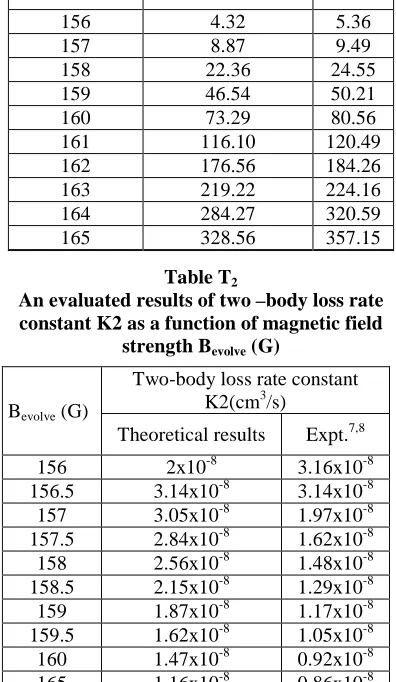
compared with the experimental data7,8. The evaluation has been performed with the help of theoretical formalism developed by K. Groal etal 9 .The results are shown in table T1, T2 and T3 respectively. In table T1, using equation(6) we have calculated the natural frequency
ν
o of Ramsy fringe. Our evaluated results are lower than the experimental data7,8 in magnitude but the trend is the same. The natural frequencyν
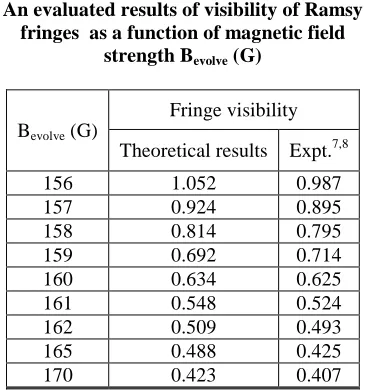
o increases with magnetic field strength Bevolve (G).Our theoretical results also show that for Bevolve >158G which is far away from the zero –energy resonance at Bo =155G, the fringe frequency closely matches with the vibrational frequencies associated with weakly bound molecular state 10,11. The two-body loss rate constant K2 is determined using equation (7) and results are shown in table T2 with the experimental data. The rate constant K2 indicates the loss of condensate atoms due to energy transfer from the magnetic field pulses. This derives initially weakly interacting Bose-Einstein conden-sates into a strongly correlated non-equilibrium state. In this calculation the deeply inelastic spin relaxation phenomena has not been included 12. Our theoretically evaluated results of loss constant K2 are in good agreement with the experimental data7,8. Visibility of Ramsy fringes are determined using equation (8) and the results are shown in table T3 along with the experimental data7,8. The evaluation has been performed using exact transition probability.1 .
no o b
P
and .2 .
no b o
P
for both the pulses of realistic sequence and their counterparts as a function of magnetic field strength13. Our theoretically evaluated results show that the fringe visibilities
decreases with the increase of magnetic field strength and for high field the decrease is almost constant. Our theoretically evaluated results are in satisfactorily agreement with the experimental data.
Table T1
An evaluated results of the natural frequency
υ0 of Ramsy fringes as a function of magnetic
field strength Bevolve (G)
Bevolve (G)
Natural frequency υ0 (MHz)
Theoretical results Expt.7,8
155 2.85 4.22
156 4.32 5.36
157 8.87 9.49
158 22.36 24.55
159 46.54 50.21
160 73.29 80.56
161 116.10 120.49
162 176.56 184.26
163 219.22 224.16
164 284.27 320.59
165 328.56 357.15
Table T2
An evaluated results of two –body loss rate constant K2 as a function of magnetic field
strength Bevolve (G)
Bevolve (G)
Two-body loss rate constant K2(cm3/s)
Theoretical results Expt.7,8
156 2x10⁻⁸ 3.16x10⁻⁸
156.5 3.14x10⁻⁸ 3.14x10⁻⁸
157 3.05x10⁻⁸ 1.97x10⁻⁸
157.5 2.84x10⁻⁸ 1.62x10⁻⁸
158 2.56x10⁻⁸ 1.48x10⁻⁸
158.5 2.15x10⁻⁸ 1.29x10⁻⁸
159 1.87x10⁻⁸ 1.17x10⁻⁸
159.5 1.62x10⁻⁸ 1.05x10⁻⁸
160 1.47x10⁻⁸ 0.92x10⁻⁸
Table T3
An evaluated results of visibility of Ramsy fringes as a function of magnetic field
strength Bevolve (G)
Bevolve (G)
Fringe visibility
Theoretical results Expt.7,8
156 1.052 0.987
157 0.924 0.895
158 0.814 0.795
159 0.692 0.714
160 0.634 0.625
161 0.548 0.524
162 0.509 0.493
165 0.488 0.425
170 0.423 0.407
REFERENCES
1. T. Kohler and K. Bernett, Phys. Rev. A 65, 033601 (2002).
2. T. Kohler, T. Gasenzer and K. Bernett, Phys. Rev. A 67, 013601 (2003).
3. S. Durr, T. Volz, A. Marte and G. Rempe, Phys. Rev. Lett. (PRL) 92, 020406 (2004).
4. K. Xu, T. Mukaiyama, J.R. Abo-Shabir,
J. K. Chin, D.E. Miller and W. Ketterle, Phys. Rev. Lett. (PRL) 91, 210402 (2003).
5. T. Mukaiyama, J. R. Abo- Shabir, K. Xu, J. K. Chin and W. Ketterle, Phys. Rev. Lett. (PRL) 92,180403 (2004). 6. S. Durr, T. Volz and G. Rempe, Phys.
Rev. A 70, 031601 (2004).
7. N. R. Claussen, S. J. J. M. Kokkelmans, S. T. Thompson, E. A. Donley, E. Hodby and C. E. Wieman, Phys. Rev. A 67, 060701 (2003).
8. E. A. Donley, N. R. Claussen, S. T. Thompson and C. E. Wieman, Nature (London) 417, 529 (2002).
9. K. Goral, T. Kohler and K. Bernett, Phys Rev. A 71, 023603 (2005).
10. T. Kohler, E. Tiesinga and P. S. Jullienne, Phys. Rev. Lett. (PRL) 94, 020402 (2005).
11. S. T. Thompson, E. Hodby and C. E. Wieman, Phys. Rev. Lett. (PRL) 94, 020409 (2005).
12. E. Timmeemans, K. V. Kherntgyan and H. He, Phys. Reports, 335, 269 (2007). 13. R. A. Duine and H. T. F. Stoof, J. Phys.