Importance of Plants in the Restoration and
Environment Development – A Case Study
Rejimon Joseph
Farmer Scientist, Njallani House, Parakkadavu, Kattappana P.O, Idukki Dist. PIN : 685508. Ph: 04868-273169, Mob: 09447105070.
Email: [email protected]
Paper No. 121 Received: April 19, 2013 Accepted: July 3, 2013 Published: September 28 , 2013 ©2013 New Delhi Publishers. All rights reserved
Citation: IJAEB: 6: 759-763 December (Special Issue) 2013
Introduction
St. Francis Assisi called sun “My brother sun” and moon “My sister moon”. This Fransican thought has come to the present day world more amplified. Now we know that we, human beings are not isolated beings. We are related to grass, trees, birds, spiders, animals, earth, air and water. Everyone is a part of universal web.
This environmental awareness has cautioned man regarding the degradation of our surroundings. Organized protests against the pollution and exploitation of natural resources have seen arising from different parts of the world. In this context Kerala has become a key point. UNESCO has given Heritage status to the western ghats. Out of the 39 areas studied under ecological background 20 of them are in Kerala. Gadgill Committee report also points out the same concept.
A study of the history of western ghats show that its natural surrounding are gradually depleting. This environmental deterioration of the western ghats has an underlying relationship with cultivation. My study is based on the environmental destruction happened to the western ghats and for providing systematic approach to restore the environmental loss occurred to it. As I was born and brought up in lap of Western ghat village, Kattappana in Idukki District, the changes occurring to my surroundings attracted me a lot. In those days, Kattappana was a backward village in the undeveloped Idukki District. Everyone living here was poor farmers migrated from low lands of Kerala, in search of better prospects. Without sufficient food, clothing and abode and also without any
infrastructure facilities, the life was actually in tragic stage. In such a deprived state I could not complete my college education.
The pollination studies done by Griger Mendel attracted me a lot. The method of changing the nature of plants through hybridization was a new information to me. I decided to apply this knowledge in improving the quality of cardamom in my family farm.
A keen observation of my farm and my surroundings enabled me to understand the loss occurring to the main crops of highrange, the sorrows of the farming community and the changes appearing in the environment of western ghat. I decided to work for fining a remedy to these issues. Keeping this vision in my mind, the projects worked out by me have become 100% fruitful and I am going forward to expand my action in this way.
Objectives
In order to carry out my work in a fruitful manner, I summarized the issues and drafted five objectives for achieving my aim.
1. To study the life situations of the farming community and the factors driven them to their deplorable condition.
2. To study the changing pattern of agriculture in highranges and its impact on the environment. 3. To study the migration of new crops to this
4. To propose remedial measures to restore the green canopy of the highrange and the vitality of the soil. 5. To propose new methods of sustainable farming to
enrich both the environment and the life of the farmers.
Methodology
In order to carry out my research work on the above mentioned objectives, they are classified into two groups. A field study is conducted to collect first hand knowledge on the environmental damages and the deprivation of the farming community in the highranges. Farm trial method is followed for developing advanced varieties of crops with high yield and better adaptability.
(a) Report on the field study conducted
Western ghats is the life savior of our state. Water, fresh air and food item are her gift. The supply of these essential item will continue only if the ecology of this area is protected and kept natural. But some misguided agricultural practices have boosted the degradation.
From the early history cardamom was the main crop of the western ghat. Along with it pepper and coffee were also grown. When the price of cardamom and yield fell down, farmers compelled to shift to annual crops like tapioca, banana, ginger, rice etc. For this huge deforestation required. The high dose of chemical fertilizer input proposed by the agricultural scientist to the cardamom and the pepper farmers had a negative influence in the development of cardamom and pepper cultivation in this area. Fungus and pests attack increased the loss. Rootes of the pepper vine and cardamom damaged and leaves become yellow and fell down. Farmers gradually withdraw from the long time crops. They started to the growing of annual crops. For this a lot of forests was to be cut down. The climate of the western ghats gradually changed. A thin shower, popularly known as ‘40th Number Rain’ which means, continuous thin shower of prolonged rain, characteristic of this area, was a unique gift. It helped to retain humid condition of the air and earth. That type of climate continued to exist for about 7 months from June to December. January and February were misty months. During March, April, May, we got intermittent summer rains. But that gifted climate changed drastically. Availability of the rain water reduced, gradual rise in atmospheric temperature is felt, and streams and water channels disappeared. Cardamom no longer considered as the main crop of high ranges. Pepper garden also become not yielding any returns. Farmers were trying
very hard to meet the both ends meet. Actually farmers were living in tears.
(b) Remedial measures proposed for the restoration and environmental development
1. Experiments in the cardamom sector
In order to make cardamom farming a profitable one, I decided to develop a better variety of cardamom. My long observation and experiments in my family cardamom garden enabled me to cross pollinate two local cardamom varieties and develop a new hybrid cardamom variety, named as ‘Njallani Cardamom’, named after my family name, ‘Njallani’. This wonderful variety was released to farmers in 1987. I would like to say that for the achievement of Njallani Cardamom, I am highly thankful to the God who strengthened my hand and sharpened my mind. The poverty of my family was the main factor which influenced me to look into this area and do this innovation. The better yield, pest resistance and high adaptability to the surroundings attracted the farmers very much. Discarding the old plants soon they changed into planting ‘Njallani Cardamom’. Also the farmers are seen investing their surplus income gained from farming the above variety, in the development of their area and society. More shops, entertainment centers and better institutions giving quality education came up. Most farmers owned their own vehicles. Njallani Cardamom was the harbinger of social development. They whole heartedly welcomed it.
Since cardamom is the only plant which thrives well under tree, keeping good forest has become a prerequisite for better yield. Thus the vanished forest reappeared in the arena. Now 95% of the farmers are planting Njallani Cardamom. Dr. M.S. Swaminathan has appreciated the commendable service rendered by Njallani Cardamom in improving the crop output and financial status of the high range farmers. Since Njallani Cardamom has become a profitable crop, farmers expanded its planting to everywhere possible and the green envelop reappeared there also. The per hectare yield of cardamom up to 1987 was below 60 Kg. to 200 Kg./ha. It jumped to average 500 Kg to 1000 Kg. The impact of Njallani Cardamom in the farming sector can be understood from the table 1. A fivefold increase in production is evident from it.
Table 1: Impact of Njallani Cardamom
Cardamom Njallani Cardamom
Average 3800 M.T. *14000 M.T.
Productivity (National)
* This jump in productivity is due to the farming of Njallani Cardamom.
Before the arrival of Njallani Cardamom seedlings were used for planting, which gave yield only after four years. Some farmers also used to plant five to seven suckers in one pit. Since Njallani Cardamom pocesses high hybrid vigor, I could find that only one sucker needed to plant in a single pit. It could produce up to 15-30 tilling within one year of planting and gave yield from the second year itself. This single sucker planting method I popularized among the farmers. Now 100% of the farmers following this single sucker planting method. For the easy development of cardamom tilling in the nursery I also developed Pathiyan method, which further reduced the yielding time from two years to one year. Acute shortage of labor in this sector compelled me to develop ‘Kuzhiyilla planting method’ through which the labor requirement for planting one hectare cardamom brought down from 120 man power to 10 manpower.
My prolonged experience with cardamom cultivation revealed to me that the huge quantity of chemical fertilizers and high dose of pesticides advised by the scientist are not helpful neither to the health of the plants nor to the viability of the soil. It actually damages the immune system of the plant and organic nature of the soil. It also destroys the friendly flies and bio-organisms. Hence the ecological degradation due to the application of the propositions of the agricultural scientists actually destroys the environment. From my keen observation it is found that major part of the farmers used more manure, fertilizers and pesticides along with plant growth boosters, ten times more than the High Production Technology (HPT) norms and above what plants needed, due to ignorance and lack of guidance. But the same level of yield, some times higher yield, could be obtained using special type and dose of fertilizers developed by me in systematized time intervals. By this way the 79,000 M.T. chemical fertilizer use could be stopped in cardamom sector alone every year. This Njallani Manure management system can be studied in two hours of training. Through this the chemical fertilizer use can be brought to ‘0’ level in five years and switch over to organic farming subsequently.
In this connection I would like to report that a similar study by the scientists of Mc Gill University of Montreal, Canada and Minnesota University of U. S., appeared in the Times of India (3rd August 2012) have conducted and arrived at a conclusion, which is same as mine, after studying the crop patterns of 150 countries, including India. The report says “India’s wheat and rice production can be increased over by 60%, sugar cane production by 41% and cotton by 73% by 2050 without cutting down forests or increasing farmed areas in any other way. It also says that the overall fertilizer usage can be reduced if judiciously applied, without adversely affecting the yields. They also point out that increase in agricultural production is associated with negative environmental impacts, including heavy use of fertilizer, most of which washes away into the water systems, causing huge damage. These findings increases the relevance of Njallani Manure Management System, which has been followed by a majority of farmers, in the present era. Another important point to remembered in this connection is the restoration of the lost forest in the areas were Njallani Cardamom was planted. As more and more farmers are willingly coming forward to plant this wonder variety, automatically these areas also bringing under forest cover. The reforestation work is carried out without spending any money from the Government account. This reforestation via planting Njallani Cardamom is done voluntarily by farmers without any government aid while crores of rupees are spending under national reforestation scheme.
But it is too tragic to see that neither central government nor the state government have come up and recognize my achievement. And also, Spices Board and State Agricultural Department are continuously keeping a blind eye on my inventions. This negligence on the part of the authorities is to be viewed along with the fact that more than 2000 crores of revenue is added per year only because of my invention. But some non governmental organizations like National Innovation Foundation, All India Radio, Karnataka Krishik Sangh, Rotary International, OISCA International and different medias have honored me with their awards. I have also presented six research papers in various science congresses.
1. Experiments in Pepper sector
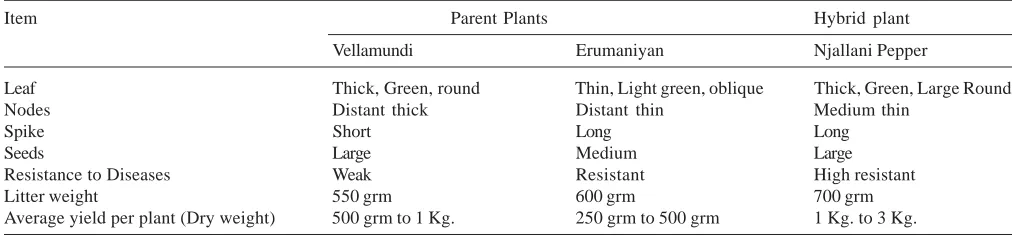
existed a pepper belt. For a long time pepper production in these areas had been showing a decrease, due to the increase in decease and fall in the price. Pepper cultivation gradually became non profitable. Farmers are one by one decided to withdraw from pepper cultivation. This withdrawal of farmers from the pepper cultivation is actually dangerous to the natural conditions of the high ranges. To this gap it is seen that rubber is being welcomed. As the pepper plantations are gradually transforming to rubber plantations, the rich heritage of the bio-diversity of the western ghat is actually under threat. This situation compelled me to concentrate in pepper and has been trying to develop a new variety and a new cultivation practice. My work in this area had started in 1984 and now it is in a position to be released. My new method of pepper planting is designed to bring back the degraded environment of the discarded pepper plantations to its original and natural form. A new hybrid variety of pepper has been developed from ‘Vellamundy’ and ‘Erumaniyan’. Erumaniyan is an indigenous local wild variety of high range. By applying special technique, matured seeds are produced. From it new hybrid generation called ‘Njallani Pepper’ is developed. It is found to be resistant to wilt and other fungal attacks and it gives high yield, about 2 Kg. per plant. 2 Kg. per plant which is higher than National Average Yeald 250 Grms. per plant. The table 2 shows the comparative merit of Njallani Pepper. The work for taking patent right to this technique is under progress.
Njallani ‘Veli’ Pepper (RÅm\n ‘then‘ s]¸À) Planting It is found that high quantity of chemical fertilizers proposed by the packages and practices of Kerala Agriculture University is damaging to the pepper vines and to the ecology of pepper plantation along with the attack of diseases. Excess of fertilizer application actually destroys the natural and humus condition of the soil. The health of
the root system and leaves are also seen damaged. These plants are found to be attacked by fungus and other pests very easily. The plant and the environment are equally damaged due to the above reason and desperate farmers discarded pepper plantations.
The solution to this painful situation I propose is to plant healthy hybrid variety of pepper in natural soil and natural surroundings. The nursing and cropping requires high man power, which is very short in this area. In these circumstances I propose Njallani Veli pepper planting method. The pepper vines are allowed to climb and spread over plastic mesh which is called veli.
Pepper vine of 6½ feet length is required for planting. The trench of 1½ ft. X 1½ ft. size is made to about 30 ft. to 50 ft. long. On the one side of the trench 1½ in. angler or G.I. pipe or eruthrina tree is fixed at a distance of 10 ft. A distance of 8 ft. is given from mesh to mesh. To this pipe plastic coated square mesh of 2 in. x 2 in. or used thick fishing net is fixed to a height of 15 ft. and to the length 30 ft. to 50 ft. ½ ft. of the trench is refilled. After that 4 or 5 different varieties of pepper vines of same growth pattern are planted together. 2½ in. of the vine is kept horizontally in the trench and again ½ in. is filled over it. The top of the vine is fixed to the mesh/net by tying it well with it. On both sides of the trench turmeric plants are planted at a distance of three feet. The turmeric plant is found to prevent the attack of micro organisms in the soil on the roots of the pepper.
The planting is done on the onset of south-west monsoon. On rooting 2 Kg. of Farm Yard Manure and Neem cake is given and covered with soil for every set of plants. By applying special technique it is seen that the vines produced healthy side branches with spikes on both sides of the mesh. As the vertical growth of the vine is limited it is seen that the lateral growth is boosted.
Table 3: Group of pepper plants with similar growth pattern. Table 2: Merit of Njallani Pepper
Item Parent Plants Hybrid plant
Vellamundi Erumaniyan Njallani Pepper
Leaf Thick, Green, round Thin, Light green, oblique Thick, Green, Large Round
Nodes Distant thick Distant thin Medium thin
Spike Short Long Long
Seeds Large Medium Large
Resistance to Diseases Weak Resistant High resistant
Litter weight 550 grm 600 grm 700 grm
Vellamundi Jeerakamundi Perumkodi Panniyoor 1 Karimunda Erumaniyan Panniyoor 2 Panniyoor 3 Njallani Pepper Kumbakkodi Panniyoor 4 Panniyoor 5
Marampedathy Kuthiravally
Njallani Hybrid pepper is seen to be giving better yield in this method. Along with it 2 to 4 more traditional varieties of pepper are to be planted in a pit for better yield. It should be remembered that pepper is originated in the Western ghats. So we have more than 30 traditional varieties of pepper now in high ranges. If we could keep the diversity of the pepper community it appears to the showing a great vigor in growth. It also seen to be showing increased immunity to the diseases.
This practice agrees with the observations of the Gadgill committee report in promoting indigenous varieties of plants in the Western ghats to retain the biodiversity.
Results
a) Cardamom sector
Now 95% of the farmers from Kerala and even from Karnataka and Tamil Nadu are planting Njallani Cardamom. So the destroyed forests are to be restored for the healthy growth of the cardamom plants. More and more farmers are coming to cardamom cultivation. National statistics say that, before 1987 i.e before the arrival of Njallani cardamom the average yield of cardamom in India was only 3,800 M.T. We could see a great jump in production with the arrival Njallani Cardamom. Now the national production is above 14,000 M.T. The increase in revenue due to the planting of this cardamom and following the planting practices is above 2,000 crores. These figures show the development brought by Njallani Cardamom and the role played by it in restoring the environment.
b) Pepper sector
Pepper farmers of the high ranges are now in distress. Almost all of the plantations got destroyed. The existing once give very little yield. These desperate farmers are compelled to seek alternative sources for their lively hood. Thus rubber comes into the sector and most farmers have started planting it. In this area, rubber is a dangerous mono crop. As per findings of the Gadgill committee and also in accordance with the direction of the UNESCO, the bio-diversity of the high ranges is to be preserved. For that a
systematic approach is needed. The help of local farmers is necessary for that. They will come to protect the funa and flora of the western ghat only if their farming activity gives financial security to them. In this problematic situation, I put forward my eco-friendly proposal to rejuvenate pepper cultivation through an affordable and return oriented farming practice. The low input manure applying system without chemical fertilizer and pesticides proposed herewith will boost the return from pepper cultivation and promote the health of the pepper vines. More over as pepper is shade loving plant, to give around 60% shade, my proposal is to plant, jack fruit trees, intermittently to promote shade, will increase the green coverage of the area. The lush green plant growing around the pepper plants can be cut at times and be used for mulching. Thus the growth of micro organisms can be promoted and also prevent soil drying. Thus the degraded environment can be brought back to normality and the development can be boosted.
Conclusion
Survival of our generation depends on the protection of our environment. In the industrial era we had been taught to exploit nature to promote development. It was a blind attack on the nature. Nature is an integrated system of different living, non living systems. The damages made to one sector produces its impact on the entire system. Now the society has come to aware of it. So the humanity as a whole is to act single mindedly for the restoration of the environment and environmental development.