A Comprehensive Literature Survey of the
Application of Modeling and Optimization
Techniques in Additive Manufacturing
Processes
A Final Year Project Presented to the
Department of Manufacturing Engineering Koya University
______________________ In Partial Fulfillment
of the Requirements for the Degree Bachelor of Science in Engineering
by
Sima M. Jwad Shanga S. Abdulkareem
Tavan A. Awaxty Sara M. Omer
Abstract
Day after day Additive Manufacturing (AM) process is gaining increasing importance as the process allows manufacturing with literally no waste while most complex shapes could be between the users‘ hands at home. Industries have recognized the significant role this technology could play in the fourth industrial revolution.
II
Acknowledgment
III
Table of contents
Abstract ... I Acknowledgments ... II List Of Figures ... IV
Chapter1 Introduction to the 3D-Printing Teghnologies ... 1
Resin Based in 3D-Printing ... 4
Powder Based 3D-Printing ... 5
Extrusion Based 3D-Printing ... 7
Chapter2 Literature Survey on Modeling of Additive Manufacturing ... 10
Chapter 3 Literature Survey on Optimization of Additive Manufacturing ... 34
Conclusion ... 67
IV
List of figures
Figure (1-1). ...8
Figure (1-2). ...9
Figure(1-3)….………12
Figure(1-4)……….13
Figure(2-1)……….21
Figure(2-2)……….24
Figure(2-3)……….…28
Figure(2-4)……….29
Figure(2-5)………32
Figure(2-6)………37
Figure(3-1)……….45
Figure(3-2)……….47
Figure(3-3)……….50
Figure(3-4)……….52
Figure(3-5)………59
Chapter 1
INTRODUCTION TO THE
3D-PRINTING
2
What is 3D-Printing?
3D-Printing or additive manufacturing is a process of making three dimensional solid objects from a digital file; 3D-Printing has evolved dramatically in the last few years. 3D-Printers have become plentiful and affordable enough that anyone can own one. Indeed, the cost of 3D-Printers [as little as $200 USD] makes them an attractive choice for small businesses, researchers, educators, and hobbyists alike. You can use a 3D-Printer in your business to create prototypes for manufacturing, develop architectural or engineering models or anything plausible[Tyag05].
Classification of the AM Systems
Additive manufacturing [AM] systems can be classified into two main sub-groups according to the temperature as follow:
1. Processes based on material melting: Fused deposition modeling [FDM], precision extrusion deposition [PED], 3D fiber deposition, precise extrusion manufacturing [PEM] and multiphase jet solidification [MJS] [Ying17].
3
Fig .1: Assembly of fused deposition modeling (FDM).[Jona17]
-MJS:- is another extrusion based – technique which was originally used for the manufacturing of a rapid density metallic and ceramic parts using a low melting point alloys or a powder-binder mixture [RoKa17].
2. Processes without material melting: Pressure-assisted micro syringe [PAM], low-temperature deposition manufacturing [LDM], 3D bio printing , robocasting, direct-write assembly and solvent-based extrusion free forming [SEF] [Ying17].
-Robocasting:- has been developed for operating high solid suspension, for printing heavy ceramics and composite materials [RoKa17].
-LDM: low-temperature deposition manufacturing process developed to produce scaffolds in a low temperature environment, and it can protect biological activity by fabricating custom pore-sized three-dimensional (3D) scaffolds[Hash14].
4
Resin-Based 3D-Printing
Resin is known as one of the most widely technology which has a capability of real translating from a solid model to a physical model in an easy fast process[GiRS15]. It is often referred to as "The mother of all 3D-Printing technologies".
Fig. 2:show process it is called top for a modest reason [00b]
About this figure the process takes place at top of the resin tank, as opposite to the bottom, the most other resin-based 3D-Printing solidifies layers during the process. Finally, all of these about where and how to polish accurate ultraviolet light onto liquid resin reason solidification.
The resin printers used Sterolithography (SLA) or digital light processing (DLP) as the way that can create the layers [Josh15].
Advantage of stereolithography including:
High precision
Quality of the part
5
of stereolithography including Limitation
Fragility
Expensive machines
Unit production
Optical Approach to Resin Formulation for 3D-Printed Microfluidics:
Microfluidics imposes various demands on 3D-printing compared to many applications because the critical features for microfluidics comprise of inner micro voids. Resins for general 3D-printing applications, yet, are not necessarily formulated to meet the demands of microfluidics and minimize the size of fabricated voids. They used an optical approach to guide custom formula of resins to minimize the cross-sectional size of fabricated flow channels models of such voids. So they focused on sterelithography (SL) 3D-Printing and Digital Light Processing (DLP) because they based on a micro mirror array and using a commercially available 3D-Printer. They develop a mathematical model for the optical potion recognize through the thickness of a 3D printed section, including the impact of voids. Found that there is a basis trade-off between the homogeneity of the optical dose within individual layers and how far the critical potion penetrates to a flow channel through fabrication [GBPW15].
Powder-Based 3D-Printing
6
up of gypsum plaster and starch, then water based binder will be used to activate the plaster, Finally, in the last step of build process the user is left with a cubic container full of loose powder [GoMC16] & [Epma13].
It has some usefulness of powder building:
low build coast
Rapid build time
Full color capability.
It has some disadvantages of powder building:-
Poor mechanical properties
Rough surface finish when compared to SLA or Selective Laser Sintering (SLS) [GoMC16].
Powder bed in pharmaceutical 3D-Printing
In this type of printing a liquid binder solution is atomizer with an device print head over a thin layer of powder- where the binder solution contact the powder bed, the powder particles are adhered together, Once the first-initial layer is printed the new layer of powder will be atomized over the initial bed and then excess loose powder brushed off there`s an obvious rule of this type of printing is that it cannot print hollow objects [Mish16] & [BiEP15].
Powder bed fusion (DMLS, SLS, SLM, and EBM)
7
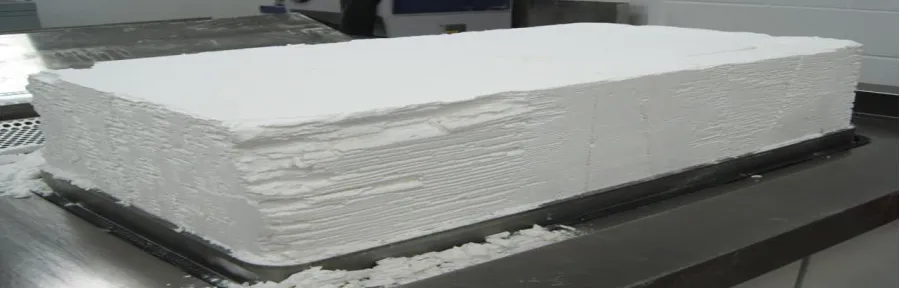
selective laser sintering (SLS) and direct metal laser sintering (DMLS) can result in lower energy, coasts shorter time, a powder bed step by step fills up with the build material as the desired area of powder is solidified through melting or shaping by the energy beam, which is usually directed by mirrors across the desired cross section of material. And finally the parts have to be removed from third powder. Unlike powder binding, many part failure, and these will have to be removed from the part post process[GoMC16]. (Fig.3) shows layers of the powder.
Fig. 3: Layers of powder
Extrusion-Based 3D-Printing
8
filament or metal wire is unwound from a coil and supplies material to produce a part[Mart16], the extruder body can act very different depend on the printer, most of the shelf printers use a direct drive system where the extruder stepper motor directly drives the plastic filament into the hot end[Josh15]and a reservoir is pushed out through a nozzle when pressure is applied ,if the pressure remain Constant, then the resulting extruded substance will flow at a invariant rate.[GiRS10]the business end of a 3D-Printer is the hot end that gets hot, as the name suggests, to melt the plastic filament which consist of three main components; the nozzle, full size dictates part quality and print speed; the heater cartridge, which produce the heat needed; and the heating barrel, which the plastic filament is fed through to be heated.[Josh15]another type of extruder exists called the Bowden extruder, which the filament is drawn to the nozzle. However the extruder body (thrust motor) is separated from the hot end by the model, but Complexity cause more difficult to assemble and maintain in operation[Alex17].
9
There are a number of key features that are common to any extrusion-based
system:
Loading of material,
Liquefaction of the material,
Application of pressure to move the material through the nozzle,
Extrusion
Plotting according to a predefined path and in a controlled manner,
Bonding of the material to itself or secondary build materials to form a coherent solid structure, and
10
Chapter 2
Literature Survey on Modeling
11
What is modeling?
Modeling of additive manufacturing technologies is improving the performance of device, machine, and mechanism parts. These technologies include stereolithography, electrolytic deposition, thermal and laserbased Printing, 3D-IC fabrication technologies, etc. They are booming nowadays, because they can provide rapid low-cost high-accuracy production of 3D items of arbitrarily complex shape [MaLy14].
Literature Survey of Modeling Techniques
in Different AM Industries
- Davies et al. (2006), Provided an overview about determined whether practitioners stilled embraced conceptual modeling seriously. In addition, What were the most popular techniques and tools used for conceptual modeling? What were the major purposes for which conceptual modeling were used? The study found that the top six most frequently used modeling techniques and methods were ER diagramming, data flow diagramming, systems flowcharting, workflow modeling, UML, and structured charts. Modeling technique was found to decrease significantly from smaller to medium-sized organizations, but then to increase significantly in larger organizations (proxying for large, complex projects).
[DGRI06].
12
have their advantages and disadvantages. Since several wind tunnel models were required to accomplish aerodynamic experiments, nowadays, one of the best methods for models and airfoils manufacturing were additive manufacturing technologies. Those methods were increasingly used in aerospace industry. Wing and tail of a wind tunnel test model which has complicated sections, were produced by fused deposition modeling technology. In order to improve mechanical properties and surface roughness an electroplating were used on the surface of a RP model. Metal models along with fused deposition modeling models and electroplating models were tested in wind tunnels with different angels of attack [DaAg12].
- Michaleris et al. (2014), reviewed both quiet and inactive element activation in detail and techniques for minimizing errors associated with element activation errors were proposed. 1D and 3D numerical examples were used to demonstrate that both methods could give equivalent results if implemented properly. Additive Manufacturing (AM) processes for metallic parts used both laser and electron beam heat sources are becoming increasingly popular due to their potential of producing near net shape structural components. The thermal history generated by additive manufacturing was essential in determining the resulting microstructure, material properties, residual stress, and distortion. Finite element techniques for modeling metal deposition heat transfer analyses of additive manufacturing were investigated in detail, in particular [Mich14].
13
of modeling and simulation related to both welding and additive manufacturing. The goals were to learn who was doing what in modeling and simulation, to summarize various approaches taken to create models, and to identify research gaps. Later sections in the report summarize implications for closed-loop-control of the process, implications for local research efforts, and implications for local modeling efforts [Seuf14].
- Denlinger et al. (2014), a finite element modeling strategy is developed to allow for the prediction of distortion accumulation in additive manufacturing (AM) large parts (on the order of meters). A 3D thermo elastoplastic analysis was performed using a hybrid quiet inactive element activation strategy combined with adaptive coarsening. At the beginning for the simulation, before material deposition commences, elements corresponding to deposition material were removed from the analysis, then elements were introduced in the model layer by layer in a quiet state with material properties rendering them irrelevant. As the moving energy source was applied on the part, elements were switched to active by restoring the actual material properties when the energy source was applied on them. A layer by layer coarsening strategy merging elements in lower layers of the build was also implemented such that while elements were added on the top of build, elements were merged below maintaining a low number of degrees of freedom in the model for the entire simulation [DeIM14].
14
was carried out. Findings – FDM and similar processes were among the most widely used rapid prototyping processes with growing application in finished part manufacturing. Key elements of the typical processes, including the material feed mechanism, liquefier and print nozzle; the build surface and environment; and approaches to part finishing were described. Approaches to estimating the motor torque and power required to achieve a desired filament feed rate were presented. Models of required heat flux, sheared on the melt and pressure drop in the liquefier are reviewed. On leaving the print nozzle, die swelling and bead cooling were considered. Approached to modeling the spread of a deposited road of material and the bonding of polymer roads to one another were also reviewed [NtSA14].
- Liu et al. (2014), showed how modeling technology is always the bottleneck problem of the product development process, as it involved most time of the product development. Contain illustrate how to improve the efficiency of modeling for additive manufacturing. As the application conditions of Additive Manufacturing continued to be mature, rapid modeling technologies would be discussed , including hierarchical modeling, standardized modeling and parametric modeling technology, which would lay the foundation for rapid modeling of product development [LiZh14].
15
low-cost high-accuracy production of 3D items of arbitrarily complex shape [MaLy14].
- Ganeriwala et al. (2014), the modeling and simulation of selective laser sintering of particulate materials was discussed. Such processes involve harnessing optical energy to heat and fuse powdered materials together in an additive process. Selective laser sintering allows for the rapid manufacturing or prototyping of parts with complex geometries. In order to simulate such a process in a rapid manner, the approach pursued by the authors was to develop a computational tool by assembling relatively simple, physically meaningful, models at the small scale, for many interacting particles. There allows for much more refined estimates of the resulting overall system temperature and, ultimately, it was changed of phase from a solid, to a liquid, and possibly even to a gas. Large-scale three-dimensional examples were provided [GaZo14].
16
applications. Covers the steps towards rapid prototyping, from conception (modeling) to manufacture [BiEP15].
- Schröder et al. (2015) showed how to develop a business model which evaluates process costs of additive manufacturing technologies. The relevant technologies were Stereolithography, Selective Laser Melting, Fused Deposition Modeling, Selective Laser Melting, Electron Beam Melting and Laser Cladding. Product costs could be calculated easily and the outcome of the evaluation would serve as a valuable decision base for industrial decision makers on how to invest in a special technology. The contain was structured in four steps. Firstly, based on a detailed description of the state of the art research, an analysis of the most important process steps in additive manufacturing was presented (see Fig.1). A new business model for additive manufacturing technologies was introduced afterwards including the implementation of their business model in a software tool. In the last step, a sensitivity analysis was done to find the most important parameters (cost drivers) for those case studies [ScFS15].
17
- Romano et al. (2015), showed that modeling and simulation could be used as a facilitating tool to predict the behavior of materials and processes and alleviate the need for extensive random experiments. Finite element simulation of thermal modeling thermal modeling of laser melting process to determine the melt pool geometry and temperature distribution in powder bed. There model was used to compare their characteristics between commonly used powder materials to include Ti6Al4V, Stainless Steel 316L, and 7075 Aluminum powders [RoLS15].
- Denlinger et al. (2016), showed how a method for modeling the effect of stress relaxation at high temperatures during laser direct energy deposition processes was experimentally validated for Ti-6Al-4V samples subjected to different inter-layer dwell times. The predicted mechanical responses were compared to those of Inconel® 625 samples, which experience no allotropic phase transformation, deposited under identical process conditions. The thermal response of workpieces in additive manufacturing was known to be strongly dependent on dwell time. Contain the dwell times used vary from 0 to 40 s. Based on past research on ferretic steels and the additive manufacturing of titanium alloys it was assumed that the effect of transformation strain in Ti-6Al-4V acted to oppose all other strain components, effectively eliminating all residual stress at temperatures above 690 °C. The model predicted that Inconel® 625 exhibits increasing distortion with decreasing dwell times but that Ti-6Al-4V displays the opposite behavior, with distortion dramatically decreasing with lowering dwell time [DeMi16].
18
fabrication of personalized AFOs. Fused deposition modeling (FDM) was a 3D-printing method with the desired strength and material deposition rate for custom AFO applications. The process planning was critical for the cycle time and quality for FDM of AFOs. Four steps in the process planning are: 1) orientation determination, 2) support generation, 3) slicing and 4) tool path generation. In the orientation determination, several factors were taken into accounts to improve the printability and mechanical performance of the fabricated AFO. To reduce the support structure, structural optimizations were applied on the AFO part without compromising of the strength. Adaptive slicing strategy was used to slice the AFO with full consideration of it was geometric characteristics. In the tool-path generation, wavy tool-path was developed to improve the manufacturing process and enhance the structural strength by parameters optimization[JiHS16].
19 Fig.2. Framework for multi-level modeling and simulation[SSHT16]
20
- Thompson et al. (2016), showed how a new two-dimensional approached to modeling manufacturing process chains. Their approach was used to consider the role of additive manufacturing technologies in process chains for a part with micro scale features and no internal geometry. It was shown that additive manufacturing could compete with traditional process chains for small production runs. Combining both types of technology added cost but no benefit in their case. The new process chain model could be used to explain the results and supported process selection, but process chain prototyping was stilled important for rapidly evolving fields like additive manufacturing [ThSM16].
- Steuben et al. (2016), showed how a critical element for the design, characterization, and certification of materials and products produced by additive manufacturing processes was the ability to accurately and efficiently model the associated materials and processes. That was necessary for tailoring these processes to endow the associated products with proper geometrical and functional features. In an effort to address these needs in a computationally elegant and at the same time physically realistic manner, concludes with a discussion on how their approach might be generalized to broader classes of additive manufacturing systems, and details are given regarding future work necessary to further developed the present methodology [StIM16].
21
deformations were in good agreement with the experimental measurements. The main contributions of their study are: (I) in the past, a point-wise comparison between simulation results and experimental measurements is more favored to validate the employed model, where the general picture was lost; (II) Rather few works have been done to show the effectiveness of widely employed quasi-static mechanical analysis in the transient LENS process[YZCM16].
- Vastola et al. (2016), Beam-based additive manufacturing (AM) is an innovative technique in which parts were built layer wise, starting from the material in powder form. As a developing manufacturing technique, achievement of excellent mechanical properties in the final part was of paramount importance for the mainstream adoption of their technique in industrial manufacturing lines. At the same time, AM offers an unprecedented opportunity to precisely control the manufacturing conditions locally within the part during build, enabling local influence on the formation of the texture and microstructure. In order to achieve the control of microstructure by tailoring the AM machine parameters, a full understanding and modeling of the heat transfer and microstructure evolution processes was needed [VZPZ16a].
22
effects of beam size, beam power density, beam scan speed, and chamber bed temperature on the magnitude and distribution of residual stresses. their study elucidates both qualitative and quantitative features of the residual stress fields originated by these manufacturing parameters [VZPZ16b].
- Bikas et al. (2016) Additive manufacturing is a technology rapidly expanding on a number of industrial sectors. It provided design freedom and environmental/ecological advantages. It transformed essentially design files to fully functional products. However, it was stilled hampered by low productivity, poor quality and uncertainty of final part mechanical properties. The root cause of undesired effects lied in the control aspects of the process. Optimization was difficult due to limited modeling approaches. Physical phenomena associated with additive manufacturing processes were complex, including melting/ solidification and vaporization, heat and mass transfer etc. The objective of the current study was to map available additive manufacturing methods based on their process mechanisms, review modeling approached based on modeling methods and identified research gap[BiSC16].
- Lee et al. (2016), showed how a computational models of the direct energy deposition and powder bed fusion processes developed for process control applications. Both models were built upon a regression metamodel of heat transfer beneath the laser beam, to which an auxiliary thermal model was added to account for residual heat in track-to-track interactions. Both models were coupled by taking temperatures predicted with the auxiliary model and incorporating them as initial conditions for metamodel predictions of future laser scans [LePr16].
23
means to derive complex models with ease as well as modify them e.g. to run DoE on the model The approach enables the definition of a machine realistic model of the metal AM build process. The model outcome could be exploited in evaluation of engineering material properties as well as e.g. analyzing in more detailed part performance with respected to fatigue. Mesh refining/coarsening was to be further developed to decrease computing times and increase model sizes. Improve links with other tools to improve physical descriptiveness, e.g. solidification and powder bed models to enhance and mitigate limitations of thermo mechanical finite elements (see Fig. 3) [AnLP16].
24
- Lieneke et al. (2016), Additive manufacturing offers several benefits compared to established manufacturing processes. However, the industrial distribution for end-use part production purposes was still limited. Reasons became apparent in process-specific challenges. There applied particularly to the limitation of geometrical deviations. The method development started with the definition of materials, machines, and process parameters for FDM, LS, and LM. Furthermore, factors influencing the geometrical accuracy of additively manufactured parts were identified. For The experimental tests, the key influencing factors were selected. The nominal dimension and alignment showed a strong impact on the dimensional deviations (See Fig.4) [LDAZ16].
Fig.4 : Means of dimensional deviations and their trend lines for x, y, and, z alignment depending on nominal dimension for FDM[LDAZ16]
25
of the device. The first manufacturing technique they chose was Fused Deposition Modeling (FDM). The reason they chose FDM was because of it was low cost and popularity. The elastic material TPU has been chosen to print our LOC immunoassay device. In order to accomplish the final design, different states of prototypes were developed to find the proper settings, geometry, functionality, and to solve emerging difficulties resulted from the characteristics of the elastic material. From their tests, they found leakage in their prototypes; they thought there problem was resulted from the resolution limit and characteristics of the FDM technique. After they applied the plastic dips method on the prototypes, the leakage problem improved and the LOC immunoassay functioned properly. They then employed the SLA technique, which could provide higher resolution and density. They used Formlabs SLA printer with their flexible resin to print their prototypes. The problem of leakage did improve, but there were two main issues. First, the elasticity of SLA prototypes was not as good as the FDM prototypes. Second, the clog problem caused by the flexible resin increased the difficulty of miniaturization [Yang16].
26
- M.Yuan et al. (2017), as a new advanced service-oriented networked manufacturing mode, cloud manufacturing (CMfg) is currently one of the main directions of development in the manufacturing industry. A resource modeling method oriented to (CMfg) was proposed to solve manufacturing resource data consistency problems, which were often caused by heterogeneity, diversity, and complexity of manufacturing resource. Motivated by the manufacturing resource modeling literature, they constructed a classification model of manufacturing resource used a line indexing method and a manufacturing resource information model for CMfg from the perspective of resource information [YuDC17].
27
- E.Brusa et al. (2017), showed the numerical modeling of a geometrically complex structural bracket for aerospace application, which was re-designed through a topological optimization and produced in Ti-6Al-4V by means of the AM. The design activity herein described required to resort to a suitable model of constitutive properties of material by facing the problem of a large number of porosity/low density areas, as detected by a tomographic analysis of the mechanical component. According to some references an equivalent isotropic and homogeneous model of material was applied. The Finite Element model based upon the assumptions of homogeneous and isotropic material might be effective in predicting the material and component strength, at least in static design
(see Fig.5)[BrSO17]
Fig.5: FEM results: equivalent Von Misses stress distribution for load case 1 (a), 2 (b) and 3 (c); strain[BrSO17]
28
in both the block and nozzle. Temperature overshoots 12°C and 18.5°C were observed during a step increase in feed rate and a priming motion respectively. Evaluating these changed with a sintering model predicted a 20% increase in bond formation, although no significant differences of bond sizes were observed using optical measurement.[PWHE17]
- Wendt et al. (2017), Provided an overview about dumbbell specimens are shown to be inadequate for the tensile testing of Additive Manufacturing monolayers. Finite Element Method (FEM) has been used in this contribution for comparing tensile-stress distributions in both conventional and rectangular samples. Different extrusion paths for the manufacturing via Fused Layer Modeling (FLM) were taken into account. The calculations showed stress concentrations in the dumbbell type specimens in the zone of variable width away from the gauge length. The results were used for explaining the differences between mechanical behavior of dumbbell and rectangular specimens made with FLM from Poly-Lactic Acid (PLA) [WVDB17].
29
-S. Leng et al. (2017), showed how to provide a framework for the development of a quality assurance (QA) program for using in medical 3D-Printing applications. An interdisciplinary QA team was built with expertise from all aspects of 3D-Printing. A systematic QA approach was established to assess the accuracy and precision of each step during the 3D-Printing process, including: image data acquisition, segmentation and processing, and 3D-Printing and cleaning. Validation of printed models was performed by qualitative inspection and quantitative measurement. The latter was achieved by scanning the printed model with a high resolution CT scanner to obtain images of the printed model, which were registered to the original patient images and the distance between them was calculated on a point-by-point basis. A phantom-based QA process, with two QA phantoms, was also develop [LMMA17].
-K. Gnanasekaran et al. (2017), Fused deposition modeling (FDM) is limited by the availability of application specific functional materials. They illustrated printing of non-conventional polymer Nano composites (CNT- and grapheme-based polybutylene terephthalate (PBT)) on a commercially available desktop 3D-Printer leading toward printing of electrically conductive structures. The printability, electrical conductivity and mechanical stability of the polymer Nano composites before and after 3D-Printing was evaluated. The results showed that 3D printed PBT/CNT objects had better conductive and mechanical properties and a better performance than 3D printed PBT/grapheme structures[GHBW17].
30
and the Skin Model Shapes Paradigm was introduced to be a promising framework for integration of shape deviations in product development, and the digital thread in AM[ZKAM17].
-S. Kale et al. (2017), a feature-based bio-CAD modeling of three-dimensional tissue scaffolds by considered spatial distribution of biologically active materials was presented for bio manufacturing and tissue engineering applications. Proposed model was based on uniform distribution of bio-active particles in different regions of scaffold, which was constrained by geometrical and biological features. The proposed method was integrated with a recently developed method of multi-material additive manufacturing of hydrogel structures, for bio-additive manufacturing of the heterogeneous scaffolds. 3D bio printed heterogeneous scaffolds were provided as an example for physical implementation of developed algorithm to validate the model[KKNK17].
- Simunovic et al. (2017) , showed metal Big Area Additive Manufacturing (MBAAM) was a new additive manufacturing (AM) technology for printing large-scale 3D objects. MBAAM was based on the gas metal arc welding process and used a continuous feed of welding wire to manufacture an object. An electric arc forms between the wire and the substrate, which melts the wire and deposits a bead of molten metal along the predetermined path [SNNC17].
31
technological or geometrical specificities of AM, to maximize product performance during the design stage Additive Manufacturing (AM) technologies had gained extensive applications due to their capable[ZhAM17]
-W. Yan et al. (2017), Electron beam selective melting (EBSM) is a promising additive manufacturing (AM) technology. The EBSM process consists of three major procedures: ① spreading a powder layer, ② preheating to slightly sinter the powder, and ③ selectively melting the powder bed. The highly transient multi-physics phenomena involved in these procedures posed a significant challenge for in situate experimental observation and measurement. To advance the understanding of the physical mechanisms in each procedure, they leverage high-fidelity modeling and post-process experiments. The models resembled the actual fabrication procedures, including ① a powder-spreading model used the discrete element method (DEM), ② a phase field (PF) model of powder sintering (solid-state sintering), and ③ a powder-melting (liquid-state sintering) model used the finite volume method (FVM)[YQMZ17].
32
which were used to present the customer requirement, product specification and design trend by usage model as well as manufacturing procedure and it was constrained by manufacturing model [AsGL17].
- Chaudhari et al. (2018), showed how the need of manufacturing of prototype of any newly designed components had significant, importance for obtaining realistic model since evolution of engineering. The ability to select the optimal orientation of build-up was one of the critical factors since it affects the part quality, build time, and part cost. It was found from the experimental results that the FDM process given lowest surface roughness across the length was obtained for specimens built with orientation along YZ0, 100% infill and at 0.30 mm layer thickness (see. Fig.6) [ChJP18].
Fig.6. (a) Photographic view of Accurate i250+ RP machine, (b) 3D model using CATIA, (c) Internal View of FDM Machine, and (d) Raw material ABS.[ChJP18]
33
serve as data for validating the control volume-based approach on the build-up scale [SeZa18].
34
Chapter 3
Literature Survey on
Optimization of Additive
35
What is optimization?
Optimization is a fundamental part of Additive Manufacturing. Material parameters, processing parameters, scanning parameters, support structures and the printed parts and must be optimized to ensure products with smallest environmental impact and highest efficiency and life time, the mini-symposium covers all aspects of optimization methods for AM. Special interest is devoted to topology optimization for AM which can be said to constitute an ideal marriage. The topology optimization parameterization represents the ultimate design freedom realizable with AM[ImDa17].
Application of Optimization Techniques in
Different AM Industries
In this chapter we summarize the application of the mathematical optimization techniques in 49 researches by organizing it according to years of publishing.
36
these tools. In a wider context, interesting developments of modeling tools also emerged from other ends such as chemical engineering or computer science. Indeed, approaches based on object-oriented modeling or constraint programming influences the evolution of optimization modeling languages too. Optimization modeling tools evolved toward fully integrated modeling management systems opening the access to databases, spreadsheets and graphical user interfaces[FrGo99].
-Jayal et. al (2010) ,Achieving sustainability in manufacturing requires a holistic view spanning not just the product, and the manufacturing processes involved in its fabrication, but also the entire supply chain, including the manufacturing systems across multiple product life-cycles. This requires improved models, metrics for sustainability evaluation, and optimization techniques at the product, process, and system levels. This paper presents an overview of recent trends and new concepts in the development of sustainable products, processes and systems. In particular, recent trends in developing improved sustainability scoring methods for products and processes, and predictive models and optimization techniques for sustainable manufacturing processes, focusing on dry, near-dry and cryogenic machining as examples, are presented[JBDJ10].
37
novel multi-step recompense calculation based on demonstrate optimization and picture emolument is created. At long last, the test comes about appear the execution of the 3D-Printing robot stage and the proposed calculations [CLLS11]. -Brackett et. al (2011),topology optimization could give the plans required to completely advantage from AM flexibility, AM creates completely printable optimization plans: this disposes of the require and costs of portion overhaul, bolsters, post handling and counting and counting AM confinements could keep up tall plan execution[BrAH11].
-Ashcroft et. al (2011),showed how most topology (TO) calculations include the penalization of complex basic highlights to dispense with fabricating troubles. Since added substance fabricating was less subordinate on fabricating imperatives, it gets to be fundamental to adjust these calculations for AM. We propose a half breed calculation comprising of an versatile coinciding technique (AMS) and a adjusted shape of the bidirectional developmental basic optimization (BESO) strategy. By tackling a standard cantilever issue, we appear that the cross breed strategy offers moved forward execution over the standard BESO strategy. It is proposed that the modern strategy is more reasonable for optimizing structures for AM in a computational effective way[AAWH11].
38
three added substance fabricating applications. To begin with, the introduction of one portion on a construct plate taking into agreement least constructs time model, least back structure and best quality surface. Moment application is centered on fitted testing of parts gotten by 3D-Printing. Taking into agreement the rules for the primary two applications. It is imperative to say that within the polyjet prepare able to select between two parameters that influence the surface quality: mate or reflexive. The normal esteem for the mate surface are Ra_m=1.04 microns, Rz_m=5.6 microns and for the shiny surface are Ra_m=0.84 mi-crons, Rz_m=3.8 microns. The surface surface was analyzed utilizing an ETALON TCM 50 measuring magnifying lens. The quality of portion surface gotten by polyjet innovation is exceptionally great and isn‘t essential a post preparing of the RP portion. The part delivered on the Z Printer appears to have the least exactness and it is the foremost delicate (needs post-processing), but it was created much faster [DrNe11].
39
40 Fig1:Schematic of selective laser sintering (SLS) with highlighted energy
components[VeRa13].
41
segments freely evolve through the casting SIMP method, and (ii) shape preserved boundary segments suppress the freeform evolvement which composed of machining features through a feature fitting algorithm[RBGM13].
-D. Panesar et. al (2013), there work investigated design analysis and optimization methods for the integration of active internal systems into a component for manufacture using multi-material 3D-Printing processes. This enables efficient design of optimal multifunctional components that exploit the design freedoms of additive manufacturing (AM). The main contributions of two area contain: 1) the automated placement and routing of electrical systems within the component volume and, 2) the accommodation of the effect of this system integration on the structural response of the part through structural topology optimization (TO). A novel voxel modeling approach was used to facilitate design flexibility and to allow direct mapping to the 3D-Printer jetting nozzles[BPAW13].
42
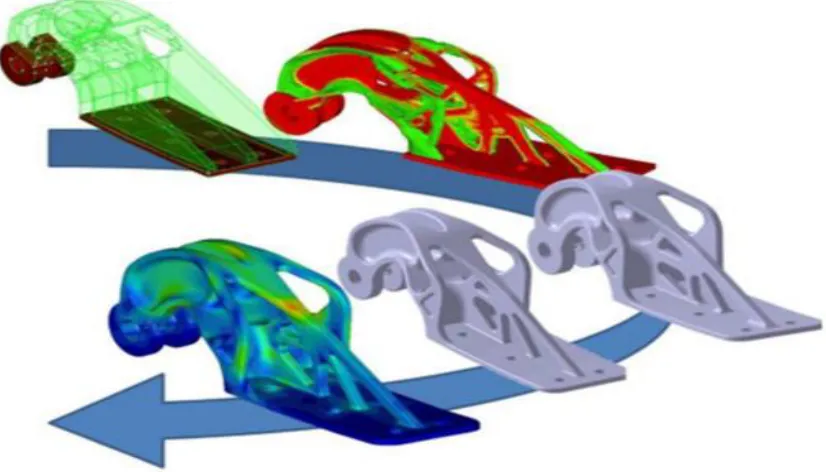
Fig 2:-Optimization loops two of aerospace part.
-Paul, Ratnadeep(2013), focused on the Metal powder based Additive Manufacturing (AM) processes which was creakingly being accepted across several industries such as aero-space, automobile, medical, consumer products and electronics systems. However, the most pressing issues faced by AM technology concerned to achieving part accuracy and excessive material and energy utilization. Therefore, a comprehensive part-level approach analyzing the relation between the different physical phenomena occurring during the manufacturing of a metal AM part is required. The virtual manufacturing model simulated the geometry of the AM part using computational geometry techniques. Points are sampled from the surface of the simulated parts simulated and used for calculating the Geometric Dimensioning and Tolerance (GD&T) errors and also for correlating these errors to the input parameters[Paul13].
43
g. mold and tool making, medical devices, aerospace and automotive industry). A resource efficient application of these processes requires a high process stability and reproducibility. These target figures were reached by numerous test rigs at the manufacturing system which cause high resource consumption and an uneconomic application of these processes. A virtual process design prior to the building phase used opportunity to enhance the process efficiency of metal-based, additive processes. Previously developed technology specific simulation models enable users to examine and optimize different process parameter compositions. Though, whilst planning the design of experiments study for the simulation based optimization, it should be considered, that with every single additional process parameter which is thereby taken into account the calculation time increases significantly. Regarding this fact, the presented research works in this publication which include procedure models for an efficient and target figure dependent analysis of a high amount of different process parameter constellations by means of the developed simulation models. Methods and procedures for the identification, categorization and prioritization of influencing parameters and their interdependencies amongst each other are shown for the target figure ―dimensional accuracy‖ and with utilizing the alloy AlSi12. The results of these investigations are summarized in a process-specific prioritization and correlation matrix [KrSZ13].
-Rogers and Ierapetritou (2014), provided an overview of the challenges associated with modeling and optimizing particulate processes and discussed the opportunities for improving pharmaceutical process development through the use of concepts from process systems engineering.
44
companies had lagged behind other specialty chemical manufacturers in the adoption of these tools. This was in part due to the challenges associated with modeling and optimization of solids-based processes. However recent advances in the modeling of particulate processes and the optimization of complex process models have created opportunities to apply PSE methods to pharmaceutical manufacturing processes [RoLe14].
-A.roger et. al(2014),investigated about The pharmaceutical industry which currently faced economic and regulatory challenges associated with process development. This was in part due to the challenges associated with modeling and optimization of solids-based processes. However recent advanced in the optimization of complex process models have created opportunities to apply PSE methods to pharmaceutical manufacturing processes. This work will provide an overview of the challenges associated with modeling and optimizing particulate processes and discuss opportunities for improving pharmaceutical process development through the use of concepts from process systems engineering[RoIe14].
45
anisotropic properties. The material usage, build time, and loading characteristics were captured for a variety of parametric structures (solid, shell, orthogonal, hexagonal, pyramid) built orientations, and internal densities (loose, compact). From this data, a model was developed that serves as a predictive tool to: (i) estimate the mechanical properties and (ii) calculate the build time and materials utilized based on various internal structural configurations for the component's application. A model that generates an optimal solution (minimum material, minimum build time, etc.) needs to be developed.(see figure 3.) Using the collected data as a foundation, an optimization model that considered the built time, material usage, surface finish, interior geometry, strength characteristics, and related parameters is presented and could be used to assist designers making informed decision with respect to strength, material usage and time, etc[ViEU14].
Fig.3 :-Parametric modeling of the modifiable element structure (a), the, parametric web-like structure, and (c) the internally modified shelled part [2][ViEU14].
46
47
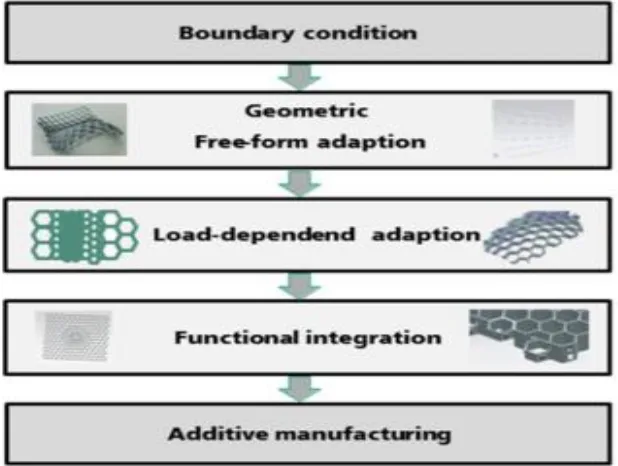
-F.riss et .al(2014),Due to their feasible geometric complexity, additive layer manufacturing (ALM) processes showed a high potential for the production of lightweight components. Therefore, ALM processes enable the realization of bionic-designed components like honeycombs, depending upon load and outer boundary conditions optimization was used, based on a closed-loop, three-step methodology: At first, each honeycomb was conformed to the surface of the part. Secondly, the structure was optimized for lightweight design. It was possible to achieve a homogeneous stress distribution in the part by varying the wall thickness, honeycomb diameter and the amount of honeycombs, depending on the subjected stresses and strains. At last, the functional components like threads or bearing carriers are integrated directly into the honeycomb core. Using all these steps as an iterative process, it is possible to reduce the mass of sandwich components about 50 percent compared to conventional approaches[ChLe14].
48
-N.gardan et. al (2015), showed how Rapid prototyping (RP) and more generally Additive Manufacturing (AM) enable the manufacture of complex geometries, which was very difficult to build with classical production. Different kind of material used numerous technologies. For each of these, two materials exist: the production material and the support one. Support material, cleaned and becomes a manufacturing residue in most cases, the material volume and the global mass of the product Improved, and an essential aim surrounding the integration of simulation in additive manufacturing process. Moreover the layer-by-layer technology of additive manufacturing allowed the design of innovative objects and the use of topological optimization in this context could create a very interesting combination. The purpose of these paper is to present a methodology and a tool, which allow the use of topological optimization for the preparation of model for RP and AM[GaSc15].
49
-A.gainor et. al (2015), showed how Topology optimization was a powerful free-form design tool that couples finite element analysis with mathematical programming to systematically design for any number of engineering problems. Additive manufacturing (AM), specifically by 3D-Printing, which is a manufacturing process where material was added through deposition or melting in a layer-by-layer fashion. Additively manufactured parts were ‗built‘ from the bottom up, allowing production of intricate designs without extra effort on the part of the engineer or technician – complexity was often said to be ‗free‘. This dissertation seeks to leverage the full potential of this burgeoning manufacturing technology by developing several new design algorithms based on topology optimization. These include multi-material projection methods appropriate for multiphase 3D-Printers, an overhang-prevention projection method capable of designing components that do not need sacrificial anchors in metal AM processes, and models for simultaneously optimizing topology and objects embedded in process. These algorithms were demonstrated on several design examples and shown to produce solutions with capabilities that exceed existing designs and/or that require less post-processing in fabrication[Gayn15].
50
optimization algorithm was introduced to optimize arbitrary 3D models with given boundary conditions. In this process, the minimum compliance problem and allowable stress problem were considered to get the relative density distribution. Third, CAD methods were developed to obtain the function between the local relative density and the variable density of cellular structure. With the aid of the function, one can convert the density distribution to the cellular vertex radius distribution and build variable density cellular structures in the given parts. Finally, a real part named pillow bracket is designed by this process to illustrate the efficiency and reliability of the new method[CZBB15].
51
design. It could recommend process parameters based on the quality requirements. Some physical interpretations was introduced to explain the experiment results. The research outcome could be used as a guideline for selecting the proper printing parameters to achieve the desired properties and help to improve the quality control of components fabricated by the BJ AM process[Chen15].
-k.salonitis et. al (2015), showed how Improvements in additive manufacturing technologies have the potential to greatly provide value to designers that could also contribute towards improving the sustainability levels of products as well as the production of lightweight products. With these improvements, it was possible to eliminate the design restrictions previously faced by manufacturers. The principles of additive manufacturing examined, design guidelines, capabilities of the manufacturing processes and structural optimization using topology optimization. Furthermore, a redesign methodology was proposed and illustrated through a redesign case study of an existing bracket. The optimal design was selected using multi-criteria decision analysis method. The challenges for using additive manufacturing technologies are discussed. The proposed methodology addressing this challenge was characterized by several advances in how the redesigned and optimized models were approached. These advances were briefly:
52
existing and the optimized design to found alternatives than could be manufactured by the chosen ALM process.
• MCDA analysis helps designers to choose one final design from the optimized designs. This analysis depends on predefined criteria than could be collected from the client[SaZa15].
53
Sorting TLBO (NSTLBO) algorithm, respectively. The results of the TLBO algorithm are compared with those obtained using genetic algorithm (GA), and quantum behaved particle swarm optimization (QPSO) algorithm. The TLBO algorithm showed better performance as compared to GA and QPSO algorithms. The NSTLBO algorithm proposed to solve the multi-objective optimization problems of the FDM process in this work is a posteriori version of the TLBO algorithm. The NSTLBO algorithm was incorporated with non-dominated sorting concept and crowding distance assignment mechanism to obtain a dense set of Pareto optimal solutions in a single simulation run. The results of the NSTLBO algorithm are compared with those obtained using non-dominated sorting genetic algorithm (NSGA-II) and the desirability function approach. The Pareto-optimal set of solutions for each problem was obtained and reported. These Pareto optimal set of solutions will help the decision maker in volatile scenarios and are useful for the FDM process[RaRa16].
54
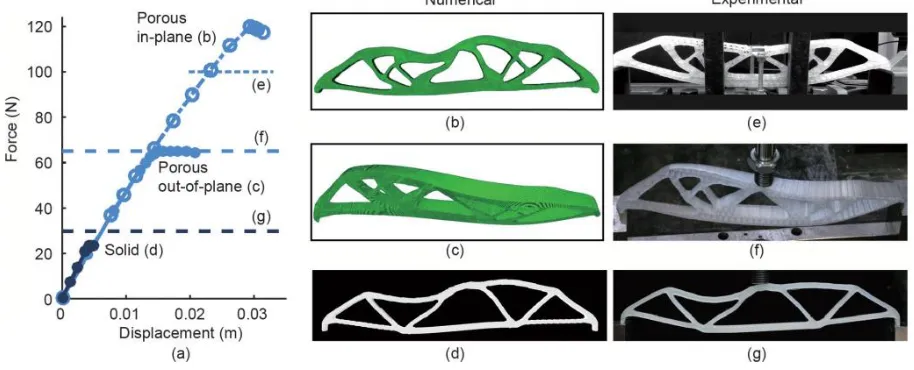
properties of the infill material, the buckling load might be more than four times higher than that of solid structures optimized under the same conditions [ClAS16].
Fig 5. Buckling analysis. (a) Comparison of the geometrically nonlinear numerical response (curves with arc-length steps indicated) with experimentally observed buckling loads (two lower horizontal dashed lines); (b)–(d) numerically determined mode shapes corresponding to curves in (a); (e) experimental response of the porous structure to a load of 100 N, indicated by the upper dashed line in (a); (f) and (g) experimental mode shapes corresponding to numerical shapes (c) and (d), with buckling load indicated by the two lower dashed lines in (a).[Clau16]
-T.pfeifer et. al (2016), one of the most common Additive Manufacturing (AM) technologies is Fused Filament Fabrication (FFF), more commonly known by the trademarked name "Fused Deposition Modeling™" (FDM™). As FFF continues to gain popularity as a method of manufacturing, an understanding of all factors involved in the FFF process becomes essential.
55
resulting solidity was found to vary throughout a printed part, which has effects on the predictability of part strength. Micro computed tomography was proven valuable in this analysis as well as being an effective tool for investigating the bead structure[PKHC16].
-T.zegard et. al (2016), showed that Additive manufacturing, a rapidly evolving field, fills the gap between topology optimization and application. Additive manufacturing has minimal limitations on the shape and complexity of the design, and new materials has been currently evolved, higher precision and larger build sizes. Two topology optimization methods addressed: the ground structure method and density-based topology optimization. The results obtained from these topology optimization methods require some degree of post-processing before they could be manufactured, some inherent issues of the optimization technique might be magnified resulting in an unfeasible or bad product. In addition, these work aims to address some of the issues and propose methodologies by which they might be alleviated. The proposed framework has applications in a number of fields, with specific examples given from the fields of health, architecture and engineering. In addition, the generated output allowed for simple communication, editing, and combination of the results into more complex designs. For the specific case of three-dimensional density-based topology optimization, a tool suitable for result inspection and generation of additive manufacturing output was also provided[ZePa16].
56
with further optimization of cutting edge geometry where tooltip overshoot during the tool entry was selected as an objective function. The model takes into consideration the interaction between three units of the machine tool such as a tool, tool post, and work piece as well as an influence of the process on the system's dynamics[GuAS17].
-E.ceretti et. al (2017), showed that one of the most applied strategies in tissue engineering consists in the development of 3D porous scaffolds with similar composition to the specific tissue. In fact, the microstructure of the scaffolds influences the final structure of the in growing tissue. Multi-layered PCL scaffolds were produced with modified FDM printer in order to analyze the influence of the extrusion technology (filament or powder extrusion head) and of the process parameters on the deposited material. In particular, dimensions and uniformity of both deposited filament and grid of the scaffolds were analyzed to understand the influence of the process parameters so as to optimize the FDM production technology[CGNF17].
57
finding more efficient layout solutions for the piston framework feasible with Additive Manufacturing techniques. The authors employed topology optimizations to define the optimal structural topology. Special care has to be taken in setting up the optimization process since the choice of the constraints, i.e. the performance targets, of the mesh size and quality and of the optimization parameters directly affect the outcome of the process[BGMM17].
-J.lopez-castro et. al (2017), indicated that DMLS (Direct Metal Laser Sintering) Additive manufacturing allows building topological optimized geometries with good mechanical properties and low weight. These features are appropriated for the aeronautical industry because the reduction of weight involves saving costs per trip. However, the manufacturing cost using SLM (Selective Laser Melting) or DMLS, is also high since titanium alloys powder is expensive. Therefore, this work point to explore the possibility of using 15-5PH stainless steel powder to balance the mechanical properties, weight and cost of the part[LMGB17].
58
dimensions, to efficiently deal with the appearance of overhang features in the course of shape optimization processes[ADEF17].
-A.verma et. al (2017), showed that Additive manufacturing (AM) was considered as the standalone production house for customized parts of different varieties. AM has found applications in various industries including medical and aerospace for both prototyping and functional part fabrication. With rapid development in additive manufacturing technologies, the future of US manufacturing and economy clearly looked bright, process sustainability of such AM devices were not well studied. This paper addresses much needed sustainability aspects of additive manufacturing processes. More specifically, material wastage and energy consumption are two major concerns of the AM processes that requires immediate attention. Both process at layer and part level enabling additive manufacturing process towards sustainability was formulated and optimized. Numerous real world examples were demonstrated and compared against conventional approaches to demonstrate the applicability of the developed approach. The models formulated here for selective laser sintering (SLS) process could be easily extended to other additive manufacturing technologies with little or no modification. Limitations of proposed research were also discussed[VeRa17].
59
to optimize a real design mold and the final optimal design was prototyped in SLA and the manufacture ability in PBF has been discussed[WJZZ17].
-J.liu (2017), showed that Hybrid additive-subtractive manufacturing was gained popularity by making full use of geometry complexity produced by additive manufacturing and dimensional accuracy derived from subtractive machining. Part design for this hybrid manufacturing approach has been done by trial-and-error, and no dedicated design methodology exists for this manufacturing approach. To address this issue, this work presents a topology optimization method for hybrid additive and subtractive manufacturing. To be specific, the boundary segments of the input design domain were categorized into two types: (i) Freeform boundary segments freely evolve through the casting SIMP method, and (ii) shape preserved boundary segments suppress the freeform evolvement and were composed of machining features through a feature fitting algorithm[LiTo17].
60
overlapping rate adjustment but weaken the single weld bead morphology optimization, the process of this paper has comprehensive considerations of droplet transfer, heat input, and shaping coefficient. It enables the capacity of fabricating metal parts with high accuracy and lays a good foundation for Bainite steel additive manufacturing[YGHL17].
-A.aboutalib et. al (2017), explained Manufacturing parts with target properties and quality in Laser-Based Additive Manufacturing (LBAM) was crucial toward enhancing the ―trustworthiness ―of this emerging technology and pushing it into the main- stream. Most of the existing LBAM studies did not use a systematic approach to optimize process parameters (e.g., laser power, laser velocity, layer thickness, etc.) for desired part properties. a novel process optimization method proposed that directly utilizes experimental data from previous studies as the initial experimental data to guide the sequential optimization experiments of the current study.
61
Total number of time- and cost-intensive experiments reduced. Method and test verified to performance via comprehensive simulation studies that test various types of prior data. The results showed that their method significantly reduced the number of optimization experiments, compared with conventional optimization methods. And also conduct a real-world case study that optimizes the relative density of parts manufactured using a Selective Laser Melting system. Combination of optimal process parameters was achieved within five experiments[ABES17].
-C. dapogny et. al (2017), A new functional of the domain proposed, to be used in shape and topology optimization problems as a means to enforce the manufacturability of structures by additive manufacturing processes. The main idea has to be build a piecewise affine approximation of the cost function and of its shape derivative by using the derivative of the elastic displacement with respect to the height of the intermediate structure[ODFM17].
62
minimization. These models were compared along with a strict overhang constrained method[WiGa17].
63
rigorously analyzed, notably by relying on the notion of signed distance function. Eventually, several numerical experiments were conducted in two dimensions to illustrate the main points of the study[DEFM17].
64
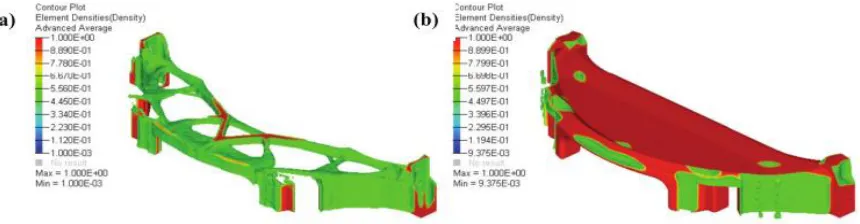
-S.mantovany et. Al (2017), showed how Topology Optimization (TO) methods optimize material layout to design light-weight and high-performance products. However, TO methods, applied for components or assembly with high complexity shape or for structures with copious number of parts respectively, do not usually take into account the manufacturability of the optimized geometries, then a heavy further work was required to engineer the product, risking to compromise the mass reduction achieved. Within an Industry 4.0 approach, manufacturing constraint to evaluate since early stages of the conceptual design to perform a TO coherent with the manufacturing technology chosen. Several approach of TO with different manufacturing constraints such as casting and extrusion were proposed and each solution was compared. The optimum conceptual design was determined in order to minimize the component weight while satisfying both the structural targets and the manufacturing constraints; a case study on a high- performance sport car dashboard was finally presented,(see fig 6. )[MPCB17].
65 Fig 7.Topology results with constrained mass 20% (a) and 80% (b) considering double draw
constraints[MPCB17]
66
-D.coupek et. al (2018), indicate that Optimization and path planning methods for multi-axis additive manufacturing presented with conventional three-axis systems. There includes an adaptation of the building direction and an algorithm for the special case of cylindrical axes. These methods can reduced the production time drastically by avoiding support structures and by using the integration of predefined building blocks to substitute the infill. Those limitations could be overcome by multi-axis FDM including more than three axes in machine kinematics. There allows to replace the work piece infill by assembled elements. The resulting base body serves as starting point for the surface printing, which requires new methods for path planning in order to exploit the full potential of multi-axis systems. However this technology will explore new application domains and industrial products[CFBR18].
67
Chapter 4
68
Conclusions
This study is about literature review consist of 3 chapters, it generally emphasizes on additive manufacturing (AM) about optimizations and modeling techniques. In the chapter one 16 references was used and gathered in this study, that emphasize on extrusion, powder, and resin based 3D-Printing.
In the second chapter 50 studies were used that accentuate modeling in AM punctuating from 2003 to 2018. Our survey has concluded that most of the studies had been published in 2016 and 2017.
![Fig .1: Assembly of fused deposition modeling (FDM).[Jona17]](https://thumb-us.123doks.com/thumbv2/123dok_us/458201.2044150/8.612.169.442.73.254/fig-assembly-fused-deposition-modeling-fdm-jona.webp)
![Fig. 2:show process it is called top for a modest reason [00b]](https://thumb-us.123doks.com/thumbv2/123dok_us/458201.2044150/9.612.132.478.219.396/fig-process-called-modest-reason-b.webp)
![Fig 6 :-Framework of the proposed accelerated process optimization method[ABES09]](https://thumb-us.123doks.com/thumbv2/123dok_us/458201.2044150/65.612.74.528.428.645/fig-framework-proposed-accelerated-process-optimization-method-abes.webp)