PURE Insights
Volume 5
Article 3
2016
Directional Preference in Drosophila melanogaster
Taylor James
Western Oregon University, [email protected]
Michael Baltzley
Western Oregon University, [email protected]
Eli Zachary
Western Oregon University, [email protected]
Spicie Davis
Western Oregon University, [email protected]
Kristin Latham
Western Oregon University, [email protected]
Follow this and additional works at:
https://digitalcommons.wou.edu/pure
Part of the
Other Life Sciences Commons
This Article is brought to you for free and open access by the Student Scholarship at Digital Commons@WOU. It has been accepted for inclusion in PURE Insights by an authorized editor of Digital Commons@WOU. For more information, please [email protected].
Recommended Citation
James, Taylor; Baltzley, Michael; Zachary, Eli; Davis, Spicie; and Latham, Kristin (2016) "Directional Preference in Drosophila melanogaster,"PURE Insights: Vol. 5 , Article 3.
Directional Preference in Drosophila melanogaster
Abstract
Diverse organisms have been shown to use the Earth’s magnetic field for orientation and navigation, but the
mechanisms underlying magnetoreception are still poorly understood. Recent research on magnetoreception
has focused on the fruit fly
Drosophila melanogaster
primarily because of its role as a model organism for
understanding the genetic mechanisms underlying behavioral traits. While current research suggests that
Drosophila
might be able to detect and orient to magnetic fields, different studies offer contradictory results. In
this study, we used a Y-maze and selective breeding to attempt to create a population of fruit flies that display a
robust magnetic orientation behavior. We used a Y-maze where each fly made 10 choices of whether to go
north or south. Of flies that exited the maze, we selected the top 20% of flies from each run to produce the
next generation. This protocol was repeated for 12 generations. Our data shows that wild-type
Drosophila
have
no innate north or south preference, nor an innate east or west preference. Additionally, after 12 generations of
selection, we have so far been unable to create populations of fruit flies with a magnetic orientation behavior.
Further research includes continued selection on our current populations of flies as well as experimental
design modifications that could possibly detect a more subtle magnetic orientation behavior.
Keywords
Drosophila melanogaster, magnetoreception, directional preference
A publication of the Program for Undergraduate Research Experiences at Western Oregon University
digitalcommons.wou.edu/pure ©2016
Directional Preference in
Drosophila melanogaster
Taylor James
, Department of Biology,
Western Oregon University
Michael Baltzley
, Department of Biology,
Western Oregon University
Eli Zachary
, Department of Biology,
Western Oregon University
Spicie Davis
, Department of Biology,
Western Oregon University
Kristin Latham
, Department of Biology,
Western Oregon University
Faculty Sponsors:
Dr. Michael Baltzley and Dr. Kristin Latham
Diverse organisms have been shown to use the Earth’s magnetic field for orientation and navigation, but the mechanisms underlying magnetoreception are still poorly understood. Recent research on
magnetoreception has focused on the fruit fly Drosophila melanogaster primarily because of its role as a model organism for understanding the genetic mechanisms underlying behavioral traits. While current research suggests that Drosophila might be able to detect and orient to magnetic fields, different studies offer contradictory results. In this study, we used a Y-maze and selective breeding to attempt to create a population of fruit flies that display a robust magnetic orientation behavior. We used a Y-maze where each fly made 10 choices of whether to go north or south. Of flies that exited the maze, we selected the top 20% of flies from each run to produce the next generation. This protocol was repeated for 12 generations. Our data shows that wild-type Drosophila have no innate north or south preference, nor an innate east or west preference. Additionally, after 12 generations of selection, we have so far been unable to create populations of fruit flies with a magnetic orientation behavior. Further research includes continued selection on our current populations of flies as well as experimental design modifications that could possibly detect a more subtle magnetic orientation behavior.
Keywords: Drosophila melanogaster, magnetoreception, directional preference
Introduction
The use of the Earth’s magnetic field for orientation was first described in birds and helped explain their ability to migrate and navigate long distances (Kramer, 1953). Research has since shown that the use of the Earth’s magnetic field for orientation and navigation is quite widespread in the animal kingdom, and includes almost every class of vertebrates and many
invertebrates (Wiltschko and Wiltschko, 1995).
Moreover, magnetic field orientation has been found not only in organisms that undergo long distance migrations crossing many miles, but also organisms that do not move long distances such as the eastern red-spotted newt Notophthalmus viridescens (Phillips and Borland, 1992), the mole rat Cryptomys hottentotus (Burda et al., 1990), and the leafcutter ant Atta columbica (Banks and Srygley, 2003). However, despite the prevalence of magnetic orientation in animals, the mechanisms underlying this ability are still poorly understood (Gegear
et al., 2008).
Currently, the two prevailing hypotheses regarding magnetoreception in animals are the magnetite model
and the radical pair model. The magnetite model proposes that there are permanently magnetic microscopic particles that are associated with specific sensory neurons, allowing for orientation (Gegear et al., 2008). The radical pair model is light-dependent and involves unpaired electrons whose spins are affected by magnetic fields (Philips and Sayeed, 1993). Evidence that animals use one of these systems does not mean that other animals do not use the other system. In fact, there is evidence that both light-dependent
magnetoreception and magnetite-based
magnetoreception are both used by individuals of certain species. For example, experimental evidence indicates that the mealworm Tenebrio molitor (Arendse, 1978; Vacha and Soukopova, 2004) and the monarch butterfly
Danaus plexippus (Perez et al., 1999; Guerra et al., 2014) each have light-based and magnetite-based magnetoreception.
Several studies have suggested that the fruit fly
James, et al. | Directional Preference in Drosophila melanogaster
PURE Insights Volume 5, Issue 1
magnetic orientation ability of Drosophila is particularly exciting because the fruit fly is an exceptionally useful genetic model for the study of behaviors (Sokolowski et al., 1984). If it is shown that Drosophila do in fact use magnetotaxis to orient and navigate, we will be able to further understand the genetic mechanisms behind this ability and apply it to other, more complex organisms, including mammals.
Thus far, the evidence that Drosophila use Earth-strength magnetic fields to orient is suggestive, but different studies have shown conflicting results. For example, adult female fruit flies were shown to orient using Earth-strength magnetic fields in one study (Gegear et al.,2008), but not in another (Phillips and Sayeed, 1993). Similarly, Drosophila larvae were shown to have innate directional preferences in one study (Painter et al., 2013), but not in another (Dommer et al., 2008). We predict that if Drosophila have the ability to orient using Earth-strength magnetic fields, we should be able to create robust lines of flies with predictable directional preferences using a selective breeding protocol.
Methods
To test directional preferences in Drosophila, we designed a sequential Y-maze, similar to a maze that was previously used to study phototaxis in Drosophila
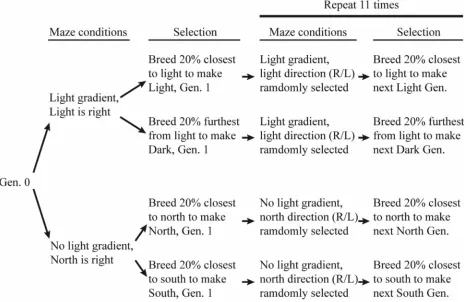
(Hadler, 1964). We first ran a wild-caught population of flies through the maze to determine if flies had an innate preference for north or south. We then selectively bred the flies to create one population of north-selected flies and a second population of south-selected flies. As a positive control, we also performed an experiment to test the phototaxic orientation behavior of wild-caught and selectively bred flies. While we plan to continue our experiment for 15 generations, we have preliminary results for our experiment after 12 generations.
Our wild population of Drosophila (Generation 0), was collected from a composting site in Monmouth, OR, USA. This generation was kept and proliferated in the lab for all Generation 0 experiments. Flies were maintained in a 12h:12h light:dark cycle at 25°C on standard dextrose medium supplemented with 0.1% Nipagen to inhibit mold.
The ambient magnetic field in the room where we conducted the experiments was 42 µT, as measured with the iPhone app Magnetometer by Kory Hearn Software. The normal strength of the magnetic field in Monmouth, OR, is approximately 52 µT (NOAA National Centers for Environmental Information). In order to select flies with a specific directional preference, we designed a maze that would require the flies to make a choice
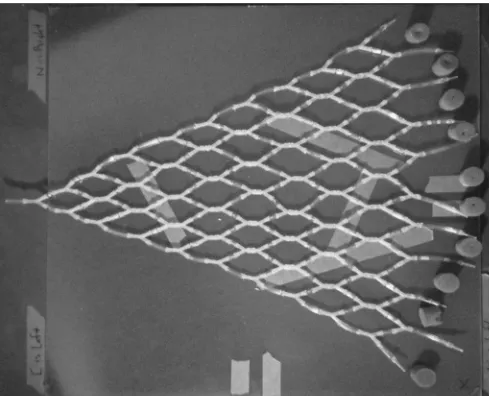
between two directions. This was accomplished through a progressive Y-maze (Figure 1), where each fly made 10 sequential choices to go right or left based on available environmental cues. Thus, each vial was assigned a number for data collection purposes, zero being the resulting vial when the fly made zero choices to go towards the given cue for that week. The
environmental cues available were either North vs. South, West vs. East, or Light vs. Dark.
The Y-maze was made out of plastic tubing with an outer diameter of 3/16” and connecting 3/16” aquatic air filter connectors. Standard plastic pipette tips were cut and inserted into the Y-connectors to prevent flies from back-tracking once a decision was made. The beginning and ends of the maze were fitted with foam stoppers punctured by the plastic pipettes. These foam stoppers allowed connection to collection vials that would hold flies after each trial until they were counted. The
collection vials were filled with food to encourage flies to finish the maze and maintain the flies until counting. The beginning vial did not contain any food and was covered with aluminum foil to block light and encourage flies to leave the starting vial.
For our north vs. south experimental flies, we set up the maze so that choosing north or south was the same as a right or left choice (Figure 2). Which direction was north or south was determined randomly for each week of experimental runs. If the week was a “right” week, we
James, et al. | Directional Preference in Drosophila melanogaster
PURE Insights Volume 5, Issue 1
turned the maze so that by going right the flies were going north. If the week was a “left” week, we turned the maze so that by going right the flies were going south. Two 40 W desk lamps, directed upward, were used to create the ambient light for each run. A fluorescent plastic light diffuser sheet was placed over top of the maze to ensure a smooth light gradient. We also
performed a trial where the Generation 0 flies made east vs. west choices, rather than north vs. south.
In our positive experimental control, we used a similar protocol as described above except that we added a light gradient. To ensure a smooth light gradient a fluorescent plastic light diffuser sheet was placed in front of the light. The light was produced via a 40 W desk lamp with a flexible neck to allow for proper directing of the light.
After each run through the maze, we anesthetized the flies with CO2 and counted the number of flies in each vial. Each successive generation was created by taking the top 20% of the flies collected from each run through the maze. For example, for a trial with the “North” population of flies where the north-most vial was vial 10, if 100 flies completed the maze with 2 flies in vial
10 and 30 flies in vial 9, we bred the 2 flies from vial 10 and 18 of the 30 flies from vial 9. The same procedure was used for the “South”, “Light”, and “Dark” populations of flies. The researchers setting up the experiment and collecting the flies were blind to which population of flies were being used in a given trial. In between runs, we allowed 2-3 weeks for breeding of each generation. During off-weeks when flies were breeding, the maze was cleaned with tap water and allowed to air dry until the next use.
To determine whether our wild-caught flies had an innate preference for light or dark and north or south, we performed 4 initial trials with Generation 0 flies: 1) the right side of the maze was light and the left side was dark; 2) the right side of the maze was north; 3) the left side of the maze was north; 4) the right side of the maze was west. Generation 12 also consisted of 4 trials: one trial each for the Light flies, the Dark flies, the North flies, and the South flies. For the Light and Dark trials, light was on the right side of the maze. For the North and South trials, north was on the right side of the maze. We compared the results of these eight trials using an ANOVA with post-hoc t-tests in Microsoft Excel (Microsoft Corporation, Redmond, WA).
James, et al. | Directional Preference in Drosophila melanogaster
PURE Insights Volume 5, Issue 1
Fruit flies are known to recognize each other and regulate their behavior accordingly (Yurkovic et al., 2006; Krupp et al., 2008). As flies move through our maze, they are likely to interact. Therefore, each fly completing the maze is not an independent data point. To address this pseudoreplication, for the Generation 12 North and South flies we performed a second experiment with both populations. After the flies completed the maze, we again collected the top 20% of flies. However, rather than breeding these flies, we ran the flies through the maze a second time. If the top 20% of flies had a directional preference, they should show that directional preference again on the 2nd run through the maze. If the top 20% were determined stochastically, they should show no directional preference on the 2nd run. Results were compared using unpaired t-tests in Microsoft Excel.Fruit flies are known to recognize each other and regulate their behavior accordingly (Yurkovic et al., 2006; Krupp et al., 2008). As flies move through our maze, they are likely to interact. Therefore, each fly completing the maze is not an independent data point. To address this pseudoreplication, for the Generation 12 North and South flies we performed a second experiment with both populations. After the flies completed the maze, we again collected the top 20% of flies. However, rather than breeding these flies, we ran the flies through the maze a second time. If the top 20% of flies had a directional preference, they should show that directional
preference again on the 2nd run through the maze. If the top 20% were determined stochastically, they should show no directional preference on the 2nd run. Results were compared using unpaired t-tests in Microsoft Excel.
Results
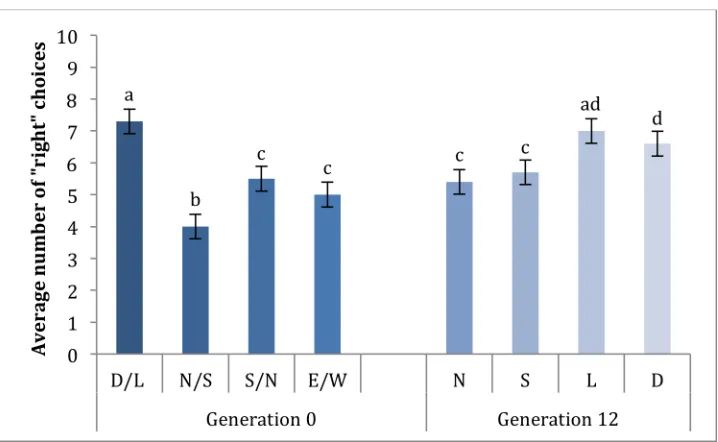
We found the maze conditions had a significant effect on the distribution of flies in the collection vials (Figure 3; ANOVA: F7, 614 = 19.07; p < 0.001). The flies in the generation 0 Light/Dark trial had a mean vial number of 7.3 ± 0.2 (± S.E.M.), which was significantly different from all other Generation 0 trials (t-tests: north to the right: p < 0.001; north to the left: p < 0.001; west to the right: p < 0.001). In generation 0, the distribution of flies from the maze where north was to the left (4.0 ± 0.2) had a significantly different distribution compared to flies from the maze where north was to the right (5.5 ± 0.3; t-test: p < 0.001) and compared to flies from the maze where west was to the right (5.0 ± 0.3; t-test: p = 0.016).
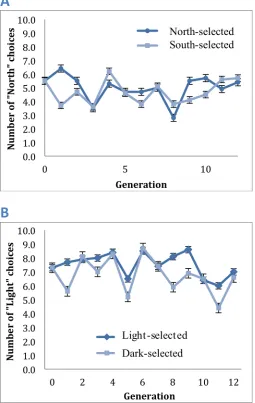
There was not an obvious change in orientation behavior due to selective breeding for our Light, North or South populations; however there does appear to be a change in behavior for our Dark population (Figure 3; Figure 4). After 12 generations of selection, the Light flies did not have a different distribution (7.0 ± 0.2) from the Generation 0 flies (t-test: p < 0.24). The Dark flies (6.6 ± 0.3) were significantly different from the
Generation 0 flies (t-test: p = 0.019). The North flies (5.4
Figure 3: Average number of choices toward the right side of the maze for the original population of flies (Generation 0), and flies after 12 rounds of selection (Generation 12). D/L represents the dark vs. light trial with the light side of the maze toward the right (n = 98). N/S represents the north vs. south trial with south to the right (n = 47). S/N represents the north vs. south trial with north to the right (n = 66). E/W represented the east vs. west trial with west to the right (n = 46). For Generation 12, N represents north-selected flies (n = 91), S represents south-selected flies (n = 155), L represents light-selected flies (n = 58), and D represents dark-selected flies (n = 61). For north vs. south trials, north was to the right. For light vs. dark trials, light was to the right. Bars with similar letters are not significantly different (post-hoc t-tests; p < 0.05). Error bars represent standard error of the mean.
James, et al. | Directional Preference in Drosophila melanogaster
PURE Insights Volume 5, Issue 1
A
B
Figure 4: The average number of (A) “North” or (B) “Light” choices made by each generation of flies after artificial breeding for each direction preference. Error bars represent standard error of the mean.
± 0.2) were not different from the Generation 0 flies when North was to the right (t-test: p = 0.90). The South flies (5.7 ± 0.2) were also not different from the
Generation 0 flies when North was to the right (t-test: p = 0.36).
The overall distribution of Generation 12 flies, both south-selected and north-selected, did not appear to be a normal distribution (Figure 5). For example, if the flies had a normal distribution with an average of 5.5, we would expect that vials 5 and 6 would have the most flies, and the numbers of flies in each vial would
decrease as the vial number increased. However, for the South Generation 12 flies, 19% of flies were found in vial 7, 7% were in vial 8, and 16% were in vial 9. Similarly, in
trial with North Generation 12 flies, 6% of flies were found in vial 6 and 14% were in vial 7.
We performed an additional experiment with the generation 12 North and South flies where we ran the flies through the maze, collected the top 20% of flies, and then ran them through the maze again. For the North flies, the average distribution on the original run through the maze (n = 308; 5.6 ± 0.1) was not different from the average distribution when the top 20% of flies were re-run through the maze (n = 53; 5.1 ± 0.3; t-test: p = 0.15). Similarly, for the South flies, the average
distribution for the original run (n = 95; 4.0 ± 0.2) was not different from the average distribution when the top 20% were re-run through the maze (n = 17; 4.1 ± 0.4; t-test: p = 0.94).
Discussion
Our two trials of north vs. south with Generation 0 flies were significantly different from the light vs. dark trial with Generation 0, consistent with previous findings that flies have an innate phototaxic behavior (Hadler, 1964). However, while previous research saw a significant separation between Light and Dark populations of flies by Generation 10 (Hadler, 1964), after 12 generations we have only seen a significant difference in the Dark population compared to our wild-caught population. The difference may be due to the fact that in Hadler (1964) the original wild-caught flies scored an average of 8.2 out of 15, whereas our wild-caught flies scored an average of 7.3 out of 10. The wild-caught flies in Hadler (1964) were 0.7 choices away from the center photo-score and our flies were 2.3 choices from the center photo-score. Using these innately stronger phototaxic flies may have led to a ceiling effect for our light-selected flies and may be contributing to our slow separation of populations.
James, et al. | Directional Preference in Drosophila melanogaster
PURE Insights Volume 5, Issue 1
Our initial trials with the wild-caught Drosophila are suggestive that the flies may have an innate directional preference for north over south. The distribution of flies in the trial when north was to the right was significantly different than the distribution of flies when north was to the left (Figure 3). However, two additional sets of experimental data do not support this initial finding. First, after 12 generations of selection, the North population and the South population of flies showed no difference in their orientation behavior. Second, when we re-ran the top 20% of the Generation 12 North flies and the top 20% of the Generation 12 South flies through the maze a second time, there was no significant difference between the directional preferences of the entire population of generation 12 flies and the top 20% of Generation 12 flies for either the North or South populations.
Our future plans include breeding the flies through 15 generations of selection, then performing multiple replicates of the Generation 0 and Generation 15 flies. Because our flies are in the maze together, each fly should not be considered an independent data point. Indeed, the distribution of our flies in the maze show clumping of flies in certain vials (Figure 5), indicating that the flies are interacting as they run through the maze. Performing replicates with the Generation 0 and Generation 15 flies will allow us to treat each group of flies that run through the maze as independent data points.
We also plan to begin a new round of breeding, using wild-caught Generation 0 flies, with a Faraday cage around our maze. If flies use cryptochrome to detect magnetic fields, we may have failed to observe orientation behavior because of ambient radio frequency fields (Phillips and Sayeed, 1993). We chose to run our initial experiments without a Faraday cage because a Faraday cage will not affect magnetite-based
magnetoreception. Evidence suggests that at least eight genera of arthropods use magnetite to detect magnetic fields, while evidence for using light-based
magnetoreception has only been found in 4 genera (Arendse, 1978; Leucht, 1984; Anderson and Vander Meer, 1993; Collett and Baron, 1994; Chittka et al., 1999; Perez et al., 1999; Vacha and Soukopova, 2004; Camlitepe et al., 2005; Gegear et al., 2008; Guerra et al., 2014; Riveros et al., 2014). Of the four genera that appear to use light-based magnetoreception, all except
Drosophila use both magnetite and a light-based mechanism. If we can selectively breed north-seeking
Drosophila with a Faraday cage, but cannot successfully breed them without a Faraday cage, this would be further evidence that Drosophila, unlike all other
arthropods tested so far, have only light-based magnetoreception.
If we ultimately confirm that Drosophila do indeed have a magnetic orientation behavior, the method of using a Y-maze coupled with selective breeding that we describe here should facilitate our understanding of the genetic basis of magnetic orientation behavior. For example, since the demonstration that Drosophila have innate positive phototaxis behavior (Hadler, 1964), subsequent genetic analysis has shown that the genes regulating photonegative behavior in Drosophila reside in the X chromosome and that genes for photopositive behavior are largely autosomal (Markow 1975). The use of a Y-maze by Hadler (1964), along with selective breeding, allowed for further exploration of the actual genetic basis for their behavior. Our goal is similar: to not only supplement the data that demonstrate magnetic orientation behavior in Drosophila, but to ultimately generate a strain of flies that can be used to find the genetic basis for magnetic orientation in Drosophila. Overall, we hope this will lead to further understanding of the genetic basis for migration behavior and orientation in a wide variety of organisms.
References
Anderson JB, Vander Meer RK (1993) Magnetic orientation in the fire ant, Solenopsis invicta. Naturwissenschaften 80: 568-570.
Arendse MC (1978) Magnetic field detection is distinct from light detection in the invertebrates Tenebrio and Talitrus. Nature 274: 357-362.
Banks AN, Srygley RB (2003) Orientation by magnetic field in leaf-cutter ants, Atta colombica (Hymenoptera: Formicidae) Ethology. 109: 835-846.
Burda H, Marhold S, Westenberger T, Wiltschko R, Wiltschko W (1990) Magnetic compass in the subterranean rodent Cryptomyshottentotus (Bathyergidae) Experientia 46: 528–530.
Camlitepe Y, Aksoy V, Uren N, Yilma A, Becenen I (2005) An experimental analysis on the magnetic field sensitivity of the black-meadow ant Formica pratensis Retzius (Hymenoptera: Formicidae). Acta Biol Hung 56: 215-224.
Chittka L, Williams NM, Rasmussen H, Thomson, JD (1999) Navigation without vision: bumblebee orientation in complete darkness. P Roy Soc Lon B Bio 266:45-50.
Collett TS, Baron J (1994) Biological compasses and the coordinate frame of landmark memories in honeybees. Nature 368: 137-140.
Dommer DH, Gazzolo PJ, Painter MS, Phillips JB (2008) Magnetic compass orientation by larval Drosophila
James, et al. | Directional Preference in Drosophila melanogaster
PURE Insights Volume 5, Issue 1
Fedele G, Green EW, Rosato E, Kyriacou CP (2014) An electromagnetic field disrupts negative geotaxis in Drosophila via a CRY-dependent pathway. Nature Communications 5: 4391.
Gegear RJ, Casselman A, Waddell S, Reppert SM (2008) Cryptochrome mediates light-dependent magnetosensitivity in Drosophila. Nature 454: 1014–1018.
Guerra PA, Gegear RJ, Reppert SM (2014) A magnetic compass aids monarch butterfly migration. Nature
Communications 5: 4164-4171.
Hadler NM (1964) Genetic influence on phototaxis in Drosophila melanogaster. Biol Bull 126: 264–273.
Kramer, G (1953) Wird die Sonnenhohe bei der Heimfindeorientierung verwertet? J. Ornithol. 94: 201–219.
Krupp JJ, Kent C, Billeter JC, Azanchi R, So AK, Schonfeld JA, Smith BP, Lucas C, Levine JD (2008) Social experience modifies pheromone expression and mating behavior in male Drosophila melanogaster. Curr Biol 18:1373– 1383.
Leucht T (1984) Responses to light under varying magnetic conditions in the honeybee, Apis mellifica. J Comp Physiol A 154: 865-870.
Markow, TA (1975) A genetic analysis of phototactic behavior in Drosophila melanogaster. I. Selection in the presence of inversions. Genetics 79: 527–534
Marley R, Giachello CNG, Scrutton NS, Baines RA, Jones AR (2014) Cryptochrome-dependent magnetic field effect on seizure response in Drosophila larvae. Sci Rep 4: 5799.
NOAA National Centers for Environmental Information. Computer Earth’s Magnetic Field Values.
https://www.ngdc.noaa.gov/geomag/magfield.shtml.
Painter MS, Dommer DH, Altizer WW, Muheim R, Phillips JB (2013) Spontaneous magnetic orientation in larval
Drosophila shares properties with learned magnetic compass responses in adult flies and mice. J Exp Biol 216: 1307-1316.
Perez SM, Taylor OR, Jander R (1999) The effect of a strong magnetic field on monarch butterfly (Danaus plexippus) migratory behavior. Naturwissenschaften 86: 140-143.
Phillips JB, Sayeed O (1993) Wavelength-dependent effects of light on magnetic compass orientation in Drosophila melanogaster. J Comp Physiol A 172: 303-308.
Phillips JB, Borland SC (1992) Behavioral evidence for the use of a light-dependent magnetoreception mechanism by a vertebrate. Nature 359: 142–144.
Riveros AJ, Esquivel DMS, Wajnberg E, Srygley RB (2014) Do leaf-cutter ants Atta colombica obtain their magnetic sensors from soil? Behav Ecol Sociobiol 68: 55-62.
Sokolowski MB, Kent C, Wong J (1984) Drosophila larval foraging behaviour: developmental stages. Animal Behavior 32: 645–651.
Vacha M, Soukopova H (2004) Magnetic orientation in the mealworm beetle Tenebrio and the effect of light. J Exp Biol 207: 1241-1248.
Wiltschko R, Wiltschko W (1995) Magnetic Orientation in Animals. Springer, Berlin, Heidelberg, New York.
Wiltschko W, Wiltschko R (2005) Magnetic orientation and magnetoreception in birds and other animals. J Comp Physiol A 191: 675-693.
Yurkovic A, Wang O, Basu AC, Kravitz EA (2006) Learning and memory associated with aggression in