164
Copyright © 2016. Vandana Publications. All Rights Reserved.
Volume-6, Issue-6, November-December 2016
International Journal of Engineering and Management Research
Page Number: 164-170
The Effect of Perceived Organizational Support and Self-Efficacy on
Operational Manager’s Readiness for Change
Hesty Prima1, Anis Eliyana2 1,2Universitas Airlangga, INDONESIA
ABSTRACT
Changes cannot be avoided in every organization, including Regional Water Supply Company in East Java as a Regionally-Owned Enterprise.There should be efforts to improve the organization through changes in order to build readiness for human resources as well as management system of the organization, especially operational managers’ readiness as those managers are the agents of changes in the organization. Accordingly, the objectives of this research are: to analyze the effect of self-efficacy to operational managers’ readiness to change and the effect of perceived organizational support to operational managers’ readiness to change in Regional Water Supply Company.
This study is an explanatory research to describe the causal relationship between variables using hypothesis testing. Data used are questionnaires as primary data. Sampling technique is census, in which the units of analysis are operational managers in Regional Water Supply Company in East Java province. Analysis technique used to test the hypotheses is Structural Equation Modeling (SEM) with AMOS 5 method.
The analysis shows that error probability score of the self-efficacy effect (X1) to the readiness to change (Y) is
0.000 which is lower than significance standard score 5% (0.05) with the positive standardized regression weight score 0.619. Therefore, self-efficacy (X1) affects the
readiness to change (Y) significantly and positively. It alsoshows that error probability score of the perception effect of organizational support (X2) to readiness to change
(Y) is 0.007 which is lower than significance standard score 5% (0.05) with positive standardized regression weight score 0.282. Therefore,perceived organizational support (X2) affects readiness to change (Y) significantly and
positively.
The research main contribution is to do the empirical test of Perceived organizational support (POS) as an antecedent variable of operational manager’s readiness for change. Another original aspect in this research is about using the operational manager as a subject that has roles as trainers, counselors, advisors, and agents for changes. However, the operational manager is not include in the top management.
Keywords---- Self-efficacy, Perceive of Organizational Support, Readiness for Change
I.
INTRODUCTION
That changes are important in an organization should be concerned by the understanding of the importance of those changes. Changes are one of most critical aspects for effective management (Hussey, 2000). Change model is built from the observation that human behaviors are in accordance with psychological balance, in which some forces,that come from past observational learning and cultural effects, tend to maintain the current behaviors.
Developing and complex organization dynamically creates challenges for the leaders. Leaders who act as agents for changes in an organization are managers. Mintzberg (1973) stated that there are ten roles of a manager in his or her workplace that are grouped into three: (1) Role between Individuals; (2) Informational Role; (3) Decision Making Role. Mintzberg then
concluded that in a broad outline, a manager’s activities are to interact with others.
165
Copyright © 2016. Vandana Publications. All Rights Reserved.
Figure 1: Triadic Reciprocal DeterminismSource Bandura, A. (2001). Social Cognitive Theory of Mass Communication. Media Psychology, 3(3), 265-299
If it is combined with the Theory of Behavior, it can be concluded that employees’ readiness to change will be affected by employees as individuals by themselves and organizational environment. This issue is also supported empirically that readiness to change comes from a combination of personal characteristics and organization (Madsen, 2003; George and Jones, 2002).
Regional Water Supply Company in East Java is a Regionally-Owned Enterprise which is demanded to improve in order to face globalization era in ASEAN Economic Community (AEC) in 2015. In implementing the improvement of the organization and service in Regional Water Supply Company especially in East Java region, it is needed to have readiness in human resources and also organizational management system. That goal can be achieved if the managers have roles as trainers, counselors, advisors, and agents for changes.
Operational managers are demanded to be capable to face organizational changes through the readiness to change, referencing to the theory of behavior by Bandura (1977), behaviors are formed by two factors which are an individual or a person and environment.
Based on the discussion regarding the importance of mangers’ readiness for organizational changes above, this research is hoped to describe the condition of operational managers’ readiness to change that happened at Regional Water Supply Company in East Java. The focus of this research is operational managers’ readiness to change at Regional Water Supply Company in East Java that is affected by variable of self-efficacy and also variable of perceived organizational support.
Hypotheses
a) There is an effect of self-efficacy to operational managers’ readiness to change at Regional Water Supply Company in East Java.
b) There is an effect of perceived organizational support to operational managers’ readiness to change at Regional Water Supply Company in East Java.
Objectives of the Study
a) To study and analyze the effect of self-efficacy to operational managers’ readiness to change at Regional Water Supply Company in East Java
b) To study and analyze the effect of perceived organizational support to operational managers’ readiness to change at Regional Water Supply Company in East Java
II.
THEORETICAL FRAMEWORK
Definition and Theory of Organizational Change
Changes are global phenomena that are unpreventable, so that every organization should make changes to follow and anticipate the changes of external environment well, internally and externally. Organizational changes are not simple processes, since organizational changes are about changes of organizational performance. Those changes are transformation that is planned or unplanned in the organizational structure, technology, and/or a person (Greenberg &Baron, 2003, p. 590).
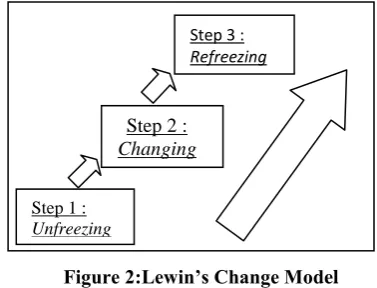
Agents of changes as persons who act as a catalyst and have responsibility to manage the changes (Robbins, 2009, p. 767) are hoped to be capable to handle problems happening, including resistance.Kurt Lewin is one of the experts that stated an idea that changes are a process that consists of three phases: unfreezing, changing, and refreezing. Change models are divided into three stages that explain the means of acting initiatively, managing, and stabilize the process of the changes, as follows:
a. Unfreezing
Unfreezing refers to create motivation and readiness to change in organization.
b. Changing
Changing is a stage of learning in which employees are given new information, new behavioral model, or new means of seeing cases.
c. Refreezing
Refreezing is a stage of changes that are stabilized. Schematically, the process of change model by Lewin can be developed in the following figure:
Figure 2:Lewin’s Change Model
Figure 2:Lewin’s Change Model
Source-- Greenberg and Baron, 2003, Behavior in Organization. New Jersey: Prentice Hall International, Inc.
This Lewin’s Change Model is developed through observation that human behaviors are formed based on psychological balance; in which those are formed by past observational learning and cultural effect that tend to maintain the current behaviors. Beside the Change Model, Kurt Lewin also made a model that is related to the changes, in which it is called Lewin’s Force-Field Theory of Change. In the Force-Field Theory of Change, Kurt Lewin expressed an idea that an organization, which is balanced between forces for
Step 1 :
Unfreezing
Mengenal perlunya perubahan
Step 2 :
Changing
Berusaha menciptak an kondisi baru
Step 3 :
Refreezing
166
Copyright © 2016. Vandana Publications. All Rights Reserved.
changes and resistance to changes, has perspectives thatmanagers can bring changes to the organization.
Definition and Theory of Self Efficacy
Self-Theory includes regulation and self-reflection, in which capabilities of self-reflection are a person who reflects back to his or her actions or experiences in a certain case, then proceeds cognitively how deep he or she believes in himself or herself to the solutions of duties in the future – acts as theoretical basis for self-efficacy (Bandura, 1999). Bandura truly emphasized that self-efficacy is a psychological mechanism which is the most important one in self-influence. Formal definition of self-efficacy that is commonly used is a statement by Bandura regarding the assessment or personal belief of “how good a person can act as needed to connect with prospective situation” (Bandura, 1982).
Broader understanding of self-efficacy and more accurate understanding of positive organizational behaviors are stated by Stajkovic and Luthans that self-efficacy refers to individual’s belief of the capability to mobilize motivation, cognitive resources, and actions needed, so that he or she successfully executes the duties in a certain context (Stajkovic &Luthans, 1998).
Leaders’ self-efficacy plays an important role in accomplishing the organizational demands which develop dynamically and complexly. Leaders’ self-efficacyis based on themselves and the understanding of efficacy. Then, it can be concluded that leaders’ self-efficacy is individual’s belief of the capabilities as leaders, and also trusts of their leadership which is supported by senior leaders, colleagues, facilities, and resources in the environment.
Bandura (1977) stated some dimensions of self-efficacy which are magnitude generality, and strength. Magnitude is related to the levels of difficulties in certain duties done. Generality, related to the field of the duties, is how deep an individual believes to do the duties. Strength is related to how strong or how weak the individual’s belief is. From those three dimensions, self-efficacy is described in each aspect as follows:
1. Magnitude aspect or levels of difficulties is capability to accomplish work with certain levels of difficulties, for instance:
a. Belief of capability in doing a job well
b. Belief of capability in searching for solutions of problems faced
2. Generality aspect or generality is capability to do a job freely and with different job fields including:
a. Belief of capability in working at a complex job field well
b. Belief of capability in working at several job fields well 3. Strength aspect or strength is how strong or weak an individual’s belief is, that can be observed through: a. Belief of capability to survive and accomplish optimal results in doing a job
b. Belief of capability in managing duties with tenacity
Definition and Theory of Perceived organizational support
In an organization, there are social interactions between individuals, as organizational members, and the organization. Theory of organizational support explains the interactions between individuals and the organization, especially studies on how an organization treats the employees. Organizational support is a level of how deep the employees believe that the organization respects their contribution and cares about their welfare (Robbins & Judge, 2008).
Related to this case, Eisenberger, Huntington, Hutchison, and Sowa, (1986); Shore and Shore (1995), Rhoades and Eisenberger (2002) stated that in order to complete the needs of socio-emotions and to assess the benefits of improvement in performance, employees create general perception to the extent of how an organization respects the contribution and cares about the employees’ welfare, in which that is called as organizational support.
Perceived organizational support refers to the perception of employees regarding how far the organization gives values to the contribution, supports, and cares about their welfare (Rhoades &Eisenberger, 2002). Perceived organizational support is also known as a global belief created by an employee regarding their assessment to the policy and organizational procedures (Rhoades &Eisenberger, 2002).
According to Rhoades and Eisenberger (2002), although that an organization respects contribution and cares about employees’ welfare is an important matter, an organization should also care that employees will seek for real support shown by the organization based on employees’ perception as aview of organizational support. A meta-analysis by Rhoades and Eisenberger (2002) indicated that there are three main categories of treatments that are viewed by the employees to have relationships with the perceived organizational support. The three main categories are as follows:
1. Justice
Cropanzano, Prehar, and Chen (2002) stated that employees will evaluate organizational justice in three classifications of different phenomena, which are the results that they get from the organization (distributive justice), formal policy or the process in which an achievement is allocated (procedural justice), and how the decision makers treat personals in an organization (interactional justice).
2. Leaders’ Support
Employees develop their general view about how far leaders assess their contribution and care about their welfare (Kottke and Sharafinski in Rhoades & Eisenberger’s, 2002). Since leaders act as agents of the organization that have responsibilities to direct and evaluate the underlings’ performance, employees also see their leaders’ orientation as an indication of an existence of organizational support (Levinson et al. in Rhoades & Eisenberger, 2002)
3. Awards from an Organization and Condition of a job Awards from an organization and condition of a job are in the forms of:
167
Copyright © 2016. Vandana Publications. All Rights Reserved.
Based on the theory of organizational support,chances to get awards (salary, acknowledgement, and promotion) will improve employees’ contribution and perceived organizational support (Rhoades & Eisenberger, 2002).
b. Autonomy
With autonomy, there is a control of how employees do their job. With autonomy, employees’ wise decisions to do a job will improveperceived organizational support (Cameron et al. in Rhoades & Eisenberger’s, 2002).
c. The Role of Stressor
Stress refers to incapability of an individual to handle demands from environment (Lazarus and Folkman in Rhoades & Eisenberger, 2002).
d. Training
Trainings in working are seen as investment for employees that will improveperceived organizational supportin the future (Wayne et al., in Rhoades & Eisenberger, 2002).
Definition of Readiness to Change
Readiness to change is comprehensive attitudes that are simultaneously affected by changing matters, how changes are made, a condition when changes happen, and a person’s characteristics demanded to make changes together asa reflection in cognitive aspects and also individuals’ emotion to prefer to accept and adopt changes made for handling current condition Holt, Armenakis, Harris, and Feild (2007). Individual’s readiness to change is defined as willingness to be open for changes (Jones, Jimmieson,& Griffiths, 2005; Eby, Adams, Russel, & Gaby,2000), cognitively and emotionally (Holt et al., 2007). Individual’s readiness to change reflects thoughts, feelings, and intentions of individuals that may or may not cause certain behaviors related to the attitudes (Desplaces, 2005).
III.
RESULTS OF PREVIOUS STUDIES
Relationship between Self Efficacy and Readiness to Change
Some empirical studies already examinedself-efficacy as precursor to build readiness for changes. Cunningham et al. (2002) showed that employees with high level of self-efficacy have high level of readiness to reverse engineer a hospital. Judge, Higgins, Thoresen, and Barrick (1999) studied generally on self-efficacy in the contexts of changes and found out that self-efficacy has positive influence related to handling changes. Self-efficacy, as capabilities for a success in managing changes, gives a mediator effect to individual’s readiness(Prochaska, Redding, & Evers, 1997). Another research about readiness of employees to change by Rafferty and Simons (2006) focused on self-efficacy, trusts in colleagues, logistics, and support system. Holt et al. (2007) studied on the employees’ belief, self-efficacy, appropriateness, management support, and personal valence. Those several researches showed that self-efficacy has positive influence to employees’ readiness.
Relationship between Perceived organizational support and Readiness to Change
In the contexts of changes, individuals’ belief assesses that an organization (leaders and colleagues) will give real support to the changes in the forms of resources and information. This belief will give contribution for individuals’ perception regarding the success or capability to apply the changes(Rafferty, Jimmieson, & Armenakis, 2012). Then, it can be concluded that perceived organizational support gives contribution to readiness to change.
Empirically, Rafferty and Simons (2006), and also Desplaces (2007) already found out that perceived organizational support is a positive influence to readiness to change.
IV.
RESEARCH METHOD
This research is to analyze and prove the effect of exogenous variable to endogenous variable. Those variables are latent variables that are formed by several indicators. Then, to analyze data in this research, analysis technique of Structural Equation Modeling (SEM) is used with causal design since the purpose of the study is to measure the causal relationship between several variables which are self-efficacy, perceived organizational support, operational managers’ readiness in city Regional Water Supply Company in East Java.
Units of analysis with a census method in this research are 130 operational managers who work for Regional Water Supply Company in East Java. Data used in this research are primary data using a method of questionnaires to collect the data. Analysis technique used to test hypotheses in this research is Structural Equation Modeling (SEM) with AMOS 5 method.
V.
FINDINGS
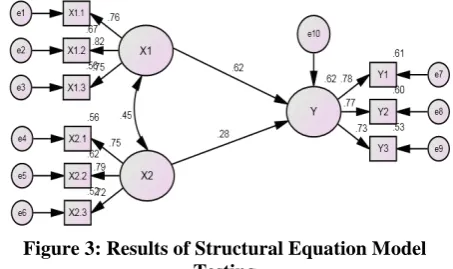
Structural equation model analysis is intended to test the model and hypotheses developed in this research. Structural equation model testing is done through two tests which are model compatibility testing and quality significance testing in regression co-efficiency. Structural model analysis is done to test the effect of self-efficacy and perceived organizational support to readiness to change.
168
Copyright © 2016. Vandana Publications. All Rights Reserved.
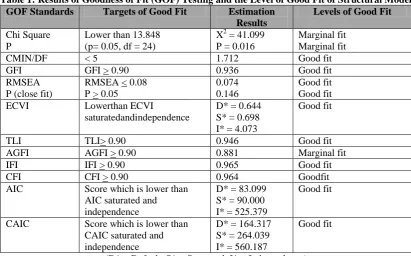
The results of goodness of fit testing of structuralmodel and criteria limit scores that show the level of good
fit can be seen as follows:
Table 1: Results of Goodness of Fit (GOF) Testing and the Level of Good Fit of Structural Model GOF Standards Targets of Good Fit Estimation
Results
Levels of Good Fit
Chi Square P
Lower than 13.848 (p= 0.05, df = 24)
X2 = 41.099 P = 0.016
Marginal fit Marginal fit
CMIN/DF < 5 1.712 Good fit
GFI GFI > 0.90 0.936 Good fit
RMSEA P (close fit)
RMSEA < 0.08 P > 0.05
0.074 0.146
Good fit Good fit ECVI Lowerthan ECVI
saturatedandindependence
D* = 0.644 S* = 0.698 I* = 4.073
Good fit
TLI TLI> 0.90 0.946 Good fit
AGFI AGFI > 0.90 0.881 Marginal fit
IFI IFI > 0.90 0.965 Good fit
CFI CFI > 0.90 0.964 Goodfit
AIC Score which is lower than AIC saturated and independence
D* = 83.099 S* = 90.000 I* = 525.379
Good fit
CAIC Score which is lower than CAIC saturated and independence
D* = 164.317 S* = 264.039 I* = 560.187
Good fit
(D* = Default, S* = Saturated, I* = Independence)
Source-- Appendix of the Results of Structural Model Analysis (Model Fit Summary)
The results of structural model analysis describe as follows:
1. The effect of self-efficacy (X1) to the readiness to change (Y) is positive, because of having positive standardized regression weight score 0.619. It means that if self-efficacy (X1) rises, readiness to change (Y) also rises; in which the rising score is the same with standardized regression weight score. The effect of self-efficacy (X1) to the readiness to change (Y) is significant because of having error probability score (p) 0.000 which is lower than the level of significance (α) 5% or 0.05.
2. The effect of perceived organizational support (X2) to the readiness to change (Y) is positive, because of having positive standardized regression weight score 0.282. It means that if perceived organizational support (X2) rises, readiness to change (Y) also rises; in which the rising score is the same with standardized regression weight score. The effect of perceived organizational support (X2) to the readiness to change (Y) is significant because of having error probability score (p) 0.007 which is lower than the level of significance (α) 5% or 0.05.
VI.
DISCUSSION
The importance of readiness to change for the employees’ performance, when organizational changes happen, becomes a measurement to the success of organizational change. That case stated by Rowden (2001) and Armenakis et al. (1993) is a key aspect of an
effort of organizational change which is related to the success or failure of the efforts of changes, in which it is readiness for changes between organizational members.
Readiness to change is defined as how far employees tend to support changes, in reverse to disobedience or rejection of changes (Zolno, 2008). The understanding of readiness to change according to Armenakis et al. (1993, p. 681) is that
“Readiness for change is defined as the employees’ beliefs and attitudes regarding the extent to which changes are needed and the organization’s ability to successfully complete the intended change”
From the understanding above, it is known that employees’ readiness to change is affected by employees’ individual factor and organizational factor. Several researchers are already done in the management contexts of a change that discuss about the employees’ readiness to change with the supporting factors that include individual and working environment, in which one of the researches is done by Miller, Madsen, and John(2006) who studied about the management relationship between leaders, working knowledge, skill, and working demands; Rafferty and Simons (2006) focused on self-efficacy, trust in colleagues, logistics, and supporting system; the research by Holt et al. (2007) is about employees’ belief, self-efficacy, management support, and personal valence. In those researches, all variables have positive influence to employees’ readiness to change.
169
Copyright © 2016. Vandana Publications. All Rights Reserved.
that self-efficacy affects significantly to the operationalmanagers’ readiness to change at city Regional Water Supply Company in East Java. The effect of self-efficacy to the readiness to change is positive; it means that if self-efficacy improves, readiness to change improves as well; as the second hypothesis states that perceived organizational support affects significantly to operational managers’ readiness to change at city Regional Water Supply Company in East Java. The effect of perceived organizational support is positive; it means that if perceived organizational support improves, readiness to change improves as well.
VII.
CONCLUSION
In this research, it can be concluded that operational managers’ readiness to change at city Regional Water Supply Company in East Java is affected by self-efficacy as individual factor and perceived organizational support as environmental factor. Self-efficacy has the highest value related to operational managers’ capability to finish a job with a certain level of difficulty. On the other hand, perceived organizational support that has the highest value is related to operational managers’ perception of awards from the organization.
In line with this case, it is known that to improve operational managers’ readiness in facing changes, it is needed to have individual factor which is operational managers’ self-efficacy and environmental factor of the organization. It is also needed to improve awards for employees, especially operational managers as agents of changes.
REFERENCES
[1] Armenakis, A. A., Harris, S. G., & Mossholder, K. W. (1993). Creating readiness for organozational change. Human Relations, 46(6), 681-703.
[2] Bandura, A. (1977). Self-efficacy: Toward a unifying theory of behavioral change. Psychological Review, 84(2), 191-215.
[3] Bandura, A. (1982). Self-efficacy mechanism in human agency. Americam Psychologist, 37(2), 122-147. [4] Bandura, A. (1997). Self-efficacy: The exercise of control. New York: WH Freeman.
[5] Cropanzano, R., Prehar, C. A., & Chen, P. Y. (2002). Using social exchange theory to distinguish procedural from interactional justice. Group Organization Management, 27(3), 324-351.
[6] Cunningham, C. E., Woodward, C. A., Shannon , H. S., MacIntosh, J., Lendrum, B., Rosenbloom, D., & Brown, J. (2002). Readiness for organizational change: A longitudinal study of workplace, psychology. Journal of Occupational and Organizational Psychology, 75(4), 377-392.
[7] Desplaces, D. (2005). A multilateral approach to individual readiness to change. The Journal of Behavioral and Applied Management, 7(1), 25-39.
[8] Desplaces, D. E., Melchar, D. E., Beauvis, L. L., & Bosco, S. M. (2007). The impact of business education on moral judgement competence: An empirical study. Journal of Business Ethics, 74(1), 73-87.
[9] Eby, L. T., Adams, D. M., Russel, J. E., & Gaby, S. H. (2000). Perceptions of organizational readiness for change: Factors related to employees' reactions to the implementation of team-based selling. Human Relations, 53(3), 419-442.
[10] Eisenberger, R., Huntington , R., Hutchison, S., & Sowa, D. (1986). Perceived organizational support. Journal of Applied Psychology, 71(3), 500-507.
[11] George, J. M., & Jones, G. R. (2002). Understanding and Managing Organizational Behavior.
New Jersey: Prentice Hall.
[12] Greenberg, J., & Baron, R. A. (2003). Behavior in Organization. New Jersey: Prentice Hall International Inc.
[13] Holt, D. T., Armenakis, A. A., Harris , S. G., & Feild, H. S. (2007). Toward a comprehensive definition of readiness for change: A review of research and instrumentation. Research in Organizational Change and Development, 16, 289-366.
[14] Hussey, D. E. (2000). How to Manage Organizational Change. Kogan Page .
[15] Jones, R. A., Jimmieson, N. L., & Griffiths , A.(2005). The impact of organizational culture and reshaping capabilities on change implementation success: The mediating role of readiness for change. Journal of Management Studies, 42(2), 361-386.
[16] Judge, T. A., Higgins, C. A., Thoresen, C. J., & Barrick, B. R. (1999). The big five personality traits, general mental ability, and career success across the life span. Personnel Psychology, 52(3), 621-652.
[17] Madsen, S. R. (2003). A model for individual change: Exploring its application to human resource development. Human Resources Development Review, 2(3), 229-251.
[18] Miller, D., Madsen, S. R., & John, C. (2006). Readiness for change: Implications on employees' relationship with management, job knowledge,and skills and job demands. Journal of Applied Management and Entrepreneurship, 11(1).
[19] Mintzberg, H. (1973). The Nature of Managerial Work. New York: Harper & Row.
[20] Prochaska, J. O., Redding, C. A., & Evers, K. E. (1997). The transtheoretical model and stages of change. In K. Glanz, B. K. Rimer, & K. Visnawath (Eds.), Health Behavior and Health Education: Theory, Research and Practice (pp. 60-84). San Fransisco: Josey-Bass A Wiley Imprint.
[21] Rafferty, A. E., & Simons, R. H. (2006). An examination of the antecedents of readiness for fine-tuning and corporate transformation changes. Journal of Business and Psychology, 20(3), 325-350.
170
Copyright © 2016. Vandana Publications. All Rights Reserved.
[23] Rhoades, L., & Eisenberger, R. (2002). Perceivedorganizational support: A review of the literature. Journal of Applied Psychology, 87(4), 698-714.
[24] Robbins, S. P. (2009). Management. French Forest NSW: Pearson Education Australia.
[25] Robbins, S. P., & Judge, T. A. (2008). Perilaku Organisasi (Organizational Behavior) (12 ed.). (D. Angelica, R. Cahyani , & A. Rosyid , Trans.) Jakarta: Salemba Empat.
[26] Rowden, R. W. (2001). The learning organization and strategic change. SAM Advanced Management Journal, 66(3), 11-24.
[27] Sansone , C., Morf, C. C., & Panter, A. T. (Eds.). (2003). The Sage Handbook of Methods in Social Psychology. Thousand Oaks, California: SAGE Publications.
[28] Shore, L. M., & Shore, T. H. (1995). Perceived organizational support and organizational justice. In R. S. Cropanzano, & K. M. Kacmar (Eds.), Organizational Politics, Justice and Support: Managing the Social Climate of the Workplace (pp. 149-164). Wesport, Conn: Quorum Books.
[29] Stajkovic, A. D., & Luthans, F. (1998). The relationship between self efficacy and work related performance: A meta-analysis. Psychological Bulettin, 124(2), 240-261.