Volume 2, Issue 11, November 2013
Page 39
ABSTRACT
Information security is not only a technical issue, but also a business and governance challenge that involves risk management, reporting, and accountability. In order to secure information assets, information security must be treated as an integral part of the institutions overall governance. The proposed Information Security Governance framework, enables institutes of higher education to implement a formal framework, which is adaptable, easy to deploy, and based on industry best practices and standards. The framework, by virtue of its design, enforces integration of the ISG framework with the corporate governance framework. The framework can be implemented incrementally, depending upon the readiness and resources available with the institutions. Recognizing the importance of the measure of success, an evaluation plan is also suggested.
In the metric based comprehensive evaluation plan, some new roles are created and their key responsi bilities and accountabilities are defined. Each metric is associated with a predefined role, so that in case of any incidence a quick response can be initiated and responsibilities can be fixed. All the metrics are classified, indicating complexity of the metric. This classification facilitates an incremental implementation of the assessment plan. Security exceptions are reported directly, without wasting any time, to the predefined roles, responsible for that particular metric or security control. This directed reporting helps in reducing response time, as the best person to handle the incident gets timely intimation, making more time available for planning and implementation.
The proposed ISG framework shall provide a strong start, to the organizations seeking to improve their information security governance.
Keywords: Information Security, ISG framework, ISG process, assessment
1.INTRODUCTION
Information Security Governance or ISG, is a subset discipline of Corporate Governance focused on information security systems and their performance and risk management [Wikipedia]. Information security governance is all of the tools, personnel and business processes that ensure that security is carried out to meet an organization's specific needs. It requires organizational structure, roles and responsibilities, performance measurement, defined tasks and oversight mechanisms [1]. Initially the focus of Information Security initiative was on security controls, which was purely of technical nature. Later the focus shifted to management of the Information Security, and at present the focus is on its governance. The following points illustrate the need of a formal Information Security plan for every academic institution.
Most critical and essential infrastructures of any university
Cost of interruption in services is significantly high
These days attacks on information systems are no more for fun only. Motivation can be theft (both of money and intellectual property), revenge, harassment, intimidation, character assassination, fraud, sabotage, crime and terrorism
Universities are favorite targets for hacker activities and attacks
Generally, the instructional and research environment of colleges and universities is more open than in government or corporate training departments and research laboratories. The academic culture tends to favor experimentation, tolerance, and individual autonomy. These characteristics make it difficult to create a culture of computer and network security [2].
1.1 Some Security Breaches in Indian Universities and Industry
Allahabad University: Allahabad University Fights Fake Website Problem: University reported the matter to the nearest police station, but the Inspector could not register the FIR as he was not sure, under which law the FIR will be registered. When consulted with the local expert in IT Act, he suggested that the offence comes under Section 66 of ITA 2008. The offence may also be considered as a violation of Section 66D (Impersonation). [Times of India, Nov 12, 2009]
IGNOU Online Test Sabotaged: India’s largest distance education university’s first experiment with online testing collapsed within minutes of taking off Saturday, a disaster which the university suspects resulted from a malicious cyber attack. The first session of IGNEAT-2009 the first online version of the entrance test was scheduled for 11 am-12.30 pm
MOB-RAIL: A Framework for Implementation
of Information Security Governance Process
and Evaluation
D.S. Bhilare
Volume 2, Issue 11, November 2013
Page 40
on October 31. A second 90-minute session was to follow at 3 pm, with three other sessions scheduled for November 1. [Indian Express, November 1, 2009]Chinese Cyber Intrusion: In yet another instance indicating that China specializes in Cyber Warfare, the report indicates that China appears to have intruded into vital army computers and stealing the data. The Government of India should collect some evidence and take up this intrusion as an act of aggression for a debate in UNO. [DNA, Dec 4, 2009]
Medical Record Sale: Recently, a British TV channel's sting operation revealed that confidential medical records sent to India for computerization were being offered for sale. The files procured under this sting operation were of patients of London Clinic, one of Britain's top private hospitals. Apparently, the data was being sold from an Indian transcription center located in Pune. This and many such earlier incidents have raised serious concerns about the data security practices of Indian business process outsourcing (BPO) companies.
2. Related Work
The International Standards Organization (ISO) has developed two specifications on the governance of information security, ISO 17799 and ISO 27001. Both have originated from British Standards, BS7799 parts 1 and 2, which have been used to certify over 2,500 organizations around the world. ISO 17799 is an international code of practice, or implementation framework, for information security best practices. ISO 27001 serves as the auditing and certification standard for the ISO 17799 framework with 133 information security controls covering eleven domains and also specifies how to design an ISO-certified Information Security Management System (ISMS).
There are some significant Indian contributions based upon the IT Act 2000/2008, which are available as Indian Information Security Framework (IISF-309), which is built under the following principles [3].
The framework is flexible enough for users in different user segment with different operational sizes to adopt practices which are appropriate and affordable. It does not mandate any specific security standard such as ISO 27001 or any other.
It incorporates the best practices in current usage but makes fine changes as required by ITA 2008.
It gives value for “Disclosure” and “Accountability”. Accordingly, it recommends a security policy to be announced by the organization and that a “Compliance officer” to be designated.
It banks on a “Client Consent” which makes framework legally binding on the prospective victim and hence meets the first of the three criteria suggested by Section 43A under explanation(ii)
According to Von Solms, there are various reasons why COBIT can be used in conjunction with ISO/IEC 27002 for Information Security Governance[4]:
COBIT contains IT governance objectives and processes, which is spread over a wide spectrum of IT governance. ISO/IEC 27002 deals specifically with IT security issues
COBIT’s processes are described at a higher level than those of ISO/IEC 27002
There are various processes that are included in both the COBIT and ISO 17799 standards
COBIT explains what must be done, while ISO/IEC 27002 describes how it should be done.
The shortcoming of using COBIT for Information Security governance is that it is not always very detailed in terms of ‘how’ to do certain things. The DCOs are more addressed to the ‘what’ must be done. In most cases some more detailed guideline for detailing precisely ‘how’ things must be done, will be needed. Because of COBIT’s history as being used by IT auditors, COBIT is in many cases preferred by IT auditors and IT Risk Managers as a framework of choice.
The shortcoming of using ISO for ISO/IEC 27002, is that it is very much a ‘stand alone’ guidance, not integrated into a wider framework for Information Technology governance.
3. PROPOSED INFORMATION SECURITY GOVERNANCE FRAMEWORK
3.1 MethodologyThe proposed methodology for ISG framework considers the following design objectives and constraints:
The proposed framework should provide an objective, standards based, and scalable ISG framework, using best practices from both corporate governance and various recognized Information Security standards.
The proposed Assessment Strategy should be flexible, which can be adapted according to existing institutional structure and resources.
Volume 2, Issue 11, November 2013
Page 41
Governance Framework is developed. This framework includes necessary control mechanism, and required organization structure for effective implementation and monitoring. This shall enforce use of appropriate technologies and ensure effective information security governance.3.2 Design Considerations, Principles and Challenges
The survey of Indian Universities conducted in 2010, shows that there are institutions having some basic ISG structure, but there are many still struggling to make a beginning [5]. The proposed framework, therefore, keeps in mind the many institutions that need to make a beginning. What is needed for the top management of these institutions is not a detailed plan for a full-scale implementation of all the aspects of information security. What is needed is a precise action plan on how to introduce an ISG program in a step-by-step manner that yields early success, while building understanding. The IT Act 2008 states that organizations handling sensitive personal data need to follow “Reasonable Security Practices” (RSP), under section 43A, failing which they will be liable for paying compensation to any person who suffers a loss. Similarly, under Section 79, there is a need for “Intermediaries” to follow “Due Diligence”. IT Act 2008, also provides data retention norms under section 67C, which should be considered part of the “Reasonable Security Practices”.
The proposed framework may not suit all the institutes as it is, as they have diverse needs and will vary their approaches to information security governance. To assist the institutions in adopting ISG program best suited to them, the following guiding principles, which are adapted from the guiding principles identified by the Task Force in their report [6].
Registrar and CISO should have an annual information security evaluation conducted, and report on performance to the Vice-Chancellor and Executive Council.
Institutions should conduct periodic risk assessments of information assets
Institutions should implement policies and procedures based on risk assessments to secure information assets.
Institutions should establish a security management structure to assign explicit individual roles, responsibilities, authority, and accountability.
Institutions should develop plans and initiate actions to provide adequate information security for networks, facilities, systems and information.
Institutions should provide information security awareness, training and education to personnel.
Institutions should conduct periodic testing and evaluation of the effectiveness of information security policies and procedures.
Institutions should create and execute a plan for remedial action to address any information security deficiencies. While designing the ISG framework the documents listed below were referred along with the research papers mentioned in the related work:
Corporate Task Force Recommendation, Information Security Governance a call to action, April 2004 [6].
Information Security Governance: Toward a Framework for Action, business software alliance, 2005 [7].
Guide for Developing Performance Metrics for Information Security, NIST Special Publication 800-80 [8].
Prioritizing IT Controls for Effective, Measurable Security. DHS, October 2006 [9].
Introduction to Security Governance, August 22, 2006 [10].
Aligning CobiT, ITIL and ISO 17799 for Business Benefit: Management and Summary
Governing for Enterprise Security (GES) Implementation Guide
Carnegie Mellon University, Software Engineering Institute, CERT, August 2007
National Institute of Standards and Technology Key Standards and Guidelines
In view of the background given above and specific needs of the Institutes of Higher Education (IHE), the ISG framework is proposed. During design of the framework various standards, Indian IT ACT 2000 and 2008 (Amendment), research papers, published reports of special interest groups, NIST publications, and white papers are referred. While designing the framework efforts are made to build an objective, standards-based, scalable, and collaborative framework, which would assist the IHE in planning and implementing ISG structure in their institutes depending upon the resources and individual needs.
The detailed ISG framework and Assessment Strategies are described in the following section.
3.3 Information Security Governance (ISG) Framework
Volume 2, Issue 11, November 2013
Page 42
Like quality, Information Security is also a continual improvement process where perfection is desired but rarely achieved. By making incremental improvements over time, periodic cycles of assessment, remediation and reporting significant and measurable progress can be achieved. The major target is to keep the process as simple as possible. One must start the process with the activities having major impact first.Finally, it is important to note that in information security, like quality, technology plays a secondary role behind process and procedures. This point is reinforced in ISO/IEC 27001, where two-third of the elements focus on policy, process and procedures [7].
In order to be effective, any information security governance framework must address the following critical factors while designing the framework. Accordingly, the following components are proposed and discussed in detail in the following section:
ISG Roles and Responsibilities
Process for ISG Implementation
Assessment and Reporting
3.3.1 ISG Roles and Responsibilities
The first step institutions need to take is establishing an organization by defining the roles and responsibilities for the implementation of information security governance.
A study conducted by, Center for Applied Research (ECAR), “Information Technology Security: Governance, Strategy, and Practice in Higher Education [11],” states that “In many collegiate environments, particularly larger ones, a decentralized culture is the norm. As a result, individual schools, laboratories, and departments may control a portion of any or all of the previously mentioned IT assets, making the job of the IT security administrator much more difficult”. Decentralized structure, mentioned above is not suitable for effective implementation and monitoring of proposed information security plan. Further, as institutions are answerable and responsible for compliance with existing laws, it is crucial that responsibilities and accountabilities are clearly defined. Therefore, a centralized formal organizational structure, having clear identification of relevant roles, and their respective responsibilities & accountabilities are described in our earlier contribution published in 2010 [12]. In view of the complexity and requirements of this new discipline, there is a need for new roles in addition to the existing ones. Accordingly, these roles are suggested: Vice-Chancellor/Executive-Council, Information Security Task Force, Registrar, Legal Advisor, Deans, Head of Departments, Dean Student Welfare, Application Owners, Director Information Technology Services, Chief Information Security Officer, Information Security Officer, Network Administrators, IT Staff and, Users.
In addition to above, new roles may be created, depending upon local technical or managerial skill requirements. As institutions are answerable and responsible for any violations of prevailing laws, structure proposed above will pinpoint non performing roles. This clarity will also help in effective implementation of the information security plans.
After identifying and describing required roles and responsibilities; process for implementation and assessment strategy are presented in the following paragraphs.
3.3.2 Process for ISG Implementation
During the literature survey, it was found that the most of the industry users are adopting the IDEAL model for the implementing the Information Security Governance. The IDEAL Model is developed by Carnegie Mellon University’s Software Engineering Institute, which describes an improvement adoption life cycle consisting of five major phases (Initiating, Diagnosing, Establishing, Acting, and Learning) [12].
I: [Initiating] Lay the groundwork for a successful improvement effort. D: [Diagnosing] Determine where you are relative to where you want to be. E: [Establishing] Plan the specifics of how you will reach your destination. A: [Acting] Do the work according to the plan.
L: [Learning] Learn from the experience and improve
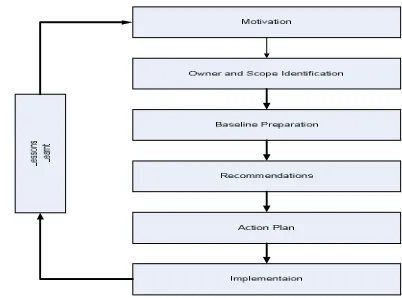
Originally developed for software process improvement, IDEAL has been adapted to facilitate any improvement effort, including information security. The proposed process model modifies and extends the existing five phases of the IDEAL model, to seven phases as described below: The proposed model is abbreviated to “MOB-RAIL”. There are seven phases in this model:
M: Motivation;
O: Owner and Scope Identification; B: Baseline Preparation;
Volume 2, Issue 11, November 2013
Page 43
I: Implementation; andL: Lessons Learnt.
Fig 1: MOB-RAIL Information Security Governance Process
Motivation: The motivation to go for a formal information security governance implementation is result of past experience, event, or legal requirement. For example, a spyware program steals critical information about a defense research, resulting in leakage of sensitive information. Sometimes, the motivation comes from the activities of peers also. Owner and Scope Identification: This activity involves identification of the scope of the activities, what is to be protected and level of protection. Who are the stake holders and who will be affected directly or indirectly? Existing resources are identified and plan for the additional resources is prepared and justified.
Baseline Preparation: Understanding of the present security posture of the institution, basically this will give the status prior to the deployment of the formal governance. This will act as a baseline document to measure the improvement made after deploying the solution. Proposed assessment strategy may be used to identify the information assets to be protected and present practices being followed and its impact.
Recommendations: Based upon the outcome of the assessment; problem areas are listed, prioritized, and a specific improvement plan is prepared and submitted to top management for consideration. These recommendations are expected to change the present security posture of the institute to a desired state. The prioritization criteria are developed based upon institutional policy, objectives, business area impact, and perhaps a recent risk assessment or audit. Each recommendation is evaluated against the criteria. Priorities could include funding, timely completion, and operational impact.
Action Plan: Before finalizing the action plan, the recommendations may be expanded further to accommodate some other requirements such as training or some changes in the work culture etc. IT may also include requirements for new skills and knowledge to adopt a particular improvement, or sources of resistance and market forces. The plan of improvement having different levels of abstraction is prepared, as the level prepared for the Vice-Chancellor or Registrar will be different from the level of plan for Information Security Officer. However, everybody should be clear about what to do, when to do, how to do, and so on. The execution of the plan is structured and managed like any project with schedules, tasks, assigned responsibilities, committed resources, milestones, deliverables, decision points, reviews, measurement, status tracking, and risk management.
Implementation: This is the procedure required to take action and execute the implementation project plan. This activity involves implementing and observing the candidate solution under controlled test environment. Problems found in the test situation are rectified and tested further before implementation. Here problems are addressed based upon the priorities decided earlier; implementation is not kept on the hold till every problem is solved.
Lessons Learnt: The objective of this activity is to compare the results with the standards or pre-decided goals. In other words, evaluate the impact of the implementation plan with the original objective of the exercise. The purpose of the MOB-RAIL process is to collect and analyze the lessons learnt from an effort and apply these to subsequent iterations. Thus, this is an evolutionary process, which is continuous, and always has a scope for an improvement.
Thus, the MOB-RAIL model, shown in the fig. 1, describes the process for implementing the ISG framework. The iterative approach of the model allows continuous implementation in the process, as lessons learnt are incorporated in the next iteration.
In order to effectively implement and monitor the information security program, it is essential to have an effective assessment strategy. The proposed assessment strategies is described below.
3.3.3 Assessment Strategy
Volume 2, Issue 11, November 2013
Page 44
Enables consistent, comparable, and repeatable assessments of security controls;
Facilitates cost-effective assessment of effectiveness of security controls;
Promotes a better understanding of the risks to organizational operations, organizational assets, individuals, and other organizations; and
Generates comprehensive and reliable information to support security assurance decisions.
Proposed metric covers the following issues pertinent to University Environment, identified on the basis of policy documents of various universities [13], [14],[15]:
Respect the privacy of others and their accounts.
Distribution of excessive amounts of unsolicited mail is inappropriate.
Most of the information published on Internet is protected by copyright law. Copyright protection also applies to much software, individual users and the University may, in some circumstances, be held legally responsible for violations of copyright.
Many laws, including those prohibiting defamation, violations of privacy, obscenity, and deceptive advertising, apply to network-based communications.
Because the Internet is international, laws of other countries may apply.
Internet resources are basically for academic activities. Its use for social and entertainment purposes should be restricted to the extent that such use does not affect the amount of bandwidth available for academic use.
The University is not responsible for the views expressed by individual users. Under certain circumstances, however, the University may be held liable if it fails to take reasonable remedial steps after it learns of illegal activities.
The University is the custodian of a wide array of personal and financial data concerning its students, staff, faculty and patients, as well as the University itself.
Shared facilities should not be tampered, it may disrupt normal operations.
The University may be compelled by law or policy to examine even personal and confidential information maintained on University computing facilities.
The use of University resources for commercial or for political activities is inappropriate and possibly illegal.
Implementation of the full set of metric described below, may not be practical for even large institutions. Therefore, an incremental approach is proposed, where institutions may begin with a base set of metric which is subset of full metric. Over the period, as institutions mature and get more resources, full set of metric may be implemented. Incremental approach ensures basic minimum security with minimal resources, remaining measures may be incorporated as institutions gain more experience and get additional budget allocation depending on success of the implementation of base plan.
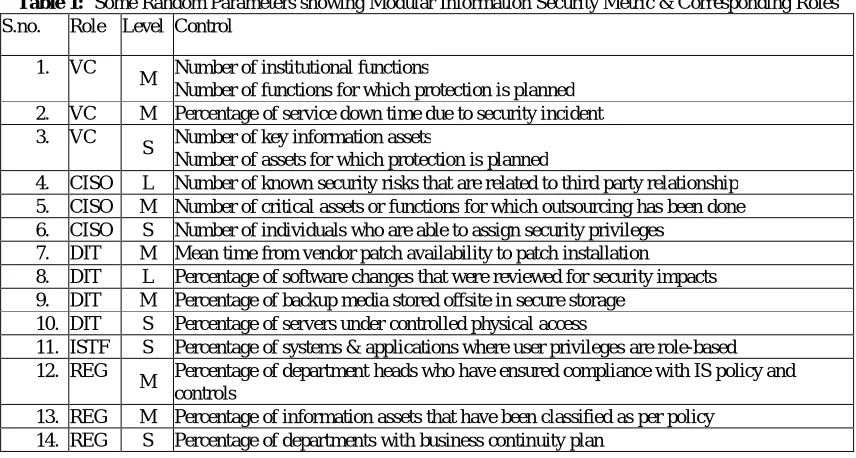
Based on the guidelines published by various standards agencies NIST ( 800-53)[16], ISO 27001, Policy documents of various universities [13],[14],[15], Indian IT Act 2000 [17], UGC/AICTE guidelines and the requirements of academic environment as discussed above, the following metric is proposed in the Table 7.2. There are three columns in the table: role, indicator and control. The control column, describes security measures to be assessed. Role column, describes roles responsible for a given metric. Each metric is associated with a unique role, so that there are no ambiguities, and plans are implemented smoothly. In order to assist start up institutions or institutions in early phase of Information Security implementation, level of metric is shown in the indicator column. Base line metrics which should be implemented in the first phase are indicated by “S”. Medium sized institutions may use additional metrics indicated by “M”.
3.3.3.1 Coding structure used in the metric. Role Column:
VC: Vice-Chancellor/Executive-Council ISTF: Information Security Task Force
REG: Registrar (Head of Administration, Finance, Development, Establishment) LA: Legal Advisor
DN: Deans & Head of Departments DSW: Dean Student Welfare AO: Application Owners
DIT: Director Information Technology Services CISO: Chief Information Security Officer ISO: Information Security Officer NA: Network Administrators and IT Staff
Volume 2, Issue 11, November 2013
Page 45
S: Indicates base metric, Starting Point for beginners, applicable to allM: Applicable to Medium sized University/College with moderate resources L: Applicable to Large Universities with ample resources
The following table gives some random parameters out of 79 parameters, which are fully described in the paper published by the author in 2009 [18].
Table 1: Some Random Parameters showing Modular Information Security Metric & Corresponding Roles S.no. Role Level Control
1. VC
M Number of institutional functions
Number of functions for which protection is planned 2. VC M Percentage of service down time due to security incident 3. VC
S Number of key information assets
Number of assets for which protection is planned
4. CISO L Number of known security risks that are related to third party relationship 5. CISO M Number of critical assets or functions for which outsourcing has been done 6. CISO S Number of individuals who are able to assign security privileges
7. DIT M Mean time from vendor patch availability to patch installation
8. DIT L Percentage of software changes that were reviewed for security impacts 9. DIT M Percentage of backup media stored offsite in secure storage
10. DIT S Percentage of servers under controlled physical access
11. ISTF S Percentage of systems & applications where user privileges are role-based 12. REG
M Percentage of department heads who have ensured compliance with IS policy and controls
13. REG M Percentage of information assets that have been classified as per policy 14. REG S Percentage of departments with business continuity plan
The metric proposed above can be implemented in a phased manner, iteratively. Initial round of assessment will give an idea of present state of security, in the institution and areas where more attention is required. Accordingly, risk mitigation strategies can be planned and implemented. This cycle may be repeated, until full metric implementation is achieved. This process would also lead to enhancement in the metric itself.
Thus, the metric proposed above covers every aspect of the information security in detail and requires substantial efforts and cost, so may not be repeated as frequently as desired. Therefore, it requires an assessment plan, which can be executed quickly and more frequently; and yet it provides a fair idea of the information security state. The assessment strategy, which fulfils this need, is described below.
4. CONCLUSION
Thus, it is concluded that the work presented here shall help IHE in building more secure campuses; where confidentiality, integrity, and availability of the information is assured. The proposed ISG framework enables integration of the ISG framework with the corporate governance framework, which shall improve the state of information security in the campuses.
Establishing a resilient information security mechanism, for higher education requires not only understanding of expectations of the academic environment, but an active participation of all stake holders. The proposed ISG framework shall provide a strong start, to organizations seeking to improve their information security governance. By using the ISG framework and metric based assessment plans, institutions shall be able to integrate information security into their corporate governance programs. The metric based assessment and reporting plan is developed as per the specific needs of the academic environment. Additional roles are created and their key responsibilities and accountabilities are defined, which is necessary to manage this complex and evolving discipline. Each metric is associated with a predefined role, so that in case of any incidence a quick response can be initiated and responsibilities can be fixed. Security exceptions are reported directly, without wasting any time to the predefined roles, responsible for that particular metric or security control. The proposed assessment strategy shall improve overall security governance.
The proposed “MOB-RAIL” model for ISG process, would be an effective model for institutions when adapting and implementing the framework and assessment strategies. The model is an organizational improvement model that serves as a roadmap for initiating, planning and implementing improvement actions.
Volume 2, Issue 11, November 2013
Page 46
score using open data bases. Another issue is design of a model projecting an optimal investment plan, keeping in view the financial value of assets, and potential tangible or intangible gains or losses in monetary terms.References
[1] Shon Harris, “Information Security Governance Guide”, http://searchsecurity.techtarget.com/generic/0,295582,sid14_gci1211236,00.html, August 2006.
[2] The CIS Security Metrics Service, The Center for Internet Security (CIS), http://securitymetrics.org/content/attach/Metricon3.0/metricon3-kreitner%20handout.pdf, July 2008.
[3] Indian Information Security Framework, IISF-309, www.naavi.org, March 2009.
[4] Von Solms, B. “Information Security governance: CobiT or ISO 17799 or both?”, Computers and Security. Volume 24, Issue 2, pp. 99 – 104, March 2005.
[5] D.S. Bhilare et al., “An investigation of information security issues in the Indian institutes of higher education: current security state and practices”, Accepted by International Journal of Computer and Network Security, ISSN: 2076-2739, January (Vol.2 No.1), 2010.
[6] Corporate Governance Task Force, ‘Information Security Governance: Call to Action’, USA, 2005
[7] Information Security Governance: Toward a Framework for Action, business software alliance, http://www.bsa.org/country/Research%20and%20Statistics/~/media/BD05BC8FF0F04CBD9D76460B4BED0E67.as hx, 2005
[8] Elizabeth, Chew, et al. Guide for Developing Performance Metrics for Information Security, Initial Public Draft (NIST Special Publication 800-80). Gaithersburg, MD: Computer Security Division, Information Technology Laboratory, National Institute of Standards and Technology, http://csrc.nist.gov/publications/nistpubs/index.html, May 2006.
[9] Kim, Gene, et al. “Prioritizing IT Controls for Effective, Measurable Security.” Department of Homeland Security, Build Security In web site, https://buildsecurityin.uscert. gov/daisy/bsi/articles/best-practices/deployment/577.html, October 2006.
[10]Harris, Shon. “Introduction to Security Governance.” SearchSecurity.com, http://searchsecurity.techtarget.com/tip/0,289483,sid14_gci1210565,00.html, August 2006.
[11]Judith B. Karuso, “Information Technology Security: Governance, Strategy, and Practice in Higher Education”, ECAR, http://net.educause.edu/ir/library/pdf/EKF/ekf0305.pdf, 2006.
[12]D.S. Bhilare, et al. , “Information Protection in Academic Campuses: A Scalable Framework”, American Journal of Computer Science, ISSN 1549-3636, Vol. 2, No. 10, pp 864-870, October 31, 2008, DOI: 10.3844/jcssp.2008.864.870
[13]University of Houston, Information Security Manual, http://www.uh.edu/infotech, referred 2008
[14]University of Washington policy document, http://www.wustl.edu/policies/compolcy.html, October 2006.
[15]University of Auckland Newzeland, Security policy and organization http://www.auckland.ac.nz/security/SecurityOrganisationPolicy.htm#1.1, Jan 2008
[16]Nist Publications: computer security resource centre, SP800-53, src.nist.gov/publications/nistpubs/, [17]Information Technology ACT 2000, www.eprocurement.gov.in/news/act2000mod.pdf
[18]D.S. Bhilare, et al., “Information Protection in Academic Campuses: A Scalable Framework”, American Journal of Computer Science, ISSN 1549-3636, Vol. 2, No. 10, pp 864-870, October 31, 2008, DOI: 10.3844/jcssp.2008.864.870
AUTHOR