The Thirty-Third AAAI Conference on Artificial Intelligence (AAAI-19)
Tied Transformers: Neural Machine
Translation with Shared Encoder and Decoder
Yingce Xia,
1Tianyu He,
2Xu Tan,
1Fei Tian,
1Di He,
3Tao Qin
1 1Microsoft Research,2University of Science and Technology of China 3Key Laboratory of Machine Perception, MOE, School of EECS, Peking University{yinxia,xuta,fetia,taoqin}@microsoft.com, [email protected], di [email protected]
Abstract
Sharing source and target side vocabularies and word embed-dings has been a popular practice in neural machine trans-lation (briefly, NMT) for similar languages (e.g., English to French or German translation). The success of such word-level sharing motivates us to move one step further: we con-sider model-level sharing and tie the whole parts of the en-coder and deen-coder of an NMT model. We share the enen-coder and decoder ofTransformer(Vaswani et al. 2017), the state-of-the-art NMT model, and obtain a compact model named
Tied Transformer. Experimental results demonstrate that such a simple method works well for both similar and dissimilar language pairs. We empirically verify our framework for both supervised NMT and unsupervised NMT: we achieve a35.52
BLEU score on IWSLT 2014 German to English translation,
28.98/29.89BLEU scores on WMT 2014 English to Ger-man translation without/with monolingual data, and a22.05
BLEU score on WMT 2016 unsupervised German to English translation.
1
Introduction
Neural machine translation (briefly, NMT), based on the encoder-decoder framework with an attention module, has made significant progress in recent years (Vaswani et al. 2017; Hassan et al. 2018; He et al. 2016; Xia et al. 2017b). A common practice for training an NMT system is to share source and target side vocabularies, especially when the two languages are similar or in the same language fam-ily, like English↔French translation (Gehring et al. 2017; Vaswani et al. 2017). Such a shared vocabulary is built upon subword units like BPE (Sennrich, Haddow, and Birch 2016b) or word pieces (Wu et al. 2016), and both source and target words are split into smaller segmentations in this shared vocabulary. Acting in this way, the words in source sentences and target sentences are mapped to the same em-bedding space, which strengthens the semantic correlation between the two languages, and regularizes a neural network model with high capacity.
Parameter sharing has a long history in machine learn-ing and has been applied in different learnlearn-ing settlearn-ings such as multi-task learning (Ruder 2017; Zhang and Yang 2017), transfer learning (Pan and Yang 2010), meta-learning (Pham
Copyright c2019, Association for the Advancement of Artificial Intelligence (www.aaai.org). All rights reserved.
et al. 2018), etc. Parameter sharing means that multiple mod-els are bridged by tying parts of or all the model parameters. It has multiple potential benefits, such as reducing the num-ber of model parameters so as to control model complex-ity (Firat et al. 2016), introducing prior knowledge to regu-larize models (Xia et al. 2018), and saving the storage space or memory size (Johnson et al. 2017). Parameter sharing is also adopted within network structure, including spatial sharing for the convolutional kernels in convolutional neural networks and temporal sharing for the transition functions in recurrent neural networks (Goodfellow et al. 2016). Inspired by the success of sharing vocabularies (and so word embed-dings) of source and target languages, a question naturally comes out: Can we go one step forward to further share the whole parts of the encoder and decoder of an NMT model?
We make an initial attempt to answer this question and then proposetied transformer. We cast the typical encoder-decoder based sequence-to-sequence model into a more compact one in that there is only one copy of parameter set, which is applicable to both the encoder and decoder. In that way we force the sharing among the weights of the encoder and the decoder, rather than only among the source-side and target-side word embeddings.
We conduct extensive experiments to test the effective-ness of our proposed model. (1) For the translation between similar languages (i.e., languages within the similar lan-guage family), like{German, Spanish, Romanian} -from/to-English, our model achieves promising even state-of-the-art results: We achieve 35.52 for IWSLT German to English translation (see Figure 2),28.98/29.89for WMT 2014 En-glish to German translation without/with monolingual data (see Table 4), and 34.67 for WMT 2016 English to Ro-manian translation (see Table 5). (2) For the translation of dissimilar languages (e.g., languages in different language families that cannot share vocabularies such as {Russian, Hebrew, Chinese}-from/to-English), our model also obtains good improvements (See Table 7&8). (3) For unsupervised NMT where no bilingual data is available, on WMT 2016 German→English translation, we improve the BLEU score from21.0to22.05(see Table 9).
2
Background
2.1
NMT Architecture
The task of NMT is to translate a sentencex ∈ X in the source language to the oney ∈ Y in the target language, whereX andY are two language spaces. An NMT model consists of an encoderfE, a decoderfD and a source-to-target attention modelfA. A source sentencexis first en-coded into a series of hidden representations by using fE, that is,(h1, h2,· · ·, hTx) = fE(x), whereTxis the length ofx,hi is the i’th hidden representation∀i ∈ [Tx]. Then, when translating thej’th wordyj in the target side, the at-tention modelfAis used to calculate the context vector of the encoder’s outputs, that is,
cj =P Tx
i=1αi,jhi, αi,j=fA(hi, sj−1), (1)
where αi,j’s have to satisfy P Tx
i=1αi,j = 1 and αi,j ≥
0. Next, based on the context vector cj, we calculate the j’s hidden representation at target side by sj =
fD(sj−1, yj−1, cj), whereyj−1is the(j−1)’th target word. Finally, sj is mapped to yj ∈ Y by a simple network. ThefE,fDcan be specialized by LSTM (Wu et al. 2016), GRU (Bahdanau, Cho, and Bengio 2015), CNN (Gehring et al. 2017), Transformer (Vaswani et al. 2017) and so on. fA can be implemented by a bilinear function like αi,j ∝
exp(hiWAsj−1)∀i ∈ [Tx], a sum of two affine transfor-mations likeαi,j ∝ exp(WA,hhi +WA,ssj−1)∀i ∈ [Tx] where theW’s are the parameters to be learned, and so on. Luong, Pham, and Manning (2015) summarize different at-tention models.
2.2
Parameter Sharing in NMT
Several parameter sharing mechanisms have been explored for multilingual NMT. Dong et al. (2015) leveraged a net-work with one encoder and multiple decoders for one-to-many language translations. Luong et al. (2016) proposed a structure with multiple encoders and one decoder for many-to-one language translation. Zoph and Knight (2016) tar-geted at a multi-source translation problem, where the de-coder is shared. Firat, Cho, and Bengio (2016) designed a network with multiple encoders and decoders plus a shared attention mechanism across different language pairs for many-to-many language translation. (Ha, Niehues, and Waibel 2016; Johnson et al. 2017) used a single encoder-decoder model to work on many-to-many languages trans-lation. While there exist quite a few papers studying param-eter sharing for multiple language translation, there are few work studying parameter sharing in one task and we attack this problem.
2.3
Brief Introduction of Transformer
Transformer (Vaswani et al. 2017) is a general framework built upon self-attention that achieves state-of-the-art results on many translation tasks. Transformer is a stacked network with several blocks. Each block consists of two or three basic modules:
(1) A self-attention moduleϕS, used to output a weighted version of its inputs. That is, given anm-element setZ = {z1, z2,· · ·, zm}, for any i ∈ [m], ziS = ϕS(zi, Z) =
Pm
j=1αi,jzj, whereαi,j is calculated by the multi-head at-tention as that proposed in Vaswani et al. (2017) withziand
Z as inputs.Z can be a collection of either source side hid-den states or target side hidhid-den states. This layer is asso-ciated with a residual connection and layer normalization LN(Ba, Kiros, and Hinton 2016), whose eventual output is LN(zi+ziS)for anyi∈[m].
(2) An optional cross-lingual (i.e., source-to-target) atten-tion model ϕC that will appear in the decoder only. Sim-ilar to ϕS, set H = {h1, h2,· · ·, HTx}, Tx is the length of source sentence x, H is the output of the last layer in the encoder, si is the i’th hidden state in the decoder,
sC
i = ϕC(si, H), where ϕC(si, H)is executed in a simi-lar way as theϕS in step (1) withsi andH as inputs. This layer will eventually outputsLN(si+sCi ). BothϕSandϕC are implemented as multi-head attention models and details can be found in Vaswani et al. (2017).
(3) A feed-forward network ϕF(z) = W2max(W1z+ b1,0) +b2, where theW’s andb’s are the parameters to be learned. Again, this layer is followed with a residual connec-tion and layer normalizaconnec-tion.
3
Our Model
In this section, we introduce the architecture of our proposed tied transformer. We describe the model architecture in Sec-tion 3.1 and give a theoretical discussion in SecSec-tion 3.2.
Figure 1: The architecture of tied transformer
3.1
Model Architecture
The architecture of tied transformer is shown in Figure 1. We follow the notations defined in Section 2.3 to mathe-matically describe our model. Tied transformer is a stacked model withLblocks, where thel’th block consists of a self-attention moduleϕlS, a cross-lingual attentionϕlCand a non-linear functionϕl
F, where superscriptl represents the layer id. We show how the encoder and decoder are shared. (1) Encoding For any input x, we initialize H0 = {h0
1, h02,· · ·, h0TX}, whereh 0
i is the word embedding of the
fol-lows: For anyl∈[L],
hli=ϕlF ϕlS(hli−1, Hl−1);
Hl={hl1, hl2,· · ·, hlT X}.
(2)
Eventually, we obtainHL, a set containing all the outputs of the last layer in the encoder.
(2) Decoding At the (j + 1)’th decoding step, denote the generated hidden states at the target side as Sl
j =
{sl
1, sl2,· · · , slj},l∈ {0,1,· · · , L}whereSj0represents the collection of word embeddings at target side. We first set s0
j+1 = yj and initialize Sj0+1 = Sj0∪ {yj}, whereyj is the word embedding of the predictedj’th wordyj. Then, for anyl∈[L],
slj+1=ϕlFϕlC ϕlS(slj−+11, Sjl−+11), HL ,
Sjl+1=Slj∪ {slj+1}.
(3)
Once we obtainsL
j+1, we could use a simple network with a softmax layer to predict the corresponding wordyj+1. We repeat decoding until meeting the end-of-sentence token.
Note that given anyl ∈ [L], theϕlS andϕlF in Eqn.(2) and Eqn.(3) are shared; however, in a standard encoder-decoder based network, such two components are not tied. This shows that our proposed model is strongly regularized during training.
Note that such a parameter sharing scheme could also be applied to LSTM based encoder-decoder frameworks. An empirical analysis is illustrated in Section 4.4.
3.2
Theoretical Discussion
We provide a brief theoretical discussion about the proposed tied transformer. Denote the parameters of the encoder, de-coder and source-to-target attention modules asθe,θdandθa respectively. For a tied transformer,θe=θd. In an NMT task, what we learn is a mappingf : X 7→ Y, that can translate sentences from source language spaceX to target language spaceY. Our objective is to minimize the (expected) risk of a modelf, which is defined as follows:
R(f) =E(x,y)∼P[`(f(x), y)]. (4)
whereP represents the underlying distribution of a source and target language sentence pair over X × Y, ` is the loss function that can achieve the mapping X × Y 7→
R. Denote Θe, Θd and Θa as the parameter spaces of the encoder, decoder and source-to-target attention model. For the conventional transformer, f ∈ Fc where Fc =
{f(x;θe, θd, θa)|θe ∈ Θe, θd ∈ Θd, θa ∈ Θa}. For the tied transformer,f ∈ FtwhereFt={f(x;θe, θd, θa)|θe∈
Θe, θd∈Θd, θa ∈Θa, θe=θd}. Obviously,Ft⊆ Fc. When training an NMT model, we minimize the empirical risk on thentraining samples{(xi, yi)}in=1,xi ∈ X,yi ∈
Y, which is defined as follows: for anyf ∈ Fcorf ∈ Ft,
Rn(f) =
1 n
n
X
i=1
`(f(xi), yi).
We introduce Rademacher complexity (Mohri et al., 2012) for our proposed method, a measure for the complexity of the function space.
Definition 1 Denote the Rademacher complexity of the standard transformer and the tied transformer as Rc
n and
Rt
nrespectively. We have
Rcn= E z,σ
h sup
f∈Fc
1 n
n
X
i=1
σi`(f(xi), yi)
i ,
Rtn= E z,σ
h sup
f∈Ft
1 n
n
X
i=1
σi`(f(xi), yi)
i ,
(5)
wherez ={z1, z2,· · ·, zn} ∼ Pn,zi = (xi, yi)in which
xi ∈ X andyi ∈ Y,σ ={σ1,· · ·, σm}are i.i.d sampled
withP(σi= 1) =P(σi=−1) = 0.5.
The following theorem holds for our proposed method:
Theorem 1 (Theorem 3.1, (Mohri et al., 2012)) Let `(f(x), y) be a mapping from X × Y to [0,1]. Then, for anyδ∈(0,1), with probability at least1−δ, the following inequalities holds:
R(f)≤Rn(f) + 2Rcn+
r 1 2nln(
1
δ),∀f ∈ Fc,
R(f)≤Rn(f) + 2Rtn+
r 1 2nln(
1
δ),∀f ∈ Ft.
SinceFt⊆ Fc, we have thatRtn ≤Rcn, which shows that tied transformers have better generalization abilities than standard transformer.
4
Experiments on Similar Languages
In this section, we verify our proposed method on languages in similar language families. We work on various amounts of training data, including IWSLT translation tasks (less than200k sentences pairs), WMT translation tasks (more than
2M sentence pairs) and the usage of monolingual data (ad-ditional8M unlabeled sentences).
4.1
Settings
We choose IWSLT 2014 {German, Spanish, Romanian} -from/to-English translation and WMT 2014
English-to-{German, Romanian}to verify our proposed algorithm. We briefly denote German, Romanian, Spanish and English as “De”, “Ro”, “Es” and “En” respectively.
Datasets For IWSLT 2014 De↔En, Es↔En and Ro↔En translation tasks, there are respectively 153k, 181k,182k sentence pairs in each datasets1. For De→En translation, we follow the common practice to lowercase all words; and we use the same validation and test sets as those used in (Edunov et al. 2018), which consists of7kand7ksentences respectively. For the other translation tasks, we do not low-ercase the words; we use IWSLT14.TED.tst2013 as the val-idation sets and IWSLT14.TED.tst2014 as test sets.
For WMT 2014 En→De and WMT 2016 En→Ro trans-lation, there are 4.5M and 2.8M bilingual sentence pairs respectively. For En→De translation, we concatenate new-stest2012 and newstest2013 as the validation set and use
1
newstest2014 as the test set. For En→Ro, we use news-dev2016 as the validation set and use newstest2016 as the test. For both IWSLT and WMT translation tasks, all the datasets are preprocessed into workpieces following (Wu et al. 2016).
Model Configurations For the IWSLT 2014 translation tasks, we choose the transformer small setting with 8
blocks, where each block contains a self-attention layer, an optional encoder-to-decoder attention layer and a feed-forward layer. The word embedding dimension, hidden state dimension, non-linear layer dimension and the number of head are256,256and1024and4respectively. For WMT 2014 En→De translation and WMT 2016 En→Ro task, we choose thetransformer bigsetting, where the four numbers are1024,1024,4096and16respectively. The dropout rate for the two settings are 0.1and0.2. For the three IWSLT 2014 translation tasks, we train each model on two V100 GPUs for up to three days until convergence and the mini-batch size is fixed as4096tokens per GPU, including both the source to target and target to source data. For the two WMT translation tasks, we train each model on four P40 GPUs for ten days until convergence. We try to use the largest possible minibatch sizes for the WMT settings to ful-fill GPU memory limitation.
Evaluation. Following (Wu et al. 2016; Vaswani et al. 2017), the eventually output is picked up by argmaxy0∈ClogP(y0|x)/|y0|α, wherexdenotes the source
sentence, C represents the candidates carried out by beam search,|y0|denotes the number of words iny0 andαis the length penalty tuned by the validation set. For IWSLT re-lated tasks, we use beam search with beam width 6 and α = 1.1 to generate candidates. For WMT related tasks, the beam size is changed to 4 and the αis chosen as 0.6
for a fair comparison with (Vaswani et al. 2017). We use the BLEU scores as the evaluation metrics, which is the geo-metric mean of fourn-gram precisions between the trans-lation results and reference sentences,n= 1,2,3,4. To be more specific, (1) For IWSLT De→En translation and WMT En→De translations, we calculate the tokenized BLEU by multi-bleu.perl2 for fair comparisons with previous methods. (2) For other IWSLT translation tasks, we use sacreBLEU3. (3) For En→Ro, we use detokenized BLEU for fair comparison with previous methods4.
4.2
Results on IWSLT Related Tasks
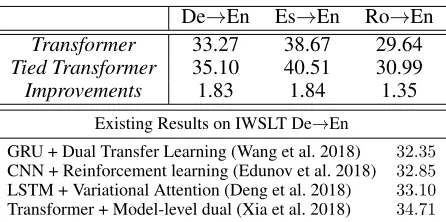
The experimental results of IWSLT 2014 translation tasks are shown in Table 1. The three rows in Table 1 represent the basic Transformer algorithm, our proposed algorithm and the improvements brought by our algorithm. We also list the IWSLT 2014 De→En results reported by previous literature. The tied transformer significantly outperforms the stan-dard transformer. The improvements are two-folded: first,
2https://github.com/moses-smt/mosesdecoder/blob/master/
scripts/generic/multi-bleu.perl
3
https://github.com/awslabs/sockeye/tree/master/contrib/ sacrebleu
4
https://github.com/moses-smt/mosesdecoder/blob/master/ scripts/tokenizer/detokenizer.perl
De→En Es→En Ro→En
Transformer 33.27 38.67 29.64 Tied Transformer 35.10 40.51 30.99 Improvements 1.83 1.84 1.35
Existing Results on IWSLT De→En
GRU + Dual Transfer Learning (Wang et al. 2018) 32.35
CNN + Reinforcement learning (Edunov et al. 2018) 32.85
LSTM + Variational Attention (Deng et al. 2018) 33.10
Transformer + Model-level dual (Xia et al. 2018) 34.71
Table 1: Results of IWSLT 2014{De, Es, Ro}-to-En trans-lation tasks.
we could seeTransformeroutperforms non-transformer sys-tems, which is helpful to get a great score; second, on top of such a strong baseline, we are still capable to further im-prove the performances, which demonstrate the effective-ness of our method. On the three tasks De→En, Es→En and Ro→En, our proposed method could outperform the Trans-former baseline by1.83,1.84and1.35points, which indeed verifies our motivation introduced in Section 1 that such a framework is helpful to improve the translations within a same language family. As far as we could survey, we achieve the best result on IWSLT 2014 De→En, whose previously best result in 33.81 provided by (Elbayad et al. 2018).
En→De En→Es En→Ro
Transformer 27.72 37.51 23.80
Tied Transformer 29.07 38.81 24.31
Improvements 1.35 1.30 0.51
Table 2: Results of IWSLT 2014 En-to-{De, Es, Ro} trans-lation tasks.
We also check the ability of translating from English to other languages. The results are shown in Table 2. Again, tying the weights of encoder and decoder outperforms the baseline. The results in Table 1 and Table 2 demonstrate that our proposed method works pretty good on the translation tasks within the same language family again.
Then, we compare our proposed tied transformer with two well-known baselines, which are both based on8-block transformers:
1. Cross-tasking sharing (Johnson et al. 2017; Ha, Niehues, and Waibel 2016), briefly denoted as CTS, which means to use one encoder-decoder based network to solve two tasks together. In this framework, the encoder is used to encode two languages and the decoder is used to decode two languages.
2. Dual supervised learning (Xia et al. 2017a), briefly denoted as DSL, in which the training objective of De→En and En→De are jointly constrained by P(x)P(y|x;θxy) = P(y)P(x|y;θyx), wherex,y,θxy,
list it as a baseline here considering we report the results of two dual tasks and they could be considered together.
The results are shown in Table 3. We have several observa-tions: (1) Our method outperforms both the standard base-line and DSL, which shows that parameter sharing is more powerful in these two tasks. (2) Compared with the cross-task sharing, our method outperforms this baseline by0.77
and0.74point, which shows that sharing parameter like ours is more useful than the others. Besides, it demonstrates that parameter sharing is indeed a useful technique in NMT for both cross-task sharing and our proposed sharing scheme, which can be seen as a kind of intra-task sharing, especially when the training data is limited.
Baseline DSL CTS Ours
De→En 33.27 33.60 34.33 35.10 En→De 27.72 27.88 28.33 29.07
Table 3: Comparison with several other baselines on IWSLT 2014 De↔En translation tasks.
Next, we explore how the test performances of our pro-posed framework change with different number of blocks and different hidden dimensions.
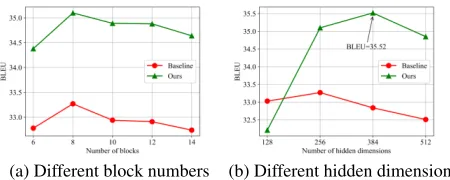
In Figure 2(a), we fix the hidden dimension as256 and increase the block number from6to14. We have the follow-ing observations: (1) our proposed algorithm always outper-forms the baseline with different number of blocks, demon-strating our algorithm has better generalization ability. (2) Both our algorithm and the baseline achieve the best re-sults at the 8-block setting. As we increase more blocks, the performances will drop, indicating that deeper models need stronger regularization.
(a) Different block numbers (b) Different hidden dimensions
Figure 2: IWSLT 2014 De→En BLEU with different model parameters.
In Figure 2(b), we fix the block number as8and vary the hidden dimensions. For the baseline. the BLEU starts to drop when the hidden dimension is larger than256. In compari-son, the BLEU of our algorithm starts to drop when the di-mension is larger than384, which shows that our algorithm has better generalization ability. Another observation is that our shared model cannot be too small: when the hidden di-mension is 128, the BLEU score of our algorithm is0.82
point lower than the baseline, which shows that the model does not have enough capacity to handle the task. Finally, by
setting the dimension as384, we improve the BLEU score from35.10to35.52, setting a new record on this task.
4.3
Results on WMT Related Tasks
To verify the performances of our algorithm on larger datasets, we move to WMT 2014 En→De and WMT 2016 En→Ro translation tasks.
In Table 4, we show the BLEU scores of En→De transla-tion. In this case, we can see that a6-block tied transformer (with BLEU28.35) can almost catch up with the standard6 -block transformer (with BLEU28.4) but using only around half of the parameters. This shows that even though the train-ing corpus is large, our method is able to catch up with the baselines.
8-layer LSTM + RL(Wu et al. 2016) 24.60 15-layer CNN network(Gehring et al. 2017) 25.16 6-block transformer(Vaswani et al. 2017) 28.40
6-block tied transformer 28.35
8-block tied transformer 28.88
12-block tied transformer 28.98
8-block tied transformer + 8M unlabeled data 29.89
Table 4: WMT 2014 En→De BLEU.
Then we increase the number of blocks. When the net-work has 8 blocks, the BLEU score is 28.88, 0.48 point ahead of the baseline. When we increase it to12blocks, the BLEU score is28.98, which achieves0.58point improve-ment over the baseline. Note that our model with 12 blocks has the approximate number of parameter with the baseline with 6 blocks.
We also check the ability of our model with the sup-port of monolingual data. We use the back-translation tech-nique to leverage monolingual data (Sennrich, Haddow, and Birch 2016a). To achieve that, we first use the4.5M bilin-gual data to train an initial De→En translation model with
32.12BLEU score. Then, we choose8M monolingual Ger-man data fromnewscrawl 20135. Next, we use the obtained De→En model to translate the8M sentences with beam-size 4 andα 1.0. Finally, we merge the original bilingual dataset and the generated English-German pairs from the monolingual data and train another En→De model based on tied transformer. In this way, we obtain29.89BLEU score, which shows that our proposed tied model can handle large amount of training data.
The En→Ro translation results are summarized in Ta-ble 5. We implement the standard transformer as baseline and get a33.05BLEU score. Our method with6blocks can achieve34.67BLEU, which is a state-of-the-art result. We also tried the 8-block network but obtained a lower score. This is because the En→Ro task does not have as much training data as En→De and thus could not apply too large models.
5
http://www.statmt.org/wmt14/
20-layer CNN network(Gehring et al. 2017) 30.02 6-block transformer(Vaswani et al. 2017) 33.05
6-block tied transformer 34.67
8-block tied transformer 34.55
Table 5: WMT 2016 En→Ro BLEU.
4.4
Tied LSTM Models for NMT
To verify the generality of sharing the encoder and decoder, we adapt our framework into the LSTM and obtained a tied LSTM model. We follow (Wu et al. 2016) to build a deep LSTM NMT model but sharing the parameters of the en-coder and the deen-coder (excluding the attention model).
We work on IWSLT 2014 De→En translation to ver-ify our idea. For the baseline, we choose a4-layer single-direction LSTM with vocabulary size 24k, word embed-ding dimension256and hidden dimension512. For the tied LSTM, we also fix the word embedding dimension as 256 and the number of layers as4. We set the hidden dimensions as 512and1024, corresponding to almost50% and100%
parameters of the baseline LSTM. We share the source em-beddings, target embeddings and the softmax matrix. We use Adadelta (Zeiler 2012) to optimize the network. The results are shown in Table 6.
Baseline hidden 512 hidden 1024
29.41 29.57 30.61
Table 6: IWSLT 2014 De→En with tied LSTMs
We can see the baseline achieves 29.41 BLEU score. Af-ter sharing the encoder and decoder, we obtain0.16gain. The improvement is not very significant due to the limited model capacity. When we increase the hidden dimension to1024, we can achieve30.61 BLEU score, which is 1.2
point improvement over the baseline. This shows that our proposed method can be generalized to more structures like LSTM. We leave how to apply our framework to more com-plex LSTMs as future work.
5
Experiments of Dissimilar Languages
In Section 4, we have verified the effectiveness of our pro-posed method for translating between languages within the same family. In this section, we analyze how our method performs to translating between languages in different fam-ilies.Settings. We choose IWSLT 2014 {Russian, Hebrew, Chinese}-from/to-English translation tasks to verify our proposed algorithm, where there are160k,151k,182k sen-tence pairs in each datasets. Russian, Hebrew and Chi-nese are briefly denoted as “Ru, He, Zh” respectively. We use IWSLT14.TED.tst2013 as the validation sets and IWSLT14.TED.tst2014 as test sets. Again, all sentences are split into wordpieces by (Wu et al. 2016). We use the same model structure and the evaluation metrics as that used in Section 4 for IWSLT 2014 tasks.
Results.The experimental results are shown in Table 7. Our proposed method outperforms the Transformer baseline by
1.16,0.97and0.87points on the three tasks.
Ru→En He→En Zh→En
Transformer 17.89 31.96 16.45
Tied Transformer 19.05 32.93 17.32
Improvements 1.16 0.97 0.87
Table 7: Experimental results on IWSLT 2014{Ru, He, Zh} -to-English translation tasks.
The English to Russian, Hebrew and Chinese translation results are shown in Table 8.We could still make improve-ments on these tasks.
En→Ru En→He En→Zh
Transformer 14.59 20.84 11.88
Tied Transformer 14.90 21.47 12.38
Improvements 0.31 0.63 0.50
Table 8: Experimental results on IWSLT 2014
English-to-{Ru, He, Zh}translation tasks.
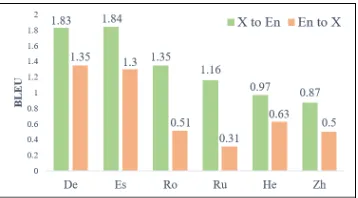
As shown in Figure 3, an interesting observation is that, no matter for similar languages or different languages, over-all, the improvement ofX →En translation quality brought by our method is larger than the corresponding En → X, whereX is the language we used in the IWSLT datasets. We conjecture that English is an easier language to decode, which results in the aforementioned observation.
Figure 3: Improvements of our method compared with the Transformer baseline.
We also find that the improvements of translating within same language family are larger than that within differ-ent language families, no matter for X-to-English transla-tion or English-to-Xtranslation. Our explanation is that the languages within the same family are easily mapped into the same language space, considering their vocabulary are shared. Working on the same semantic space will result in better improvements than those in different spaces.
solve this problem (Lample, Denoyer, and Ranzato 2018; Lample et al. 2018), which motivates us to solve unsuper-vised NMT with a tied transformer.
6.1
Model Adaption
Background We briefly introduce (Lample et al. 2018), a recent state-of-the-art unsupervised NMT algorithm and then adapt it with our tied transformer. Like the standard NMT system, an unsupervised NMT model also consists of an encoder, a source-to-target attention module, and a de-coder as well as a shared embedding for similar languages like German and English. The source sentences and target sentences are mapped into a same vocabulary using BPE techniques. The shared embedding is pretrained with fast-Text (Bojanowski et al. 2017) to get good initial values. The proposed model will handle both source-to-target translation and target-to-source translation like Johnson et al. (2017). The reason to use one model for two translation tasks is that a single model could better map two different languages into the same representation space, which is easier for decoding. The training loss of an unsupervised NMT model usually consists of two parts, a language model loss and a back-translation loss. LetPX →Ydenote the translation from space
X to spaceY, and so for the other similar notations. (1) Language model loss, implemented by a denoising au-toencoder. Mathematically,
Llm=
Ex∼X[−logPX →X(x|σ(x))]+
Ey∼Y[−logPY→Y(y|σ(y))],
(6)
whereσ(·)is a noise model with randomly dropping several words, swapping words, etc.
(2) Back translation loss, implemented by back-translating the monolingual data and feeding into the reversed models. Mathematically,
Lback=
Ex∼X[−logPY→X(x|ˆy(x))]+
Ey∼Y[−logPX →Y(y|ˆx(y))],
(7)
in which yˆ(x) = arg maxu∈YPX →Y(u|x) and xˆ(y) =
arg maxw∈XPY→X(w|y). Note that the fourP···’s are im-plemented in a single encoder-decoder based model, where each translation task has a different “task embedding”, i.e., a learnable vector indicating the translating directions. Adaption To achieve unsupervised NMT, the aforemen-tioned four modelsP···’s in Eqn. (6) and Eqn. (7) are imple-mented in a single tied transformer. The model architecture is the same as that introduced in Section 3, where each task has a task embedding as that used in Lample et al. (2018). We also useLlm+Lbackas the training loss.
6.2
Settings
We work on German↔English translation. Following Lam-ple et al. (2018), we collect50M WMT monolingual data from newscrawl 2014 to newscrawl 2017. The BPE (Sen-nrich, Haddow, and Birch 2016b) with60kmerge operations is applied to pre-process the data. Newstest2014 and new-stest2016 German↔English translation datasets are used as the validation set and test set respectively.
We follow the transformer baseconfiguration (Vaswani et al. 2017) to set the hyper-parameter of our model. The word embedding dimension, hidden state dimension, non-linear layer dimension and the number of heads of the multi-head attention are512,512and2048and8respectively. We try different settings:4blocks and8blocks for the tied trans-former. In the training phase, we fix the dropout rate as0.2, apply Adam optimizer with learning rate0.0002to optimize the network. The model is implemented in TensorFlow and trained on8M40 GPUs. In the inference phase, we use beam search with beam width4and set length penaltyαas0.6.
6.3
Results
The results of unsupervised NMT are shown in Table 9. To speed up the training, we first train an initial unsupervsied NMT model, back translate the monolingual data, train a warm-start tied transformer and then keep tuning the ob-tained model by online sampling. We can see that our pro-posed model performs best among all NMT based transla-tion systems.
BLEU
LSTM model (Lample, Denoyer, and Ranzato 2018) 13.3
4-block Transformer(Lample et al. 2018) 21.0
Our method with4blocks 21.61
Our method with8blocks 22.05
Table 9: Experimental results of unsupervised neural ma-chine translation on WMT 2016 De→En.
Specifically, when using the 4-block model, which ac-counts only half of the parameters used in (Lample et al. 2018), on De→En translation, we can achieve21.61BLEU score compared to the21.0 obtained by the baseline algo-rithm. When we increase the number of blocks from4to8, the BLEU score increases to 22.05. These results demon-strate the effectiveness of our method.
As for En→De translation, we do not observe signifi-cant improvement. Specially, we improve the En→De from
17.2 (Lample et al. 2018) to17.31/17.42on the 4/8-block model. Such a phenomenon is consistent with the results shown in Figure 3. We will leave a more detailed study in the future work.
7
Conclusion and Future Work
References
Ba, J. L.; Kiros, J. R.; and Hinton, G. E. 2016. Layer nor-malization.arXiv preprint arXiv:1607.06450.
Bahdanau, D.; Cho, K.; and Bengio, Y. 2015. Neural ma-chine translation by jointly learning to align and translate. In
ICLR.
Bojanowski, P.; Grave, E.; Joulin, A.; and Mikolov, T. 2017. Enriching word vectors with subword information. TACL
135–146.
Deng, Y.; Kim, Y.; Chiu, J.; Guo, D.; and Rush, A. M. 2018. Latent alignment and variational attention. arXiv preprint arXiv:1807.03756.
Dong, D.; Wu, H.; He, W.; Yu, D.; and Wang, H. 2015. Multi-task learning for multiple language translation. In
ACL, volume 1, 1723–1732.
Edunov, S.; Ott, M.; Auli, M.; Grangier, D.; and Ranzato, M. 2018. Classical structured prediction losses for sequence to sequence learning. InNAACL.
Elbayad, M.; Besacier, L.; and Verbeek, J. 2018. Pervasive attention: 2d convolutional neural networks for sequence-to-sequence prediction. InThe SIGNLL Conference on Com-putational Natural Language Learning.
Firat, O.; Sankaran, B.; Al-Onaizan, Y.; Vural, F. T. Y.; and Cho, K. 2016. Zero-resource translation with multi-lingual neural machine translation. EMNLP.
Firat, O.; Cho, K.; and Bengio, Y. 2016. Multi-way, mul-tilingual neural machine translation with a shared attention mechanism.arXiv preprint arXiv:1601.01073.
Gehring, J.; Auli, M.; Grangier, D.; Yarats, D.; and Dauphin, Y. N. 2017. Convolutional sequence to sequence learning. InICML.
Goodfellow, I.; Bengio, Y.; and Courville, A. 2016. Deep Learning. MIT Press.
Ha, T.-L.; Niehues, J.; and Waibel, A. 2016. Toward mul-tilingual neural machine translation with universal encoder and decoder.arXiv preprint arXiv:1611.04798.
Hassan, H.; Aue, A.; Chen, C.; Chowdhary, V.; Clark, J.; Federmann, C.; Huang, X.; Junczys-Dowmunt, M.; Lewis, W.; Li, M.; et al. 2018. Achieving human parity on au-tomatic chinese to english news translation. arXiv preprint arXiv:1803.05567.
He, D.; Xia, Y.; Qin, T.; Wang, L.; Yu, N.; Liu, T.; and Ma, W.-Y. 2016. Dual learning for machine translation. In Ad-vances in Neural Information Processing Systems, 820–828. Johnson, M.; Schuster, M.; Le, Q. V.; Krikun, M.; Wu, Y.; Chen, Z.; Thorat, N.; Vi´egas, F.; Wattenberg, M.; Corrado, G.; et al. 2017. Google’s multilingual neural machine trans-lation system: enabling zero-shot transtrans-lation.TACL.
Lample, G.; Ott, M.; Conneau, A.; Denoyer, L.; and Ran-zato, M. 2018. Phrase-based & neural unsupervised ma-chine translation. InEMNLP.
Lample, G.; Denoyer, L.; and Ranzato, M. 2018. Unsuper-vised machine translation using monolingual corpora only. InICLR.
Luong, M.-T.; Le, Q. V.; Sutskever, I.; Vinyals, O.; and Kaiser, L. 2016. Multi-task sequence to sequence learning.
ICLR.
Luong, M.-T.; Pham, H.; and Manning, C. D. 2015. Effec-tive approaches to attention-based neural machine transla-tion. InEMNLP.
Mohri, M.; Rostamizadeh, A.; and Talwalkar, A. 2012.
Foundations of machine learning. MIT press.
Pan, S. J., and Yang, Q. 2010. A survey on transfer learn-ing.IEEE Transactions on knowledge and data engineering
22(10):1345–1359.
Pham, H.; Guan, M. Y.; Zoph, B.; Le, Q. V.; and Dean, J. 2018. Efficient neural architecture search via parameter sharing.arXiv preprint arXiv:1802.03268.
Ruder, S. 2017. An overview of multi-task learning in deep neural networks. arXiv preprint arXiv:1706.05098.
Sennrich, R.; Haddow, B.; and Birch, A. 2016a. Improving neural machine translation models with monolingual data. InACL.
Sennrich, R.; Haddow, B.; and Birch, A. 2016b. Neural ma-chine translation of rare words with subword units. In Pro-ceedings of the 54th Annual Meeting of the Association for Computational Linguistics (Volume 1: Long Papers), vol-ume 1, 1715–1725.
Vaswani, A.; Shazeer, N.; Parmar, N.; Uszkoreit, J.; Jones, L.; Gomez, A. N.; Kaiser, Ł.; and Polosukhin, I. 2017. At-tention is all you need. InAdvances in Neural Information Processing Systems, 6000–6010.
Wang, Y.; Xia, Y.; Zhao, L.; Bian, J.; Qin, T.; Liu, G.; and Liu, T. 2018. Dual transfer learning for neural machine translation with marginal distribution regularization. In Pro-ceedings of the Thirty-Second AAAI Conference on Artificial Intelligence.
Wu, Y.; Schuster, M.; Chen, Z.; Le, Q. V.; Norouzi, M.; Macherey, W.; Krikun, M.; Cao, Y.; Gao, Q.; Macherey, K.; et al. 2016. Google’s neural machine translation system: Bridging the gap between human and machine translation.
CoRRabs/1609.08144.
Xia, Y.; Qin, T.; Chen, W.; Bian, J.; Yu, N.; and Liu, T.-Y. 2017a. Dual supervised learning. InICML2017.
Xia, Y.; Tian, F.; Qin, T.; Yu, N.; and Liu, T.-Y. 2017b. Se-quence generation with target attention. In ECMLPKDD, 816–831. Springer.
Xia, Y.; Tan, X.; Tian, F.; Qin, T.; Yu, N.; and Liu, T.-Y. 2018. Model-level dual learning. InInternational Confer-ence on Machine Learning, 5379–5388.
Zeiler, M. D. 2012. Adadelta: an adaptive learning rate method.arXiv preprint arXiv:1212.5701.
Zhang, Y., and Yang, Q. 2017. A survey on multi-task learn-ing.arXiv preprint arXiv:1707.08114.