∋( ))∗)+,)
Engaging Blended Learning Students:
An evolving approach to engaging
students through the VLE
Steve Hogg,
Head of Learning Technologies LIS
Andrew Doig,
Flexible Courses Instructional Developer, LIS
Abstract
Students taking part-time, distance or blended learning units who are also in employment face high commitment demands of work, life and family in addition to their study. They do not have time to face the additional challenge of making sense of difficult to access learning materials. These students are also often highly discerning, and will talk with their feet – failing to complete units that don’t engage them. At Southampton Solent University (SSU), we recognise the need to make online or blended units accessible and supportive. In order to engage students on these, we have developed a set of institutional standards for online course development that aim to make materials intuitive, easy access, clearly introduced and well-signposted. The standards also identify levels of support and collaboration in order for students to feel both engaged by and to gain maximum benefit from the learning processes. At the same time, we have established a Flexible Delivery Development and Support Team (FDDST) which collaborates with academic staff in course planning, writing and delivery. This team works with tutors to achieve the standards while aligning learning outcomes and assessment with online and blended learning activity. This paper explores the stages that led to establishing our institutional standards for online course development and the scope of activities for the FDDST. We shall explore ways in which the activities of the team have been responsive and adaptive to student experiences, and illustrate some impacts of these developments on both actual and anticipated student engagement, achievement and retention. This is an edited version of the paper that was presented in draft form as an interactive workshop at the ALDHE 2011 conference in Belfast, and has since been submitted for publication in the Journal of Learning Development in Higher Education in 2012.
Keywords: online, distance, blended learning, engagement, students in employment, virtual learning environment
The Discerning Adult Learner
These students: • are in work
• are in a variety of industries
• have reached a ‘peak’ level in their profession and so require further qualification to move up or on
• have a very specific first degree • often have young families • have limited available time
• have not been in formal education for some time (Doig 2011)
When presenting on their experience of running a blended learning Masters degree at SSU, Patrick and Newell (2009) shared an impactful quotation from one of their students: “one point about myCourse is, that’s effectively our university, that’s our lives”.
The VLE is central to the learning experience of the blended and distance learner, and they will demand that the VLE is put to effective use to enable their learning. The demands of taking on study while working, and very often taking care of a family, mean that these students will become impatient with learning provision of variable quality. The adult learner is more discerning and expects a quality learning experience.
Further, as universities strive to find new and more efficient income streams and to attract new learner constituencies, it is likely that the balance between blended and distance learning will move more towards distance. This is already occurring at SSU, where we have seen demand for entirely distance provision increase against blended because of the inability of some students to take on the commitment of face-to-face hours.
It is imperative then to keep in mind that the distance student can easily feel isolated. Creating a sense of community and creating a supportive environment is essential. However, it is very difficult to make e-learning engaging and a true learning experience. How do you create a learning experience within the VLE that is every bit as good as attending a great lecture or seminar session? How is it possible to create an experience where the student feels afterwards: ‘I really learned something there’?
Building a concept of high-quality course content
In 2009, SSU was awarded funding from the Higher Education Funding Council for England (HEFCE) and created a Strategic Development Fund to run across three years. Under this funding and the Strategic Development Programme (SDP) that resulted from it, SSU’s e-Development Centre successfully proposed the creation of a Flexible Delivery e-Development and Support Team (FDDST). The objective of this team is to bring together learning technologists, instructional and media developers along with academic staff to work on the development of high-quality course content for online blended and distance learning courses (and build on the good work to date carried out in providing technology-enhanced learning and blended learning within the University).
One of the first activities of the FDDST was an informal survey of the e-learning landscape within, and beyond, the Higher Education (HE) sector. The survey was advantaged by the move towards open education resources among institutions such as the Open University (OU), the University of Nottingham, MIT and Stanford, as well as the wealth of other examples of e-learning provision openly available, such as the BBC Academy. This survey was unstructured, as in it did not depend on fixed criteria of what defines high-quality but rather was based on the received knowledge of our internal team of e-learning experts drawing comparisons and conclusions on what would be achievable through our available human and technical resources. A variety of impactful features were identified from various providers. For instance:
learning activities aimed at student engagement within the materials
• Stanford University has gone to great lengths to provide a series of video lectures that appear in all of their Open Educational Resources, thus giving a strong sense of university identity, as well as personalising the expertise held within the institution • Nearly all providers used a consistent presentation of content within the courses or
units that they deliver; various features such as learning or communication tools as well as navigation features are presented consistently within the same frames of the web page
• Commercial providers such as lynda.com and Adobe TV present very clear introductions to each set of learning materials through high-quality video; highly engaging as well as clarifying the purpose of the resources.
Arriving at a recipe for success - the Solent Online Learning
Standard
The results of this survey, combined with reflection on the many years of collected experience of working in e-learning design and delivery have been used by the FDDST to arrive at a recipe for successful online course delivery. This recipe is a collation of standards and strategies that we believe improve the learning experience for students participating in online blended or distance learning courses. We have chosen to call this collation the ‘Solent Online Learning Standard’ (SOL Standard). This term has been applied usefully at an institutional level to suggest a set of standards or principles that all course developers and facilitators can aim to achieve. These standards being incorporated by SSU’s Academic Services in to policy placed in the Academic Handbook relating to a ‘Framework for online learning’.
It is understood that new components to the SOL Standard will be recognised as new courses are delivered and feedback received, as well as that, not all components will be applicable to all teaching contexts. It is our hope that a washback effect will occur, where learning and understanding gained in the application of the Solent Online Learning Standard with distance and blended courses can be applied more broadly across the rest of the university’s, mainly full time face-to-face courses. We are assisted in this by the work conducted by Almpanis et al (2010) in developing their Blended and Flexible Learning Framework, which identifies four different designs for blended learning that include varying levels of engagement with learning materials and peers, moving from minimum requirements at design 1 through to mixed individual and group study in design 4. The four designs of the Blended and Flexible Learning Framework should help us to provide design templates aimed at allowed tutors to more easily apply different levels of learner engagement through their online course materials.
Figure 1: Southampton Solent University ‘Solent Online Learning Standard’ for Online and Blended Learning
A consistent approach
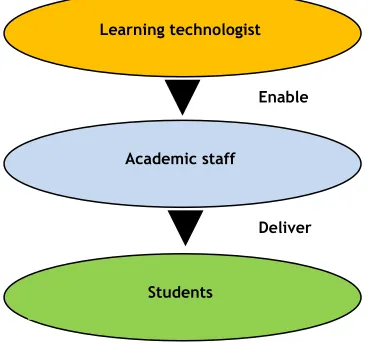
In the past, as is common with support of technology-enhanced learning within a large institution, the learning technologist works in a capacity of enabling academic staff members to deliver their VLE content independent of continuous support.
Learning technologist
Academic staff
Enable
Deliver
This model has several advantages, but most especially it means that the expert knowledge held by the learning technologist can be shared effectively with a large number of academic staff, who are then able to deliver to an even larger number of students, hopefully creating great impact within the institution. One drawback, however, is that the enabled academics may go on to deliver with varying degrees of success as the relationship does not necessarily include continued support.
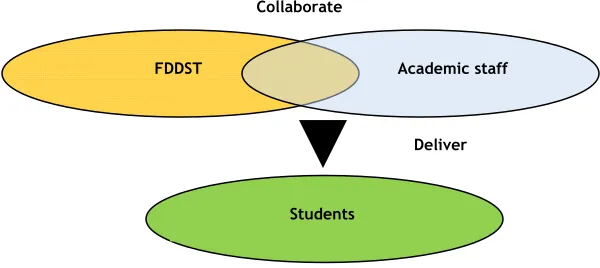
However, with the FDDST, the model works slightly differently and is very much about the members of the team working collaboratively and continuously with the academics who develop and deliver the technology-enhanced learning experiences via the VLE.
Collaborate
FDDST Academic staff
Deliver
Students
Figure 3: Model of support from the Flexible Delivery Development and Support Team
The huge advantage here is that the academic staff, individually or more usually as a course team, are continuously enabled and supported in order to deliver their VLE content. This means that the output in terms of online course content is maintained at a much more consistent standard, and the provision of online learning is enabled by a much more consistent approach to delivery.
One challenge to this model which must be considered is that this level of support is resource hungry in terms of the time spent by the members of the support team. At the moment, this is maintained through funding available from the Strategic Development Programme. It is important for the FDDST, during the duration of the available funding, to establish a costing model that weighs the effectiveness of this support against the efficiency of the provision, and hopefully establishes a strategic demand for its longevity.
Conclusion
References
ALMPANIS, T., S. PATRICK, R. MCLELLAN, C. DINSMORE, A. FAUSTINO, & W. BASUKI, 2010. Proposing a Framework for Blended and Flexible Course Design. In: Kinshuk et al., eds.
Cognition and Exploratory Learning in Digital Age: 7th International Conference, CELDA2010,
Timisoara, Romania, October 15 - 17, 2010. Proceedings: IADIS International Association for
the Development of the Information Society. Conference Proceedings, pp. 263 – 267
DOIG, A., 2011. Online Usability for Students in Employment.5th International, Education and
Development Conference INTED 2011: Valencia, Spain 8th March 2011 Proceedings: INTED
2011, pp 805-810
PATRICK, S. & J. NEWELL, 2009. Transition into or back into HE by Flexible Learning. [conference presentation] Solent Event, September 2009. Southampton Solent University
Contact
Steve Hogg
Head of Learning Technologies, LIS
02380319860
Andrew Doig
Flexible Courses Instructional Developer, LIS
02380319187