98.8%! Is project failure acceptable and inevitable?
Paul Summers
Southampton Solent University Southampton Solent Business School
Sir James Matthews Building 157 - 187 Above Bar Street
Southampton Hampshire SO14 7NN
Biographical details
Paul Summers was from 2008 till 2013 responsible for improving project
performance in Portsmouth City Council, during which time he introduced a model which proved successful in unleashing the power of beneficial change from the organisation’s project portfolio.
This model is the subject of his PhD research and this paper gives an insight into this model and its underpinning principles of education and benefits realisation.
Paul is currently a lecturer at Southampton Solent University in the Business School where he teaches, strategy, and business consultancy as well as project
management.
98.8%! Is project failure acceptable?
Abstract
Project management is in crisis; albeit largely unrecognized and unacknowledged. This crisis manifests itself in the continued poor performance of projects with a significant percentage, maybe as high as 98.8% (The Standish Group, 2014b), failing to deliver beneficial change. Until this crisis is dissolved projects will not produce the powerful results they are capable of.
In this paper the author will examine three reviews of project failure and argue that these reviews do not address the root causes of project failure and that a focus on cost and time is a cause of project failure and the lists of causes are in fact
symptoms of this singular perspective.
98.8%! Is project failure acceptable?
Introduction
Recent research by The Standish Group found that 98.8% of the projects in its database, 50,000 in total, failed when measured against six criteria; cost, time, value, scope, customer satisfaction and strategic objectives. Given this level of failure projects are failing to unleash the power which they potentially should. This paper will examine three investigations into project failure; those by The Standish Group who produce the Chaos Report, Nelson’s retrospectives at the University of West Virginia and Flyvbjerg et. al and their review of mega projects. It will be argued that these reviews take a singular view of projects based on a project definition which utilises a very narrow boundary and that the findings are actually symptoms of a focus on delivering an output to cost and time targets, “two best guesses and a phenomenon” (Atkinson, 1999)
In concluding a way forward to improve project performance is proposed with an emphasis on delivering benefits and educating project staff so they gain an understanding of the activities needed to deliver projects successfully.
Projects have been carried out throughout human history as ways of realising ideas, (Haynes, 1996; Kozak-Holland, 2011; Lenfle & Loch, 2010; Morris, 2013) for
example: the construction of the Pyramids, Stonehenge, the medieval cathedrals, numerous wars, the Manhattan project as well as smaller ideas such as cooking and consuming a meal.
The term project manager was first used by the Harvard Business Review in 1959 by Paul Gaddis, (Zhichang, 2007, p. 60) and in the 1960s PMAs started to be
incorporated bringing competence requirements, bodies of knowledge and
certifications. There are currently in excess of 750,000 people certified as project managers holding the PMAs (APM, 2011; IPMA, 2011; Project Management Institute, 2013) and PRINCE2 (Groult, 2011) qualifications alone. Notwithstanding these efforts to formalise professional standards, projects are still failing with
depressing regularity. (Dalcher, 2003; Kapsali, 2013; Ministry of Defence, 2010; The Standish Group, 2009) Indeed, it is staggering that so many certified people can produce so much failure and that this situation has developed without challenge. Projects have been defined in many ways but most authorities (e.g. Cooke-Davies, 2000, p. 19; Turner, 2008, p. 2) suggest three common characteristics: shared objectives; activities that require management; and a defined start and finish time. Definitions of project management tend to emphasise cost, time and quality as Atkinson (1999, p. 338); Cooke-Davies (2000, p. 19) show in their work. PRINCE2 defines a project as “a temporary organisation that is created for the purpose of delivering one or more business products according to an agreed Business Case.”
(Office of Government Commerce, 2009), a definition the author suggests is limiting and potentially a cause of project failure due to its singular viewpoint and focus on a project output rather than the realisation of benefits. Turner (2008, p. 2) adds the important dimension of benefits and offers a simplified definition by stating ‘A project is a temporary organization to which resources are assigned to do work to deliver beneficial change.’ This definition stresses benefits rather than outputs.
different people yet the Project Management Associations and APMG International, the global certification body for PRINCE2, suggest a standardised approach will work every time.
Project failure
Project success has historically been measured against the triple constraints of cost, time, and quality; often referred to as the iron triangle. (Atkinson, 1999; Cooke-Davies, 2000; Ika, 2009; Jenner, 2011; Morris, 1998) Quality may mean meeting technical specifications; however, quality is a subjective concept and will depend upon the perspective of the judge. (Ika, 2009, p. 8). Using these criteria means that cost and time become targets rather than constraints and leads the project
management team onto a focus on achieving those targets instead of the beneficial change the organisation commissioned the project to realise.
involved when the benefits are being realised. Seddon (2005, 2008) has highlighted the folly of turning measures into targets.
The Calleam Consulting Ltd., web site details a number of project failures both global and across all sectors and gives a flavour of project failure over the last decade or so. (Calleam Consulting Ltd, 2014) and below are detailed a number of failures from the United States of America (USA) and the United Kingdom (UK).
In the United States of America for example there were the problems that dogged the project to develop a virtual case file system for the Federal Bureau of
Investigation (FBI) in 2005 (Chua, 2009, p. 34; Friden, 2005; Martin, 2010) and the fiasco of the Denver Airport baggage handling system (Lukaitis & Cybulski, 2004; Mathiassen & Nielsen, 2008; Shore, 2008; Van De Ven & Johnson, 2006, p. 33). Shore (2008); 2009, p. 6) lists a number of projects across sectors in the USA that have failed, including Viewtron in the 1980s, Chrysler’s merger with Fiat in 2009, Airbus 380, the New York City police communications system, and the BP oil spill in the Gulf of Mexico in 2010.
Worthen (2002) relates how Nestle’s first foray into development of an Enterprise Resource Planning system proved impossible to implement successfully, resulting in the company’s decision to scrap the new system after two years work and begin the project over again.
In the UK, similarly poor outcomes are widespread. In the project to build a new Air Traffic Control center, which was ten years over schedule and still required
numerous reworks a year after opening (McKelvey, 2006). The infamous National Health Service (NHS) IT project, similarly ten years over schedule, was finally scrapped after expenditure of some £12 billion in September 2011, when it was announced that individual hospitals could choose their own preferred solutions (Information Age, 2011). In 2014 the e-borders project was finally scrapped at a cost of £224m (Glick, 2014).
"’I have serious concerns about how we managed this project,’ BBC director general Tony Hall said.” seems somewhat understated given the waste of nearly £100m of
taxpayers money. (BBC, 2013). Further UK public sector failures include the shared back office service for the Research Councils (eGov monitor, 2011) NHS’s National Programme for Information Technology (Public Service, 2011a) and FiReControl (Computing, 2011). Additionally (Public Service, 2011b) reported an ICT system for the Police was ‘detrimental to crime prevention.’ These failures are not limited to the public sector, as Haskett (2011) article about Boeing’s Dreamliner project
demonstrates. There are many more examples from the decades prior to the 2000s (e.g.Dalcher, 1999) and the concern has to be why projects continue to fail with such regularity, notwithstanding the introduction of legislative and mandatory requirements for government projects in both the USA and UK.
The Standish Group (2009) define project success in terms of time, cost, and quality requirements, known as the ‘iron triangle’, and state that an unfinished project
constitutes a failure. This definition ignores that closing a project early, and thus preventing further unproductive spend, is often a sign of mature project
management. In recommending the stopping of a project, the author saved an organization over £4M, which was able to be used elsewhere more beneficially. It was successfully argued that completion of this project would represent very poor return on investment (ROI). In a constantly changing organisational environment, a decision to cancel a project that is no longer likely to deliver beneficial outcomes should be applauded as a success. The Standish Group definition neglects to take into account the realisation of benefits from the project, as advocated by (Bradley, 2006; Jenner, 2010, 2011) and (Kerzner & Saladis, 2009) and also fails to consider the ROI from project outcomes.
USA and UK government response
These levels of project failure have led to the governments of both the United States of America (USA) and United Kingdom (UK) to legislate or mandate certain
The USA Government has introduced legislation, the Information Technology
Management Reform Act of 1996 known as the Cohen-Clinger Act, (Levinson, 2008) and mandated the use of Earned Value Management (EVM) in its project delivery in an attempt to stem the flow of project failures (United States Government
Accountability Office, 2009, p. 2). Some 12 years later further legislation was proposed; the Information Technology Investment Oversight Enhancement and Waste Prevention Act of 2008 (Levinson, 2008), this was not enacted. However, in 2009 another attempt at enacting this legislation was passed by the US Senate although it met with failure in the House of Representatives. (Govtrack.us, 2010) The UK government has widely adopted PRINCE2 as the de facto standard since the 1990s (Office of Government Commerce, 2008), and, in April 2011, the UK government introduced the Major Projects Authority (MPA) (Cabinet Office, 2011b).The Cabinet Office Minister, Francis Maude, is reported as saying ‘This Government will not allow costly failure of major projects to continue. That’s why we have set up the Major Projects Authority – to work in collaboration with central
Government Departments to help us get firmer control of our major projects, and
ensure there is a more systematic approach by departments as well as regular, planned scrutiny to keep projects on track.’ (McNiff & Whitehead, 2002)
management associations or PRINCE2 that is manifestly failing to stem the flow of poor project performance. It is clear that projects are failing notwithstanding the professional training of those charged with the responsibility to manage them. The next sections will consider in more detail the United Kingdom (UK) Government response to these widespread project failures, and then examine some literature to explore the reasons for project failure.
UK government response
The United Kingdom Government’s initial response to the high incidence of reported failure in public sector projects was to mandate the use of PRINCE (now replaced by PRINCE2), as stated on the Office of Government Commerce Web site in 2008. PRINCE (which stands for Projects in Controlled Environments) was first developed by the UK Government in 1989 as a standard approach to IT project management for central government. This methodology it is claimed has been widely adopted for projects in both the public and private sectors. The APMG International Ltd. (2007) states ‘PRINCE2 is a de facto standard developed and used extensively by the UK government and is widely recognised and used in the private sector, both in the UK
and internationally. It embodies established and proven best practice in project management.’ This description is inaccurate; firstly PRINCE2 is a methodology not a
standard and does not fully meet the requirements of ISO 21500 nor BSI 6079 which are the standards for project management. The second issue relates to best
practice; As argued by Kurtz and Snowden (2003) best practice works well in areas of certainty and agreement on the action(s) to take, in volatile, uncertain, complex and ambiguous environments, such as projects, it has less applicability and a more adaptive approach is required.
PRINCE2 provides a structured approach, setting out responsibilities for specified roles. There is a requirement to review the business case on a regular basis to ensure its continued validity. Nonetheless, it is common for projects to continue well beyond the time when the validity of the business case has been lost. The basic concept is of management by exception, using highlight reports to a project board to monitor progress on a regular basis with stage approvals as required. Interestingly, those highlight report templates that have been seen by the author have spaces for progress against cost and plan, but no spaces for reporting how the realisation of benefits is proceeding. In addition to PRINCE2, the UK Government has employed a six-stage gateway process to control and manage projects. This adds considerable overhead, as the project team is required to produce documents relating to the project and attend a series of interviews. The individual gateway can be for 3 to 4 days, involving a team of three reviewers. This process is similar to the now discredited Audit Commission inspections.
Notwithstanding these mandated requirements, projects in the public sector continue to fail spectacularly as shown in the examples described above. These continued failures have led the UK government to introduce the Major Projects Authority (Cabinet Office, 2011b) with effect from 1 April 2011. This is designed to manage high value projects in excess of £1billion, those of high complexity or innovative projects. It is intended as an improved assurance system for high risk projects (Steel, Summersgill, & Band, 2010) and comprises a number of review points for these projects (Cabinet Office, 2011a). These reviews take place at pre-determined stages, supplemented with annual reviews and quarterly updates. Given the frequency of these reviews, and from personal experience, it is estimated that this mechanism would take one person at least 53 weeks to complete, which will lead to both cost and time overruns if not built in to plans.
Steel et al. (2010, p. 11) detail the guiding principles and list the controls which should be assured;
1. Time – variance against milestones; 2. Cost – variance against planned budget; 3. Quality – degrees off the quality target;
5. Risk – limits on identified risks as a percentage of the overall budget; 6. Benefit – variance against level of benefit identified as part of the business
justification
The reader will note that the iron triangle leads the way, ahead of the desired benefits that are the reason for the project to be undertaken! This focus takes the importance away from project purpose onto project efficiency which with the PRINCE2 definition stressing products leads to sub-optimisation of the whole system. Reaching the project milestones within planned budget becomes the target for all concerned. It is the author’s contention that this concentration on the twin targets of time and cost are a significant contribution to project failure. It is not advocated that cost and time constraints be ignored, however, there is too much emphasis placed on these constraints to the detriment of delivering maximal return on investment. Frustratingly, the UK Government have seen the results of mandating PRINCE2 and imposing a formal gateway process, and noted how projects have failed in this environment, and the response has been to impose still more of the same. This appears to be a clear case of ‘doing the wrong thing righter’, by
committing more effort and resource to management activities already shown to be unproductive.
The Major Projects Authority has again mandated the use of PRINCE2 and MSP (Cabinet Office, 2011a). This means that, in theory at least; someone could attend a week’s training, successfully pass the PRINCE2 Practitioner examination, and then be appointed project manager for a £1billion + project.
It was announced on 7 February 2012 that the Said Business School at Oxford University will design and host the Major Projects Leadership Academy (MPLA). The aim of this initiative is to develop a cadre of world-class major project leaders within the UK Civil Service (Oxford University, 2012). The UK government is clearly
concentrating its efforts to improve project management performance by increasing the focus on the cost and time constraints. Fowler and Lock (2006, p. 110) state that this approach “… seeks to control costs...is attempting in vain to manage the project costs whilst losing sight of the need to manage the project benefits.”
and Leeds in subsequent years. A number of critics of the scheme, including (Rudkin, 2012) and (Aizlewood & Wellings, 2012), suggest that there will be limited benefits from this project and a poor return on investment. It will be subject to the Major Projects Authority remit. However, with the first phase due to be completed in 2026, we will have to wait a long time to assess the extent of the success or failure of this particular project. The earlier HS1 rail system, connecting the Channel Tunnel with London, was 18% over budget and 11 months late on time. More relevantly, the benefits realised have not been assessed to date and a report states that the
benefits expected were over optimistic in preparing the business case, “The HS1 project has delivered a high performing line, which was subsequently sold in a
well-managed way. But international passenger numbers are falling far short of forecasts and the project costs exceed the value of journey time saving benefits.” and “The
High Speed 1 project has brought a number of significant benefits including quicker
journey for passengers. However, the project went forward on the basis of hugely
optimistic assumptions about international passenger numbers. These were not
realised and the Department is only now developing its plan to evaluate whether the
project was value for money." (National Audit Office, 2012). It seems that the advice given in HM Treasury’s Green Book, (H M Treasury, 2003, p. 85) on optimism bias, has been ignored, again. That optimism bias is still an issue for the UK government is evidenced by the National Audit Office producing a guide in December 2013 entitled “Over-optimism in government projects” (National Audit Office, 2013) The response by the UK government to project failure extends to local government also with a belief that PRINCE2 practitioners, control processes, and compliance training will ensure project success. Sadly, the results show otherwise and yet, still the “bigger hammer” (Senge, 2006, p. 61) is applied.
Senge (2006, p. 61) suggests that ‘We all find comfort applying familiar solutions to problems, sticking to what we know best’. He goes on to describe this as ‘…what we need here is a bigger hammer’ syndrome. The bigger hammer is capable of being
interpreted in different ways; firstly an ever increasing level of control, compliance and systematic reviews. Secondly Maslow’s view “I suppose it is tempting, if the only tool you have is a hammer, to treat everything as if it were a nail.” (Maslow, 1962).
Governments have designed solutions to project failure that focus on addressing the same factors with greater rigour suggesting they only believe they have a hammer in their toolbox. Even when the introductions of PRINCE2 in the UK and EVM in the USA produced negligible improvement, both governments prescribed more of the same. Despite all the evidence showing that a prescriptive bureaucratic process of control, believed to be best practice (Eveleens & Verhoef, 2008, p. 30), leads to project failure, both the USA and UK governments continue to insist upon ‘a bigger hammer’ as a solution. Not surprisingly, projects still fail to provide good return on public investment, as well as missing planned budget and time constraints. Meadows (2009 p. 140) in describing system traps, discusses a phenomenon of seeking for the wrong goal: ‘If the goals – the indicators of satisfaction of the rules – are defined inaccurately or incompletely, the system may obediently work to produce a result that is not really intended or wanted.’ However, it is unhelpful that the project
management literature tends to concentrate on time, budget, and quality, as criteria of project success. Without a deeper investigation, it becomes easy for governments to prescribe methods that only deal with the symptoms of failure to meet cost and time targets. Such measures do not address causes, and it is therefore no surprise that expected benefits of projects continue to be elusive. Furthermore, this problem has been recognised in the project management community for many years.
Shenhar, Milosevic, Dvir, and Thamhain (2007, p. 702) comment: ‘This operational mindset is clearly reflected in the project management literature, which has
traditionally used time, budget, and performance as the main indicators for project success. Any of these measures—or even all taken together—can lead to
incomplete and misleading assessment.’
As discussed, projects have for many years been defined in terms of cost, time and quality – often called the iron triangle. Cost and time are easily measurably
throughout the life of the project. However, frequently, quality will not be measurable until the final project output is delivered. The result is that cost and time become the primary measures of project success with no consideration given to the realisation of benefits. Both governments’ insistence on targeting cost and time is an example of seeking the wrong goals. As a Ugandan proverb aptly suggests: ‘He who hunts two rats, catches none’ (Special Dictionary, 2005).The UK and USA governments, by
and deflect attention from the purpose of the project onto these targets. Seddon (2005, 2008) and The Scotsman (2012) provide a number of examples of targets as set by the UK government producing unexpected and inappropriate results.
In the following sections the reasons for project failure are examined by investigating three authorities. Firstly The CHAOS report (The Standish Group, 1996, 1999, 2009) which is widely cited and has been produced since 1995. Secondly (Nelson, 2005, 2007) examines 99 project failures in both the USA and UK across the public and private sectors. Thirdly, I look into Flyvbjerg and his colleagues’ research into megaprojects. These three views are not exclusive, as the literature is extensive in reviewing reasons for project failure, however they do represent the main findings. Flyvbjerg is The Director of Oxford's BT Centre for Major Programme Management, where the Major Projects Leadership Academy is established, which makes his views on project failure important for public sector projects in the UK. The main conclusion from this review is that project failure is systemic and poorly understood; only symptoms or first order causes are considered. This I argue means an inchoate appreciation of the problem and consequently any treatment is likely to fail. The proposals to improve project performance only resolve the issue not dissolve it. (Ackoff, 1994).
The CHAOS report
The Standish Group has been producing its CHAOS report since 1995, reviewing what it calls Information Technology (IT) projects. The CHAOS reports are widely cited to support project failure and have been used to support claims that software development project management is in crisis (Eveleens & Verhoef, 2008, p. 30; Glass, 2006, p. 15). The 1999 report (The Standish Group, 1999, p. 2) states failure to occur when the project is cancelled before completion, whereas success is
issue with these definitions stating “…they’re misleading, one-sided, pervert the estimation practice, and result in meaningless figures.” Another issue arises in
labelling projects as IT projects; and this may in itself be a factor in project failure. Bednar (2000, p. 145) points out not only that any new implementation of an information system can have a significant impact on the organization in which it is situated, but that the need to study organisational change as a result of IS
development has been recognised since the 1960’s (Neuman, 2011). Thus, such projects do not stand in isolation to the business and are more accurately described as an IT element of a project whose purpose is to bring about benefits to the
business concerned. To call them IT projects isolates them from their real purpose, deflects attention from their impact within the organisational environment and does not help in creating project success.
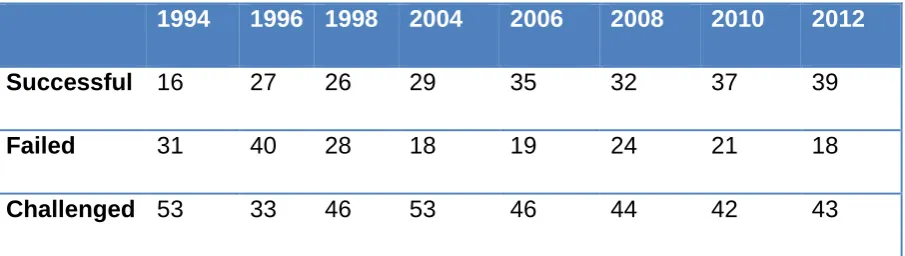
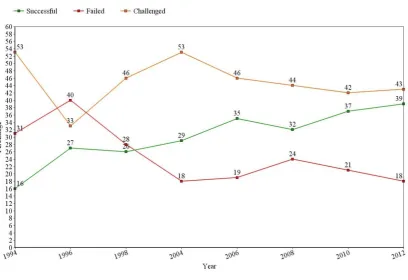
The following table from The CHAOS manifesto 2013 shows the findings from 2004 to 2012 by The CHAOS report with findings from the 1999 report added in (The Standish Group, 1999, p. 2; 2013, p. 1)
1994 1996 1998 2004 2006 2008 2010 2012
Successful 16 27 26 29 35 32 37 39
Failed 31 40 28 18 19 24 21 18
Challenged 53 33 46 53 46 44 42 43
Table 1 success rates 1994 - 2012 according to the CHAOS reports.
Figure A graph of the above data.
The 1995 CHAOS report (The Standish Group, 1995, p. 9) lists the following five reasons for challenged projects:
1. Lack of User Input;
2. Incomplete Requirements and Specifications;
3. Changing Requirements and Specifications;
4. Lack of Executive Support;
5. Technology Incompetence.
The Standish Group (2014a) in its April newsletter states that they have conducted a survey of the Standish User Research Forum (SURF) members with a single
question “what is your definition of success?” Six definitions were provided and these with their percentage scores are shown below:
3. on-target (requirements), 26%
4. on-goal (organizational strategy), 29% 5. valuable, 52%
6. satisfied, 41%
A total of 309 responses were received and each respondent was allowed up to four votes. The percentages reflect that the criterion was cast as one of the four votes. In addition about 33% of the respondents selected all of the criteria as their definition of success and 15% chose on-budget, on-time and on-target; the iron triangle.
The Standish group then applied the six definitions against the projects in their database and only 1.2% would be considered successful leaving 98.8%
unsuccessful, whereas if the single definition of on-budget was the sole criterion then 42% of projects in the database would be considered successful, still a significant rate of failure.
Standish User Research Forum (SURF) is a collection of IT executives from various user organizations throughout the world. These executives represent a cross section of the IT community from different industries, organization sizes, and geographic locations (Salipante & Aram, 2003). It is encouraging that valuable and satisfied received the highest support in this survey though both are qualitative terms and may depend upon an individual’s interpretation. I am taking valuable to mean realising benefits and return on investment (ROI) which should be identified during the feasibility stage and an evaluation plan produced.
The newsletter concludes by stating “The Standish Group believes that organizations should forget the triple constraints and focus on the value of their project portfolio, not individual projects.”
This is a major change of emphasis for The Standish Group and a more holistic view with a clear departure from the Project Management Institute’s position of success being measured by conformance to the triple constraint.
(Nelson, 2007, p. 74) lists a number of reasons for project failure garnered by undertaking retrospectives of 99 projects in 74 organisations. Students in the University of West Virginia Master of Science in the Management of Information Technology (MS MIT) degree program conducted these retrospectives
. The top five are as follows:
1. Poor estimating or scheduling; this involves scoping the project and
(Flyvbjerg, Garbuio, & Lovallo, 2009)estimating the time and effort required;
2. Ineffective stakeholder management; this involves identifying stakeholders
and their influence and interest in the project and then managing their
expectations accordingly.
3. Insufficient risk management; this involves identifying and mitigating anything
which may impact upon the project.
4. Insufficient planning; this happens when project managers jump straight into
delivery.
5. Short changed quality assurance; this comes about when projects come
under pressure and as a result testing and training are often cut.
The top three reasons occurred in half of the projects Nelson’s students investigated. (Nelson, 2007, p. 73) All of these reasons are interconnected for example planning will be poor if the planner is unable to estimate or fails to discuss with the appropriate people what and who are required to complete tasks. The five reasons listed all may occur due to insufficient time allocation and pressure to deliver the output.
Additionally, if project managers attempt to conduct project activities as a solo exercise, rather than involving both the delivery team and project board there will be a singular perspective to the project. Producing lists of reasons falls into the first trap of non systems thinking, that of reductionism. (Reynolds & Holwell, (2010, p6). Nelson (2005, p. 361) believes the “…secret to more successful project
management…” is “…learning from the past.” A number of retrospectives were
Unsurprisingly different groups had different importance, for example, the project manager group rated cost, time, and requirements highly whereas the sponsor and management rated value the highest. (Nelson, 2005, p. 365) The use of two sets of three criteria allows for process success and outcome failure, process failure and outcome success, success in both and failure in both. Nelson terms process success and outcome failure a successful failure, and process failure and outcome success a failed success. He states that the NHS has failed to learn from previous project failures and predicted the failure of the NHS IT project as mentioned earlier in this paper. (Nelson, 2007, p. 70)
Neither Nelson nor the Standish Group goes on to examine why the reasons to which they attribute failure are occurring. There is no attempt to conduct deeper examination to uncover second or deeper orders of causality. This failure to go beyond first order causes leads directly to the belief that increasing levels of control and monitoring are required in order to improve project performance – applying a bigger hammer!
Megaprojects (Flyvbjerg, Bruzelius, & Rothengatter, 2003),
(Flyvbjerg, 2013, 2014; Gharajedaghi, 2006), (Flyvbjerg et al., 2009) and (Flyvbjerg & Budzier, 2011)
In the works by these authors, over 1000 projects were examined to ascertain reasons for their failure. In the 2003 book, they claim that there is repeated over estimation of benefits and underestimation of costs related to, especially,
megaprojects sponsored by governments worldwide. Flyvbjerg et al. (2003, p. 47) state ‘…the pattern of underestimated costs and overestimated benefits…’ and ‘…use of deception and lying…’ are root causes for project failure. This is a constant theme throughout these works with the authors stating “The underlying reasons for all forecasting errors can usefully be grouped into three categories: 1) delusions or
honest mistakes; 2) deceptions or strategic manipulation of information or processes or 3) bad luck.” (Flyvbjerg et al., 2009) The authors state that bad luck is the frequent
causes 1 and 2 are more usual. Item 1 relates to unintentional bias as described by (Tversky & Kahneman, 1974) whereas item 2 is the basis of Flyvbjerg’s work, which he argues is most common. This following comment “Rather it is taken for granted that the proposed highway, stadium, dam or rail line is the correct answer to the problem, and cost–benefit estimates somehow come out just right” (Gharajedaghi,
2006, p. 21) also highlights Reynolds and Holwell (2010, p. 6) second trap of non-systems thinking – dogmatism applying a singular viewpoint. The Green Book (H M Treasury, 2003, p. 33) states that ‘There is a demonstrated, systematic, tendency for project appraisers to be overly optimistic. This is a worldwide phenomenon that
affects both the private and public sectors. Many project parameters are affected by optimism – appraisers tend to overstate benefits, and understate timings and costs, both capital and operational.’ This is known as optimism bias and the authors of the
Green Book recommend that allowances be made in project estimations and provide formulae to use. Clearly, monitoring an unrealistic budget means that failure is
certain when cost and time are the measures for success. If the budget is
underestimated, there is every probability that timescales are erroneous also, so that no amount of EVM or monitoring against time and cost will ensure that a project is ever on track. EVM will predict the outcome of the understatement quickly, leaving a choice between stopping the project or increases to the budget and time allocated - a failure according to The Standish Group (The Standish Group, 1995, p. 4). When senior managers discover the subterfuge, it is not surprising to find that they
withdraw support. However, project staff are often demoralised by this, believing this to be a general lack of executive support rather than the fault of their overestimation. Senior management is left with a choice between continuing, and being pilloried for being over budget and time, or stopping and working out excuses for being duped. The recent announcement by the UK Government of a high-speed rail link from London to Birmingham and thence on to Manchester and Leeds suggests that The Green Book and Flyvbjerg have been ignored as the opponents claim the costs are understated with the benefits being over stated and double counted.(Aizlewood & Wellings, 2012; Rudkin, 2012).
however, defines black swans as being unpredictable events; whereas risk is often predictable and can be mitigated for. Failure to mitigate risk is a failure of planning or managing, and is similar to causes identified by both The Chaos Report and Nelson. Despite the patterns of under and over estimation identified by Flyvbjerg and his co-authors, they propose better risk management as a solution. In the later article with Budzier, this solution is even more explicit. This is first order analysis with no attempt made to understand why the management of risk is poor. This I contend is dealing only with first order causality and the deeper underlying causes have not been identified.
The CHAOS report relies on surveys of staff involved in projects; whereas Nelson has carried out retrospectives that examined the reasons for project failure in more detail. It is often suggested that lack of executive support is a main reason for project failure. However, if this conclusion is based on surveys completed by project managers and delivery team personnel, it could be that they are never honest and reflective enough to accept blame themselves; for poor planning, for instance. The UK and USA governments’ emphasis on all things cost and time-related do not help, as the focus moves away from project purpose and vision, and demonstrably leads to project failure. The fact that reports of project failure still abound suggests that one or more of the following scenarios is occurring:
1. The reasons for project failure are being ignored (given the perfunctory nature of certification training this could be the case). If organisations do not carry out project retrospectives (or if they do this, but do not share their learning), this will also serve to mask the true reasons for failure. (Gharajedaghi, 2006, p. 20)
2. There is no understanding of the reasons for failure. It is insufficient to state that risk management is poor or planning is non-existent. In order to improve project performance, we need to find out why this is so. Until this is
appreciated, projects will continue to underperform.
4. We do not fully understand the nature of projects, or the environment in which projects are pursued. There seems to be an assumption by the two
governments and the project management associations that projects exist in a vacuum of order and stability, rather than the volatile environment most
usually encountered. This leads to a rigidity that hinders good project performance.
Certainly, the foregoing review shows a concentration on first order causes rather than asking why these causes are still so commonplace and the approaches by governments tend to concentrate attention upon symptoms rather than causes. Another factor which is unhelpful is the shopping list approach and the suggestion that each of the listed items can be dealt with individually thus leading to project success. The reasons in the lists are interconnected and interrelated and cannot be dissolved in isolation. Dealing with project failure in this piecemeal fashion inevitably leads to continued failure as has been witnessed.
In addition these reasons for failure are being viewed through the lens of an
inappropriate if widespread definition of projects; an output delivered against targets of cost and time. If the lens is altered to delivering beneficial change then the lists of reasons become symptoms of a poor and limiting worldview caused by pursuing the targets of cost and time. By making these constraints targets activities such as risk management, stakeholder engagement, planning and communication amongst others become less important and project failure becomes almost inevitable. Ackoff (1994, p. 185) writes “There are four very different ways of dealing with problems and messes in the real world.“ These are absolution, resolution, solution, and dissolution. The USA and UK governments’ responses to project failure tend towards resolution - a quick fix is achieved by dealing with the symptoms only. The underlying causes for project failure are not considered nor any attempt made to understand them. Satisficing will lead to the symptoms recurring as more of the same is prescribed. This may be, and often is, a starting point for interventions to improve project performance. However, there needs to be a greater appreciation (Vickers, 1982) for problem dissolution.
interconnected and interdependent not discrete as suggested in the examples cited above.
A systemic perspective
In order to expand on the concept of second order causes, let’s turn our attention to the suggestion that ‘insufficient planning’ is to blame for failure. Without exploring why this occurs, we cannot understand what is behind this reason for failure. There are a number of possible causes for insufficient planning:
1. Lack of knowledge: not understanding why planning is important; 2. Lack of competence: lacking the skills or experience to plan effectively;
3. Insufficient time allocated, due to a focus on cost and time targets: underestimating how long planning will take (or a combination of the above); 4. Pressure to ‘get on with it’: senior management and/or stakeholders may be
pressing to see something happen, planning is invisible unlike delivery
5. Lack of understanding of need: project purpose may be poorly understood; the need to have plans and regular reviews may not be understood.
It is not claimed that this is a definitive list of causes for insufficient planning.
However, it is suggested that questioning what lies behind each of these causes can lead to a much more holistic view of causality. Asking ‘why?’ can generate deepened understandings, e.g. from ‘Lack of knowledge’ we can extrapolate the following second order causes:
1. The organisation does not value time spent on planning;
2. Team members do not understand the importance of planning; 3. Team members lack experience of (the importance of) planning; 4. Team members have no competence in planning;
allows for greater understanding and creation of a more meaningful set of remedies that can be applied. This systemic approach also stress that the causes of failure may be multiple and will be context specific (Bignell and Fortune, 1994). This leads to a level of complexity that cannot be addressed with simplistic remedies. A holistic perspective needs to be achieved before any lasting solution can be applied. It is this dimension that is missing from both governments’ responses to project failings. Many terms are used in connection with projects – e.g. project management, project delivery, project governance and project purpose. The author suggests that this may lead to a misunderstanding of the nature of projects/management. A systemic view is proposed looking at three interacting elements in project context. The first of these is purpose – the rationale behind the project that justifies investment of resources. This
will include outputs, e.g. a school building or new process; outcomes, e.g. a fully equipped school with trained staff or staff trained to use the new process; and benefits expected from the project delivery, e.g. a school producing well-educated pupils who enter the workforce, or improved effectiveness from the new process. These benefits may not be achieved for some time after project delivery has finished e.g. a project to reduce obesity levels in a city. This element reflects the defining of the vision that led to the project’s inception.
The second of the interacting elements is creation of plans – this involves mapping out the activities such as stakeholder engagement and benefits management at a high level. Plans will identify who will be involved in the project and establish its structure, together with any monitoring arrangements. Often a project charter will be drawn up. This establishes responsibility for the activities required.
Actions are the third element – what must be done to achieve the outcomes and
benefits required? This aspect breaks down the plans into more detailed schedules of activities and will include planning, benefits identification and tracking, risk logging and tracking, stakeholder identification and activity, and change management. This element will be used to identify the tasks required, the personnel who will carry them out, the time needed to perform those tasks and any development needs of the team. These are the tactics for achieving the desired outcomes.
Project management – this is the governance and monitoring arrangements put in
place for project delivery. These may be staged or gated approval processes requiring reviews to be carried out at certain pre-determined stages to ensure the project continues to deliver the business benefits expected. Co-ordination of all the identified activities and tasks, and ensuring any changes are dealt with appropriately form part of this process. This is shown graphically in Figure 2.
Figure 2 Systemic view of projects
It is contended that the first element project purpose is the most important and frequently the most neglected area. Project management, as defined above, often receives the most attention to the detriment of the other elements. This view is supported by (Atkinson, 1999, p. 340) who states ‘After 50 years it appears that the definitions for project management continue to include a limited set of success criteria, namely the Iron Triangle, cost, time and quality.’ Additionally, Kerzner and Saladis (2009, p. 7) offer the view that ‘decision making based entirely on the triple constraint, with little regard for the final value of the project, may result in extreme stakeholder dissatisfaction or significant opportunity cost.’ (Jenner, 2011) also
emphasises the need for benefits to be identified and realised for true project
state: ‘As such, it (project management) needs to be integrated into corporate strategy and not relegated to the tactical arena.’
It is further believed that project methodologies and bodies of knowledge that emphasise a linear A to Z progression tend to over-simplify projects, leading to inadequate understanding of their problematic nature, made up of any number of unknowns and unknowables. Project management is often viewed in isolation from other systems within the organisation. As Ackoff (1994, p. 184) states ‘Therefore, problems should be viewed from as many different perspectives as possible before a
way of treating them is selected. The best way often involves collaboration of
multiple points of view, a transdisciplinary point of view.’ This requires an exploration
of all the elements of a project, rather than a rush to project delivery and a belief that rigorous project management alone will ensure the success of any project.
The author suggests that the USA and UK governments encourage a limited and narrow boundary in considering projects, focussing on the project management element to the exclusion of other considerations. This leads them to prescribe
methods in a frequently vain attempt to control cost and time, turning these resource constraints into targets to be met with failure becoming inevitable.
I propose that the boundary around projects be extended so that the root causes of failure can be explored. Until this understanding is achieved, it is unlikely that any solution to the issue of poor project performance which so bedevils the USA and UK government sectors will be found. (Checkland, 1999) points out that a human activity system, such as a project, can best be seen as a mental construct created in the mind of an observer. Meadows (2009 pp. 98 - 99) writes ‘We get attached to the boundaries our minds happen to be accustomed to’ and ‘…boundaries are of our own making...’ (Ulrich, 2005) introduces a concept of boundary critique ‘a systematic effort of handling boundary judgments critically.’ In the absence of such a critical
view, we fear that the catalogue of failure will continue. Conclusion
performance. In this section these assumptions are examined and finally a possible way forward is suggested.
The first assumption is that by addressing the symptoms of cost and time overruns, projects will be successfully delivered. This leads to ever tighter enforcement of prescribed methods and gateway processes in the hope of imposing control. As this situation has endured for over 20 years, it is legitimate to ask why both governments have not learned from experience to take a wider perspective on this problem
domain and seek for alternative solutions. In placing such emphasis on process rather than results, they have let down stakeholders who should have been recipients of the intended benefits from many projects.
Assumption number two by governments is that project failure may be treated as a puzzle to be solved. Actually every project comprises a complex problem space within which many puzzles are intertwined. This requires different thinking to in order to generate multiple solutions. Use of legislation to mandate requirements for
projects shows a lack of real understanding and does not deal with the root causes of failure. In particular, it demonstrates lack of focus on the purpose of projects and poor appreciation of the changing environment in which they are delivered and managed. Policies which emphasise control processes, certifications and technical skills, while ignoring a need for management of benefit realisation, will continue to produce projects that fail.
Thirdly, the solutions used by the two governments assume that it is possible to set binding budgets and time schedules early in the project lifecycle. However,
experience shows that, at this stage, there is little certainty or agreement within the project domain and many imponderables remain to be explored. If Flyvberg and The Green Book are correct in suggesting that budgets are under-estimated in order to gain approval, then many projects are set up to fail from the outset, however rigorous the controls put in place. Furthermore, the tendency to describe projects in terms of their main component (such as ‘IT projects’) is a possible contributory factor to project failure. All projects should ultimately benefit the business and support the objectives of the organisation.
in practice. We can see therefore that prescriptive methods based on this
assumption will do nothing to prevent project failure. The environment within which the project is planned may well be different from the one in which the project is executed. For instance, there may be changes in the political situation, the business may redefine its objectives, personnel may change or external factors such as the banking sector collapse may impinge. This does not mean that I believe estimating budgets, timescales and other requirements to be futile. It does mean that these activities must be carried out in a spirit of flexibility, recognising a need for constant iteration, and based on as much information as is appropriate and proportionate to the project. The concentration on the iron triangle of cost, time and quality targets as a measure of success is flawed. Projects should be initiated to create beneficial change and meet the business objectives of the organisation.
When projects are deemed to fail (as inevitably some of them will, even when this suggested approach is adopted) there is a need for greater understanding of second order causality. If, for example, it is suggested that projects are poorly planned, it needs to be uncovered the reasons why this is the case. It is not possible to dissolve the problem of project performance without this deepened understanding, and
increasing levels of control will not address this. Of course, monitoring of projects must be done. Appropriate checks and balances are needed when spending public money. However, these need to be appropriate, proportional and focussed on project purpose.
I propose that there is a better way forward for project management based on benefits realisation and project staff gaining a true understanding of the activities required to deliver their projects successfully. Firstly a greater emphasis on benefits management as the keystone of projects (Summers, 2011a). This will clarify the purpose and inform the plans of a project. Benefits management needs to be embedded within projects so that their whole rationale concentrates on stakeholder expectations. Secondly, the way project professionals are educated needs to be focused on understanding activities and continuous learning. We need to move away from ‘training’ in which a trainer tells delegates the ‘right way’ to deliver projects. The current five-day training courses leading to certifications only serve to create a false sense of security within organisations. The author believes that a deeper
improve project performance to ensure the delivery of beneficial change. Thirdly, formation of Communities of Practice to encourage collaborative learning, both within and outside an organisation, will assist in the propagation of good practice. The emphasis needs to be on understanding and continual development, rather than blind confidence in a prescribed method that may have worked well in a different project within a different environment. An action research project implementing such an approach has been undertaken by the author in a UK local government
organisation (Summers, 2011b) and proved to be successful. The performance of project delivery improved with greater ROI and an ability to stay within project constraints, further details of this research will be published in further papers. As a profession a greater understanding of project performance and resource
References
Ackoff, R. L. (1994). Systems thinking and thinking systems. System Dynamics Review, 10(2-3), 175-188. doi: 10.1002/sdr.4260100206
Aizlewood, K., & Wellings, R. (2012). High Speed 2: the next government project disaster? : Institute of Economic Affairs.
APM. (2011). Home. Retrieved 14 August, 2011, from http://www.apm.org.uk/AboutUs
APMG International Ltd. (2007). Welcome to the Official PRINCE2® Website. Retrieved 1 November, 2011, from http://www.prince-officialsite.com/
Atkinson, R. (1999). Project management: cost, time and quality, two best guesses and a phenomenon, its time to accept other success criteria. International Journal of Project Management, 17(6), 337-342. doi: 10.1016/s0263-7863(98)00069-6
BBC. (2004, 14 November 2004). 'Basically, it doesn't work'. Retrieved 18 August, 2011, from http://news.bbc.co.uk/1/hi/uk_politics/4019239.stm
BBC. (2005, 16 November 2005). CSA not suited to job, says Blair Retrieved 18 August, 2011, from http://news.bbc.co.uk/1/hi/uk/4441190.stm
BBC. (2013, 24 May 2013). BBC abandons £100m digital project. Retrieved 15 December, 2014, from http://www.bbc.co.uk/news/entertainment-arts-22651126
Bednar, P. M. (2000). A Contextual Integration of Individual and Organizational Learning Perspectives as Part of IS Analysis. Informing Science – International Journal of an Emerging Transdiscipline, 3(3), 145-156. Bignell, V., & Fortune, J. (1984). Understanding systems failuires. Manchester:
Manchester University Press.
Bradley, G. (2006). Benefits Realisation Management. Aldershot: Gower.
Cabinet Office. (2011a). Government launches Major Projects Authority. Retrieved 23 October, 2011, from
http://www.cabinetoffice.gov.uk/content/major-projects-authority
Cabinet Office. (2011b). Government launches Major Projects Authority. Retrieved 20 July, 2011, from
http://www.cabinetoffice.gov.uk/news/government-launches-major-projects-authority
Calleam Consulting Ltd. (2014). Why Projects Fail. Retrieved 14 December, 2014, from http://calleam.com/WTPF/?p=6773
Chabris, C. F., Weinberger, A., Fontaine, M., & Simons, D. J. (2011). You do not talk about Fight Club if you do not notice Fight Club: Inattentional blindness for a simulated real-world assault. Iperception, 2(2), 150-153. doi: 10.1068/i0436 Checkland, P. (1999). Systems Thinking, Systems Practice. Chichester: John Wiley
& Sons.
Chua, A. Y. K. (2009). Exhuming it projects from their graves. Journal of Computer Information Systems(Spring), 32-39.
Computing. (2011). FiReControl slammed as one of the biggest IT failures in years. from http://www.computing.co.uk/ctg/news/2110241/firecontrol-slammed-biggest-failures
Dalcher, D. (1999, 7-12 Mar 1999). Disaster in London. The LAS case study. Paper presented at the Engineering of Computer-Based Systems, 1999.
Proceedings. ECBS '99. IEEE Conference and Workshop on.
Dalcher, D. (2003). Understanding Stories of Information Systems Failures. Paper presented at the Action in Language, Organisations and Information Systems (ALOIS), Linköping, Sweden.
eGov monitor. (2011). NAO Criticises "Shared Service" Project Across Research Councils For Failing To Deliver "Value For Money". Retrieved 25 October, 2011, from http://www.egovmonitor.com/node/44316
Eveleens, J. L., & Verhoef, C. (2008). The rise and fall of the Chaos report figures. IEEE Software, 27(1), 30 - 36.
Flyvbjerg, B. (2013). Quality control and due diligence in project management: Getting decisions right by taking the outside view. International Journal of Project Management, 31(5), 760-774. doi: 10.1016/j.ijproman.2012.10.007 Flyvbjerg, B. (2014). What You Should Know About Megaprojects and Why: An
Overview. Project Management Journal, 45(2), 6-19. doi: 10.1002/pmj.21409 Flyvbjerg, B., Bruzelius, N., & Rothengatter, W. (2003). Megaprojects and risk An
anatomy of ambition (1st ed.). Cambridge: Cambridge University Press. Flyvbjerg, B., & Budzier, A. (2011). Why Your IT Project May Be Riskier Than You
Think. Harvard Business Review, 1 - 4.
Flyvbjerg, B., Garbuio, M., & Lovallo, D. (2009). Delusion and Deception in Large Infrastructure Projects: Two Models for Explaining and Preventing Executive Disaster. California Mangement Review, 51(2), 170-193. doi:
10.1225/CMR423
Fowler, A., & Lock, D. (2006). Accelerating business and IT change: transforming project delivery. Aldershot: Gower Publishing Ltd.
Friden, T. (2005, 4 Feb 2005). FBI wasted millions on Virtual Case File from http://www.cnn.com/2005/US/02/03/fbi.computers
Gharajedaghi, J. (2006). Systems Thinking: Managing Chaos and Complexity. Burlington, USA: Elsevier.
Glass, R. L. (2006). The Standish report: does it really describe a software crisis? Communications of the ACM, 49(8), 15 - 16. doi: 10.1145/1145287.1145301 Glick, B. (2014, 12 March 2014). Government finally ends e-Borders programme.
Computer Weekly.
Govtrack.us. (2010). S. 920 (111th): Information Technology Investment Oversight Enhancement and Waste Prevention Act of 2009. Retrieved 14 April, 2014, from https://www.govtrack.us/congress/bills/111/s920
Groult, E. (2011, 20/07/2011). An examination of the various PM standards offered by PMI and others: How can they be used effectively? Retrieved 24/07/2011, 2011, from http://allpm.com/index.php?name=News&file=article&sid=2487 H M Treasury. (2003). The Green Book. London: TSO.
Haskett, E. (2011). Dreamliner finally becomes a reality. Retrieved 26 September, 2011, from
http://www.managementtoday.co.uk/bulletin/mtdailybulletin/article/1095247/dr eamliner-finally-becomes-reality/
Haynes, M. E. (1996). Project Management: From idea to implementation. Lanham: National Book Network, Inc.
Information Age. (2011, 22 Sep 2011). NHS IT programme "scrapped" – again. Retrieved 18 May, 2012, from http://www.information-age.com/channels/it-services/news/1656888/nhs-it-programme-scrapped-again.thtml
IPMA. (2011). Home page. Retrieved 20 July 2011, from http://www.ipma.ch Jenner, S. (2010). Transforming government and public services: realising benefits
through project portfolio management. Farnham: Gower Pub.
Jenner, S. (2011). Realising benefits from government ICT investment - a fool's errand? (2nd ed.). Reading: Academic Publishing International Ltd.
Kapsali, M. (2013). Equifinality in project management exploring causal complexity in projects. Systems Research and Behavioral Science, 30(1), 2 - 14. doi:
10.1002/sres.2128
Kerzner, H., & Saladis, F. P. (2009). Value-driven project management (1st ed.). New Jersey: John Wiley & Sons, Inc.
Kozak-Holland, M. (2011). The History of Project Management
Kurtz, C. F., & Snowden, D. J. (2003). The new dynamics of strategy: Sense-making in a complex and complicated world. IBM SYSTEMS JOURNAL, 42(3). Lenfle, S., & Loch, C. H. (2010). Lost roots: How project management came to
emphasize control over flexibiltiy and novelty. California Mangement Review, 53(1), 32 - 55.
Levinson, M. (2008, 9 December 2008). Federal IT Project Failures: Proposed Legislation Aims to Stop the Insanity. Retrieved 14 November, 2011, from http://www.cio.com/article/469928/Federal_IT_Project_Failures_Proposed_Le gislation_Aims_to_Stop_the_Insanity
Lukaitis, S., & Cybulski, J. (2004). A Hermeneutic Analysis of the Denver International Airport Baggage Handling System. Paper presented at the Information Systems Foundations: Constructing and Criticising, The Australian National University, Canberra.
Marchand, D. A., & Hykes, A. (2006). Designed to Fail: Why IT-enabled Business Projects Underachieve. IMD Perspectives for Managers, (138). Retrieved from Perspectives for managers website:
http://m.imd.ch/research/publications/upload/PFM138_LR_Marchand_Hykes. pdf
Martin, S. (2010). Co-production of social research: strategies for engaged scholarship. Public Money & Management, 30(4), 211-218.
Maslow, A. H. (1962). Toward a Psychology of Being. New York: John Wiley & Sons. Mathiassen, L., & Nielsen, P. A. (2008). Engaged scholarship in IS research.
Scandinavian Journal of Information Systems, 20(2), 1.
McKelvey, B. (2006). Van De Ven and Johnson's “engaged scholarship”: Nice try, but…. Academy of Management Review, 31(4), 822-829.
McNiff, J., & Whitehead, J. (2002). Action research: Principles and practice (2nd ed.): Routledge.
Meadows, D. H. (2009 ). Thinking in systems: a primer (D. Wright Ed.). Abingdon: Routledge.
Ministry of Defence. (2010). The major projects report 2010. In National Audit Office (Ed.).
Morris, P. W. G. (1998). Key Issues in Project Leadership: Project management handbook. San Francisco: Jossey-Bass.
Morris, P. W. G. (2013). Reconstructing Project Management. Somerset, N.J.: Wiley. Narcotics Anonymous. (1981). World service conference of narcotics anonymous
National Audit Office. (2010). The major projects report 2010. Retrieved from http://www.nao.org.uk/publications/1011/major_projects_report_2010.aspx. National Audit Office. (2012). The completion and sale of High Speed 1. (HC 1834). .
London: The Stationery Office.
National Audit Office. (2013). Over-optimism in government projects: National Audit Office.
Nelson, R. R. (2005). Project retrospectives: evaluating project success, failure, and everything in between. MIS Quarterly Executive, 4(3 September), 361 - 372. Nelson, R. R. (2007). IT Project Management: Infamous Failures, Classic Mistakes,
and Best Practctices. MIS Quarterly Executive, 6(2 June).
Neuman, W. L. (2011). Social research methods: qualitative and quantitative approaches (7th ed., International ed. ed.). Boston
London: Pearson.
Office of Government Commerce. (2008, 2011-07-05). PRINCE2. Retrieved 16 June 2010, 2010, from
http://www.ogc.gov.uk/methods_prince_2__background.asp
Office of Government Commerce. (2009). Managing Successful Projects with PRINCE2: 2009 Edition. Norwich: The Stationery Office.
Oxford University. (2012, 7 February 2012). Saïd to deliver new ‘Major Projects Leadership Academy’ Retrieved 20 March, 2012, from
http://www.sbs.ox.ac.uk/newsandevents/news/Pages/MPLA.aspx Project Management Institute. (2013, June ). PMI Today. PM Network, 16.
Public Service. (2011a). £11bn NHS IT 'failure' to be scrapped quickly. Retrieved 26 September, 2011
Public Service. (2011b, 23 September 2011). Police ICT 'detrimental' to crime prevention. Retrieved 26 September, 2011, from
http://www.publicservice.co.uk/news_story.asp?id=17528
Reynolds, M., & Holwell, S. (2010). Introducing Systems Approaches. In M. Reynolds & S. Holwell (Eds.), Systems approaches to managing change:A practical guide. London: Springer.
Rudkin, J. (2012). Case for HS2 is based on ignorance and lies. from http://www.egovmonitor.com/node/45510
Salipante, P., & Aram, J. D. (2003). Managers as knowledge generators: The nature of practitioner‐scholar research in the nonprofit sector. Nonprofit Management and Leadership, 14(2), 129-150.
Seddon, J. (2005). Freedom from command and control: a better way to make the work work (2nd ed.). Buckingham: Vanguard Education Ltd.,.
Seddon, J. (2008). Systems thinking in the public sector (1st ed.). Axminster: Triarchy Press.
Senge, P. M. (2006). The Fifth Discipline (2nd ed.). Random House: London. Shenhar, A. J., Milosevic, D., Dvir, D., & Thamhain, H. (2007). Linking project
management to business strategy. Pennsylvania: PMI.
Shore, B. (2008). Systematic biases and culture in project failures. Project Management Journal, 39(4), 5-16. doi: 10.1002/pmj.20082
Shore, B. (2009). Project Failure. Retrieved 30 October, 2011, from http://globalprojectstrategy.com/failure.php
Special Dictionary. (Ed.) (2005) (Vols. 2011).
http://www.cabinetoffice.gov.uk/sites/default/files/resources/assurance-high-risk-projects_0.pdf.
Summers, P. (2011a). Benefits management: The keystone of project management 10. http://www.apm.org.uk/news/2011-postgraduate-student-award
Summers, P. (2011b). A systemic approach to improving project management performance. Paper presented at the 55th International Society for the Systems Sciences, University of Hull.
Taleb, N. N. (2007). The Black Swan. London: Penguin.
The Scotsman. (2012, 22 March 2012). Probe as thousands of patients forced off waiting lists Retrieved 4 April 2012, from
http://www.scotsman.com/news/probe-as-thousands-of-patients-forced-off-waiting-lists-1-2188770#
The Standish Group. (1995). The CHAOS report.
The Standish Group. (1996). Unfinished Voyages A Follow-Up to The CHAOS Report. http://www.umflint.edu/~weli/courses/bus381/assignment/vo.pdf The Standish Group. (1999). CHAOS 1999.
The Standish Group. (2009). CHAOS Summary 2009. Retrieved 14 June, 2011, from http://www.standishgroup.com/newsroom/chaos_2009.php
The Standish Group. (2013). The CHAOS manifesto 2013.
The Standish Group. (2014a, 1 April 2014). Definition of Project Success. Retrieved from http://blog.standishgroup.com/news
The Standish Group. (2014b). SURF. Retrieved 6 May, 2014, from http://blog.standishgroup.com/surf
Turner, J. R. (2008). Handbook of Project-Based Management : Leading Strategic Change in Organizations. New York, NY, USA: McGraw-Hill Professional Publishing.
Tversky, A., & Kahneman, D. (1974). Judgment under uncertainty: Heuristics and biases. science, 185(4157), 1124-1131.
Ulrich, W. (2005). A brief introduction to critical systems heuristics (CSH). (22 November). Retrieved from ECOSENSUS project website website:
http://projects.kmi.open.ac.uk/ecosensus/publications/ulrich_csh_intro.pdf United States Government Accountability Office. (2009). Information Technology:
Agencies need to improve the implementationand use of earned value techniques to help manage major system acquistions. (GAO-10-2). Washington: Retrieved from http://www.gao.gov/new.items/d102.pdf.
Van De Ven, A. H., & Johnson, P. E. (2006). Nice try, Bill, but… There you go again. Academy of Management Review, 31(4), 830-832.
Worthen, B. (2002). Nestlé's Enterprise Resource Planning (ERP) Odyssey. CIO Magazine.
http://www.cio.com/article/31066/Nestleacute_s_Enterprise_Resource_Planni ng_ERP_Odyssey
Zhichang, Z. (2007). Complexity science, systems thinking and pragmatic sensibility. Systems Research and Behavioral Science, 24(4), 445-464. doi: