Photo:
Defor
estation br
ought about thr
ough a rise in mechanized logging, and the expansion of mining and oil and gas extraction, has incr
eased in many tr
opical for
est ar
Introduction
As illustrated in the preceding chapters, clear standards exist to regulate the direct impacts of extractive industries. However, responsibility and management for the indirect impacts caused by natural resource extraction are mostly absent. Yet, these often pose the greatest threats to natural habitats as well as to indigenous territories. Although mining and oil/gas extraction have signifi-cant localized impacts on the surrounding environment, their indirect impacts can also be substantial and reach beyond the immediate exploitation areas. This is rele-vant to even extensive logging activities, especially where sustainable management practices are in place. Logging, as with min-ing and oil and gas extraction, results in
CHAPTER 7
infrastructure development that is often accompanied by the growth of human pop-ulation centers and marketplaces, depend-ent upon the exploitation of land, forests, and wildlife. Evidence from remote sens-ing indicates that infrastructure created for extractive industry operations causes wide-spread changes in regional land use. These changes can have long-term effects on forest ecosystems and forest-based livelihoods (Asner et al., 2009). In this chapter, we describe such impacts on apes and their habitats, present options for their mitigation, and examine some of the challenges faced.
The first section focuses on the indirect impacts of extractive industries on apes and ape habitats. Although all indirect impacts are important, in this chapter we concentrate on those that are most pressing at this time.
Increased hunting and poaching: the opening up of forests for extractive industries facilitates the expansion of associated roads and thus access to mar-kets. Settlements associated with extrac-tive industries can also increase demand for bushmeat if the industry does not supply employees with imported domes-tic animal meat. The lack of alternative domestic protein tacitly encourages employees and their families to feed off the forest. All hunting of apes is illegal and thus classified as poaching, however, apes also fall victim to hunting methods used for other species.
Habitat degradation and land conver-sion: although humans have always had an impact on ape habitats, more recently, deforestation brought about through a rise in mechanized logging, and the expansion of mining and oil and gas extraction, has increased in many trop-ical forest areas.
Probable introduction of infectious pathogens: habitat fragmentation, as well as industrial expansion, may force ape
populations into greater contact with one another, creating pockets of artificially higher ape densities that can trigger dis-ease outbreaks. Disdis-ease cross-infection between humans and apes (e.g. influ-enza, measles) is known to occur. Thus, increased proximity of people and apes may have significant implications for the health of both species through the spread of infectious pathogens.
The second section examines ways for preventing or reducing the impact of indi-rect effects by focusing on management practices and corporate policies, compli-ance with national policies and regulations, certification, and the uptake of voluntary guidelines. Since translation of policy into practice remains a major challenge, pri-marily because of the lack of technical and human capacity for implementation on the ground, we investigate how some extractive companies, and other stakeholders, have addressed the challenge of reducing and/ or mitigating their impacts on wildlife pop-ulations. We identify what actions they can and should take to ensure illegal hunting does not take place within their concessions, and also establish how best to engage with other stakeholders.
Of particular importance is how indirect impacts affect areas and wildlife popula-tions beyond concession boundaries, along-side the potential for cumulative impacts from multiple industrial and development projects within a specific area.
In the third section we address the challenges involved in curbing the indirect impacts of extractive industries. Since some impacts triggered by the presence of the extractive industry extend beyond the concessions’ boundaries and may not be directly associated with their activities, ascertaining the burden of obligation can be complicated. There is also the challenge of ensuring that the rights of traditional
“
Evidence from remote sensing indicates that infra structure created for extractive industry operations causes widespread changes in regional land use.communities to continue to benefit from their natural resources are not affected by any policies or practices put in place to address the indirect impacts of these industries.
The complexity and extent of the issues around indirect impacts mean that the cost of addressing them can be high. Currently, there is a lack of realistic incentives for companies to make this investment. Weak governance, inconsistent government poli-cies, insufficient resources, a lack of capacity, poor enforcement, and corruption further exacerbate the stakeholders’ ability to address the indirect impacts of extractive industries.
Key findings include:
Significant increases in the hunting and poaching of wildlife as a result of the physical presence of extractive industries have been observed.
Indirect impacts of extractive indus-tries are likely to have a more significant impact on ape conservation than local-ized direct impacts, particularly in rela-tion to mines and oil and gas wells. Illegal and unsustainable hunting
indi-rectly linked to logging operations rep-resents a far more important threat to species conservation than direct logging impacts (Milner-Gulland and Bennett, 2003; Meijaard and Sheil, 2008). The extent to which individual mining
companies can reduce their impact from haul roads, exploration drilling, and con-centrations of large numbers of employ-ees once mines become operational will determine their overall impact on ape habitat and unsustainable and illegal hunting and snaring.
Some guidelines for industry practice exist; however, critical issues remain unresolved, such as the extent to which industry and/or government is respon-sible for managing their impacts beyond the concession borders.
There is lack of clarity regarding respon-sibility, and there is a poor capacity of national and sub-national governance structures to respond to indirect impacts. If the indirect impacts of extractive
industries are not addressed, the on-going survival of many, if not all, ape popula-tions is at risk.
Indirect impacts: the
primary threat to apes
and ape habitats?
Extractive industries in tropical forests have a range of effects on biodiversity. These are classified as the direct impacts associated with the operation of extraction, or the indi-rect impacts that happen as an unintended consequence of the extractive enterprise. For example, with artisanal and small-scale mining (ASM) environmental impacts can include deforestation and improper manage-ment of mining and human waste leading to water and soil pollution. Equally, demand increases for specific plant and animal spe-cies for mining inputs such as tools, food, and medicines (Pact, 2010). Other human activities supporting ASM populations which have a detrimental impact on the environment include bushmeat hunting and poaching, tree cutting for timber, and slash-and-burn agriculture. An additional ring of environmental degradation is created by the construction of access routes allowing the wider population to access and exploit more remote areas well beyond the time frame of direct mining activities. Of all the indirect impacts, increased hunting and poaching, habitat degradation, fragmen-tation, and loss, and the threat of infec-tious diseases are widely considered to be the most pressing.
Indirect impacts arise from the activities but also from the mere presence of extrac-tive industries. Crucially, immigration of
“
If the indirect impacts of extrac tive industries are not addressed, the ongoing survival of many, if not all, ape populations is at risk.people into emerging satellite communities linked to these industries, alongside their greater access to remote areas (through road networks, other transport routes, and the opening up of pipeline tracts and industry transects), promotes higher levels of hunt-ing for bushmeat and the live animal trade. There is also the potential for intraspecies and interspecies disease transmission due to the greater proximity of ape populations to each other and to human and other animal vectors. Moreover, habitat loss and fragmentation are exacerbated through infrastructure development for power sup-plies, such as dams and power lines and the development of satellite communities, which also result in agricultural expansion, the introduction of exotic species and live-stock, which can reduce or compete for avail-able food supplies, personal logging, and so on (Asner et al., 2009; Laurance, Goosem, and Laurance, 2009).
Increased hunting and
poaching
The hunting and sale of wild animals for their meat or for the live animal trade is unsustainable in many parts of the world and is widely recognized as the primary threat to wildlife in tropical forests. This situation is often linked to the increase in demand for animal protein by the burgeon-ing human populations in many tropical regions, and the rise in access by hunters to remote forest regions. The latter has been possible through the expansion of road net-works and other access routes into remote forests. Infrastructure development, such as the building of new roads associated with industries such as logging and mineral extraction, opens up the forests to commer-cial hunting, and workers associated with these industries often turn to hunting to sup-plement their diets or to sell within and out-side the concessions (Wilkie et al., 2001; Fa,
Ryan, and Bell, 2005; Laporte et al., 2007). These factors, alongside improved hunting technology and efficient and affordable com-munications, all contribute to what many believe is widespread unsustainable hunt-ing pressure on tropical wildlife (Robinson and Bennett, 2000).
In general, hunting pressure in tropical forests worldwide has increased because of the introduction of modern firearms and stronger materials (wire cables and, more recently, nylon string) for snaring animals. The distribution of firearms is facilitated in areas of civil unrest/war, as well as through purchase, and there is a wide range of avail-able sources of stronger materials, such as telephone cables and rice sacks. As a conse-quence, current hunting pressure on tropical wildlife is unsustainable and very likely to cause the local extinction of more vulnerable species (Robinson and Bennett, 2000). This is because the hunting of wild animals for bushmeat is rampant throughout many trop-ical regions (Milner-Gulland and Bennett, 2003), even within certified logging con-cessions (Poulsen, Clark, and Bolker, 2011). The latter is in spite of the fact that if ape hunting occurs in certified concessions they are not compliant with Forest Stewardship Council (FSC) standards. Unchecked, current levels of wildlife extraction will lead to an “empty forest syndrome” (Redford, 1992), whereby forests are stripped of their medium- and large-bodied fauna, left standing but empty.
the opening up of the canopy stimulating new growth, with numbers returning to previous levels over time. Other factors influenced species abundance, namely prox-imity to protected areas and distance from roads and settlements. This likely reflects a widely recognized feature for wildlife con-servation in tropical forests – that hunting pressure is a crucial determinant of species persistence (Fa et al., 2005).
Extractive industries in the oil and gas, and timber subsectors operate and/or develop camps normally established to serv-ice centralized field stations. Such activities may include facilities for exploration and extraction of key products; installation of extraction and processing equipment; as well as being centers for data gathering activities in the field (such as exploration
lines). Often, these properties cover large areas, employ large numbers of people and inject significant amounts of capital into local economies. This rise in the number of humans inhabiting relatively undisturbed forest regions can result in a dramatic increase in bushmeat hunting. This is to meet not just growing local demands, but also increased demand from industry workers, who can now afford to buy bushmeat with their larger salaries. In a study in Gabon, where goril-las are eaten, Harcourt and Stewart (1980) reported that employees at a small iron mine in Belinga consumed 24 tons of meat from the forest in one year. As mentioned in Chapter 6 (page 181), the bushmeat trade rose dramatically to the south of the Uélé River in the Democratic Republic of Congo (DRC) following the invasion of the Bili–Uéré
Photo:In the southern
Domaine de Chasse (hunting reserve) by approximately 3000 artisanal miners (Hicks
et al., 2010). The miners relied more on pri-mate bushmeat and admitted to hunting and eating chimpanzees (Darby, Gillespie, and Hicks, 2010; L.L. Darby, unpublished data). By contrast, forest areas near sites with no ASM show less evidence of bush-meat hunting or skin trade (Hicks et al., 2010). However, further studies that allow quantification of the threat hunting poses to, or impact hunting will have on, the long-term survival of ape populations (and other primates) are urgently needed (see Coad et al., 2013). What is patently clear from the published literature is that harvest rates do not have to be high before declines pose a serious threat to ape populations. The apes’ slow development and long interbirth intervals, which determine their relatively low densities compared to other species, as described in Chapter 3, mean that even small losses of individuals can significantly reduce a population’s survival prospects very quickly.
Monitoring studies of commerce and trade of bushmeat in parts of the Congo Basin indicate low amounts of ape meat on sale (Wilkie, 2001; Fa et al., 2006). Although this may be a function of the relatively low abundance of gorillas and chimpanzees, researchers caution on drawing firm conclu-sions of hunting pressure on specific spe-cies, particularly protected wildlife, from data gathered further down the bushmeat commodity chain. Market-based surveys can be biased as they may not provide an accurate depiction of the volume and taxa harvested, particularly for species that are illegal to hunt, such as great apes (Auzel and Wilkie, 2000; Cowlishaw, Mendelson, and Rowcliffe, 2005; Allebone-Webb et al., 2011). Regional variation is found in amounts of ape meat traded, though gorillas and chim-panzees are more likely to be consumed in Cameroon, Republic of Congo, and Gabon,
which still have important populations (Caldecott and Miles, 2005; Tutin et al., 2005). However, as van Vliet, Nasi, and Taber (2011) report, across the Congo Basin apes may not constitute more than 0.5% of ani-mals sold in bushmeat markets. In general other primates rarely exceed 20% (van Vliet
et al., 2011); Bowen-Jones and Pendry (1999) estimated that primates accounted for 8–22% of hunted animals in West and Central Africa. In Asia, few data exist compared to that available for West and Central Africa to calculate the percentage of total bushmeat attributable to apes. In a large-scale analysis of hunting in Kalimantan, Meijaard et al. (2011) estimated that 1970–3100 orangutans were being killed every year, with the high-est losses recorded in Central Kalimantan. Such high hunting levels may be responsi-ble for gaps in orangutan distribution on Sumatra and Borneo (Rijksen and Meijaard, 1999), and orangutans are susceptible to extinction even at low hunting intensity (Marshall et al., 2009b).
Reasons for the hunting of orangutans, gibbons, and siamangs, which include for food, human–wildlife conflict, or for the pet trade, are all intricately linked (Nijman, 2005; Meijaard et al., 2011). All these fac-tors, however, are exacerbated by the pres-ence of extractive industries. Despite this, most studies have focused on the trade in live apes in the region, which has been more visible, therefore easier to measure. Export of wildlife to the United States alone was estimated at over 500 000 shipments of more than 1 480 000 000 live animals between 2000 and 2006 (Duckworth et al., 2012). Of these, most (92%) were for commercial purposes, largely the pet trade, and over 69% of these live animal imports originated in Southeast Asia (Duckworth et al., 2012). In remote regions of the Congo Basin range states, forest-dependent as well as indigenous peoples rely on protein from wild meat (Hart, 2000; Wilkie, 2001; Fa,
“
The hunting of apes for food, due to human– wildlife conflict, or for the pet trade are exacerbated by the presence of extractive industries.Currie, and Meeuwig, 2003). Over 100 differ-ent species, mostly mammals, are consumed as bushmeat (Fa and Peres, 2001). However, a study of hunting dynamics in southwest-ern Gabon suggested that apes were more at risk from commercial than subsistence hunting (Kuehl et al., 2009). Commercial hunters typically do not hunt in village hunt-ing areas because only the smaller, more resilient species remain. Thus, commercial hunters tend to prefer relatively pristine forest with abundant large mammals – these are often logging concessions. Most bush-meat killed by commercial hunters in con-cessions is exported to urban centers where prices are higher than in concession camps.
Hunting of apes throughout their ranges can be influenced by cultural traditions (Kuehl
et al., 2009). Although bushmeat hunting is common throughout sub-Saharan Africa, there are some communities where hunt-ing of large animals has been eliminated, as is the case in communities of artisanal miners in and around the Itombwe Reserve (DRC) (Weinberg et al., 2013). There are also examples where cultural taboos impose restrictions on the killing of monkeys and apes, as seen in the Kema clan of Baka hunter-gatherers in Cameroon (Nelson and Venant, 2008). However, commercial hunt-ing and the role extractive industries play in enabling the bushmeat trade currently supersede any of the positive effects of a few local hunting prohibitions.
Off-take of bushmeat species varies according to the hunting history of the exploited areas (Muchaal and Ngandjui, 1999), alternative employment opportuni-ties (Gill et al., 2012), local hunting controls (Eves and Ruggiero, 2000), accessibility to markets (Dupain et al., 2012), as well as hunting technology used (Alvard, 2000; Hart, 2000). Given the choice, hunters will take larger-bodied mammals, such as ungu-lates and primates, because the return for effort invested is higher for these species
(Juste et al., 1995; Fa and Brown, 2009; van Vliet et al., 2012). But, extensive use of snares to hunt a variety of ground-living species is typical throughout tropical for-ests in Africa and Asia. In southwestern Central African Republic (CAR), for example, Noss (2000) found that a total of 18 different mammal species were captured with snares, and in some cases with nets. Snaring is effective for hunting forest antelopes and other smaller prey, but gorillas and chim-panzees do inadvertently fall victim to this indiscriminate prey capture technique (Waller and Reynolds, 2001; Quiatt, Reynolds, and Stokes, 2002). Some apes succumb to injuries from snares; in other cases, they may survive without a limb (Robbins et al., 2011b). Snare hunting is pervasive and can con-tribute to the decline in wildlife. Equally, gun hunting of large vertebrate species is just as concerning. Both methods are widely used in any area accessible to hunters. Moreover, previously unexploited regions can be opened up to hunters by the extensive road net-works and other infrastructure developed by extractive industries. These networks facilitate migration of hunters into once iso-lated areas, leading to increased hunting and poaching (Auzel and Wilkie, 2000; Wilkie
et al., 2001; Poulsen et al., 2009). Logging roads and secondary access routes, includ-ing tracts cleared along pipelines, enable hunters to quickly and efficiently set and subsequently check snares, and shoot ani-mals. A logging concession in the Republic of Congo, which had a staggering 3000 km of tree inventory transects (established in a single year), enabled hunters to reduce travel time from what was once a four-day jour-ney to a one-day event (Wilkie et al., 2001). Concession roads, and vehicles, dramati-cally reduce transport logistics – walking into the forest limits hunting area and how much bushmeat can be head-carried to the road. Driving into the deepest reaches of the forest brings down the cost of hunting and
“
Previously unexploited regions can be opened up to hunters by the extensive road networks and other infrastructure developed by extractive industries.the challenges of transporting bushmeat to markets (Fimbel, Grajal, and Robinson, 2001). Even roads in national reserves have been found to assist poaching and hunting in Bolivia (Townsend, 2000) and South Africa (Kotze, 2002).
There are few studies that provide spe-cifics on temporal and spatial dynamics of hunting in relation to logging activities. One study indicated that once harvest rates start to decline and economic returns dwindled, hunters within logging concessions would abandon these catchment areas for neigh-boring, less-hunted patches, where abundant prey were perceived more likely (Wilkie
et al., 2001). In these previously unhunted areas, some species may be more vulnera-ble to hunting, given their limited exposure to hunters (Allebone-Webb et al., 2011). “Naïve” apes are highly vulnerable to hunt-ers due to their easy detection (Morgan and Sanz, 2003; Werdenich et al., 2003). Hunters who specifically target apes can swiftly deplete local populations and the density of chimpanzees and gorillas within 1–5 km of human settlements is exceedingly low, suggesting that even local hunting for the table can extirpate great apes from forests close to settlements (Tutin and Fernandez, 1984). In a nationwide ape survey in Gabon, researchers reported that heavy hunting pressure may have contributed to the reduc-tion of chimpanzee densities by 57%, and gorilla densities by as much as 72% (Tutin and Fernandez, 1984). Subsequent surveys suggest that hunting may have led to the extirpation of apes in some of these forests (Lahm, 2001).
Opening of previously inaccessible forest areas results in movement and coloniza-tion by people, which can cause dramatic increases in resident human populations (Poulsen et al., 2009). Rising incomes and improving socioeconomic conditions, often stimulated by extractive industries, aug-ment local markets by changing hunting
dynamics (Eves and Ruggiero, 2000). In northern Republic of Congo, for example, demand for bushmeat increased 64% with the arrival of industrial logging operations, with likely negative consequences on ape populations (Poulsen et al., 2009). In the case study presented in Chapter 5 on the XYZ iron ore mine in central Africa, hunting increased dramatically within the mine site and transport corridor, as a consequence of the increase in logging activities (for full details of this case study, go to page 152). Indeed, uncontrolled hunting and habitat conversion reduced chimpanzee popula-tions in Ivory Coast by more than 90% over a 20-year period (Campbell et al., 2008). Similarly, ape populations in Gabon declined by over 50% between 1983 and 2000 (Walsh
et al., 2003, p. 611). Commercial hunting was identified as the primary cause of this significant drop in ape numbers, in part facilitated by the rapid expansion of mech-anized logging.
Increased hunting pressure has imme-diate devastating effects on wildlife popu-lations, but as a consequence of the loss of seed dispersers in particular, hunting can have long-term impacts on the ecology of tropical forests. In southeastern Nigeria, a recent study compared mammalian com-munities and forest structure in three well-protected, unhunted sites with three others with no protection. The protected sites had more than three times as many primate groups (including the Cross River gorilla,
Gorilla gorilla diehli), and more than twice the number of fruit-tree seedlings as the hunted sites. From these findings, the researchers concluded that in areas with fewer primates eating fruits and dispersing their seeds (by spitting and defecation), the regeneration of fruit trees is limited and forest composition will change. Dying fruit trees will be replaced by non-fruiting trees that disperse by other means, thus reduc-ing food supply in forests. Primates (and humans) may not be able to find sufficient food to eat, leaving the forest uninhabitable for apes, even if hunting is later controlled (Effiom et al., 2013).
Habitat degradation and
fragmentation
Changes in ape habitats (degradation and fragmentation) result from both direct and indirect impacts of extractive industries. Moreover, synergetic and cumulative effects of a number of indirect impacts also occur. The scale of degradation and fragmenta-tion of habitats by logging activities depends on method of harvesting, transportation of timber, and associated management prac-tices, as discussed in Chapter 4. At one extreme, clear felling of trees is a forestry practice in which most or all trees in an area are uniformly cut down. Selective logging, on the other hand, is a practice of specific tree
spe-cies selection though others may be affected in the process. Mining operations also result in the clear felling of forest areas for drill site location, open-pit mining, and infrastruc-ture development. However, although oil and mining industries can have variable impacts, often smaller surface areas are affected compared with commercial timber extraction. Oil and mining operations may affect ape populations at a more local level compared with the larger land area often impacted by commercial logging (or planta-tion development). There is evidence that oil production activities are less impactful, with lower deforestation rates reported, as can be seen from studies in Indonesia (Wunder, 2003). But, the indirect impacts are similar for all extractive industries and just as dev-astating, through the development of trans-port networks, particularly roads, and the influx of human populations.
As indicated above, in mining, survey sites and drill pads may typically be small
CASE STUDY
Bayanga, the Dzanga-Sangha landscape, and logging
In southwestern CAR, the DzangaSangha landscape consists of a national park surrounded by production forests of high biodiversity. In 1972, a logging concession was awarded to Slovenia Bois (Blom, 1998) and a sawmill established in Bayanga, at the time a small fishing village. By 2005, the DzangaSangha landscape had a population of approx imately 6850 people, with 57% living in Bayanga, the largest of 12 vil lages. The original inhabitants, BaAka pygmies (huntergatherers) and Sangha Sangha Bantu (fishers) made up just onethird of the current population, the rest were Bantu immigrants.
in the surface area affected, often forest clearing or disruption only occurs over a few hectares of vegetation, or less, in each site. Yet, because there are often a multitude of such sites (possibly in their hundreds) scattered across the landscape and inter-connected by an elaborate network of sec-ondary and tertiary roads and access trails to service each site, the infrastructure may begin by fragmenting available habitat; whereby, species such as gorillas, reluctant to move out of their home ranges, may become isolated. Apes may also be severely disrupted by the significant disturbance of feeding and nesting sites within their range.
Indirect impacts will occur during all phases of a mining project. During Phase I, exploration of mining operations, roads can
be constructed into areas that may previ-ously have been relatively inaccessible. Even if the project does not proceed to Phases 4 and 5, construction, operation and closure, the roads will remain, enabling access for hunters, loggers, and agricultural encroach-ment. If a project proceeds to construction and operations, the mine footprint might be relatively small, but mine leases are often much larger and indirect impacts occur across a wider landscape. Mines in remote areas lead to a considerable rise in the human population. Mine workers often move with their families to the area. Other people follow to provide services to mine families, or with the expectation of finding work. Mines can attract thousands of house-holds to areas that have previously had low human populations. This in turn leads to a significant increase in demand for food and, associated with this, the development of more extensive agricultural areas. The latter may involve forest clearance, and alongside this, increased levels of hunting. This has been observed in the Rio Tinto mining oper-ations in Madagascar, started in the 1990s, where road construction encouraged and accelerated the conversion of the remaining forest to agricultural land (Virah-Sawmy and Ebeling, 2010).
In Indonesia, oil and gas industries have enabled the building of roads, bridges, and other infrastructure, thereby supporting eco-nomic development in their exploitation areas which has encouraged deforestation (Wunder, 2003). In addition to this, during the oil-boom periods of 1973–81, Indonesia’s significant revenues from oil and gas pro-duction were spent on physical and social infrastructure, agricultural investments and subsidies, strategic investments, and pres-tige projects, as well as public employment, administration, and the military (Wunder, 2003). All these have indirectly boosted agri-cultural expansion and provided funding for further development of the forestry industry.
Photo:A remote mining
Although ASM occurs at much smaller scales than commercial, large-scale mining (LSM), without road construction, it does encourage the influx of people to an area. Any analysis of the ecological impacts of ASM must be examined in relation to their specific geographical and temporal context (DeJong, 2012a). A single miner may remove much vegetation in his own right; however this is nothing in comparison to the cumulative impact of many miners (World Bank, 2008). One development project in two mining provinces in the CAR documented at least 3.67 km2 (367 hectares) of mined-out land (DeJong, 2012a), with miners moving closer to the Dzanga-Sangha protected area; in 2006 there were between 9000 and 12 000 artisanal miners living in the Kahuzi-Biéga National Park (KBNP) in the DRC – down from 10 000–15 000 in 2000, at the height of the coltan boom (Redmond, 2001). For more details on ASM, refer to Chapter 6.
Numerous social, economic, political, and policy-driven motives may act sepa-rately or in concert, and lead to extensive forest clearance and subdivision, affecting ape populations. But, forest conversion for agriculture or plantation, not logging, is in fact the leading cause of deforestation in Equatorial Africa (Achard et al., 2002; FAO, 2005; Gibbs et al., 2010). Further, there is a strong relationship between logging and deforestation owing to other land uses. Numerous examples from East and West Africa indicate that, post timber extraction, degradation of remaining habitat contin-ues as a result of intensification of other land uses (Kormos et al., 2003; FAO, 2010b; Norris et al., 2010). Hence, even though reduced-impact logging may lessen the direct effects of the industry on ape habitats, indirect ones can still have a major impact on biodiversity if left unchecked.
Fragmentation of ape habitats occurs after the initial establishment of a logging concession. As with mining, shifting
agri-culture, opening of pastures, and land clearance for farming often follow logging activities. In some regions, apes visit and may be able to persist between fragments. However, unless connected to other suitable habitats, most habitat patches are too small to provide the long-term ecological require-ments of chimpanzees or gorillas. As previ-ously highlighted in Chapter 3, Harcourt and Doherty (2005) reported that over 65% of forest fragments in Africa where primates are found are less than 1 km2. Fragments may vary in habitat quality, and thus may range from being relatively undisturbed to human modified to differing degrees, for example the typical forest–farm mosaics of West and East Africa. Such landscapes are frequently utilized by great apes (Kormos
et al., 2003; Hockings and Humle, 2009; Brncic, Amarasekaran, and McKenna, 2010; Plumptre et al., 2010). But, because agricul-tural expansion involves the planting of palatable crops, depending on proximity to neighboring forests and the particular spe-cies of cultivar, apes may adapt these items into their diets and, when close to remaining ape habitat, apes will crop raid (Hockings and Humle, 2009; Hockings and McLennan, 2012). This leads to serious conflict between people and apes, extending the impact of habitat degradation and loss.
In Sumatra and Borneo, large-scale deforestation and agricultural expansion since the 1960s threatens the survival of orangutans, particularly when logged forests are then replaced by oil palm plantations. Killing of orangutans because of their (per-ceived) impact on crops is rampant (Meijaard
distance of travel. As forest fragmentation increases, distance from the forest edge will no longer be a hindrance as all areas become easily accessible, putting orangu-tans and other wildlife at risk. Little is known about the behavior and long-term popula-tion stability of apes living in forest frag-ments. The smaller the habitat fragments left, the more difficult it may be for viable ape populations to survive. In Asia, orangu-tans have been translocated from habitat patches to nearby forest areas. These oper-ations have involved government agencies, industry, and orangutan welfare organiza-tions, e.g. Kaltim Prima Coal (KPC) with the Natural Resource Conservation Institute and BOSF (Balikpapan Orangutan Survival Foundation) (e.g. KPC, 2010), and IndoMet Coal/BHP Billiton with BOSF (ICMM, 2010b). However, translocation offers only a partial solution since apes are removed from operational areas but are exposed to other threats. Not only is the actual process stressful to the group, but additional threats and changes in the dynamics of ape behavior, such as the introduction of diseases, num-bers that exceed the carrying capacity of the area that groups are moved to, and territo-rial in-fighting, further extend the impacts of habitat degradation and loss rather than addressing them (Dennis et al., 2010a).
The threat of infectious
pathogens
Infectious diseases, alongside unsustainable hunting, and habitat loss and fragmentation, are now synergistic threats to the long-term survival of apes and their habitats. Ape range states are rapidly converting into a mosaic of human settlements, industry con-cessions, agricultural land, forest fragments, and increasingly isolated protected areas. The result is that ape populations are in closer and more frequent contact with one
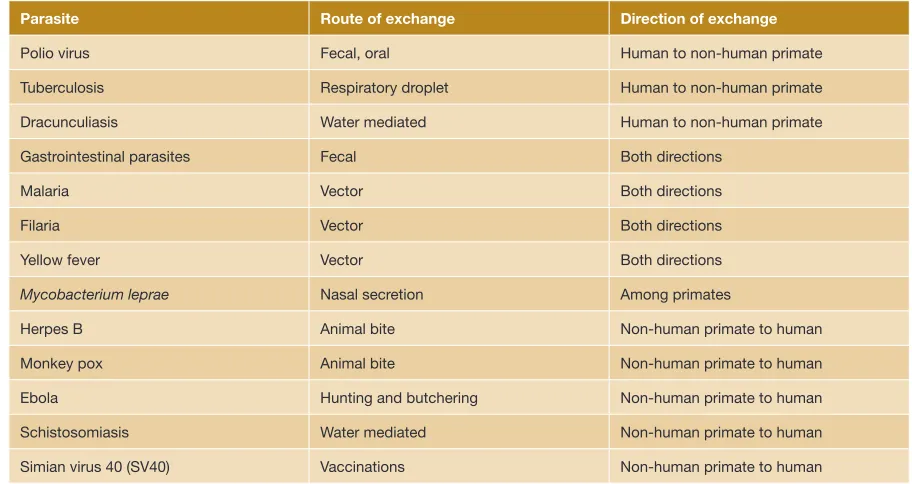
another and with people. This increased proximity may have significant negative implications for the health of both apes and humans, given the possibility of zoonotic and anthropozoonotic disease transmission between them (e.g. Homsy, 1999; Hahn et al., 2000; Woodford, Butynski, and Karesh, 2002; Rouquet et al., 2005; Leendertz et al., 2006; Goldberg et al., 2007; Gillespie and Chapman, 2008; Köndgen et al., 2008; Locatelli and Peeters, 2012). The close genetic relatedness between humans and non-human primates (in particular, great apes) facilitates the cross-species spread of pathogens. Outbreaks of human diseases can potentially affect ape populations, as the latter have not developed antibodies to even the more common human pathogens (Homsy, 1999). Thus, a variety of human viruses and bacteria, including influenza, adenovirus, rhinovirus, respiratory syncytial virus, pneumococcal pneumonia, herpes viruses, measles, polioviruses, Shigella, and gastrointestinal parasites may cause severe infection in apes (Morgan and Sanz, 2007). At the same time zoonotic diseases may pose a threat to people who live and work in the forest, and ape populations may be more exposed and/or vulnerable to infections passed between them (Table 7.1).
extractive industries continue to reach into more remote habitats and ape populations are forced into closer human proximity, we take a step towards the level of duration and intimacy of contact that resulted in the trans-mission of “new” pathogens to the Nahua.
Anthropogenic habitats are also associ-ated with an increase in the prevalence of gastrointestinal parasites (Gillespie, Chapman, and Greiner, 2005; Gillespie and Chapman, 2006, 2008). Parasitic infection from humans to wildlife, and vice versa, may occur when apes range into forests that have become logging or mining con-cessions, which were formerly part of their home range, and where there is inadequate sanitation and sewage disposal. In areas where local human populations consume foods also preferred by apes, not only are they competing over resources, but parasite cross-contamination from feces can occur, especially during peak fruiting periods where both humans and apes coincide at
these resources. Feces contain micro- and macro-parasites that are generally more resistant to environmental degradation com-pared to viruses. Moreover, apes and people are not only vulnerable to infections through close contact, some, particularly gastroin-testinal parasites, survive in water and may be water-borne and transported into ape habitats and villages via streams and rivers (Ryan and Walsh, 2011).
The Ebola virus, probably the best-known pathogen to recently threaten African apes, was first identified in 1976 and since then has killed hundreds of people. The Zaire Ebola strain has also killed around 30% of the world’s gorilla population and almost the same number of the world’s chimpanzees (Ryan and Walsh, 2011). In the Minkébé region of northeastern Gabon, for example, lowland gorilla and chimpanzee populations almost disappeared during the Ebola outbreaks of 1994 and 1996 (Chapman et al., 2005). Morvan et al. (1999,
TAblE 7.1
Parasites exchanged between humans and apes: the route and direction of exchange
Parasite Route of exchange Direction of exchange
Polio virus Fecal, oral Human to nonhuman primate
Tuberculosis Respiratory droplet Human to nonhuman primate
Dracunculiasis Water mediated Human to nonhuman primate
Gastrointestinal parasites Fecal Both directions
Malaria Vector Both directions
Filaria Vector Both directions
Yellow fever Vector Both directions
Mycobacterium leprae Nasal secretion Among primates
Herpes B Animal bite Nonhuman primate to human
Monkey pox Animal bite Nonhuman primate to human
Ebola Hunting and butchering Nonhuman primate to human
Schistosomiasis Water mediated Nonhuman primate to human
Simian virus 40 (SV40) Vaccinations Nonhuman primate to human
in Chapman et al., 2005) found that Ebola is more common at the periphery and in fragments than in deep forest. As forests become increasingly fragmented owing to human activities, more outbreaks are likely, which may significantly impact both human and ape populations.
Disease results in higher mortality levels in wild animal populations, which has an equivalent impact on the populations’ time to recovery. Population resilience in apes is particularly affected by unnatural population losses as these species are slow to mature and have low breeding rates. The combina-tion of infectious disease and unsustainable hunting, both leading to higher levels of mortality in apes, could have significant consequences for the viability of these spe-cies (Walsh et al., 2003; Walsh, 2006).
Ways to prevent or reduce
indirect impacts
Management practices and
corporate policies
All great ape populations are at risk, and threats to the remaining populations from logging, and mineral and hydrocarbon exploitation become an even more danger-ous mix, which will jeopardize the long-term survival of apes throughout the world. To mitigate these threats, a number of businesses are working with governments, nongovern-mental organizations (NGOs), planners, and field scientists to explore management prac-tices that attempt to first avoid and minimize adverse consequences, and then compensate for any residual impacts. The ultimate goal of any mitigation process for great apes and other threatened species is to produce a net positive gain by bringing more exploited areas under enhanced conservation man-agement and contributing to protected area networks and their management.
We have discussed in earlier chapters how management practices, such as Envi-ron mental and Social Impact Assessments (ESIAs), Strategic Environmental Assess-ments (SEAs), spatial planning, and the mitigation hierarchy can become best practice to managing biodiversity risk. The principle here is to avoid and minimize adverse impacts from the start of operations. Compensation should also be contemplated as a means of restitution for any residual impacts using biodiversity offsets (see Guinea case study in Chapter 8) and direct pay-ments. More proactively, some companies have already committed to stand out as lead-ers in best practice, enhancing their local, national, and international public reputation through visible corporate social responsi-bility practices.
box 7.1
Pallisco-CIFM: Responsible Management of Wildlife Policy extract*
Recognizing that industrial logging operations have an impact on wildlife in production forests, noting that, because of their large surface areas, forest concessions play an important role in preserving forest ecosystems, and adhering to the principle of sustainable management of forest resources for the ben efit of future generations, the societies of Pallisco and CIFM make a public commitment to responsibly manage the wild life of the forest that has been allocated to them. Therefore, Pallisco and CIFM will:
Implement a set of actions for wildlife upheld in a manage ment plan for which the human, logistical, and financial resources are made available.
Adopt a system of adaptive management based on com prehensive knowledge of animal populations and the risks they face. This knowledge is acquired through periodic monitoring of the effects of logging on wildlife and con tinuous collection of information about wildlife threats. Reduce the direct impact on biodiversity resulting from
their presence and activities. This involves, in particular, implementing rules prohibiting the involvement of the employees of Pallisco and CIFM in the trade in bushmeat and poaching of protected species. Access to alternative sources of quality protein, in sufficient quantity, for their workers is ensured through commissaries and canteens. Techniques for reducedimpact logging are applied in forest operations and particular care is given to the potential effects of these on wildlife and habitat quality in order to minimize negative impacts.
Minimize the indirect effects of logging on wildlife. Poaching of protected animals is not tolerated in the timber concession. Pallisco and CIFM will address this by systematically exposing any illegal activities to Justice Camerounaise, and through effective implementation of laws protecting wildlife. However, the rights of local communities in the concession are fully respected. The access of motorized vehicles in the concession is limited to the vehicles of Pallisco, CIFM, and their collaborators. Contribute to the efforts of local, national, and global
wildlife conservation and position themselves as stake holders in the various initiatives to this end. Therefore,
the recommendations of experts for the preservation of biodiversity are applied following approval by Pallisco CIFM and, in general, the requirements for management of protected areas adjacent to the concession are met.
Pallisco Adaptive Wildlife Management Plan*
The management plan used by Pallisco is based on the model developed by ZSL under WWP and includes specific goals, objectives, and indicators, such as:
Goal: To ensure that Pallisco’s forestry operations conserve biological diversity and its associated values, in line with FSC principles (for more information on FSC principles, see Chapter 4).
Based on an analysis of the context of Pallisco’s forestry operations and baseline data, objectives are agreed that help meet the goal. An example of how the plan links moni toring and management to these objectives is given below.
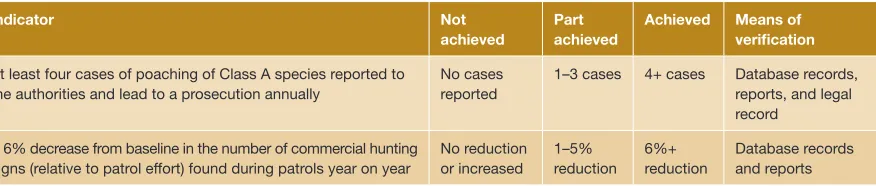
Objective 4. A significant decrease evidenced in commercial hunting and poaching of elephants, great apes and other class “A” protected species within the concessions.
Management activities are detailed in the plan (with method ologies where appropriate) that contribute to meet this objec tive including: preventive action (controlling access to the concessions, closing secondary roads, education, etc.); affirmative action (providing cheap, good quality sources of alternative protein for workers, providing employment for local community members, etc.); and enforcement (patrols, joint operations with the Ministry of Forestry and Wildlife (MINFOF), supporting prosecutions, etc.).
A suite of complementary indicators is established to meas ure progress towards meeting the objective and assess the efficacy of management actions. Implementation indicators such as verifying the establishment and maintenance of road blocks confirm that actions have been taken as planned, whilst performance indicators link management perform ance to outcomes (Table 7.2).
These management performance indicators are matched with biological indicators tracking population trends in the suite of ten Class “A” protected species found within the concessions. Together these provide a quantitative measure of the levels of illegal activity and status of the target species linked to management performance in meeting the objective. * Pallisco and CIFM, 2013. Courtesy of Pallisco and CIFM.
TAblE 7.2
Management performance indicators
Indicator Not
achieved
Part achieved
Achieved Means of verification
At least four cases of poaching of Class A species reported to the authorities and lead to a prosecution annually
No cases reported
1–3 cases 4+ cases Database records, reports, and legal record
A 6% decrease from baseline in the number of commercial hunting signs (relative to patrol effort) found during patrols year on year
No reduction or increased
1–5% reduction
6%+ reduction
and beyond the legal or certification require-ments to which the company can be held accountable. There is no doubt that this rep-resents a replicable model of how a company can signal its commitment to wildlife conser-vation and sustainable development, while responsibly exploiting a natural resource.
Although hunting has been the indirect impact that has received the most atten-tion, it is crucial to understand the different impacts that affect ape populations. As shown above, apes may also be susceptible to many human pathogens as a result of increased human presence and disturbance in ape habitats. Concurrently, humans are vulner-able to pathogens carried by apes and other animals. It is essential therefore that part of the operation policies and practice of extractive industries is to ensure employees
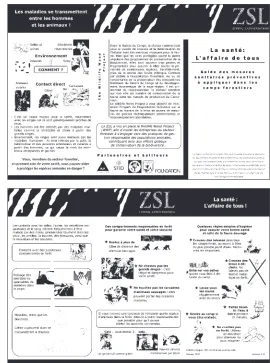
are aware of and implement safe hygiene measures. These are often simple and easily carried out measures related to washing, dis-posal of waste, and avoiding contact with dead animals. This is another example of where an NGO partner can provide support to implement improved management on the ground. The WWP, working with its partners, developed protocols for “best forest prac-tice” containing information on the poten-tial risks of disease transmission between wildlife and humans, and good sanitation and hygiene for those who spend long periods of time in forest camps. The protocol “10 Basic Rules to Avoid Zoonotic Disease Transmissions in Forest Camps” was pro-duced in the form of leaflets distributed to logging staff and local communities as part of an outreach campaign (Figure 7.1).
Photo:Apes may also be
See also Morgan et al. (2013). Although these tools will be of limited value to some groups such as the Baka, Biaka, Babongo, Efe, and Mbuti hunter-gatherers who spend many months in the forest without soap, pit latrines, and other basic hygiene essentials, it will have value to groups who can access some of the necessities to avoid disease transmission.
The result of the adherence to best prac-tices by extractive industries can stimulate examples of how economic development can proceed without completely sacrificing biodiversity and ecosystem services, which are, after all, the essential “natural capital” of all nations. In Kalimantan Gold’s Kalimantan Surya Kencana (KSK) concession (explora-tion and evalua(explora-tion phase) there is no out-side road access to the site. All materials, goods, and personnel are transported into the concession by helicopter. This mini-mizes the risk of outside incursion by roads. Because movement of workers and trans-port of materials inside the concession is also by helicopter, there is no clearing of forest to build roads for ground transportation (B. Paul, personal communication, 2013).
Although examples of good practices are growing in number, biodiversity mitiga-tion and compensamitiga-tion by extractive indus-tries are still nascent. Moreover, the results are not yet conclusive enough to verify that the practices adopted to mitigate impacts are the most suitable to maintaining viable ape populations. Much more widespread adoption and testing of mitigation measures is essential to ensure the long-term pro-tection of apes. The mitigation of indirect impacts must take into account not just con-cession areas and offset or compensation zones. To be truly effective, any such initia-tive needs to take into account the wider landscape, neighboring industrial and devel-opment projects, and community rights and needs, and to involve all of the relevant stakeholders.
Compliance with national
policies and regulations
Extractive industries are obliged to reduce illegal activities, including hunting, in their concessions but should also contribute to wider efforts to reduce illegal and unsus-tainable hunting. To achieve this involves the implementation of activities at site level, but also actively engaging with other stake-holder groups, such as local communities, NGOs, national authorities, and other extractive industries. It is essential to ensure
FigURE 7.1
WWP leaflet explaining the “10 Basic Rules to Avoid Zoonotic Disease Transmissions in Forest Camps”*
that company employees tasked with stop-ping commercial hunting do not simply burn camps, and stop and arrest marginalized subsistence hunters rather than commer-cial hunters who may be better connected. Mechanisms need to be put in place to ensure that processes do not simply target poorer subsistence hunters over commercial hunters who are known to hunt protected species.
The control of illegal activities in conces-sions requires:
1. prevention of incidents;
2. identification of illegal activities that actually take place; and
3. enforcement of sanctions.
Actions undertaken by some companies include:
Ensuring their own employees are not implicated in the bushmeat trade through developing and enforcing policies that ban them from hunting and trading bushmeat. Where relevant, certification standards also oblige companies to ensure that firearms are not carried on com-pany vehicles. To bolster this, companies provide alternative supplies of reason-ably priced sources of meat and fish for their employees.
Control of entry points to the conces-sion to prevent poachers gaining access. A key activity is erecting and manning barriers at active logging and access roads and carrying out searches of vehicles for bushmeat and firearms. It is important to ensure that the firearms carried by employees manning these entry points are controlled and cannot be used for hunting. These control activi-ties also need to be undertaken whilst acknowledging and exploring how to build on the needs, rights, and knowledge
of local communities. Alongside this, roads that are no longer used are rendered permanently impassable to vehicles. Initiating an illegal activity monitoring
program within their concessions, as detailed in the Pallisco example in Box 7.1. An important aspect of this is that patrol plans are informed by a risk assessment as part of an adaptive approach: respond-ing to findrespond-ings, intelligence, or simply ensuring that patrol activities are not predictable. For more information on WWP, see Chapter 4.
Collaborative actions:
Extractive industries are typically not mandated to arrest or prosecute and therefore must work with the national authorities to ensure that laws are enforced in their concessions and with people whom they employ. For example, in mining concessions access control by a company is sometimes made very difficult by the fact that the company only has the right to exploit the subsurface resource, and does not actually own or hold exclusive land usage rights over the land surface. This means the company is legally unable to stop hunters and poachers from entering the concession. Only the government and/or private land owners have this right. This issue can be partly resolved by granting com-panies specific rights in their concession agreements to “police” their concession area, subject to close cooperation with the law enforcement agencies.
other stakeholders to assist this process. By coordinating with local communi-ties, government agents, and NGOs an effective model for enforcement can be implemented. Well-organized compa-ny monitoring systems complemented by co-managed patrols can engender wide support as well as improve detection of illegal activities. Logistic support can be provided to government agents to enable them to respond effectively to incidents whilst the understanding of legal procedure that some NGOs can provide ensures that cases are properly pursued. Extractive industries can also use their influence to press for the proper process to be followed through. Coordinated efforts between
neigh-boring companies in controlling illegal activities will maximize efficiencies and improve the efficacy of actions such as road barriers and patrolling, as well as sharing information on poaching. Efforts to coordinate these activities should be a priority and could be an area of oppor-tunity for NGO facilitation.
A role that an outside NGO can play, such as the one assumed by ZSL as part of the WWP model, is to facilitate the develop-ment of these systems, linking the various stakeholders and associated protocols for both identifying and responding to illegal activities.
Certification
Market-linked certification systems are becoming commonplace in the logging industry. However, these are still lacking for other extractive industries. There are at least seven certification bodies worldwide, which provide incentives to timber producers to implement more sustainable practices by complying with a designated set of standards.
Certified products command either a market premium or, in other cases, market access. The FSC is the key international certification scheme in the tropics and it is supported by a range of environmental NGOs. FSC standards take the form of ten principles and associated criteria and indicators, developed through a multi-stakeholder proc-ess, that relate to explicit legal, operational, social, and environmental targets that for-est management must meet. These include criteria relating to hunting and forest incursion (see Box 7.2). For more infor-mation on certification and the FSC, go to Chapter 4.
Uptake
of voluntary guidelines
There are a number of voluntary guidelines that have been developed to assist extractive industries and other stakeholders, includ-ing governments, to implement best prac-tice, some of which include guidance on addressing indirect impacts, such as:
box 7.2
FSC criteria and hunting
“FSC Criterion 1.5 Forest management areas should be protected from illegal harvesting, settlement and other unauthorized activities.” (FSC, 2002, p. 4)
Obliging the forest manager to take measures to control illegal activi ties as well as establish systems to detect, document, and report them to the national authorities.
“FSC Criterion 6.2 Safeguards shall exist which protect rare, threat-ened and endangered species and their habitats (e.g. nesting and feeding areas). Conservation zones and protection areas shall be established, appropriate to the scale and intensity of forest manage-ment and the uniqueness of the affected resources. Inappropriate hunting, fishing, trapping and collecting shall be controlled.” (FSC, 2002, p. 6)
International Council on
Mining and Metals
(ICMM, 2006)Good practice guidance for mining and biodiversity
This guidance document developed out of the IUCN–ICMM Dialogue and includes a section on “non-mining related threats to biodiversity,” which identifies the four types of threat (p. 76) as:
“conversion of natural habitat to crop-land, urban areas or other human-dominated ecosystems;
overexploitation or overharvesting of commercially important species; introduction of invasive species,
includ-ing pests and pathogens; and
climate change, pollution and other environmental changes external to the area of interest.”
It also presents recommended practices for limiting impacts on biodiversity (p. 27), which include:
“limiting land clearing by using technol-ogies and mining practices that mini-mize habitat disturbance;
avoiding road building wherever possible by using helicopters or existing tracks – if roads are to be constructed, use existing corridors and build away from steep slopes or waterways;
removing and reclaiming roads and tracks that are no longer needed; and using native vegetation to revegetate land
cleared during exploration.”
Under “mitigation, rehabilitation and enhancement tools,” it is suggested that a way in which companies can address one of the underlying threats to biodiversity is by engaging in alternative livelihoods initiatives
Photo:In Asia, most studies
to substitute for existing unsustainable eco-nomic activities such as overharvesting of biodiversity resources and illegal hunting.
United States Agency for
International Development
(USAID, 2010)Best management practices for orangutan conservation in mining concessions
This document puts forward a number of corporate commitments, one of which is to ensure that orangutans are sensitively man-aged within the concession by consulting with experts, NGOs, and other stakeholder groups (p. 9) to:
“Implement silvicultural and other types of habitat management approaches and techniques to minimize the impact of these activities on areas used by orangutans;
Protect key ecological resources for oran-gutans in both conservation set-asides and habitat corridors; and
Work to prevent hunting of orangutans by company employees, contractors and others.”
International Tropical Timber
Organization (ITTO) and
International Union for the
Conservation of Nature (IUCN)
(ITTO and IUCN, 2009)ITTO/IUCN Guidelines for the conservation and sustainable use of biodiversity in tropical timber production forests
These guidelines advise that a number of the threats to biodiversity in tropical pro-duction forests, such as illegal mining and agriculture, hunting, and the unregulated
exploitation of other forest species, can be detected by patrolling or use of remote sens-ing and that a field presence is essential for their control. Other impacts, such as the introduction of invasive species and disease, can be harder to recognize and their con-trol will likely require specialized support (p. 48). They present priority actions under the various guidelines, which are grouped for the different stakeholders, which include the timber companies:
Provide forest employees with meat and fish that are obtained from sustainable sources.
Banks, credit facilities and multilateral financial institutions:
Take biodiversity conservation values into account in financial analyses of forest-related investments.
Create special credit programs with simplified rules to encourage biodiver-sity conservation in forest management projects.
As well as actions for the authorities, timber companies, conservation NGOs, and other relevant stakeholders to undertake in partnership, such as (p. 56):
Compile information and data on glo-bally, nationally or locally threatened species that are commonly hunted or gathered in forests and make it available in appropriate formats and in local lan-guages and dialects.
Determine the drivers of the bushmeat trade at national and international levels and increase consumer access to domestically raised meat.
IUCN
(Morgan et al., 2013)
Great Apes and FSC: Implementing ‘Ape Friendly’ Practices in Central Africa’s Logging Concessions
These guidelines cover the FSC Certifica-tion System, FSC Principle 6 – environ-mental values and impacts, and identifying and managing risks and threats to environ-mental values, and look at the scientific justification for enforcing health and safety of employees and their families (FSC Prin-ciple 6); subsidized anti-poaching teams; an employee code of conduct (FSC Principles 6 and 7); monitoring threatened species in logging concessions (FSC Principle 8); and the adaptive exploitation and protection of resources important to great apes (FSC Prin-ciple 9). There are three key recommenda-tions presented in the conclusion (p. 31):
“Decrease the risk of ape–human disease transmission in concessions through educational campaigns and by imple-menting worker health programmes and field protocols.
Strengthen law enforcement within concessions and address poaching
through the designation of controlled hunting zones. Fund well-trained and supervised teams of eco-guards and sup-port strict compliance of judiciary laws for those convicted of poaching. Implement the High Conservation
Value (HCV) approach and monitor ape populations in concessions. Refine the High Conservation Value approach through studies of the abundance and distribution of tree species that are impor-tant to apes. Execute standardized sur-veys and establish long-term monitoring of great apes in concessions, preferably in collaboration with conservation biol-ogists or ape experts.”
International Finance Corporation
(IFC, 2009)Projects and People: A Handbook for Addressing Project-Induced In-Migration
Although not specifically aimed at extractive industries, the IFC’s Handbook identifies large extractive industry projects as those best known for serious negative impacts from in-migration.
The Handbook presents:
The business case for addressing project-induced in-migration.
An overview of the issue, including the dynamics of project-induced in-migra-tion and the potential environmental and social impacts, looking in detail at issues of in-migration in relation to ASM, resettlement, indigenous peoples, areas of high biodiversity value, and cultural heritage.
How to assess the probability of project-induced in-migration and the associated risks.
Potential management approaches to reduce in-migration, enhance the posi-tive impacts, and prevent and mitigate the negative impacts.
The development of influx management strategies and how to integrate them into a project.
There are a number of other guidelines (see Chapter 4), checklists, and best prac-tice manuals, both general and specialized, such as IUCN’s guidance on World Heritage Sites and the extractive industries (Turner, 2012), and the sample set in Annex III.
beyond the actual site of extraction, except for the ICMM’s Planning for Integrated Mine Closure: Toolkit (2008). One general recom-mendation, however, is that roads in conces-sions should be blocked once projects have ended, to increase transportation costs and challenges for hunters and poachers.
Key challenges
There are a number of factors that make it difficult to achieve a reduction in indirect impacts of extractive industries on apes and ape habitats. There are also additional fac-tors that have to be taken into account. These include the differing needs and goals of the various stakeholders; communication barriers; lack of inclusion in some guide-lines, and limited uptake of all voluntary guidelines and certification schemes; lack of technical capacity within government ministries, lenders, and industry; econom-ics, a lack of will, and the complex linkages
and extended geographical reach of indirect impacts. The last blurs boundaries of respon-sibility for implementing and facilitating any strategies to reduce them. The main chal-lenges are discussed below.
The question of responsibility
A primary challenge is the question of who is responsible? Direct impacts resulting specifically from project development are normally limited to the exact boundaries of the project area, and will decline and cease at the end of the project’s life. Some of these impacts can be minimized or miti-gated through good management practices. However, indirect impacts may not even be closely associated with project activities. Instead, they can result from the actions and decisions made by people with little or no association with the project, and are simply triggered by the project’s presence. For example, a logging concession, mine, or oil
Photo:ESIAs and spatial
resource development project may result in a dramatic influx of new settlers into a previously sparsely populated area, with only a small portion of the new residents actually working for the extractive company. Most will seek employment through exist-ing or new service sectors, or simply try to benefit from the increased cash flow gener-ated by the company. Deforestation resulting from the development of new settlements and associated agricultural expansion, and increased hunting pressures from subsist-ence or commercial hunting ventures, as discussed above, are examples of indirect impacts that may be out of the immediate control of the extractive company, but are unquestionably a consequence of its presence and driven by it. The cumulative results from such indirect impacts can be far more severe than the direct impacts of project develop-ment and have a greater geographic reach. Although it may be difficult to determine who is responsible for addressing and miti-gating such indirect impacts, they are just as likely to disrupt a project as direct impacts (Energy and Biodiversity Initiative, 2003).
Although most extractive companies undertake ESIAs and spatial planning, as in the XYZ case study on page 152, the plan-ning is generally limited to the boundaries of the mine site and/or the concession area, and, for oil extraction, may include a narrow width of any pipeline transport corridor extending to a coastal port; the mitigation strategies are limited to the concession and, in some cases, distinct areas outside of the concession, such as newly created pro-tected areas. There is no assessment of indirect impacts outside of these areas, or of the cumulative impact of adjacent devel-opment. Separating out the sources and responsibilities for responding to growing indirect impacts would be a highly compli-cated task, possibly with limited results, as apportioning blame does not make for a con-structive environment in which to address
the issues at hand. Effectively addressing the indirect impacts of extractive indus-tries needs an integrated landscape-level collaborative management approach that involves and is facilitated by all stakehold-ers. This is highlighted in the IFC Handbook (2009, pp. V–VI):
Although a project cannot be held wholly responsible for in-migration associated with the broader economic development of the region, the project should assume primary responsibility for project-induced in-migration within the project area of influence. The project should assume responsibility for areas within its direct control and seek the agree-ment, coordination, and collaboration of all stakeholders, including the government, non-governmental organizations, community-based organizations and project-affected com-munities, for management of other areas lying outside of its control.
Traditional communities and
scale of action
Traditional resource use
Traditional forest dwelling communities rely on their natural resources for food, medi-cine, tools, craft materials, and so on. When areas are designated as industry conces-sions or protected areas the local communi-ties are generally excluded from the forests that they may have depended on for genera-tions. Although it is clear that unsustainable commercial and illegal hunting must be addressed it is vital that this is grounded in a good understanding of local forest dependent communities’ reliance on bush-meat, to ensure they are not adversely impacted. Socioeconomic surveys carried out by ZSL to explore bushmeat consumption patterns in communities around two large logging concessions estimated that 20 000 animals were captured per year by all the