The Thirty-Third AAAI Conference on Artificial Intelligence (AAAI-19)
Multi-Order Attentive Ranking Model for Sequential Recommendation
Lu Yu,
1Chuxu Zhang,
2Shangsong Liang,
1,3Xiangliang Zhang
11King Abdullah University of Science and Technology, Thuwal, 23955, SA
2University of Notre Dame, IN 46556, USA
3School of Data and Computer Science, Sun Yat-sen University, China
Email:{lu.yu,xiangliang.zhang}@kaust.edu.sa, [email protected], [email protected]
Abstract
In modern e-commerce, the temporal order behind users’ transactions implies the importance of exploiting the tran-sition dependency among items for better inferring what a user prefers to interact in “near future”. The types of inter-action among items are usually divided into individual-level interaction that can stand out the transition order between a pair of items, or union-level relation between a set of items and single one. However, most of existing work only cap-tures one of them from a single view, especially on mod-eling the individual-level interaction. In this paper, we
pro-pose a Multi-order Attentive Ranking Model (MARank) to
unify both individual- and union-level item interaction into preference inference model from multiple views. The idea is to represent user’s short-term preference by embedding user himself and a set of present items into multi-order fea-tures from intermedia hidden status of a deep neural network. With the help of attention mechanism, we can obtain a uni-fied embedding to keep the individual-level interactions with a linear combination of mapped items’ features. Then, we
feed the aggregated embedding to a designedresidual
neu-ral networkto capture union-level interaction. Thorough
ex-periments are conducted to show the features of MARank
under various component settings. Furthermore
experimen-tal results on several public datasets show thatMARank
sig-nificantly outperforms the state-of-the-art baselines on dif-ferent evaluation metrics. The source code can be found at https://github.com/voladorlu/MARank.
Introduction
Modeling the complicated interactions behind users’ tem-poral preferences over items is very essential for providing personalization service in many domains like e-commerce, social friend suggestion, news/article recommendation, etc. In this work, we focus on exploring users’ sequential behav-ior for predicting next item to visit/buy according to his/her given sequential transaction. One typical example is which book will Mike buy at future timetafter ordering multiple books? To answer this question, the proposed solution needs to account for a balance between general (long-term) and
sequential(short-term) patterns.
As a representative solution, Markov chain based ap-proaches (Chen et al. 2012; Rendle, Freudenthaler, and
Copyright c2019, Association for the Advancement of Artificial
Intelligence (www.aaai.org). All rights reserved.
S1 u
S2 u
S3u S4u S5u S6u
union-level
S1u S2u S3u S4u S5u S6u
individual-level
!"# !$#
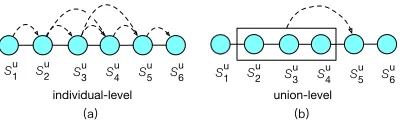
Figure 1: Toy example to illustrate individual- and union-level item relevance model.Sudenotes historical interaction sequence of useru,Su
i represents a specific item.
Schmidt-Thieme 2010; He, Kang, and McAuley 2017; He and McAuley 2016a) shine light on how to extend general user preference by fusingindividual-levelitem-item transi-tion dependency, shown asFigure 1(a), where the arrows indicate the individual-level dependency between a pair of items that don’t need to be adjacent. Given a set of previous interacted items (referred as query items), the dependency of a target item on these query items is usually measured as the average or weighted relevance value. Such individual-level dependencies can result in better recommendations, how-ever have limitations on capturing the collective influence between items. For example, buyingeggs,milk, andbutter
together indicates a higher probability of buyingflourthan
eggs,milkorbutterindividually.
To tackle this limitation, Tang et al. (Tang and Wang 2018) introduce to model union-level influence shown as Figure 1(b), which can be measured with the support-confidence for rule X → Y of the form
(xt−L,· · ·, xt−2, xt−1) → xt. Such a rule can reflect that purchase decisions are made based on what collocational products have already been ordered. However, from the evi-dences as shown in (Tang and Wang 2018), there is a serious sparsity problem asLincreases. That is, union-level item-item relation is difficult to model, especially in sparse data. Note that modeling individual-level relationship has no such a problem since only a single pair of items are involved. Despite the success of recent advances on applying
recur-rent neural network(RNN) orconvolutional neural network
recom-mendation. Therefore, we argue that individual- or union-level influence can be complementary to tackle users’ tem-poral preference learning problem. As we discussed in previ-ous paragraph, pairwise item interaction can be more easily extracted than union-to-single item interaction. In particular, it’s more important to utilize individual influence between query and target item when the large length of association rule is not well supported in sparse data.
In this paper, we propose tounify individual- and union-levelitem dependency into a Multi-order Attentive Ranking model (MARank) towards top-N sequential recommenda-tion. Modeling union-level influence can be conceptually understood by estimating the probability of associate rule
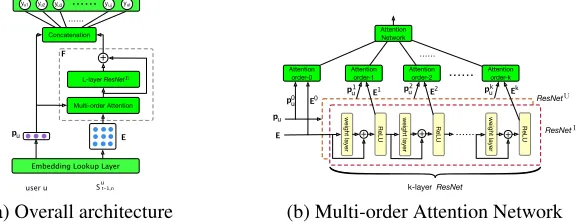
X → Y, which could be measured by the matching score between a distributional representation of an item setXand single item Y. In this work, we design a model with the com-bination of attention network and residual network to repre-sent item setX. The abstractive framework is described in
Figure 2. To better understand users’ short-term preference over items, we design a multi-order attention network to highlight the contribution of the encoded sequential items’ multi-order features from the intermedia hidden status of a feedforward residual neural network. The idea is inspired by the method to understand an image with features extracted from low to high layer, which act as object representation from different views. Then, we feed the aggregated embed-ding from the attention network as the input to a multilayer perceptron (MLP) with residual structure (encoded
union-level features), and simultaneously construct a shortcut
con-nection from input vector to the output of MLP layer. To
keepweighted individual-level features, an element-wise
ad-dition operation is applied on the output from multi-order attention network and MLP layer, then the obtained aggre-gated contextual embedding can be used to capture item-item relation from both individual- and union-level. From experimental analysis on three large-scale real datasets, we can see that the designed structure works very well to outper-form the state-of-the-art baselines. The main contributions of this paper can be summarized as:
- We propose to view user’s short-term preferences over items from multiple perspectives, and design a corre-sponding multi-order attentive neural model to extend user’s general preference by fusing both individual- and union-level temporal item-item correlations.
- The proposed attention model can learn the contribution of encoded features of sequential items from different or-der, which keeps the individual-level item-item interac-tion by augmenting the contribuinterac-tion of relevant items, but downplays the irrelevant ones. MLP encoder with resid-ual structure can help to learn high-order sequential de-pendency among items from union-level perspective.
- We conduct thorough experiments on studying the im-pacts of different components on the performance of MARank, and show that it outperforms state-of-the-art baselines in terms of different ranking metrics.
Related Work
Recommendation without Temporal Dynamics: Item rec-ommendation has become an integrated, even leading function in enormous applications involved with prod-ucts suggestion, hunting excellent musicians, etc. Early works mainly focus on optimizing rating estimation through neighborhood (Linden, Smith, and York 2003) and model based (Koren, Bell, and Volinsky 2009; Salakhutdinov, Mnih, and Hinton 2007) collaborative filtering approaches. Differently hitting users’ interests by a short ranking list as much as possible focuses on relative predicted score, other than exact estimation error.
To express the above-mentioned idea, many factorization models are proposed, ranging from point-wise (Hu, Koren, and Volinsky 2008; He et al. 2016), pairwise (Rendle et al. 2009; Yu et al. 2018), to list-wise (Shi, Larson, and Han-jalic 2010; Shi et al. 2012) ranking methods. Along with re-cent advances on designing deep neural networks (DNNs) for computer vision, text mining etc., Wuet al. (Wu et al. 2016) indicated out that factorization models can be repre-sented as a shallow neural network, which makes factoriza-tion models very flexible in incorporating encoded auxiliary information by DNNs. Heet al.(He et al. 2017) focused on capturing highly nonlinear interactions between a user-item pair by unifying factorization models with a multiple per-ceptron layers.
Next-item Prediction: Temporal dynamics (Tavakol and Brefeld 2014) in recommendation tasks have been demon-strated very effectively in personalized item prediction. In a seminal work for modeling temporal dynamics, Koren (Ko-ren 2009) explored temporal drifting user prefe(Ko-rences over items for rating estimation problem. Subsequently several works (Cheng et al. 2013; Yin et al. 2014) are inspired to care about temporal drift effect. However, most of them make use of explicit timestamp difference, and ignore an important fact that users prefer visiting related items in a short period. Chenet al.(Chen et al. 2012) utilized Markov chains to explore the transition probability among items via predicting next purchase depending on last actions. Such an idea can reflect users’ short-term preferences, however, personalization means beyond that. To better model tem-poral dynamics, several recent works like FPMC (Rendle, Freudenthaler, and Schmidt-Thieme 2010), HRM (Wang et al. 2015), TranRec (He, Kang, and McAuley 2017), Fos-sil (He and McAuley 2016b), combine users’ general (long-term) tastes with Markov chains (short-(long-term) based on fac-torization methods. Despite the success of them, it may not be sufficient to capture complicated interactions of user’s dynamic transition behaviors via the choice ofshallow
rel-evance metricslike inner-product (e.g., FPMC, HRM,
missing the sequential dependency among items.
Proposed Method
Let U andI represent the user and item set, respectively. The whole transaction data can be described asS ={Su :
u∈ U}. Each useru ∈U is associated with a transaction sequenceSu = (Su
1, S2u, ..., S|uSu|), whereStu ∈ Idenotes
a useruever interacted with an item at a specific time point. Note that we only care about the relative orders like first, second and so on, but ignore the absolute time point like 1st May, 2018. Sequential recommendation aims at predicting the next item that a user will be interested in with a given his-torical transaction sequence. Usually, only a very short list of items will be exposed to users. Therefore, hitting users’ requirement in a top-N recommendations is a non-trivial se-quential prediction problem.
Modeling Long-term User Preference
Understanding the interactions between users and items is the key to provide successful personalization service. Fac-torization model has gained lots of attention, where prox-imity between a user u and itemj can be measured as an inner-product of their embeddings:
ˆ
yu,j=pTuqj, (1)
wherepu ∈ Rd andqj ∈ Rd denote a distributional rep-resentation of user u and item j, respectively. The larger prediction yˆu,j is, the more likely that user u will act on itemjin future. However, such definition of user-item rele-vance only captures long-term preference, while discards an important fact that human behaviors naturally come along with temporal dependencies. In next section, we will dis-cuss how to augment long-term user interests by unifying both individual- and union-level item-item dependency.
Multi-order Attentive Ranking Model
The proposed model aims to express user interests over items by decomposing user’s consuming behavior into long-term and short-long-term motivations. In previous section, we already show how to capture long-term preference by ex-plicitly measuring user-item similarity with general embed-ding. In this part, we will discuss how to extend general user’s embedding with short-term interests over a small set of the mostn present items, which can be denoted as
Su
t−1,n = (Stu−1, Stu−2, ..., Stu−n). Analogous to the
objec-tive scoring function of FPMC (Rendle, Freudenthaler, and Schmidt-Thieme 2010), we formulate the MARank’s pre-dictive model as:
ˆ
yu,j=puq
T
j +F(u, S u t−1,n)m
T
j (2)
where mj ∈ Rd denotes additional item embedding to
model item-item transition dependency, and F(u, Stu−1,n)
represents the designed multi-order attentive neural model, including the components embedding lookup layer,
multi-order attention network, andresidual network(ResNet), as
shown inFigure 2(a).
Embedding Lookup Layer. The input to the neural en-coderF(u, Stu−1,n)contains two parts: a useru, and a subset
Stu−1,nincluding the most recentnitems before time pointt. The embedding lookup operation retrieves previousnitems’ embeddings, and stacked them together resulting in a matrix
E∈Rn×d:
E=
mSu t−1 mSu
t−2
.. .
mSu t−n
. (3)
Along with item embeddings, we also obtain the user em-bedding pu ∈ Rd to represent general user latent feature.
These embeddings are presented by corresponding symbols of the output of embedding lookup layer in theFigure 2(a).
Residual Network (ResNet). From theFigure 2we can see
that ResNet plays a key role on learning high-order
non-linear interactions among different elements of input vec-tors. We initialize residual network with a fully connected multilayer perceptron (MLP) but not CNN, considering the explored problem does not have nature spatial patterns like images. The definition ofL-layerResNet(L,x) is as follows:
h1=ReLU(xW1+b1+x)
h2=ReLU(h1W2+b2+h1)
· · · ·
hL=ReLU(hL−1WL+bL+hL−1)
(4)
where WL ∈ Rd×d,bL ∈ Rd represent weight matrix,
and bias vector, respectively. ReLU stands for the activa-tion funcactiva-tion rectifier linear unit. The hyper-parameter L
denotes the maximum number of residual layers. The out-put ofL-layerResNetcontains two parts that are a sequence of hidden statusHL={h1,· · · ,hL}and the last hidden unit
hL. In MARank, we instantiate three different residual net-works,i.e.ResN etI, ResN etU andResN etE. To capture complicated personal characteristics, we propose to map raw user and item embeddings into high-order features with the help of multilayer ResN etU and ResN etI, respectively. The idea is inspired by representing vision object with low-to-high level features extracted by deep neural networks. Analogously the sequence of hidden status fromResN etU
orResN etI might capture potential high-order interactions
between partial fields in user or item embedding, which can help us to discriminate the significance of items in different levels with respect to a given user.
Multi-order Attention Network. With the input embed-dingspuandE, the multi-order attention network is instanti-ated with twok-layer residual network,i.e.ResN etU(k,p
u)
and ResN etI(k,E), as shown in Figure 2(b). Since
ResN etU shares the same structure as ResN etI in
Fig-ure 2(b), we only present the feature transformation pro-cess of ResN etI. Let HUk = {p1u,· · ·,p
k
u} and H I
k =
{E1,· · ·,Ek}denote the output sequence of hidden statuses
ofResN etU andResN etI, respectively. In order to
distin-guish the sources of hidden statuses, we usepk uandE
k to represent the high-order features generated atk-th layer of
ResN etU and ResN etI. Besides the high-order features,
E
u
F
pu
Multi-order Attention
Embedding Lookup Layer
user u St-1,n L-layer ResNet
+
Concatenation …… yu1 yu2 yu3 yuj yuI
……
pu
E
Attention order-0 Attentionorder-1
weight layer
+ ReLU
weight layer
ReLU
+
Attention
order-2 …… Attentionorder-k
……
weight layer
ReLU
+
Attention Network
……
k-layer ResNet puk
pu0 E0
pu1
E1 pu2
E2 Ek
ResNet ResNet
(a) Overall architecture (b) Multi-order Attention Network
Figure 2: (a) Overall architecture of the proposed model MARank.puandEdenotes the retrieved user embedding and em-beddings for prior items inSu
t−1,n, respectively. (b) Illustration of the multi-order attention network. As residual network for encoding user and items share the same architecture, we only elaborate the specific structure ofResN etI.
set of encoded features,i.e.HUk ={pl
u|l ∈ {0,1,· · ·, k}},
HIk={El|l∈ {0,1,· · ·, k}}, wherep0
u=puandE
0=E.
To aggregate the embeddings of sequential items, we uti-lize a soft attention method. When the high-order features
HUk andHIkfor both input useruand all sequential items are ready, we can apply the following attentive model to gener-ate an integrgener-ated contextual embeddingel
c∈Rdatl-layer:
elc=
n X i=1
αlui·mlSu
t−i;
n X i=1
αlui= 1 (5)
where weight scaleαluiis normalized by a softmax layer on the attention scores when given the embedding of useruand the sequential itemSu
t−i, andmlSu
t−iis the correspondingi-th
row of transformed matrixEl. In this work, we use a two-layer network to compute the attention score as follows:
αui=Wa1g(p
l uW
a u+m
l Su
t−iW
a
i +c2) +c1
αui=
exp(αui)
Pn
i=1exp(αui)
,
whereWa∗are the shared weight matrices for attention layer.
g(x)is activation function and we usetanhactivation unit in this work. LetEb = {elc|l ∈ {0,· · · , k}}represent the set of aggregated high-order features depending the interac-tions with given user’s features. Based onEb, we have many methods to obtain the finalcontextual embedding to repre-sent user’s short-term interests with the most recentnitems. For example, we can employ multiple self-attention blocks
Transformer(Vaswani et al. 2017) to get much more
com-plicated feature interactions, or directly apply RNN. Though they can provide flexibility to model rich interactions, in this work, we prefer to using a simple soft attention network. The reason is very straightforward that wrapping a attention layer outsideEbcan help to keepindividual-levelitem-item simi-larity. Specifically, we define the soft attention as follows:
ec=Sof tAtt(E) =b βEb
β=sof tmax(Wb1g(EWb b2+batt2 ) +batt1 )
(6)
whereWb∗ acts as the weight matrices for attention layer, andβ ∈ Rk+1 is the attention weight vector. We can see
that the output of multi-order attention network actually is linear combination of the high-order features insideHIk, that isec=Pkl=0Pni=1βl·αluimlSu
t−i. If we defineF(u, S
u t−1,n) in Equation (2) asec, then second termF(u, Stu−1,n)mTj = Pk
l=0
Pn
i=1βl·αluimlSu t−im
T
j equals to weighted sum of rel-evance value of item pairs, that is, individual-level item-item interaction is captured. In order to modelunion-level
item dependency, we instantiate L-layer residual network
ResN etE(L,e
c) and use the last hidden status hL as the encoded feature to represent the set of short-tern interacted items by the given useru. Then we have the final definition
F(u, Su
t−1,n) = ec+hL, and the full definition of the pre-diction value for each item as:
ˆ
yu,j= puq
T j | {z } long−term
+
Individual−level z }| {
ecmTj +
U nion−level z }| {
hLmTj
| {z }
short−term
(7)
Ranking Optimization: To effectively learn the parameters of the proposed MARank model, we define a pairwise rank-ing loss based on the assumption that an item (positive sam-ple) this user liked will have a relative larger value than other items (negative samples) that he/she has no interest in. The loss function is formulated as:
arg min
Θ
X u∈U
X j∈Su
X s /∈Su
−lnσ(ˆyu,j,z)
+λ
2(
X u∈U
||pu||2
F + X j∈I
||mj||2F+||qj||
2
F), (8)
where|| · ||F denotesFrobeniusnorm, andyˆu,j,z = ˆyu,j−
ˆ
yu,z. Itemjis an item liked by useru, in contrast withzthat s/he shows no interest. Functionσ(x) = 1
1+exp(−x)denotes
the probability that a learned model gives a larger score to a positive sample than a negative one.λis a hyper-parameter forL2norm regularization on model parameters.
transaction sequenceSuat time pointtalong with the most
n recent itemsSu
t−1,n. Negative items /∈ Su will be uni-formly sampled. In this work, we use Adam optimizer to optimize the proposed model. Since each training sample
(u, j, z, Su
t−1,n)can be constructed independently, we can apply mini-batch SGD to speed up the training efficiency.
Discussion
Temporal Order: One may argue that temporal order is very important for sequential recommendation, in contrast, attention network over items ignores the order. Generally we canset sizenas small as possible to present user’s short-term demands, based on the assumption that user’s attention in a small session window will display his/her target motiva-tions or demands at that moment. Different from previous works highlighting the temporal orders of observed interac-tions, we argue that temporal order is not a must constraint because user usually tend to hover between different items in a small session (like the skip behavior modeled in (Tang and Wang 2018)). The anchor items that drive user to make final decision might not be the closest one, but those viewed before. The experimental evaluations further support this ar-gument, as we will show later. In MARank, we divide user’s consuming behavior into long-term and short-term patterns. The long-term preference can store user’s general tastes hid-den in the whole transaction history, which make it possible to represent short-term preference only with a set of small size of prior interacted items.
Markov Chain (MC): We find that MARank can be viewed as a generalization of classical MC-based models. Rendle
et al. introduced Factorized Personalized Markov Chains
(FPMC) based on the observation that users could con-tinuously review two closely related items. The proposed method MARank can be reduced to FPMC by keeping only individual-level contextual embedding and replacing the multi-order attention network with an average pooling operation. Different from FPMC, MARank can automati-cally weight the contribution of items through matching the relation between user and items.
Experimental Evaluation
In this section, we present our experimental results, with comparison to different kinds of baseline methods to answer the following research questions:
RQ1: Can our proposed method outperform the state-of-the-art baselines for sequential recommendation task?
RQ2: How does data sparsity influence MARank?
RQ3: How MARank is affected by each component?
Evaluation Protocol
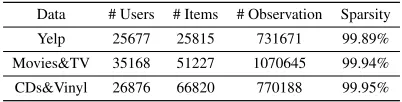
To validate the proposed method MARank for top-N se-quential recommendation, we use three publicly available datasets, Yelp1and Amazon2, with statistics information in
Table 1after pre-processing. Amazon data (He, Kang, and McAuley 2017) contains product purchase history ranging
1
https://www.yelp.com/dataset/challenge 2
https://www.amazon.com/
Table 1: Statistical information of datasets.
Data # Users # Items # Observation Sparsity
Yelp 25677 25815 731671 99.89%
Movies&TV 35168 51227 1070645 99.94%
CDs&Vinyl 26876 66820 770188 99.95%
from May 1996 - July 2014. We mainly conduct experiments on two subsets,Movies&TVcomposing user review actions on both movie and tv, andCDs&Vinylfor actions on CDs and vinyl record. As the original datasets are too sparse, we fil-ter out inactive users with fewer than 10 feedbacks. For each dataset, we convert star-rating into binary feedback regard-less of the specific rating values since we care more about the applications without explicit user feedbacks like ratings, following the evaluation in (He, Kang, and McAuley 2017; He et al. 2016). We utilize a widely used evaluation setting,
fold-out(Tang and Wang 2018; Chen et al. 2018) that is, a
number of latest interactions of each user are hold-out as test set and the remaining data is for training. Without special de-scription, we use last 20% of each user’s feedbacks as test set. Several types of state-of-the-art baselines are taken into consideration, including BPR-MF (Rendle et al. 2009),
FPMC(Rendle, Freudenthaler, and Schmidt-Thieme 2010),
TranRec (He, Kang, and McAuley 2017),GRU4Rec (Hi-dasi et al. 2016), NARM (Li et al. 2017), ACF (Chen et al. 2017), Caser (Tang and Wang 2018). We eval-uate all of algorithms at the following top-N ranking metrics: Precision@N and Recall@N (Karypis 2001),
NDCG@N (Weimer et al. 2007) and MRR@N (Shi et al. 2012; Yu et al. 2014). We implement TranRec 3,
GRU4Rec4,Caser5with the code given by the authors.
Evaluation Setup : We use grid search to se-lect the best parameter setting for different al-gorithms. These include embedding size d from {8,16,32,64}, regularization hyper-parameter λ from {0.05,0.01,0.005,0.001,0.0005,0.0001}. Since Adam is employed to optimize all the algorithms except Tran-Rec, we use Adam’s suggested default learning ratio
i.e., 0.001. Learning ratio for TranRec is selected from
{0.1,0.05,0.01,0.005}. Besides the commonly shared hyper-parameters, some algorithms have their own special setting. For FPMC, we set the length of Markov chain to one. We also tried other choices, however, the performance does not improve much. Without special mention, we fix the length N of ranked list as 20. The model is trained in Tensorflow on a GeForce GTX 1080Ti GPU.
Reproductivity: We study MARank with different number of previous items from{2,4,6,8,10}, whilen= 6gives the best results. We also try different number of hidden layersL
orkfrom{0,2,4,8}. From the experimental results, we find that 2 or 4 layers are enough to ensure competitive results. The dropout ratio and gradient clipping norm is set to 0.5
3https://sites.google.com/a/eng.ucsd.edu/ruining-he/
4
https://github.com/hidasib/GRU4Rec 5
Table 2: Ranking performance comparison (the best results of baseline are marked as * along with underline). The last row shows the improvement of MARank over the best baseline algorithm.
Methods Yelp Movies&Tv CDs&Vinyl
Measures@20 Rec Pre NDCG MRR Rec Pre NDCG MRR Rec Pre NDCG MRR
BPR-MF 0.0618 0.0156 0.0382 0.0132 0.0404 0.0095 0.0248 0.0089 0.0512 0.0121 0.0323 0.0119
GRU4Rec 0.0586 0.0151 0.0373 0.0131 0.0372 0.0098 0.0235 0.0081 0.0358 0.0093 0.023 0.0082
NARM 0.0616 0.0159 0.0401 0.0145 0.0429 0.0111 0.0273 0.0096 0.0426 0.0108 0.028 0.0104
GRU4Rec+ 0.0699 0.0179 0.0456 0.0166 0.0526 0.0138 0.0344 0.0124 0.0527 0.0138 0.0352 0.0129
NARM+ *0.0718 *0.0183 *0.0465 *0.0169 0.0587 *0.0145 0.0375 0.0136 0.0678 *0.0169 0.0449 0.0169
ACF 0.0661 0.0169 0.0425 0.0153 0.0458 0.0107 0.0286 0.0106 0.0554 0.0133 0.0357 0.0134
Caser 0.0653 0.0161 0.0415 0.0151 0.0494 0.0122 0.0318 0.0116 0.0495 0.0129 0.0346 0.0132
TranRec 0.0703 0.0176 0.0458 0.0169 0.0606 0.0135 0.0392 0.0155 *0.0704 0.0164 *0.0468 *0.0184
FPMC 0.0713 0.0178 0.0463 0.0169 *0.0608 0.0142 *0.0406 *0.0162 0.0646 0.0156 0.0450 0.0179
MARank 0.0791 0.0199 0.0509 0.0183 0.0680 0.0162 0.0444 0.0170 0.0817 0.0201 0.0552 0.0212
Improvement 10.1% 8.7% 9.4% 8.2% 11.8% 11.7% 9.3% 4.9% 16.0% 18.9% 17.8% 15.2%
3 5 10 15 20
N 0.00
0.02 0.04
N
D
C
G
@
N
Movies&TV
3 5 10 15 20
N 0.00
0.02 0.04
N
D
C
G
@
N
Yelp
BPRMF ACF GRU4Rec+ Caser TranRec FPMC NARM+ MARank
3 5 10 15 20
N 0.00
0.02 0.04 0.06
R
ec@
N
Movies&TV
3 5 10 15 20
N 0.000
0.025 0.050 0.075
R
ec@
N
Yelp
BPRMF ACF GRU4Rec+ Caser TranRec FPMC NARM+ MARank
Figure 3: Top-N recommendation evaluation with different values ofNon NDCG and Recall.
and 5, respectively.
Overall Comparison (RQ1)
We begin with evaluating the performances of the proposed MARank and all baselines. Results are shown inTable 2and we have the following observations.
It’s interesting that basic BPR-MF has competitive perfor-mance with RNN based method, GRU4Rec or NARM. Here BPR-MF considers user intrinsic preference over items, while GRU4Rec or NARM only models union-level item interaction. Such results may shine lights on the importance of user’s general taste. To further validate the effectiveness of RNN-based model, we extend GRU4Rec and NARM to GRU4Rec+ and NARM+ via adding general user-item interaction, and find that GRU4Rec+ or NARM+ can im-prove BPR-MF after incorporating item’s temporal depen-dency. Different from GRU4Rec+, NARM+ employs the at-tention network over the sequence of hidden statuses out-put by GRU. Comparing with GRU4Rec+, attention
mech-<10 [10,20) [20,50) [50,100) >=100 Num-of-feedbacks 0.00
0.05 0.10
ND
CG
@
20
Movies&TV
<10 [10,20) [20,50)[50,100) >=100 Num-of-feedbacks 0.000
0.025 0.050 0.075
ND
CG
@
20
Yelp
BPRMF ACF GRU4Rec+ Caser TranRec FPMC NARM+ MARank
<10 [10,20) [20,50)[50,100) >=100 Num-of-feedbacks 0.000
0.025 0.050 0.075
Re
c@
20
Movies&TV
<10 [10,20) [20,50)[50,100) >=100 Num-of-feedbacks 0.000
0.025 0.050 0.075
Re
c@
20
Yelp
BPRMF ACF GRU4Rec+ Caser TranRec FPMC NARM+ MARank
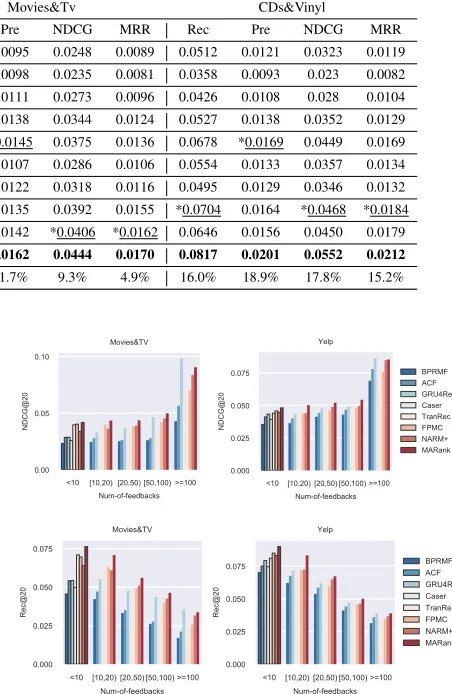
Figure 4: Recommendation evaluation on different user groups, which are separated according to the number of feedbacks.
40 60 80 Ratio of Training Samples 0.045
0.050 0.055 0.060 0.065
NDC
G@2
0
Yelp FPMC TranRec MARank
40 60 80
Ratio of Training Samples 0.039
0.040 0.041 0.042 0.043 0.044
NDC
G@2
0
Movies&TV
FPMC TranRec MARank
40 60 80
Ratio of Training Samples 0.0625
0.0650 0.0675 0.0700 0.0725 0.0750 0.0775
Re
c@2
0
Yelp FPMC TranRec MARank
40 60 80
Ratio of Training Samples 0.040
0.045 0.050 0.055 0.060 0.065
Re
c@2
0
Movies&TV FPMC TranRec MARank
Figure 5: Performance on sparse training set.xaxis stands for the proportion of training samples.
Instead of modeling union-level item interaction, Tran-Rec and FPMC are two state-of-the-art approaches based on individual-level item temporal dependency. Interestingly, both of them outperform the other baselines. This obser-vation suggests that keeping directed interaction between a pair of items is essential for sequential recommendation. Encouragingly, we can find that MARank always has better performance than other baselines. In MARank, both union-and individual-level item interaction are captured under the design of attentive neural network with residual structure. These results indicate that dealing with sequential recom-mendation task has close connection to the fusion of item-item interactions, especially temporal item-item dependency. Be-sides overall evaluation of different algorithms, Figure 3
shows that MARank is stably superior to other baselines with different length of recommendation list.
A Study on Data Sparsity (RQ2)
Performance on Different User Groups In real applica-tions, the number of feedbacks contributed by a user has a large variance. Most of users have a small number of feed-backs, which will raise “cold-start” problem. To gain more insight on the performance of each algorithm, we group users into five classes (i.e.<10, [10,20), [20,50), [50,100),
>=100) based on the number of observed feedbacks. The results are shown inFigure 4. Due to the limited space, we only present evaluation results on Rec@20 and NDCG@20. We find that recall ratio decreases as the growing num-ber of observed feedbacks. Most of the algorithms perform very well on user group with greater than 100 feedbacks, in particular, GRU4Rec+ achieves very high NDCG score on this group. It indicates that RNN-based methods favor long transaction sequence, but not short sequence. The re-sults also demonstrate that MARank can have overall supe-rior performance over different user groups.
Ratio of Training Samples To further validate the capac-ity of dealing with sparse dataset, we evaluate top-2 base-lines (i.e.TranRec, FPMC) and MARank with different
pro-Table 3: Performance with different level of item-item inter-actions. MARank-I or MARank-U represents MARank with only individual- or union-level item-item dependency.
Methods Yelp Movies&TV
Metrics@20 Rec Pre NDCG MRR Rec Pre NDCG MRR
MARank-I 0.0755 0.0185 0.0475 0.0175 0.0635 0.0153 0.0405 0.0158 MARank-U 0.0731 0.0178 0.0456 0.0168 0.0616 0.0148 0.0374 0.0145 MARank 0.0785 0.0195 0.0509 0.0183 0.0680 0.0162 0.0441 0.0170
1 2 4 6 8 10
#of Prior Items 0.0400
0.0425 0.0450 0.0475 0.0500 0.0525 0.0550
NDC
G@2
0
Yelp Movies&TV CDs&Vinyl
1 2 4 6 8 10
#of Prior Items 0.0625
0.0650 0.0675 0.0700 0.0725 0.0750 0.0775 0.0800
Re
c@2
0
Yelp Movies&TV CDs&Vinyl
Figure 6: The impact of Markov chain length.
portion of training samples. The results are shown in Fig-ure 5. We can see that MARank still outperforms baselines in both NDCG@20 and Rec@20 metrics. As increasing the ratio, all of methods achieve better recall score. These ob-servations verify that MARank can cope with data sparsity problem very well.
Analyzing Components of MARank (RQ3)
In this section, we will do ablation study on the impact of number of prior items and the contributions of individual-and union-level item-item dependency. Due to the limited space, we only explore the impact of different level item-item relations and the order of Markov chain, i.e. hyper-parametern. In following experiments, the number of resid-ual layers forResN ets are set to 2.
Individual- or Union-level We study the influence of dif-ferent types of item-item transition dependency. From the experimental results shown in Table 3, we can find that keeping only individual- or union-level can reduce the rec-ommendation performance. Comparing with MARank-U, MARank-I has more stable ranking quality, which might give a hint that individual-level item-item relevance has pos-itive impact on forecasting user’s preference.
Orders of Markov chain From previous analysis, we have demonstrated that modeling the Markov chain pat-tern is very essential for next-item recommendation. Gener-ally, MARank can achieve better and better performance on most of dataset when increasing the number of prior items,
i.e. hyper-parameter n. In this study, we validate different choices of n (from 2 to 10 in our experiments). With re-sults shown inFigure 6,n= 6gives the best performance. Such observation happens, presumably, because sequential pattern does not involve a very long sequence.
Conclusions
with discrete user behavior data, rather than image data. In this paper, we design a multi-order attentive ranking model, MARank, for sequential recommendation by unifying gen-eral and sequential patterns. We conduct extensive experi-ments on multiple large scale datasets and find that MARank significantly outperforms other baselines. In this work, we only model the dynamic user-item interactions. In real appli-cations, sequential prediction usually involves with hetero-geneous information domains. However, exploring temporal evolution of various types of information resources still re-mains to be a big challenge. In future, we’d like to design deep model to capture heterogeneous item relationship.
Acknowledgement
This work was supported by the funding from King Abdul-lah University of Science and Technology (KAUST), under award number FCC/1/1976-24-01.
References
Chen, S.; Moore, J. L.; Turnbull, D.; and Joachims, T. 2012.
Playlist prediction via metric embedding. InKDD’12, 714–722.
Chen, J.; Zhang, H.; He, X.; Nie, L.; Liu, W.; and Chua, T.-S. 2017. Attentive collaborative filtering: Multimedia recommendation with
feature- and item-level attention. InSIGIR’17.
Chen, X.; Xu, H.; Zhang, Y.; Tang, J.; Cao, Y.; Qin, Z.; and Zha, H. 2018. Sequential recommendation with user memory networks. In
WSDM ’18, 108–116.
Cheng, C.; Yang, H.; Lyu, M. R.; and King, I. 2013. Where you like to go next: Successive point-of-interest recommendation. In
IJCAI’13, 2605–2611.
He, R., and McAuley, J. 2016a. Fusing similarity models
with markov chains for sparse sequential recommendation. In
ICDM’16.
He, R., and McAuley, J. 2016b. Fusing similarity models
with markov chains for sparse sequential recommendation. In
ICDM’16, 191–200.
He, X.; Zhang, H.; Kan, M.-Y.; and Chua, T.-S. 2016. Fast matrix factorization for online recommendation with implicit feedback. In
SIGIR’16, 549–558.
He, X.; Liao, L.; Zhang, H.; Nie, L.; Hu, X.; and Chua, T.-S. 2017.
Neural collaborative filtering. InWWW’17, 173–182.
He, R.; Kang, W.-C.; and McAuley, J. 2017. Translation-based
recommendation. InRecSys’17, 161–169.
Hidasi, B.; Karatzoglou, A.; Baltrunas, L.; and Tikk, D. 2016. Session-based recommendations with recurrent neural networks.
arXiv:1511.06939.
Hu, Y.; Koren, Y.; and Volinsky, C. 2008. Collaborative filtering
for implicit feedback datasets. InICDM’08, 263–272.
Karypis, G. 2001. Evaluation of item-based top-n recommendation
algorithms. InCIKM’01, 247–254.
Koren, Y.; Bell, R.; and Volinsky, C. 2009. Matrix factorization
techniques for recommender systems.Computer42(8):30–37.
Koren, Y. 2009. Collaborative filtering with temporal dynamics. InKDD’09, 447–456.
Li, J.; Ren, P.; Chen, Z.; Ren, Z.; Lian, T.; and Ma, J. 2017.
Neu-ral attentive session-based recommendation. InProceedings of the
2017 ACM on Conference on Information and Knowledge Man-agement, CIKM ’17, 1419–1428.
Li, Z.; Zhao, H.; Liu, Q.; Mei, T.; and Cheng, E. 2018. Learning from history and present: Next-item recommendation via
discrimi-natively exploiting user behaviors. InKDD’18.
Linden, G.; Smith, B.; and York, J. 2003. Amazon.com
recommen-dations: Item-to-item collaborative filtering. IEEE Internet
Com-puting7(1):76–80.
Loyola, P.; Liu, C.; and Hirate, Y. 2017. Modeling user session and intent with an attention-based encoder-decoder architecture. In
RecSys’17, 147–151.
Rendle, S.; Freudenthaler, C.; Gantner, Z.; and Schmidt-Thieme, L. 2009. BPR: Bayesian personalized ranking from implicit feedback. InUAI’09, 452–461.
Rendle, S.; Freudenthaler, C.; and Schmidt-Thieme, L. 2010. Fac-torizing personalized markov chains for next-basket
recommenda-tion. InWWW’10, 811–820.
Salakhutdinov, R.; Mnih, A.; and Hinton, G. 2007. Restricted
boltzmann machines for collaborative filtering. InICML’07, 791–
798.
Shi, Y.; Karatzoglou, A.; Baltrunas, L.; Larson, M.; Oliver, N.; and Hanjalic, A. 2012. CLiMF: Learning to maximize reciprocal rank
with collaborative less-is-more filtering. InRecSys’12, 139–146.
Shi, Y.; Larson, M.; and Hanjalic, A. 2010. List-wise learning to
rank with matrix factorization for collaborative filtering. In
Rec-Sys’10, 269–272.
Tang, J., and Wang, K. 2018. Personalized top-n sequential
recom-mendation via convolutional sequence embedding. InWSDM ’18,
565–573.
Tavakol, M., and Brefeld, U. 2014. Factored mdps for detecting
topics of user sessions. InRecSys’14, 33–40.
Vaswani, A.; Shazeer, N.; Parmar, N.; Uszkoreit, J.; Jones, L.; Gomez, A. N.; Kaiser, L.; and Polosukhin, I. 2017. Attention is
all you need.CoRRabs/1706.03762.
Wang, P.; Guo, J.; Lan, Y.; Xu, J.; Wan, S.; and Cheng, X. 2015. Learning hierarchical representation model for nextbasket
recom-mendation. InSIGIR’15, 403–412.
Wang, S.; Hu, L.; Cao, L.; Huang, X.; Lian, D.; and Liu, W. 2018. Attention-based transactional context embedding for next-item rec-ommendation.
Weimer, M.; Karatzoglou, A.; Le, Q. V.; and Smola, A. 2007. COFIRANK maximum margin matrix factorization for
collabora-tive ranking. InNIPS’07, 1593–1600.
Wu, Y.; DuBois, C.; Zheng, A. X.; and Ester, M. 2016. Collabo-rative denoising auto-encoders for top-n recommender systems. In
WSDM’16, 153–162.
Yin, H.; Cui, B.; Chen, L.; Hu, Z.; and Huang, Z. 2014. A temporal context-aware model for user behavior modeling in social media
systems. InSIGMOD’14, 1543–1554.
Yu, X.; Ren, X.; Sun, Y.; Gu, Q.; Sturt, B.; Khandelwal, U.; Norick, B.; and Han, J. 2014. Personalized entity recommendation: A
heterogeneous information network approach. InWSDM ’14, 283–
292.
Yu, F.; Liu, Q.; Wu, S.; Wang, L.; and Tan, T. 2016. A dynamic
recurrent model for next basket recommendation. InSIGIR’16,
729–732.
Yu, L.; Zhang, C.; Liang, S.; and Zhang, X. 2018. Walkranker: A unified pairwise ranking model with multiple relations for item