Parveen et al. World Journal of Pharmaceutical and Life Sciences
PATTERN OF ANTIBIOTIC USE AND THEIR RESISTANCE IN PATIENTS ADMITTED
IN ICU
Rawshon Ara Parveen*1, Morshed Nasir2, Afm Mohibur Rahman3, Tahmina Zahan4,
Mohammad Ashfaqur Rahman5
1,4Assistant Professor, Department of Pharmacology, Holy Family Red Crescent Medical College, Dhaka, Bangladesh. 2,3Professor, Department of Pharmacology, Holy Family Red Crescent Medical College Dhaka, Bangladesh. 5Resident Medical officer, Department of Anesthesiology, ICU and Pain medicine, Holy Family Red Crescent Medical
College, Dhaka, Bangladesh.
Article Received on 14/03/2018 Article Revised on 04/04/2018 Article Accepted on 25/04/2018
INTRODUCTION
Intensive care unit (ICU) patients are more prone to develop infection, because partly, they are admitted in ICU due to infection and partly they are immunosuppressed because of critical illness and the large number of invasive devices used in them So, the total antibiotic consumption is approximately ten times greater in ICU wards than in general hospital wards.[1] Correct and adequate antibiotic coverage is important but the situation is complicated as a result of delayed identification of microorganisms, the impact of critical illness itself, pharmacokinetics and pharmacodynamics process of antibiotics, and the high prevalence of antibiotic-resistant strains.[2]
Besides treatment of infections, antibiotics are administered as prophylaxis to prevent or limit major infections in critically ill patients.[3] Antibiotics use in ICU, the consequences extend beyond unwarranted resource use and increased financial cost of therapy.[4] Antimicrobial use is associated with the selection of
associated with increased morbidity, mortality, cost, and length of stay.[5]
The emergence of antibiotic resistance is highly correlated with inappropriate use of these drugs. Appropriate antibiotic use in ICUs includes not only rapid identification and optimal treatment of bacterial infections in these terminally ill patients, it also improves our ability to avoid administering unnecessary broad-spectrum antibiotics, shortening the duration of their administration, and reduces the numbers of patients who received undue antibiotic therapy. Selection of a better empirical treatment, knowledge about pharmacokinetic-pharmacodynamic characteristics of a antibiotic to optimize its dosing and administration modalities an de-escalation once culture results become available enhances the treatment procedure towards more accuracy. But, improvement of antibiotic use in ICU often difficult due to severity of infection lead to withdrawing or postponing antibiotics, decision-making process frequently complexes due to limited expertise and it is difficult to ensure disease-long continuity of
World Journal of Pharmaceutical and Life Sciences
WJPLS
www.wjpls.org
SJIF Impact Factor: 5.088*Corresponding Author: Rawshon Ara Parveen
Assistant Professor, Department of Pharmacology, Holy Family Red Crescent Medical College, Dhaka, Bangladesh.
[1]
ABSTRACT
Prevalence of antibiotic consumption is high in critically ill patients. Besides of its economic impact, there is a chance of delayed diagnosis, difficulties in identifying causative microorganisms and the constant threat of induction of development of antibiotic resistance worsens the present situation. To analyze antibiotic consumption, antibiotic use was recorded in admitted patients in ICU during six month period by categorizing the indications for antibiotic use in both infectious and non-infectious disease in to two groups; (i) Empirical; (ii) Therapy for a bacteriologically proven infection (BPI). Among 216 patients admitted in ICU in the study period 144 cases are infectious and 72 are non- infectious. Length of stay less than 72 hours in ICU, Most of the patients (n= 133) received empirical antibiotic therapy. Staphylococcus Aureus, Acenetobactor and Pseudomonus are commonly found organism. Ceftriaxone, Meropenem and Levofloxacin were frequently used antibiotics in infectious and non- infectious cause. Antibiotic resistant shows in penicillin and cephalosporin group, whereas imipenem and meropenem were sensitive antibiotics. It may be concluded that monotherapy in non- infectious case was probably the most effective mode to reduce antibiotic use.
care by the same medical team 24 hours a day, 7 days a week.[6]
Several studies shows that 30% to 60% of antibiotics prescribed in ICUs are unnecessary, inappropriate, or suboptimal. Overprescribed and misprescribed antibiotics are undoubtedly contributes to development of antibiotic-resistant bacteria.[8] Prolonged and irrational use of antimicrobials may also increase the risk of toxicity, drug interactions and diarrhea due to
Clostridium difficile.[7] In 2009, EPIC study showed a
point prevalence study performed in 1,265 critical care units evaluated 14,414 patients estimated that over half of the patients in the ICU were infected, more than 70% of them were on antibiotics and 62% of the microbiological isolates were gram negative bacteria.[9] Most patients with sepsis (99%) received antibiotics, and in almost all (93%) the treatment was started empirically, with broad-spectrum antibiotics. ASTs followed the onset of empirical treatment in 93% of cases. De-escalation was carried out in 16 patients, while in 37.6% of cases an antibiotic had to be changed or added. Antibiotic prophylaxis in surgical patients involved widespread use of drug combinations (31% of cases) and lasted 3 days on average. In non-surgical patients antibiotic prophylaxis lasted 4.6 days and in 42% a third-generation cephalosporin was used.[10] Critically ill patients admitted in ICUs are more prone to develop new infections.[1]
Increasing antibiotic resistance potentially threatens the safety and efficacy of these drugs in patients. In a previous study, use of antibiotic divided into two major classes- (i) non- bacteriologically proven infection (non-BPI): all cases of clinical suspicion of infection, with negative or non-significant bacterial culture results, but necessitating antibiotic therapy in view of the clinical condition of the patient; (ii) bacteriologically proven infection (BPI): all cases of clinical suspicion of infection with significant culture results from samples collected from the suspected infection site that were treated with antibiotics.[7] Here in this study, antibiotic use and their resistance in a general ICU ward over a 6 month period were observed. Special emphasis was given to the indications for antibiotic use, which were divided into bacteriologically proven infections and empirical use.
MATERIALS AND METHOD
Holy family Red Crescent medical college hospital is a 400- bed facility. Critically ill medical, surgical, neurological/neurosurgical and trauma patients requiring haemodylaisis monitoring and/or mechanical ventilation were admitted to 9 bed ICU. The ICU is managed by a bunch of stuff from multidisciplinary department (anesthesiology, internal medicine, surgery, neurology, neurosurgery), with daily assistance from the departments of medical microbiology and radiology. During the study period no changes in the medical staff occurred.
From May 2016 to December 2016 all adult patients (age above 16 years), with or without mechanical ventilator, who had been admitted in ICU at least 24 hour were studied prospectively. Patients admitted more than 21 days were excluded from the study.
On the day of admission, demographic data of the individual patients, related information about antibiotics, and advice for antibiotic sensitivity test after admitted in ICU, were collected from ICU treatment sheet. After 5th day of admission in ICU of that particular patient, after collection antibiotic sensitivity test report, specific organism, antibiotic sensitivity and resistant case, antibiotic change based on that report were also recorded in a data collection sheet.
All collected data were analyzed by investigators. The multidisciplinary staffs of the ICU were not informed of the study to prevent bias.
RESULT
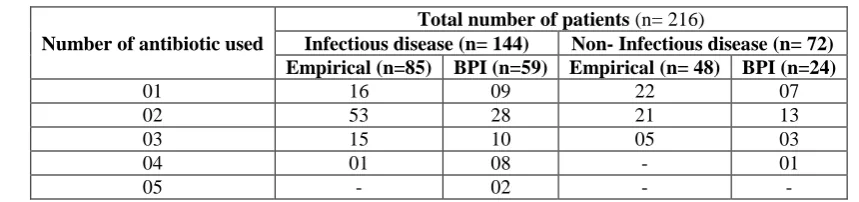
Among 216 patients, 144 cases were admitted with infectious and 72 were non– infectious diseases and all were advised for antibiotic sensitivity test. But reports were found in eighty three (83) cases. After admission in ICU, total 133 patients were treated empirically (without culture/sensitivity reports), and 83 had BPI. Among the patients received empirical therapy, 85 patients were with infection and 48 without infection. 162 patients received combination of antibiotics. Mono therapy was prescribed in 54 patients and one patient received up to five (5) different antibiotics (Table – I).
Table I: Number of antibiotics used per patients.
Number of antibiotic used
Total number of patients (n= 216)
Infectious disease (n= 144) Non- Infectious disease (n= 72)
Empirical (n=85) BPI (n=59) Empirical (n= 48) BPI (n=24)
01 16 09 22 07
02 53 28 21 13
03 15 10 05 03
04 01 08 - 01
22 different groups of antibiotics were used. Ceftriaxone, Meropenem and Levofloxacin were the highest prescribed antibiotics both empirical and bacteriological proven infection in the admitted patients in ICU.
Micro- organisms were absent in sixty two cases. Six different types of organism were found in twenty one cases. Major organism reported in this study period were
Staphylococcus Aureus, Acenetobactor and
Pseudomonus.
Majority of isolates were resistant to penicillin, cephalosporin, azithromycin, tetracycline and cotrimoxazole.
Organisms were showing sensitivity towards imipenem and meropenem.
Table II a: Antibiotics used in respiratory tract related infectious diseases.
Disease Fl
Cx A+ CA
P+
Tz Van
Cef txn
Cef dim
Cf pim
Me
Ro Imi Cl
Ci pro
Le vo
Mo xi
Met ro
Clt Azith
Ami Pl Tg
Type I
resp F 01 02 - - 04 01 - 06 01 - - 06 05 01 03 01 - - - Type II
resp F - - 01 01 01 01 - 02 - 01 - 02 02 - - - - pneum 01 06 - 06 02 - 11 01 - - 09 07 04 02 - 01 01 01 RTI 01 02 06 - 07 09 01 09 - - 02 19 03 - 02 02 - 01 -
P. Eff - - - 01 - 01 01 - - 01 - - - 01 01
TOTAL 02 05 13 01 18 14 01 29 03 01 02 37 17 05 07 03 01 03 02
Note: FlCx- Flucloxacilline, A+ CA- Amoxicillin+ Clavulonic acid, P+ Tz- Pipercillin+Tazobac, Van- Vancomycin, Ceftxn- Ceftriaxone, Cefdim- Ceftazidim, Cfpim- Cefipim, Mero- Meropenem, Imi- Imipenem, Cl- Clindamycin, Cipro- Ciprofloxacin, Levo- Levofloxacin, Moxi- Moxifloxacin, Metro- Metronidazole, Clt- Clarithromycin, Azith- Azithromycin, Ami- Amikacin, Pl- Polymixin E, Tg- Tegacyclin.
Table II b: Antibiotics used in gastro- intestinal tract related infectious diseases.
Disease Cef
txn Cef dim
Cf pim
Me Ro
Imi
pm Cl
Ci pro
Mo xi
Met ro Ac. Pancreatitis 01 - - 02 01 01 01 01 01 Ac. abdoman 02 - - 02 - - 01 01 02 Acute Gestro-enteritis 02 - 01 01 - - 02 - 02 Intestinal Obstruction - 01 - 02 - 02 01 - -
TOTAL 05 01 01 07 01 02 05 02 05
Note: FlCx- Ceftxn- Ceftriaxone, Cefdim- Ceftazidim, Cfpim- Cefipim, Mero- Meropenem, Imi- Imipenem, Cl- Clindamycin, Cipro- Ciprofloxacin, Moxi- Moxifloxacin, Metro- Metronidazole.
Table II c: Antibiotics used in miscellaneous infectious diseases.
Disease Fl
Cx A+ Ca
P+ Tz
Van Cef
txn Cef dim
Cf pim
Me
Ro Imi
Cl Ci
pro Le vo
Mo xi
Met ro
Azi
Th Ami
Post op 04 01 07 02 21 07 01 16 01 02 02 12 03 17 04 02 Cancer - - 03 - 03 01 - 03 01 02 - - 02 - - 01
UTI - - - - 01 02 - 02 01 - - 03 - - - 01
PUO - - - - 01 - 01 04 01 01 - 03 - - - -
Soft tissue
infection 03 - - - 03 - - - - 01 02 - - D. keto
acidosis - - - - 01 - - 03 - 03 - - - -
Encephalitis - - - 01 03 01 - 05 - 01 - 02 01 - - -
Cervicitis - - - 01 - - - -
GBS - - 01 - - - 01 - - 01 -
Burn - 01 - - - 01 - 01
TOTAL 07 02 11 03 30 14 02 36 04 09 02 21 07 20 05 05
Note: FlCx- Flucloxacilline, A+ CA- Amoxicillin+ Clavulonic acid, P+ Tz- Pipercillin+Tazobac, Van- Vancomycin,
Table IIa- c shows different type of antibiotics prescribed in admitted patients with infectious disease. IIa represents respiratory tract related disease. Levofloxacin was the highest prescribed drug followed by meropenem and ceftriaxone. IIb shows gestro- intestinal tract related
problem in patients, where meropenem was the most common drug. IIc shows antibiotics prescribed in other infectious disease other than respiratory tract and GIT. In these cases patients received meropenem, ceftriaxone and levofloxacin frequently.
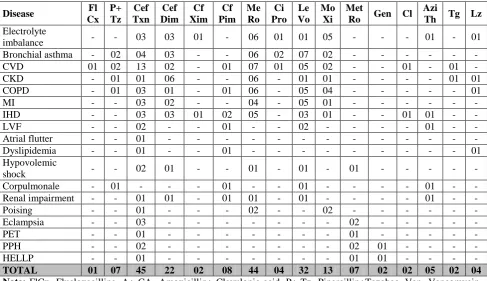
Table III: Antibiotics used in Non- infectious disease.
Disease Fl
Cx P+ Tz
Cef Txn
Cef Dim
Cf Xim
Cf Pim
Me Ro
Ci Pro
Le Vo
Mo Xi
Met
Ro Gen Cl
Azi
Th Tg Lz
Electrolyte
imbalance - - 03 03 01 - 06 01 01 05 - - - 01 - 01 Bronchial asthma - 02 04 03 - - 06 02 07 02 - - - -
CVD 01 02 13 02 - 01 07 01 05 02 - - 01 - 01 -
CKD - 01 01 06 - - 06 - 01 01 - - - - 01 01
COPD - 01 03 01 - 01 06 - 05 04 - - - 01
MI - - 03 02 - - 04 - 05 01 - - - -
IHD - - 03 03 01 02 05 - 03 01 - - 01 01 - -
LVF - - 02 - - 01 - - 02 - - - - 01 - -
Atrial flutter - - 01 - - - -
Dyslipidemia - - 01 - - 01 - - - 01
Hypovolemic
shock - - 02 01 - - 01 - 01 - 01 - - - - -
Corpulmonale - 01 - - - 01 - - 01 - - - - 01 - - Renal impairment - - 01 01 - 01 01 - 01 - - - - 01 - -
Poising - - 01 - - - 02 - - 02 - - - -
Eclampsia - - 03 - - - 02 - - - - -
PET - - 01 - - - 01 - - - - -
PPH - - 02 - - - 02 01 - - - -
HELLP - - 01 - - - 01 01 - - - -
TOTAL 01 07 45 22 02 08 44 04 32 13 07 02 02 05 02 04
Note: FlCx- Flucloxacilline, A+ CA- Amoxicillin+ Clavulonic acid, P+ Tz- Pipercillin+Tazobac, Van- Vancomycin, Ceftxn- Ceftriaxone, Cefdim- Ceftazidim, Cfpim- Cefipim, Mero- Meropenem, Imi- Imipenem, Cl- Clindamycin, Cipro- Ciprofloxacin, Levo- Levofloxacin, Moxi- Moxifloxacin, Metro- Metronidazole, Clt- Clarithromycin, Azith- Azithromycin, Tg- Tegacyclin, Lz- linezolid.
Table III shows list of patients with non- infectious disease in ICU and they received sixteen different groups of antibiotics. In these cases meropenem, ceftriaxone and levofloxacin were commonly prescribed.
DISCUSSION
The discovery of antimicrobials against infection stands as a major breakthrough in modern medical science in the last Century.[11] From the very beginning the battle between the microbes and antimicrobials has continued. Now we have a number of antimicrobials as weapons, but no governing laws towards their rational use.[12]
Prompt, appropriate, targeted antimicrobial therapy is life-saving. In this study, it was observed that 53 patients received mono-therapy and 163 admitted patient in ICU received two or more antibiotics. This excess exposure is a potent driver of colonization; increase the risk of toxicity, drug interactions and infection by multi-resistant bacteria like Clostridium difficile.[13]
In 133 cases, prescribed treatments were empirical because of unavailability of microbiological reports
before 4 to 5 days, whereas the evaluation had to be done by 48 hours which was quite difficult. Therefore diagnosis and treatment of infection still based on culture-based techniques and patients already receiving antibiotics might get no growth.
In this study list of antibiotics used in the ICU were ceftriaxone, meropenem and levofloxacin both empirically and bacteriologically proven infection cases. Vancomycin and teicoplanin used empirically in Italian ICUs.[14] Another observational study results confirmed that empirically a broad-spectrum β-lactam and an aminoglycoside increased the proportion of appropriately treated patients.[15,16]
aeruginosa, Klebsiella pneumonia, Escherichia coli, Acinetobacter baumannii.[18]
In this study, as per sensitivity analysis, the most active drugs against micro-organism were imipenem, meropenem and amikacin. Jamsidi et al also reports the same results.[17] Several study around Dhaka city and worldwide from 2010 to 2014 reported that, carbapenem resistant rate started to increase against Klebsiella,
Acinetobacter, Staphylococcus and Pseudomonas and
highly active against E.Coli.[17,18,19] Emergence of carbapenem resistance strains around the world is alarming and a threat for the treatment of the admitted patients in the ICUs. Majority of the micro- organism were resistant against penicillin and cephalosporin group in this study. Several study reported the similar findings.[17,20,21] This might be due to selective influence of extensive usage of these groups of drugs.
Multi drug resistant pathogens are most frequently encountered in the ICU. The prime reason for the development of antimicrobial resistance is antibiotic misuse. Irrational antibiotic prescription for non-documented infections in stable patients, prolonged use of broad-spectrum antibiotics without de-escalation, incorrect dosages and dosing intervals and continuation of the antibiotic course beyond the optimally recommended duration contribute to the development of resistance.[22]
This study shows the preference of antibiotics prescribed by the physicians in ICU. Levofloxacin was the most common drug for respiratory tract related infectious disease. Meropenem and ceftriaxone were commonly prescribed antibiotics among GIT related and other infections. Table III showed the list of antibiotics used in non- infectious disease. Combination of two or more antibiotics was used to treat the non- infectious condition. To promote optimization of antibiotic use in the ICU, treat the patients with documented infections except if the infections were life-threatening and avoid the antibiotics with asymptomatic colonization. De-escalation of broad-spectrum antibiotics based on clinical response and microbiological findings is needed to avoid the emergence of Multi Drug Resistance (MDR) pathogens.[23]
Some strategies followed in ICUs for rational use of antimicrobial agents like de-escalation, monitoring serum levels of the drugs, appropriate duration of therapy and use of biological markers. This strategy requires that empirical antibiotic choices be guided by local antibiotic resistance patterns and laboratory test results. The second issue involves stop the therapy when the probability of infection is low, focusing and narrowing treatment once the microorganism is known, switching to monotherapy after day 3 whenever possible, and shortening treatment to 7 to 8 days for most patients, based on the clinical response and bacteriology findings.[13] Patients with mildly or moderately severe, early-onset infections and
no specific risk factors can receive a relatively narrow-spectrum drug, like a third-generation cephalosporin.[18]
CONCLUSION
Antibiotic resistance continues to rise and complicated the selection of antibiotics in ICUs. To prevent the emergence of multi drug resistance bacteria some steps should be practiced like choose the appropriate empirical antibiotics based on local ambiogram, monotherapy in non- infectious case, A class of antibiotic is withdrawn from use for a defined time period and reintroduced at a later point of time. Most importantly a local ambiogram must be prepared and availableimidiately and also update time to time if necessary.
REFERENCES
1. Roder, BL, Nielsen SL, Magnussen P, Engquist A. Antibiotic usage in an intensive care unit in a Danish university hospital. J Antimicrob Chemother, 1993; 32(4): 633- 42.
2. Vincent JL, Basseti M, Francois B, Karam G, Chastre J, Torres A, Roberts JA, Taccone JA, Taccone FS, Rello J, Calandra T, Backer DD, Welte T and Antoneli M. Advances in antibiotic therapy in the critically ill. Crit Care, 2016; 20: 133- 36. 3. Mangram AJ, Horan TC, Pearson ML et al.
Guideline for prevention of surgical site infection: Hospital Infection Control Practices Advisory Committee. Infection Control and Hospital Epidemiology, 1999; 20: 250– 78.
4. Grohskopf LA, Huskins WC, Sinkowitz-Cochran RL, Levine GL, Goldmann DA, Jarvis WR. Pediatric Prevention Network.Use of antimicrobial agents in United States neonatal and pediatric intensivecare patients. Pediatr Infect Dis J., 2005; 24(9): 766– 77.
5. Patel SJ, Saiman L. Antibiotic resistance in neonatal intensive care unit pathogens: mechanisms, clinical impact, and prevention including antibiotic stewardship. Clin Perinatol, 2010; 37(3): 547–63. 6. Luyt CE, Bréchot N, Trouillet JN and Chastre J.
Antibiotic stewardship in the intensive care unit. Crit Care, 2014; 18: 480.
7. Bergmans DC, Bonten MJ, Gaillard CA, Van Tiel FH, Van Der Geest S, Leeuw PW, Stobberingh EE. Indications for antibiotic use in ICU patients: a one-year prospective surveillance. J Antimicrob Chemother, 1997, 39: 527-35.
8. Kollef MH. Optimizing antibiotic therapy in the intensive care unit setting. Crit Care, 2001; 5: 189- 95.
9. Vincent JL, Bihari DJ, Suter PM et al. (1995). The prevalence of nosocomial infection in intensive care units in Europe. Results of the European Prevalence of Infection in Intensive Care (EPIC) Study. EPIC International Advisory Committee. JAMA, 1995; 274: 639– 44.
pharmaco-epidemiological multicentre study, J Antimicrob Chemother, 2004; 54: 221–224.
11. Ronald P Rubin in “A Brief History of Great Discoveries in Pharmacology: In Celebration of the Centennial Anniversary of the Founding of the American Society of Pharmacology and Experimental Therapeutics” in Pharmacological Reviews, 2007; 59: 289-359.
12. Ian Phillips in “Prudent Use of Antibiotics: Are Our Expectations Justified?” in Clin Infect Dis., 2001 33(3): S130-S132. doi: 10.1086/321838.
13. Da Silva CDR, Silva M. Strategies for appropriate antibiotic use in intensive care unit. Intensive care. 2015; 3:
14. Vincent JL, Brealey D, Libert N, Abidi NE, O'Dwyer M, Zacharowski K, et al. Rapid diagnosis of infection in the critically ill, a multicenter study of molecular detection in bloodstream infections, pneumonia, and sterile site infections. Crit Care Med, 2015; 43: 2283– 91.
15. Martinez JA, Cobos-Trigueros N, Soriano A, Almela M, Ortega M, Marco F, Pitart C, Sterzik H, Lopez J, Mensa J: Influence of empiric therapy with a beta-lactam alone or combined with an aminoglycoside on prognosis of bacteremia due to gram-negative microorganisms. Antimicrob Agents Chemother, 2010; 54: 3590– 96.
16. Micek ST, Welch EC, Khan J, Pervez M, Doherty JA, Reichley RM, Kollef MH. Empiric combination antibiotic therapy is associated with improved outcome against sepsis due to gram-negative bacteria: a retrospective analysis. Antimicrob Agents Chemother, 2010; 54: 1742– 48.
17. Akter T, Murshed M, Bugum T, Nahar K, Duza SS and Shahnaz S. Antibiotic resistance pattern of bacterial isolates from intensive care unit of a tertiary care hospital in Bangladesh. Bangladesh J Med Microbial, 2014; 08(01): 07- 11.
18. Barail L, Fatema K, Haq JA, Faruq MO, Ahsan ASMA, Morsehed MAHG et al. Bacterial profile and their antimicrobial resistance pattern in an intensive care unit of a tertiary care hospitalin Dhaka. Ibrahim Med Coll. J., 2010; 4: 66- 69. 19. Jain S, Khety Z. Changing antimicrobial resistance
pattern of isolates from an ICU over a 2 year period. JAPI, 2012; 60: 27-33.
20. Jamshidi M, Javadpour S, Eftekhari TE, Moradi N and Jomehpour F. Antimicrobial resistance pattern among intensive care unit patients. African J Micro Res., 2009; 3(10): 590- 94.
21. Gagneza D, Goel N, Aggarwal R and Chaudhary U. Changing trend of antimicrobial resistance among gram negative bacilli isolated from lower respiratory tract of ICU patients: a 5 year study. Indian J Crit Care Medicine, 2011; 15(3): 164- 67.
22. Sarin MK, Vadivelan M, Bammigatti C. Antimicrobial Therapy in the Intensive Care Unit. Indian J Clin Practice, 2013; 23 (10): 601- 09.