66
Copyright © 2017. Vandana Publications. All Rights Reserved.
Volume-7, Issue-5, September-October 2017
International Journal of Engineering and Management Research
Page Number: 66-70
Tensile Strength Characteristics of Stone Matrix Asphalt with Fibre
Additives
Bindu C.S
Division of Civil Engineering, School of Engineering, Cochin University of Science and Technology, Kochi, Kerala, INDIA
ABSTRACT
Tensile strength of Stone Matrix Asphalt (SMA) is important in pavement applications, because of the problems associated with fatigue cracking. Tensile stresses are measured indirectly by a splitting tensile test. India, being an agricultural economy produces fairly huge quantity of natural fibres such as coconut, sisal, banana etc. In this paper natural fibres are used as additives to improve the tensile strength characteristics of SMA. Marshall test is conducted for optimizing the mixtures (Control mixture-without fibre and Stabilized mixtures with fibres). Based on the studies it is inferred that the optimum fibre content is 0.3% fibre by weight of mixture for all fibre mixtures irrespective of the type of fibre. The coir fibre additive is the best among the fibres investigated. Sisal and banana fibre mixtures showed almost the same strength on stabilization. The mixtures containing fibres have higher values of indirect tensile strength at failure as compared to the control mix, indicating the improved cracking potential. Decrease in strength by water conditioning is considerable and the tensile strength ratio, an indicator of resistance to moisture susceptibility goes very much below the specification limits for SMA without any fibre. Mixtures with 0.3 % fibre have more tensile strength and water resistance property than the other mixtures. A statistical analysis is performed to establish the findings of this study.
Keywords--- Stone Matrix Asphalt, Indirect tensile strength, Tensile strength ratio, Fibre
I.
INTROUCTION
Stone Matrix Asphalt (SMA) is not nearly as strong in tension as in compression. The layers in a flexible pavement structure are subjected to continuous flexing due to traffic loads resulting in tensile stresses and strains at the bottom of the surface layer. Tensile stresses are measured indirectly by a splitting tensile test. A higher
tensile strength corresponds to a stronger cracking resistance. At the same time, mixtures that are able to tolerate higher strain prior to failure are more likely to resist cracking than those unable to tolerate high strains (Tayfur, et al.,2007). A lot of research work has been reported on the performance of bituminous pavements relating the tensile strength of bituminous mixtures (Zhang, et al,2001, Behbahani, et al.,2009, Anderson et al,.2001). A higher tensile strength corresponds to a stronger low temperature cracking resistance (Huang et al, 2007). The test provides information on tensile strength, fatigue characteristics and permanent deformation characteristics of the pavement materials. The layers in a flexible pavement structure are subjected to continuous flexing as a result of the traffic loads that they carry, resulting in tensile stresses and strains at the bottom of the bituminous layers of the pavement. The magnitude of the strain is dependent on the overall stiffness of the pavement.
II.
MATERIAL
CHARACTERISATION
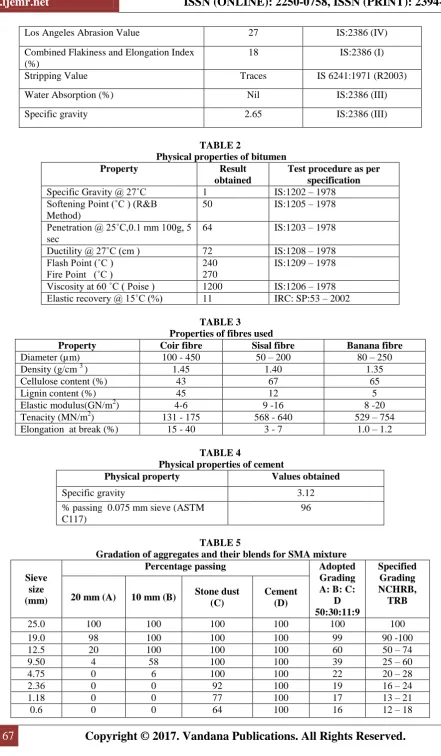
Aggregate of sizes 20mm, 10mm and stone dust procured from a local quarry at Kochi, Kerala is used in the present investigation and the physical properties of aggregates are given in Table 1. Bitumen of VG30 obtained from Kochi Refineries Limited, Kochi, is used in the preparation of mix samples and the physical properties of bitumen are given in Table 2. In this study, three natural fibres namely coir, sisal and banana fibre at different percentages by weight of mixture are used. The physical properties of fibres are given in Table 3. Ordinary Portland cement from a local market which makes a better bond with aggregate, bitumen and additives is used as the filler material and the physical properties are shown in Table 4. Gradation of aggregates and their blends for SMA mixture are given Table5.
TABLE I
Physical properties of aggregates
Property Values obtained Method of Test
67
Copyright © 2017. Vandana Publications. All Rights Reserved.
Los Angeles Abrasion Value 27 IS:2386 (IV)
Combined Flakiness and Elongation Index (%)
18 IS:2386 (I)
Stripping Value Traces IS 6241:1971 (R2003)
Water Absorption (%) Nil IS:2386 (III)
Specific gravity 2.65 IS:2386 (III)
TABLE 2
Physical properties of bitumen
Property Result
obtained
Test procedure as per specification
Specific Gravity @ 27˚C 1 IS:1202 – 1978 Softening Point (˚C ) (R&B
Method)
50 IS:1205 – 1978 Penetration @ 25˚C,0.1 mm 100g, 5
sec
64 IS:1203 – 1978 Ductility @ 27˚C (cm ) 72 IS:1208 – 1978 Flash Point (˚C )
Fire Point (˚C )
240 270
IS:1209 – 1978
Viscosity at 60 ˚C ( Poise ) 1200 IS:1206 – 1978 Elastic recovery @ 15˚C (%) 11 IRC: SP:53 – 2002
TABLE 3 Properties of fibres used
Property Coir fibre Sisal fibre Banana fibre
Diameter (µm) 100 - 450 50 – 200 80 – 250
Density (g/cm 3 ) 1.45 1.40 1.35
Cellulose content (%) 43 67 65
Lignin content (%) 45 12 5
Elastic modulus(GN/m2) 4-6 9 -16 8 -20
Tenacity (MN/m2) 131 - 175 568 - 640 529 – 754 Elongation at break (%) 15 - 40 3 - 7 1.0 – 1.2
TABLE 4
Physical properties of cement
Physical property Values obtained
Specific gravity 3.12
% passing 0.075 mm sieve (ASTM C117)
96
TABLE 5
Gradation of aggregates and their blends for SMA mixture
Sieve size (mm)
Percentage passing Adopted
Grading A: B: C:
D 50:30:11:9
Specified Grading NCHRB, TRB 20 mm (A) 10 mm (B) Stone dust
(C)
Cement (D)
25.0 100 100 100 100 100 100
19.0 98 100 100 100 99 90 -100
12.5 20 100 100 100 60 50 – 74
9.50 4 58 100 100 39 25 – 60
4.75 0 6 100 100 22 20 – 28
2.36 0 0 92 100 19 16 – 24
1.18 0 0 77 100 17 13 – 21
68
Copyright © 2017. Vandana Publications. All Rights Reserved.
0.3 0 0 45 100 14 12 – 15
0.075 0 0 6 96 9 8 – 10
III.
EXPERIMENTAL PROGRAMME
SMA mixes are prepared by mixing the graded aggregates with VG- 30 bitumen and fibres of coir, sisal and banana. The fibre content is varied between 0.1%, 0.2%, 0.3% and 0.4% by weight of mix. The fibre length in the mixture is preserved as a constant parameter with a value equal to 6 mm. In order to study the influence of fibre content on optimum bitumen content (OBC) the binder content is varied from 5.5 to 7.5% at an increment of 0.5% for each percentage of fibre for different additives and Marshall tests have been conducted .
The tensile characteristics of bituminous mixtures are evaluated by loading the cylindrical specimen along a diametric plane with a compressive load at a constant rate acting parallel to and along the vertical diametrical plane of the specimen through two opposite loading strips. This loading configuration develops a relatively uniform tensile stress perpendicular to the direction of the applied load and along the vertical diametrical plane, ultimately causing the specimen tested to fail by splitting along the vertical diameter (Kandhal, 1979, ] Ibrahim, 2000, Kennedy and Hudson, 1968). The static indirect tensile strength of a specimen is determined using the procedure outlined in ( ASTM D 6931,2007), Tensile failure occurs in the sample rather than the compressive failure. The compressive load indirectly creates a tensile load in the horizontal direction of the sample. The peak load is recorded and split tensile strength is calculated using the equation:
tD
P
S
t
2000
St= Indirect Tensile strength, kPa , t = specimen
height immediately before test, mm
P = maximum load, N , D = specimen diameter, mm .
60 specimens are prepared for each fibre additive and divided into two groups. The first group was immersed in a water bath at 60˚C, for a period of 24 hours (conditioned sample). The samples are then removed from the water bath and kept at a temperature of 25˚C for a period of 2 hours. Other set of samples (unconditioned sample) are kept at a temperature of 25˚C for a period of 2 hours without soaking. These specimens are loaded at a deformation rate of 51mm/min and the load at failure is recorded at each case. Then the tensile strength of water conditioned as well as unconditioned specimen for each fibre stabilized mixture is determined.
Moisture damage in bituminous mixes refers to the loss of serviceability due to the presence of moisture. The extent of moisture damage is called the moisture susceptibility. Tensile strength ratio (TSR) is a measure of water sensitivity. It is the ratio of the tensile strength of water conditioned specimen, (ITS wet, 60˚C, and 24 h) to the tensile strength of unconditioned specimen (ITS dry) which is expressed as a percentage.
IV.
RESULTS AND DISCUSSIONS
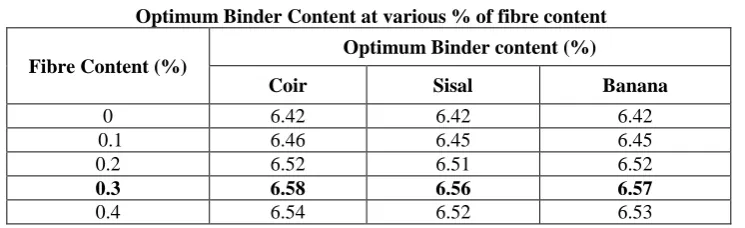
The OBC obtained for each fibre stabilized mixtures by Marshall test is given in Table 6
TABLE 6
Optimum Binder Content at various % of fibre content
Fibre Content (%)
Optimum Binder content (%)
Coir Sisal Banana
0 6.42 6.42 6.42
0.1 6.46 6.45 6.45
0.2 6.52 6.51 6.52
0.3 6.58 6.56 6.57
0.4 6.54 6.52 6.53
With an increase in fibre content, specific surface area increases and fibre absorbs more bitumen and thus OBC increases. However, after the fibre content reaches a certain value, excessive fibres are unable to disperse uniformly in the mixture and susceptible to coagulate, which actually does not improve the total specific areas,
thus OBC decreases. The coir fibre has a loose structure with the highest specific surface area, which results in the highest absorption of bitumen among these fibres.
The indirect tensile strength of SMA mixtures with fibres at various percentages are given in Table 7.
TABLE 7
Indirect tensile strength results for stabilized SMA mixtures
Additive % ITS, Unconditioned
(MPa)
ITS, Conditioned (MPa)
69
Copyright © 2017. Vandana Publications. All Rights Reserved.
Coir fibre
0.1 0.851 0.709
0.2 1.0983 1.059
0.3 1.1242 1.1048
0.4 1.0831 1.0521
Sisal fibre
0.1 0.8313 0.6915
0.2 1.0619 1.0114
0.3 1.1057 1.0766
0.4 1.0538 1.0153
Banana fibre
0.1 0.8272 0.6941
0.2 1.065 1.0107
0.3 1.1018 1.0762
0.4 1.054 1.015
The tensile strength of SMA mixes with fibre additive shows increasing trend up to 0.3% and it is found to be decreasing at 0.4% fibre content. This behavior is because, the tensile strength is related primarily to a function of the binder properties, and its stiffness influences the tensile strength. Presence of fibre in the mixture makes it stiffer. The addition of fibre beyond a certain level can increase the viscosity of binder, which results from the effects of increase in volume of fibre particles due to the absorption of binder. Therefore, this increase in viscosity inhibits the ability of the binder to coat adequately on the surface of aggregates, thereby lead to the potential loss of bonds between the fibre, binder and the aggregate.
All the fibre stabilized SMA mixtures have the maximum tensile strength at 0.3% fibre content by weight of mix for both conditioned and unconditioned SMA mixtures. The percentage increase in strength for the coir fibre stabilized mixture with respect to the control mixture is 38% and 160% respectively for unconditioned and conditioned samples. This increase is about 36% and 153% respectively for both sisal and banana fibre stabilized mixtures. The improvement in indirect tensile strength would be due to fibre’s absorption and adhesion of bitumen
which improves the interface adhesion strength and fibre’s networking and bridging cracking effects. Fibre reinforcing effect increases initially with increasing fibre content; but at high fibre content (more than 0.3%) may induce coagulation and thus reducing its reinforcing effect. Test results show that coir fibre stabilized mixtures has the highest tensile strength as compared to the other two mixtures.
Moisture susceptibility of SMA mixtures
Comparison of the tensile strength ratio (TSR) values of the various mixtures are made in Fig.1. TSR values of the control mixture is nearly 52% which is less than 70%, a minimum TSR value set forth by AASHTO T283,2007. This illustrate that the control mixture has more significant moisture susceptibility. The tensile strength ratios for the mixes containing the additives are greater than the specification limits. From these results, it can be concluded that the presence of additives significantly reduces the moisture induced damage of the SMA mixture. SMA with coir fibre gives a slightly higher tensile strength ratio than the SMA with other fibres. The specimens containing sisal and banana fibre produced almost similar results.
0
20
40
60
80
100
120
0
0.1
0.2
0.3
0.4
T
en
si
le
st
re
n
g
th
r
a
ti
o
(%)
Fibre content(%)
Coir fibre
Sisal fibre
Banana fibre
70
Copyright © 2017. Vandana Publications. All Rights Reserved.
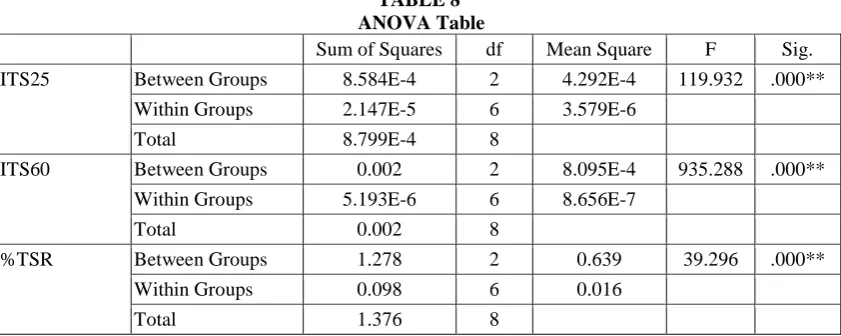
ANOVA table shows the comparison betweenvarious stabilized mixtures at optimum fibre content of 0.3% and are given in Table 8. Analysis shows that there is significant difference in the characteristics of SMA mixture for different fibres (at an optimum fibre content of 0.3% by weight of mixture) at 1% level of significance (Sig. <0.01)
showing the influence of additives on the characteristics of SMA. Homogeneous groups as identified by Tukey’s post hoc multiple comparison tests reveal that SMA stabilized with sisal and banana fibre can be grouped into the same group. SMA mixture with 0.3% coir fibre by weight of mixture is the best.
TABLE 8 ANOVA Table
Sum of Squares df Mean Square F Sig. ITS25 Between Groups 8.584E-4 2 4.292E-4 119.932 .000**
Within Groups 2.147E-5 6 3.579E-6
Total 8.799E-4 8
ITS60 Between Groups 0.002 2 8.095E-4 935.288 .000** Within Groups 5.193E-6 6 8.656E-7
Total 0.002 8
%TSR Between Groups 1.278 2 0.639 39.296 .000**
Within Groups 0.098 6 0.016
Total 1.376 8
** significantly different at 1% level of significance
V.
CONCLUSIONS
Based on the test results, the indirect tensile strength values are found to be much higher when fibre additives are incorporated in Stone Matrix Asphalt mixtures and the effect is more influential in the conditioned state. For a particular fibre, the tensile strength decreases by conditioning the sample. But this decrease is considerable in the control mixture and also the tensile strength ratio goes very much below the specification limits. This substantiates the need of additives in SMA mixtures. Addition of 0.3 % coir fibre in the SMA mixture resulted in the highest tensile strength and exhibit superior water resistance property. ANOVA shows, significant difference in the tensile strength properties among mixtures with varied fibre contents at 1% level of significance. SMA stabilized with sisal and banana fibre can be grouped into the same group. SMA mixture with 0.3% coir fibre by weight of mixture is the best among the mixtures investigated.
REFERENCES
[1] AASHTO T 283 (2007), “Resistance of Compacted Asphalt Mixtures to Moisture-Induced Damage”, American Association of State Highway and Transportation Officials,
Washington DC.
[2] ASTM D 6931 (2007), “Indirect Tensile (IDT) Strength for Bituminous Mixtures”, American Society for Testing and Materials, Philadelphia.
[3] Anderson, D.A., Lapalu, L., Marateanu, M.O., Hir, Y.M.L., Planche, J.P. and Martin, D. (2001), “Low-temperature thermal cracking of asphalt binders as ranked by strength and fracture properties”, Journal of Transportation Research Board, 1766:1-6.
[4] Behbahani, S., Nowbakht, H., Fazaeli and Rahmani, J. (2009), “Effects of Fiber Type and Content on the Rutting Performance of Stone Matrix Asphalt”, Journal of Applied Sciences, 9: 1980-1984.
[5] Huang, Y., Bird, R.N. and Heidrich, O. (2007), “A review of the use of recycled solid waste materials in asphalt pavements”, Resour Conserv Recy, Vol. 52, Issue 1, 58-73.
[6] Ibrahim, K. (2000), “The Tensile Characteristics Of Fibre Reinforced Bituminous Mixtures”, PLATFORM. Volume 1 Number 2,17-24.
[7] Kandhal, P.S. (1979), “Evaluation of Six AC-20 Asphalt Cements Using the Indirect Tensile Test”, Transportation Research Board, Transportation Research Record No. 712
[8] Kennedy, T.W. and Hudson, W.R. (1968), “Application of the Indirect Tensile Test to Stabilised Materials”,
Highway Research Record No. 235, Highway Research Board 36-48.
[9] Tayfur, S., Ozen, H. and Aksoy, A. (2007), “Investigation of rutting performance of asphalt mixtures containing polymer modifiers”, Construction and Building Materials, Vol. 21: 328 – 337.
[10] Zhang, Z., Rogue, R., Birgisson, B. and Sangpetngam, B. (2001), “Identification and verification of a suitable crack growth law”, Journal of Association of. Asphalt Paving Technology, 70: 206-241.