273
Copyright © 2017. Vandana Publications. All Rights Reserved.
Volume-7, Issue-5, September-October 2017
International Journal of Engineering and Management Research
Page Number: 273-277
Influence of Owner’s Personal Factors on Success of Micro Enterprises
(With Special Reference to Kandy District)
H.G.K.K Pitakotuwa1, K.M.M.C.B Kulathunga2, P.G.M.S.K Gamage3
1,2,3
Department of Management Sciences, Uva Wellassa University, SRI LANKA
ABSTRACT
The SMEs play a critical role in the development of the country. As a part of SMEs’, Micro Enterprises have a major role in employment and contribution to the Gross Domestic Production. This study examines the influence of owner’s Personal factors on success of Micro Enterprises in Kandy district. Questionnaires were distributed by using stratified random sampling technique to collect primary data from 100 owners of Micro Enterprises’ in Kandy district. The data were analyzed by using descriptive statistics, correlation coefficient and simple linear regression. This study concludes that owners’ personal qualities directly influence to be a successful Entrepreneur and there is a positive relationship between Enterprise success and Personal factors. The result shows that Owner’s Personal factors are influencing to success of Micro Enterprises. The study has recommended to Entrepreneurs of Micro Enterprises, policy makers and other interest parties to consider owner’s Personal factors while developing policies and strategies for Micro Enterprises.
Keywords-- Enterprise Success, Micro Enterprises,
Personal factors, Entrepreneurs
I.
INTRODUCTION
The Small and Medium enterprises (SMEs) play a crucial part in the overall economic growth of any country. The term SMEs are used to denote micro, small, medium and large enterprises. According to the Department of Census and Statistics (DCS), Micro Enterprises (MEs) are the firms which employ less than 5 employees in industry & construction, services sector and enterprise which employ less than 4 employees in trade sector.
Starting and operating a MEs contains a possibility of success as well as failure. Because of their small size and a simple management mistake is likely to lead to death of a MEs. Marlow (2009) exposed that the failure rate of small and micro scale businesses in developing countries is higher than in the developed countries. Many MEs fail in the early stage of their life
cycle. In Sri Lanka, according to 2016 statistics published by the Small Business Administration (SBA), about 78% of small business startups survive the first year and about half of all employer establishments survive at least five years. It means that there are some drivers for high business failure in initial stage of their life cycle. When business can survive more than five years means it can be assume that it is successful. Although most of the MEs are failing, still there are MEs which successful. It is needed to identify the factors to be successful for practicing Enterprise Success (ES).
When several determinants have been comprehensively studied, there are mixed results on the Entrepreneur impact on small firm growth. Several studies strongly confirmed that some owner characteristics have positive (Thapa, 2007) and significant relationships with small firm growth while other studies find insignificant relationships (Minniti and Bygrave, 2003). There are contradictory arguments between researchers about impact of Personal factors (PF). As with many developing countries, although there are scholarly studies about the Small & Medium Enterprises (SMEs) sector, there are limited research and scholarly studies about the MEs sector. There is very little information on how the MEs sector succeeded while those are not deeply evaluated.
II.
METHODOLOGY
The total population of this study is 56,229 of MEs in Kandy district. Researcher used stratified sampling technique to select sample size of 100 MEs which is more than five years in the market. Primary data collected through using a self-developed questionnaire and it was consisted of five point likert scale questions as well as close ended questions. All Cronbach's alpha values are more than 0.7, since the validity of the questionnaire was in acceptable level.
274
Copyright © 2017. Vandana Publications. All Rights Reserved.
test objectives taken in the study. Descriptive statistics has been used to develop the profile of an Entrepreneur. A correlation analysis has been conducted to identify the relationship between owner’s PF and ES. A simple linear regression analysis has been conducted to identify the influence of owner’s PF on success of MEs.
III.
PRIOR APPROACH
The researcher would consider MEs as independent organizations with less than five employees, including the proprietor for the purpose of clarity and uniformity with many of other researchers in Sri Lanka such as Cooray (2003); Gamage (2003); Delpachitra & Howard (2004). The studies found that PF, including the following dimensions be the most determinant factors affecting the growth of SMEs.
1. Owners’ Age
Age is the categorization of people to explain the difference between them and it is numerical time of life at which some particular qualification or power arises (Aapola, 2002). Age of the owners is one of the most important characteristic that is repeatedly used to predict small business performance and success (Lussier & Pfeifer, 2001). Some findings (Davidson, 1991; Storey, 1994; Adesua et al., 2008) have supported the argument that younger managers are more likely to be successful in their firms than older managers because younger managers have more energy, higher ambitions and are more likely to be committed to working long hours, which are generally necessary for a business to be successful and the rising age of enterprise owners has led to the decline in the mean efficiency. A different set of studies argues that older managers are more likely to be successful in their firms than younger managers (Littunen & Virtanen, 2006; Harada, 2003). The logic is that older managers are more experienced and have gone through many challenges, which make them strong and confident.
2. Owners’ Gender
Gender refers to the social identities attributed to women and men (Olabisi, 2011. Selamat (2012) and Okurut (2008) proposed that the returns in MEs are negatively influenced by being female-owned and many empirical studies (Habtamu, 2012; Haftom, 2013; Kokobe, 2011; Mulu, 2007) found that male-headed firms grow faster than that of female-headed, but Ilo in 2005 observed that growth of entrepreneurship among women, the social and economic factors influencing their successful performance but not negatively influence of being women. The structure between women and men and that give them differing positions of advantage and disadvantage for success of SMEs. The reason for the greater focus of women rather men are primarily because of the patriarchal nature of the society (Anderson et al., 2001).
3. Family Background
Family background is whether or not the entrepreneur comes from an entrepreneurial family (Isaga, 2015). The review of the literature on family background, researchers have argued that the children of entrepreneurs should be more likely to be successful businesses than other people (Cooper et al., 1992; Mungai & Velamuri, 2010). It is assumed that having at least one self-employed parent helps to develop the human capital of the child and also modifies expectations about what business ownership involves (Niittykangas & Tervo, 2005). Furthermore, it is suggested that these individuals are more likely to be successful in their businesses for several reasons, such as an ability to seek managerial expertise from their parents in case of business problems, easier access to information on the market as well as on other related issues (Mungai & Velamuri, 2010). Therefore, this study aimed at testing whether coming from an entrepreneurial family has any significant influence on SMEs growth.
4. Family Support
Family-to-business support in business activities can be defined as social support obtained from family members (Powell and Eddleston, 2013). Berrone et al., (2013) argued that family support is of vital importance for MEs performance because family members provide substantial support, such as external financial or physical resources. This evidence suggests that when entrepreneurs have more family support, they are more likely to be successful (Blanchflower and Oswald 1998; Berrone et al., 2013).
5. Education Level
Alberti and Poli (2004) define entrepreneurial education as the structured, formal transference of entrepreneurial competence, which in turn refers to the concepts, mental awareness and skills used by individuals throughout the process of starting and developing their growth-oriented ventures. Entrepreneurship education and training then is about the development of personal skills and behavior change. Some studies show a positive and significant relationship between education and SMEs growth (Cooper et al., 1992; Yusuf, 1997; Kim et al., 2006; Watson et al., 2003; Barringer et al., 2005), while other studies show a negative relationship between the two (Johnson et al., 1999; Bartlett & Bukvi, 2001). Subsequently, other studies have found that education does not matter in explaining the growth of SMEs (Alvarez & Crespi, 2003).
6. Personal Initiative
275
Copyright © 2017. Vandana Publications. All Rights Reserved.
skill (Ghani, 1995). This situation is difficult to apply new technology and improve productivity.
7. Prior Business Experience
Prior experience is one of the components of human capital and it's defined as the people gather information and develop skills that are useful across different occupations (Ucbasaran et al., 2008). According to Harada (2003) that an entrepreneur’s previous knowledge of the market, previous experience in the industry and related business experience all have a positive effect on turnover. It can therefore be concluded that longer experience of entrepreneurs can expect to impact firm performance. Although prior business experience is useful training, the empirical effect of such experience on business success is not entirely unambiguous (Praag, 2003; Shonesy and Gulbro, 2004).
IV.
OUR APPROACH
Once the demographic characteristics of the successful Entrepreneurs are considered the majority is males (61%) while female representation is only a small fraction (39%). Generally, the male representation in MEs sector is very high in MEs. Approximately half of Entrepreneurs are 31-40 age groups while a lower proportion, 8%, is above 50year age category. Entrepreneurs who are 41-50 age group is 15% and below the 30years are 19%. According to that, although when increasing the age, participation of MEs is low, it can be assumed that when increasing the experience, Entrepreneurs convert their MEs to small, medium or large businesses.
Only 1% of the Entrepreneurs are graduate and 1% are post graduate level, while only 7 percent of them were educated to diploma level indicating lower levels of educational attainment in the MEs. Almost half of the sample has educated up to primary level. The findings doesn’t show that all types of education play an equal role in explaining the ES. In this study, although the level of education of the Entrepreneur is significantly related to the growth of businesses, it is not necessary to have a higher education level. Most of the (81%) MEs are sole proprietorship. 12% of firms are represented partnership and 7% of businesses are family businesses.
The majority (90%) of the firms included in survey were established by Entrepreneur himself. When personal initiative is high, their self-motivation is high therefore they more focus on success. According to the perception of owners, they need all Computer literacy, Self-motivation, Administrative and technological skills, Gathering relevant information, Marketing skills and Risk-taking ability to be a successful Entrepreneur. Therefore, it implies that to cope with competition and globalization, entrepreneurs expect to have high skills to deal with new technology.
The significant amount of Entrepreneurs (42%) who engaged in MEs were unemployed before engaging this career and 34% of the Entrepreneurs were being students. It can reveal that most of the Entrepreneurs had no prior experience before the start this career. Although they hadn’t prior experience, they have succeeded in their field. Approximately half of the Entrepreneurs (49%) established their business because they are expecting higher profit.
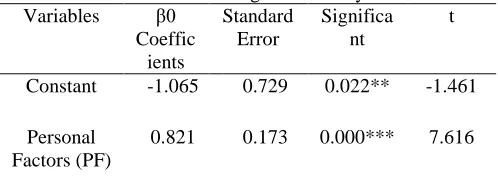
According to the correlation analysis, the probability of the association between PF and ES is 0.000 (0.000 < 0.050). This is less than 1% therefore the result is highly significant, hence it has been supported for the relationship. The null hypothesis are rejected at the 95 % confidence level and there is a relationship between PF and ES. Coefficient of variation is 0.821 indicates that there is a strong positive association between PF and ES.
Table 1: Coefficients of regression analysis with ES Variables β0
Coeffic ients
Standard Error
Significa nt
t
Constant -1.065 0.729 0.022** -1.461
Personal Factors (PF)
0.821 0.173 0.000*** 7.616
Note: Dependent variable is Enterprise success
The symbol (***) indicates the statistical significance at 99 level. The symbol (**) indicates the statistical significance at 95 level.
R2 = .802, DW = 2.106
Source: SPSS output from field information
276
Copyright © 2017. Vandana Publications. All Rights Reserved.
business based on the strengths of their specific characteristics can be hugely dependent on him.
V.
CONCLUSION
Successful Entrepreneurs’ key characteristics are being male, being younger, higher education level, being a sole proprietor, personal initiate, skills and abilities, prior experience and higher profit expectation. In Sri Lanka, there are many businesses fail in the early stage of their business life cycle because the lack of these characteristics. The study concludes that owners’ Personal factors have a positive relationship with Micro Enterprise success. It is prove the similar findings of Hagos at el., (2014). In Sri Lankan context, there are 50% of Micro Enterprises are fail in their first year (Schaefer, 2015). The reason is Micro Enterprises doesn’t have such kind of relationship because lack of these Personal factors.
The results prove that, Personal factors are positively influence to success of Micro Enterprises. The owner’s Personal factors are the key factors on which whole business is depending upon and it is most important to take advantage of business opportunities that will generate high profits. In addition, half of the businesses are fail lack of Personal factors and they will tend to conduct their business based on the strengths of their specific characteristics can be hugely dependent on personal characteristics. This finding is similar to previous studies were done by Chirwa, 2008; Mbugua et al., 2013; Janda et al., 2013; Mulu, 2007; Osinde, 2013; Enock, 2010; Habtamu, 2012. Practicing and potential Entrepreneurs will recommended to consider personal factors before launching a new business.
REFERENCES
[1] Aapola, S., Gonick, M. and Harris, A., 2005. Young femininity: Girlhood, power, and social change. Palgrave Macmillan.
[2] Abimanyu, Y., Bryant, D., Daryanto, Bandono, B., Mahrani, T., Ngapon, et al. (2011). Potensi Perusahaan UKM Untuk Go Public. Departement Keuangan Republic Indonesia , 1-53.
[3] Ahmed, S.U., 1981. Entrepreneurship and management practices among immigrants from Bangladesh in the UK (Doctoral dissertation, Henley Business School) [4] Carter, S.L. and Shaw, E., 2006. Women's business ownership: Recent research and policy developments [5] Chirwa, E.W., 2008. Effects of gender on the performance of micro and small enterprises in Malawi. Development Southern Africa, 25(3), pp.347-362. [6] Clover, T.A. and Darroch, M.A., 2005. Owners' perceptions of factors that constrain the survival and growth of small, medium and micro agribusinesses in KwaZulu-Natal, South Africa. pp.238-263.
[7] Cooper, A.C. and Dunkelberg, W.C.,1987. Entrepreneurial research: Old questions, new answers and methodological issues. Purdue University, Krannert Graduate School of Management
[8] Curran Stanworth, J., Stanworth, M.J.K. and Curran, J., 1973. Management motivation in the smaller business. Gower Publishing Company, Limited.
[9] Davidsson, P., 1991. Entrepreneurship—and after? A study of growth willingness in small firms. Journal of business venturing, 4(3), pp.211-226.
[10] Department of census and statistics, Ministry of Policy Planning Economic Affairs, Child Youth and Cultural Affairs
[11] Drucker, P.F., 1985. Entrepreneurial strategies. California Management Review, 27(2), pp.9-25. [12] Enock, N. (2010). What are the factors limiting the success and/or growth of small businesses in Tanzania: An empirical study on small business growth. (Master’s thesis, University of Arcada). Arcada, Tanzania.
[13] Gamage, J.L.S., 2014. Determinants of success of small business: A survey-based study in Kuliyapitiya divisional secretariat of Sri Lanka. International Journal of Business and Social Research, 4(6), pp.38-50.
[14] Habtamu, T. (2012). Gebremichael, A. and Abera, N., 2013. Growth Determinants of Micro and Small Enterprises: Evidence from Northern Ethiopia. Journal of Economics and Sustainable Development, 4(9).
[15] Hagos, N., Potočnik, K. and Zhou, J., 2014. Innovation and creativity in organizations: A state-of-the-science review, prospective commentary, and guiding framework. Journal of Management, 40(5), pp.1297-1333. [16] Harada, N., 2003. Who succeeds as an entrepreneur? An analysis of the post-entry performance of new firms in Japan. Japan and the world economy, 15(2), pp.211-222. [17] Hawariyuni, W., Ghani, G.M. and Derus, A.M., 2014. The determinants of the success of microenterprise: a case study of BRI clients in Medan City, Indonesia. Journal of Emerging Economies and Islamic Research, 2(1), pp.1-28. [18] Isaga, N., 2015. Owner-Managers' Demographic Characteristics and the Growth of Tanzanian Small and Medium Enterprises. International Journal of Business and Management, 10(5), p.168.
[19] Janda, K., Rausser, G. and Strielkowski, W., 2013. Determinants of Profitability of Polish Rural Micro-Enterprises at the Time of EU Accession. Eastern European Countryside, 19, pp.177-217.
[20] Kinda, T. and Loening, J.L., 2008. Small enterprise growth and the rural investment climate: evidence from Tanzania. World Bank.
[21] Lussier, R.N. and Pfeifer, S., 2001. A crossnational prediction model for business success. Journal of Small Business Management, 39(3), pp.228-239.
277
Copyright © 2017. Vandana Publications. All Rights Reserved.
[23] Minniti, M. and Bygrave, W., 2003. Global entrepreneurship monitor: national entrepreneurship assessment. United States of America.
[24] Mulu, G. (2007). Growth of micro-enterprises: Empirical evidence from Ethiopia. Ethiopian Development Research Institute (EDRI), pp.1-21.
[25] Okurut, F.N., 2008. Determinants of microenterprise performance in Uganda. The IUP Journal of Agricultural Economics, (1), pp.77-87.
[26] Olabisi, S.Y., Olagbemi, A.A. and Atere, A.A., 2011. Factors affecting small-scale business performance in informal economy in Lagos state-Nigeria: A gendered based analysis. Lagos: Lagos State University.
[27] Schaefer, 2015. Climate change and the permafrost carbon feedback. Nature, 520(7546), pp.171-179.
[28] Selamat, N.H., Razak, R.R.A., Gapor, S.A. and Sanusi, Z.A., 2011. Determinants of successful micro-enterprises in Balik Pulau, Penang Island, Malaysia. British Journal of Arts and Social Sciences, 3(1), pp.23-37. [29] Sidika, I.G., 2012. Conceptual framework of factors affecting SME development: Mediating factors on the relationship of entrepreneur traits and SME performance. Procedia Economics and Finance, 4, pp.373-383.
[30] Thapa, A.,2008. Micro-enterprises and household income. Journal of Nepalese Business Studies, 4(1), pp.110-118