778
Copyright © 2011-15. Vandana Publications. All Rights Reserved.
Volume-5, Issue-3, June-2015
International Journal of Engineering and Management Research
Page Number: 778-783
Supplier Selection in an Engineering, Procurement & Construction using
Multi Criteria Decision Making Methods
Arvind L.Pawar1, Ujwal M.Chaudhari2, Hardik Trivedi3
1,2,3
Department of Project Management, INDIA
ABSTRACT
For any organization that has to deal with Trading or market moods swings, supplier selection does play an important role in deciding the flow of the revenue in a company. Traditional supplier selection methods are very much dependent on relationship with the supplier. But this doesn’t ensure performance on the part of suppler, so to give a concrete data on supplier selection modern supplier selection model can be used. This paper talks about multi criteria decision making method for selection of vendor. MCDM methods helps to choose the best alternatives where many criteria have come into existence, the best one can be obtained by analyzing the scope & criteria of the supplied item.
Keywords — MCDM, AHP, TOPSIS
I.
INTRODUCTION
Modern day supplier selection methods more relationship dominated and many of those suppliers don’t go under a proper analysis so as to determine their worth as a future business partner. On the other hand Supplier selection could contribute to reduce purchase risk, maximize overall value to the purchaser, creation of standard selection procedure & help identify potential supplier methods.
In the present study an efficient multi criteria decision making (MCDM) approach has been proposed for
quality evaluation and performance appraisal in supplier
selection. Supplier selection is a multi-criteria decision making problem influenced by multiple performance criteria. These criteria’s/attributes may be both qualitative as well as quantitative. Qualitative criteria estimates are generally based on previous experience and expert opinion on a suitable conversion scale. This conversion is based on human judgment. Therefore predicted result may not be
accurate always because the method does not explore real data. These are analyzed by TOPSIS (Technique for order preference by similarity to ideal solution), AHP (Analytic Hierarchy Process) etc. In solution of MCDM problems there should be a common trend is to convert quantitative criteria values into an equivalent single performance index called Multi attribute performance index. MCDM is pertaining to structure and solve decision and planning problems involving multiple criteria. The main objective of this study is to support decision makers where there are huge choices exist for a problem to be solved. This study on multi criteria decision understands the need of MCDM. Many works have been proposed in determining the best optimal solution for a problem using different methods in it.
II.
LITERATURE REVIEW
In modern markets were cost cutting & squeezing the best out of raw materials ensures cost effective & high quality products. The pressure has now shifted towards supplier management. It ensures on time delivery, reduced cost, product optimization & increased profits for both parties.
So where so much is at stake, companies are always in search of finding new and efficient methods of supplier selection. The following text will shed some light on the structure of those multi decision making procedures.
779
Copyright © 2011-15. Vandana Publications. All Rights Reserved.
situation in which, having defined a set A of actions and a family F of criteria, the decision maker wishes: to determine a subset of actions considered to be the best with respect to F (choice problem).
1. Divide A into subsets according to some norms.
2. Rank the actions of A from the best to worst.
3. Describe actions and their consequences in a
formalized and systematic manner, so that decision-makers can evaluate those actions. In literature studied, many terms have been used for MCDM and these terms are given as below [2]:
• Multi-Criteria Decision Analysis (MCDA)
• Multi-Objective Decision Making (MODM)
• Multi-Attributes Decision Making (MADM)
• Multi-Dimensions Decision-Making (MDDM)
Classification of Multi-Criteria Decision-Making Methods
Following is the list of some popular MCDM methods which have been frequently used by researchers to solve some real-world multiple criteria problems:
1. AHP: Analytic Hierarchy Process.
2. ANP: Analytic Network Process.
3. ELECTRE: Elimination Et Choix Traduisant la
Realite (French)—(Elimination and Choice Translating Reality) (English)
4. GP: Goal Programming.
5. MACBETH: Measuring Attractiveness by a
Categorical Based Evaluation Technique.
6. MAUT: Multi-Attribute Utility Theory.
7. MAVT: Multi-Attribute Value Theory.
8. PROMETHEE: Preference Ranking
Organization Method for Enrichment Evaluation.
9. TOPSIS: Technique for Order Preference by
Similarity to Ideal Solution.
10. WSM: Weighted Sum Model.
The specialists have divided multi-criteria decision-making methods into three categories, whose purpose is to bring the MCDM methods together according to some similarities, namely: (i) multiple attribute theory; (ii) outranking methods; (iii) interactive methods. Roy (1996) classifies them as follows: (i) unique synthesis criterion approach, eliminating any incomparability; (ii) outranking synthesis approach, accepting incomparability; (iii) interactive local judgment approach, with trial-error interaction.
Unique synthesis criterion approach: It consists of aggregating the different points-of-view into a unique function which will be optimized. For example, MAUT (Multi-Attribute Utility Theory; Keeney and Raiffa 1976), SMART (Simple Multi-Attribute Rating Technique) family (Edwards 1977; Edwards and Barron 1994) and AHP (Analytic Hierarchy Process) (Saaty 1987).
Outranking synthesis approach: It consists in the development of a relationship called an outranking relationship, which represents the decision-maker’s preferences, the relationship being explored in order to
help the decision-maker solve his/her problems.
Interactive local judgment approach: This proposes methods which alternate calculation steps, giving successive compromising solutions, and dialog steps, leading to an extra source of information on the decision-makers preferences.
The Technique for Order of Preference by Similarity to Ideal Solution (TOPSIS) is a by Hwang and Yoon in 1981[3]. TOPSIS is based on the concept that the chosen alternative should have the shortest geometric distance from the positive ideal solution and the longest geometric distance from the negative ideal solution. It is a method of compensatory aggregation that compares a set of alternatives by identifying weights for each criterion, normalizing scores for each criterion and calculating the geometric distance between each alternative and the ideal alternative, which is the best score in each criterion. An assumption of TOPSIS is that the
criteria are
criteria are often of incongruous dimensions in multi-criteria problems. Compensatory methods such as TOPSIS allow trade-offs between criteria, where a poor result in one criterion can be negated by a good result in another criterion. This provides a more realistic form of modeling than non-compensatory methods, which include or exclude alternative solutions based on hard cut-offs.
AHP is MCDM approach and was introduced by saaty (1980) [4]. It involves decision maker’s perception. It is decision support tool which can be used to solve complex decision problems. It uses a multi-level hierarchical structure of objectives, criteria, sub criteria and alternative. AHP utilizes ratio scale for human judgments; the alternative weights reflect the relative importance of the criteria in achieving the goal of the objective.
Yaha and kingsman (1990) [5] used saaty’s (1980) AHP method to determine priority in selecting supplier. The authors applied vector rating in supplier selection. This study is performed for a government sponsored entrepreneur development program in Malaysia.
Akarte (2001) [6] used AHP to select best casting supplier from the group of evaluated suppliers. The evaluation procedure considered about 18 different criteria. Out of 18 different criteria, six are of objective and twelve are of subjective types.
Tam and Tummala (2001) [7] have used AHP in vendor selection of a telecommunication system, which is a complex, multi criteria decision problem.
Handfield, wastor and Sroufe (2002) [8] studied environments criteria to supplier assessments.
780
Copyright © 2011-15. Vandana Publications. All Rights Reserved.
III.
PROPOSED METHODOLOGY
The proposed methodology for supplier selection problem composed of TOPSIS and AHP methods.
1. TOPSIS METHOD
It consists of three Steps. They are as follows: 1. Identify the criteria to be used in the model.
2. Weigh the criteria by using expert views.
3. Evaluation of alternatives with TOPSIS and determination of the final rank.
In the first Step, with the help of going over advice of experts and their relevant specialized literature, we try to recognize variables and effective criteria in supplier selection after which criteria which will be used in their evaluation is extracted. Thereafter, list of qualified suppliers are deter-mined and in the last stage of the first step, the decision criteria are approved by decision-making team.
After the approval of decision criteria, we assigned weights on them by organizing experts’ sessions in the second step. In the last stage of this step, calculated weights of the criteria are approved by decision making team. Finally, ranks are deter-mined, using TOPSIS method in the third step.
A general TOPSIS process with six activities is listed below [2].
STEP 1: Establish a decision matrix for the ranking. The
structure of the matrix can be expressed as follows
B1 F1 F2 -- Fn
D = --
Bn
STEP 2: Calculate the normalized decision matrix
Q= [Sij].
The normalized value Sij is calculated as
m
i
n j ij ij ijP
P
S
,
1
,
2
,...,
1 2
=
=
∑
=STEP 3: Calculate the weighted normalized decision
matrix by multiplying the normalized decision matrix by its associated weights. The weighted normalized value vij is calculated as:
Vij = Wij * Sij, J=1……n; i=1……m
Where, “wj” represents the weight of the “jth
STEP 4: Determine the PIS (Positive Ideal Solution) and
NIS (Negative Ideal Solution) respectively:
” attribute or criterion.
V+= (v+
1 ……v
+
n ) = ((Max vij 1 j ∈ J), (Min vij 1 j ∈ J1))
V- = (v -1 …..v
-n) = ((Min vij 1 j∈ J), (Max vij 1 j ∈ J1))
Where J is associated with the positive criteria and J1
∑
==
−
=
m j j iji
v
v
j
m
E
1 2 * *,...,
2
,
1
,
)
(
is associated with the negative criteriaSTEP 5: Calculate the separation measures.
The separation measure Ei+ of each alternative from the PIS is given as:
Similarly, the separation measure Ei
∑
= − −=
−
=
m j j iji
v
v
j
m
E
1 2,...,
2
,
1
,
)
(
− of each alternative
from the NIS is as follows:
STEP 6: Calculate the relative closeness to the ideal
solution and rank the alternatives in descending order. The relative closeness of the alternative (Ai
m
i
E
E
E
Hi
i i ii *
,
1
,
2
,...,
*=
+
=
−−
) with respect to PIS V+ can be expressed as:
Where the index value of Hi* lies between 0 and 1. The larger the index value, the better the performance of the alternatives.
CASE STUDY
To apply this methodology, assume that the management of M/S. Hindustan Dorr-Oliver Ltd (HDOL) wants to choose their best suppliers for the Temperature transmitter out of 4 different suppliers. Based on proposed methodology, three steps are applied for assessment and selection of suppliers. In this part we deal with application of these steps.
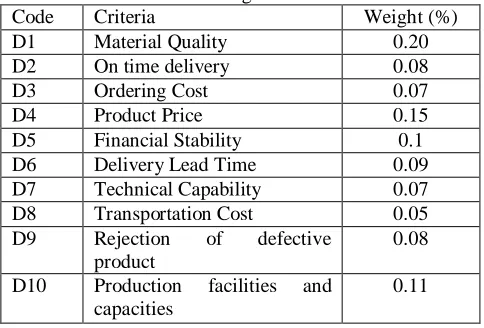
After forming decision making team, Step 1 starts developing an updated pool of supplier selection criteria for the industry, using those accepted criteria given in the literature, as well as those criteria recommended by the experts. In this numerical example, the criteria are selected as shown in Table 1. Selection of criteria is totally industry specific and based on each case the criteria can be changed and replaced. Opinions of decision makers on criteria were aggregated and weights of all criteria have been calculated by organizing the expert meeting. Assuming 4 suppliers are included in the evaluation process, information of each of the suppliers has been mentioned in Table 2. After
P11 P12 --- P1N
781
Copyright © 2011-15. Vandana Publications. All Rights Reserved.
normalizing information and considering weight of criteria in them, negative and positive separation measures, based on normalized Euclidean distance for each supplier is calculated and then final weight of each supplier is calculated.
Table 1. Selecting criteria for supplier evaluation and weight
Code Criteria Weight (%)
D1 Material Quality 0.20
D2 On time delivery 0.08
D3 Ordering Cost 0.07
D4 Product Price 0.15
D5 Financial Stability 0.1
D6 Delivery Lead Time 0.09
D7 Technical Capability 0.07
D8 Transportation Cost 0.05
D9 Rejection of defective
product
0.08
D10 Production facilities and
capacities
0.11
Step 1: Developing Decision Matrix
Table 2: Suppliers information Suppliers
Criteria
1 2 3 4
D1 (%) 95 94 96 90
D2 (%) 90 96 94 91
D3 (INR) 135 150 145 140
D4 (INR) 2800 3500 3000 3100
D5 (Grade) 5 3 6 3
D6 (Day) 12 15 14 10
D7 (%) 46 52 38 40
D8 (INR) 650 470 550 700
D9 (%) 0.02 0.03 0.01 0.02
D10(Grade) 5 4 6 7
Step 2: Calculating the normalized decision matrix
∑
=
=
n
j ij
ij ij
p
p
S
1 2
Table 3 Normalized decision matrix information of suppliers
Suppliers Criteria
1 2 3 4
D1 0.51 0.50 0.51 0.48
D2 0.49 0.52 0.51 0.49
D3 0.47 0.53 0.51 0.49
D4 0.45 0.56 0.48 0.50
D5 0.56 0.34 0.68 0.34
D6 0.47 0.58 0.54 0.39
D7 0.52 0.59 0.43 0.45
D8 0.54 0.39 0.46 0.58
D9 0.47 0.71 0.24 0.47
D10 0.45 0.36 0.53 0.62
Step 3: calculating the weighted normalized decision
matrix;
Vij = Wij*Sij Where J=1……n; i=1……….m;
Table 4: Weighted Normalized decision matrix
information of suppliers
Suppliers Criteria
1 2 3 4
D1 0.1020 0.1000 0.1020 0.0960
D2 0.0392 0.0416 0.0408 0.0392
D3 0.0329 0.0371 0.0357 0.0343
D4 0.0675 0.0840 0.0720 0.0750
D5 0.0560 0.0340 0.0680 0.0340
D6 0.0423 0.0522 0.0486 0.0351
D7 0.0364 0.0413 0.0301 0.0315
D8 0.270 0.0195 0.0230 0.0290
D9 0.0376 0.0568 0.0192 0.376
D10 0.0495 0.0396 0.0583 0.0682
Step 4: Determining the PIS (Positive Ideal Solution) and
NIS (Negative Ideal Solution).
V+ = {0.1020, 0.0416, 0.0371, 0.0840, 0.0680, 0.0522, 0.0413, 0.0290, 0.0568, 0.0396}
V- = {0.0960, 0.0392, 0.0329,0 .0675, 0.0340, 0.0351, 0 .0301, 0.0195, 0.0192, 0.0682}
Step 5: Calculating separation measures E+i calculating
separation measure E
Supplier
Table 5: Positive separation measure of suppliers and Negative separation measure of suppliers
-i
E+
i E
-i
1 0.0320 0.0367
2 0.0353 0.0544
3 0.0462 0.0388
4 0.0534 0.0219
Step 6: Separation measures and the relative closeness
782
Copyright © 2011-15. Vandana Publications. All Rights Reserved.
RESULTS
Table 6: Relative closeness coefficient of suppliers
Supplier Closeness
Coefficient H* i
Rank
Supplier 1 0.534 2
Supplier 2 0.606 1
Supplier 3 0.456 3
Supplier 4 0.290 4
Therefore, the relative closeness coefficients are determined, and four suppliers are ranked. Obtained results have been mentioned in Table-6. Thus, supplier 2 has the best score amongst 4 suppliers.
2. AHP METHOD
The AHP is a procedure designed to quantify managerial judgments of the relative importance of each of several conflicting criteria used in decision making process. In this paper we have used the following steps of AHP to help us to measure the relative importance or the weighted values of several criteria [10].
Step1: List the overall criteria and decision alternatives. Step 2: Develop a pair wise comparison matrix. Step 3: Develop a normalized matrix.
Step 4: Develop priority vector. Step 5: Rank the preferred criteria CASE STUDY
To apply this methodology, assume that the management of HDOL wants to choose their best suppliers for the ammonia gas detector out of 3 different suppliers A, B, C. Based on proposed methodology, above steps are applied for assessment and selection of suppliers.
Intensity of Importance Definition
1 Equal Importance
3 Moderate Importance
5 Strong Importance
7 Very Strong Importance
9 Extreme Importance
2,4,6,8 Intermediate Value
In comparing the alternatives say A and B, if importance of A is 3 with respect to B then importance of B is 1/3 compared to B [3].
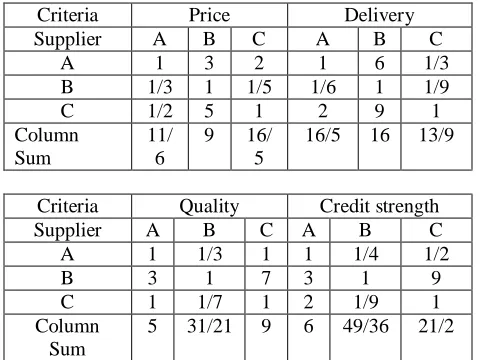
Criteria Price Delivery
Supplier A B C A B C
A 1 3 2 1 6 1/3
B 1/3 1 1/5 1/6 1 1/9
C 1/2 5 1 2 9 1
Column Sum
11/ 6
9 16/
5
16/5 16 13/9
Criteria Quality Credit strength
Supplier A B C A B C
A 1 1/3 1 1 1/4 1/2
B 3 1 7 3 1 9
C 1 1/7 1 2 1/9 1
Column Sum
5 31/21 9 6 49/36 21/2
Each entry divides by the column sum and takes the overall row average. It gives ranking of priorities.
Priority of Price for Supplier A, B, C
(6/11+3/9+10/16)/ 3 0.5012
(6/33+1/9+1/16)/ 3 0.1185
(3/11+5/9+5/16)/ 3 0.3803
Ranking of each alternative is multiply by the weight of sub-criteria or criteria.
Priority wise vector: Following the previous step we can find the Priority of each alternative with 4 criteria’s as shown in table below.
Supplier Price Delivery Quality Credit
Strength
A 0.5012 0.2819 0.1790 0.1561
B 0.1185 0.0598 0.6850 0.6196
C 0.3803 0.6583 0.1360 0.2243
Comparison matrix:
Price Delivery Quality Credit
strength
Price 1 1/5 3 4
Delivery 5 1 9 7
Quality 1/3 1/9 1 2
Credit strength
1/4 1/7 1/2 1
Sum Column
79/12 458/315 27/2 14
783
Copyright © 2011-15. Vandana Publications. All Rights Reserved.
Price Delivery Quality Credit
strength Row Avg.
Pr
ic
e
0.151 0.137 0.222 0.285 0.193
D
eliv
er
y 0.759 0.687 0.666 0.050 0.653
Q
ua
li
ty
0.050 0.076 0.074 0.142 0.086
Cre
di
t
S
tre
ng
th
0.038 0.098 0.037 0.071 0.061
Ranking of alternative = Priority wise vector X Row average of Priority Vectors of alternative
The overall weights for supplier A, B and C are calculated to be 0.3091, 0.1595, and 0.5314 respectively. Ranking of supplier C A B. Hence supplier C is the best alternative.
IV.
CONCLUSION
Supplier selection still remains an explorable field of research. Although methods keep on evolving more complex methods emerge. These methods try to answer one basic question of who’s the best choice; the major non-quantifiable aspect of human emotions still can sway the results towards the undesirable outcome.
Methods like AHP and TOPSIS can only assist in the endeavor of suppler selection and can provide one with the necessary data. But it is also a fact that methods like AHP work well in decision making for many companies. Method for decision making has now shifted from quantitative towards qualitative and performance oriented. Nowadays, Fuzzy TOPSIS and Fuzzy AHP have gained significant popularity. Based on the above review one can say that, In order to achieve best result one must consider the results of such method along with ones experience of supplier selection to gain optimum results.
REFERENCES
[1] Roy, B. (1996) Multicriteria methodology for decision aiding. Kluwer Academic Publishers, Dortrecht.
[2] E. Triantaphyllou, B. Shu, S. Nieto Sanchez, and T. Ray Multi-Criteria Decision Making: An Operations Research Approach, 1998
[3] Hwang, C.L.; Yoon, K. (1981). Multiple Attribute Decision Making: Methods and Applications. New York: Springer-Verlag.
[4] Saaty, T. (1980). The Analytic Hierarchy Process. N. Y. McGraw-Hill.
[5] Yahya, S. & B. Kingsman. (1999). Vendor rating for an entrepreneur development programme: a case study using the analytic hierarchy process method. Journal of
The Operational Research Society 50: 916-930.
[6] Akarte, M.M. (2001). Web based casting supplier evaluation using analytic hierarchy process. Journal of the Operational Research Society 52 (5): 511-522.
[7] Tam, M. C. Y. & V. M. R. Tummala. An Application of the AHP in vendor selection of a telecommunications system, 2001.
[8] Handfield, R., S. V. Walton & Sroufe, R. (2002). Applying environmental criteria to supplier assessment: A study in the application of the Analytical Hierarchy Process. European Journal of Operational Research 141: 70-87.
[9] Yu, X. & S. Jing. (2004). A Decision Model for Supplier Selection Considering Trust. Chinese Business Review 3(6): 15-20.
[10] Pema Wangchen Bhutia, Ruben Phipon Application of AHP and TOPSIS method for supplier selection problem, 2012.
[11] Lyes Benyoucef, Hongwei Ding, Xiaolan Xie, Supplier Selection Problem: Selection Criteria and Methods, 2006.
[12] Hsu-Shih Shiha, Huan-Jyh Shyurb, E. Stanley Lee, An extension of TOPSIS for group decision making, 2006. [13] Farzad Tahriri, Mohammad Rasid Osman, Aidy Ali and Rosnah Mohd Yusuff, A review of supplier selection methods in manufacturing industries, 2008.
[14] C. Lakshmanpriya, Dr. N. Sangeetha & C. Lavanpriya, Vendor Selection in Manufacturing Industry using AHP and ANN, 2013.