37
Copyright © 2011-15. Vandana Publications. All Rights Reserved.
Volume-5, Issue-3, June-2015
International Journal of Engineering and Management Research
Page Number: 37-42
Vermicomposting of Mixed Garden Litter Employing Epigeic Species of
Earthworm
Amit-Krishan1, Ankita-Srivastava2 1
Assistant Professor, Department of Civil Engineering, G.L.Bajaj Institute of Technology and Management, Gr. Noida, INDIA 2
Assistant Professor Department of Civil Engineering, Accurate Institute of Management and Technology, Gr. Noida, INDIA
ABSTRACT
We studied vermicomposting with Eisenia foetida of mixed garden litter with cow dung in 3:1 ratio, in a 180 day composting experiment. The change in chemical characteristics of mixed substance measured at 45 days intervals. The Vermicomposting resulted in significant reduction in pH (9.4 to 7.8), total organic carbon (9.84 to 8.38%), and C: N ratio (46 to 27) and increase in total Kjeldahl nitrogen (0.21 to 0.302%), ammonical nitrogen (8.78 to 16.0 mg/kg), nitrate nitrogen (85.89 to 9.2 mg/kg), available phosphate (4.34 to 7.6 mg/kg) and total potassium (6.14 to 8.9 mg/kg) after 180 days of composting. The study revealed that vermicomposting might be an efficient technology to convert negligible organic solid waste to value added product.
Keywords— Epigeic, mixed garden litter, solid waste, vermicompost
I.
INTRODUCTION
Now a day the organic solid wastes are growing rapidly with increased human population, intensive agriculture and rapid industrialization. In many developing countries like India, mixed garden litter produced from private or public gardens and kitchen gardens form a major component of putrefying organic waste. These wastes are either disposed in landfill sites, roadsides and waterways or set on fire. The ash produced adds only some of NPK content back to the soil. The burning of litter also adds to air pollution [1]. The disposal of wastes has become important for a healthy quality of environment [2].
Treatment and reprocessing of organic waste on site by vermicomposting is the most economical and sustainable option for organic waste management. It is easy to operate, manage and can be conducted in contained space provided to produce good quality product as it is a
natural process which is currently practiced with various modifications.
The ability of some earthworm species to consume a wide range of organic residues such as sewage sludge, animal wastes, crop residues, and industrial refuse has been well-established [3-6]. The most common species of earthworm for the breakdown of organic wastes are Eisenia foetida and its related species Eisenia andrei. Both of these species can grow and reproduce well in different organic waste with wide range of moisture content and can have a wide temperature tolerance as both species are prolific.
Potential and effective utilization of vermicomposts have been examined in the horticultural and agricultural industries, by various researchers. Vermicompost usually enhances seedling growth, development and productivity of wide variety of crops when used as soil additives or as components of horticultural media [7-12]. Enhancement in plant growth and productivity is based upon physical and chemical characteristics of the processed materials. Vermicomposts are finely- divided peat-like materials with high porosity, aeration, drainage, and water-holding capacity [7]. They have strong absorption capability and retention of nutrients due to their large surface area [13].
Apart from providing organic carbon and NPK, vermicompost is believed to have additional attributes of providing enzymes and hormones which stimulate plant growth [14-18]. Vermicompost is also believed to be more pathogen-free than compost [19-20]. In view of this we have explored the possibility of generating vermicompost from mixed garden litter.
38
Copyright © 2011-15. Vandana Publications. All Rights Reserved.
litter with cow dung. Chemical changes were studied to determine the suitability of Eisenia foetida for vermicomposting.
II.
METHODOLOGY
2.1 Designing of Vermicompost Tank
Three tanks were designed for performing the experiment. The volume of each tank was 64 ft3. The tank was constructed by masonry brick and plastered arranged in series. All tanks were interconnected with small hole in its partition walls. This interconnection was made for movement of earthworm from one tank to another. Another small hole was provided in bottom of tank for collection of excess water or vermiwash. Tanks were constructed in shady area or shade was maintained by using some shading material like asbestos.
2.2 Organic wastes and earthworms
1 part cow dung and 3 parts of mixed garden litter were the raw materials used for this project. Paddy husk was used as upper cover of tank. The mixed garden litter was collected from the A N College, Patna, Bihar campus and cow dung and paddy husk were collected from villages near by A N College, Patna, Bihar. The culture of earthworms (Eisenia foetida) was obtained from the Tarumitra Ashram, Digha Ghat, Patna, Bihar.
2.3 Startup Process & Loading of tanks with raw waste materials
The start-up process begins with culture of earthworm in vermibed. Cow dung was used as culturing material for Eisenia foetida. Tanks were filled with cow dung which was 3-4 day old because fresh cow dung contains lot of bacteria which inhibit its growth. Cow dung spread over bottom of floor of tank in form of layer roughly about 1 ft. Earthworms were slowly released in tanks and a thick layer of cow dung was spread to cover the earthworms. Temperature and moisture of medium was measured and maintained. Temperature was in between 30±30
A composite sample was taken before the introduction of earthworms and analysed for raw material
characteristics. Other composite samples of degraded material were taken and analysed at 45 days interval as prescribed in manual for compost issued by Central Pollution Control Board, New Delhi and Standard Methods. All the determination was carried out in triplicate. All the reported data are the arithmetic means of three replicates.
III.
RESULT AND DISCUSSION
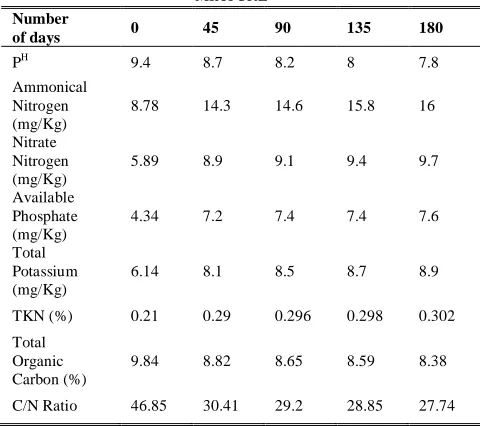
The pH, total organic carbon, Total Kjeldahl Nitrogen (TKN), nitrate nitrogen, C: N ratio, available phosphate and total potassium were analysed in each sample of vermicompost and also for raw material before vermicomposting started. The result is presented in TableI. 3.1 Impact of Vermicomposting on pH
The analysis report (Figure 1) shows that the pH of raw material was 9.4 which strongly alkaline in nature but after vermicomposting it was 7.8 which was slightly alkaline. The lower pH in the final vermicompost might have been due to the production of CO
C and moisture was around 50% through sprinkling of water. The upper surface of vermibed was covered by thin layer of paddy husk. Paddy husk prevent temperature fluctuation and moisture fluctuation in between environment and vermibed and also it works as a stabilizer. The maximum duration of culturing of earthworm was about 10 weeks. In the above duration population of earthworm got increases to 1 lakhs. It was sufficient to start the experiment. The tanks were loaded with definite proportion of crushed garden litter and cow dung in 3:1 ratioof mixed garden litters and cow dung. The maximum width of layer was 2 feet. After 180 days the composting was completely over with a result of blackish sponge, light earthen material called vermicompost.
2.4 Sampling and Analysis
2 and organic acids by microbial metabolism during the process of decomposition of substrates in the feed mixture [5,23-25]. Similar results on vermicomposting of cattle manure, fruit and vegetable wastes have been reported [26-27]. The decline in pH was also might be due to the higher mineralization of nitrogen and phosphorous into nitrate/ nitrates and orthophosphate [24]. Decrease in pH is an important factor in nitrogen retention as this element is lost as volatile ammonia at higher pH [28].
TABLE I
COMPOSITION OF RAW MATERIAL & VERMICOMPOST MIXTURE
Number
of days 0 45 90 135 180
PH 9.4 8.7 8.2 8 7.8
Ammonical Nitrogen (mg/Kg)
8.78 14.3 14.6 15.8 16
Nitrate Nitrogen (mg/Kg)
5.89 8.9 9.1 9.4 9.7
Available Phosphate (mg/Kg)
4.34 7.2 7.4 7.4 7.6
Total Potassium (mg/Kg)
6.14 8.1 8.5 8.7 8.9
TKN (%) 0.21 0.29 0.296 0.298 0.302
Total Organic Carbon (%)
9.84 8.82 8.65 8.59 8.38
39
Copyright © 2011-15. Vandana Publications. All Rights Reserved.
Figure 1: Variation of pH during vermicomposting.
3.2 Nutritional value of vermicompost
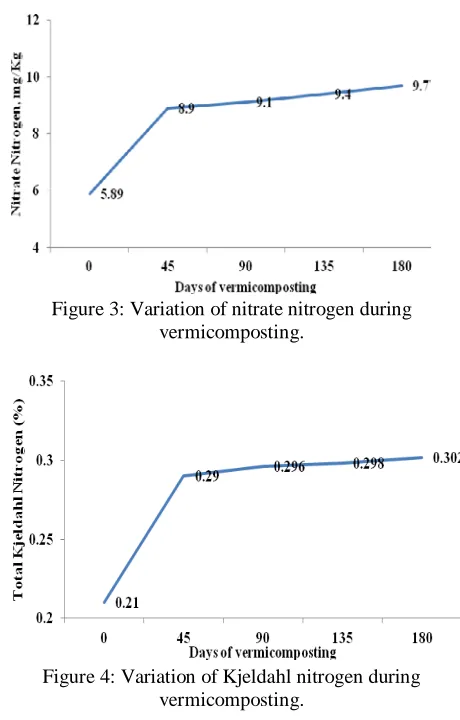
After the analysis of vermicompost it was observed that the raw material has been converted into valuable nutritional product. After 180 days, Eisenia foetida produced a vermicompost which has 82%, 64%, 75%, 44%, 43% and 14% increase in ammonical nitrogen, nitrate nitrogen, available phosphate, total phosphate, and total Kjeldahl nitrogen respectively than the raw material used. Vermicomposting resulted in increase in the total Kjeldahl nitrogen of the raw material from 0.21% to 0.302%. It has been shown in figure 2, 3 and 4. The significant increase in the ammoniacal nitrogen is probably due to mineralization of the organic matter. Earth worms enhance nitrogen mineralization and involve more in the nitrogen transformations in manure so that the mineral nitrogen may be retained in the nitrate form [29]. The enhancement of nitrogen content may be due to loss of organic carbon [30].
Figure 2: Variation of ammonical nitrogen during vermicomposting.
Figure 3: Variation of nitrate nitrogen during vermicomposting.
Figure 4: Variation of Kjeldahl nitrogen during vermicomposting.
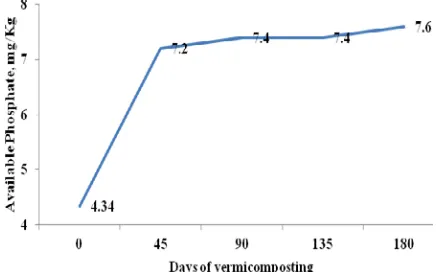
The initial available phosphorous of the raw material was 4.34 mg/kg and final was in the range of 7.6 mg/kg as shown in figure 5. The increase in available phosphorous is due to the passage of ingested material through earthworms and also due to the stimulation of microbial flora [31]. The microbial flora also increases the total potassium in the final product.
40
Copyright © 2011-15. Vandana Publications. All Rights Reserved.
Figure 5: Variation of available phosphorus during vermicomposting.
Figure 6: Variation of total potassium during vermicomposting.
3.3 Organic carbon and C/N ratio
The study revealed that the organic carbon and C/N ratio of vermicompost is decreased from 9.84 to 8.38 and 46.85 to 27.74 respectively as shown in figure 7 and 8. The organic C is lost as CO2 and total N increases during decomposition of organic waste by microbial action. The final N content of compost is dependent on the initial N present in the waste and the extent of decomposition [33-34]. Decomposition involves microflora present in the intestine of worms and gut enzymes, as well as its presence in the waste [35-37]. Presence of earthworms result in enhanced organic matter decomposition, which results in lowering of C: N ratio [10,38-40].
Figure 7: Variation of total organic carbon during vermicomposting.
Figure 8: Variation of C: N ratio during vermicomposting.
IV.
CONCLUSION
The overall study concludes vermicomposting as an alternative technology for managing biodegradable organic solid waste. Vermicompost produced by mixing cow dung and garden litter (1:3) for 180 days using exotic earthworms (Eisenia foetida) were less in total organic carbon and C:N ratio but rich in ammonical nitrogen, nitrate nitrogen, available phosphorus, total potassium and TKN. This vermicompost is analysed as better organic manure on the basis of nutrient content. Result reveals that vermicomposting is a better technology for conversion of mixed garden litter to value added material.
REFERENCES
[1] S. A. Abbasi, In: Environmental Pollution and its Control, second ed. Cogent International, Philadelphia and Pondicherry, (1999) 442.
[2] B. K. Senapati, J. M. Julka, Selection of suitable vermicomposting species under Indian conditions. In: Earthworm Resources and Vermiculture. Zoological Survey of India, Culcutta.(1993) 113– 115.
41
Copyright © 2011-15. Vandana Publications. All Rights Reserved.
potential role of the earthworm, Eiseniafoetida. Journal of Environmental Quality (1980) 9, 373–378.
[4] C. A. Edwards, I. Burrows, K. E. Fletcher, B. A. Jones, The use of earthworms for composting farm wastes. In: J.K.R Gasser, (ed) Composting Agricultural and Other Wastes. Elsevier, London and New York, (1985) 229–241. [5] P. L. S. Chan, D. A. Griffiths, The vermicomposting of pre-treated pig manure. Biological Wastes (1988)24, 57– 69.
[6] R. Hartenstein, M. S. Bisesi, Use of earthworm biotechnology for the management of effluents from intensively housed livestock. Outlook on Agriculture (1989)18, 3–7.
[7] C. A. Edwards, I. Burrows, The potential of earthworm composts as plant growth media. In: C. A. Edwards, E. Neuhauser, (eds) Earthworms in Waste and Environmental Management. SPB Academic Press, The Hague, The Netherlands, (1988) 21–32.
[8] D. P. Wilson, W. R. Carlile, Plant growth in potting media containing worm-worked duck waste. Acta Horticulturae (1989) 238, 205–220.
[9] J. C. Buckerfield, K. A. Webster, Worm-worked waste boosts grape yields: prospects for vermicompost use in vineyards. Australian and New Zealand Wine Industry Journal (1988)13, 73–76.
[10] C. A. Edwards, The use of earthworms in the breakdown and management of organic wastes. In: C. A. Edwards, (ed) Earthworm Ecology. CRC Press, Boca Raton, FL, (1998) 327–354.
[11] S. Subler, C. A. Edwards, J. Metzger, Comparing composts and vermicomposts. Bio- Cycle (1998) 39, 63– 66.
[12] R. M. Atiyeh, S. Subler, C. A. Edwards, J. Metzger, Growth of tomato plants in horticultural potting media amended with vermicompost. Pedobiologia (1999)43, 1–5. [13] Z. Shi-wei, H. Fu-zhen, The nitrogen uptake efficiency from 15N labeled chemical fertilizer in the presence of earthworm manure (cast). In: G. K. Veeresh, D. Rajagopal, C. A. Viraktamath, (eds) Advances in Management and Conservation of Soil Fauna. Oxford and IBH publishing Co., New Delhi, Bombay, (1991) 539– 542.
[14] S. A. Abbasi, E. V. Ramasamy, Biotechnological Methods of Pollution Control. Orient Longman (Universities Press India Ltd.), Hyderabad, India,(1999) 168p.
[15] R. M. Atiyeh, C. A. Edwards, S. Subler, J. D. Metzger, Pig manure vermicompost as a component of a horticultural bedding plant medium: effects on physicochemical properties and plant growth. Bioresource Technology (2001) 78, 11–20.
[16] R. M. Atiyeh, S. Lees, C. A. Edwards, N. Q. Arancon, J. D. Metzger, The influence of humic acids derived from earthworm processed organic wastes on plant growth. Bioresource Technology (2002) 84, 7–14.
[17] B. M. Doube, P. M. L. Williams, P. J. Willmott, The influence of two species of earthworm (Aporrectodeatrapezoides and Aporrectodearosea) on the growth of wheat, barley, and faba beans in three soil types in the greenhouse. Soil Biology and Biochemistry (1997) 29, 503–509.
[18] H. I. Chaoui, L. M. Zibilske, T. Ohno, Effects of earthworm casts and compost on soil microbial activity and plant nutrient availability. Soil Biology and Biochemistry (2003) 35, 295–302.
[19] M. M. Szczech, Suppressiveness of vermicompost against Fusarium wilts of tomato. Journal of Phytopathology—PhytopathologischeZeitschrift, (1999) 155–161.
[20] K. Slocum, Pathogen reduction in vermicomposting. Worm Digest (2002) 23, 27–28.
[21] M. Mpoame, A. G. Nguekam, Effect of various substrates on production of Eudriluseugeniae (Oligochaeta). Tropicultura (1994) 12, 91 – 93.
[22] C. Elvira, L. Sampedro, J. Dominguez, S. Mato, Vermicomposting of waste water sludge from paper pulp industry with nitrogen-rich material. Soil Biol. Biochem. (1996) 29, 759 – 762.
[23] APHA, Standard Methods for the Examination of Water and Wastewater, 21st Ed., American Public Health Association, Washington, DC, 2005.
[24] Kaviraj and S. Sharma, Bioresour Technol., (2003) 90(2), 169-173
[25] E. Albanell, J. Plaixats, and T. Cabrero, Biol Fert Soil., (1988) 6(3), 266-269
[26] J. Haimi, V. and Hutha, Biol Fert Soil., (1986) 2(1), 23-27
[27] C. A. Edwards, and J. R. Lofty, Biology of Earthworms. Chapman and Hall, London (1972).
[28] A. Mitchell, Soil Biol Biochem., (1997) 29(3-4), 763-766.
[29] M. Viel, D. Sayag, D., and L. Andre, Elsevier ApplSci Essex., (1987) 230-237.
[30] P. Garg, A. Gupta, and V. Santosh, Satya, Bioresour Technol., (2006) 97(3), 391-395.
[31] G. P. Mansell, J. K. Syers, and P. E. H. Gregg, Soil Biol Biochem., (1981) 13(2), 163-167
[32] R. M. Atiyeh, J. Dominguez, S. Subler, C. A. and Edwards, Pedobiologia, (2000) 44(6), 709-724
[33] J. H. Crawford, Review of composting. Process Biochem. (1983)18, 14-15.
[34] A. C. Gaur, G. Singh, Recycling of rural and urban wastes through conventional and vermicomposting. In: H.L.S. Tandon, (1995)
[35] T. G. Piearce, Gut contents of some lumbricid worms. Pedobiologia (1978) 18, 153-157.
[36] R. A. Whiston, K. J. Seal, The occurrence of cellulases in the earthworm Eiseniafoetida. Biol. Wastes (1988) 25, 239-242.
42
Copyright © 2011-15. Vandana Publications. All Rights Reserved.
(Lumbricusrubellus) Indian J. Environ. Prot. (1991)11, 680-682.
[38] O. T. Fosgate, M. R. Babb, Biodegradation of animal waste by Lumbricusterrestris. J. Dairy Sci. (1972) 55, 870-872.
[39] R. D. Kale, K. Bano, R. V. Krishnamoorthy, Potential of Perionyxexcavatus for utilization of organic wastes. Pedobiologia (1982) 23, 419-425.