The Thirty-Third AAAI Conference on Artificial Intelligence (AAAI-19)
A Layer-Based Sequential Framework for Scene Generation with GANs
Mehmet Ozgur Turkoglu,
1William Thong,
2Luuk Spreeuwers,
1Berkay Kicanaoglu
2 1University of Twente,2University of Amsterdam[email protected], [email protected],{w.e.thong, b.kicanaoglu}@uva.nl
Abstract
The visual world we sense, interpret and interact everyday is a complex composition of interleaved physical entities. There-fore, it is a very challenging task to generate vivid scenes of similar complexity using computers. In this work, we present a scene generation framework based on Generative Adversar-ial Networks (GANs) to sequentAdversar-ially compose a scene, break-ing down the underlybreak-ing problem into smaller ones. Different than the existing approaches, our framework offers an explicit control over the elements of a scene through separate back-ground and foreback-ground generators. Starting with an initially generated background, foreground objects then populate the scene one-by-one in a sequential manner. Via quantitative and qualitative experiments on a subset of the MS-COCO dataset, we show that our proposed framework produces not only more diverse images but also copes better with affine transformations and occlusion artifacts of foreground objects than its counterparts.
Introduction
The visual world we sense, interpret and interact everyday is a complex composition of interleaved physical entities. Scenes we perceive can then be altered due to accidental factors such asocclusionscaused by inter-entity interactions andself-occlusionscaused by differing vantage points with respect to the camera. These factors do not only make the problem harder but also diversifies the possible space of con-figurations given a fixed set of observable entities. Conse-quently, scene generation is challenged by high sample com-plexity in addition to photorealism constraints.
Scene generation problem has been studied extensively in (Hertzmann et al. 2001; Tappan 2008; Chen et al. 2009; Isola and Liu 2013), however the interest has certainly ex-panded with the advent of Generative Adversarial Networks (GANs) (Goodfellow et al. 2014). Although recently there have been great strides in the quality and resolution of gen-erated images (Miyato et al. 2018; Wang et al. 2018), it has mostly been addressed as learning a mapping from asingle source,e.g.noise or semantic map, totarget,e.g.images of giraffes, discarding almost all of the underlying complexity that forms a scene. This formulation sets two major restric-tions on(i)ability to control scene elements,e.g.”What
ob-Copyright c2019, Association for the Advancement of Artificial Intelligence (www.aaai.org). All rights reserved.
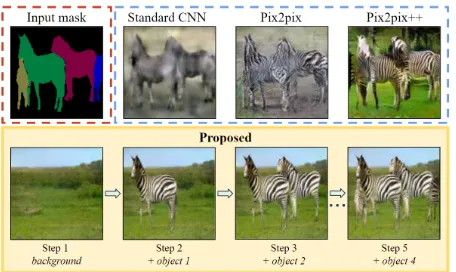
Figure 1: The proposed image generation process. Given a semantic layout map, our model composes the scene step-by-step. The first row shows the input semantic map and im-ages generated by state-of-the-art baselines.
jects will appear?” or ”How will they appear?”,(ii)ability to manipulate an existing scene,e.g.”Make that cow larger!”, while keeping rest of the scene unaltered. One possible ex-planation is that a single source representation such as a noise vector z is insufficient to explain all the complexity involved in describing a scene meaningfully.
In this paper, we tackle the scene composition task with a layered structure modeling approach. This formulation helps reducing the complexity of the problem since we deal with one subproblem at a time. Furthermore, our framework al-lows for explicit control mechanisms at multiple levels such as scene layout and individual object appearances which lack in the previous approaches.
Our main idea resembles how a landscape painter would first sketch out the overall structure,e.g.first a background such as mountain ranges or rivers, and later embellish the scene gradually with other elements to populate the scene,
model simultaneously aims to preserve the previously drawn background scene and added entities.
We propose a novel image generation framework to sequentially compose a scene, element-by-element. We achieve this by an explicit control over the elements of a scene through separate background and foreground ators. This allows user control over the objects to gener-ate, as well as, their category, their location, their shape and their appearance. Moreover, the sequential composi-tion better handles affine transformacomposi-tions of objects and bet-ter copes with object occlusions than existing conditional GAN models. Experiments are carried out on a subset of the MS-COCO dataset. Both qualitative and quantitative re-sults show the strength and the advantages of the proposed sequential framework for scene composition compared to state-of-the-art image generation baselines.
Related work
Conditional Image Generation.Various approaches have been proposed to control the generation process by condi-tioning on a class label (Odena, Olah, and Shlens 2017), an attribute vector (Kaneko, Hiramatsu, and Kashino 2017; Ding, Sricharan, and Chellappa 2018), a text descrip-tion (Reed et al. 2016a; Johnson, Gupta, and Fei-Fei 2018), or a semantic map (Isola et al. 2017; Hong et al. 2018). Reed et al. learn to control the foreground object location by con-ditioning on bounding boxes and keypoint coordinates. Isola et al. propose conditional adversarial networks as a general purpose solution to image-to-image translation problems. Their model can generate a scene from a semantic layout map similar to our work. Nevertheless, the image diversity and the limited control over scene elements are limited.
Wang et al. address these limitations of previous con-ditional models and propose a feature-embedding approach using additional encoder network in order to improve the diversity and controllability. Similar to our method, their method allows an element-level control; however, they use pre-defined low-dimensional feature map to control the ap-pearance of the elements which may limit the diversity.
Park, Yoo, and Kwak introduce a new method to learn to generate a foreground object image by conditioning on both the text description, the foreground object mask, and the given background image without altering it. This is the most relevant work to our paper. However, the method can only generate a single foreground object when the background image is given. In contrast, our framework can generate both a background and an arbitrary number of foreground objects. Sequential Image Generation.A coarse-to-fine generation process can be cast as a sequential image generation process. Denton et al. introduce a sequential model with a cascade of generative models, each of them captures the image struc-ture at a particular scale of a Laplacian pyramid. Zhang, Xu, and Li improve the image quality by increasing image reso-lution with a two-stage GANs. Song, Zhang, and Qi generate a face image from a small face patch iteratively. They refine the image by transformations between two image manifolds. These approaches differ significantly with our method but we share the same insights to generate an image sequentially by decomposing the generation process in smaller subtasks.
Similar to our method, Lin et al. and Yang et al. adopt a layered structure modeling and compose a scene sequen-tially. However, Lin et al. focus on finding the appropriate geometric transformation of an object in a background lay-out, in an iterative manner. In our work, the user defines the geometry of the object and no transformation is involved. Their objective is then orthogonal to ours. Yang et al. focus on the unsupervised discovery of object masks, in a layer-wise process. Contrary to our work, the foreground genera-tor produces a foreground mask instead of being conditioned on it. Such a scheme does not provide the same level of controllability and flexibility as ours. Moreover, their exper-iments were restricted to one object instance per image com-pared to 2.61 instances per image on average in our case.
Methodology
Problem formulation
The objective is to compose a realistic scene while allow-ing element-level control. In this work, a scene is defined as a composition of background and foreground elements. At training time, we are given a set of imagesx∈RH×W×3’s
and associated semantic layout maps M’s drawn from a joint probability distributionp(x, M). Our goal is to learn a function Φ : M → x which maps a semantic layout map to a scene image. Φ models the conditional proba-bility distribution p(x|M). In our formulation, a seman-tic layout map M consists of a set of foreground object masksM ={M1, . . . , MT}whereT is a number of
fore-ground objects in the scene and Mt ∈ {0,1}H×W×N is
a binary tensor that defines the tth foreground object lo-cation, size, shape, and class with N being the number of object categories in the dataset. For convenience, we de-fine two additional variables: (1) an aggregated semantic map Magg = maxt∈{1...T}Mt ∈ {0,1}H×W×N that is
obtained by taking the maximum value for each element in the set and (2) an occupancy map mocc
t ∈ {0,1}H×W
(mocct(ij) = maxn∈{1...N}Mt(ijn)) whose element is 1 if the
corresponding pixel is occupied by a foreground object. At both training and inference steps, the scene genera-tion process is then condigenera-tioned on bothM and a collection of noise vectors z. A new noise vector is sampled from a normal distribution for every step of the generation process, which gives individual control over the appearance of the generated elements.
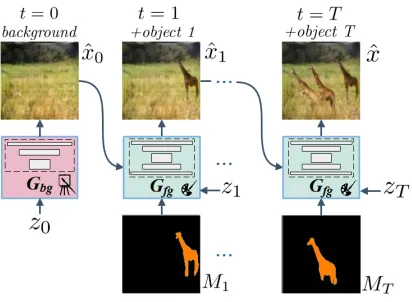
Consider Figure 2. The main objective is broken down into two simpler sub-tasks. First, we generate the back-ground canvasxˆ0 with the background generatorGbg
con-ditioned on a noise z0. Second, we sequentially add
fore-ground objects with the forefore-ground generatorGf g to reach
the final imagexˆ (= ˆxT), which contains the intendedT
foreground objects on the canvas.
Background generator The background model generates a background image without any foreground objects, similar to background distribution of the training images. The ar-chitecture consists of two main branches: (1) the first branch generates a background image xˆ0 from a noise vectorz0;
Figure 2: The proposed framework overview.Gbg,Gf g are
the background and foreground generators, respectively.
first branch. The second branch is then similar to an image translation problem, except that it is also conditioned on the features from the first branch. At inference time, we discard the second branch and only keep the first branch.
For training, we define an interleaved loss function for each branch: (1) A reconstruction loss Lrec measures the
L2 distance between a generated scene xˆ0
0 and its
gener-ated backgroundxˆ0.Lrec only penalizes pixels outside of
the foreground masks.
(1)
Lrec=Ez0,M[||(1−m
occ
agg)(ˆx0−xˆ00)||2]
is a pixel-wise multiplication and similar tomocc t ,moccagg
is an occupancy map obtained from Magg (moccagg(ij) =
maxn∈{1...N}Magg(ijn)). (2) An adversarial lossLadv
en-courages fakexˆ00images to look like real imagesx. By using these two losses together, the discriminator implicitly con-siders pixels outside of the foreground mask and this for-mulation gives freedom to implicitly inpaint the foreground regions inxˆ0.
(2)
Ladv=E(x,M)[logD(x, Magg)]
+Ez0,M[log(1−D(ˆx 0
0, Magg)]
Additionally, we apply a feature matching lossLf monˆx00
to stabilize the training (Salimans et al. 2016). So the overall objective is the following:
(3)
L=Ladv+λrLrec+λf mLf m
whereλ’s are trade-off parameters set empirically.
Foreground generator The foreground generator draws elements of a scene one-by-one. It modifies the canvas within a region or a subset of pixels. Its design makes it aware of the previously generated scene in terms of seman-tic content and global image illumination. It takes as input the previously generated scenexˆt−1, the current foreground
object maskMt, and a noisezt. We illustrate the model in
Figure 4. The action ofGf gover the scenexˆt−1at time step
tcan be expressed as follows:
(4) ˆ
xt=Gf g((1−mocct )xˆt−1, Mt, zt)
Figure 3: The background model network architecture. The
Gbg generates two images: (1) the background image, xˆ0
and (2) the scene image,xˆ00that is conditioned on a semantic layout map,Magg.
In this formulation, the foreground object generated by
Gf g is conditioned on the previous scene (xˆt−1) ignoring
the regions Mt hides. This formulation allows us to
ap-proach object generation as an image inpainting problem. As a result the foreground model can be trained similar to GANs-based image inpainting models (Pathak et al. 2016; Iizuka, Simo-Serra, and Ishikawa 2017) instead of recurrent training. During training, real images are used as an input to the generator. For each forward pass, one foreground ele-ment within the selected image is randomly picked and used.
Gf gis trained in an adversarial scheme. Two discriminators DglobalandDlocalare jointly trained withGf g.Dglobal
en-courages a global image realism:
Lglobal =E(x,M)[logDglobal(x, Magg)]
+Ezt,(x,M),Mt[log(1
−Dglobal(Gf g((1−mtocc)x, Mt, zt), Magg))]
(5)
while Dlocal encourages the foreground object realism by
focusing on the foreground region:
Llocal
=E(x,M)[logDlocal(I(x),I(Magg))]
+Ezt,(x,M),Mt[log(1
−Dlocal(I(Gf g((1−mocct )x, Mt, zt)),I(Magg)))]
(6)
where I denotes fully-differentiable bilinear interpolation operation that crops the region of interest (object bounding box) and scale it to original spatial sizes. The third loss de-fined in Eq. (7) encourages the generator to reconstruct the input image outside the bounding-box,bocc
t ∈ {0,1}H×W.
The idea for using a bounding-box instead of a mask,mocc t
is to give the generator,Gf g more flexibility to modify the
surrounding of the object accordingly.
Lrec
=Ezt,x,Mt[||(1−b
occ
t )(Gf g((1−mocct )x, Mt, zt)−x)||2]
(7)
Also, the feature matching lossLf mis imposed as similar in
Figure 4: The foreground model network architecture. The
Gf gencodes the given object semantic structure,Mtand the
previously generated scene ˆxt−1 using separate pathways
and generates a new image,xˆt.
(8)
L=Lglobal+λlLlocal+λrLrec+λf mLf m
whereλ’s are trade-off parameters set empirically.
Following Zhu et al., the noise representation is con-catenated at both the output of the encoder and within the decoder to increase stochasticity. Besides, skip connec-tions (Ronneberger, Fischer, and Brox 2015) are added to improve the reconstruction process (see Figure 4).
Experimental setup
Dataset
MS-COCO dataset (Lin et al. 2014) is used to evaluate the performance of our proposed model. The dataset contains 164K training images over 80 semantic classes. Images are annotated with object semantic masks and bounding boxes. MS-COCO contains images with multiple objects in natural environments and under different viewpoints. To ease the scene composition problem, six semantically-related cate-gories are chosen:sheep,cow,bear,elephant,giraffe and
zebra. These classes have a similar background distribution and there are around 11K images in total for these classes.
Baselines
We compare our proposed sequential model against three different baselines both quantitatively and qualitatively. All baseline models are non-sequential. They only learn a map-ping from the semantic masks to the real image domain. In all experiments, the image size is set to 128x128 pixels.
Standard CNN is a simple baseline without an adversar-ial loss. It learns a mapping from a semantic layout to a real image with an L1 reconstruction loss. The mapping is deter-ministic, i.e. the model is memorizing all the training sam-ples. The architecture is similar to Pix2Pix (described be-low) but without a discriminator.
Pix2pix is the state of the art baseline for the image-to-image translation problem (Isola et al. 2017). Pix2Pix is de-signed to learn a mapping from one image domain to another image domain. In our case, the task is to map the semantic layout domain to the real image domain. Similar to a condi-tional GANs, Pix2Pix is conditioned on a semantic layout.
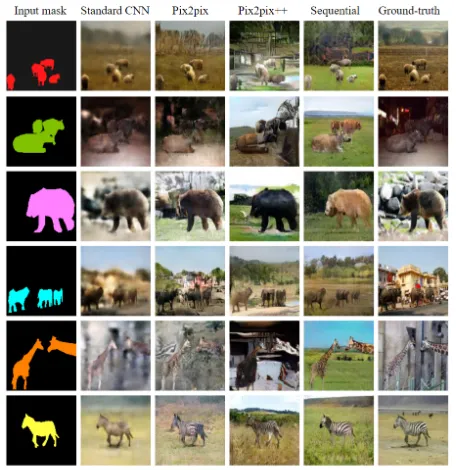
Figure 5: Comparison with state of the art models using ob-ject masks from the training set. From top to bottom:sheep,
cow,bear,elephant,giraffeandzebra. The ground truth cor-responds to to the original image.
In order to stabilize the training, the L1 reconstruction loss is utilized. Despite the adversarial training, the stochasticity of the generated images is limited. Randomness is provided only in the form of dropout, which is applied on several lay-ers of the generator at both training and test time. Pix2pix is trained exactly as described in (Isola et al. 2017).
Pix2pix++ is an enhanced version of Pix2Pix. Since the publication of Pix2Pix, there has been several improvements for the training of GANs architectures that we adopt in our proposed sequential model. For fair comparisons between Pix2Pix and our method, we apply these additional tech-niques. Hence, Pix2Pix++ consists in the same discriminator and generator architectures as our proposed model. More-over, it also integrates a spectral normalization in the dis-criminator and a feature matching loss.
Evaluation metrics
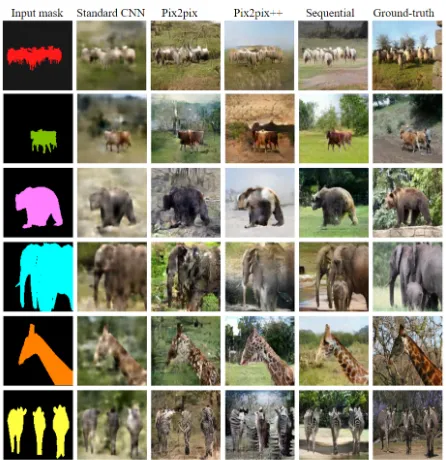
Figure 6: Comparison with state of the art models using object masks from the validation set. From top to bottom:
sheep,cow,bear,elephant,giraffe andzebra. The ground truth corresponds to the original image.
Semantic segmentation accuracy. An indirect way to measure the generated image quality is to perform semantic segmentation with an off-the-shelf model (Isola et al. 2017; Wang et al. 2018; Zhu et al. 2017a). In our experiments, we used Deeplab (Chen et al. 2018) pre-trained on the MS-COCO dataset as a segmentation model. We then measure the Intersection-over-Union (IoU) score, which computes the ratio the intersection over the union of the semantic prediction and ground truth regions. Similarly to the FID score, we report the mean IoU score based on 10k generated images conditioned on random noise vectors and semantic maps of the training set. Additionally, we also compute the mean IoU scores on the images generated conditioned on semantic maps of the validation set (450 images).
Implementation details
Following Miyato et al., both generator and discriminator architectures are based on ResNet. A spectral normalization regularizer is also applied during training. Parameters are updated with the Adam optimizer (β1= 0,β2= 0.9,
learn-ing rate of2e−4and divided by 2 every 80 epochs) (Kingma and Ba 2014). All the models are trained for 480 epochs with a batch size of 16. The parameters of the generators are updated after 5 updates of the discriminator. The trade-off hyper-parameters in the foreground generator loss func-tion (Eq. 8) are set to λl = 0.1,λr = 1e−5,λf m = 1
and in the background generator loss function (Eq. 3) to
λr = 100, λf m = 1. The code is available at https:
//github.com/0zgur0/Seq Scene Gen.
Method FID
Standard CNN 120.7
Pix2Pix 34.0
Pix2Pix++ 24.0
Sequential (proposed) 28.7 Sequential (bg from Pix2pix++) 23.2
Table 1: Frechet Inception distance (lower the better). Our proposed model with background swapping outperforms the other baselines.
Results
Comparison with state of the art
Figure 5 compares the visual result of the different baselines for the scene generation task for the six object classes in the dataset. The standard CNN produces blurry results de-spite an L1 loss to remediate this particular issue. Pix2Pix generates sharper images. However, both the standard CNN and Pix2Pix try to replicate the ground truth, which shows that it only memorizes the dataset. They lack stochastic-ity in the generation process, which dampens the diversstochastic-ity in the generated images. This behaviour should be avoided because the objective is to produce realistic scenes, not to mimic the scenes in the dataset. Diversity and image quality improve when adding the latest GANs training techniques as showcased in Pix2Pix++ and our proposed model. How-ever, Pix2Pix++ seems to struggle when multiple objects are present (row 1, 2, 4 and 5). It cannot produce a plausi-ble scene. Our model explicitly separate the foreground and background generation process, which overcomes these is-sues.
Figure 6 depicts samples generated using masks from the validation set. Compared to Figure 5, it shows the general-ization power of the different baseline models. The issues encountered by the respective baselines in Figure 5 are em-phasized in Figure 6. The standard CNN and Pix2Pix tend to produce an uniform background whereas the other two methods usually add a sky or trees besides the ground. Simi-larly, our proposed sequential model better handles multiple objects in a scene. The elephant sample (row 4) is an ex-ample. Our sequential model distinguishes three elephants while Pix2Pix++ only outputs one non-realistic object.
pro-Method Mean IoU
Train Val.
Standard CNN 0.298 0.272
Pix2Pix 0.504 0.480
Pix2Pix++ 0.608 0.605
Sequential (proposed) 0.650 0.650
Ground truth 0.803 0.770
Table 2: Semantic segmentation accuracy (higher the better). The ground truth score is computed on the original images in the dataset and acts as an upper bound. Our proposed se-quential model outperforms the other baselines.
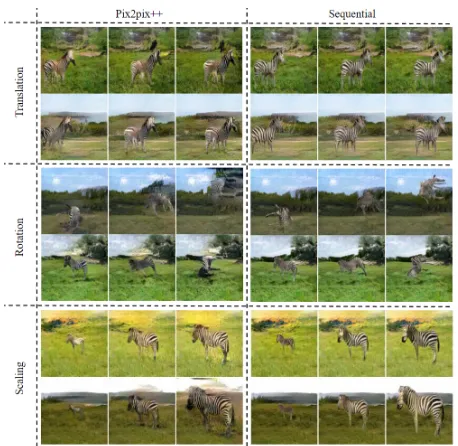
Figure 7: Object mask affine transformations. Pix2Pix++ cannot preserve the scene. It either changes the background, blend the foreground and background or suffer from color bleeding. Our model does not suffer from these artifacts.
posed model with the generated background of Pix2Pix++. After the swapping, the FID score drops and is lower than Pix2Pix++, which shows that the foreground objects are bet-ter generated. Second, Table 2 presents the mean IoU scores. In this experiment, an off-the-shelf model (Chen et al. 2018) segments the generated images. The ground truth (last row) corresponds to the mean IoU scores of the original images in the training or validation set. It then acts as an upper bound. Adding an adversarial loss improves significantly the mean IoU score. Indeed, there is a jump of 0.3 point from the stan-dard CNN to Pix2Pix. Adding the latest GANs training tech-niques also improves the mean IoU score. It corresponds to an increase of 0.1 point from the original Pix2Pix to the en-hanced Pix2Pix++. The best scores are achieved by the pro-posed model. Overall, the propro-posed sequential model gener-ates images more realistically than the conventional models.
Figure 8: Horizontal translation of two objects until they occlude each other. Pix2pix++ depicts artifacts on the fore-ground objects that are not present in our proposed model.
Foreground object mask transformation
In this experiment, several affine transformations are applied to the input object mask. Figure 7 shows how the Pix2pix++ and the proposed sequential model preserve the scene when translation, rotation and scaling operations transform the foreground object. Note that a similar noise vector con-ditions the generation process for each subset of images. Consider the Pix2Pix++ model (left column of Fig. 7). When a translation is applied, both the foreground and the background are altered. When the object is rotated, the foreground object starts to blend with the background. Pix2Pix++ seems to learn the color correlation between the ground and the legs of the zebra, which makes it impossi-ble to draw objects with large rotations. When the object is scaled up, colors of the foreground object start to bleed in the background. In contrast, our proposed sequential model (right column of Fig. 7) preserves the background up to affine transformations and do not suffer from object blend-ing or color bleedblend-ing. It does however slightly change the appearance of the foreground objects.
Foreground object occlusion
Figure 9: Composing a scene with a different order. The first order is on the left while the second order is on the right.
Figure 10: Controlling the appearance of the foreground ob-ject by altering associated input noise,z1.
occur in our proposed sequential model.
Foreground objects control
First, we investigate whether object ordering makes differ-ence in the final scene. In Figure 9, we generate the same scenes twice but with a different ordering of the object masks. We noticed small differences in terms of appear-ance,e.g.the order can have an influence on the illumination of the object. Secondly, we show that the object appearance can be altered by varying the associated noise. In Figure 10, we add a foreground object from different noise vectors but with the same mask on the same background.
Beyond generated background
Our foreground model can also be used for image editing purposes by adding an object to an existing image. In Figure 11, we add objects to the same scene but with different light-ing or seasonal conditions. The foreground model is aware of the background scene in terms of its content and its envi-ronmental conditions such as global illumination.
Beyond object masks
In the current problem formulation, the foreground gener-ator is conditioned on object masks. This limits the user control over the proposed sequential model because a user would have to draw the shape of objects to obtain a scene. In this experiment, we show how the current framework can
Figure 11: Adding new objects on existing images. Global illumination influences the object appearance.
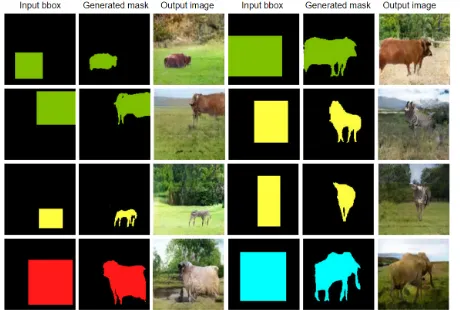
Figure 12: Generating an image starting from a bounding box instead of an object mask. Note that the masks are gen-erated in this experiment. The location of boxes controls the horizon line while the shape controls the viewpoint.
easily be extended by introducing a separate mask genera-tor model. The idea is to generate object shapes based on a bounding box. They can further be used as input to the cur-rent framework. The mask generator is a conditional GANs model which takes a bounding box and object class as input and outputs an object mask in the region of interest. In or-der to stabilize the training, a cross-entropy reconstruction loss is added to the objective function. Figure 12 presents generated mask samples from a bounding box and their fi-nal generated images. The locality of the bounding boxes influences over the horizon line. Boxes in the top (e.g.row 2 left) generate a high horizon line while boxes in the bottom (e.g.row 3 left) generate a low horizon line. The shape of the bounding boxes influences the viewpoint. Vertical rect-angles (e.g.row 2 right) generate a front view while squares or horizontal rectangles generate a side view.
Conclusion
of the scene and forms the scene progressively by draw-ing a sdraw-ingle foreground object at each step. The proposed approach improves the controllability of the image genera-tion process through a object-level control mechanism. The experimental results suggest that the sequential generation scheme also improves the image quality and the diversity. Finally, it is shown that it resolves the occlusion artifacts of the existing conditional GANs models.
Acknowledgments. We thank the anonymous reviewers for their valuable input. WT is partially supported by an NSERC scholarship.
References
Chen, T.; Cheng, M.-M.; Tan, P.; Shamir, A.; and Hu, S.-M. 2009. Sketch2photo: Internet image montage. InACM TOG.
Chen, L.-C.; Papandreou, G.; Kokkinos, I.; Murphy, K.; and Yuille, A. L. 2018. Deeplab: Semantic image segmentation with deep convolutional nets, atrous convolution, and fully connected crfs. IEEE TPAMI.
Denton, E. L.; Chintala, S.; Fergus, R.; et al. 2015. Deep generative image models using a laplacian pyramid of ad-versarial networks. InNIPS.
Ding, H.; Sricharan, K.; and Chellappa, R. 2018. Exprgan: Facial expression editing with controllable expression inten-sity. InAAAI.
Goodfellow, I.; Pouget-Abadie, J.; Mirza, M.; Xu, B.; Warde-Farley, D.; Ozair, S.; Courville, A.; and Bengio, Y. 2014. Generative adversarial nets. InNIPS.
Hertzmann, A.; Jacobs, C. E.; Oliver, N.; Curless, B.; and Salesin, D. H. 2001. Image analogies. InSIGGRAPH.
Heusel, M.; Ramsauer, H.; Unterthiner, T.; Nessler, B.; and Hochreiter, S. 2017. Gans trained by a two time-scale update rule converge to a local nash equilibrium. InNIPS.
Hong, S.; Yang, D.; Choi, J.; and Lee, H. 2018. Inferring semantic layout for hierarchical text-to-image synthesis. In
CVPR.
Iizuka, S.; Simo-Serra, E.; and Ishikawa, H. 2017. Globally and locally consistent image completion. InACM TOG.
Isola, P., and Liu, C. 2013. Scene collaging: Analysis and synthesis of natural images with semantic layers. InICCV.
Isola, P.; Zhu, J.-Y.; Zhou, T.; and Efros, A. A. 2017. Image-to-image translation with conditional adversarial networks. InCVPR.
Johnson, J.; Gupta, A.; and Fei-Fei, L. 2018. Image genera-tion from scene graphs. InCVPR.
Kaneko, T.; Hiramatsu, K.; and Kashino, K. 2017. Gener-ative attribute controller with conditional filtered generGener-ative adversarial networks. InCVPR.
Kingma, D. P., and Ba, J. 2014. Adam: A method for stochastic optimization. InICLR.
Lin, T.-Y.; Maire, M.; Belongie, S.; Hays, J.; Perona, P.; Ra-manan, D.; Doll´ar, P.; and Zitnick, C. L. 2014. Microsoft coco: Common objects in context. InECCV.
Lin, C.-H.; Yumer, E.; Wang, O.; Shechtman, E.; and Lucey, S. 2018. St-gan: Spatial transformer generative adversarial networks for image compositing. InCVPR.
Miyato, T.; Kataoka, T.; Koyama, M.; and Yoshida, Y. 2018. Spectral normalization for generative adversarial networks. InICLR.
Odena, A.; Olah, C.; and Shlens, J. 2017. Conditional image synthesis with auxiliary classifier gans. InICML.
Park, H.; Yoo, Y.; and Kwak, N. 2018. Mc-gan: Multi-conditional generative adversarial network for image syn-thesis. InBMVC.
Pathak, D.; Krahenbuhl, P.; Donahue, J.; Darrell, T.; and Efros, A. A. 2016. Context encoders: Feature learning by inpainting. InCVPR.
Reed, S.; Akata, Z.; Yan, X.; Logeswaran, L.; Schiele, B.; and Lee, H. 2016a. Generative adversarial text to image synthesis. InICML.
Reed, S. E.; Akata, Z.; Mohan, S.; Tenka, S.; Schiele, B.; and Lee, H. 2016b. Learning what and where to draw. In
NIPS.
Ronneberger, O.; Fischer, P.; and Brox, T. 2015. U-net: Convolutional networks for biomedical image segmentation. InMICCAI.
Salimans, T.; Goodfellow, I.; Zaremba, W.; Cheung, V.; Rad-ford, A.; and Chen, X. 2016. Improved techniques for train-ing gans. InNIPS.
Song, Y.; Zhang, Z.; and Qi, H. 2018. r-btn: Cross-domain face composite and synthesis from limited facial patches. In
AAAI.
Szegedy, C.; Vanhoucke, V.; Ioffe, S.; Shlens, J.; and Wojna, Z. 2016. Rethinking the inception architecture for computer vision. InCVPR.
Tappan, D. 2008. Knowledge-based spatial reasoning for scene generation from text descriptions. In AAAI, 1888– 1889.
Wang, T.-C.; Liu, M.-Y.; Zhu, J.-Y.; Tao, A.; Kautz, J.; and Catanzaro, B. 2018. High-resolution image synthesis and semantic manipulation with conditional gans. InCVPR. Yang, J.; Kannan, A.; Batra, D.; and Parikh, D. 2017. Lr-gan: Layered recursive generative adversarial networks for image generation. InICLR.
Zhang, H.; Xu, T.; and Li, H. 2017. Stackgan: Text to photo-realistic image synthesis with stacked generative adversarial networks. InICCV.
Zhu, J.-Y.; Park, T.; Isola, P.; and Efros, A. A. 2017a. Un-paired image-to-image translation using cycle-consistent ad-versarial networks. InICCV.