The Thirty-Third AAAI Conference on Artificial Intelligence (AAAI-19)
Zero-Shot Object Detection with Textual Descriptions
Zhihui Li,
1Lina Yao,
1Xiaoqin Zhang,
2Xianzhi Wang,
3Salil Kanhere,
1Huaxiang Zhang
4∗1School of Computer Science and Engineering, University of New South Wales 2College of Mathematics and Information Science, Wenzhou University
3School of Software, University of Technology Sydney
4School of Information Science and Engineering, Shandong Normal University
Abstract
Object detection is important in real-world applications. Exist-ing methods mainly focus on object detection with sufficient labelled training data or zero-shot object detection with only concept names. In this paper, we address the challenging prob-lem of zero-shot object detection with natural language de-scription, which aims to simultaneously detect and recognize novel concept instances with textual descriptions. We propose a novel deep learning framework to jointly learn visual units, visual-unit attention and word-level attention, which are com-bined to achieve word-proposal affinity by an element-wise multiplication. To the best of our knowledge, this is the first work on zero-shot object detection with textual descriptions. Since there is no directly related work in the literature, we investigate plausible solutions based on existing zero-shot ob-ject detection for a fair comparison. We conduct extensive experiments on three challenging benchmark datasets. The extensive experimental results confirm the superiority of the proposed model.
Introduction
In the last decade, researchers have made promising progress in object detection Girshick (2015); Ren et al. (2015, 2017); Lin et al. (2017). Most of these achievements rely on the collection of large-scale labeled training data. Although re-searchers have struggled to acquire larger datasets with a broader set of categories, the processing procedure is time-consuming and tedious. Furthermore, it is impossible to col-lect enough training data for rare concepts,i.e.Okapia. There-fore, a challenging problem is how to simultaneously recog-nize and locate these novel object instances with no training samples.
Zero-shot learning has been widely used to tackle the prob-lem of data scarcity Akata et al. (2016); Frome et al. (2013); Lampert, Nickisch, and Harmeling (2009); Zhang, Xiang, and Gong (2017); Zhang and Saligrama (2015); Rahman, Khan, and Porikli (2018); Mikolov et al. (2013). Most of these works focus on the concept classification problem. Al-though it remains a challenging and unsolved problem, there is still a large gap between the problem setting and real-world scenarios in the following aspects. Firstly, in most zero-shot
Copyright c2019, Association for the Advancement of Artificial Intelligence (www.aaai.org). All rights reserved.
learning benchmark datasets Welinder et al. (2010); Nils-back and Zisserman (2008); Russakovsky et al. (2015), each image has only one dominant object, while in real-world applications, multiple objects may appear in a single image. Secondly, most of the zero-shot classification methods are based on attributes and semantic descriptions, which cannot be directly applied to zero-shot detection in the entire scene image. Thirdly, the setting of zero-shot learning does not con-sider occlusions and clutter, which commonly exist in real-world applications. To close this gap, Rahman, Khan, and Porikli (2018) introduced a new “zero-shot object detection” (ZSD) problem setting method, which aims at concurrently detecting and recognizing novel instance in the absence of any training examples.
Although the data-scarcity challenge exists for a large num-ber of categories in real-world applications, there is a massive amount of textual data for these categories. These data arrive in the form of dictionary entries, online encyclopedias and other online resources. For example, English Wikipedia has 5,645,010 articles on its site, which provides a rich knowl-edge base for different topics.
model. Compared with the related works in the literature, we go beyond the traditional object recognition setting, and explore the knowledge in the natural language descriptions to detect and recognize novel (unseen) concepts.
To sum up, we make the following contributions in this work.
• We pose and address a challenging problem of zero-shot object detection with textual descriptions, which aims to si-multaneously detect and recognize unseen objects by explor-ing natural language description. To the best of our knowl-edge, this task has not yet been explored in the computer vision and machine learning communities.
• We propose a novel deep learning framework to jointly learn the visual units, visual-unit attention, and word-level attention, which are combined to achieve word-proposal affin-ity by an element-wise multiplication.
• We investigate plausible solutions based existing zero-shot object detection, and establish baselines on the zero-zero-shot object detection with textual descriptions.
• We conduct extensive experiments and component studies to demonstrate the superiority of the proposed model for zero-shot object detection with textual descriptions.
The rest of this paper is organized as follows. We first review the related works on zero-shot learning and object detection. Then we introduce the proposed framework for zero-shot object detection with unstructured textual descrip-tion. After that, we present the experimental results, followed by the conclusion and a discussion of future work.
Related Works
We briefly review the related work on zero-shot learning, object detection and language and vision. Due to space limi-tations, we cannot do justice to the entire body of literature. Zero-Shot Learning:Existing zero-shot learning algorithms exploit different methods to transfer the knowledge from seen concepts to unseen ones. These algorithms can be generally grouped into two categories: projection-based and similarity-based methods. The projection-similarity-based methods measure the relatedness between the test samples and the unseen concepts with the projected features of the visual features in the seman-tic space Lampert, Nickisch, and Harmeling (2009); Akata et al. (2016); Zhang and Saligrama (2015); Romera-Paredes and Torr (2015). Specifically, Akata et al. (2016) first project the visual features and the semantic embeddings of concepts onto a common space, and then measure the relatedness be-tween the data point and the concept. Romera-Paredes and Torr (2015) combine a linear model together with a princi-pled choice of regularizers to achieve a simple yet efficient method. In contrast, the similarity based methods Norouzi et al. (2013) exploit the discrete classifiers trained on the seen concepts in the visual feature space to determine how close the novel instance is to the seen concepts.
Object Detection:Researchers have demonstrated the supe-riority of object proposal based methods for detecting objects within an image Girshick et al. (2014); Girshick (2015); Ren et al. (2015). Specifically, Girshick et al. (2014) employ an off-the-shelf object detector to generate object proposals,
which are cropped and warped by a R-CNN framework. To take this one step further, the authors introduce a Region-of-Interest (RoI) pooling method in Girshick (2015). Their method shares the feature computation for all the proposal regions, which greatly improves the effectiveness of their algorithm. In Ren et al. (2015), Renet al.replace the off-the-shelf object detector with a region proposal network (RPN), which shares full-image convolutional features with the de-tection network. Although these object dede-tection algorithms work well on pre-defined concepts, they cannot be directly applied to novel concepts.
Vision and Language: Recent years have witnessed the rapid progresses of recurrent neural networks (RNN) for vision and language tasks,e.g., image/video caption genera-tion, visual question answering, visual-semantic embedding,
etc.Mao et al. (2016) propose a framework for joint genera-tion and comprehension, which can generate an unambiguous description for objects or regions in an image. In Yu et al. (2016), a new model is developed to incorporate detailed context into referring expression models.
The goal of visual-semantic embedding is to project both images/videos and languages onto a common space for sub-sequent classification or retrieval tasks Frome et al. (2013); Karpathy and Li (2015); Reed et al. (2016); Liu et al. (2015). For example, Reed et al. (2016) propose training an end-to-end CNN-RNN network to project the images and fine-grained visual descriptions onto a common feature space for zero-shot learning. In Liu et al. (2015), a multitask deep visual-semantic embedding model is trained to learn the multi-view distance between the video side semantic infor-mation and visual content.
Recent Progress on ZSD: We have noticed that there are three contemporary works on zero-shot object detection Bansal et al. (2018); Rahman, Khan, and Porikli (2018); Demirel, Cinbis, and Ikizler-Cinbis (2018). Bansal et al. (2018) develop background-aware models to solve the ZSD problem. Rahman, Khan, and Porikli (2018) propose a se-matnic clustering loss. Demirel, Cinbis, and Ikizler-Cinbis (2018) employ hybrid region embedding to improve the per-formance. Although these methods share a common theme of zero-shot detection with us, the proposed model significantly differ from them. All of these methods focus on exploiting the visual or semantic similarity between seen classes and unseen classes, while we propose to detect unseen concepts by exploring their natural language description.
Zero-Shot Object Detection using Textual
Description
The Model Architecture
The challenge for solving the problem of zero-shot detection with textual descriptions is to effectively build word-proposal relations. Given each word in the textual description, the network should be able to determine whether the word with its context fit the object proposal Li et al. (2017). For a textual description, we investigate all these word-proposal relation, weight the confidences of all the relations, and aggregate them to achieve the final description-proposal affinity.
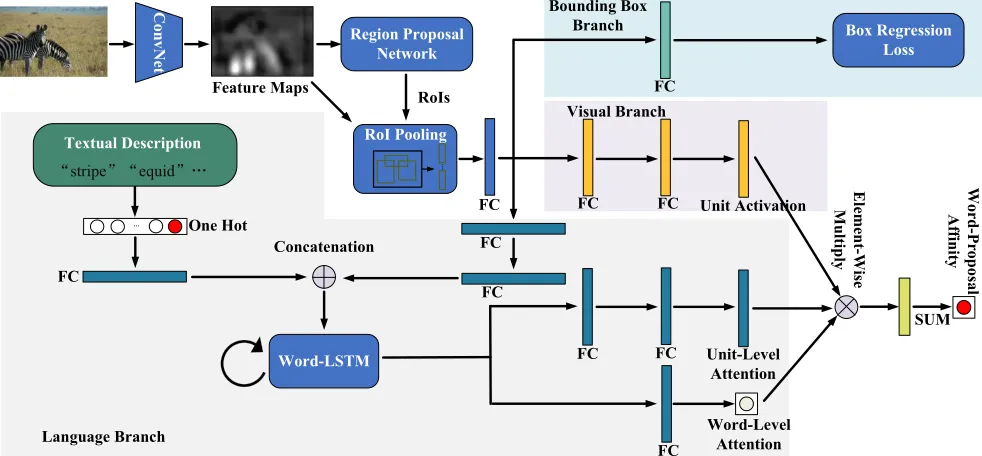
Based on the intuition mentioned above, we propose a novel deep learning framework to explore word-proposal relations and determine the affinity between a textual descrip-tion and an object proposal. We show the overall network architecture in Figure 1. The network contains three branches: a visual branch, a language branch and a bounding box regres-sion branch. The visual branch outputs visual unit activations, each of which determines whether certain object patterns exist in the object proposal. The language branch employs a recurrent neural network with long short-term memory units (LSTM). For each word in the description, it generates unit-level attention and word-level attention to weight the visual units from the visual branch. The unit-level attention determines which units should be paid more attention to. We weight all the units’ activations by both unit-level attention and word-level attention, and achieve the final affinity. Visual Feature Encoding:Given an arbitrary-sized image x, the Faster R-CNN framework employs a ConvNet (e.g.
VGG or ResNet) to extract the intermediate convolutional activations, which are used as feature maps. The RPN op-erates on these feature maps and outputs a set of candidate rectangular object proposals, each with a confidence score. Since these high-scoring object candidate proposals may be of different sizes, the framework uses a RoI pooling layer to project them to a fixed dimensional representation. We repre-sent the fixed dimensional reprerepre-sentation for each candidate object proposal asf. The RPN is generic because it outputs object proposals based on an objectness measure. Thus, a pre-trained RPN on seen concepts can be directly applied to generate object proposals for unseen novel concepts. In the remainder of our section on network architecture, we use these feature representations to learn useful representations for both seen and unseen concepts.
Visual-Language Gated Attention: We propose a visual-language gated attention mechanism to effectively mine word-proposal relations. Intuitively, for a given word, the network should assign larger weights to the visual parts which have similar semantic meanings.
We employ an LSTM network Hochreiter and Schmid-huber (1997) to train the language part of the framework because of its ability to capture the temporal relations of sequential data. For a description of each semantic concept, the LSTM network outputs attentions for different visual units word by word. We first encode these words intoK -dimensional one-hot vectors, whereKis the size of the vo-cabulary. Given the description of a concept, we use a fully connected layer (“w-fc1”) to transform thet-th word to its corresponding embedded feature vectorxtw. Furthermore, we add two fully connected layers (“v-fc1” and “v-fc2”) after the fixed dimensional representation for each object proposal,
resulting in the visual featuresxvfor the word-LSTM. Then, at every step, we feed the concatenation ofxvandxwt to the LSTM as input.
The LSTM model contains a memory cell ct, which is used to memorize the history of the previous steps. It has three controlling gates,i.e.input gateit, forget gateft, and output gateot. The LSTM model uses these controlling gates to control the update and flow direction of information. In the literature, there are many variants of LSTM and we use the LSTM proposed in Zaremba and Sutskever (2015), which iterates in the following fashion:
it=σ(Wxixt+Whiht−1+bi), (1)
ft=σ(Wxfxt+Whfht−1+bf), (2)
ot=σ(Wxoxt+Whoht−1+bo), (3)
gt=φ(Wxgxt+Whght−1+bg), (4)
ct=ftct−1+itgt, ht=oth(ct), (5) where σ represents the sigmoid function, denotes the element-wise product, and W and bare parameters to be optimized.
For each word, we propose to generate the unit-level at-tentions by feeding the output hidden statehtinto a fully connected layer with a LeakyReLU Xu et al. (2015) function and a fully connected layer with a softmax function, resulting in the attention vectorAt∈R512. Note that the visual units
vand the attention vector have the same dimension. Hence, we have the affinity between the concept description and the object proposal at thet-th word as follows:
at=
512
X
n=1
At(n)vn, (6)
s.t.
512
X
n=1
At(n) = 1, (7)
whereAt(n)is the attention value for then-th visual unit. Since each visual unit denotes the existence of certain visual object patterns and the attention valuesAttell us which visual units should more attention be placed, it is intuitive to obtain the affinity between the concept description and the object proposal at thet-th word by element-wise multiplication of the two vectors. Finally, we compute the description-proposal affinity by summing up the affinity of all words,i.e. a = PT
t=1at, whereT is the number of words in the concept
description.
To this end, we have used the unit-level attention to as-sociate the most related units to each word in the concept description. To force different visual units’ attentions to com-pete against each other, we use a softmax non-linearity func-tion in the framework. In our work, we find this solufunc-tion works well for learning effective unit-level attentions.
C
on
vN
et
Region Proposal Network
RoI Pooling
…
RoIs
FC Feature Maps
El
em
en
t-Wi
se
M
ultip
ly
SUM
Wor
d-Pr
op
osal
A
ffin
ity
FC FC
Box Regression Loss
FC
…
“stripe”“equid”… Textual Description
One Hot
FC
Word-LSTM Concatenation
FC FC Unit-Level Attention
Word-Level Attention FC
FC
Visual Branch Bounding Box
Branch
Language Branch
Unit Activation
FC
Figure 1: Overview of the proposed framework. It contains three branches: a visual branch, a language branch, and a bounding box regression branch. Different background colors are used to denote three branches. We use the visual branch to generate visual units, which capture the object patterns of the proposals. The language branch learns visual unit-level and word-level attentions for weighting visual units for each word in the description.
hidden statehtof the LSTM via a fully-connected layer with sigmoid non-linearity functiongt=σ(Wght+bg), where
Wgandbgare the parameters of the fully-connected layer to be optimized.
Then we use both visual unit-level attention and the word-level attention to compute the description-proposal affinity at thet-th word byˆat=gtP
512
n=1At(n)vn. The final affinity can be computed by the aggregation of affinities of all words
ˆ
a=PT
t=1aˆt.
The third branch is for bounding box regression, the goal of which is to predict precise location of objects by adding proper offsets to the proposals to align them with the ground truths. We implement this branch in the same way as in Faster-RCNN Ren et al. (2015) except we change the param-eterizations of the 4 coordinates as follows:
tx= log(
|x−xa|
wa
), ty= log(
|y−ya|
ha
), (8)
tw= log(
w wa
), th= log(
h ha
), (9)
t∗x= log(
|x∗−x
a|
wa
), t∗y= log(
|y∗−y
a|
ha
), (10)
t∗w= log(w
∗
wa
), t∗h= log(h
∗
ha
). (11)
Different from the widely used version in Girshick et al. (2014), we transform the first two elements using alog(·)
function to count more on close-by objects. We make this change based on the intuition that we need to model distant
objects while original bounding box regression only consid-ers closer objects.
Training Procedure
We adopt a three-step training mechanism to optimize the parameters. In the first step, we train the backbone Faster-RCNN with the seen concepts. The weights of shared layers are initialized using the Inception-ResNet v2 model (pre-trained on ImageNet) Szegedy et al. (2017). Then we train the RPN, classification and detection networks. In the second step, we train the visual-branch on the training set. This step is used to generate a series of visual unit activations, each of which encodes certain object patterns. When we jointly train the whole network, only the newly added fully connected layers are optimized. In the third step, we jointly optimize the proposed model.
We minimize an objective function following the multi-task loss in Faster R-CNN Ren et al. (2015). We define the loss function for an image as follows:
L(bi, yi, b∗i,ˆai, θ) = 1
T
X
i
(L(ˆai, yi) +L(bi, b∗i)), (12)
whereθdenotes the parameters of the deep neural network,
ˆ
Table 1: Experiment comparisons for zero-shot object detection with textual description on the ILSVRC-2017 detection dataset. Mean average precision (mAP) is used as the evaluation metric. We present the results in percentages. A larger mAP indicates better performance.
p.box syringe harmonica maraca burrito pineapple electric-f
an
iPod dishw
asher
can-opener plate-rack bench bo
w-tie
s.trunks scorpion snail hamster tiger ray train unic
ycle
g.ball h.bar mAP
SAN Rahman, Khan, and Porikli (2018) 5.9 1.5 0.3 0.2 40.6 2.9 7.7 28.5 13.3 5.1 7.8 5.2 2.6 4.6 68.9 6.3 53.8 77.6 21.9 55.2 21.5 31.2 5.3 20.3 SB Bansal et al. (2018) 6.8 1.8 0.8 0.5 43.7 3.8 8.3 30.9 15.2 6.3 8.4 6.8 3.7 6.1 71.2 7.2 58.4 79.4 23.2 58.3 23.9 34.8 6.5 22.0 DSES Bansal et al. (2018) 7.4 2.3 1.1 0.6 46.2 4.3 8.7 32.7 14.6 6.9 9.1 7.4 4.9 6.9 73.4 7.8 56.8 80.8 24.5 59.9 25.4 33.1 7.6 22.7 LAB Bansal et al. (2018) 6.5 1.6 0.7 0.5 44.1 3.6 8.2 30.1 14.9 6.4 8.8 6.4 4.1 4.8 69.9 6.9 57.1 80.2 23.6 58.2 25.1 35.6 7.2 21.9 Ours 7.8 3.1 1.9 1.1 49.4 4.0 9.4 35.2 14.2 8.1 10.6 9.0 5.5 8.1 73.5 8.6 57.9 82.3 26.9 61.5 24.9 38.2 8.9 24.1
For the detection-classification branch, we minimize the following cross-entropy loss:
L(ˆai, yi) =−(yilog ˆai+ (1−yi) log(1−ˆai)). (13)
The part of regression loss is similar to faster-RCNN regres-sion loss, except we make changes to the coordinates as in Equation (4) and Equation (5).
Experiments
In this section, we describe the extensive experiments which were conducted to evaluate the proposed framework. We first discuss the detailed experimental setup, then we discuss quan-titative results on three challenging datasets. After this, we conduct component studies to analyze the effects of different components. Finally, we present some qualitative results on the used datasets.
Experimental Setup
Dataset DescriptionThree challenging datasets have been used in this paper to evaluate the performance.
ILSVRC-2017 detection datasetRussakovsky et al. (2015) constitutes of 200 basic-level object categories. These cate-gories were carefully selected in terms of different factors such as object scale, level of image clutterness, and many others. Following Rahman, Khan, and Porikli (2018), we choose 23 categories as unseen concepts, and the rest are as unseen concepts.
MSCOCOLin et al. (2014) was collected for object detec-tion and semantic segmentadetec-tion tasks. There are multiple ob-ject instances per image with variations in occlusion, clutter, views,etc.We use training samples from the 2014 training set. Since we do not have ground-truth for the test images, we randomly select images from the validation set for testing.
VisualGenome(VG) Krishna et al. (2017) was designed primarily for visual relationship understanding. The authors also provide bounding boxes for multiple objects in the im-ages. We use this dataset because it contains bounding box information for a large number of classes. Following Bansal et al. (2018), we use images from part-1 for training, and randomly sample from part-2 for testing.
Train/Test Split:For the zero-shot learning setting, we are not allowed to use any visual examples of unseen concepts. In terms of the ILSVRC-2017 detection dataset, we use the same train/test split as in Russakovsky et al. (2015). Please refer to Russakovsky et al. (2015) for details of the split. For
the MSCOCO and VisualGenome datasets, we follow the same procedure as in Bansal et al. (2018). Specifically, we use 48 training classes and 17 test classes for MSCOCO, and 478 training classes and 130 test classes for VisualGenome. Compared Methods:To the best of our knowledge, this is
the first work for zero-shot object detection using textual description. Hence, there are no directly related algorithms with which to compare with. However, we have tried our best to implement two state-of-the-art baselines for comparison. We extend Rahman, Khan, and Porikli (2018) and Bansal et al. (2018) to our problem setting by replacing the word embedding with textual description embedding using fastText Grave et al. (2017).
Evaluation Metric:For ILSVRC-2017 detection dataset, we use the commonly used evaluation metric, mean Average Pre-cision (mAP), to evaluate the performance of novel object detection. We use this evaluation metric because it has been widely used in supervised object detection tasks. Following Bansal et al. (2018), recall is used as the evaluation metric for the MSCOCO and Visual Genome datasets. This is because that it is infeasible to exhaustively label bounding box anno-tations for all instances of an object. mAP is very sensitive to missing annotations and will count these detection results as false positives.
Implementation Details: We adopt a three-step training mechanism to optimize the parameters. Following Rahman, Khan, and Porikli (2018), we rescale the shorter size of im-ages to 600 pixels. To reduce redundancy, we employ non-maximum suppression (NMS) on proposals class probability with IoU threshold equals 0.7. During training, we use the Adam optimizer with learning rate10−5. We implement the proposed model based on the open-source package PyTorch. The code and models will be released.
Quantitative Analysis
Table 2: Experimental comparisons for zero-shot object detection with textual description on the MSCOCO and Visual Genome (VG) datasets. Recall@100 is used as the evaluation metric. We show the performance in percentages. (Larger recall is better.)
MSCOCO Visual Genome
IoU 0.4 0.5 0.6 0.4 0.5 0.6
SAN Rahman, Khan, and Porikli (2018) 35.7 26.3 14.5 6.8 5.9 3.1 SB Bansal et al. (2018) 37.8 28.6 15.4 7.2 5.6 3.4 DSES Bansal et al. (2018) 42.6 31.2 16.3 8.4 6.3 3.3 LAB Bansal et al. (2018) 35.2 22.4 12.1 8.6 6.1 3.3
Ours 45.5 34.3 18.1 9.7 7.2 4.2
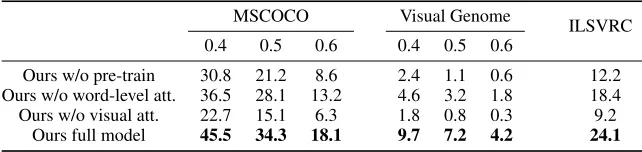
Table 3: Experimental results of different components on the three challenging benchmark datasets. mAP is used as the evaluation metric for ILSVRC and Recall@100 is used for the other two datasets. Larger value indicates better performance for both evaluation metrics.
MSCOCO Visual Genome
ILSVRC 0.4 0.5 0.6 0.4 0.5 0.6
Ours w/o pre-train 30.8 21.2 8.6 2.4 1.1 0.6 12.2 Ours w/o word-level att. 36.5 28.1 13.2 4.6 3.2 1.8 18.4 Ours w/o visual att. 22.7 15.1 6.3 1.8 0.8 0.3 9.2
Ours full model 45.5 34.3 18.1 9.7 7.2 4.2 24.1
zero-shot object detection setting. (2) The novel concepts (i.e.iPod, scorpion, tiger) which have similar concepts in the training set have much better performance than those (i.e.
pineapple, bowtie, maraca) without any similar concepts. For example, zero-shot object detection on iPod of the proposed model achieves 35.2%, while it only achieves 5.5% on bowtie. This indicates the challenge of zero-shot object detection. (3) We also notice that the performances of our re-implemented Rahman, Khan, and Porikli (2018) and Bansal et al. (2018) are generally better than the results reported in the original paper. We think this improvement is achieved because there is more information contained in the textual description than single concept name. This phenomenon confirms the benefits of exploring textual description,i.e.online encyclopedias.
We also report the extensive experiment results in terms of Recall@100 for all the compared baselines on the MSCOCO and VG datasets in Table 2. Three different IoU overlap thresholds (i.e.0.4, 0.5, 0.6) were used in these experiments. In this part, we use the threshold of IoU≥0.5 as an example for convenient discussion. From the experimental results, we observe that the proposed model generally perform much better than the other compared baselines. Specifically, the proposed model increases the recall to 34.3% from 26.3% achieved by the baseline method SAN Rahman, Khan, and Porikli (2018) on MSCOCO, and increases the recall to 7.2% from 5.9% on Visual Genome, which indicates that Visual Genome is much more challenging than MSCOCO. We also make the observations that by exploring textual description we obtain much better performance than the results reported in the original paper, especially on the challenging dataset Vi-sual Genome. For example, the performance of LAB Bansal et al. (2018) improves from 5.4% to 7.2% by exploring the embedding of textual description instead of a single concept
name.
Component Studies
In this part, we describe the extensive experiments to study the effects of different components in our model, and report the experiment results. Following previous settings, we still use mAP as the evaluation metric for the ILSVRC dataset and Recall@100 for the MSCOCO and Visual Genome datasets. As discussed in the model section, we first pre-train the net-work. From the experimental results, we can see that without pre-training, the performance of zero-shot object detection dropped dramatically on all the datasets. This indicates that the pretraining significantly affects the final performance. To evaluate the effectiveness of the visual-unit-level attention and word-level attention, we compare with two variants. For the variant without word-level attention, we treat all the words in the description equally. For the variant without visual-unit-level attention, we use average pooling instead. From the experimental results, it can be seen that both components contribute greatly to the whole model.
Qualitative Results
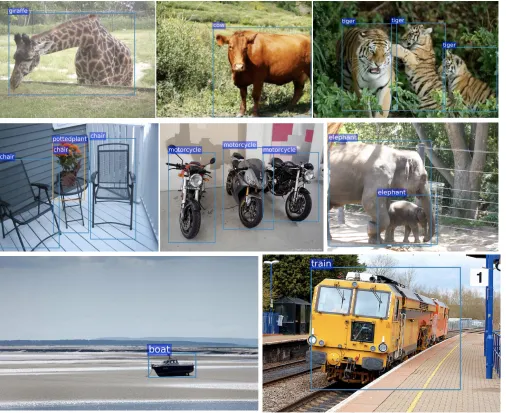
Figure 2: Selected examples of zero-shot object detection. We can see that the detection results are reasonable, which demonstrates the effectiveness of the proposed model for object detection in a zero-shot setting.
Conclusions and Future Work
In this paper, we have made the first attempt at zero-shot object detection with natural language description. To solve this challenging problem, we have proposed a joint model to learn both visual-unit-level and word-level attention. In the experiment part, we described the extensive experiments which were conducted to demonstrate the superiority of the proposed model, and investigated the effectiveness of dif-ferent components. In the future, we will incorporate the relational network into the framework to further improve the performance.
Acknowledgements
This work is supported in part by the National Natural Sci-ence Joint Fund Key Project (NSFC-General Technology Fundamental Research Joint Fund) [grant no. U1836216], in
part by the National Natural Science Foundation of China [grant no. 61772322, and grant no. 61472285], in part by the Zhejiang Provincial Natural Science Foundation [grant no. LR17F030001], in part by the project of science and technol-ogy plans of Zhejiang Province (Grants no. 2015C31168), in part by the Key Innovative Team Support and Project of science and technology plans of Wenzhou City [grant nos. G20150017, ZG2017016].
References
Akata, Z.; Perronnin, F.; Harchaoui, Z.; and Schmid, C. 2016. Label-embedding for image classification.IEEE Trans. Pat-tern Anal. Mach. Intell.38(7):1425–1438.
Di-vakaran, A. 2018. Zero-shot object detection. CoRR
abs/1804.04340.
Demirel, B.; Cinbis, R. G.; and Ikizler-Cinbis, N. 2018. Zero-shot object detection by hybrid region embedding. CoRR
abs/1805.06157.
Frome, A.; Corrado, G. S.; Shlens, J.; Bengio, S.; Dean, J.; Ranzato, M.; and Mikolov, T. 2013. Devise: A deep visual-semantic embedding model. InNIPS, 2121–2129.
Girshick, R. B.; Donahue, J.; Darrell, T.; and Malik, J. 2014. Rich feature hierarchies for accurate object detection and semantic segmentation. InCVPR.
Girshick, R. B. 2015. Fast R-CNN. InICCV.
Grave, E.; Mikolov, T.; Joulin, A.; and Bojanowski, P. 2017. Bag of tricks for efficient text classification. InEACL.
Hochreiter, S., and Schmidhuber, J. 1997. Long short-term memory.Neural Computation9(8):1735–1780.
Karpathy, A., and Li, F. 2015. Deep visual-semantic align-ments for generating image descriptions. InCVPR.
Krishna, R.; Zhu, Y.; Groth, O.; Johnson, J.; Hata, K.; Kravitz, J.; Chen, S.; Kalantidis, Y.; Li, L.; Shamma, D. A.; Bernstein, M. S.; and Fei-Fei, L. 2017. Visual genome: Connecting language and vision using crowdsourced dense image anno-tations.International Journal of Computer Vision123(1):32– 73.
Lampert, C. H.; Nickisch, H.; and Harmeling, S. 2009. Learn-ing to detect unseen object classes by between-class attribute transfer. InCVPR.
Li, S.; Xiao, T.; Li, H.; Zhou, B.; Yue, D.; and Wang, X. 2017. Person search with natural language description. InCVPR.
Lin, T.; Maire, M.; Belongie, S. J.; Hays, J.; Perona, P.; Ra-manan, D.; Doll´ar, P.; and Zitnick, C. L. 2014. Microsoft COCO: common objects in context. InECCV.
Lin, T.; Doll´ar, P.; Girshick, R. B.; He, K.; Hariharan, B.; and Belongie, S. J. 2017. Feature pyramid networks for object detection. InCVPR.
Liu, W.; Mei, T.; Zhang, Y.; Che, C.; and Luo, J. 2015. Multi-task deep visual-semantic embedding for video thumbnail selection. InCVPR.
Mao, J.; Huang, J.; Toshev, A.; Camburu, O.; Yuille, A. L.; and Murphy, K. 2016. Generation and comprehension of unambiguous object descriptions. InCVPR.
Mikolov, T.; Sutskever, I.; Chen, K.; Corrado, G. S.; and Dean, J. 2013. Distributed representations of words and phrases and their compositionality. InNIPS.
Nilsback, M., and Zisserman, A. 2008. Automated flower classification over a large number of classes. InICVGIP.
Norouzi, M.; Mikolov, T.; Bengio, S.; Singer, Y.; Shlens, J.; Frome, A.; Corrado, G.; and Dean, J. 2013. Zero-shot learning by convex combination of semantic embeddings. In
NIPS.
Rahman, S.; Khan, S. H.; and Porikli, F. 2018. Zero-shot object detection: Learning to simultaneously recognize and localize novel concepts.CoRRabs/1803.06049.
Reed, S. E.; Akata, Z.; Lee, H.; and Schiele, B. 2016. Learn-ing deep representations of fine-grained visual descriptions. InCVPR.
Ren, S.; He, K.; Girshick, R. B.; and Sun, J. 2015. Faster R-CNN: towards real-time object detection with region proposal networks. InNIPS.
Ren, S.; He, K.; Girshick, R. B.; Zhang, X.; and Sun, J. 2017. Object detection networks on convolutional feature maps.
IEEE Trans. Pattern Anal. Mach. Intell.39(7):1476–1481.
Romera-Paredes, B., and Torr, P. H. S. 2015. An embarrass-ingly simple approach to zero-shot learning. InICML.
Russakovsky, O.; Deng, J.; Su, H.; Krause, J.; Satheesh, S.; Ma, S.; Huang, Z.; Karpathy, A.; Khosla, A.; Bernstein, M. S.; Berg, A. C.; and Li, F. 2015. Imagenet large scale visual recognition challenge. International Journal of Computer Vision115(3):211–252.
Szegedy, C.; Ioffe, S.; Vanhoucke, V.; and Alemi, A. A. 2017. Inception-v4, inception-resnet and the impact of residual connections on learning. InAAAI.
Welinder, P.; Branson, S.; Mita, T.; Wah, C.; Schroff, F.; Belongie, S.; and Perona, P. 2010. Caltech-UCSD Birds 200. Technical Report CNS-TR-2010-001, California Institute of Technology.
Xu, B.; Wang, N.; Chen, T.; and Li, M. 2015. Empirical evaluation of rectified activations in convolutional network.
CoRRabs/1505.00853.
Yu, L.; Poirson, P.; Yang, S.; Berg, A. C.; and Berg, T. L. 2016. Modeling context in referring expressions. InECCV.
Zaremba, W., and Sutskever, I. 2015. Learning to execute. InICLR.
Zhang, Z., and Saligrama, V. 2015. Zero-shot learning via semantic similarity embedding. InICCV.