206 Iranian Journal of Electrical & Electronic Engineering, Vol. 8, No. 3, Sep. 2012
Computer Network Time Synchronization using a Low Cost
GPS Engine
M. H. Refan* and H. Valizadeh**
Abstract:Accurate and reliable time is necessary for financial and legal transactions, transportation, distribution systems, and many other applications. Time synchronization protocols such as NTP (the Network Time Protocol) have kept clocks of such applications synchronized to each other for many years. Nowadays there are many commercial GPS based NTP time server products at the market but they almost have a high price. In this paper we are going to use a Low Cost GPS engine to build a time server to provide time synchronization with accuracy of a few milliseconds. This time server is relatively very cheap and it can be used in almost all typical applications. We also proposed a software based NTP time server implemented in MATLAB as well.
Keywords: Time synchronization, Time synchronization Protocols, NTP (the Network Time Protocol), GPS Timing, Computer network, Time Server.
1 Introduction1
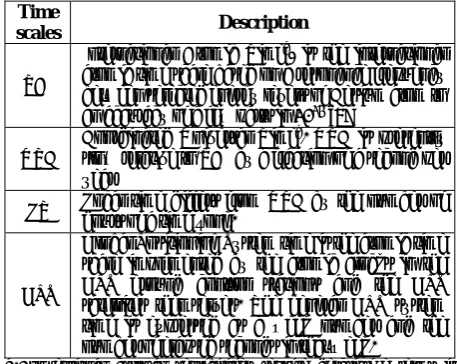
We may usually set our computer’s time by our wristwatch to within a minute or two, but on the other side accurate and reliable time is necessary for financial and legal transactions, transportation, distribution systems, and many other applications involving widely distributed resources. To make sense, as an example, in a distributed airline reservation system a seat can be sold twice or not at all if the distributed computers vary in time or there may be legal consequences when an online stock trade is completed, before it is bid [1]. In this regard, coordination to an international time scale and clock synchronization have been developed. The basis for this international level has been refined throughout history and sidereal time, earth rotation based time and atomic time have been developed [2]. Some important time scales with a brief description are presented in Table 1 and a recorded example of them on April 27, 2011 is shown in Table 2 [3].
Clock synchronization deals with the idea that internal clocks of several computers may differ Even when initially set accurately, real clocks will differ after some amount of time due to clock drift [4], caused by clocks counting time at slightly different rates so there
Iranian Journal of Electrical & Electronic Engineering, 2012. Paper first received 17 Sep. 2011 and in revised form 4 July 2012. * The Author is with the Department of Electrical and Computer Engineering Faculty, Shahid Rajaee Teacher Training University, and MAPMA Electrical and Control Engineering & Manufacturing Co. (MECO).
E-mail: [email protected]; [email protected].
** The Author is with the Department of Electrical And Computer Engineering, Shahid Rajaee Teacher Training University, Tehran, Iran.
E-mail: [email protected].
is always need for keeping these drifty clock synchronous to a reference clock or with another more accurate clock.
Table 1 A brief description of some important time scales. Time
scales Description
TAI
International Atomic Timea, is the international
atomic time scale based on a resonance frequency between selected energy levels of Cesium atom to an accuracy of a few parts in 1012 [5]
UTC
Coordinated Universal Timea. UTC is presently
slow relative to TAI by a fraction of a second per year
LT Local time differs from UTC by the number of hours of a time zone.
GPS
Global Positioning System time is the atomic time scale implemented by the atomic clocks in the GPS ground control stations and the GPS satellites themselves. The general GPS system time is expressed as a week number and the number of elapsed seconds in that week.
a.Conventional cultural sensibilities require descriptive terms in
English and abbreviations in French.
Table 2 Recorded example of important time scales recorded
on April 2011.
LT 2011-04-2716:50:19 Wednesday Day117 Time zone UTC+4.5 UTC 2011-04-2712:20:19 Wednesday Day117 55678.5141 MJD
GPS 2011-04-2712:20:34 Week 1633 303634 s week 0609, Cycle1, day 3 TAI 2011-04-2712:20:53 Wednesday Day 117 seconds 34 leap
Refan & Valizadeh: Computer Network Time Synchronization using a Low Cost GPS Engine 207 Synchronization directly to UTC requires a
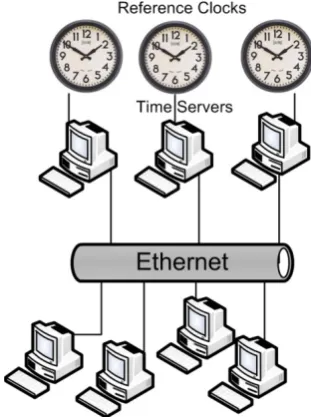
specialized radio or satellite receiver, or telephone modem source. Such sources are available for many governmental and industrial dissemination services, including the Global Positioning System (GPS), WWV/H and WWVB radio time/frequency stations [6] and [7]. U.S. Naval Observatory (USNO) and National Institute of Science and Technology (NIST) telephone modem services in the United States [8], DCF77 long wave radio time station in Germany, JJY radio time station in Japan, as well as similar systems and services in other countries [9]. If every computer be equipped with one of these clocks, the entire above mentioned problems would be solved, but for reasons of cost, unavailability in some places and their complexity it is not possible to equip every computer with a reference clock. Furthermore, the reliability requirements for time synchronization may be so strict that a single clock cannot always be trusted. Therefore, for time synchronization in practice, a structure similar to Fig. 1 is being used.According to that, some numbers of computers are getting time from reference clocks themselves and then act as primary time servers to feed a much larger group of secondary servers and clients connected with a common network with an accurate and reliable time.
Reference clocks at the top of the hierarchy should be very accurate; Nowadays Thanks to the many progresses in Global Positioning System, its time accuracy over radio stations (GPS: short-term accuracy of ± 1 microsecond, while radio signal accuracy is: +5 to +25 millisecond [10]), Noise Immunity, and worldwide availability for free, GPS based Clocks are used very often as the reference clocks over the other clock recourses.
At the present time there are many commercial GPS time synchronization products at the market but they almost have a high price, for instance a typical one is about two thousand dollars, therefore in this paper we are going to use a low cost GPS engine to build a precise clock for time synchronization. This clock is relatively very cheap and it can be used in almost all typical applications.
The remainder of this document is organized as follows. Section 2 describes some important time synchronization protocols. In Section 3 we explain how a Computer Network Time is Synchronized Using the Network Time Protocol (NTP). A brief explanation of timing data in a GPS receiver is clarified in section 4. Section 5 proposes a MATLAB based and a standalone time server board for synchronizing computer networks time. Finally computer network time synchronization results for the two proposed time servers and conclusion are presented in sections 6, 7 respectively.
Fig. 1 A typical time synchronization structure.
2 Time Synchronization Protocols
To keep time of computers synchronized to the primary time servers in a distributed network, clock synchronization protocol is required that can read a server clock, transmit the reading to one or more clients, and adjust each client clock as required.
The various synchronization protocols in use today provide different means to time synchronization, but they all follow the same general model. The client sends a request to the server and the server responds with its current time and for the best accuracy, the client needs to measure the server-client propagation delay to determine the true time offset relative to the server.
Some Important standard time synchronization protocols are as follows:
2.1 Time Protocol
Time protocol, specified in RFC868 [11], provides a site-independent, machine readable date and time. This simple protocol returns a 32-bit unformatted binary number that represents the time in Universal Time Coordinate (UTC) seconds since January 1, 1900. The server listens for time protocol requests on port 37, and responds in either TCP/IP or UDP/IP formats. Since the TIME protocol sends timestamps in seconds, it can provide only ±1 second accuracy.
2.2 Daytime Protocol
Daytime Protocol, specified in RFC867 [12] is widely used by small computers that run MS-DOS and similar operating systems. The server listens on port 13, and responds to requests in either Transmission Control Protocol/Internet Protocol (TCP/IP) or User Datagram Protocol/Internet Protocol (UDP/IP) formats. The standard does not specify an exact format for the daytime protocol, but requires that the time is sent using standard ASCII characters. Similar to TIME protocol
208 Iranian Journal of Electrical & Electronic Engineering, Vol. 8, No. 3, Sep. 2012 daytime protocol sends timestamps in seconds and it can
provide only ±1 second accuracy too. 2.3 Network Time Protocol
Network Time Protocol (NTP) originally specified in RFC958 [13] and later in RFC1059 [14], RFC1119 [15], RFC1305 [16], and current version of RFC5905 [17], is the most complex and sophisticated of the time protocols for synchronizing computer clocks across a network. Because NTP software is often bundled with the operating system it is the most common used protocol for computer network time synchronizations. The NTP client software runs continuously as a background task that periodically receives updates from one or more servers. The client software ignores responses from servers that appear to be sending the wrong time and averages the results from those that appear to be correct. The NTP servers listen for a NTP request on port 123, and respond by sending a UDP/IP data packet in the NTP format. The time stamps in this time protocol are in 64-bit, consist of 32-bit second part and 32-bit fractional seconds part allowing theoretical resolution of 2-32 second (233 picoseconds), but in
practice the accuracy of NTP depends on the network environment. In most places of the Internet of today, NTP provides time accurate to the order of 10-100 msec. while Under good conditions on a LAN without too many routers synchronization to within a few milliseconds is normal [18].
2.4 Simple Network Time Protocol
Simple Network Time Protocol (SNTP) originally specified in RFC1361 [19] and later in RFC1769 [20], RFC2030 [21], and the current version RFC4330 [22], is a less complex implementation version of NTP. It provides a simplified access strategy for servers and clients that do not require the degree of accuracy of the NTP protocol. The network packet formats of both NTP and SNTP protocols are identical, and the two are interoperable. The main difference between the two is missing the complex filtering algorithms to maintain an accurate time that NTP provides and the accuracy is around tens of milliseconds [18].
2.5 Precision Time Protocol
The Precision Time Protocol (PTP), as defined originally in the IEEE 1588-2002[23] and then with IEEE 1588-2008[24] standard, provides a method to precisely synchronize computers over a Local Area Network requiring accuracies beyond those attainable using NTP. An existing LAN, PTP is capable of synchronizing multiple clocks to better than 10 microseconds RMS, but on the other hand it is more expensive in implementation than NTP [25].
3 Computer Network Time Synchronization Using NTP
For being open source, having sufficient accuracy for typical applications and the ability to work on large networks, NTP is the one widely in use on the public Internet and numerous private networks for over almost three decades. NTP comes with most flavors of Windows as well as all flavors of UNIX. About 25 million clients implode on the NTP time servers at NIST alone [18].
3.1 Computer Clocks and NTP
Most computers have quartz or surface acoustic wave (SAW) resonator stabilized oscillator and a hardware counter that interrupts the processor at intervals of a few milliseconds, called the tick [18]. At each tick interrupt, this value is added to a system variable representing the clock time. Clock errors are due to systematic (offset) variations in network delays and latencies in computer hardware and software (jitter), as well as clock oscillator wander. The time of a computer clock relative to ideal time can be expressed as Eq. (1) [18]:
(1) where t is the current time, t0 is the time at the last measurement update, T is the time offset, R is the frequency offset, D is the drift due to resonator aging, and x is a stochastic error term.
The first two terms include systematic offsets that can be bounded by some analysis and NTP estimate these two. The third term is usually dominated by errors in the first two terms and the last random variations that cannot estimated because of its stochastic characteristics.
3.2 Network Time Protocol Principles
NTP has three major parts: the NTP software program, called a daemon in UNIX and a service in Windows; a protocol that exchanges time values between servers and clients; and a suite of algorithms that processes the time values to advance or retard the system clock [18]. For instant, we are not going to cover all the three but we are intending to describe the Protocol which is in need for designing a NTP time server. Further details can be found in the formal specifications [14-17].
The most important field in the NTP packet is the time stamp field, as it is shown in Fig. 2 an NTP timestamp is a 64-bit unsigned fixed-point number, with the integer part in the first 32 bits showing the past seconds from 0h 1 January 1900 and the fraction part in the last 32 bits.
The precision of this representation is about 2 second (233 picoseconds), which should be adequate for even the most exotic requirements.
Refan & Valizadeh: Computer Network Time Synchronization using a Low Cost GPS Engine 209
Fraction of second(32bit) Second since 1900(32bit)
Fig. 2 NTP packet timestamp format.
Table 3 NTP packet timestamp conversion example. Time Apr 26,2011 20:05.563181 Difference time from 0h 1
January 1900 111 years, 3 months, 3 weeks, 4 days Total seconds difference 3512764800 seconds
Fractional part 0.56318 seconds NTP time stamp second
field 3512837107 seconds (Hex: D161A3F3) NTP time stamp fraction of
second field 0.563181 seconds (Hex:902CA4C0)
To convert a time to this format we should calculate the seconds past since 0h 1 January 1900, leap years should be also considered. An example of this conversion is shown in Table 3.
Note that since some time in 1968 the most significant bit of the 64-bit field has been set and that the field will overflow some time in 2036, for making NTP work even from that time on, there will be 128-bit time stamps format in the next NTP versions in which the years can span the age of the universe.
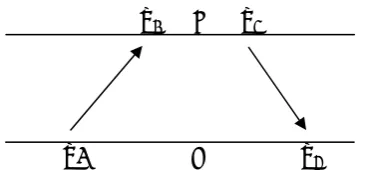
Fig. 3 shows how the timestamps are numbered and exchanged between server B and client A. First, client A sends the current time, T1, to server B. Upon arrival, B saves T1 along with the current time T2. Server B does not have to respond immediately, because it may have other duties. Sometime later, B sends the current time T3, along with the saved T1 and T2 to A. Upon arrival, A reads its clock, T4, and proceeds to compute both time offset θ and round-trip delay δ relative to B according to Eq. (2) and Eq. (3):
θ 2 1 3 4 (2) δ 4 1 3 2 (3) These values are processed in client by a suite of three concatenated algorithms, including the selection, clustering, and combining algorithms [18], the protocols also provide a way to detect duplicate and bogus packets. The result of the algorithms is a single time value representing the best guess of the system clock offset then the adjustment is implemented by the system clock.
The NTP packet is a UDP datagram [26]. The NTP packet header shown in Table 4 has 12 words followed by optional extension fields and an optional message authentication code (MAC). Following is a short description of the various fields. A complete description is given in [14-17].
Leap Indicator (LI): Warns of an impending leap second to be inserted or deleted in the UTC timescale at the end of the current day.
Version Number (VN): Identifies the NTP version.
Fig. 3 Client (A) and server (B) NTP packet exchange. Table 4 NTP Packet Header.
LI VN Mode Stratum Poll Precision Root Delay
Root Dispersion Reference ID(32 bit) Reference Timestamp (64 bit)
Originate Timestamp (64 bit) Receive Timestamp (64 bit) Transmit Timestamp (64 bit) Extension Field 1 (optional) Extension Field 2 (optional)
MAC (optional)
Mode, Stratum, and Precision: Indicate the current operating mode, stratum and local-clock precision.
Poll Interval (Poll): The current desired interval between NTP messages sent.
Root Delay: Total round-trip delay to the reference clock.
Root Dispersion: Total dispersion to the reference clock.
Reference ID: 32-bit ASCII [27] string code identifying the particular server or reference clock.
Reference Timestamp: Time when the system clock was last set or corrected, in NTP timestamp format.
Origin Timestamp: Time at the client when the request departed for the server, in NTP timestamp format.
Receive Timestamp: Time at the server when the request arrived from the client, in NTP timestamp format.
Transmit Timestamp: Time at the server when the response left for the client, in NTP timestamp format.
Destination Timestamp: Time at the client when the reply arrived from the server, in NTP timestamp format.
Extension Field 1and 2: used to add optional capabilities for example, the Autokey security protocol [28].
Message Authentication Code (MAC): consisting of the Key Identifier field and Message Digest field [17]. 4 GPS Timing
Recall from the introduction, GPS receivers can play the role of reference clocks; here we explain time data in a typical GPS receiver in brief. The GPS receiver we used here is NEO-5Q GPS receiver module [29] which is a family of stand-alone GPS receivers featuring the
T2 B T3
T1 A T4
210
Fig. 4 In use G
high perform BLOX comp only about 50
As the bl is depicting interfaces co Simply state antenna from and processi provides na selectable co Many G devices usin 1983 [32] a [33]) standa Binary proto receiver man data rates an protocol. U-proprietary U Table 5 sh containing ti seen there, accuracy of millisecond a Most GN second, refe which is sync GPS receiv specification 1PPS accura The in u synchronized with period rising/falling happening in tens of nano signal config every rising related time d the TIM-TP
GPS receiver bl
mance ublox-5 pany available
0$ at [30]. lock diagram g [31], it su
onsist of US ed the GPS g m GPS satellit ing that signa avigation and ommunication GPS receiver g NMEA 018 and recently ard protocol m ocols which a
nufacturing c nd in detail d BLOX Comp UBX binary p hows an exa
ime data capt the binary p a microsecon accuracy. NSS receivers erred to as 1 chronized to U vers is ten ns of the GP cy is shown in use GPS rec d time pulse p
of 1S to g edge (con n an UTC time oseconds (Tab gured with pu edge happe data for each P binary me
I
lock diagram.
5 positioning e in a develo
of this GPS r upports four SART, USB,
gets coded sig tes in view an als in its Base d timing dat
interfaces. rs communic 83 (first relea replacing by messages, bu are invented b companies to data compare pany uses bot protocol [34] ample of the tured from th protocol prov nd while NME
s generate a t PPS (1 Pul UTC. The acc ns of nano PS receiver in
n Table 6. ceiver provid pin with a sele
4S (0.25 to figurable) of e with very a ble 6). Fig. 5 ulse period o ening on UT pulse is achie essage from
Iranian Journ engine from opment board
receiver in Fig communicat SPI and DD gnals via an nd after decod eband Proces ta via the f cate with ot ased in March y NMEA 200 ut there are a by different G o provide hig
d to the NM th NMEA an ] in its produ e two protoc he GPS. As i vides time to
EA provides i time pulse ev lse Per Secon curacy of 1PPS oseconds; so
n use, includ des a hardwa ectable time pu o 1 Hz). Ev
f this pulse high accuracy 5(a) shows 1P of 1 second w C seconds. T evable by read
GPS. TIM
nal of Electrica U-for g. 4 tion DC. RF ding sor, four ther h of 00® also GPS gher MEA nd a ucts. cols it is an it to very nd), S in ome ding are-ulse very is y of PPS with The ding -TP me and via con cap Ta me M P S E D Ta P R T N S H a A p Fig ch2 mse
al & Electron essage contain d is available a a communic
ntinues serial ptured by an o
ble 5 Examp
ssages in the G
Message Protocol Structure $G hhm day yea ltzn <L Example $G 0.2 2,0 Decoded Time Data Da Tim Mi
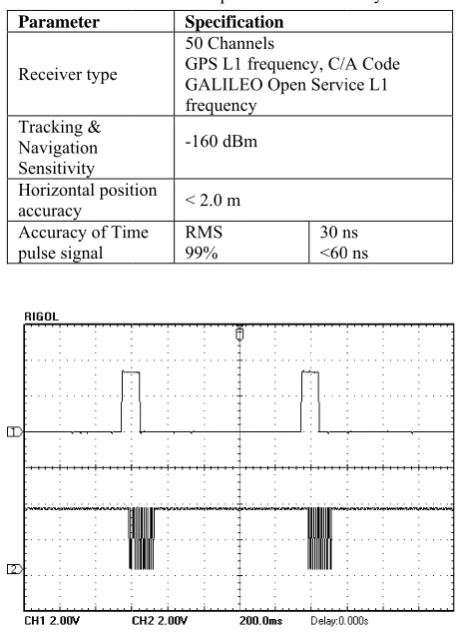
ble 6 In use GP Parameter Receiver type Tracking & Navigation Sensitivity Horizontal posit accuracy Accuracy of Tim pulse signal
g. 5 (a, upper:
2) GPS receiver ec./div,2V/div)
nic Engineerin ns time inform a few millise ation interface l output data oscilloscope.
ple of NMEA GPS receiver. ZDA NMEA GPZDA, mmss. sss, y, month, ar, ltzh, n*cs<CR> LF> GPZDA,08271 232,16,09,200 00,00*64 ate: 16.9.2002 me:08:27:10 illisecond:232
PS receiver spec
Specific 50 Chan GPS L1 GALILE frequen -160 dB
tion < 2.0 m me RMS
99%
ch1) GPS rec r serial output d .
ng, Vol. 8, No. mation of the ne
econd after ea es. Fig. 5(b) i a containing
A and binary
NAV-U Header, ID iTOW, n month, day, sec, Validity
B5 62 01 21 5E 12 0C 00 D9 FF D3 07 24 09 07 0D Date:19.2.20 Time:13:36:0 Millisecond: Nanosecond: cifications summ cation nnels
1 frequency, C/A EO Open Servi ncy
Bm
m
30 n <60
ceiver 1PPS sig data for TIM-TP
3, Sep. 2012 ext time pulse ach time pulse illustrates two this message protocol time TIMEUTC UBX D, Length, ano, year, , hour, min,
Flags
14 00 EE 7B 00 00 EF FB 7 02 13 0D
69 003 09 998 :2491409 mery A Code ice L1 ns 0 ns
gnal (b, lower: P message (200
e e o e e : 0
Refan & Vali 5 Impleme 5.1 In this pa acts like a G a computer milliseconds it is usually within an off eyeball-and-w rarely checke
Fig. 6 sh MATLAB pr GPS receive Fig. 7 shows by listening request, it s variable and sending a req response con current time packet fields response bac has a built-in Target™ too SIMULINK run Simulink so we made provided by establish UD running MA it via Etherne
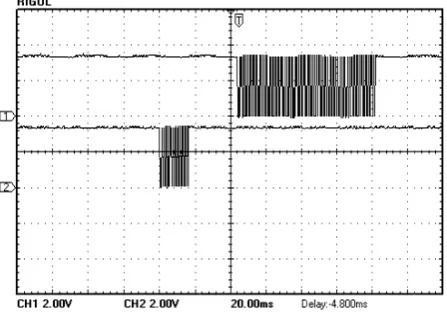
Regardin server wants message, the According to receiver (pol response abo duration is ab shown in Fig the polling response has the current t NTP packet, This error ca offset to th program.
To overc time pulse s the GPS rec
Fig. 6 Overall
izadeh: Comp enting a Time 1 MATLAB art we presen GPS master clo
r network t . Although th y enough for
fice which mo wristwatch to ed after that. hows the ove
rogram is dev er via USB in s, first, the pro to 123 port stores the req d polls the N
quest to the G ntaining the c
data in to N s according to ck to the client n UDP/IP Pac olbox but it c program, and k program to e e use of some y MATLAB c DP/IP conne ATLAB and an
et notwithstan ng the fact th s to have the ere is a problem
o Fig. 8, when lling serial da out 42 millise bout 80 millis g. 8(b)), so wh response, the s always a 80
time. Therefo , the data poin an be compens he packets b ome this issu ignal and its eiver. What w
scheme of MA
puter Network e Server
Based Time nt a MATLAB
ock, synchron to an accur is accuracy is a typical co ost computer o within a mi rall scheme f veloped that co
nterface. As t ogram waits fo and upon ar quest packet NAV-TIMUT GPS receiver current time). NTP time stam
o Table 7 and t address. Alth cket send/rece
can just be ru d both Host a
establish their e functions o central file e ction betwee ny other com nding it runs M hat whenever e current time m with MATL n we poll a me
ata is shown econds later a seconds (respo hen MATLAB e time data milliseconds ore, when MA
nts to 80 mse sated by addin before sendin ue, we should related time we need to do
ATLAB time ser
k Time Synchro Server B program wh nizing the time racy of 80± s not so much omputer netw clocks are set inute or two for this work ommunicate w the Algorithm or an NTP pac rrival of a cli in a tempor TC massage and getting G Then it conv mp and fills N
finally sends hough MATL ive block in x un on MATA and Client sho r communicati of a free toolb
xchange [35] en the host mputer connect MATLAB or n MATLAB t e it polls a ti LAB time serv essage from G in Fig. 8(a)) and the respo onse serial dat B time server g
included in error regarded ATLAB send ec. back in ti ng 80 msec. ti ng them in made use of data message o is to config
rver. onization usin hich e of ±20 but work t by and k. A with m in cket ient rary (by GPS verts NTP the LAB xPC ALB ould ion, box ] to PC ting not. ime ime ver. GPS ), it onse ta is gets the d to ds a me. ime the f the e in gure the risi the req risi as MA int mi Fig Ta dif LI Ro Ro Re Re tim Ori tim Re sta Tra tim
ng a Low Cost e time pulse
ing/falling ed e needed tim quests exactl ing/falling ed hardware in ATLAB and erface instal crocontroller
g. 7 MATLAB t
able 7 Needed
fferent working
VN Mode Stra
tum
Poll Precis
ion oot delay oot dispersion ference ID ference mestamp iginate mestamp ceive time amp ansmit mestamp
t GPS Engine to trigger e dge then read me stamps an
ly when the ge. This mean nterrupt which there shoul led. Meanwh can do the job
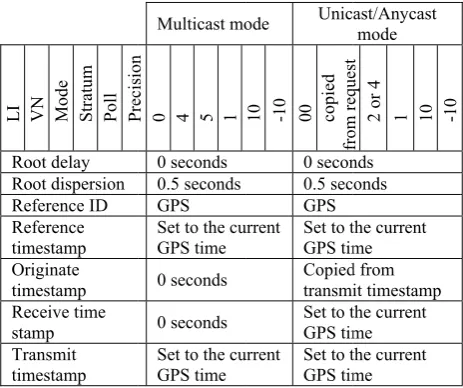
time server pro actions for b modes.
Multicast mo
Pr
ecis
ion
0 4 5 1
0 seconds 0.5 seconds GPS Set to the cu GPS time 0 seconds 0 seconds Set to the cu GPS time
every one se the related m nd answer to e time puls ns we need to h is not an ld be a data hile, a smal b!
gram algorithm building the NT
ode Unic
10 -10 00 copied
from
request
0 secon 0.5 sec GPS urrent Set to t
GPS tim Copied transmi Set to t GPS tim urrent Set to t GPS tim
211 econd with a message, make o the clients se is at its o utilize 1PPS easy task in a acquisition ll low price
m
TP packet in
ast/Anycast mode
from
request 2 or 4 1 10 -10
nds onds the current me d from it timestamp the current me the current me a e s s S n n e
212
Fig. 8 (a, upp
lower: ch2) po
5.2 Here we synchronizat synchronize The board interface, an using NTP.
As the ov shows, it c Controller IC under IEEE data and Ethe current Time
The impl presented in main loop, E (ISR) and T loop initializ graphical LC for Interrupt controller. T time a Packe Packet is che time server’s be the packet made by usi then a flag is packet upon pulse ISR is pulse; this I controller IS “Send–flag” reads TIM-T time” variabl
per: ch1) GPS olling serial data
Standalone e are going t tion server
time in preci will connect nd provides a
verall scheme
onsists of a C, which acts
802.3, a mic ernet Packets, e.
emented algo Fig. 10, it co Ethernet contro ime pulse ISR zes Ethernet CD, then it ent ts from GPS The Ethernet c et is received ecked then to s IP address in
t that should b ing “next-puls s set letting th arrival of th set to be cal ISR has high R and does a and if it be s TP message
le.
I
receiver respo a (20 msec./div
Time Server to design a which can ise time need t to GPS re accurate time of this Time GPS receiv like a Netwo crocontroller , and a graphi rithm in the m onsist of three
oller Interrupt R. At the firs controller, G ters to an endl time pulse a controller ISR by the Ethern see if it is an N n its destinatio be answered. A
se-time” varia he microcontr e next Time lled at the risi her priority th a simple job. I et, sends the N and stores it
Iranian Journ
onse serial data ,2V/div).
r Board Standalone t n be used ding applicatio eceiver, Ether e for the clie server in Fig ver, an Ether rk Ethernet C to Process G cal LCD to sh microcontrolle e sub algorith t Service Rout st step, the M GPS receiver
less loop, wait and the Ether R is called ev net controller NTP Packet w on field, and A reply packe able’s time d roller to send
pulse. The T ing edge of t han the Ether It just checks NTP packet t t in “next-pu
nal of Electrica
a (b, ime to ons. rnet ents g. 9 rnet Card GPS how er is hms, tine Main and ting rnet very IC, with if it et is data, the ime ime rnet the then ulse-Fig Fig 6 we two 1 h the int ser NT MA reg clie NT wa cou 12 suc scr ana bet clie pac pro mi
al & Electron
g. 9 Overall sch
g. 10 standalone
Results 6.1 M To examine e tested it on o PCs connec has IP: 192.16 e PC-2 has IP: Windows X egrated time rvice) installed TP Time Serve We disabled ATLAB work gistry settings
ent.In order to TP request to as running the uld successful Fig. 11 displ shows “ev ccessful time reenshot of alyzer [37]) c tween MATLA Whenever a ent synchron cket, meanwh otocol analyze crosecond acc nic Engineerin
heme of MATLA
e time server pr
MATLAB Bas if our progra a simple com cted directly w 68.1.10 with W
: 192.168.1.2 XP and Win
e synchroniz d by default, w er.
d the PC-2’s k instead. M [36] in PC-1, o PC-1 be syn PC-2’s IP ad ere, then ran
lly synchroniz lays a screensh vent viewer”
e synchroniz Wireshark ( capturing the AB and PC-2 NTP packet nizes its loca hile the inst er timestamps curacy.
ng, Vol. 8, No.
AB time server
rogram algorith
sed Time Ser am works cor mputer netwo with an Ethern Windows XP with Win 7. ndows 7 bo zation servic which can syn s W32time s Moreover, by
, we made it a nchronized by ddress, which
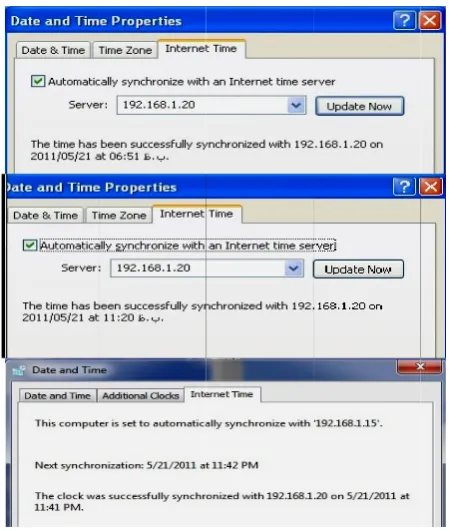
MATLAB pr ze that. hot of “date an
of PC-1 ation. Fig. a free netw NTP packet .
t is received al clock acco talled Wiresh s the receiving
3, Sep. 2012
r.
hm.
rver
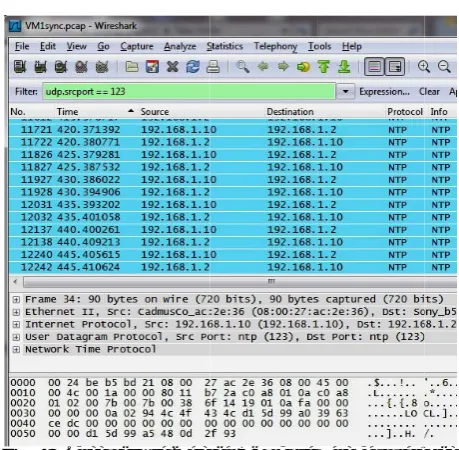
rrectly or not, ork consist of net cable. PC-installed, and oth have an ce (w32time nchronize to a service to let manipulating act as an NTP PC-2,it sends our program rogram and it nd time”. Fig. showing the 13 shows a work protocol ts transmitted in the client, ording to the hark network g packets to 1 , f -d n e a t g P s m t . e a l d , e k
Refan & Vali
Fig. 11 Screen
Fig. 12 Screen
Fig. 13 Screen
NTP packets t
To get th time differen packets in th identical in z time differe floating accu
izadeh: Comp
nshots of “date
nshots of “event
nshot of Wires transmitted betw
he synchroni nces between he client. Thes zero accuracy. ences is a m uracy. Fig. 14
puter Network
and time” in th
t viewer” in the
shark [37] softw ween MATLAB
ization accura n 2 continuou se difference . The differen measure of th
shows a cha
k Time Synchro
e Client PC.
e Client PC.
ware capturing B and PC-2.
acy, we can us received N
values should nce between th he time sev art of these ti
onization usin
g the
use NTP d be hese er’s ime
val is mi pac and aro
an in p Fig com sof ins tog syn 192 to and of tran tim rep
Fig Fig
ng a Low Cost lues for 100 N
seen there, lliseconds.
Recall from ckets was com d therefore th ound ±40 mill
6.2 St We used a p Ethernet con practice and i g. 15.
In order to mputer with “ ftware installe stalled Windo gether and con nchronized fr
2.168.1.20). A the Time serv d time” of thr
Wireshark nsmitted betw me server in w
ply are traceab
g. 15 NTP time
g. 14 MATLAB
‐40
‐30
‐20
‐10 0 10 20 30 40
1 5 9
Floating accuracy (m
s)
t GPS Engine NTP packets r , they are 5.1 the 80 m mpensated, so he accuracy o
iseconds. tandalone Tim
product of A ntroller in imp
mplemented a test the boar “Sun virtual b ed in it. Then ows XP in e nfigured W32 rom Standalo All computers ver, Fig. 16 sh ree computers
software cap ween three com
which client ble.
server prototyp B time server flo
13 17 21 25 29 33 37 4
Pac
received by th
almost limi millisecond err it won’t harm of synchroniz
me Server Bo ATMEL micro plementing the
a prototype bo rd, it was co box” [38] vir made two vir each, network 2 time service one NTP serv s successfully
hows a screen s. Fig. 17 show pturing the N mputers and th requests and
pe board. oating accuracy
41 45 49 53 57 61 65 6
cket number
213 he client, as it ited to ±20 ror in sending m the accuracy zation will be
oard
ocontrollerand e NTP server oard shown in onnected to a rtual Machine rtual machine, ked all three in each to be ver (with IP: synchronized nshot of “date ws screenshot NTP packets he standalone Time server
y.
69 73 77 81 85 89 93
t 0 g y e
d r n a e , e e : d e t s e r
214
Fig. 16 Scree
synchronized t
Fig. 17 Screen NTP packets standalone tim
Fig. 18 accuracy for is seen there will be aroun According screenshot o Fig. 10) there the GPS 1PP msec. offse
enshot of “date to the standalon
nshot of Wires transmitted be me server.
shows a ch 100 NTP pac e, the floating nd ±10 millise g to Fig. 19 of 1PPS signa e is about 15 m PS signal and et every tim
I
e and time” o ne time server.
shark [36] softw etween three c
hart of client ckets received g accuracy of econds.
that shows al and
“send-msec. time di the packet se me. Similarly
Iranian Journ
of three compu
ware capturing computers and
t clock float d by a client, a f synchronizat an oscillosc -flag” status (
fference betw ending time. T y this error
nal of Electrica
uters
g the the
ting as it tion ope (see ween This is
Fig
Fig
stat mse
com sen wil 7
ma net pro tim syn typ tim adv sou wo the ser Th tim clie mi syn be
al & Electron
g. 18 Standalon
g. 19 (a, upper tus (b, lower ec./div,2V/div)
mpensated by nding routine ll be remain a
Conclusion Time Synch any modern tworks. Gen ocedure, an ex medata to the t nchronization pes of time so me synchroni vantages over In this study urce. Meanw orldwide popu e time synchro A MATLAB rver board h hese two, both me and then s
ents. Implem llisecond a nchronization developed as
‐10
‐5 0 5 10
1
Floating accuracy (m
s)
nic Engineerin
e time server fl
r: ch1) standal r: ch2) GPS .
y adding a t program, th around ±10 ms
hronization of networks esp nerally in xternal time so
time needing protocols. To ources, the GP zation sourc r other sources
y, GPS was while, because
ularity of NTP onization proto B software ba have been de h use GPS tim spread it in N mented Time
accuracy. T board is rela a commercial
6 11 16 21 26 31 3
P
ng, Vol. 8, No.
loating accuracy
lone NTP serv receiver 1P
time offset in erefore the to sec.
f clocks is a pecially in t a time syn ource is used
applications v oday among m PS is more of
e due to it s.
used as the e of great a P protocol, it w
ocol.
ased and a sta esigned and ming signals t NTP packet m e servers h The standa atively very c
l product.
36 41 46 51 56 61 6
Packet number
3, Sep. 2012
y.
ver “send-flag” PS signal (5
n the packet otal accuracy
vital need in the computer nchronization for spreading via some time many different ften used as a ts significant external time accuracy and was chosen as andalone time implemented. to get precise message to the have a few alone time heap and can
66 71 76 81 86 91
” 5
t y
n r n g e t a t e d s e . e e w e n
Refan & Valizadeh: Computer Network Time Synchronization using a Low Cost GPS Engine 215 References
[1] Liskov B., “Practical uses of Synchronized Clocks in Distributed Systems”, Distributed Computing, Vol. 6, pp. 211-219, Apr. 1993.
[2] The University of California Observatories, Time scales, in URL: http://www.ucolick.org/~sla/ leapsecs/timescales.html, accessed on July18, 2012.
[3] GPS, UTC, and TAI Clocks, in URL: http://www.leapsecond.com/java/gpsclock.htm, accessed on July 18, 2012.
[4] Mills D. L., "On the accuracy and stability of clocks synchronized by the network time protocol in the internet system", ACM SIGCOMM Computer Communication Review, Vol. 20, pp. 65-75, 1989.
[5] Allan D. W., Gray J. E. and Machlan H. E., “The National Bureau of Standards Atomic Time Scale: Generation, Stability, Accuracy and Accessibility”. In: Blair, B.E. (Ed.). Time and Frequency Theory and Fundamentals. National Bureau of Standards Monograph 140, U.S. Department of Commerce, pp. 205-231, 1974. [6] Lombardi M. L., “NIST Time and Frequency
Services”, NIST Special Publication 432. Jan. 2002. Available online at: http://www.nist.gov/ timefreq/general/pdf/1383.pdf
[7] Nelson G. K., Lombardi M. A., and Okayama D. T., “NIST Time and Frequency Radio Stations: WWV, WWVH, and WWVB,” NIST Special Publication 250-67, 161 pages, Jan. 2005.
[8] Levine J., Weiss M., Davis D.D., Allan D.W. and Sullivan D.B., “The NIST automated computer time service.” J. Research National Institute of Standards and Technology, Vol. 94, pp. 311-321, Sep. 1989.
[9] Standard Time Signal Broadcast Channels, SW Time Signal Broadcasts, in URL: http://www.dxinfocentre.com/time.htm, accessed on July 18, 2012.
[10] Accuracy between DCF77 and GPS, hopf Elektronik - Accuracy between DCF77 and GPS, in URL: http://www.hopf.com/en/dcf-gps.htm, accessed on July 18, 2012.
[11] Postel J. and Harrenstien k., “Time protocol”, DARPA Network Working Group Report RFC-868, USC Information Sciences Institute, May. 1983.
[12] Postel J., “Daytime protocol.”, DARPA Network Working Group Report RFC-867, USC Information Sciences Institute, May. 1983.
[13] Mills D. L., “Network Time Protocol (version 0)”, DARPA Network Working Group Report RFC-958, M/A-COM Linkabit, Sep. 1985.
[14] Mills D. L., “Network Time Protocol (Version 1) - specification and implementation”, DARPA Network Working Group Report RFC-1059, University of Delaware, July 1988.
[15] Mills D. L., “Network Time Protocol (Version 2) - specification and implementation”, DARPA Network Working Group Report RFC-1119, University of Delaware, Sept. 1989.
[16] Mills D. L., “Network Time Protocol (Version 3) - Specification, Implementation and Analysis”, DARPA Network Working Group Report RFC-1305, University of Delaware, Mar. 1992.
[17] Mills D. L., “Network Time Protocol (Version 4) - Protocol and Algorithms Specification”, DARPA Network Working Group Report RFC-5905, University of Delaware, June 2010.
[18] Mills D. L., Computer Network Time Synchronization: the Network Time Protocol on Earth and in Space, Second Edition, CRC Press, 2011.
[19] Mills D. L., “Simple Network Time Protocol (SNTP)”, DARPA Network Working Group Report RFC-1361, University of Delaware, Aug. 1992.
[20] Mills D. L., “Simple Network Time Protocol (SNTP)”, DARPA Network Working Group Report RFC-1769, University of Delaware, Mar. 1995.
[21] Mills D. L., “Simple Network Time Protocol (SNTP)”, DARPA Network Working Group Report RFC-2030, University of Delaware, Oct. 1996.
[22] Mills D. L., “Simple Network Time Protocol (SNTP) Version 4 for IPv4, IPv6 and OSI, RFC 4430”, University of Delaware, Jan. 2006.
[23] IEEE Standard for a Precision Clock Synchronization Protocol for Networked Measurement and Control Systems, IEEE Standard1588-2002, 2002.
[24] IEEE Standard for a Precision Clock Synchronization Protocol for Networked Measurement and Control Systems, IEEE Standard1588-2008, July. 2008.
[25] Eidson J., Measurement Control and Communication Using IEEE 1588, London, UK, Springer, 2006.
[26] Postel J., “User Datagram Protocol”, DARPA Network Working Group Report RFC-768, USC Information Sciences Institute, Aug. 1980.
[27] Simonsen K., “Character Mnemonics and Character Sets”, DARPA Network Working Group Report RFC-1345, June 1992.
[28] Mills D. L., "The Autokey security architecture, protocol and algorithms. Electrical and Computer Engineering Technical Report 06-1-1", NDSS, Jan. 2006.
[29] u-blox 5 ROM-based GPS receiver module, NEO-5Q: GPS receiver module with KickStart, in URL: http://www.u-blox.com/en/neo-5q.html, accessed on July 18, 2012.
216 [30] Rf Tel URL: 2012. [31] u-blox Sheet,” B3, 2 blox.co 5x_Da [32] NMEA electro Associ [33] NMEA electro Associ [34] u-blox Includ numbe online blox.co blox5_ 07036) [35] MATL 2.0.6 URL: fileexc [36] Micros W32Ti http://s on July [37] The w
Wiresh http://w 2012. [38] virtual http://w
lecommunicat www.rfphon x AG. “NEO-5
” Document n 2009.Availabl
om/images/do ataSheet_%28G A 0183 stand
onics devices, iation, 1983. A 2000®stand
onics devices, iation, 2000. x AG. “u-bl ding Protoco er: GPS.G5 at: om/images/do _Protocol_Spe
).pdf.
LAB CENTR - File Excha http://www.m change/345, ac
soft Support
ime se
support.micro y 18, 2012. world’s foremo
hark-Go www.wireshar lbox.org, www.virtualbo
I tion Electroni e.com, acces 5 u-blox 5 GP number: GPS le online at ownloads/Prod GPS.G5-MS5 dard for int , National Ma dard for inte , National Ma lox 5 Recei ol Specificati -X-07036-G,2 http://w ownloads / ecifications RAL, TCP/U ange - MATL
mathworks.co ccessed on Jul t, Registry ervice,
soft.com/kb/2 ost network p
deep, rk.org/, acces
VirtualBox, ox.org/, July 1
Iranian Journ ics, RFPhone sed on July PS Modules D .G5-MS5-070 t: http://www duct_Docs/NE 5-07025%29.p terfacing mar arine Electron erfacing mar arine Electron iver Descript ion”, Docum 2009 Availa
www. Product_Doc
(GPS.G5 UDP/IP Tool LAB Central, om/matlabcent ly 18, 2012.
entries for in UR 223184, acces protocol analy
in UR ssed on July
in UR 18, 2012.
nal of Electrica e, in
18, Data 025- w.u- EO-pdf. rine nics rine nics tion ment able u- s/u- 5-X-lbox , in tral/ the RL: ssed yzer, RL: 18, RL:
Ass Eng Teh Con Teh pub res
dist
al & Electron
sistance of th gineering, Sha hran, Iran, and ntrol Engineer hran, Iran. H blications on j earch interests
tributed control
nic Engineerin
Mohamma
his B.Sc. from Iran Technology 12 years industry, h 1989 and r in the s University respectivel he Faculty o ahid Rajaee T d also working ring & Manufa He is the auth ournals and in include GPS, D
Hossein V
degree in Karaj Islam Karaj, Iran M.Sc. deg in Shahid Tehran, Ir interests a Electronic, l systems (DCS
ng, Vol. 8, No.
ad Hossein R
in Electronic University of y, Tehran, Iran working and he started stud received his M ame field an
in 1992 ly. He is curre
f Electrical a Teacher Trainin with MAPNA facturing Comp
hor of about nternational co DCS, and Autom
Valizadeh rece
electrical eng mic Azad Univ n in 2008. He gree in Electric
Rajaee Univer ran in 2012. are in the ar , Microcont S).
3, Sep. 2012
Refan received
cs Engineering f Science and n in 1972. After experience in dying again in M.Sc. and Ph.D. nd the same and 1999 ently Professor and Computer ng University, Electrical and pany (MECO), 50 scientific onferences. His mation System.
ived the B.Sc. gineering from versity (KIAU), e also got his cal Engineering rsity (SRTTU), His research rea of Digital trollers and d g d r n n . e 9 r r , d , c s
. m , s g , h l d