A Monthly Double-Blind Peer Reviewed (Refereed/Juried) Open Access International e-Journal - Included in the International Serial Directories Indexed & Listed at:
VOLUME NO.3(2013),ISSUE NO.09(SEPTEMBER) ISSN2231-5756
INTERNATIONAL JOURNAL OF RESEARCH IN COMMERCE, IT & MANAGEMENT
CONTENTS
CONTENTS
CONTENTS
CONTENTS
Sr.
No.
TITLE & NAME OF THE AUTHOR (S)
Page No. 1. ADEQUACY OF KNOWLEDGE AND ATTITUDE TOWARDS INFORMATION TECHNOLOGY OF STUDENT LIBRARY USERS AT SELECTED COLLEGES AND
UNIVERSITIES IN CALABARZON, PHILIPPINES
DR. MA. LINDIE D. MASALINTO, DR. MA. CONSUELO M. OBILLO, RUFO S CALIXTRO JR., JOSEFA G. CARRILLO & MA. XENIA Z. BITERA
1
2. MOBILITY IN HETEROGENEOUS WIRELESS NETWORK USING HMAC C. SUGANTHI & DR. C. MANOHARAN
4
3. A STUDY ON CONSUMERS PERCEPTION TOWARDS THE PURCHASE DECISION OF TWO WHEELER MOTORCYCLES IN NELLORE DISTRICT, ANDHRA PRADESH
D.V.RAMANA & DR. PARA SUBBAIAH
9
4. OPTIMIZING THE DE-DUPLICATION FOLIAGE IMAGE ACCESS IN STORAGE SYSTEMS CHITTALA RAMA SATYA & B.VIJAYA KUMAR
15
5. A STUDY ON THE IMPACT OF E TAILERS ON UNORGANISED AND ORGANISED RETAILERS WITH REFERENCE TO ELECTRONIC GOODS KALAVATHY K.S & DR. BINA PANDEY
18
6. A MODERN CLASSIFICATION OF PRICING STRATEGIES OF RETAILERS SREELATA, N. V. NARASIMHAM & DR. M. K. GUPTA
24
7. LEADERSHIP CONCEPT: AN OPINION SURVEY IN A PRIVATE SECTOR AND GOVERNMENT SECTOR DR. E. LOKANADHA REDDY & DR. G HARANATH
30
8. MARKETING MIX: A REVIEW ON THE ‘P’S OF MARKETING M.VASUDEVAN, DR. V. M. SENTHILKUMAR & K.SASIKUMAR
37
9. SECURING A BIOMETRIC TRAIT: A CASE STUDY ON FINGER PRINTS MADHU CHAUHAN & DR. R. P. SAXENA
40
10. INFORMATION AND COMMUNICATION TECHNOLOGY AND THE PERFORMANCE OF SMALL AND MEDIUM ENTERPRISES IN NASARAWA STATE, NIGERIA
UMARU DANLADI MOHAMMED & CHINELO GRACE OBELEAGU-NZELIBE
43
11. RELIABILITY TEST PLANS BASED ON LOG-LOGISTIC DISTRIBUTION R.R.L.KANTAM, B.SRIRAM & A. SUHASINI
49
12. MIGRATION AND SUSTAINABLE DEVELOPMENT DR. H.R.UMA, MADHU G.R. & MAHAMMAD HABEEB
58
13. THE ANTECEDENTS OF BRAND LOYALTY: AN EMPIRICAL STUDY ON AIRTEL CELLULAR SERVICES DR. P. SUJATHA
61
14. STATUS OF BI SOLUTIONS AT SELECTED BRANCHES OF BANKS IN RAJASTHAN DR. AZIMUDDIN KHAN
66
15. A STUDY ON USAGE OF GEOSPATIAL TECHNOLOGIES IN POWER UTILITY VARUN PRAKASH
71
16. AN IMPROVED INVISIBLE WATERMARKING TECHNIQUE FOR IMAGE AUTHENTICATION DASU VAMAN RAVI PRASAD
76
17. ORGANIZATIONAL STRUCTURE, RESPONSIBILITY, MOTIVATION LEVEL AND JOB SATISFACTION OF SELF-FINANCING ENGINEERING COLLEGES BY USING MATHEMATICAL MODELING
RAVI DATT, DR. SUNIL DUTT, DR. SITA RAM & SANTOSH KUMARI
82
18. DESIGN AND IMPLEMENTATION OF A REAL-TIME VEHICLE TRACKING SYSTEM
MAITANMI OLUSOLA STEPHEN, OGUNLERE SAMSON OJO, DR. ADEKUNLE YINKA, GREGORY ONWODI & MALASOWE BRIDGET
86
19. PERFORMANCE EVALUATION OF MANET ROUTING PROTOCOLS WITH SCALABILITY FOR E-MAIL THROUGHPUT TRAFFIC USING OPNET MODELER MANDEEP SINGH & BALWINDER SINGH
93
20. DETAILED INVESTIGATION OF RESIDENTIAL SATISFACTION IN APARTMENT’S MANAGEMENT SERVICE P. BALATHANDAYUTHAM & DR. R. SRITHARAN
98
21. A STUDY ON THE PSYCHOLOGICAL IMPACT OF REDUNDANCY ON SURVIVORS S.SOWJANYA
100
22. A STUDY ON SECURITY THREAT AWARENESS AMONG STUDENTS USING SOCIAL NETWORKING SITES, BY APPLYING DATA MINING TECHNIQUES A.PAPPU RAJAN
103
23. ELECTRONIC REMITTANCE SYSTEM IN INDIA: CHANGING PARADIGMS OF PAYMENT MECHANISMS IN INDIA SAMIR
107
24. E-SATISFACTION AND E-LOYALTY OF CONSUMERS SHOPPING ONLINE R. SATHISH KUMAR
111
25. STUDENTS PERCEPTION TOWARDS e-BANKING: SPECIAL REFERENCE TO KOLLAM DISTRICT IN KERALA NIJAZ NIZAR
114
26. TECHNOLOGICAL DRIFT TOWARDS SMART DEVICES: AN OVERVIEW MUKESH H.V & HALASWAMY D. NAIK
118
27. MOTIVATION AS AN EFFECTIVE TOOL FOR ORGANIZATIONAL DEVELOPMENT IN NIGERIA DR. ABDULSALAM JIBRIL & YUSUF SAJO
121
28. AN UNDERSTANDING OF DUNNING’S OWNERSHIP-LOCATION-INTERNALISATION (OLI) ECLECTIC THEORY OF MULTINATIONAL COMPANIES JABES GABBIS ODHIAMBO KOTIENO
124
29. AUTHORING TOOL: KEY FOR E-LEARNING SYSTEM DEVELOPMENT JAVED WASIM
128
30. ANTECEDENTS AND CONSEQUENCES OF WORK-EXHAUSTION (IT SECTOR) UMAIR NAJAM & FAISAL ABBAS
131
CHIEF PATRON
CHIEF PATRON
CHIEF PATRON
CHIEF PATRON
PROF. K. K. AGGARWAL
Chairman, Malaviya National Institute of Technology, Jaipur
(An institute of National Importance & fully funded by Ministry of Human Resource Development, Government of India)
Chancellor, K. R. Mangalam University, Gurgaon
Chancellor, Lingaya’s University, Faridabad
Founder Vice-Chancellor (1998-2008), Guru Gobind Singh Indraprastha University, Delhi
Ex. Pro Vice-Chancellor, Guru Jambheshwar University, Hisar
FOUNDER
FOUNDER
FOUNDER
FOUNDER PATRON
PATRON
PATRON
PATRON
LATE SH. RAM BHAJAN AGGARWAL
Former State Minister for Home & Tourism, Government of Haryana
Former Vice-President, Dadri Education Society, Charkhi Dadri
Former President, Chinar Syntex Ltd. (Textile Mills), Bhiwani
CO
CO
CO
CO----ORDINATOR
ORDINATOR
ORDINATOR
ORDINATOR
AMITA
Faculty, Government M. S., Mohali
ADVISORS
ADVISORS
ADVISORS
ADVISORS
DR. PRIYA RANJAN TRIVEDI
Chancellor, The Global Open University, Nagaland
PROF. M. S. SENAM RAJU
Director A. C. D., School of Management Studies, I.G.N.O.U., New Delhi
PROF. M. N. SHARMA
Chairman, M.B.A., Haryana College of Technology & Management, Kaithal
PROF. S. L. MAHANDRU
Principal (Retd.), Maharaja Agrasen College, Jagadhri
EDITOR
EDITOR
EDITOR
EDITOR
PROF. R. K. SHARMA
Professor, Bharti Vidyapeeth University Institute of Management & Research, New Delhi
CO
CO
CO
CO----EDITOR
EDITOR
EDITOR
EDITOR
DR. BHAVET
Faculty, Shree Ram Institute of Business & Management, Urjani
EDITORIAL ADVISORY BOARD
EDITORIAL ADVISORY BOARD
EDITORIAL ADVISORY BOARD
EDITORIAL ADVISORY BOARD
DR. RAJESH MODI
Faculty, Yanbu Industrial College, Kingdom of Saudi Arabia
PROF. SANJIV MITTAL
University School of Management Studies, Guru Gobind Singh I. P. University, Delhi
PROF. ANIL K. SAINI
VOLUME NO.3(2013),ISSUE NO.09(SEPTEMBER) ISSN2231-5756
INTERNATIONAL JOURNAL OF RESEARCH IN COMMERCE, IT & MANAGEMENT
DR. SAMBHAVNA
Faculty, I.I.T.M., Delhi
DR. MOHENDER KUMAR GUPTA
Associate Professor, P. J. L. N. Government College, Faridabad
DR. SHIVAKUMAR DEENE
Asst. Professor, Dept. of Commerce, School of Business Studies, Central University of Karnataka, Gulbarga
ASSOCIATE EDITORS
ASSOCIATE EDITORS
ASSOCIATE EDITORS
ASSOCIATE EDITORS
PROF. NAWAB ALI KHAN
Department of Commerce, Aligarh Muslim University, Aligarh, U.P.
PROF. ABHAY BANSAL
Head, Department of Information Technology, Amity School of Engineering & Technology, Amity
University, Noida
PROF. A. SURYANARAYANA
Department of Business Management, Osmania University, Hyderabad
DR. SAMBHAV GARG
Faculty, Shree Ram Institute of Business & Management, Urjani
PROF. V. SELVAM
SSL, VIT University, Vellore
DR. PARDEEP AHLAWAT
Associate Professor, Institute of Management Studies & Research, Maharshi Dayanand University, Rohtak
DR. S. TABASSUM SULTANA
Associate Professor, Department of Business Management, Matrusri Institute of P.G. Studies, Hyderabad
SURJEET SINGH
Asst. Professor, Department of Computer Science, G. M. N. (P.G.) College, Ambala Cantt.
TECHNICAL ADVISOR
TECHNICAL ADVISOR
TECHNICAL ADVISOR
TECHNICAL ADVISOR
AMITA
Faculty, Government M. S., Mohali
FINANCIAL ADVISORS
FINANCIAL ADVISORS
FINANCIAL ADVISORS
FINANCIAL ADVISORS
DICKIN GOYAL
Advocate & Tax Adviser, Panchkula
NEENA
Investment Consultant, Chambaghat, Solan, Himachal Pradesh
LEGAL ADVISORS
LEGAL ADVISORS
LEGAL ADVISORS
LEGAL ADVISORS
JITENDER S. CHAHAL
Advocate, Punjab & Haryana High Court, Chandigarh U.T.
CHANDER BHUSHAN SHARMA
Advocate & Consultant, District Courts, Yamunanagar at Jagadhri
SUPERINTENDENT
SUPERINTENDENT
SUPERINTENDENT
SUPERINTENDENT
CALL FOR
CALL FOR
CALL FOR
CALL FOR MANUSCRIPTS
MANUSCRIPTS
MANUSCRIPTS
MANUSCRIPTS
We invite unpublished novel, original, empirical and high quality research work pertaining to recent developments & practices in the areas of Computer Science & Applications; Commerce; Business; Finance; Marketing; Human Resource Management; General Management; Banking; Economics; Tourism Administration & Management; Education; Law; Library & Information Science; Defence & Strategic Studies; Electronic Science; Corporate Governance; Industrial Relations; and emerging paradigms in allied subjects like Accounting; Accounting Information Systems; Accounting Theory & Practice; Auditing; Behavioral Accounting; Behavioral Economics; Corporate Finance; Cost Accounting; Econometrics; Economic Development; Economic History; Financial Institutions & Markets; Financial Services; Fiscal Policy; Government & Non Profit Accounting; Industrial Organization; International Economics & Trade; International Finance; Macro Economics; Micro Economics; Rural Economics; Co-operation; Demography: Development Planning; Development Studies; Applied Economics; Development Economics; Business Economics; Monetary Policy; Public Policy Economics; Real Estate; Regional Economics; Political Science; Continuing Education; Labour Welfare; Philosophy; Psychology; Sociology; Tax Accounting; Advertising & Promotion Management; Management Information Systems (MIS); Business Law; Public Responsibility & Ethics; Communication; Direct Marketing; E-Commerce; Global Business; Health Care Administration; Labour Relations & Human Resource Management; Marketing Research; Marketing Theory & Applications; Non-Profit Organizations; Office Administration/Management; Operations Research/Statistics; Organizational Behavior & Theory; Organizational Development; Production/Operations; International Relations; Human Rights & Duties; Public Administration; Population Studies; Purchasing/Materials Management; Retailing; Sales/Selling; Services; Small Business Entrepreneurship; Strategic Management Policy; Technology/Innovation; Tourism & Hospitality; Transportation Distribution; Algorithms; Artificial Intelligence; Compilers & Translation; Computer Aided Design (CAD); Computer Aided Manufacturing; Computer Graphics; Computer Organization & Architecture; Database Structures & Systems; Discrete Structures; Internet; Management Information Systems; Modeling & Simulation; Neural Systems/Neural Networks; Numerical Analysis/Scientific Computing; Object Oriented Programming; Operating Systems; Programming Languages; Robotics; Symbolic & Formal Logic; Web Design and emerging paradigms in allied subjects.
Anybody can submit the soft copy of unpublished novel; original; empirical and high quality research work/manuscriptanytime in M.S. Word format
after preparing the same as per our GUIDELINES FOR SUBMISSION; at our email address i.e. [email protected] or online by clicking the link online submission as given on our website (FOR ONLINE SUBMISSION, CLICK HERE).
GUIDELINES FOR SUBMISSION OF MANUSCRIPT
GUIDELINES FOR SUBMISSION OF MANUSCRIPT
GUIDELINES FOR SUBMISSION OF MANUSCRIPT
GUIDELINES FOR SUBMISSION OF MANUSCRIPT
1. COVERING LETTER FOR SUBMISSION:
DATED: _____________ THE EDITOR
IJRCM
Subject: SUBMISSION OF MANUSCRIPT IN THE AREA OF.
(e.g. Finance/Marketing/HRM/General Management/Economics/Psychology/Law/Computer/IT/Engineering/Mathematics/other, please specify)
DEAR SIR/MADAM
Please find my submission of manuscript entitled ‘___________________________________________’ for possible publication in your journals.
I hereby affirm that the contents of this manuscript are original. Furthermore, it has neither been published elsewhere in any language fully or partly, nor is it under review for publication elsewhere.
I affirm that all the author (s) have seen and agreed to the submitted version of the manuscript and their inclusion of name (s) as co-author (s).
Also, if my/our manuscript is accepted, I/We agree to comply with the formalities as given on the website of the journal & you are free to publish our contribution in any of your journals.
NAME OF CORRESPONDING AUTHOR: Designation:
Affiliation with full address, contact numbers & Pin Code: Residential address with Pin Code:
Mobile Number (s): Landline Number (s): E-mail Address: Alternate E-mail Address:
NOTES:
a) The whole manuscript is required to be in ONE MS WORD FILE only (pdf. version is liable to be rejected without any consideration), which will start from the covering letter, inside the manuscript.
b) The sender is required to mentionthe following in the SUBJECT COLUMN of the mail:
New Manuscript for Review in the area of (Finance/Marketing/HRM/General Management/Economics/Psychology/Law/Computer/IT/ Engineering/Mathematics/other, please specify)
c) There is no need to give any text in the body of mail, except the cases where the author wishes to give any specific message w.r.t. to the manuscript. d) The total size of the file containing the manuscript is required to be below 500 KB.
e) Abstract alone will not be considered for review, and the author is required to submit the complete manuscript in the first instance.
f) The journal gives acknowledgement w.r.t. the receipt of every email and in case of non-receipt of acknowledgment from the journal, w.r.t. the submission of manuscript, within two days of submission, the corresponding author is required to demand for the same by sending separate mail to the journal.
2. MANUSCRIPT TITLE: The title of the paper should be in a 12 point Calibri Font. It should be bold typed, centered and fully capitalised.
3. AUTHOR NAME (S) & AFFILIATIONS: The author (s) full name, designation, affiliation (s), address, mobile/landline numbers, and email/alternate email address should be in italic & 11-point Calibri Font. It must be centered underneath the title.
VOLUME NO.3(2013),ISSUE NO.09(SEPTEMBER) ISSN2231-5756
INTERNATIONAL JOURNAL OF RESEARCH IN COMMERCE, IT & MANAGEMENT
5. KEYWORDS: Abstract must be followed by a list of keywords, subject to the maximum of five. These should be arranged in alphabetic order separated by commas and full stops at the end.
6. MANUSCRIPT: Manuscript must be in BRITISH ENGLISH prepared on a standard A4 size PORTRAIT SETTING PAPER. It must be prepared on a single space and single column with 1” margin set for top, bottom, left and right. It should be typed in 8 point Calibri Font with page numbers at the bottom and centre of every page. It should be free from grammatical, spelling and punctuation errors and must be thoroughly edited.
7. HEADINGS: All the headings should be in a 10 point Calibri Font. These must be bold-faced, aligned left and fully capitalised. Leave a blank line before each heading.
8. SUB-HEADINGS: All the sub-headings should be in a 8 point Calibri Font. These must be bold-faced, aligned left and fully capitalised.
9. MAIN TEXT: The main text should follow the following sequence:
INTRODUCTION
REVIEW OF LITERATURE
NEED/IMPORTANCE OF THE STUDY
STATEMENT OF THE PROBLEM
OBJECTIVES
HYPOTHESES
RESEARCH METHODOLOGY
RESULTS & DISCUSSION
FINDINGS
RECOMMENDATIONS/SUGGESTIONS
CONCLUSIONS
SCOPE FOR FURTHER RESEARCH
ACKNOWLEDGMENTS
REFERENCES
APPENDIX/ANNEXURE
It should be in a 8 point Calibri Font, single spaced and justified. The manuscript should preferably not exceed 5000 WORDS.
10. FIGURES &TABLES: These should be simple, crystal clear, centered, separately numbered & self explained, and titles must be above the table/figure. Sources of data should be mentioned below the table/figure. It should be ensured that the tables/figures are referred to from the main text.
11. EQUATIONS:These should be consecutively numbered in parentheses, horizontally centered with equation number placed at the right.
12. REFERENCES: The list of all references should be alphabetically arranged. The author (s) should mention only the actually utilised references in the preparation of manuscript and they are supposed to follow Harvard Style of Referencing. The author (s) are supposed to follow the references as per the following:
•
All works cited in the text (including sources for tables and figures) should be listed alphabetically.•
Use (ed.) for one editor, and (ed.s) for multiple editors.•
When listing two or more works by one author, use --- (20xx), such as after Kohl (1997), use --- (2001), etc, in chronologically ascending order.•
Indicate (opening and closing) page numbers for articles in journals and for chapters in books.•
The title of books and journals should be in italics. Double quotation marks are used for titles of journal articles, book chapters, dissertations, reports, working papers, unpublished material, etc.•
For titles in a language other than English, provide an English translation in parentheses.•
The location of endnotes within the text should be indicated by superscript numbers.PLEASE USE THE FOLLOWING FOR STYLE AND PUNCTUATION IN REFERENCES: BOOKS
•
Bowersox, Donald J., Closs, David J., (1996), "Logistical Management." Tata McGraw, Hill, New Delhi.•
Hunker, H.L. and A.J. Wright (1963), "Factors of Industrial Location in Ohio" Ohio State University, Nigeria.CONTRIBUTIONS TO BOOKS
•
Sharma T., Kwatra, G. (2008) Effectiveness of Social Advertising: A Study of Selected Campaigns, Corporate Social Responsibility, Edited by David Crowther & Nicholas Capaldi, Ashgate Research Companion to Corporate Social Responsibility, Chapter 15, pp 287-303.JOURNAL AND OTHER ARTICLES
•
Schemenner, R.W., Huber, J.C. and Cook, R.L. (1987), "Geographic Differences and the Location of New Manufacturing Facilities," Journal of Urban Economics, Vol. 21, No. 1, pp. 83-104.CONFERENCE PAPERS
•
Garg, Sambhav (2011): "Business Ethics" Paper presented at the Annual International Conference for the All India Management Association, New Delhi, India, 19–22 June.UNPUBLISHED DISSERTATIONS AND THESES
•
Kumar S. (2011): "Customer Value: A Comparative Study of Rural and Urban Customers," Thesis, Kurukshetra University, Kurukshetra.ONLINE RESOURCES
•
Always indicate the date that the source was accessed, as online resources are frequently updated or removed.WEBSITES
MIGRATION AND SUSTAINABLE DEVELOPMENT
DR. H.R.UMA
PROFESSOR
UNIVERSITY OF MYSORE
MANASAGANGOTRI
MADHU G.R.
JUNIOR RESEARCH FELLOW
DEPARTMENT OF STUDIES IN ECONOMICS & CO OPERATION
UNIVERSITY OF MYSORE
MYSORE
MAHAMMAD HABEEB
JUNIOR RESEARCH FELLOW
UNIVERSITY OF MYSORE
MYSORE
ABSTRACT
Migration process is one of common trends in globalized economy. It may be international or internal migration, migration helpful to the improve the living standard as individual and achieving development and growth of the economy. In this paper try to analyze the relationship between regional migration and sustainable development .
KEYWORDS
Migration, Rural, urban, sustainable development.
INTRODUCTION
s discussed in Rio+20, migration has been recognized for its increasing importance and relevance to the social, economic and environmental dimensions of sustainable development. Although the share of international migrants in the world’s population has remained at Approximately 3 per cent for more than 20 years, their absolute numbers have increased significantly: in 1990, approximately 156 million people lived outside their country of birth, but today this figure has increased to approximately 215 million. At the same time, today approximately 740 million internal migrants are estimated to have moved away from their places of birth within the borders of their own countries.
Economic migrants are the world’s fastest growing group of migrants. At the micro level, individual migrants can be motivated to leave their homes in pursuit of what are perceived to be better economic and social opportunities elsewhere. On a macro-level, migration is stimulated by the globalization of trade, transport and communications technologies, as well as by demographic dynamics.
Like international migration, movement within the borders of a country is driven by the search for better opportunities. Rural-urban and urban-urban migration is primarily driven by economic and social causes, with environmental change increasingly influencing movement. In Asia, workers are increasingly moving to cities and manufacturing centers due to wage differentials and labour opportunities. Rural-urban and urban-urban migration is expected to contribute to the significant urbanization of Africa and Asia in coming decades, with most growth taking place in medium-sized cities (those with populations between 500,000 and 1 million people).
An increasingly urban population provides many opportunities for achieving poverty reduction and sustainable development. When migrants are attracted to cities because of employment opportunities, net benefits are likely to accrue as the concentration of ideas, skill, and capital lead to positive spill-over. Cities have the potential to concentrate and make education, health, finance and other services more accessible, and communication and transport networks contribute to engagement in public life. Remittances - a portion of migrant earnings. Also help lift families out of poverty in migrant-sending communities.
Agricultural labourers, especially in smaller villages away from towns and cities, are generally unskilled workers carrying on agricultural operation in the centuries old traditional ways. Most agricultural workers belong to the depressed classes, which have been neglected for ages. The low caste and depressed classes have been socially handicapped and they never had the courage to assert themselves. In some parts of India, agricultural labourers are migratory; moving in search of jobs at the time of harvesting. This movement has some time helped them to get the benefits of growth and development.
DEFINITIONS
Sustainable development: The Brundtland Commission Report entitled Our Common Future (1987) defined sustainable development as “development, which meets the needs of the present without compromising the ability of future generations to meet their own needs”. The 1992 Earth Summit in Rio de Janeiro put the concept of sustainable development on national and international policy agendas.
Migration: Migrationis the crossing of the boundary of a political or administrative unit for a certain minimum period of time. It includes the movement of refugees, displaced persons, uprooted people as well as economic migrants.
RESEARCH GAP
Migration is one of the common trends in these days. In the same way agriculture labour migration is also common in these days. Agriculture labourer face so many problems in his living condition and these problems push him from his native place and migrate to other places where he get good employment and income opportunity. In Karnataka there is lot of disparities between North and South Karnataka and the drought is more prevalent in North which has led to the migration of agricultural labourers from north to south Karnataka in search of jobs. This study focuses on this type of migrant labourers who have migrated from north Karnataka to south Karnataka for employment in construction fields, and tries to prove that this type of migration of the marginalized section has helped in their Sustainable development.
OBJECTIVES OF THE PAPER
1) To analyze the socio economic conditions of migrant labourers from south Karnataka to north Karnataka. 2) To examine the link between migration and sustainable development.
VOLUME NO.3(2013),ISSUE NO.09(SEPTEMBER) ISSN2231-5756
INTERNATIONAL JOURNAL OF RESEARCH IN COMMERCE, IT & MANAGEMENT
HYPOTHESES
Ho=there is no change in labourers income after the migration.
H1 = there is a significant change in income after the migration.
METHODOLOGY
Details regarding the socio-economic conditions of the selected laborers are based on the information collected through interview schedule.200 respondents are selected from different construction fields in Mysore. Primary data collected from the respondents with the help of questionnaire. SPSS package is use for data analysis. Paired T test method was used to analyze wage differences before and after migration. Excel is used for tabulation and construction of Chart .The analysis of the socio-economic background of the selected seasonal migrant laborers has helped to explain the situational factors at the place of origin which make them to migrate. The specific focus of the paper is to understand the socio-economic background of migrant labourers and sustainable development of the migrant labourers through migration to other sector for better livelihood.
TABLE 1: AGE OF THE LABOURERS
Age Frequency percent 11-20 26 13.0 21-30 64 32.0 31-40 70 35.0 41-50 40 20.0 TOTAL 200 100.0
Table 1 has classified these labourers on the basis of age. As shown in the table it is middle age group which is showing more inclination towards migration to improve their economic status.32% of labourers are 21-30 age group, 35%of labourers are 31-40 age group and other remaining part fall in low and higher age group. It is clear from the table that the migration is very pronounced in the highly productive age group is 20-40 years
TABLE 2: MALE AND FEMALE RATIO
Gender Frequency Percentage Female 64 32.0 Male 136 68.0 Total 200 100
The data has been classified on the basis of gender also. And it is men who are more migratory in this group. And the 32% of female population is normally the dependent wife who follows husband to his working place. In most of the cases they are also joining the hands of their husbands to improve the family income and they expressed their willingness to work in an alien place than in their native.
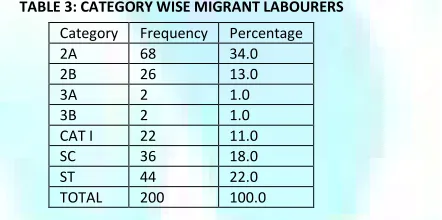
TABLE 3: CATEGORY WISE MIGRANT LABOURERS
The result shows the socio – economic conditions of the migrant labourers, table 3 refers the category wise migrated laborers and their percentage. According to this table the migrated laborers from north Karnataka has been classified into SC and STs, OBCs and others and it is very clear that out of the total more than 40% are SCs and STs ,34 %belong to 2A(kuraba) . This clearly shows that the majority of the poor agricultural labourers, who migrate for their livelihood, are from this marginalized group.
TABLE 4: EDUCATIONAL LEVELS OF MIGRANT LABOURERS
Education is very crucial for inclusive growth and this has been tested in this research paper and as expected the number of illiterates is very high (62%).25%of the labourers are having higher primary school level and the maximum level of education among these people is high school level(13%).This works like a vicious circle for these people. They are poor and are not able to get good education and they are not getting good education because they are poor.
TABLE 5: WORKING STATUS OF MIGRANTS Status Frequency Percent
Helper 8 4.0 Labour 176 88.0 Mason 16 8.0 Total 200 100.0
Above table shows that 88%of migrants are working as labourers, they are unskilled hence they draw lower wages compare to mason and other workers who are working in construction fields.
TABLE 6: PAIRED SAMPLE T TEST
Paired Differences
After And Before Migration Mean Std. Deviation Std. Error Mean t df Sig. (2-tailed) -4110.000 4309.620 430.620 9.537 99 .000
Above Table6 refers to the wage earning status of the migrant labourers before and after their migration from north to south Karnataka. As shown above, the table value is greater than calculated value (9.537> 1.984).therefore the null hypothesis is rejected. Rejecting null hypothesis shows that the test is statically significant. There is a significant difference between income level of the migrated labourers before and after their migration. The income has actually increased.
Category Frequency Percentage 2A 68 34.0 2B 26 13.0 3A 2 1.0 3B 2 1.0 CAT I 22 11.0 SC 36 18.0 ST 44 22.0 TOTAL 200 100.0
This type of migration not only helped to improve the standard of living of the migrant labourers, but also made them economically and socially included as majority of them belongs to the marginalized communities.
FINDINGS AND CONCLUSION
The above study helps us to make some observation as below.
The migrant labourers from North Karnataka are becoming the main labour source to the construction sector in the cities and the construction works of the cities are pulling these labourers because of high wages. Migrated labourers are coming to southern region in good number for employment to fulfilling their financial as well as social needs. Most of the labourers have own land holding but they find it very difficult to survive because of this adverse environment in agriculture sector, Therefore they migrate to other sectors where they are got higher wages, Since majority of these migrant labourers have come from poor background and low socio economic status, the migration has helped them to improve not only their financial status but also their educational, social status. In this way they felt that the migration has helped them to get included in the sustainable development process. In this type they earn more money with migration and fulfill their financial needs and contribute to the sustainable development of the country and their social- economic development.
REFERENCES
1. Global Economic Prospects (2006) the World Bank.
2. J,Edward Taylor, Joaquin Arango,(1996), International Migration and Community Development, Population Index, Vol. 62, No. 3, pp. 397-418.
3. Jajati Keshari Parida,S Madheswaran,(2011) “Determinants Of Migration And Remittance In India, Empirical Evidence” The Institute for Social and Economic Change, Bangalore, Working paper272.
4. Kalpana Bardhan(1973)Factors Affecting Wage Rates for Agricultural Labour” Economic and Political Weekly, Vol. 8, No. 26, pp. A56-A64 5. M. S. A. Rao (1966) “Urbanisation in a Delhi Village: Some Social Aspects” Economic and Political Weekly, Vol. 1, No. 9 , pp. 365-370. 6. M. S. Gore (1975)”Development and a Strategy for Urbanisation: Absence of a Positive 115+117-119.
7. M.H. Wani, Shahid Yousuf, S.H. Baba and S.A. Wani(2011), “agricultural labour migration: causes and implications”, Agricultural Economics Research Review Vol. 24 (Conference Number) 2011
8. Nata Duvvury,(1989”)Women in Agriculture: A Review of the Indian Literature” Economic and Political Weekly, Vol. 24, No. 43 (Oct. 28, 1989), pp. WS96-WS112
9. Nigel Harris (2005)”Migration and Development” Economic and Political Weekly, Vol. 40, No. 43, pp. 4591-4595.
10. Nirmala Banerjee (1969)”What Course for Urbanisation in India?” Economic and Political Weekly, Vol. 4, No. 28/30, pp. 1173-1176.
11. Omprakash Parganiha1, M.L. Sharma2, P.M. Paraye,(2009)Migration Effect of Agricultural Labourers on Agricultural Activities, Indian Res. J. Ext. Edu. 9 (3), September, 2009
12. P. Parthasarathy Rao, P. S. Birthal and P. K. Joshi (2006)”Diversification towards High Value Agriculture: Role of Urbanization and Infrastructure”, Economic and Political Weekly, Vol. 41, No. 26, pp. 2747-2753.
13. Pabitra Giri (1998)Urbanisation in West Bengal, 1951-1991, Economic and Political Weekly, Vol. 33, No. 47/48, pp. 3033-3035+3037-3038.
14. Per Lundborg and Paul S. Segerstrom (2000), International Migration and Growth in Developed Countries: A Theoretical Analysis, Economica, New Series, Vol. 67, No. 268 (Nov., 2000), pp. 579-604.
15. Robyn Eversole (2008) “Development in Motion: What to Think about Migration? “, Development in Practice”, Vol. 18, No. 1, pp. 94-99.
VOLUME NO.3(2013),ISSUE NO.09(SEPTEMBER) ISSN2231-5756
INTERNATIONAL JOURNAL OF RESEARCH IN COMMERCE, IT & MANAGEMENT
REQUEST FOR FEEDBACK
Dear Readers
At the very outset, International Journal of Research in Commerce, IT and Management (IJRCM)
acknowledges & appreciates your efforts in showing interest in our present issue under your kind perusal.
I would like to request you to supply your critical comments and suggestions about the material published
in this issue as well as on the journal as a whole, on our E-mail i.e.
for further
improvements in the interest of research.
If you have any queries please feel free to contact us on our E-mail
.
I am sure that your feedback and deliberations would make future issues better – a result of our joint
effort.
Looking forward an appropriate consideration.
With sincere regards
Thanking you profoundly
Academically yours
Sd/-