A Monthly Double-Blind Peer Reviewed (Refereed/Juried) Open Access International e-Journal - Included in the International Serial Directories Indexed & Listed at:
VOLUME NO.3(2013),ISSUE NO.12(DECEMBER) ISSN2231-5756
INTERNATIONAL JOURNAL OF RESEARCH IN COMMERCE, IT & MANAGEMENT
CONTENTS
Sr.
No.
TITLE & NAME OF THE AUTHOR (S)
Page No.
1. ROLE OF IT IN COMMERCE EDUCATION IN INDIA: A KEY TO ACHIEVE INCLUSIVE GROWTH AND SUSTAINABILITY
DR. SONAL SHARMA & DR. M. K. SINGH
1 2. AGRIBUSINESS POTENTIAL IMPACT OF HORTICULTURE CROPS: AN AGRICULTURAL ECONOMIC ANALYSIS OF CASHEW NUT IN TAMIL
NADU
DR. R.LOGANATHAN & DR. M.CHANDRASEKARAN
8
3. REAL IMPACT OF IMPACT FACTOR RESEARCH JOURNALS ON RESEARCH PAPERS
SHUBHANGI JAIN & DR. PRATEEK SHARMA
13 4. GREEN CONSUMERISM: AWARENESS OF ENVIRONMENTAL ISSUES AMONG CONSUMERS IN TAMILNADU
DR. K. SALEEM KHAN, DR. A. MOHAMED SALI & K.SHARIFA NIZARA
21 5. REFINED HR SCENARIO IN INDIAN IT INDUSTRY
U. JEYASUTHARSAN & DR. N. RAJASEKAR
27 6. AN ANALYSIS OF FACTORS AFFECTING POST-HARVESTING FOOD LOSS IN PERISHABLE CHAIN
N. ARUNFRED & DR. D. KINSLIN
32 7. ANALYSIS OF LIQUIDITY AND PROFITABILITY IN TEXTILE INDUSTRY IN INDIA
DR. T. MADHU SUDANA & DR. B. PHANISWARA RAJU
35 8. TECHNOLOGICAL DEVELOPMENTS IN INDIAN BANKING SECTOR
N. SURESH BABU & DR. G.V.CHALAM
43 9. FOREIGN DIRECT INVESTMENT IN MULTIBRAND RETAILING IN INDIA: FROM STAKEHOLDERS PERSPECTIVES
DR. P. SANTHI
48 10. COMPARATIVE STUDY OF IMAGE ENHANCEMENT TECHNIQUES
SANJEEV KUMAR & NAVNEET GOLCHHA
53 11. IMPLEMENTATION OF SHORTEST PATH ALGORITHM FOR RECTILINEAR STEINER TREE PROBLEM
SAKSHI RAJPUT
57 12. A STUDY ON FAST MOVING CONSUMER GOODS MARKETING WITH SPECIAL REFERENCE TO SAKTHI MASALA PRODUCTS
R. BUVANESWARI, B.BHARATHI & MAHALAKSHMI VENKATESH
61 13. A STUDY ON CONSUMER BEHAVIOUR TOWARDS RETAIL STORES WITH REFERENCE TO BIG BAZAAR IN COIMBATORE CITY
B.DEVIPRIYA & DR. M. NANDHINI
64 14. ROLE OF MARKET ORIENTATION IN PERFORMANCE OF SMALL-SCALE INDUSTRIES: A STUDY OF UNISOPENT PVT. LTD.
NISHU MARWAH
67 15. STRATEGIC THINKING: A KEY FOR COMPETITIVENESS IN SMALL BUSINESS OPERATING IN NIGERIA
ONYEAGHALA OBIOMA, H. & UKPATA, SUNDAY IJUO
70 16. IS SMALL SCALE IRRIGATION A SOLUTION FOR ALLEVIATING RURAL POVERTY IN TIGRAY? (CASE STUDY IN HINTALLO WAJIRAT)
TEFERA KEBEDE LEYU
77 17. ENVIRONMENTAL CORRELATES OF SCIENCE, TECHNICAL, VOCATIONAL AND BUSINESS EDUCATION FOR ECONOMIC TRANSFORMATION
IN NIGERIA
UKPATA, SUNDAY IJUO & DR. ONYEUKWU, PAULINE EBERE
85
18. EMPLOYEES PERCEPTION TOWARDS HRD CLIMATE IN THE BANKING SECTOR: A CASE STUDY OF JAMMU AND KASHMIR BANK
RAFIA GULZAR
90 19. POVERTY REDUCTION: A PREDICATE OF HUMAN CAPACITY DEVELOPMENT IN NIGERIA
ONYEAGHALA, OBIOMA, H., KAPPE, MAMMAN, P. & DIBAL, HYELADI STANLEY
95 20. A STUDY ON LEADERSHIP STYLES OF SELECTED ENGINEERING UNITS LOCATED IN GIDC, VITTHAL UDYOGNAGAR, GUJARAT
SAMIR P RATHOD & MEHUL J MISTRY
101 21. ADOPTION OF THE TECHNOLOGY ACCEPTANCE MODEL TO DETERMINE THE FACTORS THAT DRIVE TO SHOP ONLINE
ANKUR SANGWAN
107 22. TO ASSESS THE EFFECT OF INTELLECTUAL CAPITAL ON ORGANIZATIONAL PERFORMANCE IN THE MANUFACTURING SECTOR
JOHN WEKESA WANJALA
113 23. THE ANALYSIS AND DERIVATION OF A NEW FRAMEWORK TO INVEST IN GOLD
ANKUR SANGWAN
119 24. THE FINANCIAL STATEMENT ANALYSIS OF TAMIL NADU NEWSPRINT AND PAPERS LIMITED, KARUR
OMBEGA OGUTA KEPHAR
127 25. NATURAL RESOURCE AND CIVIL WARS: A CRITICAL ANALYSIS
SIDDHARTH RATHORE
136 26. EMERGENCE OF HEDGE FUNDS: IMPLICATIONS ON THE INDIAN CAPITAL MARKET
ANINDITA CHAKRAVORTY
140 27. TRAINING AND DEVELOPMENT PROGRAMMES IN TAMILNADU STATE TRANSPORT CORPORATION LIMITED, KUMBAKONAM
D. PAUL DHINAKARAN
146 28. INDIGENIZATION OF MILITARY HARDWARE: A NECESSITY FOR INDIA?
SIDDHARTH RATHORE
150 29. A STUDY ON THE STATUS OF FACULTY DEVELOPMENT ACTIVITIES IN ENGINEERING INSTITUTIONS
S. MURALI
153 30. WIRELESS MONITORING AND RECORDING OF ENVIRONMENTAL PARAMETERS BASED ON XBEE AND PIC
ARAVIND.S
158
CHIEF PATRON
PROF. K. K. AGGARWAL
Chairman, Malaviya National Institute of Technology, Jaipur
(An institute of National Importance & fully funded by Ministry of Human Resource Development, Government of India)
Chancellor, K. R. Mangalam University, Gurgaon
Chancellor, Lingaya’s University, Faridabad
Founder Vice-Chancellor (1998-2008), Guru Gobind Singh Indraprastha University, Delhi
Ex. Pro Vice-Chancellor, Guru Jambheshwar University, Hisar
FOUNDER PATRON
LATE SH. RAM BHAJAN AGGARWAL
Former State Minister for Home & Tourism, Government of Haryana
Former Vice-President, Dadri Education Society, Charkhi Dadri
Former President, Chinar Syntex Ltd. (Textile Mills), Bhiwani
CO-ORDINATOR
AMITA
Faculty, Government M. S., Mohali
ADVISORS
DR. PRIYA RANJAN TRIVEDI
Chancellor, The Global Open University, Nagaland
PROF. M. S. SENAM RAJU
Director A. C. D., School of Management Studies, I.G.N.O.U., New Delhi
PROF. M. N. SHARMA
Chairman, M.B.A., Haryana College of Technology & Management, Kaithal
PROF. S. L. MAHANDRU
Principal (Retd.), Maharaja Agrasen College, Jagadhri
EDITOR
PROF. R. K. SHARMA
Professor, Bharti Vidyapeeth University Institute of Management & Research, New Delhi
CO-EDITOR
DR. BHAVET
Faculty, Shree Ram Institute of Business & Management, Urjani
EDITORIAL ADVISORY BOARD
DR. RAJESH MODI
Faculty, Yanbu Industrial College, Kingdom of Saudi Arabia
PROF. SANJIV MITTAL
University School of Management Studies, Guru Gobind Singh I. P. University, Delhi
PROF. ANIL K. SAINI
VOLUME NO.3(2013),ISSUE NO.12(DECEMBER) ISSN2231-5756
INTERNATIONAL JOURNAL OF RESEARCH IN COMMERCE, IT & MANAGEMENT
DR. SAMBHAVNA
Faculty, I.I.T.M., Delhi
DR. MOHENDER KUMAR GUPTA
Associate Professor, P. J. L. N. Government College, Faridabad
DR. SHIVAKUMAR DEENE
Asst. Professor, Dept. of Commerce, School of Business Studies, Central University of Karnataka, Gulbarga
ASSOCIATE EDITORS
PROF. NAWAB ALI KHAN
Department of Commerce, Aligarh Muslim University, Aligarh, U.P.
PROF. ABHAY BANSAL
Head, Department of Information Technology, Amity School of Engineering & Technology, Amity
University, Noida
PROF. A. SURYANARAYANA
Department of Business Management, Osmania University, Hyderabad
DR. SAMBHAV GARG
Faculty, Shree Ram Institute of Business & Management, Urjani
PROF. V. SELVAM
SSL, VIT University, Vellore
DR. PARDEEP AHLAWAT
Associate Professor, Institute of Management Studies & Research, Maharshi Dayanand University, Rohtak
DR. S. TABASSUM SULTANA
Associate Professor, Department of Business Management, Matrusri Institute of P.G. Studies, Hyderabad
SURJEET SINGH
Asst. Professor, Department of Computer Science, G. M. N. (P.G.) College, Ambala Cantt.
TECHNICAL ADVISOR
AMITA
Faculty, Government M. S., Mohali
FINANCIAL ADVISORS
DICKIN GOYAL
Advocate & Tax Adviser, Panchkula
NEENA
Investment Consultant, Chambaghat, Solan, Himachal Pradesh
LEGAL ADVISORS
JITENDER S. CHAHAL
Advocate, Punjab & Haryana High Court, Chandigarh U.T.
CHANDER BHUSHAN SHARMA
Advocate & Consultant, District Courts, Yamunanagar at Jagadhri
CALL FOR MANUSCRIPTS
We invite unpublished novel, original, empirical and high quality research work pertaining to recent developments & practices in the areas of Computer Science & Applications; Commerce; Business; Finance; Marketing; Human Resource Management; General Management; Banking; Economics; Tourism Administration & Management; Education; Law; Library & Information Science; Defence & Strategic Studies; Electronic Science; Corporate Governance; Industrial Relations; and emerging paradigms in allied subjects like Accounting; Accounting Information Systems; Accounting Theory & Practice; Auditing; Behavioral Accounting; Behavioral Economics; Corporate Finance; Cost Accounting; Econometrics; Economic Development; Economic History; Financial Institutions & Markets; Financial Services; Fiscal Policy; Government & Non Profit Accounting; Industrial Organization; International Economics & Trade; International Finance; Macro Economics; Micro Economics; Rural Economics; Co-operation; Demography: Development Planning; Development Studies; Applied Economics; Development Economics; Business Economics; Monetary Policy; Public Policy Economics; Real Estate; Regional Economics; Political Science; Continuing Education; Labour Welfare; Philosophy; Psychology; Sociology; Tax Accounting; Advertising & Promotion Management; Management Information Systems (MIS); Business Law; Public Responsibility & Ethics; Communication; Direct Marketing; E-Commerce; Global Business; Health Care Administration; Labour Relations & Human Resource Management; Marketing Research; Marketing Theory & Applications; Non-Profit Organizations; Office Administration/Management; Operations Research/Statistics; Organizational Behavior & Theory; Organizational Development; Production/Operations; International Relations; Human Rights & Duties; Public Administration; Population Studies; Purchasing/Materials Management; Retailing; Sales/Selling; Services; Small Business Entrepreneurship; Strategic Management Policy; Technology/Innovation; Tourism & Hospitality; Transportation Distribution; Algorithms; Artificial Intelligence; Compilers & Translation; Computer Aided Design (CAD); Computer Aided Manufacturing; Computer Graphics; Computer Organization & Architecture; Database Structures & Systems; Discrete Structures; Internet; Management Information Systems; Modeling & Simulation; Neural Systems/Neural Networks; Numerical Analysis/Scientific Computing; Object Oriented Programming; Operating Systems; Programming Languages; Robotics; Symbolic & Formal Logic; Web Design and emerging paradigms in allied subjects.
Anybody can submit the soft copy of unpublished novel; original; empirical and high quality research work/manuscriptanytime in M.S. Word format
after preparing the same as per our GUIDELINES FOR SUBMISSION; at our email address i.e. [email protected] or online by clicking the link online submission as given on our website (FOR ONLINE SUBMISSION, CLICK HERE).
GUIDELINES FOR SUBMISSION OF MANUSCRIPT
1. COVERING LETTER FOR SUBMISSION:
DATED: _____________ THE EDITOR
IJRCM
Subject: SUBMISSION OF MANUSCRIPT IN THE AREA OF.
(e.g. Finance/Marketing/HRM/General Management/Economics/Psychology/Law/Computer/IT/Engineering/Mathematics/other, please specify)
DEAR SIR/MADAM
Please find my submission of manuscript entitled ‘___________________________________________’ for possible publication in your journals.
I hereby affirm that the contents of this manuscript are original. Furthermore, it has neither been published elsewhere in any language fully or partly, nor is it under review for publication elsewhere.
I affirm that all the author (s) have seen and agreed to the submitted version of the manuscript and their inclusion of name (s) as co-author (s).
Also, if my/our manuscript is accepted, I/We agree to comply with the formalities as given on the website of the journal & you are free to publish our contribution in any of your journals.
NAME OF CORRESPONDING AUTHOR: Designation:
Affiliation with full address, contact numbers & Pin Code: Residential address with Pin Code:
Mobile Number (s): Landline Number (s): E-mail Address: Alternate E-mail Address:
NOTES:
a) The whole manuscript is required to be in ONE MS WORD FILE only (pdf. version is liable to be rejected without any consideration), which will start from the covering letter, inside the manuscript.
b) The sender is required to mentionthe following in the SUBJECT COLUMN of the mail:
New Manuscript for Review in the area of (Finance/Marketing/HRM/General Management/Economics/Psychology/Law/Computer/IT/ Engineering/Mathematics/other, please specify)
c) There is no need to give any text in the body of mail, except the cases where the author wishes to give any specific message w.r.t. to the manuscript. d) The total size of the file containing the manuscript is required to be below 500 KB.
e) Abstract alone will not be considered for review, and the author is required to submit the complete manuscript in the first instance.
f) The journal gives acknowledgement w.r.t. the receipt of every email and in case of non-receipt of acknowledgment from the journal, w.r.t. the submission of manuscript, within two days of submission, the corresponding author is required to demand for the same by sending separate mail to the journal. 2. MANUSCRIPT TITLE: The title of the paper should be in a 12 point Calibri Font. It should be bold typed, centered and fully capitalised.
3. AUTHOR NAME (S) & AFFILIATIONS: The author (s) full name, designation, affiliation (s), address, mobile/landline numbers, and email/alternate email address should be in italic & 11-point Calibri Font. It must be centered underneath the title.
VOLUME NO.3(2013),ISSUE NO.12(DECEMBER) ISSN2231-5756
INTERNATIONAL JOURNAL OF RESEARCH IN COMMERCE, IT & MANAGEMENT
5. KEYWORDS: Abstract must be followed by a list of keywords, subject to the maximum of five. These should be arranged in alphabetic order separated by commas and full stops at the end.
6. MANUSCRIPT: Manuscript must be in BRITISH ENGLISH prepared on a standard A4 size PORTRAIT SETTING PAPER. It must be prepared on a single space and single column with 1” margin set for top, bottom, left and right. It should be typed in 8 point Calibri Font with page numbers at the bottom and centre of every page. It should be free from grammatical, spelling and punctuation errors and must be thoroughly edited.
7. HEADINGS: All the headings should be in a 10 point Calibri Font. These must be bold-faced, aligned left and fully capitalised. Leave a blank line before each heading.
8. SUB-HEADINGS: All the sub-headings should be in a 8 point Calibri Font. These must be bold-faced, aligned left and fully capitalised. 9. MAIN TEXT: The main text should follow the following sequence:
INTRODUCTION
REVIEW OF LITERATURE
NEED/IMPORTANCE OF THE STUDY
STATEMENT OF THE PROBLEM
OBJECTIVES
HYPOTHESES
RESEARCH METHODOLOGY
RESULTS & DISCUSSION
FINDINGS
RECOMMENDATIONS/SUGGESTIONS
CONCLUSIONS
SCOPE FOR FURTHER RESEARCH
ACKNOWLEDGMENTS
REFERENCES
APPENDIX/ANNEXURE
It should be in a 8 point Calibri Font, single spaced and justified. The manuscript should preferably not exceed 5000 WORDS.
10. FIGURES &TABLES: These should be simple, crystal clear, centered, separately numbered & self explained, and titles must be above the table/figure. Sources of data should be mentioned below the table/figure. It should be ensured that the tables/figures are referred to from the main text.
11. EQUATIONS:These should be consecutively numbered in parentheses, horizontally centered with equation number placed at the right.
12. REFERENCES: The list of all references should be alphabetically arranged. The author (s) should mention only the actually utilised references in the preparation of manuscript and they are supposed to follow Harvard Style of Referencing. The author (s) are supposed to follow the references as per the following:
•
All works cited in the text (including sources for tables and figures) should be listed alphabetically.•
Use (ed.) for one editor, and (ed.s) for multiple editors.•
When listing two or more works by one author, use --- (20xx), such as after Kohl (1997), use --- (2001), etc, in chronologically ascending order.•
Indicate (opening and closing) page numbers for articles in journals and for chapters in books.•
The title of books and journals should be in italics. Double quotation marks are used for titles of journal articles, book chapters, dissertations, reports, working papers, unpublished material, etc.•
For titles in a language other than English, provide an English translation in parentheses.•
The location of endnotes within the text should be indicated by superscript numbers.PLEASE USE THE FOLLOWING FOR STYLE AND PUNCTUATION IN REFERENCES: BOOKS
•
Bowersox, Donald J., Closs, David J., (1996), "Logistical Management." Tata McGraw, Hill, New Delhi.•
Hunker, H.L. and A.J. Wright (1963), "Factors of Industrial Location in Ohio" Ohio State University, Nigeria.CONTRIBUTIONS TO BOOKS
•
Sharma T., Kwatra, G. (2008) Effectiveness of Social Advertising: A Study of Selected Campaigns, Corporate Social Responsibility, Edited by David Crowther & Nicholas Capaldi, Ashgate Research Companion to Corporate Social Responsibility, Chapter 15, pp 287-303.JOURNAL AND OTHER ARTICLES
•
Schemenner, R.W., Huber, J.C. and Cook, R.L. (1987), "Geographic Differences and the Location of New Manufacturing Facilities," Journal of Urban Economics, Vol. 21, No. 1, pp. 83-104.CONFERENCE PAPERS
•
Garg, Sambhav (2011): "Business Ethics" Paper presented at the Annual International Conference for the All India Management Association, New Delhi, India, 19–22 June.UNPUBLISHED DISSERTATIONS AND THESES
•
Kumar S. (2011): "Customer Value: A Comparative Study of Rural and Urban Customers," Thesis, Kurukshetra University, Kurukshetra.ONLINE RESOURCES
•
Always indicate the date that the source was accessed, as online resources are frequently updated or removed.WEBSITES
TECHNOLOGICAL DEVELOPMENTS IN INDIAN BANKING SECTOR
N. SURESH BABU
RESEARCH SCHOLAR
DEPARTMENT OF COMMERCE & BUSINESS ADMINISTRATION
ACHARYA NAGARJUNA UNIVERSITY
NAGARJUNA NAGAR
DR. G.V.CHALAM
PROFESSOR
DEPARTMENT OF COMMERCE & BUSINESS ADMINISTRATION
ACHARYA NAGARJUNA UNIVERSITY
NAGARJUNA NAGAR
ABSTRACT
This paper studies about the technological developments (innovations) in Indian Banking Sector. It also highlights the benefits and challenges of innovative banking trends. The purpose of the study is to analyze the effects of technological developments in banking growth and development in India. The use of technology in expanding banking operations is one of the focus areas of Indian banking sector. The banks in India are using information technology not only to improve their own internal processes but also to improve facilities and services to the banking community at large. The efficient use of technology has provided accurate and timely management of the increased volume of transactions achieved larger customer base. By designing the safe and secured technology, banks will reach the door-steps of customers.
KEYWORDS
Technology, ATM, ECS, NEFT, RTGS.
INTRODUCTION
anking sector plays a significant role in development of any Economy. In recent years, the technological development of the Indian banking sector has become a novel topic for discussion. Internet usage in India continues to grow over the period of time. Now, India has achieved the third largest internet population country in the world after China (at 575 m) and the US (at 275m). At 150 million total internet users, the internet penetration in India remains at 12% vs. 43% in China and 80% in the US. However, the low penetration of internet usage in India presents unmatchable growth opportunity for the internet sector in coming years. In one's view, India will likely see golden period of the internet usage between 2013 and 2018 with incredible growth opportunities and popular growth of e-Commerce adoption. A recent study conducted by Sandeep Aggarwal, Founder CEO of shop clues.com) found that India among the top five countries with highest internet usage.
TABLE-1: PENETRATION OF INTERNET USERS BY THE LEADING NATIONS AS ON 31ST MARCH 2012
Sl. No Country Internet users Penetration (% of population ) % of world users Population 1 China 538,000,000 40.1 22.4 1,343,239,923 2 United States 245,203,319 78.1 10.2 313,847,465 3 India 137,000,000 11.4 5.7 1,205,073,612 4 Japan 101,228,736 79.5 4.2 127,368,088 5 Brazil 88,494,756 45.6 3.7 193,946,886 6 Total world 2,405,518,376 34.3 100 7,017,846,922
Source : World Internet User Statistics, June 30, 2012
NEED FOR PROMOTING INTERNET BANKING IN INDIA
Over the last decade, most of the banks completed the transformation to technology-driven signalizations. Moving from a manual scale- constrained environment to a global presence with automated systems and processes, it is difficult to envisage the adverse scenario, and the sector was in the era before the reforms, when a simple deposit of withdrawal of Cash would require a day. ATMs mobile banking and online bill payments, like mobile phone bills, telephone bills, electricity bills, water bills, credit card bills, rail reservations, movie tickets booking, insurance premiums and also online trading , shop payments, deposit renewal requests for cheque book, demand drafts, etc., of all these services will be provided to the customers.
With the emergence of Universal Banking, banks aim at to provide all banking product and service offering under one roof and their end over is to be customer relationship and move towards “Relationship Banking”, customers are increasingly moving away from the confines of traditional branch banking and seeking the convenience of remote electronic banking. Information technology and the communications networking systems have revolutionized the working of banks and financial entities all over the world.
TABLE -2: SELECT INDICATORS OF FINANCIAL INCLUSION IN DIFFERENT NATIONS AS ON 31.03.2013
Country No. of branches (per 0.1million adults) No. of ATMs (per 0.1 million adults) Bank loan as % of GDP Bank deposits as % GDP India 10.64 8.90 51.75 68.43
Australia 29.61 166.92 128.75 107.10 Brazil 46.15 119.63 40.28 53.26 France 41.58 109.80 42.85 34.77 United States 35.43 - 46.83 57.78 Korea 18.80 - 90.65 80.82
Source: - Report on Trend and Progress of Banking in India, RBI (2011-12).
The coverage of banking and the number of ATMs in different countries are shown in Table -2. It can be seen from the data in table -2 that India is a highly under banked country among various nations in the globe and also show that the number of ATMs also very meager which shows that there is a poor financial inclusion in India.
VOLUME NO.3(2013),ISSUE NO.12(DECEMBER) ISSN2231-5756
INTERNATIONAL JOURNAL OF RESEARCH IN COMMERCE, IT & MANAGEMENT
TECHNOLOGICAL DEVELOPMENT IN INDIAN BANKS
Over the years, the Reserve Bank has laid special emphasis on technology infusion in the day to day operations of banks. Technology, apart from increasing the efficiency of banking services, it is expected to boost the ongoing process of financial inclusion emphasized by the Reserve Bank of India.
In recent years, increase in the number of off-site ATMs in various locations as well as use of mobile phones for delivering banking technology has further facilitated banking outreach in remote areas. The IT vision document, 2011-17 of the Reserve Bank of India sets out the road map for implementation of key IT applications in banking with special emphasis on seamless delivery of banking services through effective implementation of Business Continuity Management (BCM) information security policy and Business Process Re-engineering (BPR).
COMPUTERIZATION IN BANKS
The peace and quality of banking was changed by technological advancement through computerization as well as the adoption of core banking solutions was one of the major steps in improving the efficiency of banking services, while new private sector banks and foreign banks started their operations in the mid-nineties followed by liberalization, were front runners in adopting technology. Among the total number of public sector bank branches, 98% are fully computerized and within which almost 90% of the branches are on core banking platform at the end of March 2011, whereas all branches of SBI are fully computerized.
TABLE-3: COMPUTERIZATION OF PUBLIC SECTOR BANKS AS ON MARCH 31, 2011 ( % of Bank branches) Category 2010 2011
I. Fully computerized branches (a+bs) (a). Branches under core banking solutions (b). Branches already computerized.
II. Partially computerized branches
95.0 79.4 15.6 5.0 97.8 90.0 7.8 2.2 Source: Report on Trends and Progress of Banking in India, RBI (2010-11)
CHANGING TREND OF THE PAYMENT SYSTEMS FROM CASH TO CASHLESS
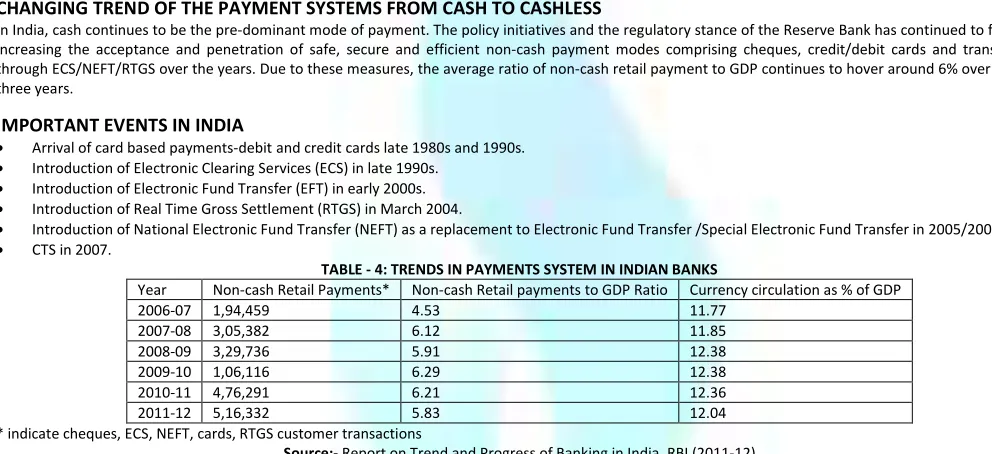
In India, cash continues to be the pre-dominant mode of payment. The policy initiatives and the regulatory stance of the Reserve Bank has continued to focus on increasing the acceptance and penetration of safe, secure and efficient non-cash payment modes comprising cheques, credit/debit cards and transactions through ECS/NEFT/RTGS over the years. Due to these measures, the average ratio of non-cash retail payment to GDP continues to hover around 6% over the last three years.
IMPORTANT EVENTS IN INDIA
• Arrival of card based payments-debit and credit cards late 1980s and 1990s.
• Introduction of Electronic Clearing Services (ECS) in late 1990s.
• Introduction of Electronic Fund Transfer (EFT) in early 2000s.
• Introduction of Real Time Gross Settlement (RTGS) in March 2004.
• Introduction of National Electronic Fund Transfer (NEFT) as a replacement to Electronic Fund Transfer /Special Electronic Fund Transfer in 2005/2006
• CTS in 2007.
TABLE - 4: TRENDS IN PAYMENTS SYSTEM IN INDIAN BANKS
Year Non-cash Retail Payments* Non-cash Retail payments to GDP Ratio Currency circulation as % of GDP 2006-07 1,94,459 4.53 11.77
2007-08 3,05,382 6.12 11.85 2008-09 3,29,736 5.91 12.38 2009-10 1,06,116 6.29 12.38 2010-11 4,76,291 6.21 12.36 2011-12 5,16,332 5.83 12.04 * indicate cheques, ECS, NEFT, cards, RTGS customer transactions
Source:- Report on Trend and Progress of Banking in India, RBI (2011-12)
The bank-led model for mobile banking has also started gaining popularity in the recent months. At the end of June 2012, 69 banks were granted approval to provide mobile banking facility, of which 49 have started operations. During November 2010, National Payment Corporation of India (NPCI) was given approval to launch Interbank mobile payment service (IMPS), which is a unique 24x7 Inter-bank electronic funds transfer system providing instantaneous credit to the beneficiaries with this channel having now stabilized and gaining further customer acceptance, the earlier transaction limit for mobile banking has been removed by the RBI. The banks are now free to fix their own per transaction limit based on their own risk perception with the approval of their respective boards.
NATIONAL ELECTRONIC FUND TRANSFER (NEFT)
NEFT is an online system of transferring funds of Indian financial institutions, especially loans. This facility is used mainly to transfer funds less than Rs 2,00,000. The NEFT system in India commenced from 21st November, 2005. The NEFT was sent to over all banks which were participating in the special Electronic Funds Transfer (NEFT) clearing. It was made on the Structured Financial Messaging Solutions (SFMS) platform. Public Key Infrastructure (PKI) technique used in the NEFT to maintain security. Apart from this, the volume and value of transactions through the two major electronic payment systems of the county, i.e., RTGS and NEFT has increased rapidly over the period.
TABLE -5: PROGRESS OF NATIONAL ELECTRONIC FUND TRANSFER IN INDIA
Year Volume(in million) Value (in billion) 2009-10 66.3 4095
2010-11 132.3 9321 2011-12 226 17,903
Source: Report on Trend and Progress of Banking in India, RBI (2011-12)
Table-5 shows the data on the progress of NEFT in size and value of the business during the period 2009-12. It can be observed from the data in table-5 that the size and value of the NEFT operations during the last three years are increasing cent per cent every year. It can be said from this analysis that there is a tremendous progress in India in making use of the banking technology.
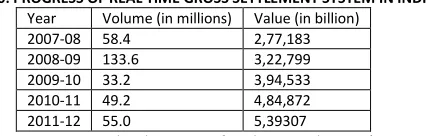
REAL TIME GROSS SETTLEMENT (RTGS)
TABLE-6: PROGRESS OF REAL TIME GROSS SETTLEMENT SYSTEM IN INDIA
Year Volume (in millions) Value (in billion) 2007-08 58.4 2,77,183 2008-09 133.6 3,22,799 2009-10 33.2 3,94,533 2010-11 49.2 4,84,872 2011-12 55.0 5,39307
Source:- Report on Trend and progress of Banking in India , RBI (2011-12)
Pre-payment Instruments (PPT) have emerged as a convenient replacement/substitution for cash transaction, besides providing a proper audit trail. The PPIs are payment instruments which facilitate purchase of goods and services against the value stored on such instruments. At end of June 2012, 40 banks (including the Department of Posts, Government of India) and 21 non-bank entities were granted approval/authorization under the Payment and Settlement System (PSS), Act 2007 to issue PPIs in India. Three types of PPIs are popularly issued, viz., paper voucher, cards and m-wallets. Amongst these, the paper vouchers are the most popular in terms of number and value. These were mainly issued by non-banks. However, efforts are underway to migrate these paper based PPIs to electronic modes.
TABLE-7:- % OF PRE-PAYMENT INSTRUMENTS DURING 2011-12 (Volume in million, value in billion)
Instrument type No. of PPIs issued % to total PPIs issued Value of PPIs issued % to total PPIs issued Paper voucher 42.00 97.0 1.76 60.8
Card based 0.57 1.3 1.04 35.8 Mobile account/ballet 0.55 1.3 0.1 3.5 total 43.00 100.00 2.9 100.00
Source: Report on trend and progress of Banking in India, RBI (2011-12)
Table-7 presents the data on percentage of pre-payment instruments during 2011-12. It can be seen from the data in table-7 that the paper voucher instrument is playing a dominant role among the different categories of the PPIs during the period of study. Going forward, the relaxation in the demotic money transfer guidelines introduced in October 2011 are expected to provide further impetus towards financial inclusion through electronic PPIs, including the use of m-wallets by enabling all authorized entities, both banks as well as non-banks to increase domestic remittances through formal payment channels.
ELECTRONIC CLEARING SERVICE (ECS)
The ECS is a mode of electronic funds transfer from one bank account to another bank account by using the services of a clearing house. This is used for bulk transfers form one account to many accounts and vice- versa. There are two types of ECS, viz., ECS (credit) and ECS (debit). The ECS (Credit) is used for affording credit to a large number of beneficiaries by raising a single debit to an account such as dividend, payments of salary, interest, pension, etc. Whereas, the ECS (Debit) is used for raising debits to a number of accounts holders for crediting a particular institution, e.g., payment to utility companies, like telephone, electricity or charges such as house tax, water tax, etc.
TABLE -7: VOLUME AND VALUE OF ELECTRONIC CLEARING SERVICES BY SCBS. (Volume in Million, Value in Billion)
Items
Volume % of change Value % of change 2010-11 2011-12 2010-11 2011-12 2010-11 2011-12 2010-11 2011-12 ECS Credit 117 122 19.5 4.3 1817 1838 54.5 1.2 ECS Debit 157 165 5.0 5.1 736 834 5.9 13.3
Source:- Report on Trend and Progress of Banking in India, RBI(2011-12)
Table-7 presents the data on change of electronic credit and debit transactions through the electronic clearing services during 2010-12. It can seen from the data in table-7 that the ECS debit transactions both in size and value are more when compared to the credit transactions during the period of study.
AUTOMATIC TELLER MACHINES (ATMs)
ATM is the most popular device in India, which enables the customers to withdraw their money 24 hours a day 7 days a week. It includes many other bank related transactions, such as cash withdrawal, paying bills, fees and taxes, printing bank statements, funds transfer, purchasing online products, train ticket reservations, purchases from shopping malls, donating to charities, cheques processing module, adding pre-paid cell phone/mobile phone credit, advertising channels for own or third party products and services. Thus, the ATM card performs the routine banking transactions without interacting with a human teller.
TABLE- 8: BRANCHES AND ATMS OF SCHEDULED COMMERCIAL BANKS (As on March -31, 2012)
Bank Groups Number of Branches Number of ATMs Rural Semi urban Urban Metro- Politian Total On-site Off-site Total Nationalized Bank 15,606 12,154 10,744 10,132 48,636 18,277 12,773 31,050 State Bank Group 56,582 5,619 3,504 3,125 18,830 15,735 11,408 27,143 Old Private sector banks (OPSBs) 3,342 2,025 1,395 1,085 5,386 3,342 2,429 5,771 New Private Sector Banks (NPSBs) 700 2,662 2,174 2,530 8,066 9,907 20,401 30,308 Foreign Banks (FBs) 7 8 61 246 322 284 1130 1414 Total 23,776 22,468 17,878 17,118 81,240 47,545 48,141 95,686
Source:-Report on Trend and Progress of Banking in India, RBI (2011-12)
Table-8 shows the data on the bank coverage and ATM facility of different types of banks in various regions at the end of 31st March 2012. It can be seen from the data in table-8 that 29.26% of the bank branches are located in rural areas and 27.65% of the branches are located in semi-urban areas. Further, it is also observed that 60% of the nationalized bank branches are located in rural and semi urban areas. The ATMs installed in the country at the end March 2012, new private sector banks had the largest share in offsite ATMs, while nationalized banks have the largest share in onsite ATMs. During the year 2011-12, an additional 21,000 ATMs were deployed by these banks. The public sector banks accounted for more than 60% of the ATMs at the same time, while close to one third of the total ATMs were attributed to new private sector banks. This trend indicates that it is a move towards door-step banking.
CARDS TRANSACTION
Debit card is a plastic card which provides alternative payment method for cash when making transaction. By using debit card, the cardholder can see the balance available in his account. Debit card is mainly used for cash withdraw from ATM, at point of time also on the internet for online purchase, funds transfer, paying bills, accessing detail account information, changing PIN, etc.. The bank provides the debit card free of cost at the time of opening account. From 1st January 2011, the RBI declared that for every transaction with debit card on ATM has to enter password for every transaction. This is done for security purpose.
DEBIT AND CREDIT CARDS
VOLUME NO.3(2013),ISSUE NO.12(DECEMBER) ISSN2231-5756
INTERNATIONAL JOURNAL OF RESEARCH IN COMMERCE, IT & MANAGEMENT
credit cards at the same time were issued by new private sector banks. The trends in issuance of debit and credit cards by the public sector banks in India during the period 2006-07 to 2011-12 were shown in chart-1. It can be seen from the chart-1 that the debit cards issue is dominating the issue of credit cards by the banks in India. It shows that the banks are following a positive policy in taking the public in its fold as an inclusive model. It can be concluded from the foregoing analysis that the circulation of hard currency is being reduced and the plastic money can be increased which is a welcome trend in banking activities.
CHART-1: NO OF CREDIT/ DEBIT CARDS OUTSTANDING
Source: Report on Trend and Progress of Banking in India, RBI(2011-2012).
Chart-2 shows the share of different bank groups in issuing of debit and credit cards during the period 2006-07 and 2011-12. It can be observed from the chart-2 that among the various banks the new private sector banks are issuing more debit cards than that of other groups of banks in India. It can be said that the newly entered private sector banks are more technological advanced ones in order to avail the technological developments in India.
CHART- 2:- SHARE OF BANK GROUPS IN TOTAL CREDIT/DEBIT CARDS (31st March, 2012)
Source: Report on Trend and Progress of Banking in India, RBI (2011-2012).
IMPLICATIONS
The banks were quickly responded to the changes in the industry; especially the new generation banks. The continuation of the trend has defined and re-engineered by the banking operations as a whole with more customization through leveraging technology. As technology makes banking convenient, customers can access banking services and do banking transactions any time and from anywhere. The importance of physical branches is going down. Thus, the changes have the following implication:
Anywhere any time any place banking. Timeless and placeless banking. Banking at convenience. Dismantling of physical structure.
Good bye to traditional instruments and innovation to new instruments. Leading to currency-less monetary system.
Disappearance of conventional risk and arrival of new risks.
CHALLENGES IN IMPLEMENTATION
At present structure, banking in India is largely depended on technology. It is necessary that banks have appropriate and adequate arrangements for disaster recovery and business continuity to face any event of natural disaster or operational failures.
BUSINESS CONTINUITY MANAGEMENT (BCM)
In recent years, an integrated “Business Continuity Management”(BCM) arrangement encompassing continuity planning for all business functions including data centers has evolved, with support provided by the Reserve Bank of India. In addition to address the issues of disruption in business process arising from technology failure appropriate disaster recovery and business continuity arrangement have been implemented by the RBI data centers.
CORE BANKING SOLUTIONS
Considering the importance of accuracy and timelines regulatory reporting a project on automating data flow from the core banking solution (CBS) or other IT systems of commercial banks to the reserve bank was announced in the monitory policy statement of 2010-11. The approach paper released in November 2011, prepared by a core group with representation from banks, the reserve bank, IDRBT and the IBA envisions the implementation in two phases. In the first phase, banks were advised to ensure seamless flow of data from their transaction server to their management information system (MIS) Server while the second phase would involve the reserve bank to introduce system for generating all returns from banks’ MIS. Implementation of the first phase is in progress and is monitored
0 50 100 150 200 250 300
2006-07 2007-08 2008-09 2009-10 2010-11 2011-12
credit cards Debit cards Column1
0 10 20 30 40 50 60
SBI NB OPRB NPRB FB
and reviewed at quarterly intervals. In the second phase, the RBI would introduce a system for the flow of data from the MIS server of banks in a straight through process.
TECHNICAL ADVISORY GROUP (TAG)
Considering the tremendous growth in volume of transactions through the RTGs system, a technical advisory group (TAG) with numbers from technology institutes, banks and reserve bank was constituted in order to review the RTGs system. The group recommended building up the new generation RTGs (NG-RTGS) system, which would encompass key features such as:
Liquidity saving mechanism.
Advanced queue management system.
Various modes of access as per the size of the bank. Extensible mark- up language (XML) based messaging system.
Real time information and transaction monitoring and control system having the dashboard facility.
FUTURE TRENDS
Energy management and move towards Green Technology: Most of the banks are conscious of the carbon foot print generated and are working towards energy management and use of Green Technology.
Some of the measures adopted are:
• Solar powered ATMs.
• Use of windmill energy.
• Adoption of server virtualization technologies to save on floor space, power and cooling components.
• Adoption of Blade server Technology to have higher computing power in small foot print.
• Up gradation of old power hungry servers, storage and networking equipment’s
• Dynamic power capping of servers, desktops by employing newer power saving.
• Technologies like process stepping.
CONCLUSION
Use of technology in expanding banking is one of the focus areas of banks. The banks in India are using information technology not only to improve their own internal processes but also to increase facilities and services to the banking community at large. Efficient use of technology has facilitated accurate and timely management of the increased transaction volume of banks of that comes with larger customer base. By designing and use of simple safe and secure technology, banks reach at door-step of customer and further develop in the existing electronic payments.
REFERENCES
1. Arvind Sharma (2007), “IT in Banking – promise of more Benefits,” The Hindu survey of Indian Industry -2007 PP-54-58. 2. B.S Savant (-) “Technological developments in Indian banking sector,” Indian streams research Journal, vol-1, pp-1-4. 3. Bose Jayashree (2006), “E-Banking in India”, the paradigm shiffs, The ICFAI university press. PP.22-23.
4. “Computerization in Development Financial institutions (DFIS) IDBI Experience.” journal of development finance, June 1995, PP. 26.
5. Ramachandran and Kavitha (2009), “Profitability of the Indian Scheduled commercial Banks: A case Analysis”, The ICFAI University Press, PP 129-139. 6. Shastri R.V (2003) ”Recent Trends in Banking Industry: IT emergence”, Analyst (March) PP 45-46.
7. Shatish and Bala Bharathi (2007), “Indian Banking Industry; challenging times aheed”, chartered financial analyst, PP 68-70.
8. Sreelatha and Chandra Sekhar (2012), “Role of technology in India Banking sector,” International journal of management and Business studies, vol. 2(4), PP. 36-40.
9. Sunitha Agarwal and Ankit Jain (–), “Technological advancement in banking sector in India: challenges ahead. Available site on www.abhinavjournal.com vol. 2 (1) pp-89-96
VOLUME NO.3(2013),ISSUE NO.12(DECEMBER) ISSN2231-5756
INTERNATIONAL JOURNAL OF RESEARCH IN COMMERCE, IT & MANAGEMENT
REQUEST FOR FEEDBACK
Dear Readers
At the very outset, International Journal of Research in Commerce, IT & Management (IJRCM)
acknowledges & appreciates your efforts in showing interest in our present issue under your kind perusal.
I would like to request you tosupply your critical comments and suggestions about the material published
in this issue as well as on the journal as a whole, on our E-mail
for further
improvements in the interest of research.
If youhave any queries please feel free to contact us on our E-mail
.
I am sure that your feedback and deliberations would make future issues better – a result of our joint
effort.
Looking forward an appropriate consideration.
With sincere regards
Thanking you profoundly
Academically yours
Sd/-
Co-ordinator
DISCLAIMER