VOLUME NO.6(2016),ISSUE NO.09(
SEPTEMBER
) ISSN2231-5756A Monthly Double-Blind Peer Reviewed (Refereed/Juried) Open Access International e-Journal - Included in the International Serial Directories
Indexed & Listed at:
Ulrich's Periodicals Directory ©, ProQuest, U.S.A., EBSCO Publishing, U.S.A., Cabell’s Directories of Publishing Opportunities, U.S.A., Google Scholar, Open J-Gage, India [link of the same is duly available at Inflibnet of University Grants Commission (U.G.C.)],
Index Copernicus Publishers Panel, Poland with IC Value of 5.09 & number of libraries all around the world.
VOLUME NO. 6 (2016), ISSUE NO. 09 (SEPTEMBER)
ISSN
2231-5756
INTERNATIONAL JOURNAL OF RESEARCH IN COMMERCE, IT & MANAGEMENT
CONTENTS
Sr.
No.
TITLE & NAME OF THE AUTHOR (S)
Page
No.
1
.
OPTIMIZING CAPITAL STRUCTURE THROUGH DEBT TO EQUITY BALANCING: A STUDY OF SELECTED
ZIMBABWE STOCK EXCHANGE LISTED COMPANIES
DR. B. NGWENYA
1
2
.
MAIZE CULTIVATION IN KARNATAKA & GROWERS’ AWARENESS ON PRICE RISK MANAGEMENT TOOLS.
V. CHANDRA SEKHAR RAO & DR. G V KESAVA RAO
5
3
.
A STUDY OF LEAD LAGS RELATIONSHIP BETWEEN NSE EQUITY MARKET AND SINGLE STOCK FUTURES
DR. SANDHYA SRIDEVI MARIPINI & SATYANARAYANA KOILADA
11
4
.
MOBILE PHONE MESSAGING INTERVENTIONS MAY PROVIDE BENEFIT IN SUPPORTING THE
SELF-MANAGEMENT OF LONG-TERM ILLNESSES: AN ANALYSIS
SURENDRA NATH SHUKLA & DR. J K SHARMA
18
5
.
LECTURERS’ PERCEPTION ON STUDENTS’ APPRAISAL OF COURSES AND TEACHING: A CASE OF UNIVERSITY
OF CAPE COAST, GHANA
EMMANUEL KOFI GYIMAH, ALBERT JUSTICE KWARTENG, ERIC ANANE & IVY KESEWAA NKRUMAH
21
6
.
EDUCATION AS A MEANS OF WOMEN’S EMPOWERMENT: A STUDY ON THE PARENTS’ ATTITUDES
DEEPRAJ CHAKRABARTY, DEBOSMITA NATH & DR. D. GHOSE
27
7
.
A STUDY ON OVERALL IMPACT OF TRAINING AND DEVELOPMENT ON JOB PERFORMANCE, MORALE OF
EMPLOYEES AND TO REDUCE THE EMPLOYEE RESISTANCE TO NEW TECHNOLOGY
DR. MAHESHA KEMPEGOWDA & PURUSHOTHAM.C.J
30
8
.
MILLING STUDIES OF PULSES USING DIFFERENT PRE-MILLING TREATMENT OF PIGEON PEA (
CAJANUS
CAJAN
)
MEDHA VYAS & PRIYANKA BHADOURIYA
35
9
.
A STUDY ON FINANCIAL DERIVATIVE OPTIONS WITH REFERENCE TO SELECTED SECTORS
BHAGYA LAKSHMI.K & DR. N. BABITHA THIMMAIAH
41
10
.
AN ARTICLE ON PERFORMANCE APPRAISAL: A STUDY WITH REFERENCE TO KIRLOSKAR ELECTRIC CO. LTD.,
MYSORE
SOWMYA.H.L
48
11
.
TECHNOLOGICAL INNOVATIONS IN INDIAN BANKING SECTOR: AN INSTRUMENT FOR ECONOMIC GROWTH
DR. PRAGYA PRASHANT GUPTA
50
12
.
LITERACY AND LITERARY PROGRAMMES AND THEIR IMPLEMENTATION IN INDIA
HARISH R.
56
13
.
THE DEVELOPMENT OF MANAGERIAL WOMEN OF BELOW POVERTY LINE SELF HELP GROUP IN DISTRICT
GONIDA IN MAHARASHTRA
KU.MRUNALI S. LILHARE
60
14
.
PROBLEMS AND PROSPECTS OF KUDUMBASREE LINKED MICRO ENTERPRISES
VARGHESE JOY
62
15
.
PROBLEMS AND PROSPECTS OF LEATHER INDUSTRY IN VELLORE DISTRICT
DR. AJAY KUMAR SHARMA
66
16
.
CHANGING E-TAIL TRENDS IN INDIA
AMIT KISHORE SINHA & DR. GYANENDRA B. S. JOHRI
73
17
.
A STUDY ON TWO WHEELER PURCHASING PATTERN OF COLLEGE STUDENTS IN KOTTARAKARA TALUK
ANCY SAM
79
18
.
HUMAN INTERACTION WITH SMART MOBILE PHONE
DR. C. NIRMALA
84
19
.
POLITICIZATION OF STUDENTS' UNIONS: A STUDY IN BHUBANESWAR, ODISHA
PRASANTA MOHAPATRA
87
20
.
RELEVANCE OF UNORGANISED RETAILERS AND THEIR PROBLEMS WITH SPECIAL EMPHASIS TO CALICUT
CITY
SHAHIBA.EC
93
VOLUME NO. 6 (2016), ISSUE NO. 09 (SEPTEMBER)
ISSN
2231-5756
INTERNATIONAL JOURNAL OF RESEARCH IN COMMERCE, IT & MANAGEMENT
CHIEF PATRON
PROF. K. K. AGGARWAL
Chairman, Malaviya National Institute of Technology, Jaipur
(An institute of National Importance & fully funded by Ministry of Human Resource Development, Government of India)
Chancellor, K. R. Mangalam University, Gurgaon
Chancellor, Lingaya’s University, Faridabad
Founder Vice-Chancellor (1998-2008), Guru Gobind Singh Indraprastha University, Delhi
Ex. Pro Vice-Chancellor, Guru Jambheshwar University, Hisar
FOUNDER PATRON
LATE SH. RAM BHAJAN AGGARWAL
Former State Minister for Home & Tourism, Government of Haryana
Former Vice-President, Dadri Education Society, Charkhi Dadri
Former President, Chinar Syntex Ltd. (Textile Mills), Bhiwani
FORMER CO-ORDINATOR
DR. S. GARG
Faculty, Shree Ram Institute of Business & Management, Urjani
ADVISORS
PROF. M. S. SENAM RAJU
Director A. C. D., School of Management Studies, I.G.N.O.U., New Delhi
PROF. M. N. SHARMA
Chairman, M.B.A., Haryana College of Technology & Management, Kaithal
PROF. S. L. MAHANDRU
Principal (Retd.), Maharaja Agrasen College, Jagadhri
EDITOR
PROF. R. K. SHARMA
Professor, Bharti Vidyapeeth University Institute of Management & Research, New Delhi
CO-EDITOR
DR. BHAVET
Faculty, Shree Ram Institute of Engineering & Technology, Urjani
EDITORIAL ADVISORY BOARD
DR. RAJESH MODI
Faculty, Yanbu Industrial College, Kingdom of Saudi Arabia
PROF. SANJIV MITTAL
University School of Management Studies, Guru Gobind Singh I. P. University, Delhi
PROF. ANIL K. SAINI
Chairperson (CRC), Guru Gobind Singh I. P. University, Delhi
DR. SAMBHAVNA
VOLUME NO. 6 (2016), ISSUE NO. 09 (SEPTEMBER)
ISSN
2231-5756
INTERNATIONAL JOURNAL OF RESEARCH IN COMMERCE, IT & MANAGEMENT
DR. MOHENDER KUMAR GUPTA
Associate Professor, P. J. L. N. Government College, Faridabad
DR. SHIVAKUMAR DEENE
Asst. Professor, Dept. of Commerce, School of Business Studies, Central University of Karnataka, Gulbarga
ASSOCIATE EDITORS
PROF. NAWAB ALI KHAN
Department of Commerce, Aligarh Muslim University, Aligarh, U.P.
PROF. ABHAY BANSAL
Head, Department of I.T., Amity School of Engineering & Technology, Amity University, Noida
PROF. A. SURYANARAYANA
Department of Business Management, Osmania University, Hyderabad
PROF. V. SELVAM
SSL, VIT University, Vellore
DR. PARDEEP AHLAWAT
Associate Professor, Institute of Management Studies & Research, Maharshi Dayanand University, Rohtak
DR. S. TABASSUM SULTANA
Associate Professor, Department of Business Management, Matrusri Institute of P.G. Studies, Hyderabad
SURJEET SINGH
Asst. Professor, Department of Computer Science, G. M. N. (P.G.) College, Ambala Cantt.
FORMER TECHNICAL ADVISOR
AMITA
Faculty, Government M. S., Mohali
FINANCIAL ADVISORS
DICKIN GOYAL
Advocate & Tax Adviser, Panchkula
NEENA
Investment Consultant, Chambaghat, Solan, Himachal Pradesh
LEGAL ADVISORS
JITENDER S. CHAHAL
Advocate, Punjab & Haryana High Court, Chandigarh U.T.
CHANDER BHUSHAN SHARMA
Advocate & Consultant, District Courts, Yamunanagar at Jagadhri
SUPERINTENDENT
VOLUME NO. 6 (2016), ISSUE NO. 09 (SEPTEMBER)
ISSN
2231-5756
INTERNATIONAL JOURNAL OF RESEARCH IN COMMERCE, IT & MANAGEMENT
CALL FOR MANUSCRIPTS
We invite unpublished novel, original, empirical and high quality research work pertaining to the recent developments & practices in the areas of Com-puter Science & Applications; Commerce; Business; Finance; Marketing; Human Resource Management; General Management; Banking; Economics; Tourism Administration & Management; Education; Law; Library & Information Science; Defence & Strategic Studies; Electronic Science; Corporate Gov-ernance; Industrial Relations; and emerging paradigms in allied subjects like Accounting; Accounting Information Systems; Accounting Theory & Practice; Auditing; Behavioral Accounting; Behavioral Economics; Corporate Finance; Cost Accounting; Econometrics; Economic Development; Economic History; Financial Institutions & Markets; Financial Services; Fiscal Policy; Government & Non Profit Accounting; Industrial Organization; International Economics & Trade; International Finance; Macro Economics; Micro Economics; Rural Economics; Co-operation; Demography: Development Planning; Development Studies; Applied Economics; Development Economics; Business Economics; Monetary Policy; Public Policy Economics; Real Estate; Regional Economics; Political Science; Continuing Education; Labour Welfare; Philosophy; Psychology; Sociology; Tax Accounting; Advertising & Promotion Management; Management Information Systems (MIS); Business Law; Public Responsibility & Ethics; Communication; Direct Marketing; E-Commerce; Global Business; Health Care Administration; Labour Relations & Human Resource Management; Marketing Research; Marketing Theory & Applications; Non-Profit Or-ganizations; Office Administration/Management; Operations Research/Statistics; Organizational Behavior & Theory; Organizational Development; Pro-duction/Operations; International Relations; Human Rights & Duties; Public Administration; Population Studies; Purchasing/Materials Management; Re-tailing; Sales/Selling; Services; Small Business Entrepreneurship; Strategic Management Policy; Technology/Innovation; Tourism & Hospitality; Transpor-tation Distribution; Algorithms; Artificial Intelligence; Compilers & Translation; Computer Aided Design (CAD); Computer Aided Manufacturing; Computer Graphics; Computer Organization & Architecture; Database Structures & Systems; Discrete Structures; Internet; Management Information Systems; Mod-eling & Simulation; Neural Systems/Neural Networks; Numerical Analysis/Scientific Computing; Object Oriented Programming; Operating Systems; Pro-gramming Languages; Robotics; Symbolic & Formal Logic; Web Design and emerging paradigms in allied subjects.
Anybody can submit the soft copy of unpublished novel; original; empirical and high quality research work/manuscriptanytime in M.S. Word format after preparing the same as per our GUIDELINES FOR SUBMISSION; at our email address i.e. [email protected] or online by clicking the link online
submission as given on our website (FOR ONLINE SUBMISSION, CLICK HERE).
GUIDELINES FOR SUBMISSION OF MANUSCRIPT
1. COVERING LETTER FOR SUBMISSION:
DATED: _____________
THE EDITOR
IJRCM
Subject: SUBMISSION OF MANUSCRIPT IN THE AREA OF .
(e.g. Finance/Mkt./HRM/General Mgt./Engineering/Economics/Computer/IT/ Education/Psychology/Law/Math/other, please specify)
DEAR SIR/MADAM
Please find my submission of manuscript titled ‘___________________________________________’ for likely publication in one of your journals.
I hereby affirm that the contents of this manuscript are original. Furthermore, it has neither been published anywhere in any language fully or partly, nor it is under review for publication elsewhere.
I affirm that all the co-authors of this manuscript have seen the submitted version of the manuscript and have agreed to inclusion of their names as co-authors.
Also, if my/our manuscript is accepted, I agree to comply with the formalities as given on the website of the journal. The Journal has discretion to publish our contribution in any of its journals.
NAME OF CORRESPONDING AUTHOR :
Designation/Post* :
Institution/College/University with full address & Pin Code :
Residential address with Pin Code :
Mobile Number (s) with country ISD code :
Is WhatsApp or Viber active on your above noted Mobile Number (Yes/No) :
Landline Number (s) with country ISD code :
E-mail Address :
Alternate E-mail Address :
Nationality :
* i.e. Alumnus (Male Alumni), Alumna (Female Alumni), Student, Research Scholar (M. Phil), Research Scholar (Ph. D.), JRF, Research Assistant, Assistant
Lecturer, Lecturer, Senior Lecturer, Junior Assistant Professor, Assistant Professor, Senior Assistant Professor, Co-ordinator, Reader, Associate
Profes-sor, ProfesProfes-sor, Head, Vice-Principal, Dy. Director, Principal, Director, Dean, President, Vice Chancellor, Industry Designation etc. The qualification of
VOLUME NO. 6 (2016), ISSUE NO. 09 (SEPTEMBER)
ISSN
2231-5756
INTERNATIONAL JOURNAL OF RESEARCH IN COMMERCE, IT & MANAGEMENT
NOTES:
a) The whole manuscript has to be in ONE MS WORD FILE only, which will start from the covering letter, inside the manuscript. pdf. version is liable to be rejected without any consideration.
b) The sender is required to mention the following in the SUBJECT COLUMNof the mail:
New Manuscript for Review in the area of (e.g. Finance/Marketing/HRM/General Mgt./Engineering/Economics/Computer/IT/
Education/Psychology/Law/Math/other, please specify)
c) There is no need to give any text in the body of the mail, except the cases where the author wishes to give any specific message
w.r.t. to the manuscript.
d) The total size of the file containing the manuscript is expected to be below 1000 KB.
e) Only the Abstract will not be considered for review and the author is required to submit the complete manuscript in the first instance.
f) The journal gives acknowledgement w.r.t. the receipt of every email within twenty-four hours and in case of non-receipt of acknowledgment from the journal, w.r.t. the submission of the manuscript, within two days of its submission, the corresponding author is required to demand for the same by sending a separate mail to the journal.
g) The author (s) name or details should not appear anywhere on the body of the manuscript, except on the covering letter and the cover page of the manuscript, in the manner as mentioned in the guidelines.
2. MANUSCRIPT TITLE: The title of the paper should be typed in bold letters, centeredand fully capitalised.
3. AUTHOR NAME (S) & AFFILIATIONS: Author (s) name, designation, affiliation (s), address, mobile/landline number (s), and
email/al-ternate email address should be given underneath the title.
4. ACKNOWLEDGMENTS: Acknowledgements can be given to reviewers, guides, funding institutions, etc., if any.
5. ABSTRACT: Abstract should be in fully Italic printing, ranging between 150 to 300 words. The abstract must be informative and
eluci-dating the background, aims, methods, results & conclusion in a SINGLE PARA. Abbreviations must be mentioned in full.
6. KEYWORDS: Abstract must be followed by a list of keywords, subject to the maximum of five. These should be arranged in alphabetic
order separated by commas and full stop at the end. All words of the keywords, including the first one should be in small letters, except special words e.g. name of the Countries, abbreviations etc.
7. JEL CODE: Provide the appropriate Journal of Economic Literature Classification System code (s). JEL codes are available at
www.aea-web.org/econlit/jelCodes.php. However, mentioning of JEL Code is not mandatory.
8. MANUSCRIPT: Manuscript must be in BRITISH ENGLISH prepared on a standard A4 size PORTRAIT SETTING PAPER. It should be free
from any errors i.e. grammatical, spelling or punctuation. It must be thoroughly edited at your end.
9. HEADINGS: All the headings must be bold-faced, aligned left and fully capitalised. Leave a blank line before each heading.
10. SUB-HEADINGS: All the sub-headings must be bold-faced, aligned left and fully capitalised.
11. MAIN TEXT:
THE MAIN TEXT SHOULD FOLLOW THE FOLLOWING SEQUENCE:
INTRODUCTION
REVIEW OF LITERATURE
NEED/IMPORTANCE OF THE STUDY
STATEMENT OF THE PROBLEM
OBJECTIVES
HYPOTHESIS (ES)
RESEARCH METHODOLOGY
RESULTS & DISCUSSION
FINDINGS
RECOMMENDATIONS/SUGGESTIONS
CONCLUSIONS
LIMITATIONS
SCOPE FOR FURTHER RESEARCH
REFERENCES
APPENDIX/ANNEXURE
VOLUME NO. 6 (2016), ISSUE NO. 09 (SEPTEMBER)
ISSN
2231-5756
INTERNATIONAL JOURNAL OF RESEARCH IN COMMERCE, IT & MANAGEMENT
12. FIGURES & TABLES: These should be simple, crystal CLEAR, centered, separately numbered & self-explained, and the titles must be
above the table/figure. Sources of data should be mentioned below the table/figure. It should be ensured that the tables/figures are
referred to from the main text.
13. EQUATIONS/FORMULAE: These should be consecutively numbered in parenthesis, left aligned with equation/formulae number placed
at the right. The equation editor provided with standard versions of Microsoft Word may be utilised. If any other equation editor is utilised, author must confirm that these equations may be viewed and edited in versions of Microsoft Office that does not have the editor.
14. ACRONYMS: These should not be used in the abstract. The use of acronyms is elsewhere is acceptable. Acronyms should be defined
on its first use in each section e.g. Reserve Bank of India (RBI). Acronyms should be redefined on first use in subsequent sections.
15. REFERENCES: The list of all references should be alphabetically arranged. The author (s) should mention only the actually utilised
references in the preparation of manuscript and they may follow Harvard Style of Referencing. Also check to ensure that everything
that you are including in the reference section is duly cited in the paper. The author (s) are supposed to follow the references as per
the following:
•
All works cited in the text (including sources for tables and figures) should be listed alphabetically.•
Use (ed.) for one editor, and (ed.s) for multiple editors.•
When listing two or more works by one author, use --- (20xx), such as after Kohl (1997), use --- (2001), etc., in chronologically ascending order.•
Indicate (opening and closing) page numbers for articles in journals and for chapters in books.•
The title of books and journals should be in italic printing. Double quotation marks are used for titles of journal articles, book chapters, dissertations, reports, working papers, unpublished material, etc.•
For titles in a language other than English, provide an English translation in parenthesis.•
Headers, footers, endnotes and footnotes should not be used in the document. However, you can mention short notes to elucidatesome specific point, which may be placed in number orders before the references.
PLEASE USE THE FOLLOWING FOR STYLE AND PUNCTUATION IN REFERENCES:
BOOKS
•
Bowersox, Donald J., Closs, David J., (1996), "Logistical Management." Tata McGraw, Hill, New Delhi.•
Hunker, H.L. and A.J. Wright (1963), "Factors of Industrial Location in Ohio" Ohio State University, Nigeria.CONTRIBUTIONS TO BOOKS
•
Sharma T., Kwatra, G. (2008) Effectiveness of Social Advertising: A Study of Selected Campaigns, Corporate Social Responsibility, Edited by David Crowther & Nicholas Capaldi, Ashgate Research Companion to Corporate Social Responsibility, Chapter 15, pp 287-303.JOURNAL AND OTHER ARTICLES
•
Schemenner, R.W., Huber, J.C. and Cook, R.L. (1987), "Geographic Differences and the Location of New Manufacturing Facilities," Jour-nal of Urban Economics, Vol. 21, No. 1, pp. 83-104.CONFERENCE PAPERS
•
Garg, Sambhav (2011): "Business Ethics" Paper presented at the Annual International Conference for the All India Management Asso-ciation, New Delhi, India, 19–23UNPUBLISHED DISSERTATIONS
•
Kumar S. (2011): "Customer Value: A Comparative Study of Rural and Urban Customers," Thesis, Kurukshetra University, Kurukshetra.ONLINE RESOURCES
•
Always indicate the date that the source was accessed, as online resources are frequently updated or removed.WEBSITES
VOLUME NO. 6 (2016), ISSUE NO. 09 (SEPTEMBER)
ISSN
2231-5756
INTERNATIONAL JOURNAL OF RESEARCH IN COMMERCE, IT & MANAGEMENT
CHANGING E-TAIL TRENDS IN INDIA
AMIT KISHORE SINHA
RESEARCH SCHOLAR
DEPARTMENT OF COMMERCE
INDIRA GANDHI NATIONAL TRIBAL UNIVERSITY
AMARKANTAK
DR. GYANENDRA B. S. JOHRI
ASST. PROFESSOR
DEPARTMENT OF COMMERCE
INDIRA GANDHI NATIONAL TRIBAL UNIVERSITY
AMARKANTAK
ABSTRACT
E-tail refers to Electronic retailing i.e. offering goods and services by the marketer to the retail customers through the internet. In the present decade this category of business has grabbed a lot attention on account of significant increase in the number of companies in this area and lucrative offerings and sales growth made by such retailers. This paper aims at identification and analysis of significant changes in e-tail trends along with major causes of such changes.
KEYWORDS
electronic commerce, electronic retailing, retail, it, internet, e-tail.
INTRODUCTION
usinesses are developing rapidly with Information Technology (IT) being the key driver in current times and that is changing the way companies are mar-keting their products and services also. Suitable use of IT in marmar-keting could lead to competitive advantage to companies as it can be the source of im-provement over existing products and better marketing results (Tzokas and Saren, 1997; Tatikonda and Stock, 2003; Bond and Houston, 2003). Moreover, there has been growing interest among researchers toward studying online shopping behavior in developing countries (Park and Jun 2003; So, Wong, and Sculli 2005; Martı´nez-Lo´pez, Luna, and Martı´nez 2005; Haque et al. 2007; Cho and Jialin 2008; Riley, Scarpi, and Manaresi 2009; Hashim, Ghani, and Said 2009; Hasan 2010)
This paper aims to catch hold the changing scenario in the business to customer segment of Electronic Retailing (termed as e-Tail in next part of literature). It can be briefly understood with the help of below mentioned points.
CAUSES OF CHANGES IN E-TAIL INDUSTRY
Changing Global Trends: According to a study conducted by Google with BCG in year 2014 namely ‘Insurance @ Digital 20X by 2020’ it was revealed that World
had 6.7 billion mobile phone connections, 2.7 billion internet users and 1.7 billion social media users at the end of year 2013. This is projected that by year 2018 these numbers will be drastically changed and world will have 8 billion mobile connections, 3.3 billion internet users, 3 billion smart phones. This upside trend is again positive and lucrative opportunity for online marketers.
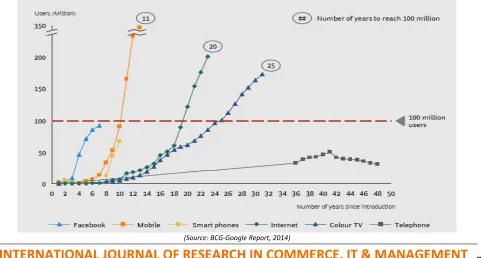
On one front of Technology adoption, it can be counted that Telephone took almost 110 years whereas Television took 49 years to reach 1 billion connections globally. But in case of internet subscription it took only 14 tears to reach 1 billion mark whereas smartphones took only 8 years to reach the same level. When we talk about India on same parameter we find that here colour television took 25 years to achieve 100 million customers whereas internet took 20 years and smartphones took 11 years to reach to the level of 100 million (refer Figure 1).
FIGURE 1: TECHNOLOGY ADOPTION CURVE IN INDIA
(Source: BCG-Google Report, 2014)
VOLUME NO. 6 (2016), ISSUE NO. 09 (SEPTEMBER)
ISSN
2231-5756
INTERNATIONAL JOURNAL OF RESEARCH IN COMMERCE, IT & MANAGEMENT
Changing ncoumber of internet users: As we can observe in our lives that internet facility is used by one and all for variety of purposes including business,
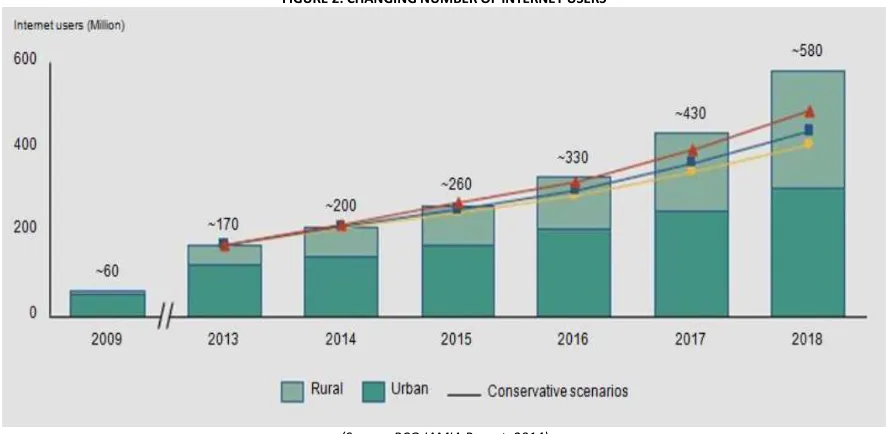
profession, job, entertainment, vacation etc. This situation is not present only in our surroundings but also in rest of the India too. A survey was conducted by Boston Consulting Group (BCG) in association with Internet and Mobile Association of India (IAMAI). In the report by the researcher it was published that Internet users in India were more than 170 million at the end of 2013. This number was close to seven million at the end of 2001. Report further projects that by the end of 2018 this number of internet users may cross the limit of 580 million. This increasing number of internet users creates a favourable atmosphere for development of e-tail (refer Figure 2).
FIGURE 2: CHANGING NUMBER OF INTERNET USERS
(Source: BCG-IAMIA Report, 2014)
Change from Urban to Rural Internet Users: BCG-IAMAI Report 2015 states that today almost 29% of internet users are from rural locations. It is further expected
that by 2018 this percentage may raise upto 40 to 50. In this way almost half the users will be from rural areas. This new market for e-tail companies can be a huge untapped market. Especially those products which are not available in village can be supplied. Branded products are also rarely available in rural areas. There it seems a good indication for the marketers (refer Figure 2).
Changing demography and Internet usage: As per BCG-IAMAI Report, approximately 40% internet users are above the age of 25 till 2013. It is projected that by
the end of 2018 this percentage will be above 54. This will surely be in favour of internet related businesses. It is further noteworthy that out of total internet users 25% are females this number is also projected to increase upto 33% by 2018. As in several studies it is also found that females have important influence in family purchase decisions therefore such shift will provide more attractive environment for the online shopping companies.
FIGURE 3: CHANGING DEMOGRAPHY OF INTERNET USERS
(Source: BCG-IAMIA Report, 2014)
Report further ensures the attractiveness of e-tail industry for employees too. It is estimated almost 4.5 lakh employees are working for this industry and the number is projected to reach 20 lakhs by 2018. Such increase will provide better penetration to internet related businesses as it will provide significant word of mouth publicity by its employees itself.
Change in Average Internet speed: Internet speed is getting a subject matter of discussion everywhere in India. Even Indian Prime Minister has expressed his
VOLUME NO. 6 (2016), ISSUE NO. 09 (SEPTEMBER)
ISSN
2231-5756
INTERNATIONAL JOURNAL OF RESEARCH IN COMMERCE, IT & MANAGEMENT
FIGURE 4: INTERNET SPEED IN INDIA, 2015
(Source: AKAMAI, Speed of the Internet, 2015)
EFFECTS ON E-TAIL INDUSTRY DUE TO ABOVE MENTIONED CAUSES
Change in Internet Penetration: Likewise increase in number of internet users it is also noteworthy that internet penetration is also increasing rapidly in India. It
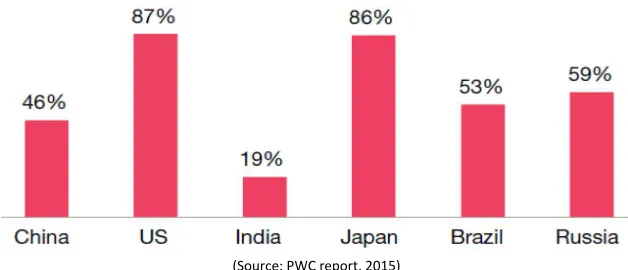
started with 1 % penetration in year 2000 and now reached to 19% level till 2014 (BCG-GOOGLE REPORT 2014). Even this 19% penetration is extremely low in comparison to several other countries like Russia (61%), Brazil (54%) and China (50%). This significant difference demonstrates substantial opportunity in this industry for the marketers (refer Figure 4).
FIGURE 5: INTERNET PENETRATION IN SELECTED COUNTRIES
(Source: PWC report, 2015)
Change in Industry size: The manner in which number of internet users is increasing this becomes a need to have more speedy and affordable internet services to
be made available to users. This has resulted in more number of internet service providers. Almost every telecom company has identified this opportunity and started giving internet services through different mediums. All these activities had resulted in increase in total Internet industry size. According to a report namely ‘eCommerce in India- Accelerating Growth’ by Pricewaterhouse Coopers, in year 2014, it was revealed that industry has reached to almost 3.5 billion USD by the closing of year 2014. Earlier it was close to 0.4 billion USD in year 2009. This increasing size of industry certainly creates possibilities for e-tail organizations too.
FIGURE 6: eCOMMERCE AND E-TAIL GROWTH IN INDIA
VOLUME NO. 6 (2016), ISSUE NO. 09 (SEPTEMBER)
ISSN
2231-5756
INTERNATIONAL JOURNAL OF RESEARCH IN COMMERCE, IT & MANAGEMENT
Change in Investment in the Industry: A growing industry automatically attracts new investments. Same activity is taking place in case of e-tail business. With
rapid increase of industry, it has provided opportunity for fresh investment as well. New investment in industry is also a symbol of attractiveness in industry. It can be sensed that market forces are positive towards e-tail business. According a report by Indian Brand Equity Foundation, ‘The Rise and Rise of E-Commerce in India’- 2013 it was revealed that e-tailing could generate Rs 110 million USD in year 2010. An article published in Business Standard on Feb 6, 2015 under heading ‘India set to become world’s fastest growing e-commerce market’ reveals that Indian e-tail industry attracted Rs 4.5 billion USD in year 2014. Such change in condition is obviously in favour of customers and e-tailors both. Further details of fresh investment in form of private equity deals during year 2014 have been provided in the Table.
FIGURE 7: TOP 20 PRIVATE EQUITY INVESTMENT DEALS IN eCommerce, 2014
(Source: PWC Report, 2014)
Change in Market share of e-tail out of total retail industry: Number of e-tail companies is increasing. New players are joining. Big old players are solidifying their
positions. Organizations from outside India are attracted to India and few of them (like Amazon) have already joined Indian market place to compete with Indian players. This changing scenario has been projected by Pricewaterhouse Coopers in its report namely ‘eCommerce in India- Accelerating Growth’. Report predicts that present market share of e-tail which is 0.4 % (2014) of total retail business should reach to 3% by 2018. It is also encouraging projection for both, markets and customers.
FIGURE 8: SHARE OF E-TAIL IN TOTAL INDIAN RETAIL
(Source: PWC Report, 2014)
Changing Internet contribution to GDP: Indian GDP rate has been fluctuating, generally in line with global trends. Contribution by Internet business has been
showcasing consistent upside trend in past years. As per 2013 statistics internet business contributed 3.2% (almost 60 billion USD) of GDP which is better than Russia (2.7%), Brazil (2.9%) and China (3.1%) also. But still we are lagging far behind from UK (10.1%), Japan (5.5%) and US (5.2%). As per BCG-IAMAI estimations Indian GDP will reach to 4.6% (approximately 160 billion USD) by the year 2018.
Change in number of orders by customers: Pricewaterhouse Coopers in its report published that number of orders placed by customer to e-tail companies were
VOLUME NO. 6 (2016), ISSUE NO. 09 (SEPTEMBER)
ISSN
2231-5756
INTERNATIONAL JOURNAL OF RESEARCH IN COMMERCE, IT & MANAGEMENT
FIGURE 9: ORDERS BY INDIAN CUSTOMERS PER MONTH (IN MILLION)
(Source: PWC Report, 2014)
Change in opportunities for Small and Medium Enterprises (SMEs): SMEs have always been in the key position of industries for the development of the related
country. Internet related startups give significant opportunity to start a small business with least possible capital because infrastructure related expenses are extremely low here. According to BCG-IAMAI expectation by 2018 India will be served by more than 8 million SMEs related to internet businesses. Earlier this number was 3.5 million till 2013. Such a big leap in the number of SMEs in a single industry will give boost to the industry and plenty of opportunities will be available thereafter.
Change regarding cost related benefits to Service Organisations: In lack of need of extensive physical infrastructure requirements service providing organisation
like banking units will be at ease. Such Organisations are offering their services from a location apart from their branches. For example, banks provide ATM related facility which can be used for significantly different options. This has not only reduced the burden of bank but also made the transactions less expensive in the hands of banking units.
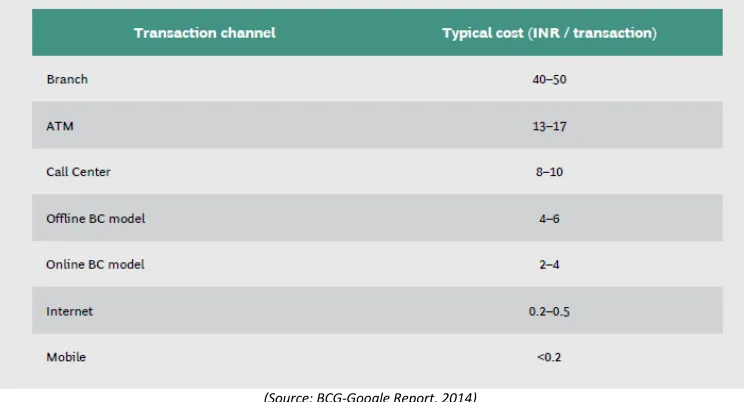
As per BCG-Google report 2014, banking units which were spending Rs 40-50 per transaction while operating from banks has now come down to an amount less that Rs 0.50 when such services are used electronically through internet. This has showcased another dip in cost while using mobile banking services. Therefore, such changes are beneficial for marketer and customers too (refer Table Lower transaction cost through digitization).
FIGURE 10: LOWER TRANSACTION COST THROUGH DIGITIZATION
(Source: BCG-Google Report, 2014)
Unique Initiatives- There are several unique initiatives taken by different E-Commerce Organisations. A couple of them are below mentioned.
Storeking: This organization is a startup business set up in Karnataka to serve the people residing in villages. Business model uses the shop area of locally known
retailer of village and puts kiosk over there. As per terms of this business-model, an Initial deposit of Rs 10,000 should be made by retailer (in whose premises kiosk is placed) in favour of Storeking. Retailer gets a variable commission upto 10% on every sale. Once customer has made full payment to the retailer, order request is made through the kiosk. As a result, ordered product will be delivered in two days’ time. For delivery purposes Storeking uses the existing channel of retail goods delivery used by the shopkeepers. Most important element is the language used in kiosk is local language. This made the purchase process very easy for the rural customers. They can choose the required product from the list of products mentioned in the kiosk. Therefore, they need not to have any personal internet connection for such purchases. Customers don’t get heavy discounts on their purchases in this method of retailing but they get desired product in the specified time. Surprisingly, among most saleable products in villages by Storeking, one is anti-ageing cream.
E-Swasthya: Another unique effort is made by; Piramal Group’s E-Swasthya.Itwas established in 100 centres in villages and treated close to 86000 patients in
recent past, in three districts of Rajasthan. It arranges medical consultancy and drugs at the doorstep of villagers by using telemedicine model. In this model organisation provides training to an educated lady of the village and supports her with medicines and a mobile phone for curing others with organizational efforts. Therefore, with the help of electronic infrastructural support different types of value additions can be achieved in the society.
CONCLUSION
VOLUME NO. 6 (2016), ISSUE NO. 09 (SEPTEMBER)
ISSN
2231-5756
INTERNATIONAL JOURNAL OF RESEARCH IN COMMERCE, IT & MANAGEMENT
related industry size, fresh investment inflow in internet related businesses, enhancing share of e-tail in total retail industry, growing participation of internet related industry in GDP, more opportunities to SMEs etc.
REFERENCES
1. Akamai Internet News and Research Agency. (2015) State of the Internet Q3 Report. Available at
https://www.akamai.com/us/en/multimedia/docu-ments/report/q3-2015-soti-connectivity-final.pdf
2. BCG (Boston Consulting Group) - GOOGLE REPORT 2014: Insurance @ Digital 20X by 2020. Available at http://www.bcgindia.com/documents/file156453.pdf
3. BCG (Boston Consulting Group) – IAMAI (Internet and Mobile Association of India) REPORT 2015: [email protected]; Creating a $200 Billion Internet
Economy. Available at http://www.bcgindia.com/documents/file180687.pdf
4. Bond, E.U. III and Houston, M.B. (2003). Barriers to matching new technologies and market opportunities in established firms. Journal of Product Innovation
Management, 20, 120-135
5. Business Standard. India set to become world’s fastest growing e-commerce market. Feb 6, 2015. Available at
http://www.business-standard.com/arti-cle/companies/india-set-to-become-world-s-fastest-growing-e-commerce-market-115020601227_1.html
6. Cho, H., and Jialin, S. K. (2008). Influence of gender on Internet commerce: An explorative study in Singapore. Journal of Internet Commerce, 7 (1), 95–119
7. Haque, H., Tarofder, A. K., Mahmud, S. A. and Ismail, A. Z. (2007). Internet advertisement in Malaysia: A study on attitudinal differences. The Electronic
Journal on Information Systems in Developing Countries, 31(9), 1–15
8. Hasan, B. (2010). Exploring gender differences in online shopping attitude. Computers in Human Behavior 26, 597–601
9. Hashim, A., Ghani, E. K. and Said, J. (2009). Does consumers’ demographic profile influence online shopping? An examination using Fishbein’s Theory.
Cana-dian Social Science, 5(6), 19–31
10. India Brand Equity Foundation. Jan 2013. The Rise ad Rise of E-Commerce in India. Available at
http://www.ibef.org/download/The-Rise-and-Rise-of-E-com-merce-in-India.pdf
11. Martı´nez-Lo´pez, F. J., Luna, P. and Martı´nez, F. J. (2005). Online shopping, the standard learning hierarchy, and consumers’ internet expertise: An
American-Spanish comparison. Internet Research, 15 (3), 312–334
12. Park, C., and Jun, J. K. (2003). A cross-cultural comparison of Internet buying behavior: Effects of Internet usage, perceived risks, and innovativeness.
Inter-national Marketing Review, 20 (5), 534–553
13. PricewaterhouseCoopers Report, 2015: E-Commerce in India: Accelerating growth. Available at
http://www.pwc.in/assets/pdfs/publications/2015/ecom-merce-in-india-accelerating-growth.pdf
14. Riley, F. D., Scarpi, D. and Manaresi, A. (2009). Purchasing services online: A two-country generalization of possible influences. Journal of Services Marketing,
23(2), 93–103
15. So, W. C. M., Wong, T. N. D. and Sculli, D. (2005). Factors affecting intentions to purchase via the internet. Industrial Management & Data Systems, 105(9),
1225–1244
16. Tatikonda, M.V. and Stock, G.N. (2003). Product technology transfer in the upstream supply chain. Journal of Product Innovation Management, Vol. 20,
444-467.
VOLUME NO. 6 (2016), ISSUE NO. 09 (SEPTEMBER)
ISSN
2231-5756
INTERNATIONAL JOURNAL OF RESEARCH IN COMMERCE, IT & MANAGEMENT
REQUEST FOR FEEDBACK
Dear Readers
At the very outset, International Journal of Research in Commerce, IT & Management (IJRCM) acknowledges
& appreciates your efforts in showing interest in our present issue under your kind perusal.
I would like to request you to supply your critical comments and suggestions about the material published
in this issue, as well as on the journal as a whole, on our e-mail
for further
improve-ments in the interest of research.
If you have any queries, please feel free to contact us on our e-mail
.
I am sure that your feedback and deliberations would make future issues better – a result of our joint effort.
Looking forward to an appropriate consideration.
With sincere regards
Thanking you profoundly
Academically yours
Sd/-
Co-ordinator
DISCLAIMER
VOLUME NO. 6 (2016), ISSUE NO. 09 (SEPTEMBER)
ISSN
2231-5756