BASNEF model for using safe contraception methods
Masomeh Rostami Moez1, Seyeed Mohammad Mahdi Hazavehei2, Babak Moeini3, Akram Karimi4, Ghodratollah Roshanaei5
Abstract
Most unintended pregnancies occur when unsafe contraceptive methods are exercised. This study aimed to determine the effectiveness of a training program based on the BASNEF model in promoting safe contraceptive methods among couples. This study was conducted on 120 women using unsafe contraceptive methods who visited Hamedan's healthcare centers. Six centers with the highest rate of admission for unintended pregnancies were randomly divided into an intervention group and a control group. Sixty couples from three health centers were randomly assigned to the intervention group and sixty couples from the other three were assigned to the control group. First, the pretest was conducted via a questionnaire; second, members of the intervention group received training based on the BASNEF model, and 6 weeks later, both groups were evaluated through a self-report posttest. The results were analyzed in SPSS-16 using descriptive statistics, Chi-square test, independent and paired t-test. The results showed that there was a significant difference between the mean score of knowledge, behavioral beliefs, attitude toward behavior, subjective norms, behavioral intentions and enabling factors in the intervention group and in the control group. Additionally, the difference between constructs of the model was significant in the intervention group before and after the intervention. At the end of the study, 55.5% of women in the intervention group were using safe contraceptive methods. According to the results, we can claim that training couples based on the BASNEF model is effective in promoting safe contraceptive methods among them.
Keywords: Contraception, Education, Health Impact Assessment, Intervention Studies
Journal of Research & Health
Social Development & Health Promotion Research Center
Vol. 4, No.2, Summer 2014 Pages: 705-713
Original Article
1. PhD Student in Health Education and Promotion, Faculty of Health, Hamadan University of Medical Sciences, Hamedan, Iran
2. Professor of Health Education, Research Center of Health Sciences, Faculty of Health, Hamadan University of Medical Sciences, Hamedan, Iran
3. Correspondence to: Associate Professor of Health Education, Social Determinants of Health Research Centers, Faculty of Health, Hamadan University of Medical Sciences,, Hamedan, Iran Tel/Fax: +98 81 38380509 Email: [email protected] 4. Assistant Professor of Health Education, Public Health’s Department, Faculty of Health, Hamadan University of Medical Sciences,, Hamedan, Iran
5. Assisstant Professor of Biostatistics, Biostatistics and Epidemiology Department, Faculty of Health, Hamadan University of Medical Sciences,, Hamedan, Iran
Received: 4 Aug 2012 Accepted: 21 May 213
How to cite this article: Rostami Moez M, Hazavehei SMM, Moeini B, Karimi A, Roshanaei Gh. Effectiveness of educational program based on BASNEF model for using safe contraception methods.
J Research Health2014; 4(2): 705-713.
Introduction
The prevalence of unintended pregnancies varies across the world, but their undesirable outcomes are the same [1]. Unintended pregnancy occurs when the couple, or at least one of them does not intend to have a child, or when pregnancy is unplanned and unintended [2,3]. Fertile women of all ages are prone to
its consequences by 25% to 30% [5].
Most unintended pregnancies occur due to the irregular usage of contraceptive methods or the discontinuation thereof, which is a rather widespread trend across the world [6]. According to a DHS study conducted on 15 developing countries, the rate of irregular use of contraceptive methods varied from 9% to 34% depending on the country, and the reasons reported included the side-effects of the methods, failure of the methods, spouse's objection and other health concerns. Even in developed countries, half of the unintended pregnancies occur due to the irregular use of contraceptive methods. The irregular use of contraceptive methods is a complex case especially foe women whose pregnancy intentions have a significant role in their lives. Reducing unintended pregnancies among couples depends on the emphasis they put on contraception and their choice of safe contraceptive methods. Key factors determining successful contraception is the couple's motivation, the method's ease of use and its persistent usability [6]. The rate of unintended pregnancies occurring due to method failure is less than 10% [7]. If no contraceptive method is used, the chance of getting pregnant will be 85% over a year; if withdrawal method or condom is used, the chance of pregnancy decreases to 27% and 15%, respectively. If these methods are properly used, the chance will decrease to as low as 4% and 0.2%. If IUD, contraceptive pills, tubectomy or vasectomy is used, the chance of pregnancy decreases to lower than 0.5% [8]. Social and cultural factors are predictive factors that should be considered when consulting with couples about the contraceptive methods available to them [9]. There are several health educational models that can be used for seeking causes, analyzing and interpreting healthy behaviors [10]. One of these models is the BASNEF model as explained by John Hubley, which includes beliefs toward behavioral outcome, attitude toward behavior, subjective norms and enabling factors.
This model is a combination of the Precede-Proceed model and the Expectancy-value
theory [11,12]. The most significant construct of the BASNEF model is behavior and practice of the behavior [11]. Beliefs and attitudes are influenced by the culture, values, traditions, education, the media and personal experiences. Subjective norms include family, society, social media and peer pressure. Enabling factors can be income, women's status, time and skills [11,13]. This model can be proposed as a new educational method [14]. In developing countries, the BASNEF model is used to meet the health educational needs of the society [11]. Picture 1 depicts the schematic outline of the BASNEF model.
Hazavehei et al. [15] suggested that 75.8% of all unintended pregnancies occurring over a period of 6 months were the outcome of using condoms or the withdrawal method, and considering the high prevalence of unintended pregnancies occurring due to the use of unsafe contraceptive methods in Hamadan in spite of the conventional family planning training programs, it seemed that designing and implementing training programs based on health education models is necessary for encouraging couples who were using these two methods to switch to safer contraceptive methods. Given that the BASNEF model can perfectly examine all the different aspects of health behavior, and since Iran National Health Network System has introduced the BASNEF model as its official behavior change and planning model, the present intervention was designed and implemented.
The purpose of this study is to determine the effectiveness of health educational programs based on the BASNEF model in promoting the use of safe contraceptive methods among couples prone to unintended pregnancies.
Method
condom) who were covered by Hamedan's healthcare centers.
The method of simple random sampling was used, by first collecting the phone numbers of women using the withdrawal or condom for contraception from family planning offices of every healthcare center, and subsequently inviting them over the phone to participate in the study. By using the relevant formula for calculating the sample size required for comparing the two mean scores, and by estimating the power 80% and the confidence coefficient of 95%, sample size was determined 45. Therefore, considering a sample loss of 30%, each group comprised of 60 members. Six healthcare centers with the highest rate of admission for unintended pregnancy were chosen according to the findings of a study conducted by Hazavehei et al. [15] through a simple random sampling method and were thus divided into an intervention and a control group. Three healthcare centers were selected as the intervention group and three as the control group. The inclusion criteria included the use of unsafe contraceptive methods (i.e. the withdrawal or condom), willingness to participate in the study, having at least one child, and being at least 25 years old, while the exclusion criteria included the unwillingness to participate in the study, being absent from classes for two sessions or more, and the failure to fill out the posttest questionnaires. Respondents received information on how to proceed with the project, what its purpose was and how the information provided by them would remain confidential, and they then entered the study voluntarily. Written consent form was obtained from the respondents before the study began and the project was approved by the Ethics Committee of Hamedan University of Medical Sciences.
A researcher-made self-report questionnaire was used to collect data. If respondents had a low level of literacy, the questionnaire was filled out with the assistance of the researcher or a trained interviewer asking the questions orally. Given the lack of a standard questionnaire, the required questionnaire
groups of 10 and they received the designed training over a period of 3 days, and each intervention group sat for class for 3 days, an hour each day. The control group only received their conventional training. The educational content for the intervention group was prepared for them in the form of a booklet for the couple and a specific pamphlet for men and covered the following topics: the significance of unintended pregnancy and its risk factors (intended constructs: knowledge and attitude), the anatomy and physiology of fertility in men and women (intended constructs: knowledge, beliefs, attitude and subjective beliefs), hormonal contraception (injections and pills), IUD, condom, emergency contraception, tubectomy and vasectomy, and common misconceptions (intended constructs: knowledge, attitude, normative beliefs, enabling factors and beliefs). The men's specific pamphlet and group discussions with health workers were intended to activate the subjective norms. The training program involved the use of information posters presenting men’s and women's pelvis anatomy and a booklet and was conducted in the form of lectures, Q&A, group discussions in class and one-on-one consultations.
At the end of the training program, participants were given the researcher's phone number for future consultations or potential questions and general follow-up of the results.
Six weeks after the intervention ended, the posttest self-report questionnaires were filled out in both the intervention and the control group and their current method of contraception was noted. Five people from the intervention group and 5 from the control group were excluded study according to the exclusion criteria and eventually the data provided by the remaining 55 people of each group were analyzed. The data entered into the SPSS 16 software were analyzed using independent t-test for comparing the results obtained from the intervention and the control group, paired t-test for comparing the pre- and post-intervention results of each group, and descriptive statistics and Chi-square test.
Results
The mean age of women was 30.89 ± 48.59 in the intervention group and 31.67 ± 51.46 in the control group. 34.5% of women in the intervention group and 32.7% of those in the control group had elementary education, and 96.4% of the women in the intervention group and 94.5% of those in the control group were housewives. Results were not indicative of a significant difference in age, number of children, number of sons and daughters, couples' education, couples' job and family income between the intervention group and control group as the two were nearly matched for these variables (p>0.05).
Discussion
Results of the study generally showed that a training program based on theories can be effective in promoting safe contraceptive methods. The mean score of knowledge about unintended pregnancy and contraceptive methods was low in both intervention and control groups at the beginning of the study, which might have been due to the inadequacy or the low quality of the education provided by healthcare centers. In the intervention group, the mean score of knowledge increased by 24% post-training while in the control group it only increased by 2%; the significant difference between the mean score of knowledge in the two groups after they each received their proper training signifies the greater effectiveness of a training program based on the BASNEF model in promoting women’s knowledge compared
with a more routine program. The results of this study were similar to those conducted by Movaghar, Lopez and Ferriera, in which the participants' mean score of knowledge about contraceptive methods increased after they received their proper training [16, 18]. In a study conducted by Bennett, a low level of education and a low knowledge were linked to the use of unsafe contraceptive methods [19]. Increased knowledge can be effective in the recognition of the different methods available and the perception of their benefits and barriers, which can, in turn, change the individual's beliefs and attitude and increase her decision-making skills and eventually lead to her choosing a safe contraceptive method.
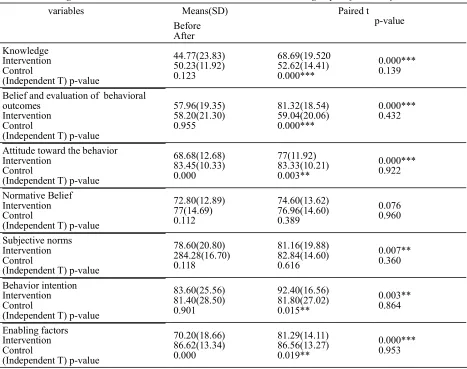
In the intervention group, the mean score of behavioral beliefs increased by 23.36% post-Table 1 Knowledge and BASNEF constructs score in intervention and control groups before and after intervention
variables Means(SD) Paired t
p-value Before
After Knowledge
Intervention Control
(Independent T) p-value
44.77(23.83) 50.23(11.92) 0.123
68.69(19.520 52.62(14.41) 0.000***
0.000*** 0.139
Belief and evaluation of behavioral outcomes
Intervention Control
(Independent T) p-value
57.96(19.35) 58.20(21.30) 0.955
81.32(18.54) 59.04(20.06)
0.000***
0.000*** 0.432
Attitude toward the behavior Intervention
Control
(Independent T) p-value
68.68(12.68) 83.45(10.33) 0.000
77(11.92) 83.33(10.21) 0.003**
0.000*** 0.922
Normative Belief Intervention Control
(Independent T) p-value
72.80(12.89) 77(14.69) 0.112
74.60(13.62) 76.96(14.60) 0.389
0.076 0.960
Subjective norms Intervention Control
(Independent T) p-value
78.60(20.80) 284.28(16.70) 0.118
81.16(19.88) 82.84(14.60) 0.616
0.007** 0.360
Behavior intention Intervention Control
(Independent T) p-value
83.60(25.56) 81.40(28.50) 0.901
92.40(16.56) 81.80(27.02) 0.015**
0.003** 0.864
Enabling factors Intervention Control
(Independent T) p-value
70.20(18.66) 86.62(13.34) 0.000
81.29(14.11) 86.56(13.27) 0.019**
0.000*** 0.953
education and thus a significant difference was observed between the mean scores of behavioral beliefs in the control group and in the intervention group, signifying that the designed training program had a positive effect on this variable. In the present study, over half of the women believed that the current methods affected their beauty, weight gain and weight loss in one way or another and harmed their mental and overall health, which could be the reason for their not using safe contraceptive methods. Evaluation of behavioral outcomes takes place before the practice of those behaviors; therefore, if women have a positive evaluation of this behavior, they will be encouraged to use safe contraceptive methods. In other words, an increased knowledge affected the positive evaluation of behavioral outcomes. In a study by Kein, behavioral beliefs about the use of condoms and the prevention of venereal diseases signifies the positive or negative evaluation of behavioral outcomes on their part and increased the use of condoms [20]. The training methods and content planning employed in this study based on the BASNEF model affected women's evaluation of behavioral outcomes and modified their beliefs about safe contraceptive methods. The significant difference observed between the scores of the intervention group pre- and post-intervention as well as that observed between the scores of the intervention group and the control group post-intervention is both indicative of this claim.
The increase in the intervention group's mean score of attitude from 68.68 to 77 and the significant difference between the two groups' mean score of attitude post-intervention signify the positive effect of the designed training program in the attitude of women in the intervention group. Attitude is considered a psychological tendency indicating a positive or negative and a desirable or undesirable evaluation of a certain behavior, and depends on the person’s cognitive, emotional and behavioral reactions. Couples participating in this study received training on the anatomy and physiology of the reproductive system and the ovulation process, pregnancy and menstruation,
the significance of contraception and the risky consequences associated with unintended pregnancies, and common misbeliefs were also discussed to change their attitude. In a study by Coles et al. women had a negative attitude toward effective contraceptive methods and were concerned about their side effects and the possibility of infertility and were therefore not using them [21]. Studies conducted in Tanzania suggested that a positive attitude toward condoms has increased their use [22]. In a study conducted in Uganda by Nalwadda et al. the change in the attitude of women in the intervention group led to their increased use of contraceptive methods [23]. Results of the mentioned studies are all in compliance with results of the present study; we can therefore attest to the usefulness of the proposed training program in modifying women's attitude toward the use of safe contraceptive methods through encouraging and modifying their beliefs.
the greatest degree of influence on the women's choice and use of safe contraceptive methods, to become actively engaged in the study. The significant increase in the results of the paired t-test proves this claim true. The presence of the husbands during the consultation sessions or their indirect training can be highly effective in determining the women's intention to use safe contraceptive methods. In the intervention group, the mean score of normative beliefs increased by 1.80 while in the control group it only decreased. Nevertheless, these changes were not significant, and it seems that changing normative beliefs requires first a change in society's beliefs.
One of the most powerful factors predicting behavior is behavioral intention. A comparison of the mean scores of behavioral intention in the groups studied pre- and post-intervention show that, in the intervention group, the mean score of behavioral intention increased from 83.60 to 92.40, and a significant difference was witnessed between the mean score of behavioral intention in the intervention group and the control group (P-value = 0.015). In a study conducted by Peyman, women's intention to properly use contraception pills in the intervention group and the control group became significantly different post-intervention, and in the intervention group, women's intention to properly use contraception pills increased significantly post-intervention [25]. A study conducted by Miri on the effect of training in family planning on the male nomads of Birjand indicated that the men's intention to use contraceptive methods and to encourage their wives to do the same changed significantly post-intervention (p<0.01), which is in compliance with the results of the present study [26]. Results of the study suggest that the training intervention had a positive effect on the women's intention to use safe contraceptive methods. Intention is one of the powerful factors predicting behavior; therefore, both intention and the factors contributing to it, namely, attitude and subjective norms, should be considered when consulting with couples about their contraception options.
intervention group and those in the control group with respect to their proper use of contraception pills, i.e. their behavior. In the study conducted by Hosseini, over half of the couples were using effective contraceptive methods post-intervention [28 ]. Results of the mentioned studies are in compliance with ours. The limitation of the present study was that men had indirect training through pamphlets because they were busy at work.
Conclusion
The present study showed that the BASNEF model is an appropriate framework through which training interventions can be designed for women prone to unintended pregnancies. If health workers are determined to educate and encourage fertile women to use safe contraceptive methods, they should perhaps concentrate on women's attitude, the enabling factors, the social pressure on women by their husbands and women’s intention to use these methods.
Acknowledgements
This research project was funded by the Research Deputy of Hamedan University of Medical Sciences and was carried out as a master’s thesis in health education, registered on Nov. 30th, 2011. The researchers would like to extend their gratitude to the health workers of Hamedan city and all participants.
Contributions
Study design: BM, MRM, AK, SMMH Data collection and analysis: AK, GHR
Manuscript preparation: BM, MRM, AK, SMMH
Conflict of interest
"The authors declare that they have no competing interests."
References
1- Najafian M, Karami KB, Cheraghi M, Mohammad Jafari R. Prevalence of and some factors relating with unwanted pregnancy, in Ahwaz City, Iran, 2010. ISRN Obstet Gynecol2011; doi: 10.5402/2011/523430 avail-able at URL: http://www.ncbi.nlm.nih.gov/pmc/articles/ PMC3205614/?tool=pubmed.
2- Sanaie Nasab H, Rashidi Jahan H, Tavakoli R,
Ta-vakoli HR, Amin shokravi F. Correlates of unwant-ed pregnancy among pregnant women attending medical and health centers in Semnan, Iran. Ha-yat2009:15(2):81-86. [In Persian]
3- Khousheh Mehri G, Ebrahim Taheri G, Hatami Z, Safaari M. Prevalence of unwanted pregnancy and its related factors in women referring to health centers in south of Tehran. Journal of Nursing and Midwife-ry2008; 16(59):26-32 (Persian).
4- Kumral A, Duman N, Tatli MM, Ozbek A, Demir-cioglu F, Ozkan H.. Hypernatramic dehydration due to high sodium concentration in breast milk possible rela-tionship with unwanted pregnancy. Acta peadiatr2002; 91(11):1268-9 .
5- Fekri SH.,Vakili MM, Mousavinasab N. The effect of male participation in quality and quantity improve-ment of family planning in Islamabad-Zanjan. Journal of Zanjan University of Medical Sciences and Health Services2007; 14(58):41-8. [In Persian]
6- Curtis S, Evens E, Sambisa W. Contraceptive dis-continuation and unintended pregnancy: An imperfect relationship. Int Perspect Sex Reprod Health2011; 37(2):58-66
7-Nguyen PH, Budiharsana MP. Receiving voluntary family planning services has no relationship with the paradoxical situation of high uses contraceptives and abortion in Viet Name: a cross sectional study. BMC women’s health2012; 28(12):14. doi:10.1186/1472-6874-12-14.
8- Blumenthal PD, Voedisch A, Genzell-Danielson K. Strategies to prevent unintended pregnancy: increasing use of long acting reversible contraception. Hum Re-prod Update2011; 17(1): 121-37.
9- Phares T, Cui Y, Baldwin S.Effective birth control use among women at risk for unintended pregnancy in Los Angeles, California. Womens health Issues2012; 22(4):e351-8. (in press)http://dx.doi.org/10.1016/j. whi.2012.04.002
10- Glanz k, Rimer BK ,Viswanath K. Health behavior and health education ; Theory, Research and Practice. Sanfrancisco, Jossey-bass; 4th edition, 2008.
11- Hubley J .Communicating health. An action guide to health education and health promotion.2 ed. Oxford: Macmillan education Ltd1993: 20-180.
12- Hubley J. Understanding behavior: The key to suc-cessful health education. Trop Doct1988, 18(3): 134-8. 13- Reimers P. The influence of the workplace envi-ronment on breastfeeding practice of working mothers returning to work: A case study of two companies in Kwazulunatal.2009; Dissertation .available at: http:// ir.dut.ac.za/handle/10321/448?show=full.
14- Hazavehei S, Sharifirad G, Kargar M. The compar-ison of educational intervention effect Using BASNEF and classic models on improving assertion skill level. J Res Health Sci2008; 28,8(1): 1-11
Hamadan city: Applying BASNEF model. Research proj-ect approved in Hamadan University of Medical Scienc-es,Research center of health science.2011. [In Persian] 16- Movaghar M, Soltanian AR, Movaghar M. The im-pact of population and family planning course on the knowledge and attitude of students towards contraceptive methods: a study on female students of Islamic Azad uni-versity/Abadan branch in 2005-6. Strides in Development of Medical Education 2007; 4(1):44-50. [In Persian] 17- Ferreira AL1, Souza AI, Lima RA, Braga C. Choices
on contraceptive methods in post-abortion family plan-ning clinic in the northest Brazil. Reprod Health2010: 10;7:5 doi:10.1186/1742-4755-7-5.
18- Lopez LM, Tolley EE, Grimes DA, Chen-Mok M. Theory-based interventions for contraception . Co-chrane Database Syst Rev2011;16 (3):CD007249. doi: 10.1002/14651858.CD007249.pub3.
19- Bennett IM, Culhane JF, Mccollum KF, EloI T. Un-intended rapid repeat pregnancy and low education stat-ue: any role for depression and contraceptive use? Am J Obstet Gynecol2006;194749-754:(3) .
20- Kiene SM, Tennen H, Armeli S. Today I’ll use a condom, but who knows about tomorrow. Health psycho2008:27(4):463-72.
21- Coles MS, Makino KK, Stanwood Nl. Contraceptive experiences among adolescents who experience unin-tended birth. Contraception2011:84(6): 578-84. 22- Bryan A, Kagee A, Broadds ME. Condom use among Sought African adolescents: developing and test-ing theoretical models of intention and behavior. Aids behave2006:10(4):387-397.
23- Nalwadda G, Mirembe F, Byamugisha J, Faxelide E. Persistent high fertility in Uganda: young people recount obstacle and enabling factors to use of contraceptives. BMC public health2010; 10:530. doi: 10.1186/1471-2458-10-530
24- Enah C, Sommers M, Moneyham L, Long CA. Pi-loting an HIV prevention intervention for Cameroonian girls. JANAC2010:21(6):513-21.
25- Peyman N, Heidarnia A, Ghofranipour F, Kazemne-jad A, Khodaee GH, Aminshokravi F. The relationship between perceived self-efficacy and contraceptive be-haviors among Iranian women referring to health centers in Mashhad in order to decrease unwanted pregnancies. Journal of Reproduction & Fertility2007:8(1):78-90 [In Persian].
26- Miri MR. Modifying Behavioral Intention Model and its application in family planning education for tribes men in Birjand. Dissertation for Ph.D in health educa-tion. Tarbiat Modarres University2003 . [In Persian] 27- Hazavehei SMM, Pirzadeh A, Entezari MH, Hasanzadeh A. The effect of educational program based on BASNEF model on the nutritional behavior of stu-dents. Journal of Zahedan University of Medical Scienc-es2011; 13(1):23-29. [In Persian]
28- Hosseini H, Abdi F, Mashhadizadeh A, Rezaei A. Investigate men cooperation in family planning after a group training program of their spouses. Journal of
Is-fahan Medical School2011; 29(131): 252-258. [In Per-sian]