PSYCHROMETRY: FROM PARTIAL PRESSURES TO MOLE FRACTIONS
by
Clifford C.O. Ezeilo
Department of Mechanical Engineering University of Nigeria, Nsukka.
(Original Manuscript received, January 15, 1980.)
ABSTRACT
This study uses the viria1 and interaction coefficients of the normal air components in deriving compressibility factors and thereafter a simple iterative formulation for mole fractions. Conversion from partial pressures to mole fractions now becomes tractable by means of determinate multipliers. The results obtained compare most favourab1y with the widely accepted derivations due to Goff and Gratch. One possible advantage is that the presented formulation permits the evaluation of those multipliers without reference to the virial and interaction coefficients provided that the "dry air" and moist air compressibility’s are very accurately measured. A possible simplification is that this partial pressure multiplier is expressed explicitly in a form suggesting acceptable results for air-water gaseous mixtures outside the range of normal air psychometry.
NOTATION
P pressure (m-bar)
V specific volume (m3/Kg-mole)
RO universal gas constant =
0.083143
m3 bar/Kg-mole. K
= 8.3143 KJ/Kg-mole. K
T absolute temperature (K)
Z compressibility factor
(dimensionless)
B, B’,A11, Aaa, Aww = second virial
Coefficients
(consistent units)
C,C’ A111’ A aa a, Awww = third virial
Coefficients
(consistent units)
D Fourth virial coefficient (consistent units)
X Mole fraction (dimensionless ) K Boltzmann constant =1.39053 X10⁻²³ (j/k)
N Avogadro number = 6.023 x 1026/KG- mole
Ε Maximum negative value of the molecular potential energy (J)
Q Closest approach o two
molecules considered as rigid spheres (m)
Angstrom unit = 1.0x10⁻¹⁰ meter
T* reduced temperature:. T(k/ɛ). (dimensionless)
B* reduced second virial
coefficient
= B/ . (dimensionless)
bo second viral from the potent
malfunction= 2 No3/3 (m3
/Kg-mole)
f pressure multiplier
(dimensionless)
w specific humidity (g/kg dry air)
Subscripts
ss state of air saturated with water vapour
a dry air alone w water vapour alone
aa molecules of air in pairs also air alone in mixture
ww water molecules in pairs also water alone in mixture
aw air and water molecules also
air watersecond virial
interaction in the binary
mixture
aaa air molecules in threes also the third virial coefficient for air alone
vww water molecules taken in threes also water alone in the third viral coefficient
aww,aaww air-water third virial
water molecules and one water plus two molecule of air
1. INTRODUCTION
The earliest studies of
psychrometry considered normal air as an ideal gas mixture. Partial pressures then become identical: to mole fractions and sets of
psychometric parameters result
from rather elementary
thermodynamic relations. Search for more accurate data has long
led to the realization that
neither dry air nor pure water vapour behaves like an ideal gas, despite the fact that the dry air
component normally exists at
temperatures far inexcess of the critical point temperature while the vapour pressure is much below the critical pressure of steam. This destroys the Gibbs-Dalton law as a basis for standardization.
Modifications of the
classical ideal gas equation of state to fit the observed data
have been made by many
investigators. Most of these
efforts take the form of measuring the compressibility factors of dry air, water vapour and their binary mixtures at various mixing ratios and thereafter expressing the P-V-T data as a virial equation of
state. Thus from the simple
relation
PV = RO T (ideal gas) (1)
we have the equations
PV/ROT=Z=1+B/V+C/V2+D/V3+(Volume
series) (2)
and
PV/ROT = Z = 1+ B1 P +C1P2 + ……..
(Pressure series) (3)
The above two expressions are virial equations of state in which
the second and third virial
coefficients are related in the form
B1 = B/(R
OT) and C1= (C-B2) /(ROT)2
(4) Writing
PV/ROT = 1- 11 111 P2
T R A T R A O O
(5) it would follow that
A11 = -B (6)
and A111 = -(C –B 2) /(ROT) (7)
A11 the virial coefficients: B, C, B 1, C1, A11 and A111 are functions of temperature and some
often tabulated for single
component gases.
For air as a single component gas
Zaa = PV/ROT = 1 – (P/ROT)Aaa
- aaa
O A T R P 2 (8)
Similarly for water vapour,
Zww = (PV/ROT) = 1 – (P/ROT)Aww -
(p2/ R
OT)Aww (9)
When two or more dissimilar gases form a mixture, interaction force constants complicate the analysis. In the case of binary mixture of dry air and water vapour
Zaw = PV/RTO = 1 - P/RoT[ Aaa+ 2xa
xwAaw + Aww] (11)
where Aaw is the interaction
coefficient between the air and vapour molecules considered in pairs. In eqn.10 the series is restricted to the second virial and interaction coefficients only.
This restriction has been
identified as the "Three Liquid Theory" of binary gas mixtures in statistical thermodynamics.
If the third viral and
interaction coefficients are also
known, then, considering the
molecules in groups of threes will extend eqn.10 into the longer series relation
Zaw = = 1 - [ Aaa+
2xa xwAaw + Aww] – P2/RoT[ Aaaa +
Aaaa and Awww are the third virial
coefficient while Aaaw and Aaww are
the interaction third virial
coefficients. Hilesenrath [1 ] tabulates values of B, C, and D for dry air form 50 k to 1500 k. Goff [2 ] give tables of Aaa’ Aww,
Awww and Aaw for air – water
mixtures for the temperature range -900c.
Keyes [3] gives values from which Aww and Awww can be deduced for pure
water vapoure. Mason and monchick [4] have produced data from which Aww may be evaluated, and they stipulate that only the first,
second and third virial
coefficients have simple physical interpretations. Goff and Gratch [5] formulation sets
X3aAaaa= xwAaaw= xa Aaww=0.0 (12)
and arrive at the generally
accepted equation [6]
Zaw = 1 - [ Aaa+ 2xa xwAaw + Aww]
+P/Po( Awww )] (3)
Theory and reported experimental deductions do not agree on the
interaction second virial
coefficient Aaw and considerable
uncertainties still exist [4] as to the values of the interaction third virial coefficients Aaaw and
Aaww Goff and Gratch [5] give
values of Z for dry air at temperature varying from -1000C to
+60oCfor pressures ranging from
zero to 1100 mb. Their data for moist air are reported at 25%
mixing ratio to degree of
saturation intervals from 0OC to
600C and at total pressures of
0,300, 700 and 1100 mb. They also tabulate values corresponding to pure water vapour (vapour over ice
and vapour over water) at
saturation or boiling point
temperatures of-l000C to +600C.
Hilsenratch [1] presents values
for steam at one and ten
atmospheres pressure for absolute temperatures ranging from 3800K to
8500K. His data for dry air are
presented in a deviations form leading of a table of (Zaa-1) x
105.
In all the literature
quoted above the accuracy level of the data will be inadequate for the theory developed later: a
theory that relies on small
differences. Practically, if the compressibility factors of dry air (Zaa) and air-water mixtures (Zaw)
are measured to the high degree of accuracy demanded by the analysis, then the precise values of the
interaction and virial
coefficients become an exercise in statistical thermodynamics. That the available measured data do not
satisfy this need of small
differences has led to the inverse problem of evaluating Z from the known second virial coefficients and the theoretical predictions of the interaction coefficients.
In this inverse problem,
statistical thermodynamics
considers water vapour molecules as polar molecules with the force constants (which determine the
second virial coefficients)
evaluated on the basis of the
Stockmayer 12-6-3 Potential
Function. Dry air, on the other hand, is of non-polar molecules with the force constants evaluated from the Lenard Jones 12 - 6 Potential. Standard works in this field are contained in books such as by Tieu and Lienhard [7] and by Hirschfelder et al [8]. Extensions to moist air (as a binary mixture) are reported by Hirschfelder et al,[8] Shaddock [9] and Mason and Monchick [4]. Statistical single -
value constants such as k, and
exist for dry air (as of non-polar molecules) and pure steam (as of polar molecules). For dry air, the reduced second virial coefficients B*(=B/b ) and reduced temperatures T* are available as one of the Lenard-Jones . gases in a tabular form [9, 10] for the range
0.30 ≤ T*= T(ε/k) ≤ 50.
pure steam in the: range 0.80 ≤ T* ≤ 100.
An assumption made by Hirschfelder et. al. is that the effective interaction force constant between a polar and a non-polar molecule is identical in value to that between two non-polar molecules.
With this assumption the
interaction coefficients of air-water mixtures can be determined for a good rage of temperatures. In this work the second and third virial coefficients for single-component gases are taken from existing results (Hilsenrath [11] for air and Keyes [3] for steam).
The interaction second virial
coefficients are computed from statistical data. The differences between these theoretical values and those due to Goff and Gratch are compared. The effect on the moist air compressibility factor is found to be small. On the partial pressure multiplier the
difference becomes practically
insignificant. This multiplier
(fss) is computed for air
saturated with water vapour at total pressures varying from 800 mb to 110mb. The nearest relations found in the literature, where f is expressed explicitly in terms of other variables, as in the formula developed, are reported by Harrison [12] using two data
sources: the first due to
Landsbaum, Dodd’s and Stutsman [3] and the second using the data from Webster [14]. Both are of the form
fss = [1 + (P-Pss)] C(T) (14)
(in our present notation)
where C(T) is a suitable function
of temperature but with the
dimensions of atmosphere.
2. THEORY
When moles of dry air alone Occupies volume (V) at temperature (T) under the pressure (pa) then
from a eqn.8
(V/ROT)= xa [1- - ( )2 ]
(15)
Similarly for xw moles of water
vapour alone, using eqn. 9 gives (V/ROT)= xw [1- –
]
(16)
If x + xw = 1.00 and the above
gases mix under Gibbs-dalton law, then
+ V/ROT =xa +xw - -
- - (17)
where xa = and xw =
P1
a and p1w are idealized partial
pressures to yields the pressure P.
Thus, on considering the gases as Gibbs-Dalton gases one arrives at the relation.
PV/ROT = 1- [ Aaa+ Aww] -
[ Aaaa + Awww] (18)
Since + = P.
However, for the real mixing process, it is shown by eqn.l1 that the interaction coefficients get involved. Thus if Pa and Pw are
the actual partial pressures on mixing, then from eqn. 11
(Pa +Pw) V/ROT = 1- [ Aaa+
2xaxwAaw + Aww] - [ Aaaa +
3 xwAaaw + 3xa Awww] +
……….. (19)
Dividing eqn.19 with eqn.18 result with series approximation in the mixture partial pressures equation
(Pa + Pw)/P =1- [2xaxwAaw]-
[3 xwAaaw + 3xa Aaww]+ (20)
It would be obvious from the above that mixing of the dissimilar gases leads to the inequality
pa + pw (21)
which consequently invalidate the Gibbsalton Law.
When the third virial interaction coefficients are neglected eqn.20 reduces to
pa + pw = P- [2xaxwAaw] (21)
The above equation is quoted by Goff [15] who also gives the
following relations between
partial pressures and mole
fractions:
Pa = xaP + [-Aaa + xw(Aaa -2Aaw
+Aww)] P2 + (22)
It is easily verified that the addition of the last two equations results in eqn.21.
Since
xa + xw = 1.00 (24)
eqn.23 readily transforms to yield
Pw/P = xw-xa[ Aaa + 2xaxwAaw + Aww]
(P/ROT) + Aaa (P/ROT) (25)
Pw/P=xw–xa(1-zaw)+ (1-zaa) (26)
Zaw=(PV/ROT)aw
=1-[ ]P (27)
and
zaa = (PV/ROT)aa= 1- ( Aaa (28)
The last two equations follow from
eqn.10 but the longer
series/equation given in 13 can also be used in eqn.26 for numerical values of z.
A further reduction of eqn.26 when xa 0.00 results in the final
expression
Pw/P=xw(2zaa – zaw)– (zaa - zaw) (29)
or
xw = [Pw/P+(zaa–zaw)]/(2zaa–zaw) (30)
The object of this analysis is the evaluation of the mole fraction
(xw) when the vapour pressure (Pw)
is known. The problem therefore demands that both zaa and zaw be
evaluated fairly accurately since small differences are involved. In order that mole fractions can
be determinate from partial
pressures we define the partial pressure multiplier (faw) in the
form
xw =faw (Pw /P) (31)
Hence from eqn. 30, faw can be
written explicitly to give faw=[1+(P/Pw)+(zaa–zaw)]/(2zaa–zaw)
(32)
The special case of wet – bulb
saturation or dew point
temperature would result in the equivalent equations.
xss=[Pss/P+(zaa–zaw)]/(2zaa–zss) (33)
and
fss=[1+(P/Pss)(zaa–zss)]/(2zaa–zss)
(34)
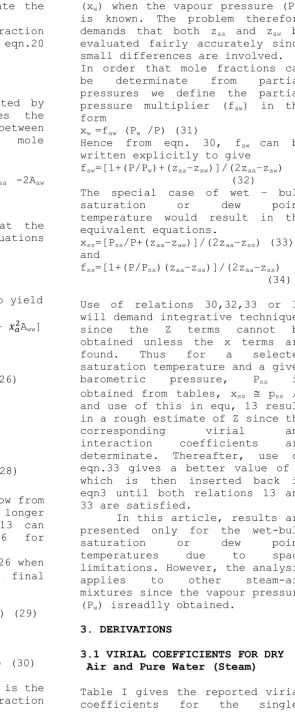
Use of relations 30,32,33 or 34 will demand integrative techniques since the Z terms cannot be obtained unless the x terms are
found. Thus for a selected
saturation temperature and a given
barometric pressure, Pss is
obtained from tables, xss pss /p
and use of this in equ, 13 result in a rough estimate of Z since the
corresponding virial and
interaction coefficients are
determinate. Thereafter, use of eqn.33 gives a better value of x which is then inserted back in eqn3 until both relations 13 and 33 are satisfied.
In this article, results are presented only for the wet-bulb
saturation or dew point
temperatures due to space
limitations. However, the analysis
applies to other steam-air
mixtures since the vapour pressure (Pw) isread1ly obtained.
3. DERIVATIONS
3.1 VIRIAL COEFFICIENTS FOR DRY Air and Pure Water (Steam)
Table I gives the reported virial
single-component gases: dry air and steam from three sources. Agreements are sufficiently close to permit no further reference to theoretical formulations. For substitution in eqn.13, Hilsenrath's data are used for air while those due to Keyes are utilized for steam. It is
found that Hilsenrath's table
which is given in 10 K intervals can be curve-fitted for the range 240 K <T <370 K with the equation
Aaa = 205.0067-.3653(T) +
0.003159(T2)–0.2674 x10⁻⁵ (T3) (35)
Use of the above relation reduces inter potation errors.
3.2 The Interaction
Second Virial Coefficients
Theoretical results are obtained
in the manner suggested by
Shaddock which relies on the intermolecular force constants for dry air, pure water vapour and
air-vapour mixtures. These
statistical force constants are reported as follows:
(i)Dry Air: (Lennard Jones 12-6 Potential): Non-polar molecules.
=3.522
(bo)aa=1.2615 =55.11x10⁻³m3 /kg-mole
aa/k = 99.2 k
(ii)Pure Water Vapour (Stockmayer 12-6-3 Potential):
Polar molecules.
=2.65
(bo)ww=1.2615 =2.48x10⁻³m3/kg-mole
ww/k = 380 k
(iii)Steam-Air Mixtures (Lennard Jones 12-6 Potential):
Polar/non-polar molecules in a binary mixture.
=3.053
(bo)aw=35.90x10⁻³m3/kg-mole
aw/k = 220.5 k
For the above force constants to be valid in eqn.13, use of eqn.6 results in the equalities:
Aaa = -Baa = -(b0)aa Aaw = -Baw = -(b0)aw
Aww = -Bww = -(b0)ww
where B* is the reduced second virial interaction coefficient in the volume series (eqn.2). Tables exist to relate B* to the reduced temperature (T*) for non-polar substances (Bird and Spotz [10])
and for polar molecules
(Rowlinson[11]). Hence, for any selected absolute temperature (T), T.* can be evaluated and hence B*. It follows that Aaa, Aww and Aaw are
determinate. The first two of
these parameters differ only
slightly from the data of Table 1.
The third, which is the
interaction second virial
coefficient, is tabulated in Table 2. These calculated theoretical results differ significantly from the experimental extrapolations due to Goff [2].This difference is of the order 50% above Goff’s data for the temperature range covered. However, when used in eqn. 13 the
effect on the compressibility
factor is not very significant. This is illustrated in Fig. 1 where both zaa and zss are plotted
for saturation temperature of up to 70 0C at a total pressure of
Table 1: Virial Coefficients for Dry Air and Pure Water Substance from Three Sources
t(0c) A aa X 103
(m3/ kg - mole)
A ww X 103
(m3/ kg - mole)
Aww X 103
(m3/ kg mole Atmos )
Goff[2] Hilsenrath[1] Goff[2] Keyes[3] Goff[2] Keyes[3]
-30 21.6 21.360 - - - -
-10 15.7 15.755 2300 - - -
0 13.2 13.275 1830 1854.4 - 4130.4
10 10.9 10.988 1510 1519.5 - 2095.6
20 8.81 8.879 1260 1266.0 - 1131.9
30 6.87 6.932 1074 1070.5 - 641.3
40 5.09 5.130 924 916.8 - 379.0
50 3.44 3.457 803 794.1 - 233.2
60 1.91 1.897 705 694.9 110 146.5
70 0.49 0.435 625 613.3 72 96.7
80 -0.84 -0.946 558 545.7 48 65.44
90 -2.07 -2.261 501 489.0 33 45.26
100 - -33.528 - 441.0 - 32.01
Table 2: Interation Second Virial Coefficients for Moist air
t(0c) -30 10 0 10 20 30 40 50 60 70 80 90 100
Aaw x
103 (m3/kg mole)
(a)Goff 51.8 45.0 42.0 39.3 36.8 34.5 32.3 30.4 28.5 26.8 25.2 23.7
(b)Theoretical 73.31 66.57 62.65 58.19 54.44 51.15 47.93 45.16 42.49 40.02 37..67 35.62 33.55
Fig.1 compressibility factors of dry air (Zaa) and saturated air (Zaa) at
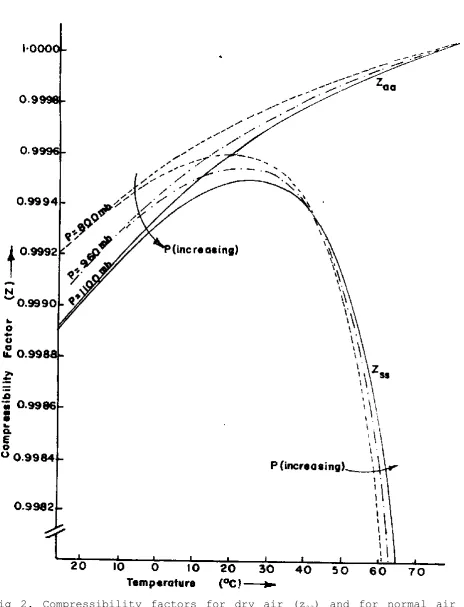
Fig 2. Compressibility factors for dry air (zaa) and for normal air at
3.3 Compressibility Factors
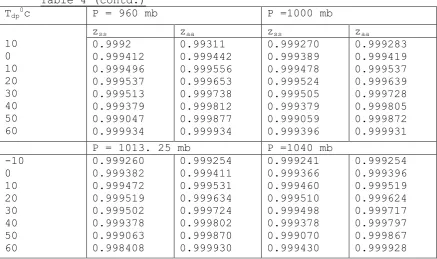
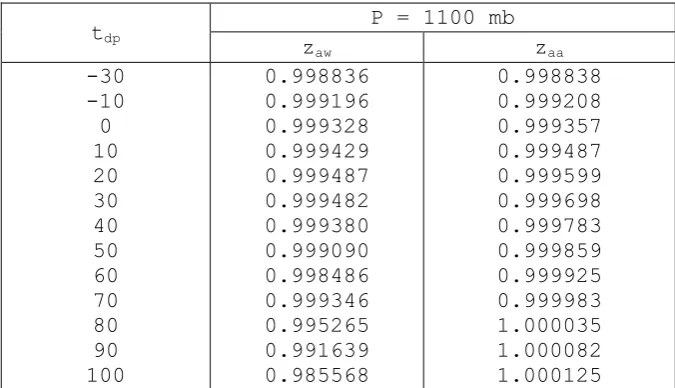
Indications so far are that the derived compressibility factors will not differ significantly (in the case of dry air alone) from other reported data. This is illustrated in Table 3 for dry air at one atmosphere pressure. The same trend was shown in Fig.1 for 1100 mb pressure. Table 4 gives
derived results for changing
barometric pressures while fig.2 gives a general trend within the temperature and pressure limits of normal air psychromery. When Table 4 is compared with Goff and Gratch's tabulation [16] for Z ,it would be observed that some minor differences occur at the fourth decimal point. These are due to
the idealized interaction
coefficients adapted in the
current analysis.
However, the vital significance of the present study is that both Zaa
and Zss are calculated to an order
of magnitude that gives meaning to their differences and thus permits use of eqns.25-29.
3.4 The Partial Pressure Multiplier (fSS)
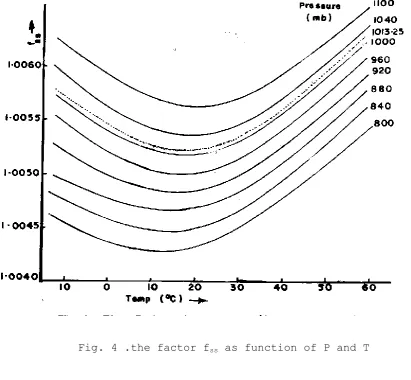
The values of zaa (dry air) and zss
(vapour-saturated air) derived are now utilized in eqns.33 and 34 to obtain both the saturation mole-fraction Xss and the multiplier fss
also at saturation. The results are presented graphically in figs. 3 and 4.
In fig.3, a comparison is made between the derived results at 1100 mb total pressure and the
tabulations of Webster [14],
Harrison [12] and Goff and Gratch
[5] at the same pressure.
Variation X is obtained using the
theoretical interaction force
constants with coefficients as tabulated in Table 2(b). Curve Y is a result of using Goff's interaction coefficients (Table 2(a) in the establishment of Z. Differences exhibited in these
drawings are not nearly as
significant as they look. Within
the range of normal air
psychometric (-100C to 60oC) the
factor fss has reported values
Table 3: Comparison of Z values obtained from the present work to those Tabulated by Hilsenrath[1] at one atmosphere pressure
Table 4. Derived Compressibility Factors of Water-Saturated Air and Dry Air at Dew Point Temperature
P = 800 mb P - 840 mb
Tdp0c
Zss Zaa Zss Zaa
ss -10 0 10 20 30 40 50 60 0.999413 0.999505 0.999569 0.999590 0.999542 0.999373 0.998980 0.998180 0.999426 0.999535 0.999630 0.999711 0.999782 0.999844 0.999898 0.999945 0.999384 0.999482 0.999551 0.999551 0.999535 0.999376 0.999000 0.998228 0.999397 0.999512 0.999611 0.999696 0.999771 0.999836 0.999893 0.999942
P = 880 mb P = 920 mb
-10 0 10 20 30 40 5O 60 0.999356 0.999459 0.999533 0.999564 0.999528 0.999377 0.999017 0.99)8276 0.999368 0.999489 0.999593 0.999682 0.999.760 0.999828 0.999887 0.999939 0.999327 0.999435 0.999515 0.999550 0.999521 0.999382 0.999023 0.999320 0.999340 0.999465 0.999574 0.999668 0.999749 0.999820 0.999882 0.999937 ,
T (k) Zaa
(Hilesenrath)
Zaa (present) t 0c
260 0.99923 0.999254
270 0.99937 0.999411 -10
280 0.99949 0.999531 0
290 0.99960 0.999634 10
300 0.99970 0.999724 20
310 0.99978 0.999802 30
320 0.99985 0.999870 40
330 0.99991 0.999930 50
Table 4 (contd.)
Tdp0c P = 960 mb P =1000 mb
10 0 10 20 30 40 50 60
zss zaa zss zaa
0.9992 0.999412 0.999496 0.999537 0.999513 0.999379 0.999047 0.999934
0.99311 0.999442 0.999556 0.999653 0.999738 0.999812 0.999877 0.999934
0.999270 0.999389 0.999478 0.999524 0.999505 0.999379 0.999059 0.999396
0.999283 0.999419 0.999537 0.999639 0.999728 0.999805 0.999872 0.999931
P = 1013. 25 mb P =1040 mb
-10 0 10 20 30 40 50 60
0.999260 0.999382 0.999472 0.999519 0.999502 0.999378 0.999063 0.998408
0.999254 0.999411 0.999531 0.999634 0.999724 0.999802 0.999870 0.999930
0.999241 0.999366 0.999460 0.999510 0.999498 0.999378 0.999070 0.999430
tdp
P = 1100 mb
zaw zaa
-30 -10 0 10 20 30 40 50 60 70 80 90 100
0.998836 0.999196 0.999328 0.999429 0.999487 0.999482 0.999380 0.999090 0.998486 0.999346 0.995265 0.991639 0.985568
0.998838 0.999208 0.999357 0.999487 0.999599 0.999698 0.999783 0.999859 0.999925 0.999983 1.000035 1.000082 1.000125
Fig. 3: comparisons of the reported values of the functions fss with
Fig. 4 .the factor fss as function of P and T
We note also that the data due to
Goff and Gratch cannot be
extrapolated without grave loss of accuracy. It would be obvious that as the vapour pressure approaches the total pressure, fss would tend
to unity. This is represented by eqn.26 when xa tends to zero. At a
saturation temperature
corresponding to the total
pressure, steam would exist as a
single-component mixture and
fss=1.0000. For the 1100 mb total
pressure, fg.3 gives the
corresponding temperature as 1020C
which is a graphical approximation of 102.320C reported in the 1970
UK Steam Tables.
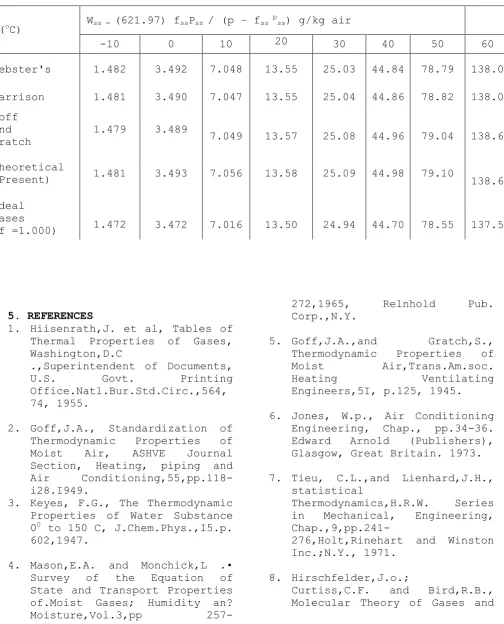
Table 5 also indicates that an assumption of the _Gibbs-Dalton Law (fss = 1.0000) under-estimates
the mole fraction and thus the
specific humidity at all
temperatures with the inherent
differences increasing with
temperature. The same trend is
obtained with decreasing total pressures for a fixed temperature.
4. CONCLUDING REMARKS
This paper suggests a new
formulation for partial pressure multipliers in air-water mixtures of the atmosphere. This multiplier is derived in a form that is
explicit in terms of such
measurable parameters, as partial
pressures and compressibility
factors of dry air and of moist air. The simplicity lies in the fact that virial and interaction coefficients need not be known if these compressibility factors can be measured to a high degree of accuracy. The theoretical approach adapted for the second virial interaction coefficients can be seen as an idealized technique in the absence of highly accurate experimental data.
of Goff and Gratch. These results indicate that equally acceptable
values can follow from a simpler analysis.
Table 5:Specific Humidity at Saturation Using Partial Pressure Multipliers from 4 sources (1100 mb Total Pressure)
5. REFERENCES
1. Hiisenrath,J. et al, Tables of Thermal Properties of Gases, Washington,D.C
.,Superintendent of Documents,
U.S. Govt. Printing
Office.Natl.Bur.Std.Circ.,564, 74, 1955.
2. Goff,J.A., Standardization of
Thermodynamic Properties of
Moist Air, ASHVE Journal
Section, Heating, piping and
Air
Conditioning,55,pp.118-i28.I949.
3. Keyes, F.G., The Thermodynamic Properties of Water Substance 00 to 150 C, J.Chem.Phys.,I5.p.
602,1947.
4. Mason,E.A. and Monchick,L .•
Survey of the Equation of State and Transport Properties of.Moist Gases; Humidity an?
Moisture,Vol.3,pp
257-272,1965, Relnhold Pub.
Corp.,N.Y.
5. Goff,J.A.,and Gratch,S.,
Thermodynamic Properties of
Moist Air,Trans.Am.soc.
Heating Ventilating
Engineers,5I, p.125, 1945.
6. Jones, W.p., Air Conditioning Engineering, Chap., pp.34-36.
Edward Arnold (Publishers),
Glasgow, Great Britain. 1973.
7. Tieu, C.L.,and Lienhard,J.H.,
statistical
Thermodynamics,H.R.W. Series
in Mechanical, Engineering,
Chap.,9,pp.241-276,Holt,Rinehart and Winston Inc.;N.Y., 1971.
8. Hirschfelder,J.o.;
Curtiss,C.F. and Bird,R.B.,
Molecular Theory of Gases and t(oC) Wss = (621.97) fssPss / (p – fss
p
ss) g/kg air
-10 0 10 20 30 40 50 60
Webster's 1.482 3.492 7.048 13.55 25.03 44.84 78.79 138.0
Harrison 1.481 3.490 7.047 13.55 25.04 44.86 78.82 138.0
Goff and Gratch
1.479 3.489
7.049 13.57 25.08 44.96 79.04 138.6
Theoretical
(Present) 1.481 3.493 7.056 13.58 25.09 44.98 79.10 138.6
Ideal Gases
Liquids,John Wiley and Sons. Inc.,N.Y., 1964.
9. Chaadock.J.B, moist Air
Properties fromTabulated
Yirial Coefficients, Humidity and· Moisture, Vo1.3, pp.273-2 kei84 Reinhold Pub. Corp., N.Y., 1965.
10.Bird,R.B. and Spotz,E.L.,The
Virial Equation of State.
University of Wisconsin NRL Report CM599,I950.
11.Rowlinson.J.S., Transactions,
Faraday Society, 45. 1949
12.Harrison,L.p., Imperfect Gas
Relations,Humidity and
Moisture, Vol.3,pp.105-255,
Reinhold Pub. Corp.,
N.Y.,1965.
13.Landsbaum,E.M.;Dodds.W.s. and
Stutzman,L. Humidity of
Compressed Air, Ind.
Engr.Chem. ,47,p. 101,1955.
14.Webster,J.L .• The Effect of
Water Vapour Pressure of
Superimposed Air Pressure
jsoc. chem.ind.69.p 343, 1950
15.Goff,J.A. The Gibbs-Dalton Law
Not aBasis for
Standardization. Humidity and Moisture, ·op cit. pp. :285-:287 .Reinhold Pub.Corp ,J.Y. '1%5.
16.Goff,J.A. ,and Gratch,S•
SmithsonianMeteorological
Tables, edited by List, J.R .. Washington, D.C., Smithsonian
Institution, Sixth Edition

![Table 3: Comparison of Z values obtained from the present work to those Tabulated by Hilsenrath[1] at one atmosphere pressure](https://thumb-us.123doks.com/thumbv2/123dok_us/97263.2011381/11.595.57.484.441.732/table-comparison-obtained-present-tabulated-hilsenrath-atmosphere-pressure.webp)