A. Bijalwan (2018) / Presence of Trees Under Agroforestry Systems Along Altitude in Gangotri Valley of Garhwal Himalaya, India
59
International Journal of Current Research in
Biosciences and Plant Biology
Volume 5 ● Number 5 (May-2018)● ISSN: 2349-8080 (Online)Journal homepage: www.ijcrbp.com
Original Research Article doi: https://doi.org/10.20546/ijcrbp.2018.505.010
Presence of Trees under Agroforestry Systems along Altitude in
Gangotri Valley of Garhwal Himalaya, India
Arvind Bijalwan*
Area of Technical Forestry, Indian Institute of Forest management (IIFM), Bhopal– 462 003, Madhya Pradesh, India
*Corresponding author.
A r t i c l e I n f o A B S T R A C T
Date of Acceptance:
15 April 2018
Date of Publication:
06 May 2018
In this study, the tree species found on farm lands under agroforestry systems in different villages of Gangotri valley along altitude was documented. The three
altitudinal range viz., lower (1000-1500 m), middle (1500-2000 m) and higher (2000-2500
m) were studied. The higher diversity was recorded in forest tree species (29 species with 18 families) compared to horticulture trees (17 species with 10 families). Among forest trees, gymnosperms were represented by five species (three families) and angiosperms by 24 species (15 families). Maximum number of forest trees were found in mid-altitudinal range (18 species), whereas in horticulture trees the highest presence was observed in lower altitude (14). In the forest trees, 2 species yield fiber, 4 ornamentals, 5 edibles, 10 recognized with medicinally important, 12 have other uses, 15 as fodder, 18 as timber and 23 for fuel-wood purpose. Fruits of all the horticulture trees are mostly edible but some time used for other domestic purpose too. Both forest and horticultural tree were reported to have significant importance to the local people.
K e y w o r d s
Agroforestry Altitude gradient Forest trees Gangotri valley Horticulture trees
Introduction
After food crop, the second place comes for trees because trees are also source of innumerable services. Trees are also a part of diverse agroforestry systems and traditional agroforestry systems have been practiced in Garhwal region of Uttarakhand since early period (Iqbal et al., 2014; Gupta and Arora, 2015). Agroforestry is an effective practice to improve farmer livelihood and simultaneously increasing the green cover of
the area. The present study was an attempt to enlist the different forest and horticulture tree species growing on agriculture field under agroforestry.
Materials and methods
A. Bijalwan (2018) / Presence of Trees Under Agroforestry Systems Along Altitude in Gangotri Valley of Garhwal Himalaya, India
60 (1765 m) and Malla (1837 m) in middle and
Jhalagaon (2213 m) and Sukkhi (2500 m) in higher altitude were selected according to varying altitudinal ranges (lower altitude 1000-1500m, middle altitude 1500-2000 m and higher altitude 2000-2500 m). Random quadrats were laid in different areas according to species area curve during 2016-2017.
Results and discussion
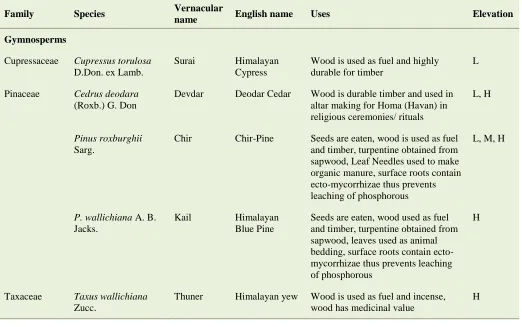
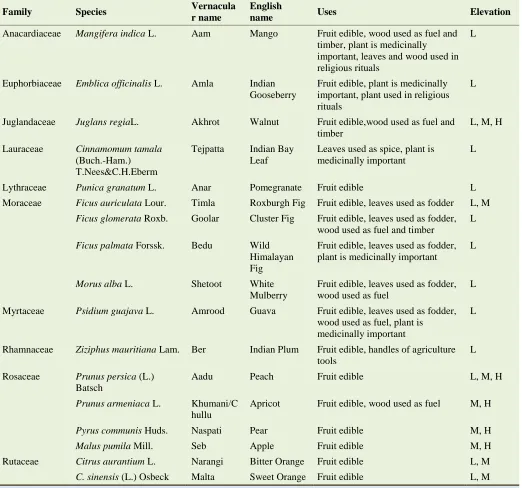
In the present study, 29 species of forest trees were observed as agroforestry tree species comprising 18 families, out of which five species were of gymnosperms (three families) and 24 species (15 families) were of angiosperms (Table 1). In horticulture trees, there were 17 species (10 families). Middle (18 species) altitude region showed highest number of forest tree species followed by lower (16) and higher (6) altitude, whereas, in horticulture trees, lower (14 species)
altitude showed greatest species diversity followed by middle (8) and higher (5) altitude region (Table 2). Some forest tree species were restricted to particular altitude region, where middle (9 species) altitude shows greatest confinement trailed by lower (7) and higher (3) altitude region. Among horticultural trees, lower altitude depicted highest number of restricted species (9), whereas, middle and higher altitude showed no species restriction. Seven forest tree species were observed in both lower-middle altitude regions namely, Celtis australis, Grewia optiva, Jacaranda mimosifolia,
Melia azedarach, Populus ciliata, Quercus
leucotrichophora, Toona ciliata and only one
(Pistacia integerrima) species in middle-higher altitude region (Table 1). One peculiar species was Cedrus deodara which was observed in lower and higher altitude region, but not in middle altitude region. The most widely distributed species was Pinus roxburghii, which was observed in all three altitude regions.
Table 1. Forest Trees under Agroforestry system along elevation.
Family Species Vernacular
name English name Uses Elevation
Gymnosperms
Cupressaceae Cupressus torulosa
D.Don. ex Lamb.
Surai Himalayan
Cypress
Wood is used as fuel and highly durable for timber
L
Pinaceae Cedrus deodara
(Roxb.) G. Don
Devdar Deodar Cedar Wood is durable timber and used in altar making for Homa (Havan) in religious ceremonies/ rituals
L, H
Pinus roxburghii
Sarg.
Chir Chir-Pine Seeds are eaten, wood is used as fuel
and timber, turpentine obtained from sapwood, Leaf Needles used to make organic manure, surface roots contain ecto-mycorrhizae thus prevents leaching of phosphorous
L, M, H
P. wallichiana A. B. Jacks.
Kail Himalayan
Blue Pine
Seeds are eaten, wood used as fuel and timber, turpentine obtained from sapwood, leaves used as animal bedding, surface roots contain ecto-mycorrhizae thus prevents leaching of phosphorous
H
Taxaceae Taxus wallichiana
Zucc.
Thuner Himalayan yew Wood is used as fuel and incense, wood has medicinal value
A. Bijalwan (2018) / Presence of Trees Under Agroforestry Systems Along Altitude in Gangotri Valley of Garhwal Himalaya, India
61
Family Species Vernacular
name English name Uses Elevation
Angiosperms
Anacardiaceae Pistacia integerrima
J.L. Stewart ex Brandis
Kathkankad Zebrawood Leaves are used as fodder, wood used as fuel and timber, plant is medicinally important
M, H
Betulaceae Alnus nepalensis D. Don.
Utis Alder Leaves used as fodder, wood as fuel
and timber, plant fix N2 through
symbiotic association with
actinomycete forming root nodules (Frankia)
M
Bignoniaceae Jacaranda
mimosifolia D. Don.
Neeli Gulmohar
Jacaranda Wood used as fuel, plant is medicinally important, grown for ornamental purpose
L, M
Ericaceae Lyonia ovalifolia
(Wall.) Drude
Ainyaar Oval Leaved
Lyonia
Wood used as fuel and timber M
Rhododendron
arboreum Sm.
Buransh Tree
Rhododendron
Wood is used as fuel, flowers has medicinal importance, used to make squash, jams, pickles, and offered to deities
M
Fabaceae Bauhinia purpurea L. Guriyal Purple Bauhinia Leaves are used as fodder, wood used as fuel and timber, grown for ornamental purpose also
L
B. variegata (L.) Benth.
Kachnar Orchid tree Leaves are used as fodder and used to make eating plates (‘pattal’ & ‘dona’), wood used as fuel and timber, grown for ornamental purpose
L
Erythrina variegata L. Pangar Indian coral
tree
plant is medicinally important, grown for ornamental purpose
M
Fagaceae Querucs floribunda
Lindl. ex A. Camus
Moru Green Oak Leaves used as fodder, wood used as
fuel, timber and used to make handles for agriculture implements
M
Q. leucotrichophora A. Camus
Banjh White Oak Leaves used as fodder, wood used as
fuel, timber and used to make handles for agriculture implements
L, M
Q. semecarpifolia Sm. Kharsu Brown Oak Leaves used as fodder, wood used as
fuel, timber
M
Lauraceae Persea odoratissima (Nees) Kosterm.
Kawla Fragrant Bay
Tree
Wood used as fuel, plant is medicinally important
M
Malvaceae Bombax ceiba L. Semal Kapok, Red
Silk Cotton
Flower buds are edible, fibres are obtained from inner fruit wall
L
Meliaceae Melia azedarach L. Dainkan, Bakain
China Berry Leaves used as fodder, wood used as fuel and timber
L, M
Toona ciliata M. Roem.
Toon Red Cedar Leaves used as fodder, wood used as
fuel and timber, plant is medicinally important
A. Bijalwan (2018) / Presence of Trees Under Agroforestry Systems Along Altitude in Gangotri Valley of Garhwal Himalaya, India
62
Family Species Vernacular
name English name Uses Elevation
Moraceae F. palmata Forssk. Bedu Wild
Himalayan Fig
Fruit is edible, leaves used as fodder M
F. religiosa L. Peepal Sacred Fig Fruit is edible, leaves used as fodder
and in religious ritual, wood used as fuel
L
Myrtaceae Eucalyptus sp. Neelgiri Eucalypt Wood is used as fuel and timber,
plant is medicinally important
L
Salicaceae Casearia tomentosa
Roxb.
Chhila Toothed Leaf
Chilla
Plant is medicinally important M
Populus ciliata Wall. ex Royle
Van Peepal Himalayan Poplar
Leaves used as fodder, wood used as fuel and timber
L, M
Sapindaceae Acer acuminatum
Wall. ex D.Don
Kanjal Tapering Leaf
Maple
Leaves used as tea, wood in handles of agriculture implements, plant is medicinally important
H
Sapindus mukorossi
Gaertn
Reetha Indian
Soapberry
Leaves used as fodder, wood used as fuel, fruit pulp used as soap
L
Tiliaceae Grewia optiva J. R. Drumm. ex Burret
Bhimal Leaves used as fodder, fibre obtained
from bark, wood used as fuel, timber, used to make handles of agriculture implements and as torchlight (‘Muchala’), bark used as hair wash
L, M
Ulmaceae Celtis australis L. Khadik European
Hackberry
Leaves used as fodder, wood used as fuel and timber
L, M
Abbreviations: L – lower elevation (1000-1500 m, a.m.s.l.), M – middle elevation (1500-2000 m, a.m.s.l.), H – higher elevation (2000-2500 m, a.m.s.l.), m, a.m.s.l. – meters, above mean sea level
Among, horticulture trees, three species showed distribution in lower-middle altitude region viz., Citrus aurantium, C. sinensis and Ficus auriculata, three species in middle-higher region – Malus
pumila, Prunus armeniaca and Pyrus communis
while, only one species was observed in all the three altitudes – Prunus persica (Table 2).
In forest trees, 23 species yield fuel-wood, 18 timbers, 15 fodder, 12 have other uses, 10 have medicinal importance, five are edible, four are ornamental and two yield fiber. In the edible species, the economically important part is flower bud (1 species), fruit (2) and seeds (2). In the fiber yielding species, fibers are obtained from inside of fruit wall and bark. Other uses of forest tree species are: religious, used in juice and squash, as
torchlight, turpentine source, as soap, in making eating plates and bowls and in making handles of agriculture equipments. In the horticulture species fruits are edible, among the forest tree species, three species were found in- Fabaceae, Fagaceae and Pinaceae, and two species were recorded in Ericaceae, Meliaceae, Moraceae, Salicaceae and Sapindaceae and rest of the families contained one species each.
A. Bijalwan (2018) / Presence of Trees Under Agroforestry Systems Along Altitude in Gangotri Valley of Garhwal Himalaya, India
63 presence over a long time, whereas, people
started growing horticulture trees afterward for fruit purpose, b) the seeds of forest trees can use services of local seed dispersers or have winged seeds (e.g. Pinus, Cedrus) to disperse their seeds whereas, horticulture trees rely on human service for seed sowing or seedling/sapling plantation, c)
forest trees are hardy and adapted to local climatic conditions, thus, they can better resist local environmental fluctuations, whereas, horticulture trees cannot resist climate extreme, and d) forest trees retained by the farmer are mostly multipurpose and supplement their daily domestic need.
Table 2. Horticulture trees under agroforestry system along elevation.
Family Species Vernacula
r name
English
name Uses Elevation
Anacardiaceae Mangifera indica L. Aam Mango Fruit edible, wood used as fuel and
timber, plant is medicinally
important, leaves and wood used in religious rituals
L
Euphorbiaceae Emblica officinalis L. Amla Indian
Gooseberry
Fruit edible, plant is medicinally important, plant used in religious rituals
L
Juglandaceae Juglans regiaL. Akhrot Walnut Fruit edible,wood used as fuel and
timber
L, M, H
Lauraceae Cinnamomum tamala
(Buch.-Ham.) T.Nees&C.H.Eberm
Tejpatta Indian Bay Leaf
Leaves used as spice, plant is medicinally important
L
Lythraceae Punica granatum L. Anar Pomegranate Fruit edible L
Moraceae Ficus auriculata Lour. Timla Roxburgh Fig Fruit edible, leaves used as fodder L, M
Ficus glomerata Roxb. Goolar Cluster Fig Fruit edible, leaves used as fodder,
wood used as fuel and timber
L
Ficus palmata Forssk. Bedu Wild
Himalayan Fig
Fruit edible, leaves used as fodder, plant is medicinally important
L
Morus alba L. Shetoot White
Mulberry
Fruit edible, leaves used as fodder, wood used as fuel
L
Myrtaceae Psidium guajava L. Amrood Guava Fruit edible, leaves used as fodder,
wood used as fuel, plant is medicinally important
L
Rhamnaceae Ziziphus mauritiana Lam. Ber Indian Plum Fruit edible, handles of agriculture tools
L
Rosaceae Prunus persica (L.) Batsch
Aadu Peach Fruit edible L, M, H
Prunus armeniaca L. Khumani/C
hullu
Apricot Fruit edible, wood used as fuel M, H
Pyrus communis Huds. Naspati Pear Fruit edible M, H
Malus pumila Mill. Seb Apple Fruit edible M, H
Rutaceae Citrus aurantium L. Narangi Bitter Orange Fruit edible L, M
C. sinensis (L.) Osbeck Malta Sweet Orange Fruit edible L, M
A. Bijalwan (2018) / Presence of Trees Under Agroforestry Systems Along Altitude in Gangotri Valley of Garhwal Himalaya, India
64 A greater number of forest tree were found in
middle altitude region on agroforestry because more number of population reside in the middle region moreover, mid-altitude represents a transition zone between lower and higher altitude region and thus, the middle altitude region does not possess the climatic extreme of lower and higher (freezing and moist winter) region. The more horticulture species were found in lower altitude region as compared to middle and higher altitude region. Bijalwan and Dobriyal (2016) recorded lesser number of trees in higher altitude and more tree density in lower altitude in different agroforestry systems in upper Yamuna region of Uttarakashi district. Some forest and horticulture tree species were found in two adjacent altitude regions and this can be attributed to the adaptive capacity of the tree, while species such as Pinus roxburghii was found in all the altitude studied, which could be due to species possessing a wide ecological niche.
Conclusion
The study concludes that forest and horticulture trees provide livelihood support to the villagers by multiple and multifunctional uses. Farmers also deliberately retain these tree species on their farmland for daily domestic and edible purposes.
Conflict of interest statement
Author declares that there is no conflict of interest.
Acknowledgement
The author thanks to Director, Indian Institute of
Forest Management, Bhopal for providing support to conduct this study. The author is also thankful to International Papers, Hyderabad (IP-IIFM Paul Brown Centre of Excellence) for providing the financial assistant to conduct the study “Community Livelihood promotion through assessment of Biodiversity and Carbon Sequestration potential in Agroforestry systems along altitude and aspects of Western Himalaya (Project No. IIFM/AB/Ext./Res/Proj./ 2016/03). The author extends thanks to forest department of Uttarkashi and local people of the study area for their help and support during the study.
References
Bijalwan, A., Dobriyal, M.J.R., 2016. Geometry, distribution and regeneration pattern of trees in agroforestry systems along altitude and aspects in the upper Yamuna region of Uttarakhand Himalaya, India. Appl. Ecol. Environ. Sci. 4(1), 15-25.
Gupta, R.D., Arora, S., 2015. Agroforestry as alternate land use system for sustaining rural livelihoods in Himalayan ecosystem. In: Advances in Soil and Water Resource Management for Food and Livelihood Security in Changing Climate (Eds.: Suraj Bhan and Sanjay Arora). Soil Conservation Society of India, New Delhi. pp.656-669.
Iqbal, K., Hussain, A., Khan, R.A., Pala, N. A., Bhat, J. A., Negi, A.K., 2014. Traditional agroforestry system: A case study from district Chamoli of Garhwal Himalaya. Amer.-Euras. J. Agric. Environ. Sci. 14(9), 905-912.
How to cite this article:
Bijalwan, A., 2018. Presence of trees under agroforestry systems along altitude in Gangotri valley of Garhwal Himalaya, India. Int. J. Curr. Res. Biosci. Plant Biol. 5(5), 59-64.