The Statistical Performance of Collaborative Inference
G´erard Biau [email protected]
Laboratoire de Statistique Th´eorique et Appliqu´ee, FRE CNRS 3684 Universit´e Pierre et Marie Curie
Boˆıte 158, 4 place Jussieu 75005, Paris, France
Kevin Bleakley [email protected]
INRIA Saclay – Ile-de-France 1 rue Honor´e d’Estienne d’Orves 91120, Palaiseau, France
Benoˆıt Cadre [email protected]
IRMAR, ENS Rennes Campus de Ker Lann Avenue Robert Schuman 35170 Bruz, France
Editor:G´abor Lugosi
Abstract
The statistical analysis of massive and complex data sets will require the development of algorithms that depend on distributed computing and collaborative inference. Inspired by this, we propose a collaborative framework that aims to estimate the unknown mean
θ of a random variable X. In the model we present, a certain number of calculation units, distributed across a communication network represented by a graph, participate in the estimation ofθ by sequentially receiving independent data from X while exchanging messages via a stochastic matrixAdefined over the graph. We give precise conditions on the matrixAunder which the statistical precision of the individual units is comparable to that of a (gold standard) virtual centralized estimate, even though each unit does not have access to all of the data. We show in particular the fundamental role played by both the non-trivial eigenvalues of A and the Ramanujan class of expander graphs, which provide remarkable performance for moderate algorithmic cost.
Keywords: distributed computing, collaborative estimation, stochastic matrix, graph theory, complexity, Ramanujan graph
1. Introduction
set-ting is challenging. Indeed, good distributed and collaborative architectures should maintain the desired statistical accuracy of their centralized counterpart, while retaining sufficient flexibility and avoiding communication bottlenecks which may excessively slow down com-putations. The literature is too vast to permit anything like a fair summary within the confines of a short introduction—the papers by Duchi et al. (2012), Jordan (2013), Zhang et al. (2013), and references therein contain a sample of relevant work.
Similarly, the advent of sensor, wireless, and peer-to-peer networks in science and tech-nology necessitates the design of distributed and information-exchange algorithms (Boyd et al., 2006; Predd et al., 2009). Such networks are designed to perform inference and prediction tasks for the environments they are sensing. Nonetheless, they are typically characterized by constraints on energy, bandwidth, and/or privacy, which limit the sen-sors’ ability to share data with each other or with a hub for centralized processing. For example, in a hospital network, the aim is to make safer decisions by sharing information between therapeutic services. However, a simple exchange of database entries containing patient details can pose information privacy risks. At the same time, a large percentage of medical data may require exchanging high-resolution images, the centralized processing of which may be computationally prohibitive. Overall, such constraints call for the design of communication-constrained distributed procedures, where each node exchanges informa-tion with only a few of its neighbors at each time instance. The goal in this setting is to distribute the learning task in a computationally efficient way, and make sure that the statistical performance of the network matches that of the centralized version.
The foregoing observations have motivated the development and analysis of many local message-passing algorithms for distributed and collaborative inference, optimization, and learning. Roughly speaking, message-passing procedures are those that use only local com-munication to approximately achieve the same end as global (i.e., centralized) algorithms, which require sending raw data to a central processing facility. Message-passing algorithms are thought to be efficient by virtue of their exploitation of local communication. They have been successfully involved in kernel linear least-squares regression estimation (Predd et al., 2009), support vector machines (Forero et al., 2010), sparse L1 regression (Mateos et al., 2010), gradient-type optimization (Tsitsiklis et al., 1986; Bertsekas and Tsitsiklis, 1997), and various online inference and learning tasks (Bianchi et al., 2011a,b, 2013). An important research effort has also been devoted to so-called averaging and consensus problems, where a set of autonomous agents—which may be sensors or nodes of a computer network—compute the average of their opinions in the presence of restricted communication capabilities and try to agree on a collective decision (e.g., Blondel et al., 2005; Olshevsky and Tsitsiklis, 2011).
of this article is to give a more precise answer to this fundamental question. In order to present in the clearest way possible the properties such a network must have, we undertake this study for the most simple statistic possible: the mean.
In the model we consider, there are a number of computing agents (also known as nodes or processors) that sequentially estimate the mean of a random variable by regularly updating an estimate stored in their memory. Meanwhile, they exchange messages, thus informing each other about the results of their latest computations. Agents that receive messages use them to directly update the value in their memory by forming a convex combination. We focus primarily on the properties that the communication process must satisfy to ensure that the statistical precision of a single processor—that only sees part of the data—is similar to that of an inaccessible centralized intelligence that could tackle the whole data set at once. The literature is surprisingly quiet on this question, which we believe is of fundamental importance if we want to provide concrete tradeoffs between communication constraints and statistical accuracy.
This paper makes several important contributions. First, in Section 2 we introduce communication network models and define a performance ratio allowing us to quantify the statistical quality of a network. In Section 3 we analyze the asymptotic behavior of this performance ratio as the number of data items treceived online sequentially per node becomes large, and give precise conditions on communication matricesAso that this ratio is asymptotically optimal. Section 4 goes one step further, connecting the rate of convergence of the ratio with the behavior of the eigenvalues ofA. In Section 5 we present the remarkable Ramanujan expander graphs and analyze the tradeoff between statistical efficiency and communication complexity for these graphs with a series of simulation studies. Lastly, Section 6 provides several elements for analysis of more complicated asynchronous models with delays. A short discussion follows in Section 7. For clarity, proofs are gathered in Section 8.
2. The model
LetX be a square-integrable real-valued random variable, with EX=θ and Var(X) =σ2.
We consider a set{1, . . . , N}of computing entities (N ≥2) that collectively participate in the estimation ofθ. In this distributed model, agentisequentially receives an i.i.d. sequence X1(i), . . . , Xt(i), . . . , distributed as the prototype X, and forms, at each time t, an estimate of θ. It is assumed throughout that the Xt(i) are independent when both t ≥ 1 and i ∈ {1, . . . , N}vary.
In the absence of communication between agents, the natural estimate held by agent i at timet is the empirical mean
¯ Xt(i)= 1
t
t X
k=1 Xk(i).
Equivalently, processoriis initialized withX1(i)and performs its estimation via the iteration
¯
Xt(+1i) = t ¯
Xt(i)+Xt(+1i)
Let > denote transposition and assume that vectors are in column format. Letting Xt =
(Xt(1), . . . , Xt(N))> and ¯Xt= ( ¯Xt(1), . . . ,X¯
(N)
t )>, we see that
¯ Xt+1=
tX¯t+Xt+1
t+ 1 , t≥1. (1) In a more complicated collaborative setting, besides its own measurements and computa-tions, each agent may also receive messages from other processors and combine this infor-mation with its own conclusions. At its core, this message-passing process can be modeled by adirectedgraphG = (V,E) with vertex setV ={1, . . . , N}and edge setE. This graph represents the way agents communicate, with an edge fromj toi(in that order) if j sends information toi. Furthermore, we have anN ×N stochastic matrix A= (aij)1≤i,j≤N (i.e.,
aij ≥ 0 and for each i, PNj=1aij = 1) with associated graph G, i.e., aij >0 if and only if
(j, i) ∈ E. The matrix A accounts for the way agents incorporate information during the collaborative process. Denoting by θˆt = (ˆθ(1)t , . . . ,θˆ
(N)
t )> the collection of estimates held
by the N agents over time, the computation/combining mechanism is assumed to be as follows:
ˆ
θt+1 = t t+ 1A
ˆ
θt+
1
t+ 1Xt+1, t≥1, withθˆ1 = (X1(1), . . . , X
(N)
1 )>. Thus, each individual estimate ˆθ (i)
t+1 is a convex combination of the estimates ˆθ(tj) held by the agents over the network at time t, augmented by the new observation Xt(+1i) .
The matrix A models the way processors exchange messages and collaborate, ranging from A =IN (the N ×N identity matrix, i.e., no communication) to A=11>/N (where
1 = (1, . . . ,1)>, i.e., full communication). We note in particular that the choice A = IN
gives back iteration (1) with θˆt= ¯Xt. We also note that, given a graphG, various choices
are possible forA. Thus, aside from a convenient way to represent a communication channel over which agents can retrieve information from each other, the matrixA can be seen as a “tuning parameter” onG to improve the statistical performance ofθˆt, as we shall see later.
Important examples forA include the choices
A1 = 1 2 1 1 1 0 1
1 0 1 ..
. ... ... ... ... ... ... ... ... 1 0 1
1 0 1 1 1 (2) and
A2 = 1 3 2 1 1 1 1
1 1 1 ..
. ... ... ... ... ... ... ... ... 1 1 1
(unmarked entries are zero).
It is easy to verify that for all t≥1,
ˆ
θt=
1 t
t−1
X
k=0
AkXt−k. (4)
Thus, denoting by k · k the Euclidean norm (for vector or matrices), we may write, for all t≥1,
Ekθˆt−θ1k2 =
1 t2E
t−1
X
k=0
Ak(Xt−k−θ1)
2
(sinceAk is a stochastic matrix)
= 1 t2
t X
k=1 E
A
t−k(X
k−θ1)
2 ,
by independence of X1, . . . ,Xt. It follows that
Ekθˆt−θ1k2 ≤EkX1−θ1k2× 1 t2
t−1
X
k=0
kAkk2
≤EkX1−θ1k2×
N t .
In the last inequality, we used the fact that Ak is a stochastic matrix and thus kAkk2 ≤N for all k ≥ 0. We can merely conclude that Ekθˆt−θ1k2 → 0 as t → ∞ (mean-squared
error consistency), and so ˆθt(i) → θ in probability for each i∈ {1, . . . , N}. Put differently, the agents asymptotically agree on the (true) value of the parameter, independently of the choice of the (stochastic) matrixA—this property is often called consensus in the distributed optimization literature (see, e.g., Bertsekas and Tsitsiklis, 1997). We insist on the fact that in our framework, consensus is obvious, and is not the question we are looking at here.
The consensus property, although interesting, does not say anything about the positive (or negative) impact of the graph on the comparative performances of estimates with respect to a centralized version. To clarify this remark, assume that there exists a centralized intelligence that could tackle all data X1(1), . . . , Xt(1), . . . , X1(N), . . . , Xt(N) at time t, and take advantage of these sample points to assess the value of the parameterθ. In this ideal framework, the natural estimate of θis the global empirical mean
¯
XN t=
1 N t
N X
i=1
t X
k=1 Xk(i),
0 50 100 150 200 250 300 350 400 0.44
0.46 0.48 0.5 0.52 0.54 0.56
t
Me s s age -pas s ing (A=A2)
0 50 100 150 200 250 300 350 400
0.44 0.46 0.48 0.5 0.52 0.54 0.56
t
No me s s age -pas s ing (A=I5)
¯
Xt(i), i= 1 : 5
¯ X5t
ˆ
θ(i)
t , i= 1 : 5
¯ X5t
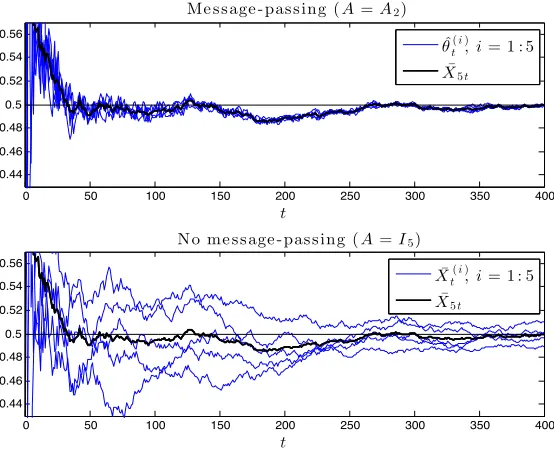
Figure 1: Convergence of individual nodes’ estimates with and without message-passing.
Thus, a natural question arises: can the message-passing process be tapped to ensure that the individual estimates ˆθt(i) achieve statistical accuracy “close” to that of the gold standard ¯XN t? Figure 1 illustrates this pertinent question.
In the trials shown, i.i.d. uniform random variables on [0,1] are delivered online to N = 5 nodes, one to each at each time t. With message-passing (here,A=A2), each node aggregates the new data point with data it has seen previously and messages received from its nearest neighbors in the network. We see that all of the five nodes’ updates seem to converge with a performance comparable to that of the (unseen) global estimate ¯XN t to
the mean 0.5. In contrast, in the absence of message-passing (A =I5), individual nodes’ estimates do still converge to 0.5, but at a slower rate.
To deal with this question of statistical accuracy satisfactorily, we first need a criterion to compare the performance of θˆt with that of ¯XN t. Perhaps the most natural one is the
following ratio, which depends upon the matrix A:
τt(A) =
E( ¯XN t−θ)1
2 Ekθˆt−θ1k2
, t≥1.
The more this ratio is close to 1, the more the collaborative algorithm is statistically efficient, in the sense that its performance compares favorably to that of the centralized gold standard. In the remainder of the paper, we callτt(A) theperformance ratioat time t.
Of particular interest in our approach is the stochastic matrix A, which plays a crucial role in the analysis. Roughly, a good choice for A is one for which τt(A) is not too far
in the sense that no node should play a dominant role. To formalize this idea, we define the communication-complexity indexC(A) as the maximal indegree of the edges of the graphG associated withA, i.e., the maximal number of edges pointing to a node inG (by convention, self-loops are counted twice whenG is undirected). Essentially,Ais communication-efficient whenC(A) is small with respect toN or, more generally, whenC(A) = O(1) asN becomes large.
To provide some context,C(A) measures in a certain sense the “local” aspect of message exchanges induced by A. We have in mind node connection set-ups where C(A) is small, perhaps due to energy or bandwidth constraints in the system’s architecture, or when for privacy reasons data must not be sent to a central node. Indeed, a large C(A) roughly means that one or several nodes play centralized roles—precisely what we are trying to avoid. Furthermore, the decentralized networks we are interested in can be seen as being more autonomous than high-C(A) ones, in the sense that having few network connections means less things that can potentially break, as well as improved robustness due to the fact that the loss of one node does not lead to destruction of the whole system. As examples, the matrices A1 andA2 defined earlier haveC(A1) = 3 and C(A2) = 4, respectively, while the stochastic matrixA3 below hasC(A3) =N + 1:
A3 = 1 N
1 1 1 · · · 1 1 1
1 N −1
1 N −1
..
. ... ... ... ... ... ...
1 N −1
. (5)
Thus, from a network complexity point of view,A1 andA2 are preferable toA3 where node 1 has the flavor of a central command center.
Now, having definedτt(A) andC(A), it is natural to suspect that there will be some kind
of tradeoff between implementing a low-complexity message-passing algorithm (i.e., C(A) small) and achieving good asymptotic performance (i.e., τt(A)≈ 1 for large t). Our main
goal in the next few sections is to probe this intuition by analyzing the asymptotic behavior of τt(A) as t → ∞ under various assumptions on A. We start by proving that τt(A) ≤ 1
for all t ≥ 1, and give precise conditions on the matrix A under whichτt(A) → 1. Thus,
thanks to the benefit of inter-agent communication, the statistical accuracy of individual estimates may be asymptotically comparable to that of the gold standard, despite the fact that none of the agents in the network have access to all of the data. Indeed, as we shall see, this stunning result is possible even for low-C(A) matrices. The take-home message here is that the communication process, once cleverly designed, may “boost” the individual estimates, even in the presence of severe communication constraints. We also provide an asymptotic development ofτt(A), which offers valuable information on the optimal way to
design the communication network in terms of the eigenvalues ofA.
3. Convergence of the performance ratio
Recall that a stochastic square matrix A = (aij)1≤i,j≤N is irreducible if for every pair of
indicesiand j, there exists a nonnegative integer ksuch that (Ak)ij is not equal to 0. The
Proposition 1 We have N1 ≤τt(A)≤1 for allt≥1. In addition, if A is reducible, then
τt(A)≤1−
1
N + 1, t≥1.
It is apparent from the proof of the proposition (all proofs are found in Section 8) that the lower bound 1/N for τt(A) is achieved by taking A = IN, which is clearly the worst
choice in terms of communication. This proposition also shows that the irreducibility of A is a necessary condition for the collaborative algorithm to be statistically efficient, for otherwise there exists ε∈(0,1) such that τt(A)≤1−εfor all t≥1.
We recall from the theory of Markov chains (e.g., Grimmett and Stirzaker, 2001) that for a fixed agenti∈ {1, . . . , N}, the period ofiis the greatest common divisor of all positive integersksuch that (Ak)
ii>0. WhenAis irreducible, the period of every state is the same
and is called the period of A. The following lemma describes the asymptotic behavior of τt(A) as ttends to infinity.
Lemma 2 Assume thatA is irreducible, and letdbe its period. Then there exist projectors
Q1, . . . , Qd such that
τt(A)→
1
Pd
`=1kQ`k2
as t→ ∞.
The projectors Q1, . . . , Qd in Lemma 2 originate from the decomposition
Ak=
d X
`=1
λk`Q`+ X
γ∈Γ
γkQγ(k),
where λ1 = 1, . . . , λd are the eigenvalues of A (distinct) of unit modulus, Γ the set of
eigenvalues of A of modulus strictly smaller than 1, and Qγ(k) certain N ×N matrices
(see Theorem 8 in the proofs section). In particular, we see that τt(A) → 1 as t → ∞ if
and only if Pd
`=1kQ`k2 = 1. It turns out that this condition is satisfied if and only if A
is irreducible, aperiodic (i.e., d= 1), and bistochastic, i.e., PN
i=1aij =
PN
j=1aij = 1 for all (i, j)∈ {1, . . . , N}2. This important result is encapsulated in the next theorem.
Theorem 3 We have τt(A) → 1 as t → ∞ if and only if A is irreducible, aperiodic, and bistochastic.
Theorem 3 offers necessary and sufficient conditions for the communication matrixAto be asymptotically statistically efficient. Put differently, under the conditions of the theorem, the message-passing process conveys sufficient information to local computations to make individual estimates as accurate as the gold standard for large t. We again stress that this theorem is new and different from results obtained in the consensus literature. The theorem shows that one machine, on its own, if it is well-informed, does as good a job as a virtual central machine that has access to all the data.
In the context of multi-agent coordination, an example of such a communication network is the so-called (time-invariant) equal neighbor model (Tsitsiklis et al., 1986; Olshevsky and Tsitsiklis, 2011), in which
aij =
where
N(i) =j∈ {1, . . . , N}:aij >0
is the set of agents whose value is taken into account byi, and|N(i)|its cardinality. Clearly, the communication matrixA is stochastic, and also bistochastic as soon asAis symmetric (bidirectional model). Assuming in addition that the directed graph G associated with A is connected means thatAis irreducible. Moreover, ifaii>0 for somei∈ {1, . . . , N}, then
A is also aperiodic, so the conditions of Theorem 3 are fulfilled.
Another way to choose an irreducible, aperiodic, and bistochastic matrix on an undi-rected graph is by letting aij = 1/max(1 +d(i),1 +d(j)), whered(i) is the degree of node
i; following this,aii is set to that which is needed to make each row sum to 1.
It is also interesting to note that there exist low-C(A) matrices that meet the require-ments of Theorem 3. This is for instance the case of matrices A1 and A2 in (2) and (3), which are irreducible, aperiodic, and bistochastic, and satisfyC(A)≤4. Also note that the matrixA3in (5), though irreducible, aperiodic, and bistochastic, should be avoided because C(A3) =N+ 1.
We stress that the irreducibility and aperiodicity conditions are inherent properties of the graph G, not A, insofar as these conditions do not depend upon the actual values of the nonzero entries ofA. This is different for the bistochasticity condition, which requires knowledge of the coefficients of A. In fact, as observed by Sinkhorn and Knopp (1967), it is not always possible to associate such a bistochastic matrix with a given directed graph G. To be more precise, consider G= (gij)1≤i,j≤N, the transpose of the adjacency matrix
of the graph G—that is, gij ∈ {0,1} and gij = 1 ⇔ (j, i) ∈ E. Then G is said to have
total support if, for every positive element gij, there exists a permutation σ of {1, . . . , N}
such thatj=σ(i) andQN
k=1gkσ(k)>0. The main theorem of Sinkhorn and Knopp (1967) asserts that there exists a bistochastic matrix A of the form A =D1GD2, where D1 and D2 areN×N diagonal matrices with positive diagonals, if and only ifGhas total support. The algorithm to induceA fromGis called the Sinkhorn-Knopp algorithm. It does this by generating a sequence of matrices whose rows and columns are normalized alternately. It is known that the convergence of the algorithm is linear, and upper bounds have been given for its rate of convergence (e.g., Knight, 2008).
Nevertheless, if for some reason we face a situation where it is impossible to associate a bistochastic matrix with the graphG, Proposition 4 below shows that it is still possible to obtain information about the performance ratio, providedA is irreducible and aperiodic.
Proposition 4 Assume that A is irreducible and aperiodic. Then
τt(A)→
1
Nkµk2 as t→ ∞,
where µ is the stationary distribution of A.
To illustrate this result, take N = 2 and consider the graph G with (symmetric) adja-cency matrix11> (i.e., full communication). Various stochastic matrices may be associated withG, each with a certain statistical performance. For α >1 a given parameter, we may choose for example
Hα =
1 α
1 α−1 1 α−1
When α= 2, we haveτt(H2)→1 by Theorem 3. More generally, using Proposition 4, it is an easy exercise to prove that, as t→ ∞,
τt(Hα)→
α2 2 + 2(α−1)2.
We see that the statistical performance of the local estimates deteriorates as α becomes large, for in this case τt(Hα) gets closer and closer to 1/2. This toy model exemplifies the
role the stochastic matrix is playing as a “tuning parameter” to improve the performance of the distributed estimate.
4. Convergence rates
Theorem 3 gives precise conditions ensuring τt(A) = 1 + o(1), but does not say anything
about the rate (i.e., the behavior of the second-order term) at which this convergence occurs. It turns out that a much more informative limit may be obtained at the price of the mild additional assumption that the stochastic matrixA is symmetric (and hence bistochastic).
Theorem 5 Assume that A is irreducible, aperiodic, and symmetric. Let 1 > γ2 ≥ · · · ≥
γN >−1 be the eigenvalues of A different from1. Then
τt(A) =
1
1 +1tPN `=2
1−γ2t ` 1−γ2
` .
In addition, setting
S(A) =
N X
`=2 1
1−γ`2 and Γ(A) = max2≤`≤N|γ`|, we have, for allt≥1,
1−S(A)
t ≤τt(A)≤1− S(A)
t + Γ
2t(A)S(A)
t +
S(A)
t
2
.
Clearly, we thus have
t 1−τt(A)
→S(A) ast→ ∞.
The take-home message is that the smaller the coefficient S(A), the better the matrix A performs from a statistical point of view. In this respect, we note that S(A) ≥ N −
1 (uniformly over the set of stochastic, irreducible, aperiodic, and symmetric matrices). Consider the full-communication matrix
A0 = 1 N11
>
, (6)
roughly equivalent to a centralized algorithm and, as such, is considered inefficient from a computational point of view. On the other hand, intuitively, the amount of statistical information propagating through the network is large soS(A0) should be small. Indeed, it is easy to see that in this case,γ`= 0 for all`∈ {2, . . . , N}andS(A0) =N−1. Therefore, although complex in terms of communication,A0 is statistically optimal.
Remark 6 Interestingly, as pointed out by a referee, S(A) has a graph theoretic
interpre-tation as the Kemeny constant of the Markov chain A2, and may be written in terms of
hitting times. Consequently, for a number of graphs it is easy to compute—see Jadbabaie and Olshevsky (2015) for example.
For a comparative study of statistical performance and communication complexity of matrices, let us consider the sparser graph associated with the tridiagonal matrixA1defined in (2). With this choice,γ`= cos(`−N1)π (Fiedler, 1972), so that
S(A1) =
N−1
X
`=1 1 1−cos2 `π
N
= N 2
6 + O(N) asN → ∞. (7)
Thus, we lose a power ofN but now have lower communication complexity C(A1) = 3. Let us now consider the tridiagonal matrix A2 defined in (3). Noticing that 3A2 = 2A1 +IN, we deduce that for the matrix A2, γ` = 13 + 23cos(`−N1)π, 2 ≤ `≤ N. Thus, as
N → ∞,
S(A2) = N2
9 + O(N). (8)
By comparing (7) and (8), we can conclude that the matricesA1andA2, which are both low-C(A), are also nearly equivalent from a statistical efficiency point of view. A2is nevertheless preferable to A1, which has a larger constant in front of the N2. This slight difference may be due to the fact that most of the diagonal elements of A1 are zero, so that agents i∈ {2, . . . , N−1} do not integrate their current value in the next iteration, as happens for A2. Furthermore, for large N, the performance ofA1 and A2 are expected to dramatically deteriorate in comparison with those of A0, since S(A1) and S(A2) are proportional to N2, while S(A
0) is proportional toN.
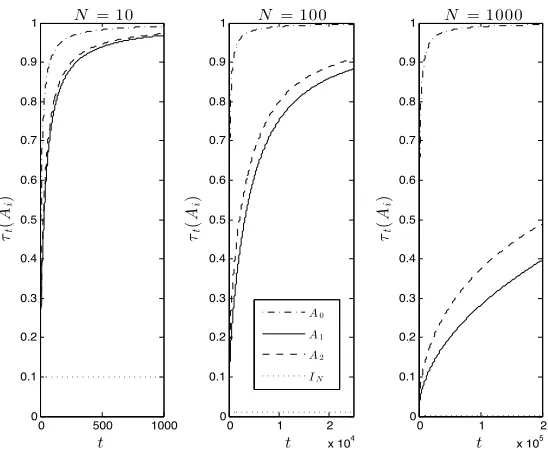
Figure 2 shows the evolution of τt(A) for N fixed and t increasing for the matrices
A=A0,A1,A2 as well as the identityIN. As expected, we see convergence ofτt(Ai) to 1,
with degraded performance as the number of agentsN increases. Also, we see that the lack of message-passing for IN means it is statistically inefficient, with constant τt(IN) = 1/N
for all t.
The discussion and plots above highlight the crucial influence of S(A) on the perfor-mance of the communication network. Indeed, Theorem 5 shows that the optimal order for S(A) isN, and that this scaling is achieved by the computationally-inefficient choiceA0— see (6). Thus, a natural question to ask is whether there exist communication networks that have S(A) proportional to N and, simultaneously, C(A) constant or small with respect to N. These two conditions, which are in a sense contradictory, impose that the absolute values of the non-trivial eigenvalues γ` stay far from 1, while the maximal indegree of the
0 500 1000 0
0.1 0.2 0.3 0.4 0.5 0.6 0.7 0.8 0.9 1
τ
t
(
A
i
)
t
N = 10
0 1 2
x 104 0
0.1 0.2 0.3 0.4 0.5 0.6 0.7 0.8 0.9 1
t
τ
t
(
A
i
)
N = 100
A0
A1
A2
IN
0 1 2
x 105 0
0.1 0.2 0.3 0.4 0.5 0.6 0.7 0.8 0.9 1
τ
t
(
A
i
)
t N = 1000
Figure 2: Evolution ofτt(Ai) withtfor different values ofN, forA=A0,A1,A2, andIN.
5. Ramanujan graphs
In this section, we considerundirectedgraphsG = (V,E) that are alsod-regular, in the sense that all vertices have the same degree d; that is each vertex is incident to exactly dedges. Recall that in this definition, self-loops are counted twice and multiple edges are allowed. However, in what follows, we restrict ourselves to graphs without self-loops and multiple edges. In this setting, the natural (bistochastic) communication matrix A associated with G is A = 1dG, where G = (gij)1≤i,j≤N is the adjacency matrix of G (gij ∈ {0,1} and
gij = 1⇔(i, j)∈E). Note thatC(A) =d.
The matrix G is symmetric and we let d = µ1 ≥ µ2 ≥ · · · ≥ µN ≥ −d be its (real)
eigenvalues. Similarly, we let 1 = γ1 ≥ γ2 ≥ · · · ≥ γN ≥ −1 be the eigenvalues of A,
with the straightforward correspondence γi = µi/d. We note that A is irreducible (or,
equivalently, that G is connected) if and only if d > µ2 (see, e.g., Shlomo et al., 2006, Section 2.3). In addition, A is aperiodic as soon as µN > −d. According to the
Alon-Boppana theorem (Nilli, 1991) one has, for every d-regular graph,
µ2 ≥2√d−1−oN(1),
where the oN(1) term is a quantity that tends to zero for every fixeddasN → ∞. Moreover,
a d-regular graph G is called Ramanujan if
max |µ`|:µ` < d
≤2√d−1.
expander graphs, which have the apparently contradictory features of being both highly connected and at the same time sparse (for a review, see Shlomo et al., 2006).
Although the existence of Ramanujan graphs for any degree larger than or equal to 3 has been recently established by Marcus et al. (2015), their explicit construction remains difficult to use in practice. However, a conjecture by Alon (1986), proved by Friedman (2008) (see also Bordenave, 2015) asserts that mostd-regular graphs are Ramanujan, in the sense that for every ε >0,
P
max |µ2|,|µN|
≥2√d−1 +ε→0 asN → ∞,
or equivalently, in terms of the eigenvalues of A,
P
max |γ2|,|γN|
≥ 2
√
d−1 d +ε
→0 asN → ∞.
In both results, the limit is along any sequence going to infinity with N d even, and the probability is with respect to random graphs uniformly sampled in the family of d-regular graphs with vertex setV ={1, . . . , N}.
In order to generate a random irreducible, aperiodicd-regular Ramanujan graph, we can first generate a random d-regular graph using an improved version of the standardpairing
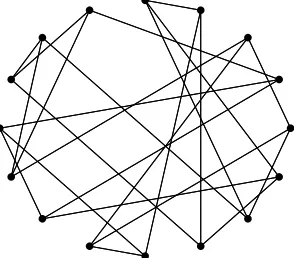
algorithm, proposed by Steger and Wormald (1999). We retain it if it passes the tests of being irreducible, aperiodic, and Ramanujan as described above. Otherwise, we continue to generate ad-regular graph until all these conditions are satisfied. Figure 3 gives an example of a 3-regular Ramanujan graph with N = 16 vertices, generated in this way.
Figure 3: Randomly-generated 3-regular Ramanujan graph withN = 16 vertices.
Now, given an irreducible and aperiodic communication matrix A associated with a d-regular Ramanujan graphG, we have, wheneverd≥3,
S(A)≤ N −1
1−4(dd−21)
.
full-communication matrix A0, which has S(A0) = N −1 but inadmissible complexity C(A0) =N+ 1.
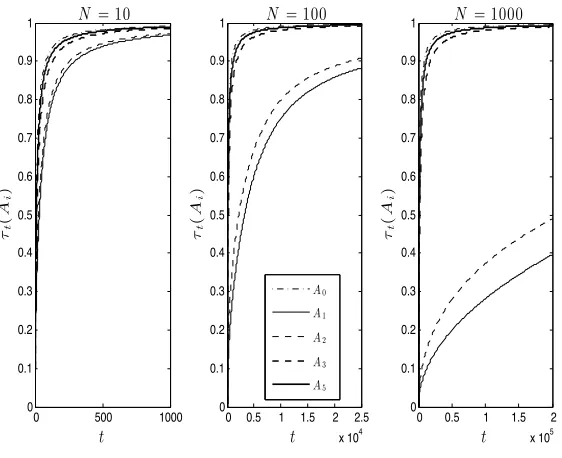
The statistical efficiency of these graphs is further highlighted in Figure 4. It shows results for 3- and 5-regular Ramanujan-type matrices (A3 and A5) as well as the previous results for non-Ramanujan-type matrices A0,A1, andA2 (see Figure 2).
0 0.5 1 1.5 2 x 10⁵ 0
0.1 0.2 0.3 0.4 0.5 0.6 0.7 0.8 0.9 1
τ
t
(
A
i
)
t N = 1000
0 500 1000
0 0.1 0.2 0.3 0.4 0.5 0.6 0.7 0.8 0.9 1
τ
t
(
A
i
)
t
N = 10
0 0.5 1 1.5 2 2.5 x 10⁴ 0
0.1 0.2 0.3 0.4 0.5 0.6 0.7 0.8 0.9 1
t
τ
t
(
A
i
)
N = 100
A0
A1
A2
A3
A5
Figure 4: Evolution of τt(Ai) witht for different values ofN, forA=A0,A1,A2 as before with the addition of 3- and 5-regular Ramanujan-type matricesA3 and A5.
We see that A3 is already close to the statistical performance of A0, the saturated network, and for all intents and purposes A5 is essentially as good as A0, even when there are N = 1000 nodes; i.e., the statistical performance of the 5-regular Ramanujan graph is barely distinguishable from that of the totally connected graph! Nevertheless, we must not forget that the possibility of building such efficient networks in real-world situations will ultimately depend on the specific application, and may not always be possible.
Next, assuming that the Ramanujan-type matrix A is irreducible and aperiodic, it is apparent that there is a compromise to be made between the communication complexity of the algorithm (as measured by the degree index C(A) =d) and its statistical performance (as measured by the coefficientS(A)). Clearly, the two are in conflict. Upon this a question arises: is it possible to reach a compromise in the range of statistical performances S(A) while varying the communication complexity between d = 3 and d = N? The answer is affirmative, as shown in the following simulation exercise.
We fix N = 200 and then for eachd= 3, . . . , N:
(ii) Compute the (non-unitary) eigenvalues γ(2d), . . . , γN(d) of the matrix Ad and evaluate
the sum
S(Ad) = N X
`=2 1
1− γ`(d)2.
(iii) Plot S(Ad) and βC(Ad) = βd as well as penalized sums S(Ad) +βC(Ad) for β ∈ {1/2,1,2,4}, whereβrepresents an explicit cost incurred when increasing the number of connections between nodes.
Results are shown in Figure 5, whered?refers to thedfor which the penalized sumS(Ad)+
βC(Ad) is minimized.
0 20 40
0 50 100 150 200 250 300 350 400
d
β = 1/2, d⋆= 20
0 20 40
0 50 100 150 200 250 300 350 400
d
β = 1, d⋆= 14
0 20 40
0 50 100 150 200 250 300 350 400
d
β = 2, d⋆= 10
0 20 40
0 50 100 150 200 250 300 350 400
d
β = 4, d⋆= 7
S(Ad)
βC(Ad) S +βC
Figure 5: Statistical efficiency vs communication complexity tradeoff for four different node communication penaltiesβ. d? is the dwhich minimizesS(A
d) +βC(Ad).
We observe that S(Ad) is decreasing whereas C(Ad) increases linearly. The tradeoff
between statistical efficiency and communication complexity can be seen as minimizing their penalized sum, where β for example represents a monetary cost incurred by adding new network connections between nodes. We see that the optimal d? and thus the number of node connections decreases as the cost of adding new ones increases.
Next, let us investigate the tradeoffs involved in the case where we have a large but fixed total numberT of data to be streamed toN nodes, each receiving one new data value from timet= 1 to timet=T /N. In this context, the natural question to ask is how many nodes should we choose, and how much communication should we allow between them in order to get “very good” results for a “low” cost? Here a low cost comes from both limiting the number of nodes as well as the number of connections between them.
In the same set-up for Ad defined above, one way to look at this is to ask, for each
C(Ad) =dfor which the performance ratioτt(Ad) is at least 0.99 after receiving all the data,
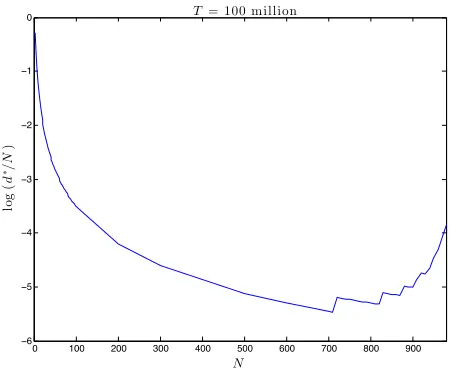
i.e., whent=T /N? Then, as there is also a cost associated with increasingN, minimizing C(Ad?)/N (where d? is this smallest dchosen) should help us choose the number of nodes N and the amount of connection C(Ad?) between them. The result of this is shown in Figure 6 forT = 100 million data points.
0 100 200 300 400 500 600 700 800 900
−6
−5
−4
−3
−2
−1 0
lo
g
(
d
∗/N
)
N T= 100 million
Figure 6: Optimizing the number of nodes N and the level of communication d required between nodes to obtain a performance ratio τt(Ad) ≥ 0.99 given a large fixed
quantity of dataT.
The minimum is found at (N, d?) = (710,3), suggesting that with 100 million data
points, one can get excellent performance results (τt(Ad?) ≥ 0.99) for a low cost with around 700 nodes, each connected only to three other nodes! Increasing N further raises the cost necessary to obtain the same performance, both due to the price of adding more nodes, as well as requiring more connections between them: d? must increase to 4, 5, and so on.
6. Asynchronous models
some agents to compute faster and execute more iterations than others and allow commu-nication delays to be substantial.
Communication delays are incorporated into our model as follows. ForB a nonnegative integer, we assume that the last instant beforetwhere agentj sent a message to agentiis t−Bij, where Bij ∈ {0, . . . , B}. Put differently, recalling that ˆθt(i) is the estimate held by
agentiat timet, we have
ˆ
θt(+1i) = 1 t+ 1
N X
j=1
aij(t−Bij)ˆθ(t−j)Bij+ 1 t+ 1X
(i)
t+1, t≥1. (9)
Thus, at timet, when agent iuses the value of another agentj, this value is not necessarily the most recent one ˆθ(tj), but rather an outdated one ˆθ(t−j)B
ij, where Bij represents the communication delay. The time instants t−Bij are deterministic and, in any case, 0 ≤
Bij ≤B, i.e., we assume that delays are bounded. Notice that some of the valuest−Bij in
(9) may be negative—in this case, by convention we set ˆθ(tj−)B
ij = 0. Our goal is to establish a counterpart to Theorem 3 in the presence of communication delays. As usual, we set
ˆ
θt= (ˆθ(1)t , . . . ,θˆ
(N)
t )>.
Let κ(t) be the smallest ` such that for all (k0, . . . , k`) ∈ {1, . . . , N}`+1 satisfying Q`
j=1akj−1kj >0,we have
t−`− ` X
j=1
Bkj−1kj ≤B.
Observe that t−`−P`
j=1Bkj−1kj is the last time before twhen a message was sent from agentk0 to agent k` via k1, . . . , k`−1. Accordingly, κ(t) is nothing but the smallest number of transitions needed to return at a time instant earlier than B, whatever the path. We note that κ(t) is roughly of ordert, since
1
B+ 1 ≤lim inft→∞
κ(t)
t ≤lim supt→∞
κ(t) t ≤1.
From now on, it is assumed that A=A1, i.e., the irreducible, aperiodic, and symmetric matrix defined in (2). Besides its simplicity, this choice is motivated by the fact thatA1 is communication-efficient while its associated performance obeys
τt(A)≈1−
N2 6t
for largetand N. The main result of the section now follows.
Theorem 7 Assume that X is bounded and let A = A1 be defined as in (2). Then, as t→ ∞,
E
t
κ(t)θˆt−θ1
2 = O
1 t
.
perhaps at the expense of higher communication complexity. Second, a greater implemen-tation flexibility and tolerance to system failure and uncertainty. On the other hand, the powerful result of Theorem 7 comes at the price of assumptions on the transmission net-work, which essentially demand that communication delays Bij are time-independent. In
fact, we find that the introduction of delays considerably complicates the consistency anal-ysis ofτt(A) even for the simple case of the empirical mean. This unexpected mathematical
burden is due to the fact that the introduction of delays makes the analysis of the variance of the estimates quite complicated.
7. Conclusions and future work
This article has introduced new ideas which show how units collaborating among them-selves can “boost” the statistical properties of the individual estimates by appropriately sharing information. Clearly, calculating the mean is a “simple” task with respect to cur-rent applications—our main motivation was to open a new front in this research direction. The obvious next step is to deal with more realistic problems in maximum likelihood, pre-diction, and learning.
As kindly pointed out by a referee, casting the problem using a single irreducible and aperiodic matrix A is a much more constrained approach than simply asking what are “good” communication schemes on a given graph and lettingA be random and depend on t, i.e., At. In this more general case, we could have many more zeros than the graph’s
adjacency matrix, the case of random pairwise gossip being an example. There may be interesting choices of At that lead to good convergence properties. This is a promising
direction for future research.
8. Proofs
We start this section by recalling the following important theorem, whose proof can be found for example in Foata and Fuchs (2004, Theorems 6.8.3 and 6.8.4). Here and elsewhere, A stands for the stochastic communication matrix.
Theorem 8 Let λ1, . . . , λd be the eigenvalues of A of unit modulus (withλ1 = 1) and Γ be
the set of eigenvalues of A of modulus strictly smaller than 1.
(i) There exist projectorsQ1, . . . , Qd such that, for all k≥N,
Ak=
d X
`=1
λk`Q`+ X
γ∈Γ
γkQγ(k),
where the matrices {Qγ(k) : k ≥ N, γ ∈ Γ} satisfy Qγ(k)Qγ0(k0) = Qγ(k+k0) if
γ =γ0, and 0 otherwise. In addition, for all γ ∈Γ, limk→∞γkQγ(k) = 0.
(ii) The sequence (Ak)k≥0 converges in the Ces`aro sense to Q1, i.e., 1
t
t X
k=0
8.1 Proof of Proposition 1
According to (4), since Ak is a stochastic matrix, we have
ˆ
θt−θ1=
1 t
t−1
X
k=0
Ak(Xt−k−θ1).
Therefore, it may be assumed, without loss of generality, that θ= 0. Thus,
τt(A) =
EX¯N t1
2 Ekθˆtk2
.
Next, letAk = (a(k)
ij )1≤i,j≤N. Then, for each i∈ {1, . . . , N},
ˆ θ(ti) = 1
t
t−1
X
k=0
N X
j=1
aij(k)Xt(−j)k, t≥1.
By independence of the samples,
E θˆ(ti) 2
= σ 2 t2
t−1
X
k=0
N X
j=1
a(ijk)2
.
Upon noting that E( ¯XN t)2 = σ 2
N t, we get
τt(A) =
NE X¯N t 2
E θˆ(1)t 2
+· · ·+E θˆ(tN) 2
= Pt−1t
k=0kAkk2 .
Since each Ak is a stochastic matrix, kAkk2 ≤N and, by the Cauchy-Schwarz inequality,
kAkk ≥ 1. Thus, N1 ≤ τt(A) ≤ 1, the lower bound being achieved when A is the identity
matrix.
Let us now assume that A is reducible, and let C ({1, . . . , N} be a recurrence class.
Arguing as above, we obtain that for alli∈C,
E θˆt(i) 2
= σ 2 t2
t−1
X
k=0
N X
j=1
a(ijk)2
≥ σ
2 t2
t−1
X
k=0
X
j∈C
a(ijk)2
.
Since C is a recurrence class, the restriction of A to entries in C is a stochastic matrix as well. Thus, settingN1 =|C|, by the Cauchy-Schwarz inequality,
E θˆ(ti) 2
≥ (
σ2
tN1 ifi∈C σ2
To conclude,
τt(A) =
σ2/t
P
i∈CE θˆ
(i)
t 2
+P
i /∈CE θˆ
(i)
t 2
≤ 1
1 + (N−N1)/N
≤ N
N + 1, sinceN −N1 ≥1.
8.2 Proof of Lemma 2
As in the previous proof, we assume thatθ= 0. Recall that
ˆ
θt=
1 t
t−1
X
k=0
AkXt−k, t≥1.
Thus, for all t≥1,
Ekθˆtk2 =
1 t2E
t−1
X
k=0
AkXt−k 2 = 1 t2
t−1
X
k=0
EkAkXt−kk2
(by independence ofX1, . . . ,Xt)
= 1 t2EX
>
1
t−1 X
k=0
(Ak)>Ak
X1.
Denote by λ1 = 1, . . . , λd the eigenvalues of A of modulus 1, and let Γ be the set of
eigenvaluesγ ofA of modulus strictly smaller than 1. According to Theorem 8, there exist projectorsQ1, . . . , Qd and matricesQγ(k) such that for all k≥N,
Ak=
d X
`=1
λk`Q`+ X
γ∈Γ
γkQγ(k).
Therefore,
t−1
X
k=0
(Ak)>Ak=
t−1
X
k=0
( ¯Ak)>Ak
=
t−1
X k=0 d X `=1 ¯ λk`Q¯`+
X
γ∈Γ ¯ γkQ¯γ(k)
> d X
j=1
λkjQj+ X
γ∈Γ
γkQγ(k)
=
t−1
X k=0 d X `,j=1 ¯
Here, we have used Ces`aro’s lemma combined with the fact that, by Theorem 8, for any γ ∈Γ, limk→∞γkQγ(k) = 0.
Since A is irreducible, according to the Perron-Frobenius theorem (e.g., Grimmett and Stirzaker, 2001, page 240), we have that λ` =e
2πi(`−1)
d , 1≤`≤d. Accordingly, ¯
λ`λj =e 2πi(j−`)
d = 1⇔j=`. Thus,
t−1
X
k=0
(Ak)>Ak=t
d X
`=1 ¯
Q>` Q`+ O(1) + o(t).
LettingQ=Pd
`=1Q¯>` Q`, we obtain
tEkθˆtk2 =EX>1QX1+EX>1
1 t
t−1
X
k=0
(Ak)>Ak−Q
X1 (10)
=EX>1QX1+ o(1) =
d X
`=1
EkQ`X1k2+ o(1). Denoting byQ`,ij the (i, j)-entry ofQ`, we conclude
tEkθˆtk2 = d X
`=1 E
N X
i=1
N
X
j=1 Q`,ijX
(j) 1
2
+ o(1)
=σ2
d X
`=1
N X
i,j=1
Q2`,ij+ o(1)
(by independence ofX1(1), . . . , X1(N)) =σ2
d X
`=1
kQ`k2+ o(1).
Lastly, recalling thatEkX¯N t1k2 = σ 2
t , we obtain
τt(A) =
1
Pd
`=1kQ`k2+ o(1)
= Pd 1
`=1kQ`k2
+ o(1).
8.3 Proof of Theorem 3
Sufficiency. Assume that A is irreducible, aperiodic, and bistochastic. The first two conditions imply that 1 is the unique eigenvalue ofAof unit modulus. Therefore, according to Lemma 2, we only need to prove that the projectorQ1 satisfieskQ1k= 1.
Since Ais bistochastic, its stationary distribution is the uniform distribution on the set
{1, . . . , N}. Moreover, sinceA is irreducible and aperiodic, we have, ask→ ∞,
Ak→ 1
N
1 1 . . . 1 ..
. ... ... ... 1 1 . . . 1
By comparing this limit with that of the second statement of Theorem 8, we conclude by Ces`aro’s lemma that
Q1 = 1 N
1 1 . . . 1 ..
. ... ... ... 1 1 . . . 1
.
This implies in particular thatkQ1k= 1.
Necessity. Assume that τt(A) tends to 1 as t → ∞. According to Proposition 1, A
is irreducible. Thus, by Lemma 2, we have Pd
`=1kQ`k2 = 1. Observe, since each Q` is
a projector, that kQ`k ≥ 1. Therefore, the identity Pd`=1kQ`k2 = 1 implies d = 1 and kQ1k= 1. We conclude thatA is aperiodic.
Then, since Ais irreducible and aperiodic, we have, as k→ ∞,
Ak→
µ
.. .
µ
,
where µis the stationary distribution of A, represented as a row vector. Comparing once again this limit with the second statement of Theorem 8, we see that
Q1 =
µ
.. .
µ
.
Thus,kQ1k2 =Nkµk2 = 1. In particular, lettingµ= (µ1, . . . , µ
N), we have
N
N X
i=1 µ2i =
N X
i=1 µi.
This is an equality case in the Cauchy-Schwarz inequality, from which we deduce that µ
is the uniform distribution on {1, . . . , N}. Sinceµ is the stationary distribution ofA, this implies thatA is bistochastic.
8.4 Proof of Proposition 4
If A is irreducible and aperiodic, then by Lemma 2, τt(A) → kQ11k2 as t → ∞. But, as
k→ ∞,
Ak→
µ
.. .
µ
,
8.5 Proof of Theorem 5
Without loss of generality, assume that θ = 0. Since A is irreducible and aperiodic, the matrixQin the proof of Lemma 2 isQ=Q>1Q1. Moreover, sinceA is also bistochastic, we have already seen that as k→ ∞,
Ak→ 1
N
1 1 . . . 1 ..
. ... ... ... 1 1 . . . 1
. (11)
However, by the second statement of Theorem 8, the above matrix is equal to Q1. Thus, the projector Q1 is symmetric, which impliesQ=Q1.
Next, we deduce from (10) that
τt(A) =
σ2 EX>1QX1+EX>1 1t
Pt−1
k=0(Ak)>Ak−Q
X1
= σ
2 σ2+EX>
1 1t Pt−1
k=0A2k−Q
X1
, (12)
by symmetry ofA and the fact thatEX>1QX1 =σ2. The symmetric matrixA can be put into the form
A=U DU>,
whereU is a unitary matrix with real entries (so, U>=U−1) andD= diag(1, γ2, . . . , γN),
with 1> γ2≥ · · · ≥γN >−1. Therefore, as k→ ∞,
1 t
t−1
X
k=0
A2k=U
1 t
t−1
X
k=0 D2k
U>→U
1 0 . . . 0 0 0 . . . 0
..
. ... ... ... 0 0 . . . 0
U>.
However, by (11) and Ces`aro’s lemma,
1 t
t−1
X
k=0
A2k→Q ask→ ∞.
It follows that Q=U M U>, where
M =
1 0 . . . 0 0 0 . . . 0
..
. ... ... ... 0 0 . . . 0
Thus,
1 t
t−1
X
k=0
A2k−Q=U
1 t
t−1
X
k=0
D2k−M
U> =U 1 t
t−1
X
k=0
diag 0, γ22k, . . . , γN2k
U>
=Udiag
0,1 t
1−γ2t
2 1−γ22, . . . ,
1 t
1−γN2k 1−γN2
U>.
Next, set
α`=
1 t
1−γ`2t 1−γ2
`
, 2≤`≤N,
and letU = (uij)1≤i,j≤N. With this notation, the (i, j)-entry of the matrix 1tPtk−=01 A2k−Q
is
N X
`=2
ui`α`uj`.
Hence,
X>1
1 t
t−1
X
k=0
A2k−Q
X1 =
N X
i=1 X1(i)
N X j=1 N X `=2
ui`α`uj`
X1(j). Thus,
EX>1
1 t
t−1
X
k=0
A2k−Q
X1=σ2
N X i=1 N X `=2
ui`α`ui`
=σ2
N X i=1 N X `=2 α`u2i`
=σ2
N X `=2 α` = σ 2 t N X `=2
1−γ`2t 1−γ`2. We conclude from (12) that
τt(A) =
1
1 +1tPN `=2
1−γ2t ` 1−γ2
` .
This shows the first statement of the theorem. Using the inequality 1+1x ≥1−x, valid for all x≥0, we have
τt(A)≥1−
1 t
N X
`=2
1−γ`2t 1−γ2
`
≥1−S(A)
Finally, evoking the inequality 1+1x ≤1−x+x2, valid for all x≥0, we conclude
τt(A)≤1−
1 t
N X
`=2
1−γ2t `
1−γ2
`
+
1 t
N X
`=2
1−γ2t `
1−γ2
`
2
≤1− S(A)
t + Γ
2t(A)S(A)
t +
S(A)
t
2
.
8.6 Proof of Theorem 7
From now on, we fix k0 ∈ {1, . . . , N} and let Zt(i) =tθˆ
(i)
t for anyi∈ {1, . . . , N}. Thus, for
all t≥1,
Z(k0)
t =
N X
k=1 ak0kZ
(k)
t−Bk0k−1+X (k0)
t ,
and
Z(k0)
t =
N X
k1,k2=1
ak0k1ak1k2Z
(k2)
t−Bk0k1−Bk1k2−2+ N X
k1=1
ak0k1X
(k1)
t−Bk0k1−1+X
(k0)
t . (13)
Our first task is to iterate this formula. To do so, we need additional notation. For ` a positive integer and k∈ {1, . . . , N}, letK`(k) be the set of vectors in{1, . . . , N}`+1 of the form (k0, k1, . . . , k`−1, k) such thatw(K`(k))>0, where
w K`(k)=ak0k1ak1k2. . . ak`−2k`−1ak`−1k.
In particular, by our choice of A, we have w(K`(k)) = 2−` for any k. Next, we set
∆ K`(k)=`+Bk0k1 +Bk1k2 +· · ·+Bk`−2k`−1+Bk`−1k.
When ` = 0, then by convention K0(k) = (k0), w(K0(k)) = 1 if k =k0 and 0 otherwise, and ∆(K0(k)) = 0.
We are now ready to iterate (13). To do so, observe that
Z(k0)
t =
N X
k=1
X
Kκ(t)(k)
w Kκ(t)(k)Z(k)
t−∆(Kκ(t)(k))
+
κ(t)−1
X
`=0
N X
k=1
X
K`(k)
w K`(k)
X(k)
t−∆(K`(k))
def
=Rt1+R2t. (14)
By the definition of κ(t), for all k∈ {1, . . . , N},t−∆(Kκ(t)(k))≤B. Since X is bounded, we deduce that there existsC >0 such that
|R1t| ≤C
N X
k=1
X
Kκ(t)(k)
This implies that|R1t| ≤C. To see this, note thatAκ(t) is a stochastic matrix and that for all k∈ {1, . . . , N},
X
Kκ(t)(k)
w Kκ(t)(k)
= (Aκ(t))k0k.
The analysis of the term Rt2 is more delicate. The difficulty arises from the fact that this term is not a sum of independent random variables, and therefore its components must be grouped. Since eachBij is smaller thanB and ∆(K`(k)) =x implies x≥`, we obtain
R2t =
κ(t)−1
X
`=0
N X
k=1 (B+1)`
X
x=0
X
K`(k):∆(K`(k))=x
w K`(k)Xt(−k)x
=
(B+1)(κ(t)−1)
X x=0 N X k=1 x X
`=bx/(B+1)c+1
X
K`(k):∆(K`(k))=x
w K`(k)
Xt(−k)x
(b·c is the floor function). By independence of theXj(i), we get
Var(R2t) =σ2
(B+1)(κ(t)−1)
X x=0 N X k=1 x X
`=bx/(B+1)c+1
X
K`(k):∆(K`(k))=x
w K`(k)
2
.
Recalling that w(K`(k)) = 2−`, we obtain
Var(R2t) =σ2
(B+1)(κ(t)−1)
X x=0 N X k=1 x X
`=bx/(B+1)c+1 1 2`
K
`(k) : ∆ K`(k)
=x 2 .
Next, consider the Markov chain (Yn)n≥0 with transition matrix A such that Y0 = k0. Observe that
P
Y` =k, ` X
j=1
BYj−1Yj =x−`
= 1 2` K
`(k) : ∆ K`(k)
=x
.
Moreover, for fixedx, the events
`
X
j=1
BYj−1Yj =x−`
, j x B+ 1
k
+ 1≤`≤x,
are disjoint since the Bij are nonnegative. Thus,
x X
`=bx/(B+1)c+1 1 2`
K
`(k) : ∆ K`(k)
=x
≤1,
and so,
Var(Rt2)≤σ2
(B+1)(κ(t)−1)
X
x=0
N X
k=1
1 =σ2N (B+ 1)κ(t)−B
The expectation ofR2t is easier to compute. Indeed, since eachA` is a stochastic matrix,
ERt2=θ κ(t)−1
X
`=0
N X
k=1
X
K`(k)
w K`(k)=θ
κ(t)−1
X
`=0
N X
k=1
(A`)k0k=θκ(t).
Combining (14), (15), and the fact that|R1t| ≤C, we obtain
E
t κ(t)θˆ
(k0)
t −θ
2
=E
R1t κ(t) +
R2t κ(t) −θ
2
=E
R2t −ER2t κ(t) +
R1t κ(t)
2
= O
1 κ(t)
.
The result follows from the identity 1/κ(t) = O(1/t).
Acknowledgments
G´erard Biau would like to acknowledge support for this project from the Institut univer-sitaire de France. The authors also thank the Action Editor and two referees for valuable comments and insightful suggestions, which led to a substantial improvement of the paper.
References
N. Alon. Eigenvalues and expanders. Combinatorica, 6:83–96, 1986.
D.P. Bertsekas and J.N. Tsitsiklis. Parallel and Distributed Computation: Numerical Meth-ods. Athena Scientific, Belmont, 1997.
P. Bianchi, G. Fort, W. Hachem, and J. Jakubowicz. Convergence of a distributed parameter estimator for sensor networks with local averaging of the estimates. InProceedings of the
36th IEEE International Conference on Acoustics, Speech and Signal Processing, 2011a.
P. Bianchi, G. Fort, W. Hachem, and J. Jakubowicz. Performance analysis of a distributed Robbins-Monro algorithm for sensor networks. InProceedings of the 19th European Signal
Processing Conference, 2011b.
P. Bianchi, S. Cl´emen¸con, J. Jakubowicz, and G. Morral. On-line learning gossip algo-rithm in multi-agent systems with local decision rules. In Proceedings of the 2013 IEEE
International Conference on Big Data, 2013.
V.D. Blondel, J.M. Hendrickx, A. Olshevsky, and J.N. Tsitsiklis. Convergent in multiagent coordination, consensus, and flocking. In Proceedings of the Joint 44th IEEE Conference
on Decision and Control and European Control Conference, 2005.
S. Boyd, A. Ghosh, B. Prabhakar, and D. Shah. Randomized gossip algorithms. IEEE
Transactions on Information Theory, 52:2508–2530, 2006.
J.C. Duchi, A. Agarwal, and M.J. Wainwright. Dual averaging for distributed optimization: Convergence analysis and network scaling. IEEE Transactions on Automatic Control, 57: 592–606, 2012.
M. Fiedler. Bounds for eigenvalues of doubly stochastic matrices. Linear Algebra and Its Applications, 5:299–310, 1972.
D. Foata and A. Fuchs.Processus Stochastiques : Processus de Poisson, Chaˆınes de Markov
et Martingales. Dunod, Paris, 2004.
P.A. Forero, A. Cano, and G.B. Giannakis. Consensus-based distributed support vector machines. Journal of Machine Learning Research, 11:1663–1707, 2010.
J. Friedman.A Proof of Alon’s Second Eigenvalue Conjecture and Related Problems, volume 195 ofMemoirs of the American Mathematical Society. American Mathematical Society, Providence, 2008.
G.R. Grimmett and D.R. Stirzaker. Probability and Random Processes. Third Edition. Oxford University Press, Oxford, 2001.
A. Jadbabaie and A. Olshevsky. On performance of consensus protocols subject to noise: Role of hitting times and network structure. arXiv:1508.00036, 2015.
M.I. Jordan. On statistics, computation and scalability. Bernoulli, 19:1378–1390, 2013.
P.A. Knight. The Sinkhorn-Knopp algorithm: Convergence and applications.SIAM Journal
on Matrix Analysis and Applications, 30:261–275, 2008.
A.W. Marcus, D.A. Spielman, and N. Srivastava. Interlacing families I: Bipartite Ramanujan graphs of all degrees. Annals of Mathematics, 182:307–325, 2015.
G. Mateos, J.A. Bazerques, and G.B. Giannakis. Distributed sparse linear regression.IEEE
Transactions on Signal Processing, 58:5262–5276, 2010.
A. Nilli. On the second eigenvalue of a graph. Discrete Mathematics, 91:207–210, 1991.
A. Olshevsky and J.N. Tsitsiklis. Convergence speed in distributed consensus and averaging.
SIAM Review, 53:747–772, 2011.
J.B. Predd, S.R. Kulkarni, and H.V. Poor. A collaborative training algorithm for distributed learning. IEEE Transactions on Automatic Control, 55:1856–1871, 2009.
H. Shlomo, N. Linial, and A. Wigderson. Expander graphs and their applications. Bulletin
of the American Mathematical Society, 43:439–561, 2006.
R. Sinkhorn and P. Knopp. Concerning nonnegative matrices and doubly stochastic
A. Steger and N.C. Wormald. Generating random regular graphs quickly. Combinatorics,
Probability and Computing, 8:377–396, 1999.
J.N. Tsitsiklis, D.P. Bertsekas, and M. Athans. Distributed asynchronous deterministic and stochastic gradient optimization algorithms. IEEE Transactions on Automatic Control, 31:803–812, 1986.