Debendra Bhandari, Zhou Jianhua (Correspondence)
[email protected], [email protected]
+This article is published under the terms of the Creative Commons Attribution License 4.0 Author(s) retain the copyright of this article. Publication rights with Alkhaer Publications. Published at: http://www.ijsciences.com/pub/issue/2017-03/
DOI: 10.18483/ijSci.1214; Online ISSN: 2305-3925; Print ISSN: 2410-4477
Household Dependency on Buffer Zone
Community Forest and its Implication for
Management of Chitwan National Park, Nepal
Debendra Bhandari
1
, Zhou Jianhua
1
1
School of Economics and Management, Beijing Forestry University, No (35), Qinghua East Road, Haidian District, Beijing, P.R. China, Post code –100083
Abstract: Conservation of biodiversity in Protected Areas will be more challenging if local communities are heavily dependent on them for various forest products and subsistence needs. Thus this study sought to identify the demographic and socioeconomic variable that influence forest dependency exploring the relationship of forest dependency and household characteristics of the households of the Panbari Buffer Zone Community Forest User Group of Chitwan National Park, Nepal. A sample of 130 households was randomly selected for the household survey using stratified random sampling and collected was analyzed using logistic regression model. Logistic regression result indicate that wealth status of the poor household, household family size, livestock population, agricultural income and education are the five major determinants of forest dependency in Panbari Buffer Zone Community Forest. Policy interventions to ensure long-term success of landscape-level conservation of Chitwan National Park are needed to decrease dependence on forest resources expanding educational and training opportunities; and the policy measures that aim at increasing agriculture income, generating off-farm employment opportunities, supply of the alternatives of fuel wood energy and adopting agrisilvicultural system for the supply of fodder for the livestock.
Keywords: Buffer Zone Community Forest, Chitwan National Park, forest dependency, logistic regression, Nepal
1. Introduction
Forest dependency of the human beings is a multifaceted phenomenon due to the fact that forests provide a diverse stream of benefits to humans such as timber, fuel wood, fodder, non-timber forest products (NTFPs), recreational experience as a direct benefits and also depends upon forests indirectly for things such as biodiversity, air and water quality, carbon sequestration, and other ecological services (Beckley 1998, Masozera 2002, Adam and EL Tayeb 2014). In many developing countries, the households’ dependency on the forest resources has motivated the policy makers to decentralize the approach of forest management to the evolution of community forestry (CF) as the dominant forest management strategy (Rai et al. 2016). CF has a significant contribution to the improvement of environmental conditions in degraded areas and enhancing the livelihoods of forest dependent communities (Baland and Platteau 1999, Shrestha et al. 2010, Pandit and Bevilacqua 2011). Thus adopting the CF management strategy, Nepal is now regarded as one of the world’s leading examples of successful community-based forest
management after the decades of deforestation in later of the twentieth century (Gautam et al. 2004, Dhakal and Masuda 2008, Gurung et al. 2011, Pokharel et al. 2012). As a result, 35 percent of the population of Nepal is involved in community forestry management program: managing 1.81 million hectares of forest by 19,361 Community Forestry User Groups (CFUGs) which has benefited 2.46 million households (DoF 2016).
http://www.ijSciences.com
Volume 6
– March
2017 (03
)
69
buffer zone management in Nepal was to develop apartnership between the park and the local people in biodiversity conservation with the forest resource use (CNP 2013). In Nepal, forest resource use and the conservation of the National Parks are well defined by National Parks and Wildlife Conservation Act of 1973; and Buffer Zone Management Regulation, 1996 and states that the ownership of the land of Buffer zone Community forest belongs to the Government of Nepal giving only the use rights to the buffer zone user groups (HMGN 1996). Moreover, these regulations enjoined participation and empowerment of local people for the conservation, management, and use of natural resources; and have tried to address the problems of people whose livelihoods are adversely affected by the parks/ reserves through community development. But, at present, BZCF is considered as additional habitat for wild animals that is viewed from the point of wildlife conservation aspect in which the programs directed towards the conservation of wildlife (CNP 2013) and gradually supporting the local people to meet their daily basic needs of fuel wood, fodder, grasses and other forest resources (Bhusal 2014).
Research studies related to the household surveys have revealed the higher dependency of the rural poor people on forest resources due to the fact that greater proportion of their total income comes from forest resources collection (Sunderlin et al. 2005, Bhandari and Uibrig 2008, Sapkota and Odén 2008). Similarly, Odihi (2003) noted that one cause of deforestation was the lack of alternative energy sources and high-profit margins from the fuel wood economy. Moreover, forests are promoted to improve the well- being of local communities (Elands et al. 2004), and large numbers of poor people have occupied extensive forest areas for their livelihoods for the use of forest resources in the tropics (Wunder 2001). In the context of Nepal, forests are intently related to the survival of the rural poor that fulfill the basic needs. Moreover, 65 percent of households are dependent on the forest resources for the collection of the firewood; and 43 percent households collect the fodder from the forest to feed their livestock’s (CBS 2011). The procurement of fuel wood for cooking and house heating accounts for 83% of the energy consumption and the dependency on timber and NTFPs exceeds 95% (Gautam 2006). Livestock rearing is highly reliable on the grazing and fodder collection which is traditionally practiced (FAO 2010). However, household dependency on the forest resources has an adverse impact on biodiversity; and extreme pressure on these resources which has resulted in the declination of the conservation and preservation of the resources (Parker and Thapa 2012). Therefore, preservation and conservation of biodiversity of protected areas has become complex and challenging in the sense that the local people are
more dependent on forest resources for energy, agriculture, nutritional, medicinal, and other subsistence needs (Adam and EL Tayeb 2014; Jain and Sajjad 2015 citing in Bahuguna 2000). So, governments are often strapped for resources to protect, conserve and sustainably use natural resources. In such situations, buffer zone with some level of use of forest resources from the protected areas can play an important role in ensuring natural resource conservation and develop positive response towards the conservation of protected areas.
Several studies have indicated that forest dependency varies across households and these households depend more or less on forest resources depending on their demographic and socioeconomic characteristics (Gunatilake 1998, Masozera and Alavalapati 2004, Adhikari et al. 2004, Baral and Heinen 2007, Panta et al. 2008, Lepetu et al. 2009, Bwalya 2011, Adam and EL Tayeb 2014, Jain and Sajjad 2015). Simultaneously, Pandey et al., 2014 reported that fodder collection from the forest showed that households are highly dependent on the forest resources, which may cause the degradation of forests and in that context, providing the policy options that focus on intensification of forest tree farming on farmland can reduce the dependency on the forest as fodder collection. In some instances, alternative sources of income and livelihood can reduce the dependency on the forest resources (Gunatilake 1998, Sapkota and Odén 2008, Fikir et al. 2016). New ERA (2004) incorporates that the environmental awareness classes taken at the local schools of the Buffer Zone areas had a positive impact and due to this awareness program, cleanliness in the household and community environment was improved; and households had prioritized for keeping a small size of livestock, stall feeding practice, tree plantation and bio-gas installation.
http://www.ijSciences.com
Volume 6
– March
2017 (03
)
70
CNP and its buffer zone (CNP 2013). Therefore it isessential to determine and examine the household socioeconomic variables of the local people living around the CNP with respect to the forest dependency so that management programs of buffer zone can be effectively implemented.
Thus, understanding the household different characteristics and relationships among local communities and their resource use patterns is supportive in designing management plans for the community-based management programs as well as to develop the conservation and development strategies (Gunatilake 1998, Masozera and Alavalapati 2004, Lepetu 2007, Lepetu et al. 2009, Jain and Sajjad 2015). In absence of the information about household forest dependency, any steps in the management of the buffer zone will have unwanted consequences and may constrain the positive outcome. Still needed, however, is a better understanding of how household dependency on the forest resources is associated with different demographic and socioeconomic variables which tend to solve the problem of the community level decision-making and, ultimately, landscape outcomes. Therefore, the identification of the factors affecting forest dependency is an initial step towards devising policies that are beneficial for an equitable sustainable resource management and conservation of biodiversity. Here, we describe the results of a household survey of Panbari Buffer Zone Community Forest User Group members of CNP in southern Nepal (Fig. 1). Our first research objective sought to identify the demographic and socioeconomic variable that influences supportive dependency on forest resources. Our second research objective explored the relationship of forest resource use (dependency) and household characteristics with the better implications for the conservation of Chitwan National Park.
2. Materials and methods
2.1 Study area
Chitwan National Park, established in 1973, is a UNESCO-designated World Heritage Site. CNP is especially renowned for its protection of Asian one-horned rhinoceros (Rhinoceros unicornis), Royal Bengal tiger (Panthera tigris), Gharial crocodile (Gavialis gangeticus) and Asian elephants (Elephas maximus). CNP and its Buffer Zone is situated in southern part of Central Nepal which spreads over 4 districts: Chitwan, Nawalparasi, Parsa and Makawanpur having the area of 932 km2 and an area of 750 km2 has surrounded the park as its buffer zone (CNP 2013, DNPWC 2016).
http://www.ijSciences.com
Volume 6
– March
2017 (03
)
71
Figure 1: The location of Chitwan National Park, its Buffer Zone and village sampled2.2 Data Collection
This study site: Panbari Buffer Zone Community Forest User Group (PBZCFUG) was selected based on three criteria i) The operational plan of this PBZCF was recently revised in 2015: 5 years operational plan approved by CNP and it was first handed over to User groups on 2009; ii) A socially complex site, but secure enough to carry out fieldwork; iii) Large numbers of forest-dependent households. The target population for this study is the user group members of PBZCF. In selecting the households to be sampled, stratified random sampling was used. To determine the relative economic status of each household of the PBZCFUG, a wealth ranking based on PRA technique was organized. The empirical validity of this method as a means of socioeconomic stratification of households has already been tested in CF-related research in Nepal (Richards et al. 1999). Wealth ranking of the total households was conducted with the user committee members along with the other key persons viz. school teachers and VDC leaders, which was involved in their respective settlements for this exercise. This type of category was also used by Dhakal and Masuda 2008; Dhital 2004; Sapkota and Odén 2008. Following the criteria provided by Sapkota and Odén (2008), this wealth ranking categorized the total households into 3 strata: rich (186 households), medium (392 households) and poor (271 households)
based on the calculation of landholding size, livestock unit, and off-farm income.
Based on the wealth ranking, a stratified random sampling was performed to draw the sample households for household survey in order to secure the representation of each economic class: rich, medium, poor. According to Neuman (1994), more than 10% sampling intensity for the moderately large population is valid for the social studies. Therefore, a total of 130 households: 30 rich, 59 medium and 41 poor households were randomly chosen at 15% sampling intensity and interviewed.
http://www.ijSciences.com
Volume 6
– March
2017 (03
)
72
Questions were asked to obtain information onhouseholds’ size; distance from the forests; residency of years; forest resource collection time and collected quantity; benefits of Buffer zone program; time contributed for different forest management activities; landholdings; production of different agriculture crops; number of livestock; major income sources; caste and ethnicity; and other issues related to household level of wildlife conflict. In addition, secondary data was collected from the BZCF records and government documents respectively.
2.3 Forest dependency model specifications The concept of forest dependency is focused on the degree of concentration of a particular forest based livelihood in a particular area (Illukpitiya 2006). Differences in forest dependency of the local people arises due to disparities in the socioeconomic conditions, values, beliefs, goals and preferences of the members of that community (Adhikari et al. 2004) and will not remain static over time, resulting in changing resource dependency over time (Cavendish 2000). Based on methods used by other researchers described previously, the proportion of income from the forest resource was used to estimate forest dependency. This relative value of resource dependency was used since it is easily calculated from information readily available from respondents, provides an acceptable indication of dependency and has been used in other studies such as by (Gunatilake 1998, Masozera and Alavalapati 2004, Baral and Heinen 2007, Chandool 2007, Lepetu et al. 2009, Adam and EL Tayeb 2014). Thus, dependency index as a forest dependency of households of the PBZCFUG was calculated as the ratio of annual income earned from forest to the total annual household income. Incomes are accounted by US$. During the field study in October 2016, the exchange rate of 1 US$ was equal to 106 Nepalese currency (NRs). The procedures that were followed to derive income from each source are explained below.
Household annual income
= ∑(Forest income + Farm income + Off farm income)
Forest income
Forest income as the benefit from the forest was calculated as the sum of the benefits got from forest management; forest products collection, buffer zone program or PBZCFUG support; and other benefits such as training and workshop allowance. Forest products collected from the forest were recorded for each household during the household survey. The collected forest products from the PBZCF were firewood, fodder, thatch grass, Sal (Shorea robusta) leaf, mushroom and sand/gravel/stone. The income was computed annually for marketable forest products—including firewood, sand/gravel/stone by
multiplying each item’s quantity by its market price. Time cost was taken into consideration for the calculation of income from non-traded forest products such as fodder for livestock, thatch grass, mushrooms and sal leaves. Following Rai et al. (2016), the value of time was estimated under two scenarios: (i) the market wage rate and (ii) the opportunity cost of time with the paid work. The time for each forest products collection was collected from the interview of each household. The opportunity cost of time may vary across the individuals within society. Therefore, in this calculation the opportunity cost of time was assumed to be 47% of the market wage rate based on the estimates of Rai and Scarborough (2013 & 2015). According to HMGN (1992) and ILO (2007), the standard amount of working hours per week is 48 and per day working hour is 8 hours with 1 day rest in a week. In addition, market wage rate of Nawalparasi district of the year 2016 was NRs 440. Thus the forest products collection time cost, as the income from the non-traded forest products was calculated by multiplying the 47 percent of the wage rate with total forest products collection days.
Farm income
Farm income includes the income from the agricultural crops and the livestock. Agricultural income includes cultivation of crops for purposes of both household consumption and selling. The quantity of crop yield was obtained from individual households through face-to-face interviews. In the absence of the local market, the price of each agricultural product was obtained from price as reported by the respondents. The annual household income from agriculture was computed as the product of the quantity of the agriculture crop yield and respective prices. Furthermore, the livestock income included the sales of the livestock and income from the products of livestock such as milk, egg.
Off farm income
Off farm income included the incomes from the business, salaried jobs, pension, wage labor, remittances. Wage labor in the study area is mostly in the agricultural activities. The wage rate and a number of working days/hours reported by the respondents are used in the estimation. Income from salaried jobs, pension, business, and remittances was also obtained from the respondents’ interview.
Coulibaly-http://www.ijSciences.com
Volume 6
– March
2017 (03
)
73
Lingani et al. 2009, Lepetu et al. 2009, Tieguhongand Nkamgnia 2012, Adam and EL Tayeb 2014, Jain and Sajjad 2015). As well as Gujarati (1995) has stated that the logistic function, as a binary dependent variable is analytically convenient that approximates the normal distribution satisfactorily. Nepal Government does not have any base for assigning the forest dependency index. Therefore, the dependency index of the sampled households was divided at the median (Lepetu et al. 2009). Although there are a few circumstances in this study that the forest dependency index ranges 40% and beyond, the majority of cases are clustered at the lower end of the scale, with most of them falling below 5%. These high values for only a few cases have a significant effect on the mean but little or no effect on the median, making the median a better indication of central tendency in this example (Mertler and Vannatta 2005).
Peng and So (2002) mentioned that the logistic regression is an alternative technique to overcome the limitations of the OLS regression in handling dichotomous outcomes (high forest dependency and low forest dependency) whose probability is related to the explanatory variables that are postulated to influence the outcome. Thus the forest dependency index as the dependent variable in the logistic regression model was first converted to a dichotomous dummy variable by separating the
‘‘supportive’’ dependency index scores from the ‘‘unsupportive’’ scores at the median. Due to the dichotomous dummy variables of the forest dependency, the variable was assigned a value of “1” (supportive) if the household forest dependency index is ≥ 0.05 and a value of “0” (unsupportive) if the household forest dependency index is less than 0.05.
The model used to estimate forest dependency is specified as follows
ln[Pi/ (1− Pi)]= β0 + β1X1i + β2X2i +...+ βkXki Where, subscript i denotes the i-th observation in the sample; P is the probability of the outcome; β0 is the
intercept term; and β1, β2, ……, βk are the
coefficients associated with each explanatory variable X1, X2, ..., Xk. In this study, the explanatory variables
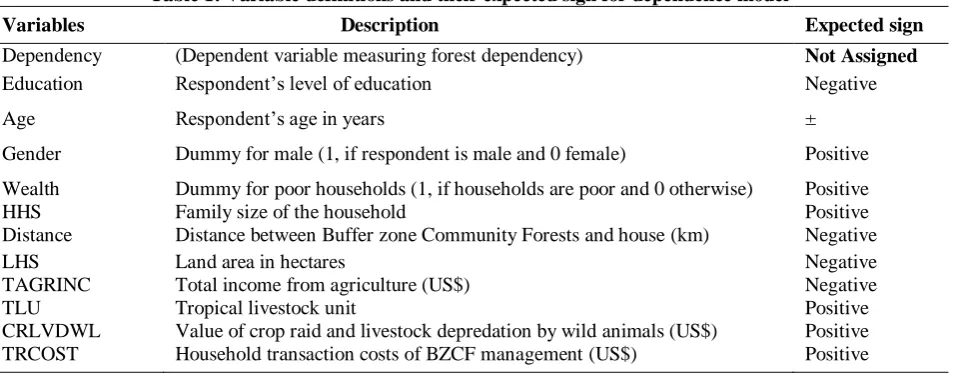
used to explain household’s dependency on forest resources include education, age, gender, wealth status, distance to the forest from the house, household size, agriculture income, livestock unit, landholding size, transaction cost of forest management, crop raid and livestock depredation by wildlife (Table 1). Therefore, before presenting the results of estimation, a brief description of each explanatory variable and expected theoretical relationship to forest dependency is provided below.
Table 1: Variable definitions and their expected sign for dependence model
Variables Description Expected sign
Dependency (Dependent variable measuring forest dependency) Not Assigned
Education Respondent’s level of education Negative
Age Respondent’s age in years ±
Gender Dummy for male (1, if respondent is male and 0 female) Positive
Wealth Dummy for poor households (1, if households are poor and 0 otherwise) Positive
HHS Family size of the household Positive
Distance Distance between Buffer zone Community Forests and house (km) Negative
LHS Land area in hectares Negative
TAGRINC Total income from agriculture (US$) Negative
TLU Tropical livestock unit Positive
CRLVDWL Value of crop raid and livestock depredation by wild animals (US$) Positive TRCOST Household transaction costs of BZCF management (US$) Positive
Education: In general, education provides better and diverse employment opportunities. It is argued that high level of education diverts rural communities people from agricultural and other subsistence activities, which leads to low extraction forest products (Gunatilake 1998, Hegde and Enters 2000, Masozera and Alavalapati 2004, Adhikari et al. 2004). In this context, it is assumed that the household dependency is negatively related to the level of education of the respondents of PBZCFUG.
http://www.ijSciences.com
Volume 6
– March
2017 (03
)
74
compared with women (Lepetu et al. 2009). It istherefore assumed that the male-headed households derive more forest products than female-headed households.
Age: Age is not the limiting factor for the collection of forest products. Younger villagers in the rural community are less dependent on the forest resources because of their willingness to explore opportunities outside the forest and have an easier time compared to their elders in finding jobs outside of forest (Jain and Sajjad 2015). Furthermore, the age of the household head is also correlated with household’s experience in managing common resources and has a better experience in local resources management and quality harvesting than younger ones (Adhikari et al. 2004). On the other hand, the older age of the household head reduce the probability of collection of forest resources because of the less mobility (Köhlin and Parks 2001) and old people may not take the risk of going into the forest for forest resource collection (Lepetu et al. 2009). Therefore, the effect of age of household head on forest dependency is indeterminate.
Wealth status (WEALTH): The rich households depend less on forest resources and have ample choices of substitutes such as LP gas; bio-gas; and electricity (Panta et al. 2008, Sapkota and Odén 2008). Due to the harsh economic condition of the household, poor cannot afford the substitution. Reddy and Chakravarty (1999) argued that the poor have less land and greater share of the forest income makes them more dependent on forests resources, and community-based forest management is attractive for the poor households (Khanal 2001). As such, it is hypothesized that poor households may be associated with the increased forest dependency.
Household size (HHS): Families with more household members have more mouths to feed and tend to extract more forest resources for their livelihood (Gunatilake 1998, Hegde and Enters 2000, Jain and Sajjad 2015). The increase in the household members increases the fuel wood demand. In fact, a larger household extracts more forest resources due to more labor availability to collect and gather various forest resources (Adhikari et al. 2004). In addition, higher unemployment on the periphery of the forest tends the large families to depend more on forest resources in order to increase their income or to meet their subsistence needs. Hence, the household size may be significantly and positively correlated with the forest dependency.
Distance: The PBZCF distance from the respondent’s household was found out from the GPS coordinates recorded at the time of the household survey. For this purpose GPS receiver: Garmin GPS Map 64S was
used to navigate the location of the respondent household. Again these locations were analyzed in ARCMAP 10 to find the distance between the PBZCF boundary and the household. Households near to the forest area are more probable to collect more forest resources from the community-based forests and reverse was true for the distant users because of the difficulties in carrying harvested products (Adhikari, 2003; Sapkota and Odén, 2008). Further, Varughese and Ostrom (2001) argued that the rural households nearby the forest have more secure and accessible supply of forest products nevertheless they are controlled by rules and regulations. Therefore the distance between the forest and the household may decrease the utilization of forest products.
Landholding size (LHS): During the field survey, the land area was asked in Nepali standard unit “katha” and later converted into hectares. In general, households holding more own land are less dependent on the forest resources of the Protected Areas because they possess alternative means to maintain their livelihood through agriculture (Gunatilake 1998). Thus, landholding size is expected to have a negative relationship to forest dependency.
Agriculture income (TAGRINC): Adam and EL Tayeb (2014), Gunatilake (1998) and Masozera and Alavalapati (2004) showed that higher agriculture productivity and agriculture income result in less extraction of forest resources. This is expected because households would rather prefer to work on their farms than the collection of the forest products. Therefore, it hypothesized that the agriculture income is significant and negatively correlated with forest dependency.
http://www.ijSciences.com
Volume 6
– March
2017 (03
)
75
wildlife damage may have a positive relation with theforest dependency.
Transaction cost (TRCOST): Household transaction cost is the household’s opportunity cost of time spent for the conservation and management of PBZCF. These costs are incurred when implementing various activities such as cleaning; pruning; singling; plantation; forest fire extinguishing and fire line construction; forest road repair and maintenance; and other obligatory forestry activities like patrolling of forest (Adhikari and Lovett 2006). The same methodology used for the calculation of forest income was applied to find the opportunity cost of time for calculating the transaction cost. Adhikari (2003b) found that households who spent more time on forest management and forest related decision-making activities appear to obtain more forest product income. Therefore it is assumed that the transaction cost of the forest management has a positive effect on the collection of forest resources.
3. Result and discussion
3.1 Demographic and Socioeconomic Characteristics of Households
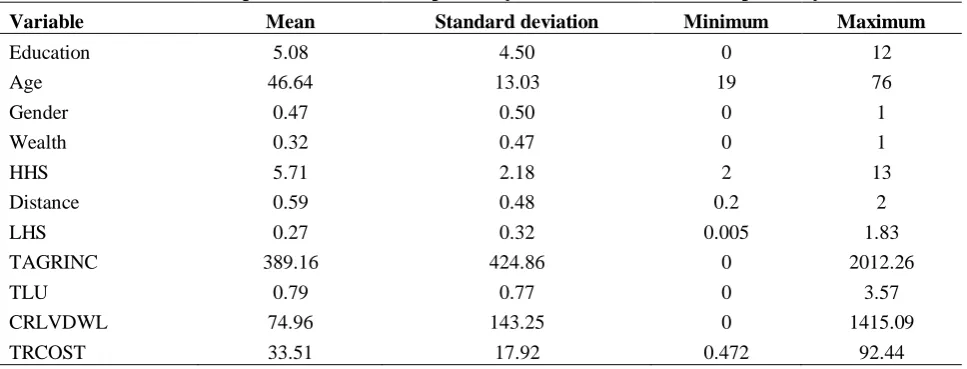
The descriptive statistics of the household’s characteristics is shown in table 2. Among the 130 respondents of PBZCFUG members 46.92 % and 53.08 % were male and female respectively. Altogether 37.69% of the respondents were illiterate and 10.77 % respondents only had the access to the “upper level” schools and colleges. In addition, according to the age categorized by Mehta and Heinen (2001), younger (16–35), middle-aged (36– 55), and older ( ≤ 56): 27.69, 44.62 and 27.69 % of the respondents were younger, middle-aged and older respectively. The main wildlife raiding the agriculture crop were one-horned rhinoceros, forest
cow and wild boar. In addition, Royal Bengal tiger and common leopard (Panthera pardus) were the main wild animals that cause depredation of livestock in the Naya Belhani village. About 72.31% respondents of PBZCFUG reported that their livelihood has been directly affected by the wildlife as a problem of crop raiding and livestock depredation. Furthermore, the average transaction cost US$ 33.51 per year shows that the average household benefits from the PBZCF was about 9 times greater than household transaction cost of management of PBZCF.
In PBZCFUG 23.08, 45.38 and 31.54 % of the respondents were categorized as rich, medium and poor respectively. Moreover, the average annual income of the rich, medium and poor household was US$ 7013.44, 3254.01 and 1866.798respectively. In addition, the average forest dependency index of rich, medium and poor was 0.01, 0.06 and 0.35 respectively. The respondents of the PBZCFUG had different level of forest income with different quantity of forest products collection among different wealth groups. The average firewood collection of rich, medium and poor households was 555, 1401 and 5190 kg per year respectively. In addition, rich, medium and poor households respectively collected annual average of 724, 2522 and 5431 kg of fodder. Furthermore, the study of Richards et al. (2003) showed that per capita consumption of firewood in Nepal is 700 kg per year but annual firewood consumption of poor household of PBZCFUG was 807 kg per capita. Moreover, the annual average forest income and agriculture income of the rich, medium and poor households from the PBZCF were US$ 71, 193 and 646; and US$ 618, 351 and 275 respectively. Furthermore, the average land area owned by the rich, medium and poor was 0.57, 0.26 and .08 hectares respectively
Table 2: Descriptive statistic of the explanatory variables used in forest dependency
Variable Mean Standard deviation Minimum Maximum
Education 5.08 4.50 0 12
Age 46.64 13.03 19 76
Gender 0.47 0.50 0 1
Wealth 0.32 0.47 0 1
HHS 5.71 2.18 2 13
Distance 0.59 0.48 0.2 2
LHS 0.27 0.32 0.005 1.83
TAGRINC 389.16 424.86 0 2012.26
TLU 0.79 0.77 0 3.57
CRLVDWL 74.96 143.25 0 1415.09
http://www.ijSciences.com
Volume 6
– March
2017 (03
)
76
3.2. Forest DependencyBased on the data collected, only 48 % of the households in the PBZCFUG were considered highly dependent on forest resources. The mean number of hours spent by the households in the forest resource collection was 15.7 hours per week. Moreover, firewood and fodder were the main forest products collected from the PBZCF by the forest user members. Respondent households collected annually an average of 2400 kg and 3024 kg of firewood and fodder respectively. This shows that the annual consumption of firewood per capita was 420.4 kg. Besides firewood and fodder, other forest resources such as thatch grass, mushroom and Sal leafs were extracted in a very low quantity by the households of PBZCFUG. The average annual forest income of the household was US$ 308 and this forest income has shared in 14.1 % of their total income on the households of PBZCFUG.
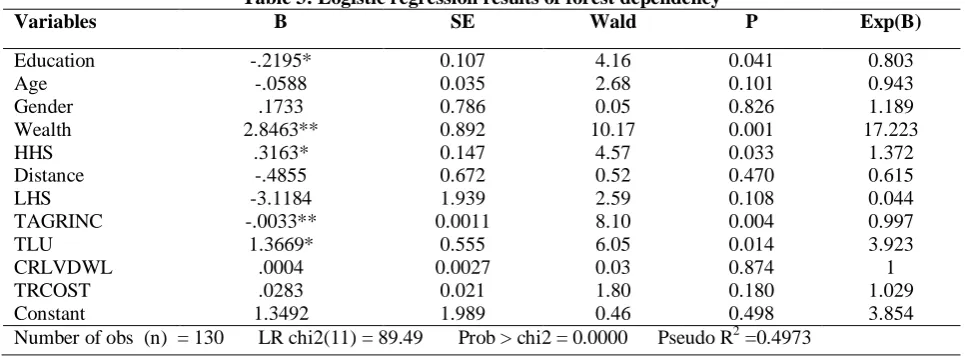
Results of the model explaining the forest dependency are presented in Table 3. For the estimation of the logistic regression analysis, 130 sampled forest user members of PBCF were taken as
a total number of observations. In addition, the parameters estimated for the model were eventuated at 1% and 5% level of significance. The likelihood ratio test of this logistic regression shows that this model is significant with a chi-square value of 89.49. This result indicates that the explanatory variables included in the model are significantly related to the dependent variable: forest dependency. Furthermore, this forest dependency model produced a Pseudo R2 value of 0.49 suggesting a moderate explanatory power of the model. The logit model predicted forest dependency with 83.8 % accuracy. Thus, only 16.2% of the values are deviated from the actual distribution.
In this model, many explanatory variables have the expected effect on forest dependency. While coefficients on the Wealth, TAGRINC are statistically significant at 1%; and variable Education, HHS, TLU are statistically significant at 5%. The other coefficients on the explanatory variables: Age, Gender, Distance, LHS, CRLVDWL and TRCOST are statistically insignificant.
Table 3: Logistic regression results of forest dependency
Variables B SE Wald P Exp(B)
Education -.2195* 0.107 4.16 0.041 0.803
Age -.0588 0.035 2.68 0.101 0.943
Gender .1733 0.786 0.05 0.826 1.189
Wealth 2.8463** 0.892 10.17 0.001 17.223
HHS .3163* 0.147 4.57 0.033 1.372
Distance -.4855 0.672 0.52 0.470 0.615
LHS -3.1184 1.939 2.59 0.108 0.044
TAGRINC -.0033** 0.0011 8.10 0.004 0.997
TLU 1.3669* 0.555 6.05 0.014 3.923
CRLVDWL .0004 0.0027 0.03 0.874 1
TRCOST .0283 0.021 1.80 0.180 1.029
Constant 1.3492 1.989 0.46 0.498 3.854
Number of obs (n) = 130 LR chi2(11) = 89.49 Prob > chi2 = 0.0000 Pseudo R2 =0.4973
* Indicates significance at the 5% level; and ** indicates significance at the 1% level The variable Education shows a negative relationship
with forest dependency and is statistically significant. This further shows that better-educated households may have better earning opportunities in or outside the village than non-educated people. This finding is similar to that of Adhikari et al. (2004) which argues that fuel wood collection for the educated people makes unprofitable due to the higher opportunity costs of collection. Similarly, Gunatilake (1998) also observed that education is negatively related to forest income in the tropical biosphere reserves in Sri Lanka. However a study of Mamo et al. (2007) in two Peasant Associations (PAs) of Dendi district, Ethiopia showed that the education of household head had no significant effect on forest income even
if the education had a negative relationship with forest income.
http://www.ijSciences.com
Volume 6
– March
2017 (03
)
77
positive relationship with the forest income in therural households of the Cross River Community Forest, Nigeria. Sapkota and Odén (2008) found that the rich households are statistically significant and have negative relationship on the collection of the fuel wood in the Shankarnagar CF of Rupandehi district of Nepal. This finding has contradiction over Adhikari et al. (2004) findings, as that finding showed that the rich households had significant positive relation with the fuel wood and fodder collection in the mid-hills community forests of Kabhre Palanchok and Sindhu Palchowk district of Nepal which indicates that resource usage from CF is directly proportional to private endowments.
The variable household size (HHS) has a positive relationship and significant with forest dependency. This suggests that large families are more dependent on forest resources. This is due to the fact that limited income opportunities and higher unemployment in the rural areas tends large families to depend more on forest resources to fulfill their basic needs. Moreover, to support large family members of the household, they have to increase their earnings in addition to main livelihood activities so that the quantity of production may rise due to more number of household members engaging in forest resource collection. This finding is corroborated by other studies in Nepal (Adhikari et al. 2004) and elsewhere (Mamo et al. 2007, Coulibaly-Lingani et al. 2009, Lepetu et al. 2009, Fonta et al. 2011, Fikir et al. 2016). In addition, other studies have also found HHS expected with a coefficient significant at P<0.1 (Masozera and Alavalapati 2004, Adam and EL Tayeb 2014). However, a study carried by Baral and Heinen (2007) found that the household size had the negative relationship with the forest dependency in the Bardia National Park and Suklaphata Wildlife Reserve of Nepal: however, since the relation is insignificant, it cannot possibly be a contradiction.
The variable agricultural income (TAGRINC) shows a negative relationship with forest dependency. This implies that households with high total agriculture income are less dependent on forest resources due to the fact that most of the grasses and fodder for livestock consumption is derived from the agriculture land. Furthermore, agroforestry system reduces the gathering of forest resources and provides both fodder and firewood for the rural communities. Thus, agriculture reduces quantity of extraction of forest resources and its income, by competing for and taking over labor as well as time that would otherwise be invested for forest related activities. Moreover, this finding is similar to the finding of Gunatilake (1998) where the significance of agriculture income was found to have a negative impact on forest dependency due to the diversified household income from agriculture as the source of
livelihood. As well as, Moe and Liu (2016) result illustrated that the agriculture income was significant (P<0.01) with a negative relationship to the forest income from NTFPs due to the high income from agriculture and livestock in Tharawady district of Myanmar. Furthermore, this finding is also supported by the findings of other studies (Masozera and Alavalapati 2004, Mamo et al. 2007, Adam and EL Tayeb 2014).
Again in this study, the variable Tropical Livestock Unit (TLU) shows the positive relationship with forest dependency and it is statistically significant. This implies that the greater the livestock population of a household, the greater the predicted forest dependency with a larger opportunity cost of time on grass and fodder collection. This finding is similar to that of Baral and Heinen (2007) that illustrated the positive relationship of livestock unit significant to the forest dependency with its coefficient value of P<0.01 in the western lowland protected areas of Nepal. Furthermore, this finding is also supported by the findings of other studies (Adhikari et al. 2004, Jain and Sajjad 2015, Fikir et al. 2016).
The variables Gender, Distance, LHS, CRLVDWL and TRCOST have consistent signs but are not statistically significant. In addition, the result has shown that Age has the negative effect on the forest dependency but is not statistically significant. As, the Wald test value of the Distance, CRLVDWL, and Gender are very small, these variables are not the important factor in the PBZCFUG to explain the forest dependency. The household’s transaction cost (TRCOST) of the management of PBZCF is very low with respect to the total income of the forest, which has resulted the positive relationship but nonsignificant in comparison to other variables. Bhandari and Uibrig (2008) found that the transaction cost of management of Kalika BZCF of CNP was US$ 51.9 which was about three times less than the household transaction cost of the Choutari CF (not Protected Area CF) and this shows that the buffer zone community forest holds less forest management activities and has less effect on forest resources collection with respect to the transaction cost.
4. Conclusion
http://www.ijSciences.com
Volume 6
– March
2017 (03
)
78
plan (operational plan) of PBZCF. Firewood andfodder are the main forest products collected by the households of PBZCF. This study found that poor households in the Naya Belhani village with low average income are highly dependent on the PBZCF. Annually these poor households collect a large quantity of fuel wood and fodder from the PBZCF and the forest income shares 35% of their total income. Furthermore, results of logistic regression analysis revealed that agriculture income and education is shown to reduce forest dependency; and wealth status: poor, livestock population and household size of the family members increases the forest dependency of the households of PBZCFUG.
In this context, the positive and the negative significant relationships should be respectively minimized and maximized in order to enhance greater cooperation from user members of PBZCF and achieve sustainable conservation of CNP and its PBZCF with the proper utilization of forest products. Hence, policy interventions to ensure long-term success of landscape-level conservation are needed to decrease dependence on natural resources. In this situation, decentralization program such as BZCF need to be more carefully designed so that participation can be biased in favor of the poor and the marginal. All of these findings point to one thing. Rural poverty will exacerbate the need for forest resources and thus increase the household dependency on the PBZCF of CNP. Although the report of Ministry of Forests and Soil Conservation of Nepal states the Master Plan for Forestry Sector has ‘‘enhanced the livelihoods of the rural people who have been involved while giving special focus to the needs of poor and disadvantaged households,’’ it also cautions that the policy has ‘‘failed to have significant impacts on rural employment and the local economy,’’ noting that ‘‘a clear policy for the allocation of national forest to the various community-based forest management regimes is lacking – especially for the Tarai region” which is the area of our study (GoN 2014 p.2).
Therefore, policy measures that aim at increasing agriculture income; generating off-farm employment opportunities such as tourism for PBZCFUG members; and maximizing environmental and conservation education through awareness program are needed to reduce forest dependency and enhance forest conservation. In addition, programs that reduce the poverty level of the poor with the livelihood upliftment of local households are needed in the management plan of PBZCF that mainly emphasize on the poor households. Moreover educational and training opportunities may be fruitful with the poverty reduction program. Furthermore, dependency over forests for supply of fodder for the livestock can be overcome through the interventions of intensives
in the policy that focus on agrisilvicultural system: fodder tree farming in the buffer zone area, practicing stall-feeding and herding less number of livestock. As well as controlling family size through the provision of advantageous policy incentives and providing the funds for bio-gas plant establishment could help reduce the PBZCFUG household dependency on forest resources, which will finally support conservation of the CNP minimizing fuel wood extraction. Here attention should be given to the family’s having large numbers adults who are unemployed and are in need of alternative means for income generation. As the Narayani river, with its unique landscape provides this place home for one-horned rhinoceros, tourism should be promoted in order to engage the adult members of the household in the employment generation activities. Furthermore, the management plan of PBZCF provides 5 years of forest management activities such as cleaning, pruning and thinning. If this management plan is properly implemented in the field, this may also help to reduce the pressure on fuel wood collection and the forest will be also sustainably managed according to the management plan. As a whole, the policy interventions for the sustainable balance between conservation, forest resource use, socioeconomic development, and expansion of the tourism in the buffer zone area can increase both legitimacy and efficiency of conservation efforts of Chitwan National Park.
Acknowledgement
The authors are grateful to APFNet (Asia Pacific Network for Sustainable Forest Management and Rehabilitation) for granting the scholarship for the first author: Debendra Bhandari to pursue M.Sc. degree in Forest Economics and Management at Beijing Forestry University. We also thank Datendra Kumar Golay and PBZCFUG members for their help throughout field data collection. In addition, special thanks also goes to the Department of Forests of Nepal for allowing first author to study abroad.
Reference
1. Adam, Y.O., and EL Tayeb, M.A. 2014. Forest Dependency and its Effect on Conservation in Sudan: A Case of Sarf-Saaid Reserved Forest in Gadarif State. Agriculture & Forestry 60(3): 107–121.
2. Adhikari, B. 2003a. What Determines Household Dependency on Community Forests; Paper Submitted to the World Forestry Congress, Qubic,Canada. Available from http://www.fao.org/docrep/ARTICLE/WFC/XII/0044-A1.HTM#P10_167 [accessed 22 October 2016].
3. Adhikari, B. 2003b. Property Rights and Natural Resources: Socio-Economic Heterogeneity and Common Property Resource Management. South Asian Network for Development and Environmental Economics (SANDEE). Kathmandu, Nepal.
http://www.ijSciences.com
Volume 6
– March
2017 (03
)
79
Economics 48(2): 245–257.
doi:10.1016/j.ecolecon.2003.08.008.
5. Adhikari, B., and Lovett, J.C. 2006. Transaction Costs and Community-Based Natural Resource Management in Nepal. Journal of Environmental Management 78(1): 5–15. doi:10.1016/j.jenvman.2005.04.005.
6. Baland, J.-M., and Platteau, J.-P. 1999. The Ambiguous Impact of Inequality on Local Resource Management. World Development 27(5): 773–788. doi:10.1016/S0305-750X(99)00026-1.
7. Baral, N., and Heinen, J.T. 2007. Resources Use, Conservation Attitudes, Management Intervention and Park-People Relations in the Western Terai landscape of Nepal. Environmental Conservation 34(1): 64. doi:10.1017/S0376892907003670.
8. Beckley, T.M. 1998. The Nestedness of Forest Dependence: A Conceptual Framework and Empirical Exploration. Society and Natural resource 11(2): 101–121.
9. Bhandari, A.R., and Uibrig, H. 2008. Who is Benefiting More from Common Property Forest Resources: Poor or LessPoor? Banko Janakari 18(1): 42–47.
10. Bhusal, N.P. 2014. Buffer Zone Management System in Protected Areas of Nepal. The Third Pole: Journal of Geography Education 11: 34–44. doi:10.3126/ttp.v11i0.11558.
11. Budhathoki, P. 2005. Royal Chitwan National Park: A World Heritage Site with Buffer Zone. In People and Protected Areas in South Asia. Edited by U.R. Sharma and P.B. Yonzon. Resources Himalaya Foundation.
12. Bwalya, S.M. 2011. Household Dependence on Forest Income in Rural Zambia. Zambia Social Journal 2(1): 67–86. 13. Cavendish, W. 2000. Empirical Regularities in the Poverty-Environment Relationship of Rural Households: Evidence from Zimbabwe. World Development 28(11): 1979–2003. doi:10.1016/S0305-750X(00)00066-8.
14. CBS. 2011. Nepal living Standards Survey 2010/11. Government of Nepal, National Planning Commission Secretariat, Central Bureau of Statistics (CBS). Kathmandu, Nepal.
15. Chandool, C. 2007. Households’ Resource Use, Conservation Attitude and Percieved Socioeconomic Impact of the Protected Areas Policy in the Nariva Swamp, Trinidad and Tabago. PhD Thesis. University of Florida.
16. CNP. 2013. Chitwan National Park and it’s Buffer Zone: Management Plan 2013-2017. Department of National Parks and Wildlife Conservation, Chitwan National Park (CNP). Chitwan, Nepal.
17. CNP. 2015. Chitwan National Park:Annual report (2014 July to 2015 June). Department of National Parks and Wildlife Conservation, Chitwan National Park (CNP). Chitwan, Nepal.
18. Coulibaly-Lingani, P., Tigabu, M., Savadogo, P., Oden, P.C., and Ouadba, J.M. 2009. Determinants of Access to Forest Products in Southern Burkina Faso. Forest Policy and
Economics 11(7): 516–524.
doi:10.1016/j.forpol.2009.06.002.
19. Dhakal, B., and Thapa, B. 2015. Buffer Zone Management Issues in Chitwan National Park , Nepal : a Case Study of Kolhuwa Village Development. Parks 21(2).
20. Dhakal, M., and Masuda, M. 2008. Role of Participatory Forest Management in Rural Livelihood Improvement : A Case of Nawalparasi District , Nepal. Tropics 17(2): 159– 168. doi:10.3759/tropics.17.159.
21. Dhital, K. 2004. Environmental Economic Methods of Evaluating Protected Area (A case study of Chitwan National Park). Printers world. Kathmandu,Nepal.
22. DNPWC. 2016. Annual Report, Fiscal Year July 2015-June 2016. Government of Nepal, Ministry of Forests and Soil Conservation, Department of National Parks and Wildlife Conservation (DNPWC). Kathmandu, Nepal.
23. DoF. 2016. Community Forestry. Department of Forests, Community Forest Division. Kathmandu, Nepal. Available from
http://dof.gov.np/dof_community_forest_division/community _forestry_dof [accessed 24 November 2016].
24. Elands, B.H.M., O’Leary, T.N., Boerwinkel, H.W.J., and Freerk Wiersum, K. 2004. Forests as a Mirror of Rural Conditions; Local Views on the Role of Forests Across Europe. Forest Policy and Economics 6(5): 469–482. doi:10.1016/j.forpol.2004.01.003.
25. FAO. 2003. Compendium of Agricultural–Environmental Indicators: 1989–91 to 2000. Food and Agriculture Organization of the United States (FAO). Rome.
26. FAO. 2010. Global Forest Resources Assessment 2010. Food and Agriculture organisation of the United States (FAO) 147: 350 pp. Rome.
27. Fikir, D., Tadesse, W., and Gure, A. 2016. Economic Contribution to Local Livelihoods and Households Dependency on Dry Land Forest Products in Hammer District, Southeastern Ethiopia. International Journal of Forestry Research 2016: 1–11. doi:10.1155/2016/5474680. 28. Fonta, W.M., Ichoku, H.E., and Ayuk, E. 2011. The
Distributional Impacts of Forest Income on Household Welfare in Rural Nigeria. Journal of Economics and Sustainable Development 2(1): 1–13. Available from http://www.iiste.org/Journals/index.php/JEDS/article/view/13 0.
29. Gautam, A.P., Shivakoti, G.P., and Webb, E.L. 2004. A Review of Forest Policies, Institutions, and Changes in the Resource Condition in Nepal. International Forestry Review
6(2): 136–148. doi:10.1505/ifor.6.2.136.38397.
30. Gautam, K.H. 2006. Forestry, Politicians and Power— Perspectives from Nepal’s Forest Policy. Forest Policy and Economics 8(2): 175–182. doi:10.1016/j.forpol.2004.07.001. 31. GoN. 2014. Review of Implementation of the Master Plan for
the Forestry Sector: Achievements and Lessons. Government of Nepal, Ministry of Forests and Soil Conservation. Kathmandu, Nepal.
32. Gunatilake, H. 1998. The Role of Rural Development in Protecting Tropical Rainforests: Evidence from Sri Lanka. Journal of Environmental Management 53(3): 273–292. doi:10.1006/jema.1998.0201.
33. Gurung, A., Karki, R., and Bista, R. 2011. Community-Based Forest Management in Nepal : Opportunities and Challenges. Resources and Environment 1(1): 26–31. doi:10. 5923/j.re.20110101.04.
34. Hegde, R., and Enters, T. 2000. Forest Products and Household Economy: A Case Study from Mudumalai Wildlife Sanctuary, Southern India. Environmental
Conservation 27(3): 250–259.
doi:10.1017/S037689290000028X.
35. HMGN. 1992. Labour Act 1992. His Majestys’ Government of Nepal.
36. HMGN. 1996. Buffer Zone Management Regulation 1996. His Majestys’ Government of Nepal, Ministry of Forests and Soil Conservation. Kathmandu, Nepal.
37. Illukpitiya, P.M.P. 2006. Agricultural Effeciency and Dependency on Forest Resources: An Economic Analysis of Rural Households and the Conservation of Natural Forests in Srilanka. PhD Thesis. University of Hawai.
38. ILO. 2007. Working Time Around the World:Trends in Working Hours, Laws and Policies in a Global Comparative Perspective. International Labour Organization: 239. Geneva. doi:10.4324/9780203945216.
39. Jain, P., and Sajjad, H. 2015. Household Dependency on Forest Resources in the Sariska Tiger Reserve (STR), India: Implications for Management. Journal of Sustainable Forestry 35(1): 60–74. doi:10.1080/10549811.2015.1099108. 40. Khanal, K.P. 2001. Economic Evaluation of Community Forestry in Nepal and its Equity Distribution Effect. M.Sc. Thesis. Royal Veterinary and Agricultural University. Copenhagen, Denmark.
http://www.ijSciences.com
Volume 6
– March
2017 (03
)
80
42. Lepetu, J. 2007. Socio Economic Impact and Stakeholder Preference to Conservation of Forest Reserves: A Case Study of Kasane Forest Reserve, Botswana. PhD Thesis. University of Florida.
43. Lepetu, J., Alavalapati, J., and Nair, P.K. 2009. Forest Dependency and its Implication for Protected Areas Management: A Case Study from Kasane Forest Reserve, Botswana. International Journal of Environmental Research
3(4): 525–536.
44. Mamo, G., Sjaastad, E., and Vedeld, P. 2007. Economic Dependence on Forest Resources: A Case from Dendi District, Ethiopia. Forest Policy and Economics 9(8): 916– 927. doi:10.1016/j.forpol.2006.08.001.
45. Masozera, M.K. 2002. Socioeconomic Impact Analysis of the Conservation of the Nyungwe Forest Reserve, Rwanda. M.Sc. Thesis. University of Florida.
46. Masozera, M.K., and Alavalapati, J.R.R. 2004. Forest Dependency and its Implications for Protected Areas Management: A Case Study From the Nyungwe Forest Reserve, Rwanda. Scandinavian Journal of Forest Research
19(sup004): 85–92. doi:10.1080/14004080410034164. 47. Mehta, J.N., and Heinan, J.T. 2001. Does Community-Based
Conservation Shape Favorable Attitudes Among Locals? An Empirical Study from Nepal. Environmental Management
28(2): 165–177. doi:10.1007/s002670010215.
48. Mertler, C.A., and Vannatta, R.A. 2005. Advanced and Multivariate Statistical Methods: Practical Application and Interpretation. In 3rd edition. Pyrczak, California, USA. 49. Moe, K.T., and Liu, J. 2016. Economic Contribution of
Non-timber Forest Products (NTFPs) to Rural Livelihoods in the Tharawady District of Myanmar. doi:10.18483/ijSci.904. 50. Neuman, L.W. 1994. Social Research Methods: Qualitative
and Quantitative Approaches. In Allyn and Bacon, 2nd edition. London.
51. New ERA/UNDP. 2004. Impact Assessment of Buffer zone Programme in Nepal. United Nations Development Programme (UNDP). Kathmandu, Nepal.
52. Odihi, J. 2003. Deforestation in Afforestation Priority zone in Sudano-Sahelian Nigeria. Applied Geography 23(4): 227– 259. doi:10.1016/j.apgeog.2003.08.004.
53. Pandey, R., Harrison, S., and Gupta, A.K. 2014. Resource Availability versus Resource Extraction in Forests: Analysis of Forest Fodder System in Forest Density Classes in Lower Himalayas, India. Small-scale Forestry 13(3): 267–279. doi:10.1007/s11842-013-9253-3.
54. Pandit, R., and Bevilacqua, E. 2011. Forest Users and Environmental Impacts of Community Forestry in the Hills of Nepal. Forest Policy and Economics 13(5): 345–352. doi:10.1016/j.forpol.2011.03.009.
55. Panta, M., Kim, K., and Joshi, C. 2008. Temporal Mapping of Deforestation and Forest Degradation in Nepal: Applications to Forest Conservation. Forest Ecology and Management 256(9): 1587–1595. doi:10.1016/j.foreco.2008.07.023.
56. Parker, P., and Thapa, B. 2012. Natural Resource Dependency and Decentralized Conservation Within Kanchenjunga Conservation Area Project, Nepal. Environmental Management 49(2): 435–444. doi:10.1007/s00267-011-9791-4.
57. PBZCF. 2015. Panbari Bufferzone Community Forest Operation Plan (2015/2016 - 2019/2020). Panbari Bufferzone Community Forest User Group. Naya Belhani 1 and 2, Nawalparasi.
58. Peng, C.-Y.J., and So, T.-S.H. 2002. Logistic Rrgression
Analysis and Reporting: A Primer. Understanding Statistics
1(1): 31–70.
59. Pokharel, R.K., Tiwari, K.R., and Rayamajhi, S. 2012. Nepal’s Community Forestry: Need of Better Governance. In
Global Perspectives on Sustainable Forest Management.
Edited by C.A. Okia. InTech. pp. 43–58. doi:10.5772/33439. 60. Rai, R.K., Neupane, P., and Dhakal, A. 2016. Is the
Contribution of Community Forest Users Financially Efficient? A Household Level Benefit-Cost Analysis of Community Forest Management in Nepal. International Journal of the Commons 10(1): 142–157. doi:10.18352/ijc.594.
61. Rai, R.K., and Scarborough, H. 2013. Economic Value of Mitigation of Plant Invaders in a Subsistence Economy: Incorporating Labour as a Mode of Payment. Environment and Development Economics 18(02): 225–244. doi:10.1017/S1355770X1200037X.
62. Rai, R.K., and Scarborough, H. 2015. Nonmarket Valuation in Developing Countries: Incorporating Labour Contributions in Environmental Benefits Estimates. Australian Journal of Agricultural and Resource Economics 59(4): 479–498. doi:10.1111/1467-8489.12071.
63. Reddy, S.R.C., and Chakravarty, S.P. 1999. Forest Dependence and Income Distribution in a Subsistence Economy: Evidence from India. World Development 27(7): 1141–1149. doi:10.1016/S0305-750X(99)00057-1.
64. Richards, M., Kanel, K., Maharjan, M.R., and Davies, J. 1999. Towards Participatory Economic Analysis by Forest User Groups in Nepal. Overseas Development Institute in collaboration with the Nepal-UK Community Forestry Project.
65. Richards, M., Maharjan, M., and Kanel, K. 2003. Economics, Poverty and Transparency: Measuring Equity in Forest User Groups. Journal of Forest and Livelihood 3(1): 91–106. 66. Sapkota, I.P., and Odén, P.C. 2008. Household Characterstics
and Dependency on Community Forests. International Journal of Social Forestry 1(2): 123–144.
67. Shrestha, U.B., Shrestha, B.B., and Shrestha, S. 2010. Biodiversity Conservation in Community Forests of Nepal: Rhetoric and Reality. International Journal of Biodiversity and Conservation 2(5): 98–104. Available from http://www.academicjournals.org/article/article1380179127_ Shrestha et al.pdf.
68. Spiteri, A., and Nepal, S.K. 2008. Distributing Conservation Incentives in the Buffer zone of Chitwan National Park, Nepal. Environmental Conservation 35(1): 76–86. doi:10.1017/S0376892908004451.
69. Sunderlin, W.D., Belcher, B., Santoso, L., Angelsen, A., Burgers, P., Nasi, R., and Wunder, S. 2005. Livelihoods, Forests, and Conservation in Developing Countries: An Overview. World Development 33(9 SPEC. ISS.): 1383– 1402. doi:10.1016/j.worlddev.2004.10.004.
70. Tieguhong, J.C., and Nkamgnia, E.M. 2012. Household Dependence on Forests around Lobeke National Park, Cameroon. International Forestry Review 14(2): 196–212. doi:10.1505/146554812800923426.
71. Varughese, G., and Ostrom, E. 2001. The Contested Role of Heterogeneity in Collective Action: Some Evidence from Community Forestry in Nepal. World Development 29(5): 747–765. doi:10.1016/S0305-750X(01)00012-2.
72. Wunder, S. 2001. Poverty Alleviation and Tropical Forests - What Scope for Synergies? World Development 29(11): 1817–1833. doi:10.1016/S0305-750X(01)00070-5.