Akila et al. 2016 ISSN: 2349 – 4891
Correlations of Biomechanical Characteristics with Ball Speed in Penalty Corner Push-In
Effect of Integrated Yoga Modules with and without Satvic Diet on Selected Physiological
Variables among College Female Students
K.Akila1 & Dr.U.Narayani2
1Ph.D., Research Scholar, Department of Physical Education, Tamilnadu Physical Education and Sports University, Chennai, Tamilnadu, India. 2Assistant Professor, St.John’s College of Physical Education, Tirunelveli, Tamilnadu, India.
Received 7th April 2016, Accepted 17th May 2016
Abstract
The purpose of the study was to find out the effect of integrated yoga modules with and without satvic food on selected physiological variables among college female students. To achieve the purpose of the present study, sixty college female students from Dhanalakshmi Srinivasan Group of Institutions, Perambalur, Tamilnadu, India were selected as subjects at random and their ages ranged from 18 to 21 years. The subjects were divided into three equal groups of twenty each. Group I acted as Experimental Group I (Integrated Yoga Module), Group II acted as Experimental Group II (Integrated Yoga Module with Satvic Diet) Group III acted as Control Group. The requirement of the experiment procedures, testing as well as exercise schedule was explained to the subjects so as to get full co-operation of the effort required on their part and prior to the administration of the study. Pre test was conducted for all the subjects on selected physiological variables. This initial test scores formed as pre test scores of the subjects. The groups were assigned as Experimental Group I, Experimental Group II and Control Group in an equivalent manner. Experimental Group I was exposed to integrated yoga module, Experimental Group II was exposed to integrated yoga module with satvic diet and Control Group was not exposed to any experimental training other than their regular daily activities. The duration of experimental period was 12 weeks. After the experimental treatment, all the sixty subjects were tested on their physiological variables. This final test scores formed as post test scores of the subjects. The pre test and post test scores were subjected to statistical analysis using Analysis of Covariance (ANCOVA) to find out the significance among the mean differences, whenever the ‘F’ ratio for adjusted test was found to be significant, Scheffe’s post hoc test was used. In all cases 0.05 level of significance was fixed to test hypotheses. The integrated yoga modules group had shown significant improvement in all the elected physiological variables among college female students after undergoing integrated yoga modules for a period of twelve weeks. The integrated yoga modules with satvic diet group had shown significant improvement in all the elected physiological variables among college female students after undergoing integrated yoga modules with satvic diet for a period of twelve weeks. The integrated yoga modules with satvic diet group had shown significant improvement in all the elected physiological variables among college female students than the integrated yoga module and control group.
Keywords: Integrated Yoga, Satvic Food, Physiological, Female Students.
© Copy Right, IJRRAS, 2016. All Rights Reserved.
Introduction
Yoga includes recommendations on eating habits. Saṇḍilya Upanishad and Svatmarama both state that Mitahara (eating in moderation) is an important part of yoga practice. It is one of the Yamas (virtuous self restraints). These texts while discussing yoga diet, however, make no mention of satvic diet. The application of the Sattva and Tamas concepts to food is a later and relatively new extension to the Mitahara virtue in Yoga literature. Verses 1.57 through 1.63 of Hatha Yoga Pradipika suggests that taste cravings should not drive one‟s eating habits, rather the best diet is one that is tasty, nutritious and likable as well as sufficient to meet
Correspondence
K.Akila,
E-mail:[email protected], Ph. +9170944 66468
the needs of one‟s body. It recommends that one must “eat only when one feels hungry” and “neither overeat nor eat to completely fill the capacity of one‟s stomach; rather leave a quarter portion empty and fill three quarters with quality food and fresh water”. Verses 1.59 to 1.61 of Hathayoga Pradipika suggest that the „„mitahara‟‟ regimen of a yogi avoids foods with excessive amounts of sour, salt, bitterness, oil, spice burn, unripe vegetables, fermented foods or alcohol. The practice of Mitahara, in Hathayoga Pradipika, includes avoiding stale, impure and tamasic foods, and consuming moderate amounts of fresh, vital and satvic foods (Christopher, 2009).
The Indian text Bhagavad Gita links sattva, rajas and tamas to food in verses 17.8 through 17.10. It states that those who are in the Sattva state of mind prefer foods that are life giving, purifying to one's existence and that give strength, health, happiness and
ISSN: 2349 - 4891
International
satisfaction. Sattva-oriented foods are juicy, oily, wholesome, and pleasing to taste. Non-Sattva oriented foods are too bitter, too sour, too salty, too spicy, too pungent, too astringent, stale, tasteless or decomposed. Non-Satvic foods cause distress, disease and disorders. In the context of Yoga, attention to one's diet is essential for good health of body and mind, and the virtue of Mitahara is one where the yogi is aware of the quantity and quality of food and drinks he or she consumes, takes neither too much nor too little, and suits it to one's health condition and needs.
Methodology
The purpose of the study was to find out the effect of integrated yoga modules with and without satvic food on selected physiological variables among college female students. To achieve the purpose of the present study, sixty college female students from Dhanalakshmi Srinivasan Group of Institutions, Perambalur, Tamilnadu, India were selected as subjects at random and their ages ranged from 18 to 21 years. The subjects were divided into three equal groups of twenty each. Group I acted as Experimental Group I (Integrated Yoga Module), Group II acted as Experimental Group II (Integrated Yoga Module with Satvic Diet) Group III
acted as Control Group. The requirement of the experiment procedures, testing as well as exercise schedule was explained to the subjects so as to get full co-operation of the effort required on their part and prior to the administration of the study. Pre test was conducted for all the subjects on selected physiological variables. This initial test scores formed as pre test scores of the subjects. The groups were assigned as Experimental Group I, Experimental Group II and Control Group in an equivalent manner. Experimental Group I was exposed to integrated yoga module, Experimental Group II was exposed to integrated yoga module with satvic diet and Control Group was not exposed to any experimental training other than their regular daily activities. The duration of experimental period was 12 weeks. After the experimental treatment, all the sixty subjects were tested on their physiological variables. This final test scores formed as post test scores of the subjects. The pre test and post test scores were subjected to statistical analysis using Analysis of Covariance (ANCOVA) to find out the significance among the mean differences, whenever the „F‟ ratio for adjusted test was found to be significant, Scheffe‟s post hoc test was used. In all cases 0.05 level of significance was fixed to test hypotheses.
Results
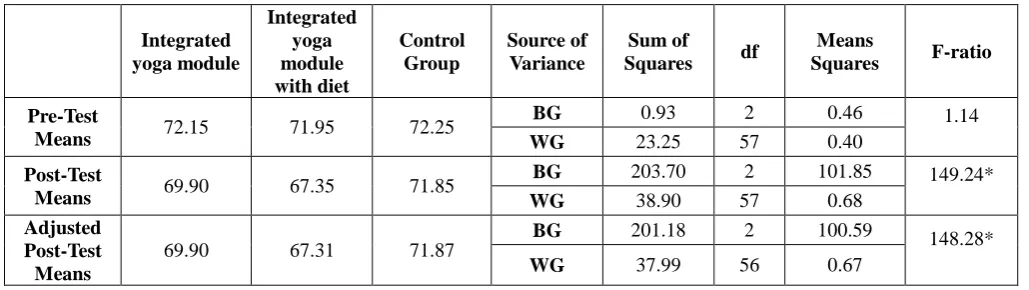
Table I. Computation of analysis of covariance of mean of integrated yoga module, integrated yoga module with diet and control groups on resting pulse rate
Integrated yoga module
Integrated yoga module with diet
Control Group
Source of Variance
Sum of
Squares df
Means
Squares F-ratio
Pre-Test
Means 72.15 71.95 72.25
BG 0.93 2 0.46 1.14
WG 23.25 57 0.40
Post-Test
Means 69.90 67.35 71.85
BG 203.70 2 101.85 149.24*
WG 38.90 57 0.68
Adjusted Post-Test Means
69.90 67.31 71.87
BG 201.18 2 100.59 148.28*
WG 37.99 56 0.67
An examination of table - I indicated that the pretest means of integrated yoga module, integrated yoga module with diet and control groups were 72.15, 71.95 and 72.25 respectively. The obtained F-ratio for the pre-test was 1.14 and the table F-ratio was 3.15. Hence the pre-test mean F-ratio was insignificant at 0.05 level of confidence for the degree of freedom 2 and 57. This proved that there were no significant difference between the experimental and control groups indicating that the process of randomization of the groups was perfect while assigning the subjects to groups. The post-test means of the integrated yoga module, integrated yoga module with diet and control groups were 69.90, 67.35 and 71.85 respectively. The obtained F-ratio for the post-test was 149.24 and the table F-ratio was 3.15. Hence the post-test mean F-ratio was significant at 0.05 level of
Table II. The scheffe‟s test for the differences between the adjusted post test paired means on resting pulse rate
Adjusted Post-test means
Mean Difference Required CI Integrated yoga module Integrated yoga module with diet Control Group
69.90 67.31 --- 2.59*
0.67
69.90 --- 71.87 1.97*
--- 67.31 71.87 4.56*
* Significant at 0.05 level of confidence
The multiple comparisons showed in table II proved that there existed significant differences between the adjusted means of integrated yoga module and integrated yoga module with diet group (2.59), integrated yoga module and control group (1.97) and integrated
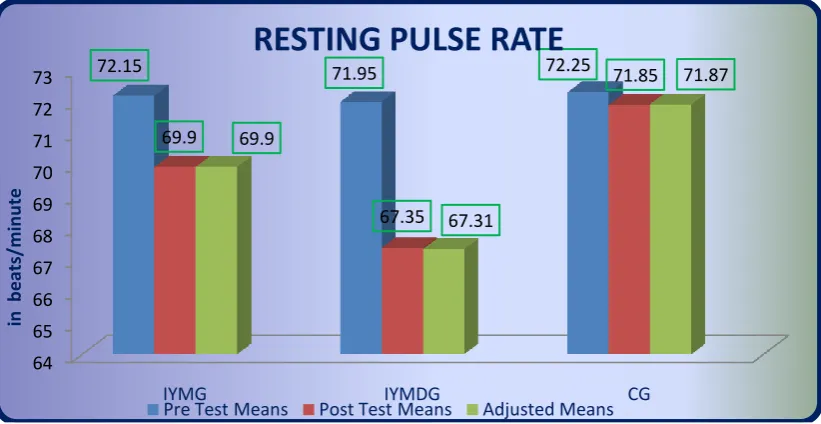
yoga module with diet and control group (4.56) at 0.05 level of confidence with the confidence interval value of 0.67. The pre, post and adjusted means on resting pulse rate were presented through bar diagram for better understanding of the results of this study in Figure-I.
Figure I. Pre post and adjusted post test differences of the, integrated yoga module, integrated yoga module with diet and control groups on resting pulse rate
Table III. Computation of analysis of covariance of mean of integrated yoga module, integrated yoga module with diet and control groups on systolic blood pressure
Integrated yoga module
Integrated yoga module with diet
Control Group
Source of Variance
Sum of Squares
df Means Squares
F-ratio
Pre-Test Means
122.70 122.50 122.10 BG 3.73 2 1.86 1.28
WG 83.00 57 1.45
Post-Test Means
120.15 117.90 121.90 BG 160.83 2 80.41 76.20*
WG 60.15 57 1.05
Adjusted Post-Test Means
120.13 117.89 121.92 BG 160.43 2 80.21 75.24*
WG 59.70 56 1.06
An examination of table - III indicated that the pre test means of integrated yoga module, integrated yoga module with diet and control groups were 122.70, 122.50 and 122.10 respectively. The obtained F-ratio for the pre-test was 1.28 and the table F-ratio was 3.15. Hence the
pre-test mean F-ratio was insignificant at 0.05 level of confidence for the degree of freedom 2 and 57. This proved that there were no significant difference between the experimental and control groups indicating that the process of randomization of the groups was perfect while
64 65 66 67 68 69 70 71 72 73
IYMG IYMDG CG
72.15 71.95 72.25
69.9
67.35
71.85
69.9
67.31
71.87
in
b
e
ats/
m
in
u
te
RESTING PULSE RATE
assigning the subjects to groups. The post-test means of the integrated yoga module, integrated yoga module with diet and control groups were 120.15, 117.90 and 121.90 respectively. The obtained F-ratio for the post-test was 76.20 and the table F-ratio was 3.15. Hence the post-test mean F-ratio was significant at 0.05 level of confidence for the degree of freedom 2 and 57. This proved that the differences between the post test means of the subjects were significant. The adjusted post-test means of the integrated yoga module, integrated yoga module with diet and control groups were 120.13, 117.89 and 121.92
respectively. The obtained F-ratio for the adjusted post-test means was 75.24 and the table F-ratio was 3.16. Hence the adjusted post-test mean F-ratio was significant at 0.05 level of confidence for the degree of freedom 2 and 56. This proved that there was a significant difference among the means due to the experimental trainings on systolic blood pressure. Since significant differences were recorded, the results were subjected to post hoc analysis using Scheffe‟s post hoc test. The results were presented in table – IV.
Table IV. The scheffe‟s test for the differences between the adjusted post test paired means on systolic blood pressure
Adjusted Post-test means
Mean Difference Required CI Integrated yoga module Integrated yoga module with diet Control Group
120.13 117.89 --- 2.24*
0.84
120.13 --- 121.92 1.79*
--- 117.89 121.92 4.03*
* Significant at 0.05 level of confidence
The multiple comparisons showed in table IV proved that there existed significant differences between the adjusted means of integrated yoga module and integrated yoga module with diet group (2.24), integrated yoga module and control group (1.79) and integrated
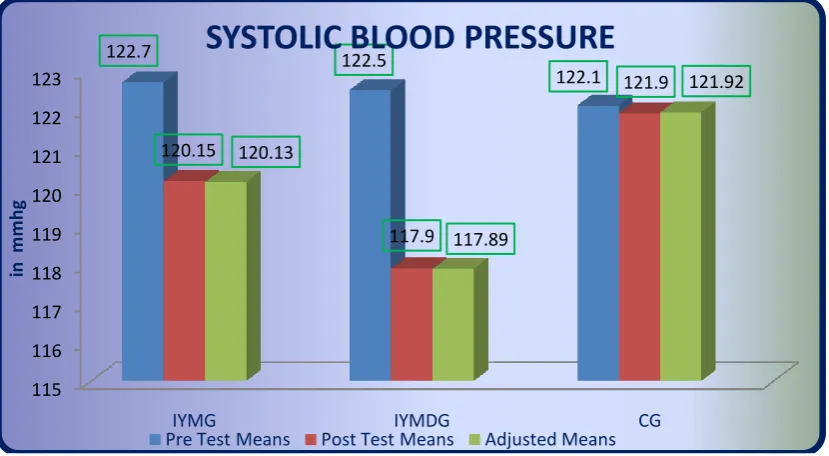
yoga module with diet and control group (4.03) at 0.05 level of confidence with the confidence interval value of 0.84. The pre, post and adjusted means on systolic blood pressure were presented through bar diagram for better understanding of the results of this study in figure-II.
Figure II. Pre post and adjusted post test differences of the, integrated yoga module, integrated yoga module and diet and control groups on systolic blood pressure
115 116 117 118 119 120 121 122 123
IYMG IYMDG CG
122.7 122.5
122.1
120.15
117.9
121.9
120.13
117.89
121.92
in
m
m
h
g
SYSTOLIC BLOOD PRESSURE
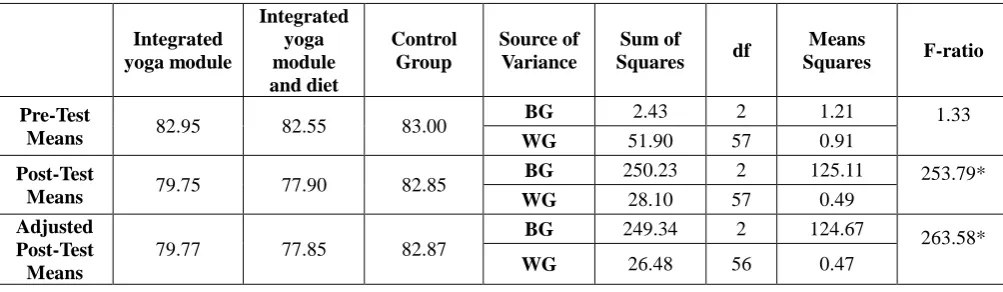
Table V. Computation of analysis of covariance of mean of integrated yoga module, integrated yoga module and diet and control groups on diastolic blood pressure
Integrated yoga module
Integrated yoga module and diet
Control Group
Source of Variance
Sum of
Squares df
Means
Squares F-ratio
Pre-Test
Means 82.95 82.55 83.00
BG 2.43 2 1.21 1.33
WG 51.90 57 0.91
Post-Test
Means 79.75 77.90 82.85
BG 250.23 2 125.11 253.79*
WG 28.10 57 0.49
Adjusted Post-Test Means
79.77 77.85 82.87
BG 249.34 2 124.67 263.58*
WG 26.48 56 0.47
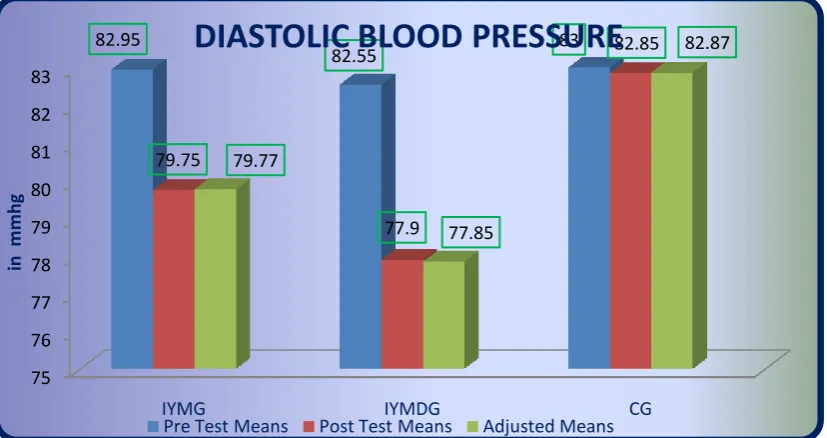
An examination of table - V indicated that the pre test means of integrated yoga module, integrated yoga module and diet and control groups were 82.95, 82.55 and 83.00 respectively. The obtained F-ratio for the pre-test was 1.33 and the table F-ratio was 3.15. Hence the pre-test mean F-ratio was insignificant at 0.05 level of confidence for the degree of freedom 2 and 57. This proved that there were no significant difference between the experimental and control groups indicating that the process of randomization of the groups was perfect while assigning the subjects to groups. The post-test means of the integrated yoga module, integrated yoga module and diet and control groups were 79.75, 77.90 and 82.85 respectively. The obtained F-ratio for the post-test was 253.79 and the table F-ratio was 3.15. Hence the post-test mean F-ratio was significant at 0.05
level of confidence for the degree of freedom 2 and 57. This proved that the differences between the post test means of the subjects were significant. The adjusted post-test means of the integrated yoga module, integrated yoga module and diet and control groups were 79.77, 77.85 and 82.87 respectively. The obtained F-ratio for the adjusted post-test means was 263.58 and the table F-ratio was 3.16. Hence the adjusted post-test mean F-F-ratio was significant at 0.05 level of confidence for the degree of freedom 2 and 56. This proved that there was a significant difference among the means due to the experimental trainings on diastolic blood pressure. Since significant differences were recorded, the results were subjected to post hoc analysis using Scheffe‟s post hoc test. The results were presented in table-VI.
Table VI. The scheffe‟s test for the differences between the adjusted post test paired means on diastolic blood pressure
Adjusted Post-test means Mean Difference Required CI Integrated yoga module Integrated yoga module and diet Control Group
79.77 77.85 --- 1.92* 0.56
79.77 --- 82.87 3.10*
--- 77.85 82.87 5.02*
* Significant at 0.05 level of confidence
The multiple comparisons showed in Table VI proved that there existed significant differences between the adjusted means of integrated yoga module and integrated yoga module with diet group (1.92), integrated yoga module and control group (3.10) and integrated
Figure III. Pre post and adjusted post test differences of the, integrated yoga module, integrated yoga module and diet and control groups on diastolic blood pressure
Conclusions
From the analysis of the data, the following conclusions were drawn:
1. The integrated yoga modules group had shown significant improvement in all the elected physiological variables among college female students after undergoing integrated yoga modules for a period of twelve weeks.
2. The integrated yoga modules with satvic diet group had shown significant improvement in all the elected physiological variables among college female students after undergoing integrated yoga modules with satvic diet for a period of twelve weeks.
3. The integrated yoga modules with satvic diet group had shown significant improvement in all the elected physiological variables among college female students than the integrated yoga module and control group.
References
1. Andre Van Lysebeth, (1987). Yoga Self – Taught, Delhi: Tarage Paper Back.
2. Chandrasekaran.K (2003). Yoga for Health, Delhi; Khel Sathiya Kendra.
3. Ganpat, T.S. & Nagendra, H.R. (2011). Integrated yoga therapy for improving mental health in managers. Ind Psychiatry J, 20:45-8.
4. Gunasheela, S., Jayashree, R., Malini, A., Nagarathna, R., Nagendra, H.R. & Rakhshani, A. (2013). Effect of the integrated approach of yoga therapy on platelet count and uric acid in pregnancy: A multicenter stratified randomized single-blind study. International Journal of Yoga, 6, 1, 39-46.
5. Iyengar, B.K.S. (1986). Light on Yoga. London: George Allen and Unwin Publishing Ltd.
6. Jesintha, R. & Parthiban, J. (2007). Influence of yogic practices on resting pulse rate breath holding time and cardio respiratory endurance of school Khokho players” paper presented at the international conference on “Metabolic Syndrome in Yoga and Naturopathy” Alagappa University,
Karaikudi.
7. Joshi.K (2001). Yogic Pranayama, New Delhi: Orient Paper Backs.
8. Padmanabhan, T.V & Dr.K.Chandrasekaran. (2015). Effect of Integrated Yoga Module on Somatic Cognitive and Affective Anxiety among Elderly Men Living in Old Age Homes.
International Journal of Recent Research and Applied Studies, 2, 11(2), 7 – 11.
9. Paul, T. (2013). Food Yoga - Nourishing Body, Mind & Soul, 2nd Edition.
10. Schuver, K.J. & Lewis, B.A. (2016). Mindfulness-based yoga intervention for women with depression. Complement Ther Med. 26:85-91. 11. Scott, G. (2002). The Ayurvedic Guide to
Diet, Chapter 8: The Sattvic Diet, pages 107-132. 12. Sengupta, P. (2012). Health Impacts of Yoga
and Pranayama: A State of the Art Review. Int J Prev Med. 3(7):444-58.
13. Singh, R.B. Reddy, K.K. Jan Fedacko, Fabien De Meester, Agnieszka Wilczynska and Wilson D.W. (2011). Ancient Concepts of Nutrition and the Diet in Hunter-gatherers. The Open Nutraceuticals Journal, 2011, 4, 130-135.
14. Swami Devaprasad (1998). Yoga for integral Health and Growth. Bangalore, N.B.C.L.C.
75 76 77 78 79 80 81 82 83
IYMG IYMDG CG
82.95
82.55 83
79.75
77.9
82.85
79.77
77.85
82.87
in
m
m
h
g
DIASTOLIC BLOOD PRESSURE
Pre Test Means Post Test Means Adjusted Means