Open Access
Research
Prefermentation improves xylose utilization in simultaneous
saccharification and co-fermentation of pretreated spruce
Magnus Bertilsson*, Kim Olofsson and Gunnar Lidén
Address: Department of Chemical Engineering, Lund University, Box 124, SE-221 00 Lund, Sweden
Email: Magnus Bertilsson* - [email protected]; Kim Olofsson - [email protected]; Gunnar Lidén - [email protected]
* Corresponding author
Abstract
Background: Simultaneous saccharification and fermentation (SSF) is a promising process option for ethanol production from lignocellulosic materials. However, both the overall ethanol yield and the final ethanol concentration in the fermentation broth must be high. Hence, almost complete conversion of both hexoses and pentoses must be achieved in SSF at a high solid content. A principal difficulty is to obtain an efficient pentose uptake in the presence of high glucose and inhibitor concentrations. Initial glucose present in pretreated spruce decreases the xylose utilization by yeast, due to competitive inhibition of sugar transport. In the current work, prefermentation was studied as a possible means to overcome the problem of competitive inhibition. The free hexoses, initially present in the slurry, were in these experiments fermented before adding the enzymes, thereby lowering the glucose concentration.
Results: This work shows that a high degree of xylose conversion and high ethanol yields can be achieved in SSF of pretreated spruce with a xylose fermenting strain of Saccharomyces cerevisiae
(TMB3400) at 7% and 10% water insoluble solids (WIS). Prefermentation and fed-batch operation, both separately and in combination, improved xylose utilization. Up to 77% xylose utilization and 85% of theoretical ethanol yield (based on total sugars), giving a final ethanol concentration of 45 g L-1, were obtained in fed-batch SSF at 10% WIS when prefermentation was applied.
Conclusion: Clearly, the mode of fermentation has a high impact on the xylose conversion by yeast in SSF. Prefermentation enhances xylose uptake most likely because of the reduced transport inhibition, in both batch and fed-batch operation. The process significance of this will be even greater for xylose-rich feedstocks.
Background
Simultaneous saccharification and fermentation (SSF) [1] has proved to be an interesting option for ethanol produc-tion from lignocellulosic materials [2]. Critical factors for the process economy are a high final ethanol concentra-tion in the fermentaconcentra-tion along with a high overall ethanol yield [3]. In order to increase the ethanol concentration, a
high content of water insoluble solids (WIS) is needed. At higher WIS contents, however, the concentrations of inhibitors and hexoses (inhibiting xylose uptake) will be higher. In addition, mixing problems may occur. These effects will probably be less pronounced in fed-batch SSF compared with the simple batch mode.
Published: 8 April 2009
Biotechnology for Biofuels 2009, 2:8 doi:10.1186/1754-6834-2-8
Received: 19 November 2008 Accepted: 8 April 2009
This article is available from: http://www.biotechnologyforbiofuels.com/content/2/1/8
© 2009 Bertilsson et al; licensee BioMed Central Ltd.
High overall ethanol yield requires conversion of all the sugars present, that is, both hexoses and pentoses, which can be achieved by, for example, genetically engineered
strains of Saccharomyces cerevisiae. Principally, genes
encoding xylose isomerase (XI) from bacteria and fungi [4,5], or genes encoding xylose reductase (XR) and xylitol dehydrogenase (XDH) from fungi [6,7] can be
intro-duced. A well-known problem in S. cerevisiae is that xylose
transport into the cell is inhibited by glucose, since xylose and glucose compete for the same transport systems [8,9] and the affinity for xylose is approximately 200-fold lower than for glucose [10]. Therefore, the glucose concentra-tion must be low in order to obtain efficient xylose uptake. Mannose, present in spruce hydrolyzate, is also known to inhibit xylose uptake. Due to the lower affinity for mannose this effect is, however, not as strong as with glucose [9]. In this work we only focus on glucose.
Nevertheless, it has been shown that glucose enhances xylose utilization at low but non-zero concentrations [11,12], which can be attributed to induction of trans-porter systems [11,13], induction of glycolytic enzymes [14] and improved co-factor generation [11]. The positive effects of glucose on xylose uptake make SSF an interest-ing process concept for co-fermentation. After pretreat-ment, hemicellulosic sugars, i.e. the pentoses (and also hexoses), are present as monomers while a large fraction of the glucose content is present as glucan fibres in the WIS. Thus, monomeric glucose is continuously released by the action of enzymes during the process, which could
favour pentose utilization. The xylose-utilizing strain of S.
cerevisiae used in this work, TMB3400 [15], has previously been used for SSF of lignocellulosic materials rich in xylose. Öhgren et al [16] improved the ethanol yield on pretreated corn stover at 10% WIS from 46% to 54% based on glucose and xylose, when Baker's yeast was replaced by TMB3400. In another study [17], it was found that the strain TMB3400 was to be preferred over the yeast
Pichia stipitis for SSF of pretreated sugarcane bagasse. A xylose utilization of about 40% was reported at 7.5% WIS and an ethanol yield on glucose and xylose of 59%. Good results have also recently been obtained on wheat straw [18] where about 40% of the xylose was utilized at 9% WIS giving an ethanol yield on glucose and xylose of 71%. In the case of spruce, the overall ethanol yield can be esti-mated to increase by about 8% if the xylose fraction is completely utilized in the SSF [19]. However, xylose con-version in spruce is expected to be challenging, due to the high glucose to xylose ratio. Furthermore, due to the rela-tively severe pretreatment conditions, the fermentability is expected to be lower in the spruce hydrolyzate [20].
In the current work, co-fermentation of glucose and xylose from pretreated spruce was studied using the xylose-fer-menting yeast TMB3400 in lab-scale SSF experiments. In
order to enhance the xylose uptake, the concept of prefer-mentation, that is, the fermentation of initially available free glucose in the liquid before addition of enzymes, was tested. The idea was to reduce the competitive inhibition on xylose uptake by hexoses in this way. Not only batch but also fed-batch experiments were carried out. The prin-cipal advantages of fed-batch relate to the lower viscosity during the process and the gradual addition of inhibitors and hexoses.
Methods
Raw material and pretreatment
Wood chips from spruce, about 2 to 10 mm in size, were provided by a Swedish sawmill (Widtsköfle Sågverk AB). The wood chips were impregnated in closed plastic bags
for 20 min with SO2 (2.5%w/w moisture). Subsequently,
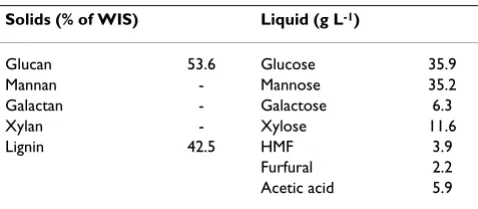
the impregnated chips were steam-pretreated batch-wise (1.5 kg chips per batch) at 210°C for 5 min in a 10 L reac-tor [21]. The pretreated material was then sreac-tored at 4°C. The composition of the slurry is shown in Table 1. The water-insoluble and liquid fractions were separated by pressing and vacuum filtering. The two fractions were ana-lyzed using NREL (National Renewable Energy Laborato-ries) standard procedures [22,23]. The WIS content of the slurry, measured by weighing the washed and dried (105°C) fibres, was 16.6%. Before the pretreated material was used for cultivation or SSF, 10 M NaOH was added to reach pH 4.9.
Cell cultivation
The recombinant xylose-fermenting strain S. cerevisiae
TMB3400 [15] was used in the SSF experiments. Yeast cells to be used in SSF were produced by aerobic batch tivation on glucose, followed by an aerobic fed-batch cul-tivation on spruce hydrolyzate liquid, in order to improve inhibitor tolerance by adaptation as previously shown by Alkasrawi et al [24].
The yeast was inoculated in 300 mL flasks containing 100
mL media supplemented with 16.5 g L-1 glucose, 7.5 g L-1
(NH4)2SO4, 3.5 g L-1 KH
2PO4, 0.74 g L-1 MgSO4·7H2O, 1
mL trace metal solution and 0.1 mL vitamin solution. The trace metal and vitamin solutions were prepared
accord-Table 1: Composition of the pretreated spruce material
Solids (% of WIS) Liquid (g L-1)
Glucan 53.6 Glucose 35.9 Mannan - Mannose 35.2 Galactan - Galactose 6.3
Xylan - Xylose 11.6
Lignin 42.5 HMF 3.9
Furfural 2.2 Acetic acid 5.9
ing to Taherzadeh et al [25]. The cells were grown for 24 h at 30°C and pH 5 in a rotary shaker at 160 rpm.
Aerobic batch cultivation was performed in a 2.5 L biore-actor (Biostat A, B. Braun Biotech International, Melsun-gen, Germany) at 30°C. The working volume was 0.7 L
and the medium contained 20.0 g L-1 glucose, 20.0 g L-1
(NH4)2SO4, 10.0 g L-1 KH
2PO4, 2.0 g L-1 MgSO4, 27.0 mL
L-1 trace metal solution and 2.7 mL L-1 vitamin solution.
The cultivation was initiated by adding 20.0 mL of the inoculum to the bioreactor. Aeration was maintained at
1.0 L min-1 and the stirrer speed was kept at 700 rpm.
Upon depletion of the ethanol produced in the batch phase, the feeding of liquid from the pretreated material was initiated. 1.0 L of the liquid fraction was added with
an initial feed rate of 0.04 L h-1 that was increased linearly
to 0.10 L h-1 during 16 h of cultivation. The aeration
dur-ing the fed-batch phase was maintained at 1.4 L min-1 and
the stirrer speed was kept at 700 rpm. The pH was main-tained at 5.0 throughout the cultivation, by automatic addition of 3 M NaOH.
After cultivation the cells were harvested by centrifugation in 700 mL flasks using a HERMLE Z 513K centrifuge (HERMLE Labortechnik, Wehingen, Germany). The pel-lets were resuspended in 0.9% NaCl solution in order to
obtain a cell suspension with a dry weight of 75 g L-1. The
time between cell harvest and initiation of the SSF was no longer than 4 h.
Simultaneous saccharification and fermentation
All SSF experiments were carried out in 2.5 L bioreactors (Biostat A, B. Braun Biotech International, Melsungen, Germany; Biostat A plus, Sartorius, Melsungen, Germany and BIOFLO III, New Brunswick Scientific, Edison, NJ, USA) with a final working weight of 1.4 kg. The batch experiments were carried out with a content of 7% or 10% WIS. The fed-batch experiments were performed with an initial WIS content of 6%, and slurry was added in equal pulses every fifth hour up to 20 h of fermentation. After the slurry additions, the total amount of slurry (initial and added amount) corresponded to a WIS content of 10%. All SSF experiments were carried out at 34°C for 96 h, and the pH was maintained at 5.0 throughout the fermenta-tion by automatic addifermenta-tion of 3 M NaOH. To obtain the desired WIS content, the slurry was diluted with sterile deionized water. The SSF medium was supplemented to
obtain 0.5 g L-1 NH
4H2PO4, 0.025 g L-1 MgSO4·7H2O and
1.0 g L-1 yeast extract. The experiments were initiated by
addition of a dry weight concentration of 4 g L-1 cells. The
enzyme preparation, Celluclast, was provided by Novozymes A/S, Bagsvaerd, Denmark, and had a cellulase
activity of 35 FPU g-1 and a β-glucosidase activity of 20 IU
g-1. This was used together with Novozyme 188
(Novozymes A/S, Bagsvaerd, Denmark) with a β
-glucosi-dase activity of 339 IU g-1. The amount of enzyme added
corresponded to a cellulase activity of 30 FPU g-1 glucan,
and a total β-glucosidase activity of 60 IU g-1 glucan.
Pre-fermentation was applied by adding the enzymes when
glucose was almost depleted (<1 g L-1), i.e. at 7 h in
exper-iments at 7% WIS and at 10 h and 3 h in batch and fed-batch experiments, respectively, at 10% WIS. Samples for high performance liquid chromatography (HPLC) analy-sis were taken repeatedly throughout the SSF.
Analysis
The cell mass concentration during the cell cultivation was measured in duplicates from 10 mL samples. The samples were centrifuged at 1000 × g for 7 min (Z200 A, HERMLE Labortechnik, Wehingen, Germany). The super-natants were discarded, and the pellets were washed with 0.9% NaCl solution and centrifuged a second time. The pellets were dried at 105°C overnight and subsequently weighed.
HPLC was used for analysis of the metabolites and sub-strates. Samples of the fermentation liquid were centri-fuged at 16,000 × g in 2 mL Eppendorf tubes for 5 min (Z 160 M, HERMLE Labortechnik, Wehingen, Germany).
The supernatant was filtered using 0.2 μm sterile filters
and the filtered samples were stored at -20°C. The sugar concentrations were determined using a polymer column (Aminex HPX-87P, Bio-Rad Laboratories, München, Ger-many) at 85°C. MilliQ-water was used as eluent, with a
flow rate of 0.6 mL min-1. Ethanol, glycerol, acetate, HMF
and furfural were analyzed using an Aminex HPX-87H column (Bio-Rad Laboratories, München, Germany) at
60°C. The eluent was 5 mM H2SO4 with a flow rate of 0.6
mL min-1. The compounds of interest were detected with
a refractive index detector (Waters 2410, Waters, Milford, MA, USA).
Yield calculations
The ethanol yield, YSE, was calculated based on the total
amount of fermentable sugars added to the SSF, i.e. the sum of available glucose, mannose, galactose and xylose present in the slurry, including both monomers and oli-gomers in the liquid and glucan fibres in the WIS. The the-oretical weight of glucose released during the hydrolysis was (due to the addition of water) 1.11 times the weight of glucan. By using a maximal theoretical ethanol yield of
0.51 g g-1 (yield for hexoses) the percentage of the
theoret-ical yield was defined as Y*SE = 100*YSE/0.51. When our
results are related to previous results with Baker's yeast, the yields are given on available hexoses (glucose, man-nose and galactose) only, in order to be comparable.
Results
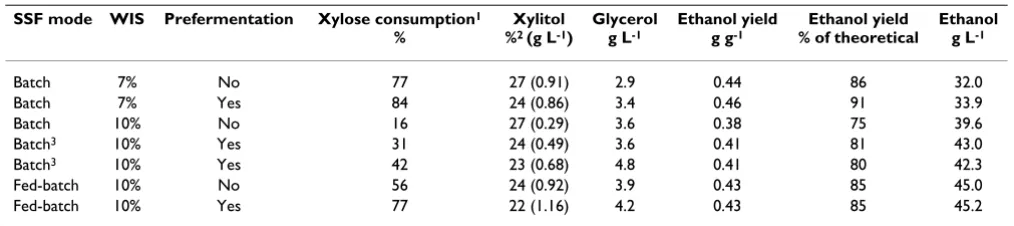
studied in batch experiments at 7% WIS, and in both batch and fed-batch experiments at 10% WIS. Prefermen-tation was investigated as a means to decrease the glucose level and improve the xylose conversion (Table 2).
Batch SSF at 7% WIS
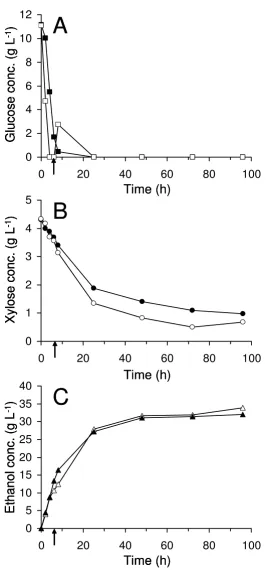
At 7% WIS, the glucose concentration was quickly reduced
to 0 g L-1 within 24 h. The glucose level was then
main-tained at this level throughout the SSF in both experi-ments (Figure 1A). After 96 h, 77% of the xylose was utilized without applying prefermentation. An ethanol
concentration of 32.0 g L-1 was achieved, corresponding to
a yield of 0.44 g g-1 on total sugars (86% of the theoretical
yield). By applying prefermentation, a xylose utilization as high as 84% was achieved (Figure 1B). The difference in final xylose concentration was however low compared with the total sugar content.
Batch SSF at 10% WIS
In a commercial bioethanol process, it is desirable that the substrate load is higher than 7% WIS. Experiments were conducted also at 10% WIS, but not at higher WIS content due to limitations of mixing and fermentability. As expected, the utilization of xylose was lower than at 7% WIS, and only 16% of the xylose was utilized in the exper-iment without prefermentation at 10% WIS. The final
eth-anol concentration reached 39.6 g L-1 and the ethanol
yield was 0.38 g g-1 on total fermentable sugars,
corre-sponding to 75% of the theoretical yield. Prefermentation at 10% WIS resulted as intended in lower glucose concen-tration throughout the fermentations (Figure 2A) accom-panied by higher xylose conversions (Figure 2B). In these experiments (with prefermentation) 31% and 42% of the xylose was taken up respectively. This resulted in ethanol
yields of about 0.41 g g-1 on total fermentable sugars, or
about 80% of the theoretical yield in both experiments (Table 2). The increased ethanol yield, when preferment-ing the initial sugars, was partly due to the improved xylose utilization, but may also be partly explained by a slightly higher hexose conversion in these experiments.
However, the measured final concentrations of sugars in these experiments do not completely explain the higher ethanol (and by-product formations) in the case of prefer-mentation, indicating that more glucose must have been released from the fibres in these experiments.
Fed-batch SSF at 10% WIS
The glucose concentration in the reactor can be further controlled by running the SSF in a fed-batch mode, that is, with the pretreated material added gradually, either con-tinuously or (as in this case) at specific time points during the experiments. The fed-batch experiments resulted in higher xylose conversions than the batch experiments. Also in fed-batch operation, prefermentation seemed to improve the xylose consumption (Figure 3B) and 77% of the xylose was taken up. An ethanol yield of 85% of the theoretical yield was achieved.
Discussion
Simultaneous co-fermentation and saccharification of
spruce using the recombinant strain S. cerevisiae TMB3400
was experimentally investigated in the current study. Co-fermentation of xylose and glucose is a rather challenging task, given the high ratio of glucose to xylose in the spruce material itself. The concept of prefermentation, that is, the idea to initially convert the free glucose in the medium before adding enzymes, was therefore introduced in order to improve xylose uptake in SSF. This was also combined with fed-batch, which provides a further degree of free-dom in terms of affecting the free glucose to xylose ratio.
In SSF at 7% WIS, the xylose was extensively taken up, both when the enzymes were added initially and when prefermentation was applied (Table 2), resulting in high ethanol yields. In these experiments, the competitive glu-cose inhibition of xylose uptake was reduced at an early stage, due to relatively low amount of initial glucose and inhibitors. Thus, in this case prefermentation becomes less important. In this experiment xylose uptake seemed to be boosted rather than inhibited by the small glucose
Table 2: Ethanol yields and concentrations of metabolites obtained after 96 h
SSF mode WIS Prefermentation Xylose consumption1
%
Xylitol
%2 (g L-1)
Glycerol
g L-1
Ethanol yield
g g-1
Ethanol yield % of theoretical
Ethanol
g L-1
Batch 7% No 77 27 (0.91) 2.9 0.44 86 32.0
Batch 7% Yes 84 24 (0.86) 3.4 0.46 91 33.9
Batch 10% No 16 27 (0.29) 3.6 0.38 75 39.6
Batch3 10% Yes 31 24 (0.49) 3.6 0.41 81 43.0
Batch3 10% Yes 42 23 (0.68) 4.8 0.41 80 42.3
Fed-batch 10% No 56 24 (0.92) 3.9 0.43 85 45.0 Fed-batch 10% Yes 77 22 (1.16) 4.2 0.43 85 45.2
1Related to total amount of available xylose. 2Xylitol formation related to consumed xylose.
Measured concentrations in batch SSF at 7% WIS
Figure 1
Measured concentrations in batch SSF at 7% WIS. Glucose concentration (A), xylose concentration (B) and ethanol concentration (C). Filled symbols represent experiment without prefermentation and unfilled symbols represent experiment with prefermentation. The time of enzyme addition, in the case of prefermentation, is marked with an arrow.
0
5
10
15
20
25
30
35
40
0
20
40
60
80
100
0
1
2
3
4
5
0
20
40
60
80
100
0
2
4
6
8
10
0
20
40
60
80
100
Time (h)
Time (h)
Glucos
e
c
onc. (g L
-1
Xylose
conc. (g L
-1
)
Ethanol
conc. (g L
-1
)
A
C
B
12
Time (h)
)
0
5
10
15
20
25
30
35
40
0
20
40
60
80
100
0
1
2
3
4
5
0
20
40
60
80
100
0
2
4
6
8
10
0
20
40
60
80
100
Time (h)
Time (h)
Time (h)
Time (h)
Glucos
e
c
onc. (g L
-1
Xylose
conc. (g L
-1
)
Ethanol
conc. (g L
-1
)
Glucos
e
c
onc. (g L
-1
Xylose
conc. (g L
-1
)
Ethanol
conc. (g L
-1
)
A
C
B
A
C
B
12
Time (h)
Time (h)
Measured concentrations in batch SSF at 10% WIS
Figure 2
Measured concentrations in batch SSF at 10% WIS. Glucose concentration (A), xylose concentration (B) and ethanol concentration (C). Filled symbols represent experiment without prefermentation and unfilled symbols represent duplicate experiments with prefermentation. The time of enzyme addition, in the case of prefermentation, is marked with an arrow.
0
1
2
3
4
5
6
7
8
0
20
40
60
80
100
0
5
10
15
20
0
20
40
60
80
10
25
0
0
5
10
15
20
25
30
35
40
45
50
Time (h)
Time (h)
Glucose
conc. (g L
-1
Xylose
conc. (g L
-1
)
Ethanol
conc. (g L
-1
)
0
20
40
60
80
100
Time (h)
)
A
C
B
0
1
2
3
4
5
6
7
8
0
20
40
60
80
100
0
5
10
15
20
0
20
40
60
80
10
25
0
0
5
10
15
20
25
30
35
40
45
50
Time (h)
Time (h)
Time (h)
Time (h)
Glucose
conc. (g L
-1
Xylose
conc. (g L
-1
)
Ethanol
conc. (g L
-1
)
Glucose
conc. (g L
-1
Xylose
conc. (g L
-1
)
Ethanol
conc. (g L
-1
)
0
20
40
60
80
100
Time (h)
Time (h)
))
A
A
C
B
Measured concentrations in fed-batch SSF at 10% WIS
Figure 3
Measured concentrations in fed-batch SSF at 10% WIS. Glucose concentration (A), xylose concentration (B) and etha-nol concentration (C). Filled symbols represent experiment without prefermentation and unfilled symbols represent experi-ment with preferexperi-mentation. The time of enzyme addition, in the case of preferexperi-mentation, is marked with an arrow.
0
2
4
6
8
10
0
20
40
60
80
10
12
0
0
1
2
3
4
5
0
20
40
60
80
100
0
5
10
15
20
25
30
35
40
45
50
Glucose
c
onc. (g L
-1
Xylose
c
onc. (g L
-1
)
Ethanol
conc. (g L
-1
)
Time (h)
Time (h)
C
B
0
20
40
60
80
100
)
Time (h)
A
0
2
4
6
8
10
0
20
40
60
80
10
12
0
0
1
2
3
4
5
0
20
40
60
80
100
0
5
10
15
20
25
30
35
40
45
50
0
20
40
60
80
100
0
2
4
6
8
10
0
20
40
60
80
10
12
0
0
1
2
3
4
5
0
20
40
60
80
100
0
5
10
15
20
25
30
35
40
45
50
Glucose
c
onc. (g L
-1
Xylose
c
onc. (g L
-1
)
Ethanol
conc. (g L
-1
)
Glucose
c
onc. (g L
-1
Xylose
c
onc. (g L
-1
)
Ethanol
conc. (g L
-1
)
Time (h)
Time (h)
Time (h)
Time (h)
C
B
C
B
0
20
40
60
80
100
))
Time (h)
Time (h)
A
overshoot that appeared after enzyme addition (Figure 1) in the case of prefermentation. Previous studies on spruce with Baker's yeast have resulted in 91% of theoretical eth-anol yield on hexoses (glucose, mannose and galactose) at 5% WIS [26] and 92% at 8% WIS [24]. Due to extensive xylose utilization in this study, 97% of theoretical ethanol yield was achieved.
In batch SSF at 10% WIS, TMB3400 exhibited difficulties in completely fermenting glucose within 96 h in the ordi-nary batch experiment (Figure 2A). A residual
concentra-tion of about 2 g L-1 was still found at the end of the
experiment. The xylose uptake, in percent, at this high WIS concentration was much lower compared with when 7% WIS was used. The main reason is probably the large amount of glucose available. By increasing the WIS con-tent, the concentrations of various inhibitors from the pretreatment are also increased, which most likely also lowers the fermentability. The batch experiment at 10% WIS with prefermentation was run in duplicate (Figure 2) to allow for estimation of variances. The standard devia-tion of the final xylose uptake and ethanol concentradevia-tion was estimated to be <20% and <2% of the respective means. These experiments also illustrate the difficulty of reproducing the exact glucose profile from the time of enzyme addition when carrying out prefermentation experiments. This can possibly be due to the glucose-sens-ing mechanisms in yeast (for example, induction of hex-ose transporters) [27]. When gluchex-ose concentration approaches zero, small differences in concentration at the time of enzyme addition, may highly influence the uptake rate, giving rise to different degrees of glucose accumula-tion.
However, at 10% WIS, prefermentation had a considera-ble effect, resulting in lower glucose levels which signifi-cantly enhanced the xylose consumption from 16% to 31% and 42%, respectively. In addition, slightly more glu-cose seemed to be released from the fibres. Thus, prefer-mentation possesses another possible advantage – it may reduce the end-product inhibition of cellulases, allowing more efficient hydrolysis. These two effects together prob-ably account for the higher ethanol yield in the case of prefermentation.
An alternative explanation may be the mechanisms of sugar transporter inactivation. Non-growing cells exhibit inactivation of the sugar transporters [28] in the presence of a fermentable carbon source. However, if no carbon source is available, catabolite inactivation does not occur [29], or occurs only marginally [30]. There are previous indications that no growth occurs in SSF of spruce at high WIS content [31]. The rapid hexose depletion in the case of prefermentation could therefore reduce the effect of catabolite inactivation. In contrast, when prefermentation
is not applied, catabolite inactivation of sugar transporters may be a reason for lower xylose uptake and incomplete hexose fermentation.
Batch experiments on other spruce materials have indi-cated that in harsher environments, prefermentation does not always improve the overall SSF. However, xylose uptake is consistently enhanced by prefermentation dur-ing the initial 24 h also in these materials.
Previously, Rudolf et al [31] carried out SSF of spruce at 10% WIS using Baker's yeast, and ethanol yields of 80 to 84% on hexoses for batch SSF were reported. In this study, corresponding batch yields were 79 to 86%. Thus, despite partial xylose utilization, SSF of spruce with TMB3400 did not necessarily improve the ethanol yields in batch exper-iments at 10% WIS. The relatively low xylose content in spruce, and by-product formation, may explain this absence of improvement in batch. TMB3400 has been shown to produce more glycerol than Baker's yeast, which reduces the ethanol formed from xylose [32].
In agreement with previous SSF studies with TMB3400 using other feedstocks [16,18], the fed-batch strategy yielded the highest xylose uptakes at 10% WIS. This can be principally explained by the lower glucose levels, and the lower concentrations of toxic compounds. In the present study, 77% xylose conversion and as high yields as 85% of theoretical on total sugars (90% calculated based on
hexoses) or 45.2 g L-1 ethanol were achieved within 96 h
when combining fed-batch and prefermentation. Yields of 78 to 84% on hexoses have previously been reported from similar fed-batch experiments with Baker's yeast [31]. Thus, when using the fed-batch strategy TMB3400 gives higher yields than ordinary Baker's yeast. Prefermen-tation improved xylose transport, also in these experi-ments, although this extra xylose consumption led mostly to by-products. Hence, there is a need for further engineer-ing of the yeast in order to effectively utilize the xylose that is taken up.
concentra-tion and thereby promote good xylose uptake condiconcentra-tions at an early stage of the SSF. The process can potentially be further improved to achieve optimal co-fermentation con-ditions by balancing the formation rate (by the action of enzymes) and consumption rate of glucose (by fermenta-tion). This involves optimizing the enzyme addition, the feed of enzymes, the feed of substrate – and perhaps even a feed of yeast. In addition, the possible effects of man-nose on the xylose uptake should also be considered in future work on mannose-rich materials.
Conclusion
This work shows that although pretreated spruce contains high levels of glucose and considerably less xylose, a high degree of xylose conversion can be obtained with the xylose-fermenting yeast strain TMB3400 in SSF at high WIS contents. Thereby higher ethanol yields than with ordinary Baker's yeast are possible. Furthermore, by pre-fermentation of initial hexoses, xylose uptake can be improved in SSF. The main benefits of prefermentation are, however, expected in other more xylose-rich materi-als.
Competing interests
The authors declare that they have no competing interests.
Authors' contributions
MB carried out the major part of the experimental work and made a first draft. KO carried out part of the experi-mental work. GL initiated the study, set the overall goals of the work and contributed to the design of the study. All authors were actively contributing to the discussion, dur-ing the whole work, and the preparation of the final man-uscript. All authors have read and approved the final manuscript.
Acknowledgements
We want to thank our colleagues at the Department of Applied Microbiol-ogy, Lund University, for valuable discussions and for providing the xylose-fermenting strain. This work was financially supported by the Swedish Energy Agency.
References
1. Takagi M, Abe S, Suzuki S, Emert GH, Yata N: A method for pro-duction of alcohol directly from cellulose using cellulase and yeast. Bioconversion Symposium; New Dehli, India 1977:551-571. 2. Wingren A, Galbe M, Zacchi G: Techno-economic evaluation of
producing ethanol from softwood: Comparison of SSF and SHF and identification of bottlenecks. Biotechnol Prog 2003, 19:1109-1117.
3. von Sivers M, Zacchi G: Ethanol from lignocellulosics: a review of the economy. Bioresour Technol 1996, 56:131-140.
4. Karhumaa K, Hahn-Hägerdal B, Gorwa-Grauslund MF: Investiga-tion of limiting metabolic steps in the utilizaInvestiga-tion of xylose by recombinant Saccharomyces cerevisiae using metabolic engi-neering. Yeast 2005, 22:359-368.
5. Kuyper M, Hartog MMP, Toirkens MJ, Almering MJH, Winkler AA, van Dijken JP, Pronk JT: Metabolic engineering of a xylose-iso-merase-expressing Saccharomyces cerevisiae strain for rapid anaerobic xylose fermentation. FEMS Yeast Res 2005, 5:399-409.
6. Kötter P, Amore R, Hollenberg CP, Ciriacy M: Isolation and char-acterization of the Pichia stipitis xylitol dehydrogenase gene, XYL2, and construction of a xylose-utilizing Saccharomyces cerevisiae transformant. Curr Genet 1990, 18:493-500.
7. Eliasson A, Christensson C, Wahlbom CF, Hahn-Hägerdal B: Anaer-obic xylose fermentation by recombinant Saccharomyces cer-evisiae carrying XYL1, XYL2, and XKS1 in mineral medium chemostat cultures. Appl Environ Microbiol 2000, 66:3381-3386. 8. Kilian SG, Uden N: Transport of xylose and glucose in the
xylose-fermenting yeast Pichia stipitis. Appl Microbiol Biotechnol 1988, 27:545-548.
9. Meinander NQ, Hahn-Hägerdal B: Influence of cosubstrate con-centration on xylose conversion by recombinant, XYL1-expressing Saccharomyces cerevisiae: a comparison of differ-ent sugars and ethanol as cosubstrates. Appl Environ Microbiol 1997, 63:1959-1964.
10. Kötter P, Ciriacy M: Xylose fermentation by Saccharomyces cer-evisiae. Appl Microbiol Biotechnol 1993, 38:776-783.
11. Pitkänen J-P, Aristidou A, Salusjärvi L, Ruohonen L, Penttilä M: Met-abolic flux analysis of xylose metabolism in recombinant Sac-charomyces cerevisiae using continuous culture. Metab Eng 2003, 5:16-31.
12. Meinander NQ, Boels I, Hahn-Hägerdal B: Fermentation of xylose/glucose mixtures by metabolically engineered Sac-charomyces cerevisiae strains expressing XYL1 and XYL2 from Pichia stipitis with and without overexpression of TAL1.
Bioresour Technol 1999, 68:79-87.
13. Bertilsson M, Andersson J, Lidén G: Modeling simultaneous glu-cose and xylose uptake in Saccharomyces cerevisiae from kinetics and gene expression of sugar transporters. Bioprocess Biosyst Eng 2008, 31:369-377.
14. Boles E, Müller S, Zimmermann FK: A multi-layered sensory sys-tem controls yeast glycolytic gene expression. Mol Microbiol 1996, 19:641-642.
15. Wahlbom CF, van Zyl WH, Jonsson LJ, Hahn-Hägerdal B, Otero RRC: Generation of the improved recombinant xylose-utilizing
Saccharomyces cerevisiae TMB 3400 by random mutagenesis and physiological comparison with Pichia stipitis CBS 6054.
FEMS Yeast Res 2003, 3:319-326.
16. Öhgren K, Bengtsson O, Gorwa-Grauslund MF, Galbe M, Hahn-Häg-erdal B, Zacchi G: Simultaneous saccharification and co-fer-mentation of glucose and xylose in steam-pretreated corn stover at high fiber content with Saccharomyces cerevisiae
TMB3400. J Biotechnol 2006, 126:488-498.
17. Rudolf A, Baudel H, Zacchi G, Hahn-Hägerdal B, Lidén G: Simulta-neous saccharification and fermentation of steam-pre-treated bagasse using Saccharomyces cerevisiae TMB3400 and Pichia stipitis CBS6054. Biotechnol Bioeng 2008, 99:783-790. 18. Olofsson K, Rudolf A, Lidén G: Designing simultaneous
sacchar-ification and fermentation for improved xylose conversion by a recombinant strain of Saccharomyces cerevisiae. J Biotech-nol 2008, 134:112-120.
19. Sassner P, Galbe M, Zacchi G: Techno-economic evaluation of bioethanol production from three different lignocellulosic materials. Biomass Bioenerg 2008, 32:422-430.
20. Palmqvist E, Hahn-Hägerdal B: Fermentation of lignocellulosic hydrolysates. II: inhibitors and mechanisms of inhibition.
Bioresour Technol 2000, 74:25-33.
21. Stenberg K, Tengborg C, Galbe M, Zacchi G: Optimisation of steam pretreatment of SO2-impregnated mixed softwoods for ethanol production. J Chem Tech Biotechnol 1998, 71:299-308. 22. Sluiter A, Hames B, Ruiz R, Scarlata C, Sluiter J, Tempelton D: Deter-mination of structural carbohydrates and lignin in biomass. NREL, Golden, CO; 2004.
23. Ruiz R, Ehrman T: Dilute acid hydrolysis procedure for deter-mination of total sugars in the liquid fraction of process sam-ples. NREL, Golden, CO; 1996.
24. Alkasrawi M, Rudolf A, Lidén G: Influence of strain and cultiva-tion procedure on the performance of simultaneous saccha-rification and fermentation of steam pretreated spruce.
Enzyme Microb Technol 2006, 38:279-287.
25. Taherzadeh MJ, Lidén G, Gustafsson L, Niklasson C: The effects of pantothenate deficiency and acetate addition on anaerobic batch fermentation of glucose by Saccharomyces cerevisiae.
Publish with BioMed Central and every scientist can read your work free of charge
"BioMed Central will be the most significant development for disseminating the results of biomedical researc h in our lifetime."
Sir Paul Nurse, Cancer Research UK
Your research papers will be:
available free of charge to the entire biomedical community
peer reviewed and published immediately upon acceptance
cited in PubMed and archived on PubMed Central
yours — you keep the copyright
Submit your manuscript here:
http://www.biomedcentral.com/info/publishing_adv.asp
BioMedcentral 26. Söderström J, Galbe M, Zacchi G: Separate versus simultaneous
saccharification and fermentation of two-step pretreated softwood for ethanol production. J Wood Chem Technol 2005, 25:187-202.
27. Özcan S, Dover J, Johnston M: Glucose sensing and signaling by two glucose receptors in the yeast Saccharomyces cerevisiae.
EMBO J 1998, 17:2566-2573.
28. Lagunas R, Dominguez C, Busturia A, Sáez M: Mechanisms of appearance of the Pasteur effect in Saccharomyces cerevisiae: Inactivation of sugar transport systems. J Bacteriol 1982, 152:19-25.
29. Busturia A, Lagunas R: Catabolite inactivation of the glucose transport system in Saccharomyces cerevisiae. J Gen Microbiol 1986, 132:379-385.
30. Alonso A, Kotyk A: Apparent half-lives of sugar transport pro-teins in Saccharomyces cerevisiae. Folie Microbiol 1978, 23:118-125.
31. Rudolf A, Alkasrawi M, Zacchi G, Lidén G: A comparison between batch and fed-batch simultaneous saccharification and fer-mentation of steam pretreated spruce. Enzyme Microb Technol 2005, 37:195-205.