1 1
2 3
Applied Animal Behaviour Science
Doi: 10.1016/j.applanim.2008.02.005
Final revision – NOT EDITED by the journal
45
6
7
8 9 10 11 12 13 14 15 16 17 18 19 20 21 22 23 24
Effects of cage-cleaning frequency on laboratory rat
reproduction, cannibalism, and welfare
Charlotte C. Burn1* and Georgia J. Mason2
1
Department of Zoology, University of Oxford, South Parks Road, Oxford OX1 3PS, UK and 2Department of Animal & Poultry Science, University of Guelph, Ontario,
N1G 2W1, Canada
Running title: Cage-cleaning frequency effects on breeding rats
2 25
26 27 28 29 30 31 32 33 34 35 36 37 38 39 40 41 42 43 44 45 46 47 48
Abstract
Regular cage-cleaning is important for health, but for breeding rats it disrupts the nest and removes olfactory signals important for parental care. To investigate how
different cage-cleaning frequencies affect breeding rats' health and welfare, we monitored reproductive output, pup mortality, pup sex-ratios, parental
chromodacryorrhoea and in-cage ammonia levels for rats in a commercial breeding facility. Cages were cleaned twice-weekly, once-weekly or every two weeks (18 cages/group), replicated in two buildings, for the entire 36-week reproductive period. Frequent cage-cleaning had no clear benefits or major negative effects, showing no significant reductions in ammonia levels, or affects on health or overall pup mortality. However, frequent cage-cleaning slightly but significantly increased cannibalistic behaviour. This was because: (i) vulnerable 0-2 day old pups were more likely to be exposed to a cage-cleaning event in the more frequent cage-cleaning regimes, physically disturbing them, and disrupting the nest and scent marks; and (ii) in the twice-weekly and weekly-cleaned groups, pups under 2 days old at their first cage-cleaning were more likely to be cannibalised. Possible mechanisms behind these effects are discussed, including that cleaning might induce premature births, or stress the parents through noise or olfactory and physical disturbance. Finally, the cage-cleaning frequency producing most pups differed between the two buildings – an interactive effect corroborating previous findings that same-strain rodents’ phenotypes can differ with environment. Overall, we suggest that for breeding rats, cage-cleaning regimes should minimise noise, dissemination of unfamiliar conspecific odours, and physical disturbance during very late pregnancy and the first few days following birth.
3 49
50 51 52 53 54 55 56 57 58 59 60 61 62 63 64 65 66 67 68 69 70 71 72
1.
Introduction
Cleaning of animals’ cages or enclosures is necessary for almost all captive animals, whether they are kept in laboratories, farms, or zoos, or as pets, to prevent waste products accumulating to harmful or aversive levels. More frequent cleaning of rodent cages can reduce ammonia levels (Carissimi et al., 2000; Reeb-Whitaker et al., 2001; Burn et al., 2006a) and microbial counts (Borrello et al., 1998), and increase rodent health (e.g. Cisar & Jayson, 1967; Van Winkle & Balk, 1986). However,
cage-cleaning almost always involves temporary displacement of each animal, physical and olfactory disruption of the ‘home’ environment, and human contact, which could each cause stress. Cage-cleaning does indeed cause acute increases in arousal and possibly transient stress in diverse species including rhesus macaques (Line et al., 1989), mice (Gray & Hurst, 1995; but see Blom et al., 1993), hamsters (Conn et al., 1990;
Gattermann & Weinandy, 1996), rats (Saibaba et al., 1996; Schnecko et al., 1998; Duke et al., 2001; Sharp et al., 2002; Burn et al., 2006b) and snakes (Chiszar et al., 1980).
Whether frequent cage-cleaning causes chronic or cumulative stress is far less certain. In mice, two studies found that cleaning mouse cages more frequently
increases pup mortality (Chantry, 1964; Reeb-Whitaker et al., 2001). Breeding mice whose cages were cleaned more frequently also tended to have higher corticosterone concentrations (Reeb-Whitaker et al., 2001). Even merely disturbing breeding mice, by regularly lifting the cage-lid and inspecting the hidden individuals, caused a strong trend towards poorer breeding success (Peters et al., 2002).
4 73
74 75 76 77 78 79 80 81 82 83 84 85 86 87 88 89 90 91 92 93 94 95 96
little evidence that it is a cause for concern in those animals (Burn, 2006; Burn et al., 2006a; Burn et al., 2006b). However, one small-scale study of breeding rats did find indications that cage-cleaning has long-term effects. That work involved six Osborne-Mendel females per treatment (Cisar & Jayson, 1967). More pups were successfully weaned, they weighed more, and fewer needed to be culled by the experimenters in the twice-weekly cage-cleaned group than those in the weekly cleaned group. However, cannibalism was more frequent in the twice-weekly cleaned group.
Our aim here was to investigate how cage-cleaning frequency affects the general health, welfare, and reproductive success of breeding rats and their pups on a large scale. Even if non-breeding rats are little affected by
frequent-cage-cleaning (Burn, 2006; Burn et al., 2006a; Burn et al., 2006b), we were concerned that breeding rat populations could be more affected, for a number of reasons. Firstly, olfactory signals are very important in rat parental care. These include the pheromone, diodecyl proprionate, produced from the pup preputial gland to induce maternal licking (Brouettelahlou et al., 1991); odours produced by dams that prevent cohabiting males from killing pups (Mennella & Moltz, 1988), and that guide pups to the nipples (Porter & Winberg, 1999); and scents deposited in the bedding by the dams that reduce pup activity levels, keeping them in the nest (Porter & Winberg, 1999). Cage-cleaning could directly remove some of those signals (Mennella & Moltz, 1988; Porter & Winberg, 1999), and/or mask them with odours from human hands or gloves (including scents from previously handled rats). Furthermore, rodent cage-cleaning is accompanied by loud noise (Gamble, 1982; Voipio et al., 2006), physical
5 97
98 99 100 101 102 103 104 105 106 107 108 109 110 111 112 113 114 115 116
the nest structure, and involves transferring pups to a temporarily colder environment (e.g. Chantry, 1964; Lee & Williams, 1975). Acute physical stressors such as these could trigger neglect and/or cannibalism of pups (Lane Petter, 1968). In the longer-term, if frequent cage-cleaning causes chronic stress to the parents, this could also reduce their fertility (Boice, 1972), reduce pup birth weights and increase mortality rates (e.g. Cabrera et al., 1999).
Rats comprise 20% of all laboratory animals used in Europe (Commission of the European Communities, 2003) and about 14% of those in Canada (Canadian Council on Animal Care, 2001);thusany findings relevant to their health, welfare, and productivity would have implications for a large number of animals, in both commercial and research facilities.Here, we assessed the effects of twice-weekly, weekly and fortnightly cage-cleaning on the rats of a commercial breeding company (Harlan, Bicester, UK). We used outbred albino Wistars, chosen because they are one of the most commonly used stocks in the UK, and because they are pair-mated (rather than harem-mated), enabling us to follow the lifetime breeding performance of
6 117
118 119 120 121 122 123 124 125 126 127 128 129 130 131 132 133 134 135 136 137 138 139 140
2.
Materials and methods
2.1. Animals and housing
The study animals were 108 pairs of Wistar (HsdBrlHan:WIST) rats, consisting of 54 pairs housed in each of two similar buildings (‘A’ and ‘B’) maintained under
commercial, barrier conditions. The cages were polypropylene (51 x 32 x 20 cm, L x W x H) with a stainless steel mesh lid. Each cage contained autoclaved Lignocel 3-4 sawdust (J. Rettenmaier & Söhne, Holzmühle, Germany), to a depth of about 2 cm. They were provided with pelleted chow (2018S sterilisable, Harlan Teklad, Bicester, UK) ad libitum, and water was constantly available from an automatic system. The temperature and humidity were 19-21oC and 55 +/- 1 %, respectively. The light:dark cycle was 12:12 h, with 2 h dawn and dusk periods (only half the lights were on).
In Building A there were approximately 6200 adult rats plus pre-weanling offspring (BN/SsN, LE and LH) and in Building B there were 6000 (all
HsdBrlHan:WIST). Obvious differences between the buildings were that the colony in A was populated in 2001 and all rats were kept in polypropylene cages, while B was populated in 2004 and rats outside the current study were kept in wire-bottomed cages. The individual staff also differed between the buildings.
The study was staggered between the two buildings, with Building A being 1 month ahead of Building B. Pairs were formed at 10 weeks of age. The experiment continued for the commercial lifetimes of the pairs, which is 9 months (36 weeks). Pups were weaned between 19 and 26 days of age (depending on their weight) at cage-cleaning, as is standard practice.
7 141
142 143 144 145 146 147 148 149 150 151 152 153 154
155 156 157 158 159 160 161 162 163 164
per treatment in each building).Cages were cleaned by replacing the cage bases and bedding with fresh ones, but the cage lids were retained. Cage emptying was carried out manually on an unventilated table. The rats were always handled by the same technician. Due to the scale of the technicians’ work in this commercial facility, randomising the positions of cages or the cleaning sequence proved to be logistically unmanageable, so cages were instead arranged within same-treatment racks. The tier-positions of cages within the racks, which are known to affect rat behaviour and physiology (e.g. Rao, 1991; Reinhardt, 2004; Izídio et al., 2005), were balanced across treatments, but the replication across the two buildings was especially worthwhile to help control for unknown rack effects.
The animals were cared for in accordance with the code of practice for the housing and care of animals in designated breeding and supplying establishments (Home Office, 1995), and was approved by the local ethical review process at the University of Oxford.
2.2. Data collection
8 165
166 167 168 169 170 171 172 173 174 175 176 177 178 179 180 181 182 183 184 185 186 187 188
were recorded as ‘stillborn’, ‘eaten by the parents’, ‘missing’, ‘found dead’ or, in the case of cage-flooding, ‘wet’.
After 4 months in each building, ammonia concentrations were measured in each cage. A pump with Gastec glass measuring tubes with a range of 0.5–60 ppm were used (Anachem Ltd., Bedfordshire, UK). These were inserted in through the door in the top of the cage, and the measurements were taken in the centre of the cage just above the sawdust. Measurements were taken on the day before all cages were cleaned, so the fortnightly cleaned cages had 13 days of soiling, contrasting with the twice-weekly cleaned ones, which had only 2–3 days of soiling.
Both parents’ noses were scored for chromodacryorrhoea – ‘red/bloody tears’, a Harderian gland secretion that increases in a variety of aversive situations in rats (Harkness & Ridgway, 1980; Mason et al., 2004; Burn, 2006) – by an experienced experimenter, wearing a powered respirator due to rodent allergy. This took place 8 months into the project because older rats produce more chromodacryorrhoea than young ones (Harkness & Ridgway, 1980), and hence the secretion is more visible. Scoring was carried out in Building B alone, because it was not possible to enter both buildings within the necessary timescale due to potential disease transfer (particularly since the respirator could not be completely sterilised). The observer tapped gently with a pen on the front of each cage to encourage the rats to present their noses for inspection. The method used for scoring was on a 6-point scale (0-5), as described elsewhere (Burn et al., 2006a; Burn et al., 2006b). Chromodacryorrhoea
9 189
190 191 192 193 194 195 196 197 198 199 200 201 202 203 204 205 206 207 208 209 210
2.3. Statistical analysis
For the lifetime breeding parameters and ammonia measurements, general linear models (GLMs) were used, with cage-cleaning frequency and building, and their interactions as fixed factors. For the pup weights from the first and third litters, the sex of the pups and their cage (a random factor, nested in cage-cleaning frequency and building) were also included. For chromodacryorrhoea, the cage, the order in which cages were observed, and whether the measurement was taken before or after cleaning were included alongside cleaning frequency, and their interactions. Data were square-root, log, or arcsine square-root transformed as necessary, and the model residuals were inspected graphically to verify whether they met the assumptions of the model. For those variables that did not meet the assumptions of GLMs, logistic regressions were used. Models were improved by removing redundant non-significant
interactions. The statistical program used was MinitabTM version 14 (Minitab Ltd, Pennsylvania, USA).
10 211
212 213 214 215 216 217 218 219 220 221 222 223 224 225 226 227 228 229 230 231 232 233 234
3.
Results
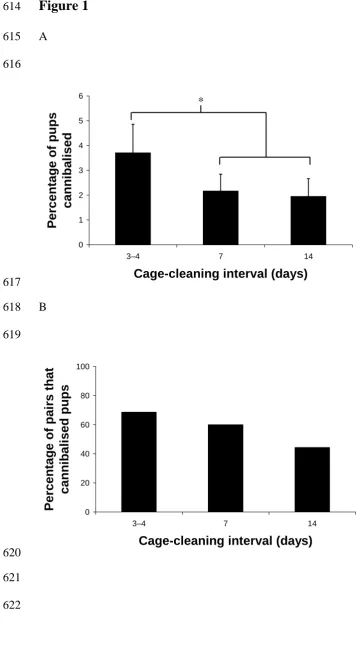
Cage-cleaning frequency had no significant main effects except that more pups were cannibalised when cages were cleaned more frequently (Figure 1). Other recorded mortalities did not show this pattern. More frequent cleaning increased cannibalism in terms of both how many pups were eaten or missing (z = 2.15; n = 106; P = 0.032) and the percentage of pairs that did or did not eat or miss pups (z = 2.06; n = 106; P = 0.039). An interaction between age at first cage-cleaning and the treatment group meant that, in the twice-weekly and, to a lesser extent, the once-weekly cleaning treatments cannibalism was more likely to occur if cages were cleaned sooner after birth (i.e. when the pups were younger), but this was not observed in the fortnightly treatment (t = 2.85, DF = 882, with 106 clusters, P = 0.005) (Figure 2). The absolute percentage of pups that were cannibalised was only 2.60 +/- 0.04 % of all pups born, but at least one pup was cannibalised from 10.9% of litters. Also, cannibalism was the largest recorded type of pup mortality (stillborns: 0.38% of pups born; individuals found dead: 0.77%; and deaths from cage-flooding: 0.76%). The weaning weights of surviving pups from litters that had included some cannibalised pups did not differ significantly from other pup weights.
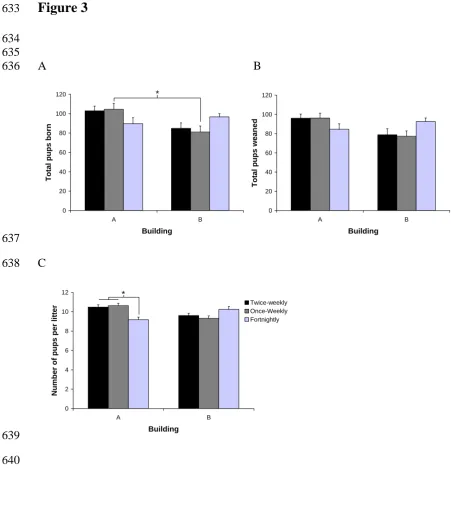
Cage-cleaning frequency had no other main effects, not even on ammonia concentrations (twice-weekly mean +/- S.E.: 13.5+/-0.5 versus fortnightly: 13.9+/-0.6; P = 0.642). However, it interacted with the building the rats were housed in (Figure
3): the fortnightly cleaning group had the fewest pups born and weaned in Building A, but in Building B the most were born and weaned in that treatment group (number born: F2, 100 = 4.47; P = 0.014; number weaned: F2, 100 = 4.30; P = 0.016). This effect
11 235
236 237 238 239 240 241 242 243 244 245 246 247 248
249
250 251 252 253 254 255 256 257
having the smallest litters in Building A, and the largest in Building B (F2, 100 = 7.86;
P = 0.001) (Figure 3).
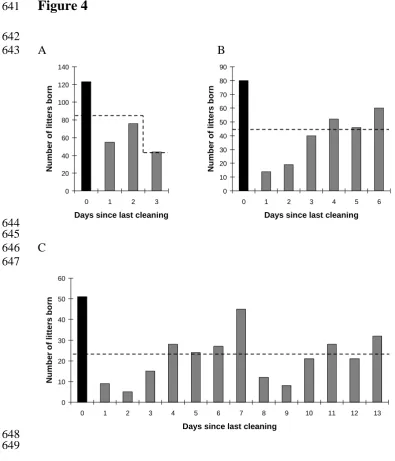
Significantly more births were recorded on the cage-cleaning day itself, compared with non-cleaning days (F1, 107 = 37.79; P < 0.001) (Figure 4). Thus, births
on the day of cage-cleaning appeared around twice as likely as expected by chance, in the weekly and fortnightly cleaning groups. For the fortnightly cleaning treatment, Figure 4 suggests that births also peaked one week after cleaning.
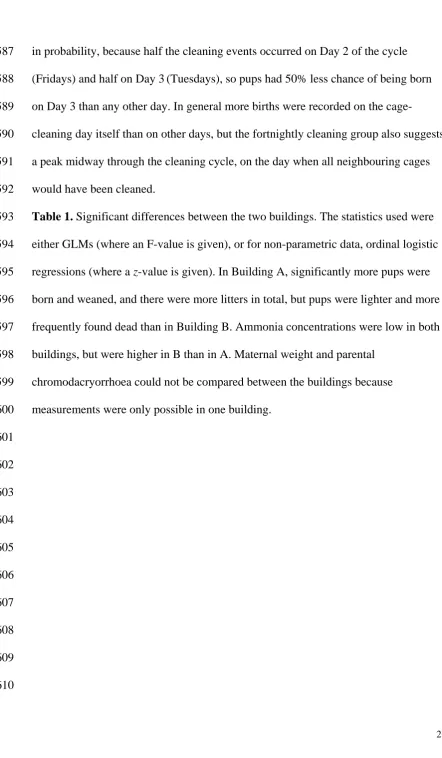
Building also had a significant main effect (Table 1) on every variable tested, except for the pup sex ratios and mortality from cannibalism or stillbirths (parental chromodacryorrhoea and maternal weight were only tested in one building). In Building A more pups were born and weaned and there were more litters in total, but each pup was lighter than in Building B and a higher proportion of them were found dead. The weight difference between male and female pups (males being heavier) was significantly more pronounced in Building B than in A for the first litters.
4.
Discussion
We investigated whether cage-cleaning frequency affected the reproductive performance and welfare of breeding rats. Overall, we found no significant main effects of cleaning frequency on any health and fertility measures (mortality rates and numbers of pups born and weaned), on other indices sensitive to stress
(chromodacryorrhoea, maternal reproductive decline and weight gain, and pup sex ratio), or on ammonia levels. Furthermore, in a follow-up study, we found no
12 258
259 260 261 262 263 264 265 266 267 268 269 270 271 272 273 274 275 276 277 278 279 280 281
However, we found that cannibalism increased with more frequent cage-cleaning, which is consistent with the small-scale study by Cisar and Jayson (1967), and with common perception (e.g. Home Office, 1995; Hansen et al., 2000).
Cannibalism was rare, affecting about 2.6% of all the pups born, which is approximately consistent with previous studies (Chantry, 1964; Reynolds, 1981; DeSantis & Schmaltz, 1984), so cleaning frequency had no significant effect on pup mortality generally. Nevertheless, under these clean conditions and with this outbred strain, other causes of mortality were even rarer. Therefore, on a large scale or with more susceptible rat strains, reducing cannibalism might lead to signifcant increases in the numbers of pups weaned.
Cannibalistic behaviour is not a uniform phenomenon (Elwood, 1991); it can sometimes be a response to pups that are already dead or dying, and other times be a by-product of direct infanticide, which in turn can be a response to various different situations (Fox, 1975; DeSantis & Schmaltz, 1984). Here we found no indication that it occurred as a result of poor maternal health or welfare (Boice, 1972), since cage-cleaning frequency had no significant effects on maternal chromodacryorrhoea, weight gain, rate of reproductive decline, or litter sex ratios. Cage-cleaning also did not seem to affect litter size, so the increased cannibalism in the more frequent cage-cleaning groups was not a response to larger litters (Day & Galef, 1977; Gandelman & Simon, 1978).
13 282
283 284 285 286 287 288 289 290 291 292 293 294 295 296 297 298 299 300 301 302 303 304
cannibalism through more frequent olfactory (e.g. Mennella & Moltz, 1988; Moles et al., 2004) auditory, and/or physical (Lane Petter, 1968; Busnel & Molin, 1978) disturbances, or nest disruption and cooling (e.g. Chantry, 1964; Lee & Williams, 1975) at a time when pups were vulnerable. Noise certainly reaches a peak during cleaning and is a stressor (Gamble, 1982; Voipio et al., 2006), so cleaning cages as quietly as possible around breeding rats could help prevent cannibalism (Lane Petter, 1968; Busnel & Molin, 1978). Cage-cleaning in an unventilated area of the stock room also increases airborne levels of rodent urinary proteins (Thulin et al., 2002), potentially disseminating unfamiliar conspecific odours between cages – since unfamiliar male odours are known to stress mother rats (Moles et al., 2004), this olfactory disturbance should be avoided where possible. Figure 2 shows that, in more frequently cleaned cages, cannibalism was more likely to occur
if cage-cleaning occurred on the day of birth (consistent with cannibalism of prematurely born pups), or during the first 2 days following it (consistent with
cannibalism when cages containing very young pups are disturbed). Note that we had no information on when cannibalism events occurred, so even though cage-cleaning affected them, they were not necessarily on the same day as cage-cleaning.
14 305
306 307 308 309 310 311 312 313 314 315 316 317 318 319 320 321 322 323 324 325 326 327 328
possibly once-weekly cleaning regimes this might be an effective way of reducing cannibalism (Figure 2).
Overall, cage-cleaning frequency affected the mean litter size, and
correspondingly the numbers of pups born and weaned, but the effect depended on the building the pups were born and raised in: fortnightly cage-cleaning was associated with the greatest number of pups in one building and the fewest in the other. These interactions between cage-cleaning frequency and building imply that if we had only carried out our study in Building A, we would have concluded that fortnightly cage-cleaning reduces the numbers of pups, while we would have concluded the opposite had we only used Building B. This could have been due to differences between the cage racks, the different humans working in the buildings, olfactory or vocal communications within the different animal populations, or any number of
environmental differences. This supports and extends the finding that rats of the same strain differ between different breeding companies (Rex et al., 1996; Germann et al., 1998); here they differed within the same breeding company. Therefore, in agreement with previous studies (e.g. Crabbe et al., 1999; Wurbel, 2000; Wahlsten et al., 2003; Garner et al., 2006), our findings reveal difficulties regarding the feasibility of standardisation between different experiments, and reaffirm the merits of replicating research under different conditions.
15 329
330 331 332 333 334 335 336 337 338 339 340 341 342 343 344 345 346 347 348 349 350 351
Therefore, frequent cage-cleaning might have been essential for preventing disease. In contrast, our study animals were kept in a barrier unit, in which there were no detected pathogens (Harlan’s Health Monitoring reports, 2005, unpublished) and ammonia levels were almost certainly lower (Table 1, cf. Perkins & Lipman, 1995; Carissimi et al., 2000).
16 352
353 354 355 356 357 358
359
360 361 362 363 364 365 366 367 368
369
370 371 372 373 374
Apart from cage-cleaning effects, most variables differed between the two buildings. Interestingly, the differences between the buildings corresponded to the pattern of reproductive trade-offs predicted by theory, in that offspring ‘quality’ is balanced against the number of offspring produced (Smith & Fretwell, 1974). Building A produced more offspring (in terms of numbers born, weaned and the number of litters), but each individual pup weighed less, sexual dimorphism was reduced, and pup mortalities were higher than in Building B.
5.
Conclusion
Here and in a follow up study (Burn et al., in press), we found no clear
benefits of frequent cage-cleaning to breeding rats, but it did increase the likelihood of cannibalism, and the cleaning process itself might have triggered parturition. We would therefore recommend that cages are not cleaned during the last few days of pregnancy (possibly avoiding premature induction of birth) or the first 2 days
following birth (avoiding acute early disturbances). Also, more research is required about what aspects of cleaning trigger cannibalism, but until then, noise and the transfer of odours between cages are likely stressors, and should be kept to a minimum when cleaning the cages of breeding rats.
6.
Acknowledgements
17 375
376 377 378 379 380 381 382 383 384 385 386 387 388 389 390 391 392 393 394 395 396
7.
References
Blom, H. J. M., Witkam, A. C. P., Schlingmann, F., Hoogervorst, M. J. C., Van de Weerd, H. A., Baumans, V., Beynen, A. C., 1993. Demonstration of preference for clean versus soiled cages as expressed by laboratory mice. Unpublished Ph.D. thesis, Utrecht University, Utrecht, The Netherlands. Boice, R., 1972. Some behavioral tests of domestication in Norway rats. Behaviour
42, 198-231.
Borrello, P., D'Amore, E., Di Virgilio, A., Panzini, G., Valeri, M., Lorenzini, R. N., 1998. The use of AGI as a method to measure microbial contamination in the cage microenvironment. Anim. Technol. 49, 81-85.
Brouettelahlou, I., Amouroux, R., Chastrette, F., Cosnier, J., Stoffelsma, J.,
Vernetmaury, E., 1991. Dodecyl propionate, attractant from rat pup preputial gland - characterization and identification. J. Chem. Ecol. 17, 1343-1354. Burn, C. C., 2006. Effects of husbandry manipulations and the laboratory
environment on rat health and welfare. Unpublished D.Phil. thesis, University of Oxford, Oxford, UK.
Burn, C. C., Day, M. J., Peters, A., Mason, G. J., 2006a. Long-term effects of cage-cleaning frequency and bedding type on laboratory rat health, welfare, and handleability: a cross-laboratory study. Lab. Anim. 40, 353-370.
Burn, C. C., Peters, A., Mason, G. J., 2006b. Acute effects of cage-cleaning at
18 397
398 399 400 401 402 403 404 405 406 407 408 409 410 411 412 413 414 415 416 417 418 419
Burn, C. C., Deacon, R., Mason, G. J., in press. Marked for life? Effects of early cage cleaning frequency, delivery batch and identification tail-marking on adult rat anxiety profiles. Dev. Psychobiol.
Busnel, M. C., Molin, D., 1978. Preliminary results of the effects of noise on gestating mice and their pups. In J. L. Fletch, R. G. Busnel (Eds.), Effects of noise on wildlife (pp. 209-248). New York: Academic Press.
Cabrera, R. J., Rodriguez-Echandia, E. L., Jatuff, A. S., Foscolo, M., 1999. Effects of prenatal exposure to a mild chronic variable stress on body weight,
preweaning mortality and rat behavior. Braz. J. Med. Biol. Res. 32, 1229-1237.
Canadian Council on Animal Care. (2001). CCAC Animal Use Survey - 2001. Retrieved July 2007, from
http://www.ccac.ca/en/Publications/Facts_Figures/pdfs/aus2001-all.pdf Carissimi, A. S., Chaguri, L. C. A. A., Teixeira, M. A., Mori, C. M. C., Macchione,
M., Sant' Anna, E. T. G., Saldiva, P. H. N., Souza, N. L., Merusse, J. B. L., 2000. Effects of two ventilation systems and bedding change frequency on cage environmental factors in rats (Rattus norvegicus). Anim. Technol. 51, 161-170.
Chantry, D., 1964. The effects of handling and cage changing on breeding mice. J. Anim. Technicians Assoc. 15, 78-80.
19 420
421 422 423 424 425 426 427 428 429 430 431 432 433 434 435 436 437 438 439 440 441 442 443
Cisar, C. F., Jayson, G., 1967. Effects of frequency of cage cleaning on rat litters prior to weaning. Lab. Anim. Care 17, 215-217.
Commission of the European Communities. 2003. Third report from the Commission to the Council and the European Parliament on the statistics on the number of animals used for experimental and other scientific purposes in the member states of the European Union (No. COM/2003/0019). Brussels: Commission of the European Communities.
Conn, C. A., Borer, K. T., Kluger, M. J., 1990. Body temperature rhythm and response to pyrogen in exercising and sedentary hamsters. Med. Sci. Sports Exerc. 22, 636-642.
Crabbe, J. C., Wahlsten, D., Dudek, B. C., 1999. Genetics of mouse behavior: interactions with laboratory environment. Science 284, 1670-1672.
Day, C. S., Galef, B. G., 1977. Pup cannibalism: One aspect of maternal behavior in golden hamsters. J. Comp. Physiol. Psychol. 91, 1179-1189.
DeSantis, D. T., Schmaltz, L. W., 1984. The mother-litter relationship in
developmental rat studies: cannibalism vs caring. Dev. Psychobiol. 17, 255-262.
Duke, J., Zammit, T., Lawson, D., 2001. The effects of routine cage-cleaning on cardiovascular and behavioural parameters in male Sprague-Dawley rats. Contemp. Top. Lab. Anim. Sci. 40, 17-20.
Elwood, R. W., 1991. Ethical implications of studies on infanticide and maternal aggression in rodents. Anim. Behav. 42, 841-849.
20 444
445 446 447 448 449 450 451 452 453 454 455 456 457 458 459 460 461 462 463 464 465 466 467
Gamble, M. R., 1982. Noise and laboratory animals. J. Inst. Anim. Technicians 33, 5-15.
Gandelman, R., Simon, N. G., 1978. Spontaneous pup-killing by mice in response to large litters. Dev. Psychobiol. 11, 235-241.
Garner, J. P., Thogerson, C. M., Mench, J. A., Würbel, H., 2006. Standardization and the Red Queen: applying methodologies from ethology, neuropsychology, and field biology to problems in high-throughput behavioral methods. Paper presented at the Proceedings of the 40th International Congress of the ISAE, Bristol.
Gattermann, R., Weinandy, R., 1996. Time of day and stress response to different stressors in experimental animals. Part I: Golden hamster (Mesocricetus auratus Waterhouse, 1839). J. Exp. Anim. Sci. 38, 66-76.
Germann, P. G., Hafner, D., Hanauer, G., Drommer, W., 1998. Incidence and severity of granulomatous pneumonia in Brown Norway rats: Breeder related
variations. J. Exp. Anim. Sci. 39, 22-33.
Glynn, L. M., Wadhwa, P. D., Dunkel-Schetter, C., Chicz-DeMet, A., Sandman, C. A., 2001. When stress happens matters: Effects of earthquake timing on stress responsivity in pregnancy. Am. J. Obstet. Gynecol. 184, 637-642.
Gray, S., Hurst, J. L., 1995. The effect of cage cleaning on aggression within groups of male laboratory mice. Anim. Behav. 49, 821-826.
21 468
469 470 471 472 473 474 475 476 477 478 479 480 481 482 483 484 485 486 487 488 489 490 491
Consultation of Parties to the European Convention for the Protection of Vertebrate Animals used for Experimental and Other Scientific Purposes. Harkness, J. E., Ridgway, M. D., 1980. Chromodacryorrhea in laboratory rats (Rattus
norvegicus): etiologic considerations. Lab. Anim. Sci. 30, 841-844.
Hobel, C., Culhane, J., 2003. Role of psychosocial and nutritional stress on poor pregnancy outcome. J. Nutr. 133, 1709S-1717.
Home Office, 1995. Code of Practice for the housing and care of animals in designated breeding and supplying establishments, Home Office, UK
Izídio, G. S., Lopes, D. M., Spricigo Jr, L., Ramos, A., 2005. Common variations in the pretest environment influence genotypic comparisons in models of anxiety. Genes, Brain & Behavior 4, 412-419.
Lane Petter, W., 1968. Cannibalism in rats and mice. Proc. R. Soc. Med. 61, 1295-1296.
Lee, M. H. S., Williams, D. I., 1975. Long term changes in nest condition and pup grouping following handling of rat litters. Dev. Psychobiol. 8, 91-95.
Libbin, R. M., Person, P., 1979. Neonatal rat surgery: Avoiding maternal cannibalism. Science 206, 66.
Line, S. W., Morgan, K. N., Markowitz, H., 1989. Heart rate and activity of rhesus monkeys in response to routine events. Lab. Primate Newsl. 28, 9-12. Mason, G., Wilson, D., Hampton, C., Wurbel, H., 2004. Non-invasively assessing
disturbance and stress in laboratory rats by scoring chromodacryorrhoea. Alt. Lab. Anim. 32, 153-159.
22 492
493 494 495 496 497 498 499 500 501 502 503 504 505 506 507 508 509 510 511 512 513 514 515
Mohan, C., 1974. Age-dependent cannibalism in a colony of albino rats. Lab. Anim. 8, 83-84.
Moles, A., Rizzi, R., D'Amato, F. R., 2004. Postnatal stress in mice: Does stressing the mother have the same effect as stressing the pups? Dev. Psychobiol. 44, 230-237.
Perkins, S. E., Lipman, N. S., 1995. Characterization and quantification of
microenvironmental contaminants in isolator cages with a variety of contact beddings. Contemp. Top. Lab. Anim. Sci. 34, 93-98.
Peters, A. G., Bywater, P. M., Festing, M. F. W., 2002. The effect of daily disturbance on the breeding performance of mice. Lab. Anim. 36, 188-192.
Porter, G., 1968. Pre-weaning loss of laboratory animals. Proc. R. Soc. Med. 61, 1295.
Porter, R. H., Winberg, J., 1999. Unique salience of maternal breast odors for newborn infants. Neurosci. Biobehav. Rev. 23, 439-449.
Rao, G. N., 1991. Light intensity-associated eye lesions of Fischer-344 rats in long-term studies. Toxicol. Pathol. 19, 148-155.
Reeb-Whitaker, C. K., Paigen, B., Beamer, W. G., Bronson, R. T., Churchill, G. A., Schweitzer, I. B., Myers, D. D., 2001. The impact of reduced frequency of cage changes on the health of mice housed in ventilated cages. Lab. Anim. 35, 58-73.
Reinhardt, V., 2004. Common husbandry-related variables in biomedical research with animals. Lab. Anim. 38, 213-235.
23 516
517 518 519 520 521 522 523 524 525 526 527 528 529 530 531 532 533 534 535 536 537 538 539
Reynolds, R. D., 1981. Preventing maternal cannibalism in rats. Science 213, 1146. Saibaba, P., Sales, G. D., Stodulski, G., Hau, J., 1996. Behaviour of rats in their home
cages: Daytime variations and effects of routine husbandry procedures analysed by time sampling techniques. Lab. Anim. 30, 13-21.
Schnecko, A., Witte, K., Lemmer, B., 1998. Effects of routine procedures on cardiovascular parameters of Sprague-Dawley rats in periods of activity and rest. J. Exp. Anim. Sci. 38, 181-190.
Sharp, J. L., Zammit, T. G., Azar, T. A., Lawson, D. M., 2002. Stress-like responses to common procedures in male rats housed alone or with other rats. Contemp. Top. Lab. Anim. Sci. 41, 8-14.
Silver, M., 1990. Prenatal maturation, the timing of birth and how it may be regulated in domestic animals. Exp. Physiol. 75, 285-307.
Smith, C. C., Fretwell, S. D., 1974. Optimal balance between size and number of offspring. Am. Nat. 108, 499-506.
Thulin, H., Bjorkdahl, M., Karlsson, A.-s., Renstrom, A., 2002. Reduction of
exposure to laboratory animal allergens in a research laboratory. Ann. Occup. Hyg. 46, 61-68.
Van Winkle, T. J., Balk, M. W., 1986. Spontaneous corneal opacities in laboratory mice. Lab. Anim. Sci. 36, 248-255.
Voipio, H. M., Nevalainen, T., Halonen, P., Hakumäki, M., Björk, E., 2006. Role of cage material, working style and hearing sensitivity in perception of animal care noise. Lab. Anim. 40, 400-409.
24 540
541 542 543 544 545 546 547 548 549 550 551 552 553 554 555 556 557 558 559 560 561 562
McKinnon, C. S., Merrill, C. M., Nolte, C., Schalomon, M., Schlumbohm, J. P., Sibert, J. R., Wenger, C. D., Dudek, B. C., Crabbe, J. C., 2003. Different data from different labs: Lessons from studies of gene-environment
interaction. J. Neurobiol. 54, 283-311.
25 563
564 565 566 567 568 569 570 571 572 573 574 575 576 577 578 579 580 581 582 583 584 585 586
Figure and table captions
Figure 1. The effect of cage-cleaning frequency on cannibalism of pups. More frequent cleaning increased (A) the mean (+/- S.E.) proportion of pups that were cannibalised in the two buildings, and (B) the percentage of parents that cannibalised pups at some stage during the project. * indicates the pairwise significant difference (P < 0.05) on graph A, but in graph B it was the covariate trend across cleaning intervals that was significant.
Figure 2. The relationship between the age of the litters when their cages were first cleaned and the likelihood of cannibalism. The fitted lines and shaded 95%
confidence intervals show that for the twice-weekly, and to a lesser extent the once-weekly, cleaning group cannibalism was more likely if cage-cleaning occurred earlier in life. There was no significant trend in the fortnightly cleaned group. Note that the day of cleaning might not necessarily have been the day the pups were cannibalised; data on when the cannibalism occurred were not available, so the pups may have been eaten at a later date.
Figure 3. The mean (S.E.) lifetime number of pups (A) born and (B) weaned, and (C) the litter size for breeding pairs cage-cleaned at different frequencies in two different buildings. The fortnightly cage-cleaning decreased the number of offspring compared with more frequent cage-cleaning in Building A, but it increased the number of offspring in Building B.
Figure 4. The numbers of pups born on each day of the (A) twice-weekly, (B) weekly and (C) fortnightly cage-cleaning cycle. The cage-cleaning day, Day 0, is
26 587
588 589 590 591 592 593 594 595 596 597 598 599 600 601 602 603 604 605 606 607 608 609 610
in probability, because half the cleaning events occurred on Day 2 of the cycle (Fridays) and half on Day 3(Tuesdays), so pups had 50% less chance of being born on Day 3 than any other day. In general more births were recorded on the
cage-cleaning day itself than on other days, but the fortnightly cage-cleaning group also suggests a peak midway through the cleaning cycle, on the day when all neighbouring cages would have been cleaned.
Table 1. Significant differences between the two buildings. The statistics used were either GLMs (where an F-value is given), or for non-parametric data, ordinal logistic regressions (where a z-value is given). In Building A, significantly more pups were born and weaned, and there were more litters in total, but pups were lighter and more frequently found dead than in Building B. Ammonia concentrations were low in both buildings, but were higher in B than in A. Maternal weight and parental
27 611
Table 1
Variable Statistical values Building A (mean +/- SE)
Building B (mean +/- SE)
Effect direction
Number born per pair
F1, 100 = 6.40; P =
0.013 98.9 +/- 3.4 87.6 +/- 3.0 A > B Number weaned
per pair
F1, 100 = 4.70; P =
0.032 92.1 +/- 3.0 82.9 +/- 3.1 A > B Number of litters
per pair
Odds = 3.59; z = 3.39; n = 106; P = 0.001
9.9 +/- 0.2 9.0 +/- 0.3 A > B
Number found dead per pair
Odds = 5.41; z = 2.10; n = 106; P = 0.036
1.3 +/- 0.4 0.4 +/- 0.3 A > B
1st litter pup weight (g)
F1, 96 = 19.77; P
<0.001 40.9 +/- 1.0 47.3 +/- 0.9 B > A 3rd litter pup
weight (g)
F1, 95 = 16.97; P
<0.001 39.8 +/- 1.3 46.9 +/- 1.3 B > A 1st litter
male-female weight difference (g)
F1, 96 = 6.02; P =
0.016 0.51 +/- 0.50 2.09 +/- 0.40 B > A
Ammonia (ppm) F1, 101 = 273.33; P
<0.001 10.9 +/- 0.3 16.5 +/- 0.2 B > A 612
28 614
615 616
Figure 1
A
0 1 2 3 4 5 6
3–4 7 14
Cage-cleaning interval (days)
Pe
rc
e
n
tage of
pups
c
a
nni
bal
is
e
d
617 618 619
*
B
0 20 40 60 80 100
3–4 7 14
Cage-cleaning interval (days)
Percen
tag
e o
f pai
rs th
at
can
n
ib
ali
s
ed
pu
ps
29 623
624 625
Figure 2
0 0.05 0.1 0.15 0.2 0.25 0.3
0 2 4 6 8 10 12 14
Age at first cage-cleaning (days)
Probability of cannibalism
in a litter
Fortnightly Once-weekly Twice-weekly
30 633
634 635 636
Figure 3
A B
0 20 40 60 80 100 120
A B
Building
Tot
al
pup
s bor
n
*
0 20 40 60 80 100 120
A B
Building
To
ta
l pu
p
s
we
an
e
d
637 638 C
0 2 4 6 8 10 12
A B
Building
Nu
mber
of
pup
s per
l
it
ter
Twice-weekly Once-Weekly Fortnightly
*
31 641
642 643
Figure 4
A B
0 20 40 60 80 100 120 140
0 1 2 3
Days since last cleaning
Nu m b e r o f lit te rs b o rn 0 10 20 30 40 50 60 70 80 90
0 1 2 3 4 5 6
Days since last cleaning
Nu m b e r o f lit te rs b o rn 644 645 646 647 C 0 10 20 30 40 50 60
0 1 2 3 4 5 6 7 8 9 10 11 12 13
Days since last cleaning