Interdisciplinary Collaboration to Integrate
Inquiry-Oriented Learning in
Undergraduate Science Practicals
Gerry Raynera, Kate Charlton-Robba, Christopher D. Thompsonb and Theo Hughesc
Corresponding author: [email protected]
aSchool of Biological Sciences, Monash University, Clayton VIC 3800, Australia bSchool of Chemistry, Monash University, Clayton VIC 3800, Australia
cSchool of Physics, Monash University, Clayton VIC 3800, Australia
Keywords: inquiry-oriented learning, science education, practical skills, interdisciplinary collaboration, mentorship
International Journal of Innovation in Science and Mathematics Education, 21(5), 1-11, 2013
Abstract
The benefits of inquiry-oriented learning (IOL) in undergraduate science courses have been validated through a considerable range of studies incorporating observation and examination data, as well as qualitative and quantitative feedback from students and employers. However, IOL initiatives often occur in single subject or discipline areas, meaning that students may experience IOL in isolated or disjunct forms, without the synergies made possible through interdisciplinary collaboration by educators. This paper reports on the progress of an interdisciplinary approach to develop, implement and evaluate IOL practicals in first year biology, chemistry and physics laboratory teaching programs. This initiative, founded on principles of collegiality and mentorship among the team members, has involved professional development of teaching associates (aka demonstrators), collaboration in the design and branding of inquiry-oriented practicals, and a degree of interdisciplinary alignment of practical assessments. The initiative has generated a more student-centred and coherent approach to enhancement of scientific literacy and a range of associated skills, provided greater clarity and transparency for students, and scaffolded inquiry-oriented approaches throughout the degree.
Introduction and rationale
K-12 years, and generating independent, critical thinking science practitioners at the end of a tertiary degree. DeHaan (2005: p. 253) contends that there is “a substantial body of evidence that instructional strategies in science that encourage undergraduates to become actively engaged in their own learning - i.e. scientific teaching - produce levels of understanding, knowledge retention and transfer that are greater than those resulting from traditional lecture/lab classes”.
The roots of inquiry learning lie in the pioneering work of Vygotsky (1978), who promoted the notion that learning can be enhanced through the solving of problems. Vygotsky took this further, by contending that working in groups to solve problems facilitated more effective learning than if students attempted this on their own. Inquiry oriented learning can be described in various ways, including inquiry-based learning (IBL), inquiry-guided learning (IGL), authentic learning (Lombardi, 2007), activity-lead learning (Wilson-Medhurst & Glendinning, 2009) and process-oriented guided inquiry learning (POGIL) (Farrell, Moog & Spencer, 1999). Closely related approaches include problem-based learning (Barrows & Tamblyn, 1980; Hmelo-Silver, 2004), scenario-based learning (Herrington, Oliver & Reeves, 2003) and case-based learning (Christensen & Hansen, 1981). All of these approaches are essentially subsets of what are termed
active learning strategies (Bellanca, 2009). While there may be subtle differences among these
inquiry approaches, they set out to achieve the same end goal; students’ acquisition of new knowledge, abilities and attitudes through their investigation of questions, scenarios, issues and problems, for which there may be no definite solution (Lee, 2004).
Calls for the incorporation of IOL in undergraduate science curricula have become more urgent in the past decade, both in Australia (Kirkup, 2012) and internationally (Fowler, Matthews, Schielack, Webb, & Wu, 2012). In Australia this may be in part due to innovations in teaching practices and student learning via the agency of the Australian F-10 and senior secondary science curricula. Another potential contributor to such calls, but at the other end of the education continuum, has been a refocusing of the spotlight on clearly defining and enhancing graduate attributes (e.g. Barrie, 2005), including demonstration of higher order learning such as problem solving, critical thinking and the analysis, synthesis and application of knowledge. While the introduction of IOL into undergraduate STEM programs is laudable, it appears to most often occur as sporadic initiatives by enthusiastic but isolated practitioners, or alternatively into a single discipline. Examples in science or related disciplines include nursing (Andrews & Jones, 1996), ecology (Spronken-Smith, Walker, Dickinson, Closs, Lord, & Harland, 2011) and an honours program (Rogers & Abell, 2008). Compounding this is an apparent dearth of empirical research about how inquiry learning has been implemented in higher education (Aditomoa, Walczak, Kandl, & Schwinfus, 2011), particularly in large enrolment first year science subjects. However, the plethora of mounting global problems (e.g. climate change, disease) demands an increased focus on interdisciplinary research aimed at preventing, resolving or at worst ameliorating such issues. One avenue for such endeavours must be the development of engaging and meaningful courses that integrate inquiry connections among science disciplines. Starting points have been established, both for specific laboratory experiments at a particular year level (e.g. Van Hecke, Karukstis, Haskell, McFadden, & Wettack, 2002; Wenzel, 2006), and more comprehensive laboratory programs (Abdella, Walczak, Kandl, & Schwinefus, 2011).
that academics across science disciplines communicate to share ideas and best practice, develop consistency in regard to the structure and assessment of practical activities, and importantly, collaborate on the development and integration of meaningful inquiry-type activities. The value of mentorship and collaboration in enhancing science teaching and learning has been previously demonstrated (e.g. Johnson, Bird, Fyffe, & Yench, 2012). Where IOL-related innovations are made, these must then be built on in subsequent years to scaffold the nature of that learning, so that emerging graduates will be much better situated for further study or employment. This paper reports on the planning, implementation and outcomes of such an initiative.
Initiating the dialogue
This project was founded on initial discussions among first year science coordinators about frustrations and limitations associated with an historical reliance on recipe-driven practicals. In 2012, first year biology and chemistry subject coordinators received funding to collaborate on the development and integration of IOL practicals in their subjects. Subsequent discussions with physics staff facilitated broader cooperation about IOL initiatives and in providing standardised assessment of first year practicals. An important framework requirement for all IOL activities was that they had tobuild on the ‘Science Inquiry Skills’ component that underpins the recently finalised senior secondary science Australian curricula in these subjects
(http://www.australiancurriculum.edu.au). The resulting project was then submitted to SaMnet
(Science and Mathematics Network of Australian University Educators) for inclusion as a supported action-learning project.
Figure 1: Common template used for IOL practicals in the three disciplines.
Following development of the conceptual framework, in May 2012, OLT Fellow Les Kirkup conducted an interdisciplinary IOL workshop at Monash University. During his fellowship, Kirkup has explored a range of IOL factors, including a reconsideration of learning through inquiry in undergraduate science curricula and the use of technology to support learning through inquiry (Kirkup, 2013). The Monash workshop, attended by academic and professional staff from the Faculty of Science and Faculty of Medicine, Nursing and Health Sciences, challenged participants to reflect on their own teaching philosophy, engaged them in team-based, IOL approaches to answer a simple, science experiment, and provided perspectives on how participants might integrate IOL initiatives into their own disciplines.
Teaching associate training
Teaching associates (TAs) have become an increasingly important element, in terms of face-to-face teaching, in university science departments (Percy, Scoufis, Parry, Goody, Hicks, Macdonald, Martinez, Szorenyi-Reischl, Ryan, Wills & Sheridan, 2008). Thus, inquiry-type practical initiatives must consider the perspectives and concerns of TAs and any possible effects, perceived or actual, on their effectiveness as educators. As French and Russell (2002) point out, inquiry-type teaching is more demanding of TAs in terms of preparation time and the knowledge required, which serves to increase their workload.
to their roles and to reflect on the considerable value of linking scientific endeavour with student learning. With respect to (iii), Campbell, Wolf, Der, Packenham & Abd-Hamid (2012) have demonstrated the value of repositioning teaching around the values of constructivism, achieved through instructional strategies that actively engage learners to create, interpret, reorganise or synthesise knowledge. The workshop was scheduled to ensure that all TAs had undertaken at least one semester of teaching, and were thus not complete novices. In order to prevent potential bias, TAs were not informed about the nature and aims of the workshop. The workshop commenced with a survey of TA perceptions of the current laboratory program, their understanding of the term inquiry, whether they believed inquiry was built into the current program, and what skills they think students should gain from practicals compared to what they consider students actually currently gain from practicals. Following the survey, TAs worked in small groups (3-4) to discuss and solve a relatively simple problem, using an IOL approach. On conclusion of the workshop, TAs were resurveyed about their perceptions of inquiry, differences between recipe-based and IOL practicals, any concerns they had about demonstrating IOL practicals and importantly, if they thought the IOL approach encouraged independent and critical thinking and reflected what scientists actually do.
Results from the TA workshop were very encouraging, with 82% of TAs appearing to have a reasonable understanding of the term inquiry, with major themes being around the words
questions and asking. Further, 55% of TAs reported that their understanding of the term inquiry
had changed or somewhat changed as a result of the workshop, mainly in relation to the attributes investigation and problem solving or how to better conduct or teach an IOL practical (Rayner, Charlton-Robb, Hughes & Thompson, In prep.). Notably, TAs recognised that the major differences in demonstrating an IOL compared to a non-IOL (recipe-based) practical were the importance of the student’s role in learning (i.e. critical thinking about concepts, development of curiosity and creativity) and the nature of their own role and responsibilities in IOL activities. More than 85% of surveyed TAs considered that an IOL approach encouraged independent, critical thinking, provided a good stepping stone to studies at higher levels, and better reflected what researchers actually do.
Redevelopment of practical curricula
Initial dialogue among the project team identified some relatively simple changes to all practical programs. This included standardization of assessment, such that all 1st year practical activities would be based on a standard number of marks. This provided a clear message to students that regardless of unit, practical components would be weighted equally in each discipline.
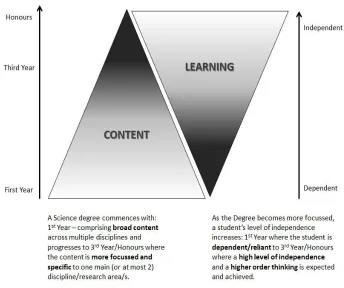
Developed inquiry practicals were badged as ‘IDEA Experiments’, to distinguish them from more widely used recipe-based activities. The “IDEA” acronym was conceived from Inquiry-Design-Explore-Answer, as a reference to the scientific method invoked by the authentic research practice this kind of activity aimed to foster. These IDEA practicals were thus flagged as being distinctive and different to others that students had previously undertaken in their university studies. Another important element of the collaboration was the development of a common template using the conceptual model (Fig. 1), which together with information about the rationale and aims of the program, became a frontispiece for each IDEA practical.
the foundations and principles of IOL (step 3). For these practical activities in each of biology, chemistry and physics, a blend of inquiry attributes such as hypothesis testing, critical thinking, problem solving and collaborative learning were used to structure and guide students, prior to analysis and submission or presentation of student outcomes (Fig. 2).
Figure 2: Interdisciplinary and integrative framework for the IOL practicals.
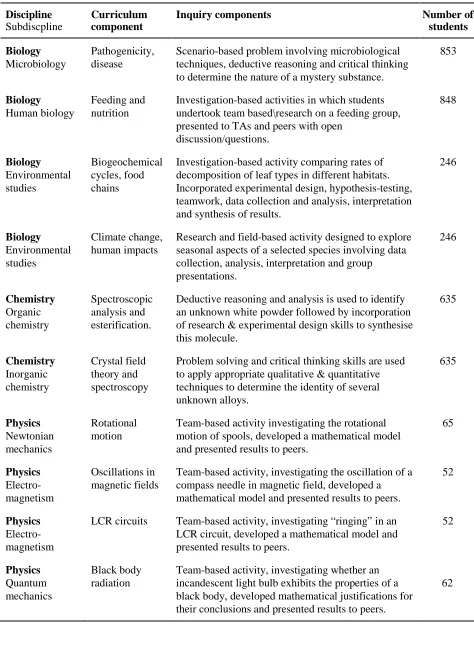
Table 1: Focus and nature of inquiry components of IOL activities in each discipline.
Discipline
Subdiscpline
Curriculum component
Inquiry components Number of
students
Biology Microbiology
Pathogenicity, disease
Scenario-based problem involving microbiological techniques, deductive reasoning and critical thinking to determine the nature of a mystery substance.
853
Biology
Human biology
Feeding and nutrition
Investigation-based activities in which students undertook team based\research on a feeding group, presented to TAs and peers with open
discussion/questions. 848 Biology Environmental studies Biogeochemical cycles, food chains
Investigation-based activity comparing rates of decomposition of leaf types in different habitats. Incorporated experimental design, hypothesis-testing, teamwork, data collection and analysis, interpretation and synthesis of results.
246 Biology Environmental studies Climate change, human impacts
Research and field-based activity designed to explore seasonal aspects of a selected species involving data collection, analysis, interpretation and group presentations. 246 Chemistry Organic chemistry Spectroscopic analysis and esterification.
Deductive reasoning and analysis is used to identify an unknown white powder followed by incorporation of research & experimental design skills to synthesise this molecule. 635 Chemistry Inorganic chemistry Crystal field theory and spectroscopy
Problem solving and critical thinking skills are used to apply appropriate qualitative & quantitative techniques to determine the identity of several unknown alloys. 635 Physics Newtonian mechanics Rotational motion
Team-based activity investigating the rotational motion of spools, developed a mathematical model and presented results to peers.
65 Physics Electro-magnetism Oscillations in magnetic fields
Team-based activity, investigating the oscillation of a compass needle in magnetic field, developed a mathematical model and presented results to peers.
52
Physics
Electro-magnetism
LCR circuits Team-based activity, investigating “ringing” in an LCR circuit, developed a mathematical model and presented results to peers.
52 Physics Quantum mechanics Black body radiation
Team-based activity, investigating whether an incandescent light bulb exhibits the properties of a black body, developed mathematical justifications for their conclusions and presented results to peers.
Student evaluations - reflection
Student perspectives of the value of practicals to their learning in science are salient. Of all learning activities (i.e. lectures, practicals in labs or the field, workshops and tutorials) that science students undertake, they rate their practicals most highly (Unpublished data, SETU – Student Evaluation of Teaching and Unit, Monash University, 2008-2012), although this may not be true for all science student cohorts (Mann & Robinson, 2009). Practical work promotes a range of things, including and perhaps most importantly, scientific literacy. The caveat is that genuine scientific literacy requires that students actually do science (Handelsman, Houser & Kriegel, 1997), which demands opportunities for scientific inquiry which integrate skills development with the scientific method, including the asking of meaningful scientific questions.
Several trends emerged from student evaluations of IDEA practicals (3611 student surveys submitted across the ten IDEA practicals). The major trends included: the nature of the activities required considerably more higher-order thinking, including critical thinking and problem solving; the practicals seemed to be much more closely aligned with what students imagined researchers actually do; and they enjoyed the teamwork, communication and freedom of IDEA practicals (Rayner et al., In prep.). It is also noteworthy that when asked about the main lessons learned from each practical, student responses included aspects of inquiry (i.e. critical thinking, self-directed group learning, presentation skills etc.) in addition to topic-related content, such as disease (biology), rotational motion (physics) or spectroscopy (chemistry).
Findings and discussion
The project outcomes included new conceptions of thinking about the ways that students develop and apply their learning in science. A range of new activities, all based on the above IDEA template described above, were developed and incorporated into the first year laboratory programs in the Schools of Biology, Chemistry and Physics. Ranging from guided-inquiry through to full-inquiry, each discipline introduced at least two new activities, redefining the format for students accustomed to recipe-driven laboratory activities. The third outcome, a new culture of teaching and learning, has been driven through professional development of teaching associates, and implementation to students, including perceptions of their value to students. By explicitly badging these exercises, and providing teaching associate support and training, a clear message has been disseminated that IDEA Experiments constitute a non-traditional, more authentic approach to investigating science in laboratory or field-based activities (Lee, 2012).
evaluation and synthesis to their critical thinking and problem-solving skills (as per Healey and Jenkins, 2009).
The collaboration among educators has been valuable at many levels. First, dialogue and increased communication among discipline academics has catalysed the development of new ways of engaging students in science teaching laboratories and field-based projects. Second, successful implementation of these IDEA practicals testifies that large enrolments are not an impediment to inquiry learning in the undergraduate laboratory, even at first year level. Provided the exercises are well considered, have some degree of guidance or structure, and that the concept of inquiry is well explained to the student cohort, this kind of activity can both run smoothly and enable high quality learning for students.
The interdisciplinary nature of this project enabled each discipline expert to consider the perspectives and feedback provided by education-focussed staff in the other science disciplines. This strongly aligns with observations by Bush, Pelaez, Rudd, Stevens, Tanner, & Williams (2013) of the important role that education-focussed academics – whom they called ‘science faculty with education specialties’ (SFES) – play in improving undergraduate science education. Given that less than 50% of students will continue on in each subject as their major, it is important to obtain an experienced opinion from experts outside the discipline, to ensure that a more challenging inquiry approach is implemented at a reasonable level of difficulty. Faculty funding was also a critical factor in the success of the project, enabling the appointment of a researcher to design and implement surveys, and collect and analyse data. The mentor support and structure of the SaMnet scheme was also particularly valuable in regard to framing the project, facilitating self-reflection, by providing a ‘critical friend’ for the project, and in generating scholarly output.
In 2013, the three science Schools involved in this project have continued to reinvigorate and transform their Level 1 laboratory programs with new IDEA experiments. This has been done while still recognizing the value of recipe-type practicals, which will continue to have a role in undergraduate laboratories, particularly for large enrolment first year subjects. The SaMnet team members are also working with colleagues coordinating upper year level subjects to scaffold student learning via IDEA-type practicals across a range of disciplines, including chemistry, biochemistry, physiology and microbiology. Scaffolding of IOL activities will prevent issues associated with minimal guidance, outlined by Kirschner, Sweller and Clark (2006). For inquiry practicals or field exercises that run over several weeks, and which Healey & Jenkins (2009) recommend for investigative-type activities, it is vital that students receive feedback on the approaches they are using and what they have actually learned. Thus, meaningful guidance and formative assessment is an essential structural component of inquiry learning, as students need to recognize if their understanding is correct, their design or methods are accurate, and their skills at an appropriate standard (Kvale, 2007).
Conclusions
learning, and provision of best practice exemplars for student learning. Important further elements are the ongoing professional development of teaching associates to enhance their pedagogical knowledge and skills, and evaluation and feedback from students about the value of IOL activities, so that where necessary, they can be modified and enhanced.
The tertiary sector must be prepared to build on inquiry initiatives being implemented at the secondary level, through the Australian senior science curricula. To succeed in this, university educators will need to collaborate, restructure undergraduate curricula and invest the time and resources required to support IOL. This will align strongly with the vision of Yager (2000), who more than a decade ago presented a charter for enhancing science teaching and learning in the USA over the first quarter of the 21st century. The collegial and interdisciplinary nature of this project, to foster inquiry modes of learning through teaching associate training and student-centered project work, together with appropriate methods of formative assessment and reflection, provide an example of how this might be undertaken in an Australian context.
Acknowledgements
The authors would like to thank Associate Professor Cristina Varsavsky for her enthusiasm and ongoing support for the project and the Faculty of Science for funding to provide research assistance and teaching buyout for the project collaborators. We would also like to thank Associate Professor Liz Johnson (La Trobe University), the project’s
critical friend, for her enthusiasm, guidance and incisive and valuable feedback on the structure and direction of the project, and advice about communication and dissemination of its outcomes.
References
Abdella, B. R. J., Walczak, M. M., Kandl, K. A., & Schwinefus, J. J. (2011). Integrated chemistry and biology for first-year college students. Journal of Chemical Education, 88, 1257-1263.
Aditomoa, A., Goodyear, P., Bliuc, A-M., & Ellis, R. A. (2011). Inquiry-based learning in higher education: Principal forms, educational objectives, and disciplinary variations, Studies in Higher Education,
DOI: 10.1080/03075079.2011.616584.
Andrews, M., & Jones, P. R. (1996). Problem-based learning in an undergraduate nursing programme: A case study.
Journal of Advanced Nursing, 23(2), 357–65.
Barrie, S. (2005). Rethinking generic graduate attributes. HERDSA News, 27(1), 1-6.
Barrows, H. S., & Tamblyn, R. M. (1980). Problem-based Learning: An Approach to Medical Education. New York: Springer Publishing company.
Bellanca, J. (2009). 200+ Active Learning Strategies and Projects for Engaging Students’ Multiple Intelligences. Thousand Oaks, CA: Corwin Press.
Brew, A. (2003). Teaching and research: New relationships and their implications for inquiry-based teaching and learning in higher education. Higher Education Research and Development, 22(1), 3-18.
Bush, S. D., Pelaez, N. J., Rudd, J. A., Stevens, M. T., Tanner, K. D., & Williams, K. S. (2013). Widespread distribution and unexpected variation among science faculty with education specialties (SFES) across the United States. Proceedings of the National Academy of Sciences, 110(18), 7170-7175.
Campbell, T., Wolf, P. G., Der, J. P., Packenham, E., & Abd-Hamid, N. (2012). Scientific inquiry in the genetics laboratory: Biologists and university science teacher educators collaborating to increase engagements in science processes. Journal of College Science Teaching, 41(3), 82-89.
Christensen, C. R., & Hansen A. J. (1981). Teaching and the case method. Boston: Harvard Business School Publishing Division.
DeHaan, R. L. (2005). The impending revolution in undergraduate science education. Journal of Science Education and Technology, 14(2), 253-269.
Fowler, D. A., Matthews, P. R., Schielack, J. F. Webb, R. C., & Wu, X. B. (2012). The power of inquiry as a way of learning in undergraduate education at a large research university. New Directions for Teaching and Learning,
129, 81-91.
French, D., & Russell, C. (2002). Do graduate teaching assistants benefit from teaching inquiry-based laboratories?
Bioscience, 52(11), 1036-1041.
Handelsman, J., Houser, B., & Kriegel, H. (1997). Biology Brought to Life: A Guide to Teaching Students to Think Like Scientists. Dubuque, Iowa: Times Mirror Higher Education Group.
Healey, M., & Jenkins, A. (2009). Developing Undergraduate Research and Inquiry. York: The Higher Education Academy.
Herrington, J., Oliver, R., & Reeves, T. C. (2003). Patterns of engagement in authentic online learning environments.
Australian Journal of Educational Technology, 19(1), 59-71.
Hmelo-Silver, C. E. (2004). Problem-based learning: What and how do students learn? Educational Psychology Review, 16(3), 235-266.
Johnson, E. D., Bird, F., Fyffe, J., & Yench, E. (2012). Champions or helpers: Leadership in curriculum reform in science. Journal of University Teaching & Learning Practice, 9(3), 7.
Kirkup, L. (2013). Inquiry-oriented learning in science: transforming practice through forging new partnerships and perspectives. Final report. Canberra: Australian Government Office for Learning and Teaching. Kirschner, P. A., Sweller, J., & Clark, R. E. (2006). Why minimal guidance during instruction does not work: An
analysis of the failure of constructivist, discovery, problem-based, experiential, and inquiry-based teaching.
Educational Psychologist, 41(2), 75-86.
Kvale, S. (2007). Contradictions of assessment for learning in institutions of higher learning. in D. Boud and N. Falchikov (Eds.) Rethinking assessment in higher education. New York: Routledge, pp. 57-71.
Lee, V. S. (Ed.) (2004). Teaching and learning through inquiry: A guidebook for institutions and instructors. Sterling, Va.: Stylus.
Lee, V. S. (2012). What is inquiry-guided learning? New Directions for Teaching and Learning, 129, 5-14. Lombardi, M. M. (2007). Authentic learning for the 21st century: An overview. EDUCAUSE Learning Initiative:
Advancing Learning through IT Innovation.
Mann, S., & Robinson, A. (2009). Boredom in the lecture theatre: an investigation into the contributors, moderators and outcomes of boredom amongst university students. British Educational Research Journal, 35(2), 243-258. National Research Council (2009). A New Biology for the 21st Century. Washington, DC: National Academy Press. Percy, A., Scoufis, M., Parry, S., Goody, A., Hicks, M., Macdonald, I., Martinez, K., Szorenyi-Reischl, N., Ryan, Y.,
Wills, S., & Sheridan, L. (2008). The RED Report, Recognition - Enhancement - Development: The
Contribution of Sessional Teachers to Higher Education. Sydney: Australian Learning and Teaching Council. Rayner, G., Charlton-Robb, K., Hughes, T., & Thompson, C. (In prep). The importance and extent of
inquiry-oriented learning in undergraduate science: Insights from the teaching coalface.
Rogers, M. A. P., & Abell, S. K. (2008). The design, enactment, and experience of inquiry-based instruction in undergraduate science education: A case study. Science Education, 92(4), 591–607.
Spronken-Smith, R., Walker, R., Dickinson, J., Closs, G., Lord, J., & Harland, T. (2011). Redesigning a curriculum for inquiry: An ecology case study. Instructional Science 39(5), 721-735.
Van Hecke, G. R., Karukstis, K. K., Haskell, R. C., McFadden, C. S., & Wettack, F. S. (2002). An integration of chemistry, biology, and physics: The interdisciplinary laboratory. Journal of Chemical Education, 79(7), 837-844.
Vygotsky, L. (1978). Interaction between learning and development, In Mind and Society, Cambridge, MA: Cambridge University Press, pp. 79-91.
Welch, W. W. (1984). A science-based approach to science learning. in D. Holdzkom and P. B. Lutz (Eds) Research within reach: A research-guided response to the concerns of educators. Charleston, West Virg.: RDIS.
Wenzel, T. J. (2006). General chemistry: Expanding the learning outcomes and promoting interdisciplinary connections through the use of a semester-long project. CBE life sciences education, 5(1), 76–84. Wilson-Medhurst, S., & Glendinning, I. (2009). Winning hearts and minds: Implementing activity led learning
(ALL). Proceedings of the Learning by Developing: New Ways to Learn Conference, Laurea, Helsinki.
Yager, R. (2000). A vision for what science education should be like for the first 25 years of a new millennium.