JIEM, 2014 – 7(5): 1167-1182 – Online ISSN: 2013-0953 – Print ISSN: 2013-8423 http://dx. doi. org/10. 3926/jiem. 1127
A
D
eterministic
A
lgorithm for
G
enerating
O
ptimal
T
hree-S
tage
layouts of
H
omogenous
S
trip
P
ieces
Jun Ji
1, Fei-Fei Xing
2, Jun Du
1, Ning Shi
1, Yao-Dong Cui
31
Beijing Polytechnic (China)
2BMEI CO., LTD. (China)
3Guangxi University (China)
[email protected], [email protected], [email protected], [email protected], [email protected]
Received: March 2014
Accepted: September 2014
Abstract:
Purpose:
The time required by the algorithms for general layouts to solve the large-scale
two-dimensional cutting problems may become unaffordable. So this paper presents an exact
algorithm to solve above problems.
Design/methodology/approach:
The algorithm uses the dynamic programming algorithm
to generate the optimal homogenous strips, solves the knapsack problem to determine the
optimal layout of the homogenous strip in the composite strip and the composite strip in the
segment, and optimally selects the enumerated segments to compose the three-stage layout.
Findings:
The algorithm not only meets the shearing and punching process need, but also
achieves good results within reasonable time.
are better than that of the above three algorithms. Experimental results show that the algorithm
to solve a large-scale piece packing quickly and efficiency.
Keywords:
two-dimensional layout, homogenous strip, dynamic programming recursion
1. Introduction
The unconstrained two-dimensional cutting (UTDC) problem refers to a series of small shape (or part) non-overlapping on a rectangular panel and the optimization objective of the problems is to find an arrangement for maximizing the material usage. UTDC problem is widely used in the leather, wood, metal and other manufacturing industries. Although many researchers have studied the UTDC problem, from the theory of computational complexity theory, layout problem have been proved to be a quiet difficult combinatorial optimization problem (Cui, 2013; Han, Bennell & Zhao, 2013; Thomas & Chaudhari, 2013; He & Wu, 2013; Liu & Liu, 2011; Ji, Lu & Cha, 2012; Huang & Liu, 2006; Jiang, Lv & Liu, 2008).
According to the UTDC problem, the layouts can be divided into the general layouts and the specific layouts. On the one hand, when the layouts have no any constraint, the layouts are called the general layouts (Gilmore & Gomory, 1965; Beasley, 1985; Cui, Wang & Li, 2005; Seong & Kang, 2003; Hifi & Zissimopoulos, 1996; Alvarez-Valdes, Parajon & Tamarit, 2002); on the other hand, when the layouts must meet some specific production request, the layouts are called the specific layout.
Now, there are some exact algorithms for the general layouts (Gilmore & Gomory, 1965; Cui et al., 2005). But the computation results in the references indicate that the computation time of these algorithms cannot be intolerable for solving the large scale UTDC problems. So many researchers have committed to study the specific layouts. The specific layouts have three advantages: meeting the practical production technology; high computation efficiency; the results are close to the optimal results.
3HS layout is the superset of the classic three-stage, two-segment, T-shape and the classic two-stage layout, and we will introduce it in the section 2.4.
The layout decides the layout value. The sequence of the above layouts value from largest to smallest is follows: the general layout, the classic three-stage layout, the two-segment layout, the T-shape layout, and the classic two-stage layout. This paper’s 3HS layout is between the general layout and the classic three-stage layout.
This paper will introduce 3HS layout in part 2; the exact algorithm for generating the 3HS layout in part 3; the experiments and results analysis in part 4; conclusion in part 5.
2. 3HS layout
2.1. Homogenous stripe
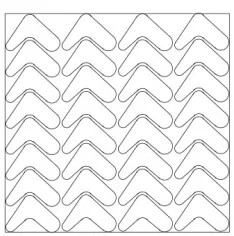
The homogenous stripe consists of the same size with same dimension. Figure 1(a) shows horizontal homogenous rectangular stripes, and its width is the blank width. Figure 1(b) shows vertical homogenous irregular stripes, and its width is the blank length.
(a) The horizontal homogenous stripe (b) The vertical homogenous stripe
Figure 1. The homogenous stripe
2.2. Composite strip
(a) The X composite strip (b) The Y composite strip
Figure 2. The composite strip
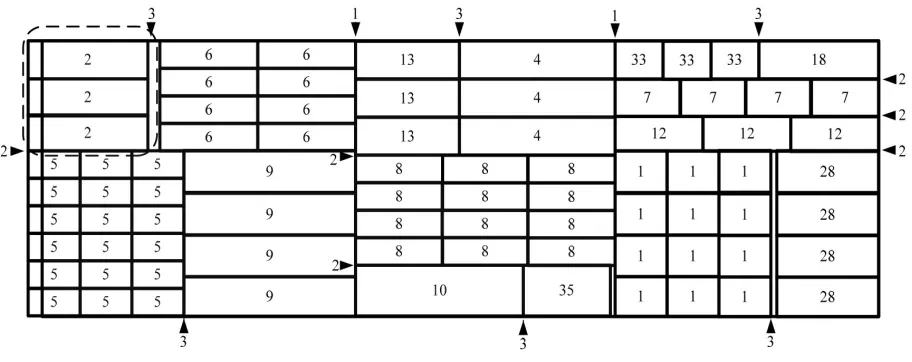
Figure 3 shows the process of its being cut. The arrow is the cut station, and the number is the cuts sequence. After the composite strip cut into homogenous stripe, the blank is been separated from homogenous stripe by the punch.
Figure 3. The cutting process of composite strip
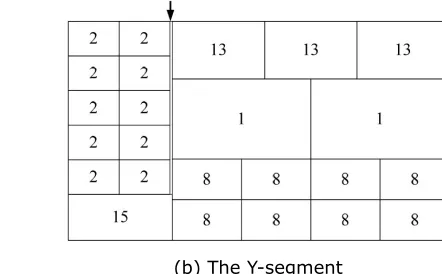
2.3. Segment
(a) The X-segment (b) The Y-segment
Figure 4. The segment
2.4. 3HS layout
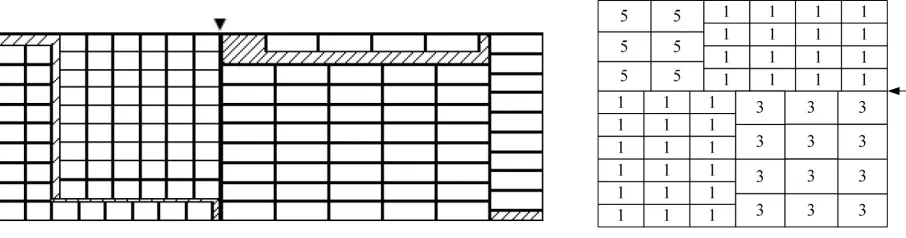
Figure 5 shows the 3HS layouts. Each 3HS layout composes of many segments. In 3HS layout, if it consists of some horizontal X-segments from left to right, it is called 3HSX layout (Figure 5(a)); if it consists of some vertical Y-segments from up to bottom, it is called 3HSY layout (Figure 5(b)).
(a) The 3HSX layout (b) The 3HSY layout
Figure 5. The types of the 3HS layout
Figure 6. The 3HSX layout and its cutting process
In 3HS layout, if each blank takes place of the homogenous strip, the 3HS layout turns into the classic three-stage layout; if the number of the segment is 2, the 3HS layout becomes the two-segment layout; if segments are X-segment and Y-segment, the 3HS layout turns into the T-shape layout. In addition, the T-shape layout is the superset of the classic two-stage layout (Cui, 2004a). Thus, the 3HS layout is the superset of the classic three-stage, two-segment, T-shape, and the classic two-stage layout. In other words, the solution of 3HS layout is better than that of the above four layouts.
3. The algorithm for generating 3HS layout
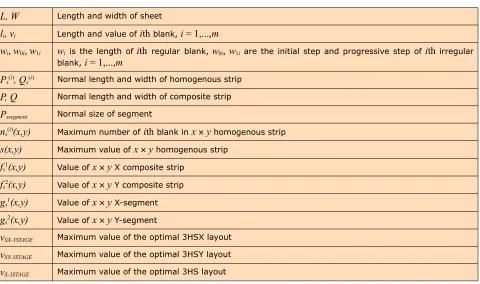
3.1. Notes and functions
L, W Length and width of sheet
li, vi Length and value of ith blank, i = 1,...,m
wi, w0i, w1i wi is the length of ith regular blank, w0i, w1i are the initial step and progressive step of ith irregular
blank, i = 1,...,m
Ps(i), Qs(i) Normal length and width of homogenous strip P, Q Normal length and width of composite strip
Pssegment Normal size of segment
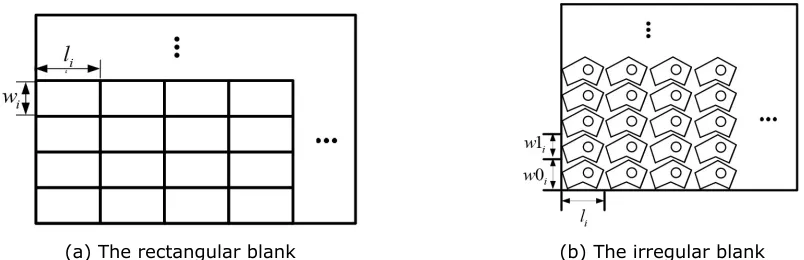
ns(i)(x,y) Maximum number of ith blank in x y homogenous strip s(x,y) Maximum value of x y homogenous strip
fs1(x,y) Value of x y X composite strip fs2(x,y) Value of x y Y composite strip gs1(x,y) Value of x y X-segment gs2(x,y) Value of x y Y-segment
vSX-3STAGE Maximum value of the optimal 3HSX layout
vSY-3STAGE Maximum value of the optimal 3HSY layout
vS-3STAGE Maximum value of the optimal 3HS layout
Table 1. Notes and function
3.2. The steps of algorithm
Supposed the size of sheet and blank are integer, and the blank direction is fixed. The algorithm of 3HS layout (3HSA) includes the following steps:
Step 1. Determining the optimal homogenous strip by dynamic programming algorithm;
Step 2. Solving the optimal homogenous strip layout in composite strip by knapsack problem;
Step 3. Solving the optimal composite strip in segment by knapsack problem;
Step 4. Determining the optimal 3HSX layout by knapsack problem;
Step 5. Determining the optimal 3HSY layout by knapsack problem;
Step 6. Solving the optimal 3HS layout.
3.3. The normal size
and
x0
is the optimal normal size that is lessen thanx
, andy0
is the optimal normal size that is lessen thany
. To different layout, according to normal size features, we should define it appropriately to improve the solving speed.Definition 1. The homogenous strip normal size
According to above description, the homogenous strip consists of blanks with same shape, and the blank direction is fixed. Therefore, the homogenous strip length normal size
Ps
(i) is thelength linear combination of each blank. The equation is follows:
(1) (1) The homogenous width normal size of regular blank
Qs
(i) is follows:(2) (2) The homogenous width normal size of irregular blank
Qs
(i) is follows:(3) The
0
andL
are added to the normal size sequence. ThePs
(i)=
p1
s,
p2
s,...,
pM
s represents thehomogenous strip length normal size of
i
th
blank, andM
is the number of normal size; and theQs
(i)=
q1
s,
q2
s,...,
qN
s represents the homogenous strip width normal size ofi
th
blank, andN
isthe number of normal size.
Definition 2. The composite strip normal size
According to above description, the composite strip composes of homogenous strips. So, the composite strip length normal size
P
is the length linear combination of each blank:(4)
(1) The composite strip width normal size of regular blank
Q
is follows:(2) The composite strip width normal size of irregular blank
Q
is follows:(6)
The
0
andL
are added to the normal size sequence. Thep1
,
p2
,...,
p
M represents the compositestrip length normal size, and
M
is the number of normal size; theq1
,
q2
,...,
q
N represents thecomposite strip width normal size, and
N
is the number of normal size.Definition 3. The segment normal size
According to above description, the segment consists of composite strip. Therefore, the segment normal width
Pssegment
is the collection of composite strip length normal size:(7) If both the segment width and length belong to
Pssegment
, then the segment is a normal segment.3.4. The value of homogenous strip
x
y
(1) Solving the maximum number that the homogenous strip
x
y
includes blanksAssume that
ns
(i)(x, y)
is the maximum number ofi
th
blank in the homogenousx
y
, and thereis following recursive formula, and
x
Ps
(i),
y
Qs
(i):• The maximum number of
i
th
regular blank in the homogenousx
y
:(8)
• The maximum number of
i
th
irregular blank in the homogenousx
y
:(a) The rectangular blank (b) The irregular blank
Figure 7. The blanks number of the homogenous strip x y
(2) Determining the blank maximum value in homogenous
x
y
Suppose
s
(
x, y
)
is the maximum value in homogenousx
y
, andvi
is thei
th
blank value, then:(10)
3.5. Determining the homogenous strip optimal layout in composite strip
(1) Determining the homogenous strip optimal layout in X composite strip Suppose
fs
1(
x, y
)
is the value of X composite stripx
y
, andx
P; y
Q
:(11)
The solution of above knapsack problem can refer to literature (Kellerer, Pferschy & Pisinger, 2004).
(2) Determining the composite strip optimal layout in Y composite strip Suppose
fs
2(
x, y
)
is the value of Y composite stripx
y
, andx
P; y
Q
:3.6. Determining the section optimal layout in segment
Assume that
gs
1(
x, y
)
is the value of X-segmentx
y
, andgs
2(
x, y
)
is the value of Y-segmentx
y
. So, there is following formula, andx, y
Pssegment
:(13)
The following equation determines
gs
2(
x, y
)
:(14)
3.7. The optimal 3HS layout
Suppose
vSX-3STAGE
is the value of optimal 3HSX layout:(15)
Suppose
vSY-3STAGE
is the value of optimal 3HSY layout:(16)
Suppose
vS-3STAGE
is the value of optimal 3HS layout:(17)
3.8. The steps of generating the optimal 3HS layout
The algorithm for contains the following steps:
Step 1. Determining the normal of homogenous strip, composite strip and segment from Sect. 3.3.
Step 2. Determining the optimal homogenous strip from Sect. 3.4.
Step 3. Determining the optimal composite strip by equations (11) and (12).
Step 4. Determining the optimal segment by equations (13) and (14).
3.9. The time complexity of the 3HSA
The time it takes for determining the normal size of composite strip and section from Sect. 3.3 is
O
(
mL
)
.The time it takes for determining the optimal homogenous strip from Sect. 3.4 is
O
(
mLW
)
. The time it takes for determining the optimal composite strip with equation (11) and (12) isO
(
LW
2+
WL
2)
.The time it takes for determining the optimal segment with equation (13) and (14) is
O
(
L
2+
W
2)
.Therefore, the total time it takes for determining the optimal 3HS layout is
O
(
LW
2+
WL
2+
L
2+
W
2)
. BecausemL << mLW
,W
2<< LW
2 andL
2<< L
2W
, therefore, the timecomplexity is
=
O
[
LW
(
m
+
L
+
W
)]
.4. The computation results
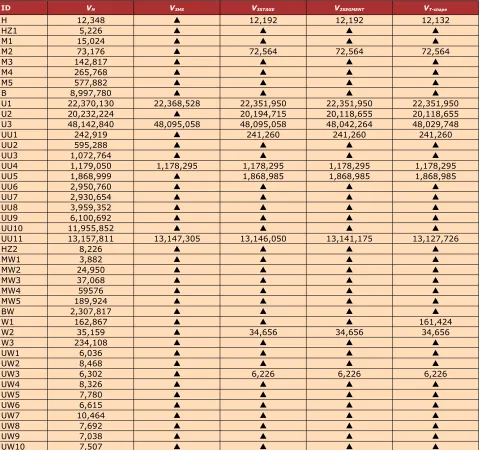
As we known, there is no report about the algorithm for generating 3HS layout. The section illustrates the efficiency of this paper algorithm by 43 conventional benchmarks. The benchmark problems use computer with Pentium 4 CPU, clock speed with 2.8 GHz, main memory with 512MB. The problems can be downloaded from website http://www.laria.u-picardie.fr/hifi/OR-Benchmark. The section compares the 3HS layout with the classic three-stage, two-segment, and T-shape and general layouts.
3HS The algorithm of generating optimal 3HS layout
3STAGE Hifi’s (Hifi, 2001) algorithm of generating optimal three-stage layout
2SEGMENT The algorithm of Reference (Fayard & Zissimopoulos, 1995) to generate optimal two-segment layout
T-shape The algorithm of Reference (Cui, 2004a) to generate optimal T-shape layout GENERAL The algorithm of Reference (Cui, Wang & Li, 2005) to generate optimal general
layout
According to the above description, the sequence for layout value of above layouts is follows:
ID VN V3HS V3STAGE V2SEGMENT VT-shape
H 12,348 ▲ 12,192 12,192 12,132
HZ1 5,226 ▲ ▲ ▲ ▲
M1 15,024 ▲ ▲ ▲ ▲
M2 73,176 ▲ 72,564 72,564 72,564
M3 142,817 ▲ ▲ ▲ ▲
M4 265,768 ▲ ▲ ▲ ▲
M5 577,882 ▲ ▲ ▲ ▲
B 8,997,780 ▲ ▲ ▲ ▲
U1 22,370,130 22,368,528 22,351,950 22,351,950 22,351,950
U2 20,232,224 ▲ 20,194,715 20,118,655 20,118,655
U3 48,142,840 48,095,058 48,095,058 48,042,264 48,029,748
UU1 242,919 ▲ 241,260 241,260 241,260
UU2 595,288 ▲ ▲ ▲ ▲
UU3 1,072,764 ▲ ▲ ▲ ▲
UU4 1,179,050 1,178,295 1,178,295 1,178,295 1,178,295
UU5 1,868,999 ▲ 1,868,985 1,868,985 1,868,985
UU6 2,950,760 ▲ ▲ ▲ ▲
UU7 2,930,654 ▲ ▲ ▲ ▲
UU8 3,959,352 ▲ ▲ ▲ ▲
UU9 6,100,692 ▲ ▲ ▲ ▲
UU10 11,955,852 ▲ ▲ ▲ ▲
UU11 13,157,811 13,147,305 13,146,050 13,141,175 13,127,726
HZ2 8,226 ▲ ▲ ▲ ▲
MW1 3,882 ▲ ▲ ▲ ▲
MW2 24,950 ▲ ▲ ▲ ▲
MW3 37,068 ▲ ▲ ▲ ▲
MW4 59576 ▲ ▲ ▲ ▲
MW5 189,924 ▲ ▲ ▲ ▲
BW 2,307,817 ▲ ▲ ▲ ▲
W1 162,867 ▲ ▲ ▲ 161,424
W2 35,159 ▲ 34,656 34,656 34,656
W3 234,108 ▲ ▲ ▲ ▲
UW1 6,036 ▲ ▲ ▲ ▲
UW2 8,468 ▲ ▲ ▲ ▲
UW3 6,302 ▲ 6,226 6,226 6,226
UW4 8,326 ▲ ▲ ▲ ▲
UW5 7,780 ▲ ▲ ▲ ▲
UW6 6,615 ▲ ▲ ▲ ▲
UW7 10,464 ▲ ▲ ▲ ▲
UW8 7,692 ▲ ▲ ▲ ▲
UW9 7,038 ▲ ▲ ▲ ▲
UW10 7,507 ▲ ▲ ▲ ▲
Table 2. The computation results of different layouts
From tables, we can draw conclusions: 1) The optimal results of this paper’s algorithm are equal or very close to the general algorithm; 2) The optimal results of this paper’s algorithm are better than the classic three-stage, two-segment, T-shape.
Layouts 3HS 3STAGE 2SEGMENT T-shape
The optimal number of problems 39 32 32 31
Table 3. The optimal number of different layouts
2SEGMENT and T-shape layout’s optimal results is 32, 32 and 31 respectively. Therefore, the results of this paper algorithm are better than other layouts.
3STAGE 2SEGMENT T-Shape
3HS 9 10 10
3STAGE 3 5
2SEGMENT 4
Table 4. The better number problem of different layouts
Table 4 lists the optimal number of different layouts, and these statistical data come from Table 2. In 43 classical benchmark problems, 1) there are 9 problems that the 3HS layout is better than 3STAGE and 2SEGMENT, and 10 problems for T-shape; 2) there are 3 problems that the 3STAGE layout is better than 2SEGMENT and 5 problems for T-shape; 3) there are 4 problems that the 2SEGMENT layout is better than T-shape. The 3HSA total time it takes for solving 43 problems from table 2 is 93.74s, and each problem’s average time is 2.18s. Therefore, the time is reasonable in practical application.
5. Conclusions
It is very difficult to solve UTDC problem. Although there are exact algorithms, the practical computation results indicate these algorithms only solve small scale problems efficiently. These algorithm’s time it takes for solving large scale problems is unaffordable. Therefore, people usually solve the problem by two types algorithms, first, the algorithms for generating specific layouts, which not only meet the practical production technology, but also solve large scale problems efficiently within reasonable time, for example, the classic three-stage layout, two-segment layout and T-shape layout; second, the results of genetic algorithm is close to general layout algorithm.
References
Alvarez-Valdes, R., Parajon, A., & Tamarit, J.M. (2002). A tabu search algorithm for large-scale guillotine (un)constrained two-dimensional cutting problems. Computers & Operations Research, 29, 925-47. http://dx.doi.org/10.1016/S0305-0548(00)00095-2
Beasley, J.E. (1985). Algorithms for unconstrained two-dimensional guillotine cutting. Journal of the Operational Research Society, 36, 297-306. http://dx.doi.org/10.1057/jors.1985.51
Cui, Y. (2004a). Generating optimal T-shape cutting patterns for rectangular blanks. Journal of Engineering Manufacture, 218, 857-866. http://dx.doi.org/10.1243/0954405041486037
Cui, Y. (2013). A new dynamic programming for three staged cutting patterns. Journal of global optimization, 55, 349-357. http://dx.doi.org/10.1007/s10898-012-9930-3
Cui, Y., Wang, Z., & Li, J. (2005). Exact and heuristic algorithms for staged cutting problems.
Journal of Engineering Manufacture, 219, 201-208. http://dx.doi.org/10.1243/95440505X8136
Fayard, D., & Zissimopoulos, V. (1995). An approximation algorithm for solving unconstrained two-dimensional knapsack problems. European Journal of Operational Research, 84, 618-632. http://dx.doi.org/10.1016/0377-2217(93)E0221-I
Gilmore, P.C., & Gomory, R.E. (1965). Multistage cutting problems of two and more dimensions. Operations Research, 13, 94-119. http://dx.doi.org/10.1287/opre.13.1.94
Han, W., Bennell, J.A., & Zhao, X.Z. (2013). Construction heuristics for two-dimensional irregular shape bin packing with guillotine constraints. European journal of operational research, 230, 495-504. http://dx.doi.org/10.1016/j.ejor.2013.04.048
He, Y.H., & Wu, Y. (2013). Packing non-identical circles within a rectangle with open length.
Journal of global optimization, 56, 1187-1215. http://dx.doi.org/10.1007/s10898-012-9948-6
Hifi, M. (2001). Exact algorithms for large-scale unconstrained two and three staged cutting problems. Computational Optimization and Applications, 18, 63-88.
http://dx.doi.org/10.1023/A:1008743711658
Hifi, M., & Zissimopoulos, V. (1996). A recursive exact algorithm for weighted two-dimensional cutting. European Journal of Operational Research, 91, 553-564. http://dx.doi.org/10.1016/0377-2217(95)00343-6
Ji, J., Lu, Y., & Cha, J. (2012). A deterministic algorithm for optimal two-segment cutting patterns of rectangular blanks. Chinese Journal of Computers, 35(1), 183-191.
http://dx.doi.org/10.3724/SP.J.1016.2012.00183
Jiang, X., Lv, X., & Liu, C. (2008). Optimal Packing of Rectangles with an Adaptive Simulated Annealing Genetic Algorithm. Journal of Computer-Aided Design & Computer Graphics, 11, 1425-1431.
Kellerer, H., Pferschy, U., & Pisinger, D. (2004). Knapsack problems, Berlin : Springer.
http://dx.doi.org/10.1007/978-3-540-24777-7
Liu, Z., & Liu, J. (2011). Simulated Annealing Algorithm for Solving Circular Packing Problem.
Computer Engineering, 37, 197-199.
Seong, G.G., & Kang, M.K. (2003). A best-first branch and bound algorithm for unconstrained two-dimensional cutting problems. Operations Research Letters, 3 1 , 3 0 1 - 3 0 7 .
http://dx.doi.org/10.1016/S0167-6377(03)00002-6
Thomas, J., & Chaudhari, N.S. (2013). Hybrid approach for 2D strip packing problem using genetic algorithm. Advances in notes in computer science, 7902, 566-574.
Journal of Industrial Engineering and Management, 2014 (www. jiem. org)
Article's contents are provided on a Attribution-Non Commercial 3. 0 Creative commons license. Readers are allowed to copy, distribute and communicate article's contents, provided the author's and Journal of Industrial Engineering and Management's names are included.