THE EFFECTS OF REFLECTIVE TEACHING ON AN INTENSIVE
TEACHER TRAINING PROGRAM
Mei Hua Lan
Wenzao Ursuline College of Languages, Taiwan email: [email protected]
Kai-Ping Wang
Shu-Zen Junior College of Medicine and Management, Taiwan email: [email protected]
Abstract: The preliminary case study was conducted to understand the effects of
reflective teaching approach on English teachers' teaching performances in a
short-term intensive teacher training program, and to know the participating English teachers’ feedback to the program. Totally 13 English teachers, who had taught
English for 1 to 5 years, participated in this program for 3 weeks with 54 instruction
hours. During the intensive program, teachers were asked to design lesson plans
and demonstrate their lessons, while their peers, other experienced teachers,
provided them with constructive feedback. In addition, the presenters self-assessed
and reflected on their own teaching. Through several cycles of teaching
demonstrations, peer-assessments, self-assessments and reflections, most teachers
indicated that the reflective teaching approach was beneficial for sharpening their
teaching skills, equipping them with additional teaching strategies and class
management skills, and raising their awareness of the needs for examinations of their
teaching reflectively in the future, and the importance of reflection of their own
teaching for improvements. To give the teachers more inputs and inspirations,
experienced teachers with creative teaching ideas were invited as guest speakers, and
positive feedback to the guest speeches was also drawn. The findings of this study
were expected to provide some pedagogical inspirations for the related fields,
especially English teacher training in EFL contexts.
Keywords: Reflective Teaching; Professional Development; Teaching English to
Young Learners
PENGARUH PEMBELAJARAN REFLEKTIF ATAS PROGRAM
PELATIHAN GURU INTENSIF
memahami pengaruh pendekatan pengajaran reflektif terhadap kinerja mengajar guru bahasa Inggris dalam program intensif pelatihan guru, dan untuk mengetahui umpan balik terhadap program yang mereka ikuti. Tiga belas guru bahasa Inggris yang memiliki pengalaman mengajar 1 sampai 5 tahun ikut berpartisipasi dalam program pelatihan 3 minggu dengan 54 jam pelatihan. Selama program intensif tersebut, guru diminta untuk membuat rencana pembelajaran dan melaksanakan rencana pembelajaran tersebut, sementara guru-guru yang lainnya memberikan umpan balik yang konstruktif. Selain itu, guru yang melaksanakan rencana pembelajaran tersebut melakukan penilaian diri dan melakukan refleksi mengenai pengajarannya. Melalui beberapa siklus peragaan mengajar, penilaian teman sebaya, penilaian dan refleksi diri, kebanyakan guru berpendapat bahwa pendekatan pengajaran reflektif berguna untuk mempertajam keterampilan mengajar, memperkaya strategi mengajar dan keterampilan pengelolaan kelas, dan meningkatkan kesadaran mereka terhadap pentingnya memperhatikan pengajaran secara reflektif mereka di masa depan dan pentingnya refleksi terhadap pengajaran mereka. Untuk memberikan input dan inspirasi kepada mereka, guru-guru berpengalaman yang memiliki ide-ide kreatif diundang sebagai pembicara tamu, dan umpan balik positif dari mereka dirangkum. Hasil temuan dari kajian ini diharapkan mampu memberikan inspirasi pedagogis bagi bidang yang berkaitan, terutama pelatihan guru bahasa Inggris dalam konteks EFL
Katakunci: pembelajaran reflektif; pengembangan profesi; pengajaran bahasa
Inggris untuk anak usia dini
With recent changes of English language
policies, the Ministry of Education of
Taiwan has encouraged extensive
trainings and certifications of elementary
English teachers to enhance better
language teaching quality of early
language education in Taiwan. For
certifications and professional
development, the local government in
Kaohsiung, in southern Taiwan,
sponsored English teachers to take credit
courses during their summer vacation,
and hoped to assist teachers to learn
more practical English teaching
techniques or new pedagogies for
teaching English four skills. For this
reason, the researcher of the study
gained the opportunity to conduct a
research on the effects of reflective
teaching on the teaching performances of
English teachers in elementary schools,
and the study hoped to help teachers in
practice to reflect on their own teaching,
and figure out ways to improve their
own English teaching to young learners.
Recently, reflective teaching, which
refers to critical examinations of our
motivation, thinking, and practice
(Bailey, Curtis & Nunan, 2001), has
been highlighted and re-emphasized in
the educational field, especially for
purposes of reflective teaching are to
evoke teachers' self-awareness and
creativity in teaching, and to enhance
teachers' active participations in constant
searches for reasonable and effective
solutions to their own teaching problems
in teaching practices in order to improve
their teaching eventually. In many
reflective teaching studies, the action
research method has often been
employed to assist teachers to
re-examine their teaching goals and
objectives during the teaching processes,
and to solve relevant teaching problems
across the processes. Based on the
action research framework, the recent
study intends to understand the effects of
reflective teaching and English teachers’
feedback to the approach in the
short-term teacher training program.
The research findings are expected to
provide pedagogical contributions in the
relevant fields.
Generally speaking, reflective
practices can be considered as being able
to examine our own professional
behaviors and practice for improving our
professional performances and
developing relevant skills (Clarke &
Croft, 1998). Hence, the professional
development and improvement may
involve different perspectives in our
professions, such as our knowledge,
skills, attitudes and awareness that we
change or adapt through reflective
teaching(Narvaéz, 2010). According to
Bailey et al. (2001) reflective teaching
involves critical examination of our
motivation, thinking, and practice. That
is, we cannot say that we are reflective
teachers if we only plan our lessons carefully and mark learners’ papers.
As Kemmis (1985) put it, reflection
is a process which involves an inward
examination of our thoughts and thought
processes, and an outward consideration
of the situation in which we find
ourselves. In other words, reflection is
a mirror to practice, yet we need to
develop some positive attitudes for being
reflective teachers, being open-minded,
responsible, and dedicative. According
to Narvaéz (2010), we will certainly
change our beliefs, attitudes, skills,
knowledge and awareness with these
attitudes and with reflective teaching.
However, reflective teaching is a
cyclical process and it is a skill that can
be developed over time (Narvaéz, 2010).
When reflective teachers started teaching,
they might ask themselves some
questions, reflecting on how their class
had been and how they could improve it
for next time. However, as the time
passes by, those teachers might
incorporate more elements into their
reflections since they are aware and have
more knowledge. Once reflective
teachers start to implement the changes
inspired by reflective teaching, then the
reflective and evaluative cycle begins
again. In a word, reflective teaching is
a process with cycles of reflections,
modifications and evaluation during the
teaching processes across time.
theoretical framework from the works of
Dewey (1933) and Schön (1983). As
Dewey (1933) argued, reflection is an
active and constant process to have
in-depth thinking and examinations of
personal beliefs, theoretical basis of
practice and the cause-effect relation-
ships of events in order to solve
problems. According to Schön (1983), “reflection-in-action” occurs in the experience when professionals connect
their feelings to theories to inform their
actions in the situation as it happens. On
the other hand, “reflection-on-action”
takes place as spending time exploring
how and why reactions to an encounter
unfolded. Both facets of reflection
enables professionals learn to frame and
reframe complex and ambiguous
problems, test out various scenarios and
modify their actions as a result (Schön,
1987). Kemmis (1985) further pointed
out that reflection is a process of internal
and external debates to help one to better
understand his or her thinking process.
In a word, the theory proposed by Schön
based on Dewey’s philosophy is
important in explaining how processes,
experiences and understanding generated
through reflection can improve on what
we do when we take reflection in and on
action together (Rodman, 2010).
Reflective teaching has been
employed for pre-service teacher training
and professional development of
in-service teachers. According to Moon
(2006), reflective engagement helps
pre-service teachers to actively consider
and reconsider beliefs and practices that
allow them to move toward meta-
cognition in teaching. Through the
processes of consideration and reconsi-
deration of their beliefs and teaching,
pre-service teachers can improve their
abilities to monitor their decisions about
what and how they teach. It is a major
responsibility of teacher education to
facilitate a reflective, self-monitoring
practice and to promote such a practice as
a critical and active habit that improves the
pre-service teachers’ pedagogical abilities
(Rodman, 2010). Similarly, Costa and
Kallick (2000) pointed out that experience
in the classroom can reinforce the concept
that self-reflection enables pre-service
teachers to construct meanings from their
work in it. Likewise, Pedro (2005)
indicated that reflective teaching
encourages pre-service teachers to practice
critical thinking about their practice.
Specifically, reflective teaching assists
pre-service teachers to develop their
abilities to examine their own concepts,
theories and beliefs about teaching and
subject matter (Posner, 2005; Rodman,
2010).
In several empirical studies, effects
of reflective teaching of pre-service
teachers have been examined and studied.
For example, Pedro (2005) conducted a
qualitative, interpretive study to examine
how five pre-service teachers
constructed meanings of reflective
practice, and how these meanings
informed their practice. Downey (2008)
guided reflection of a recorded teaching
assignment enhanced subjects’
development of the knowledge, skills
and dispositions needed to be an
effective educator. Danielowich (2007)
explored how science teachers could
deal with the conflicts between the
teaching objectives and real practice
through reflections in a variety of
contexts. Orland-Barak and Yinon
(2007) guided pre-service teachers to
reflect on class interactions to enhance
the integrations of theory and practice.
In Moran (2007), it was found that
reflective practice was helpful for
pre-service teachers’ self-modifications
during the teaching. The findings of
these studies support the notion that
pre-service teachers have the ability to
develop a better understanding of the
skills and knowledge and self-awareness
through reflection. They point out how
reflective practice can and should be
encouraged in different pedagogical
contexts (Rodman, 2010).
In Taiwan, a couple of empirical
studies were conducted to understand the
effects of reflective teaching in practice.
Chio (2004), for instance, investigated
senior teachers’ teaching reflections, and
suggested that reflective teaching was
significant for teachers’ professional
development. Yang (2004) conducted a
research on professional development of
elementary school math teachers’
reflective teaching skills, employing
social networking to guide math
teachers’ reflections. The study found
that most teachers mainly reflected on
teaching methods while reflections on
practices were comparatively fewer;
however, teachers’ teaching became
more open, student-centered after
reflective teaching.
In addition, Tsai (2004) investigated
the nature of reflective teaching of
pre-service teachers and found that the
reflection results were restricted by the
limited abilities of pre-service teachers
so that the pre-service teachers were not
able to put the inspirations from
reflective teaching into practice instantly.
Tzeng (2002) examined pre-service
teachers’ understanding and concepts of
class management and found that
pre-service teachers had different levels
of reflections depending on various
contexts. The study findings of Yuen
(2005) indicated that reflective teaching
was beneficial for enhancing learners’
confidence and being considerate in
teaching.
The findings of the previous studies
suggest the positive effects of reflective
teaching on teacher training and
teachers’ professional development.
However, limited research has been
conducted to employ reflective teaching
approach for in-practice teachers who
teach English as a foreign language to
young learners that might need more
teachers’ scaffolding and clear teaching
objectives and procedures. Based on
the previous research findings of
reflective teaching in teacher training,
the framework of action research, the
current research intends to know English teachers’ feedback to the reflective teaching approach in the short-term
teacher training program and how it
might assist them professionally.
METHOD
Totally, 13 subjects, 2 male and 11 female
teachers, were involved in this study. All of
the subjects were teaching English to 3rd to
6th graders in elementary schools in
southern Taiwan, and they have taught
English for less than 5 years. Half of the
subjects were full-time teachers while the
other half was part-time teachers. Most of
the teachers in this study were able to
lecture in English fluently.
The instruments employed in this
study include a Feedback Questionnaire on the Reflective-Teaching-Based Course, a
Questionnaire on Reflective-Teaching, a
Self-Assessment Form of Teaching Demonstration and a Peer-Assessment Form of Teaching Demonstration. The
Feedback Questionnaire on the Reflective-Teaching-Based Course contains 25 Likert-scale items and 4 open-ended
questions to know the subjects’ feedback to
the overall course design and guest
speeches. The Questionnaire on Reflective Teaching had 2 parts with 15 Likert-scale items and 1 open-ended question regarding
the gained inspirations and reflections to
relevant activities for reflective teaching.
The Self-assessment and Peer- assessment Forms of Teaching Demonstration
contained identical items to guide the
teachers to self-evaluate and assess their
peers’ teaching demonstration from 5
aspects, including content design
appropriateness, presentation clearness,
successful teaching strategy applications,
class management effectiveness and good
communication skills.
Before the implementations of
reflective teaching (the preparation phase),
all subjects were asked to demonstrate a
pre-study teaching and it served as a
reference for diagnosing the English
teachers’ instructions. Then, lectures,
pedagogical tasks and the reflective
teaching approach was applied to help the
English teachers to self- assess, peer-assess
and reflect on their own 2 teaching
demonstrations for diagnosis and
consultations. Also, 2 experienced
elementary school teachers for were invited
to share some creative ideas for teaching
English to young learners. The training
program lasted for 3 weeks with 54
instruction hours, and the course offered
intensive daily lectures and discussions.
Finally, the subjects were asked to complete
the feedback questionnaires anonymously
without the class instructor’s presence, and
they were also guided to provide their
responses to the course design, reflective
teaching and guest speeches. Quantitative
and qualitative analyses were then
conducted for better under- standing of the
participants’ feedback and the effects of
reflective teaching
FINDINGS AND DISCUSSION
applied for analyzing the quantitative data,
as shown in Table 1 to Table 4. Besides,
qualitative analyses were for describing
subjects' responses to the open-ended
questions in questionnaires. With both
quantitative and qualitative analyses, we
can have a more holistic picture on the
effects of reflective teaching.
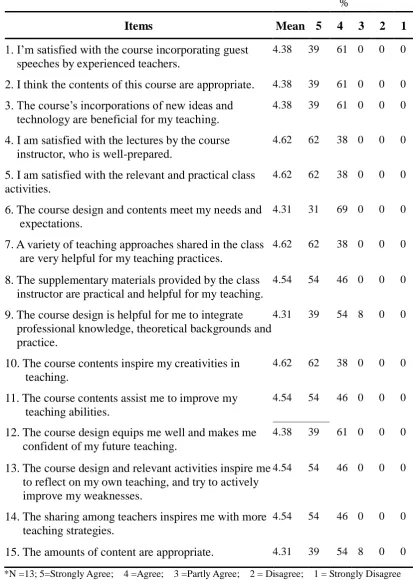
According to Table 1, the subjects in
this study indicated positive feedback to the
course design. Specifically, all teachers
were satisfied with the course incorporating
guest speeches by experienced teachers
(item 1), the lectures by the course
instructor (item 4) and the relevant and
practical class activities in this course (item
5). Also, most of the teachers thought the
course contents were appropriate (item 2),
the course design and contents met their
needs and expectations (item 6), and the
amounts of content were appropriate (item
15).
In addition, the English teachers
indicated that the reflective-teaching- based
course was beneficial in several ways. For
example, the course’s incorporations of
new ideas and technology (item 3),
introduction of a variety of teaching
approaches (item 7) and the supplementary
materials provided by the class instructor
(item 8) were practical and helpful for their
teaching.
Furthermore, all teachers thought that
the course design was helpful for them to
integrate professional knowledge, theoretical
backgrounds and practice (item 9). The
course contents also assisted them to
improve their teaching abilities (item 10),
and the course design equipped them well
and made them confident of their future
teaching (item 12). Finally, the participants
of the study responded that the course design
inspired them in different ways. For
instance, the course contents assisted them to
improve their teaching abilities (item 11), to
reflect on their own teaching, and teachers
try to actively improve their weaknesses
(item 13), while the sharing among teachers
inspires them with more teaching strategies
(item 14). In sum, the course design of this
study employing reflective teaching drew
positive results and feedback and was
considered appropriate and helpful for
teachers’ teaching practice and professional
development.
The qualitative analysis results (see
Appendix) lent support for the
quantitative data discussed in the
previous sections. Particularly, most
subjects provided positive feedback to
the rich resources provided by the class
teacher. They also pointed out that the
class discussions, comments and
suggestions by the peers and class
teachers after the teaching demonstrations
and the review of relevant language
teaching methods and approaches were
extremely helpful for them. Some
teachers responded that the course design
and reflective teaching assisted them to
constantly re-examine their objectives and
teaching strategies or class activity design,
and to inspire them to try innovative or
new ways of teaching. The qualitative
results are consistent with the quantitative
relevant studies as mentioned before. The
following are some excerpts from the
teachers’ feedback to the open-ended
questions in the course feedback
questionnaire.
The comments and suggestions provided by peers and the class teacher after teaching demonstrations were very practical. In the course, teacher reviewed some language teaching approaches and recalled my memories. (T002)
The course helped me rethink my previous course and activity designs and re-evaluate if they are consistent with my teaching objectives. (T009)
The course helped me understand how to incorporate on-line resources to enhance my students’ learning, but I need to pay attention to
if the applications of on-line resources would be consistent with my teaching needs and objectives. Also, the learners play a very critical role in my course design. (T011)
The course encouraged me to try new teaching approaches and techniques. For example, the final story-telling demonstration task was quite interesting and challenging, but they are helpful. T invited some Ts (guest speakers) to share their practical experiences. They really gave me some good ideas, and I couldn’t wait to try them in my class. (T013)
In sum, the participating teachers
benefit from the reflective-teaching-
based course, and the course assisted
them to relate the practices to the prior
knowledge, re-evaluate their own
teaching, observe good teaching
techniques and adapt observed helpful
teaching strategies to their class.
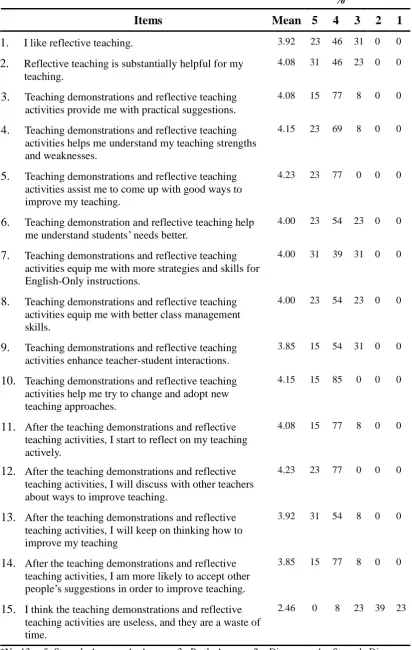
According to Table 2, most subjects
indicated positive feedback to the
reflective teaching approach. Specifically,
all teachers thought that teaching
demonstrations and reflective teaching
activities assisted them to come up with
good ways to improve their teaching
(item 5). Also, teachers agreed that
teaching demonstrations and reflective
teaching activities helped them try to
change and adopt new teaching
approaches (item 10). In addition, all
teachers indicated that they would
discuss with other teachers about ways
to improve teaching after the teaching
demonstrations and reflective teaching
activities (item 12).
The above results were consistent
with the findings of the previous studies
that suggested advantages of reflective
teaching for inspiring teachers to adopt
new or better ways to improve their
teaching (Rodman, 2010), for teacher’s
modifications of their current teaching
(Moon, 2006), and for constantly being
reflective on their own teaching (Moran,
2007).
Furthermore, the results of Table 2
indicated that more than 90% of the
teachers thought that the reflective
teaching practice in the training program
helped them be aware of their strengths
and weaknesses of their own teaching and
be more willing to accept others’
Table 1: Teachers’ feedback to the course based on reflective-teaching
%
Items Mean 5 4 3 2 1
1. I’m satisfied with the course incorporating guest speeches by experienced teachers.
4.38 39 61 0 0 0
2. I think the contents of this course are appropriate. 4.38 39 61 0 0 0
3. The course’s incorporations of new ideas and technology are beneficial for my teaching.
4.38 39 61 0 0 0
4. I am satisfied with the lectures by the course instructor, who is well-prepared.
4.62 62 38 0 0 0
5. I am satisfied with the relevant and practical class activities.
4.62 62 38 0 0 0
6. The course design and contents meet my needs and expectations.
4.31 31 69 0 0 0
7. A variety of teaching approaches shared in the class are very helpful for my teaching practices.
4.62 62 38 0 0 0
8. The supplementary materials provided by the class instructor are practical and helpful for my teaching.
4.54 54 46 0 0 0
9. The course design is helpful for me to integrate professional knowledge, theoretical backgrounds and practice.
4.31 39 54 8 0 0
10. The course contents inspire my creativities in teaching.
4.62 62 38 0 0 0
11. The course contents assist me to improve my teaching abilities.
4.54 54 46 0 0 0
12. The course design equips me well and makes me confident of my future teaching.
4.38 39 61 0 0 0
13. The course design and relevant activities inspire me to reflect on my own teaching, and try to actively improve my weaknesses.
4.54 54 46 0 0 0
14. The sharing among teachers inspires me with more teaching strategies.
4.54 54 46 0 0 0
15. The amounts of content are appropriate. 4.31 39 54 8 0 0
Table 2: Teachers’ feedback to reflective-teaching
%
Items Mean 5 4 3 2 1
1. I like reflective teaching. 3.92 23 46 31 0 0
2. Reflective teaching is substantially helpful for my teaching.
4.08 31 46 23 0 0
3. Teaching demonstrations and reflective teaching activities provide me with practical suggestions.
4.08 15 77 8 0 0
4. Teaching demonstrations and reflective teaching activities helps me understand my teaching strengths and weaknesses.
4.15 23 69 8 0 0
5. Teaching demonstrations and reflective teaching activities assist me to come up with good ways to improve my teaching.
4.23 23 77 0 0 0
6. Teaching demonstration and reflective teaching help me understand students’ needs better.
4.00 23 54 23 0 0
7. Teaching demonstrations and reflective teaching activities equip me with more strategies and skills for English-Only instructions.
4.00 31 39 31 0 0
8. Teaching demonstrations and reflective teaching activities equip me with better class management skills.
4.00 23 54 23 0 0
9. Teaching demonstrations and reflective teaching activities enhance teacher-student interactions.
3.85 15 54 31 0 0
10. Teaching demonstrations and reflective teaching activities help me try to change and adopt new teaching approaches.
4.15 15 85 0 0 0
11. After the teaching demonstrations and reflective teaching activities, I start to reflect on my teaching actively.
4.08 15 77 8 0 0
12. After the teaching demonstrations and reflective teaching activities, I will discuss with other teachers about ways to improve teaching.
4.23 23 77 0 0 0
13. After the teaching demonstrations and reflective teaching activities, I will keep on thinking how to improve my teaching
3.92 31 54 8 0 0
14. After the teaching demonstrations and reflective teaching activities, I am more likely to accept other people’s suggestions in order to improve teaching.
3.85 15 77 8 0 0
15. I think the teaching demonstrations and reflective teaching activities are useless, and they are a waste of time.
2.46 0 8 23 39 23
Accordingly, most teachers (92%)
agreed that teaching demonstrations and
reflective teaching activities provided
them with practical suggestions (item 3),
and teaching demonstrations and
reflective teaching activities helped them
understand their teaching strengths and
weaknesses (item 4). Also, most teachers
(92%) indicated that they started to
reflect on their teaching actively after
teaching demonstrations and teaching
activities (item 11), while they were
more likely to accept other people’s
suggestions to improve teaching after the
teaching demonstrations and reflective
teaching activities (item 14). The
above results confirm the findings of the
previous studies that suggested the
positive effects of reflective teaching on
teacher’s critical thinking (Pedro, 2005)
and actively involved in the reflection
processes to re-examine their beliefs and
objectives for better teaching (Posner,
2005; Rodman, 2010).
Finally, most teachers (60% to 70%)
liked reflective teaching and agreed that
reflective teaching could be helpful for
their teaching in several ways.
According to the results in Table 2, most
teachers (about 70%) liked reflective
teaching (item 1), and 77% of them
thought that reflective teaching was
substantially helpful for their teaching
(item 2). Also, more than 70% of the
teachers indicated that teaching
demonstration and reflective teaching
helped them understand students’ needs
better (item 6), and the relevant
reflective activities equipped them with
more strategies and skills for
English-Only instructions (item 7).
Furthermore, most teachers (about 70%
to 80%) agreed that teaching
demonstrations and reflective teaching
activities equipped them with better class
management skills (item 8), and they
enhanced teacher-student interactions
(item 9). Finally, 85% of the teachers
indicated that they would keep on
thinking how to improve their teaching
after the teaching demonstrations and
reflective teaching activities (item 13),
and more than 60% of them didn’t think
that the teaching demonstrations and
reflective teaching activities were useless,
but a waste of time.
Like the quantitative results
discussed in the previous sections, most
subjects indicate that reflective teaching
helps them re-examine their own
teaching, strengths, weaknesses and
objectives, and constantly reflect on their
own teaching. Also, they can learn
from each other through teaching
demonstrations, and improve their own.
In addition, some of them points out that
reflective teaching helps them modify or
adopt some concepts (e.g. new understanding of the role of warm-up activities in each section byT001).
The following are some excerpts
from the subjects’ feedback to the
open-ended questions in the
The course helped me re-examine teaching of English reading, and the relationship between English reading and writing. (T001)
Through observations, feedback or comments as well as theoretical backgrounds, we are provided with good ideas and chances for constant improvements in teaching. (T007)
The course helped me rethink my previous course and activity designs, and
re-evaluate if they are consistent with my
teaching objectives. (T009)
The above findings supported the
conclusions of the previous studies (Chio,
2004; Downey, 2008; Narvaéz, 2010;
Tzeng, 2002) that argued for the positive
effects of reflective teaching on
equipping teachers with better
professional skills and knowledge (e.g.
instructional strategies or techniques,
class management skills and
teacher-student interactions, etc.)
In sum, the findings of the present
study support the conclusions of
previous studies about the positive
effects of reflective teaching on teachers’
professional development in terms of
teaching and class management
strategies, and on teachers’
self-awareness of practicality of their
teaching beliefs and objectives. Most
importantly, the reflective teaching
approach encourages teachers to develop
constant and active reflections on their
own teaching for continuous
improvements in teaching and
professional development. Hence,
more research or teacher training
programs should be encouraged in the
relevant fields.
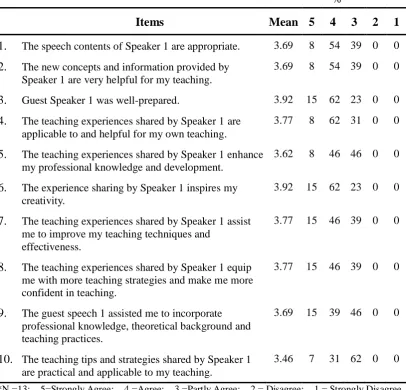
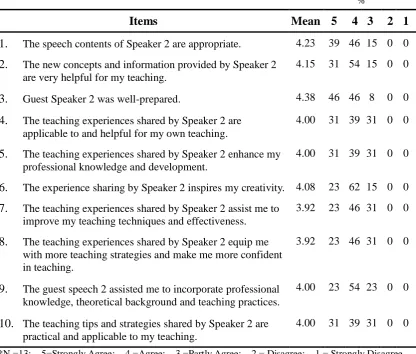
Table 3 and Table 4 show the
participants’ feedback to guest speeches
of experienced English teachers on
creative teaching ideas for teaching
English to elementary students.
Positive results have been drawn on the
subjects’ feedback to both guest
speeches. According to Table 3 and
Table 4, most subjects (more than 60% )
thought that the speech contents of the
2 guest speeches were appropriate (item
1), and the new concepts and
information provided by both speeches
were very helpful for their teaching (item
2). Also, more than 60% of the
subjects thought that the experience
sharing by both speeches assisted them
to improve their teaching techniques and
effectiveness (item 7), and equipped
them with more teaching strategies and
made them more confident in teaching.
Furthermore, more than 90% of the
teachers in the training program
indicated that guest speeches were
well-prepared (item 3) because the
speaker brought a lot of supplementary
teaching materials, teaching aids, game
sets and students’ assignments; the
teaching experiences shared by both
speakers were applicable to and helpful
for their own teaching (item 4), and the
experience sharing by both speakers
inspired their creativity (item 6). In
addition, more than half of the teachers
agreed that the teaching experiences
shared by both speakers enhanced their
development (item 5) and assisted them
to incorporate professional knowledge,
theoretical background and teaching
practices (item 9). The rich resources
could inspire the teachers in this study in
several ways and evoke their creativities
to adapt some of the materials or
activities to their own classroom.
However, only about 40% of the
subjects in the study indicated that he
teaching tips and strategies shared by
Speaker 1 were practical and applicable
to their teaching, and more than 60% of
them held neutral opinions. Those
teachers’ concerns of the practicality of
the shared ideas by Speaker 1 might be
due to time concerns (about 2 hours
weekly) for the language teaching in the
contexts of public schools, and some of
the reading instruction tips or extensive
reading activities might need more time
to have positive effects on pupils’
development of reading proficiency.
Nevertheless, most teachers held positive
attitudes and opinions about the ideas
and creative activities shared by the first
speaker.
Table 3: Feedback to guest speech 1
%
Items Mean 5 4 3 2 1
1. The speech contents of Speaker 1 are appropriate. 3.69 8 54 39 0 0
2. The new concepts and information provided by Speaker 1 are very helpful for my teaching.
3.69 8 54 39 0 0
3. Guest Speaker 1 was well-prepared. 3.92 15 62 23 0 0
4. The teaching experiences shared by Speaker 1 are applicable to and helpful for my own teaching.
3.77 8 62 31 0 0
5. The teaching experiences shared by Speaker 1 enhance my professional knowledge and development.
3.62 8 46 46 0 0
6. The experience sharing by Speaker 1 inspires my creativity.
3.92 15 62 23 0 0
7. The teaching experiences shared by Speaker 1 assist me to improve my teaching techniques and
effectiveness.
3.77 15 46 39 0 0
8. The teaching experiences shared by Speaker 1 equip me with more teaching strategies and make me more confident in teaching.
3.77 15 46 39 0 0
9. The guest speech 1 assisted me to incorporate professional knowledge, theoretical background and teaching practices.
3.69 15 39 46 0 0
10. The teaching tips and strategies shared by Speaker 1 are practical and applicable to my teaching.
In sum, positive feedback has been
drawn from the subjects (English
teachers) in this study. Most feedback
indicated the applicability and
practicality of the shared ideas, activities
and task designs to the English teaching
in the elementary schools. The most
importantly, those ideas shared by the
experienced teachers inspired the
teachers in the training program
described in this study, and enhanced
their professional development in
teaching knowledge, skills and
strategies.
Likewise, the qualitative analyses of
the subjects' responses to guest speeches
provide supportive descriptions and
explanations. Most subjects indicate that
some of the adapted games, such as SET
and UNO, and grammatical teaching tips
shared by the Speaker 1 are practical,
applicable and inspiring. Some
subjects stated that they could adapt the
ideas or options shared by Speaker 1 and
develop their own teaching aids, and
applied the teaching aids for teaching of
letter, vocabulary and grammar.
Table 4: Feedback to guest speech 2
%
Items Mean 5 4 3 2 1
1. The speech contents of Speaker 2 are appropriate. 4.23 39 46 15 0 0
2. The new concepts and information provided by Speaker 2 are very helpful for my teaching.
4.15 31 54 15 0 0
3. Guest Speaker 2 was well-prepared. 4.38 46 46 8 0 0
4. The teaching experiences shared by Speaker 2 are applicable to and helpful for my own teaching.
4.00 31 39 31 0 0
5. The teaching experiences shared by Speaker 2 enhance my professional knowledge and development.
4.00 31 39 31 0 0
6. The experience sharing by Speaker 2 inspires my creativity. 4.08 23 62 15 0 0
7. The teaching experiences shared by Speaker 2 assist me to improve my teaching techniques and effectiveness.
3.92 23 46 31 0 0
8. The teaching experiences shared by Speaker 2 equip me with more teaching strategies and make me more confident in teaching.
3.92 23 46 31 0 0
9. The guest speech 2 assisted me to incorporate professional knowledge, theoretical background and teaching practices.
4.00 23 54 23 0 0
10. The teaching tips and strategies shared by Speaker 2 are practical and applicable to my teaching.
4.00 31 39 31 0 0
Gobang and 5-sense teaching, and
grammatical teaching aids and some
creative teaching ideas shared by the
Speaker 2 are practical, applicable and
inspiring. Some subjects thought
Speaker 2 was very passionate and the
creative ideas and teaching resources or
aids were very inspiring and helpful.
Also, some of them acknowledged the
teaching passions shown by the second
speaker. Finally, the second speaker
inspired most of the subjects in this
study for more options to integrate
reading and writing to language class.
Some excerpts of students' feedback
to the guest speeches are described as
follows:
Guest Speaker 1 provided a variety of options for class activities, and I can apply
them to my class with slight adjustments or
modifications. (T002)
A variety of teaching activities, such as
SET and UNO, and other grammar analyses and instruction tips. (T005)
The Uno game and activities can be
incorporated to the theme-based
vocabulary learning. (T001)
Guest Speaker 2 adopted and modified a lot of teaching activities, and this inspired me that I could change or modify mine as well. (T013)
In sum, the qualitative findings of
subjects' feedback to the course,
reflective teaching and guest speeches
were consistent with the quantitative
results discussed in the earlier sections,
and indicate the positive effects of the
course design, the positive influences of
reflective teaching and guest speeches in
Learning Tasks That Were Considered Beneficial
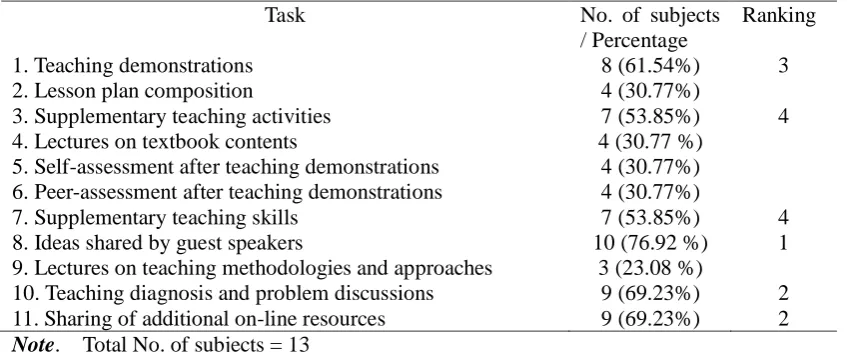
Table 5 illustrates the subjects’ feedback
to the beneficial task(s) in the
reflective-teaching based program.
Accordingly, the teaching ideas shared
by the guest speakers, who are
experienced teachers, are considered the
most helpful. The result is consistent
with the discussions in the previous
section about participating English
teachers’ feedback to the class for the
open-ended question regarding the most
inspiring task in the program. The
following are some excerpts from the
teachers’ feedback to one of the
open-ended questions in the course
feedback questionnaire.
From the sharing of the experienced
teachers, I’ve learned some new
different ways of teaching and a lot of
practical teaching strategies that I can
adapt and use in my own class. (T004)
T invited some Ts to share their
practical experiences. They really
gave me some good ideas, and I
couldn’t wait to try them in my class.
(T013)
The feedback provided by the
English teachers who participated in this
short-term program indicates that the
sharing of ideas and experiences by the
experienced teachers, the guest speakers,
inspire them with new ideas that can be
employed in their classes, and they are
willing to try them out and improve their
the experienced teachers evoke the
participants of the course to reflect on
the possibilities to incorporate the new
ideas to their classes, and try to make a
difference.
The second most beneficial tasks
are teaching diagnosis / problem
discussions and on-line resources.
Teaching demonstrations and
supplementary teaching activities / skills
were also considered helpful. The
following excerpts from the teachers’
feedback to one of the open-ended
questions in the course feedback
questionnaire can lend some supports for
the results in Table 5.
The comments and suggestions
provided by peers and the class teacher after teaching demonstrations were very practical. (T002)
The class discussions with peers and teaching demonstration inspired me to try different teaching methods and
teaching ideas…With the rich
resources and contents provided by the class teacher, I learnt a lot and made a progress in a short period of time. (T004)
The resources provided by the class teacher, real practice (demonstration), class discussions were all very helpful for my teaching. (T011)
The results above in Table 5 and
feedback by the participating teachers
indicate that the demonstrating teachers
appreciate others’ comments and
suggestions, and they are willing to
accept the advice and improve their own
teaching. Besides, those teachers think
class discussions with peers and the
lecturers could give them more
inspirations than the paper-based
self-assessment or peer-assessment.
Due to the time limit of the intensive
program, the researcher was not able to
conduct follow-up interviews addressing
on this issue. Future research could
take this factor into account when tasks
are designed for reflective teaching.
Table 5: The most beneficial learning tasks
Task No. of subjects
/ Percentage
Ranking
1. Teaching demonstrations 8 (61.54%) 3
2. Lesson plan composition 4 (30.77%)
3. Supplementary teaching activities 7 (53.85%) 4
4. Lectures on textbook contents 4 (30.77 %)
5. Self-assessment after teaching demonstrations 4 (30.77%) 6. Peer-assessment after teaching demonstrations 4 (30.77%)
7. Supplementary teaching skills 7 (53.85%) 4
8. Ideas shared by guest speakers 10 (76.92 %) 1
9. Lectures on teaching methodologies and approaches 3 (23.08 %)
10. Teaching diagnosis and problem discussions 9 (69.23%) 2 11. Sharing of additional on-line resources 9 (69.23%) 2
CONCLUSION
The present study was designed to guide
English teachers of elementary schools
in southern Taiwan to practice reflective
teaching and to understand the medium
of instructions. Through reflections on
teaching demonstration, the lecturer's
and peers' comments and suggestions,
the subjects (teachers) were guided to
self-assess strengths and weaknesses of
their own instructions, and were
equipped with strategies to cope with
problems in their classes. The
quantitative and qualitative analyses all
indicate positive feedback of the
reflective teaching on teaching
improvements, diagnosis of teaching
strengths and weaknesses as well as
awareness-raising for teachers'
reflections in their future teaching.
Specifically, reflective teaching assisted
teachers to be more aware of the
importance of understanding students'
needs, and helped them improve their
class management skills, instructions and
class interactions. It also influenced
teachers to remind themselves of the
importance to constantly reflect on their
own teaching and ways to improve their
instructions. However, the length of
the present study (3 weeks) was
comparatively short, so the
interpretations and generalizations of the
study findings should be careful. More
relevant studies on effects of reflective
teaching for a longer period of time, and
involvements of more subjects should be
encouraged in the future. For further
verifications of teachers' applications of
the reflective teaching and learnt
techniques from this program, follow-up
studies with class visits, videotaped
teaching and semi-structured interviews
are suggested. Also, further research
can be conducted to compare the
long-turn teaching performances
between reflective teachers and
non-reflective teachers and students'
performances in reflective teaching and
non-reflective teaching classes to have
more holistic understanding of the
effects of reflective teaching.
REFERENCE
Bailey, K, Curtis, A. & Nunan, D. (2001).
Pursuing professional development: The self as source. Boston, MA: Heinle & Heinle.
Chio, C. P. (2004). A teacher’s
reflections on teaching processes. Unpublished master’s thesis,
National Taipei University of
Education, Taipei, Taiwan.
Clarke, R., & Croft, P. (1998). Critical reading for the reflective practitioner.
Oxford, UK: Elsevier Butterworth-
Heinemann.
Costa, A. L. & Kallick, B. (2000).
Getting into the habit of reflection.
Educational leadership, April, pp. 60-66.
Danielowich, R. (2007). Negotiating the
conflicts: Reexamining the structure
and function of reflection in science
teacher learning. Science Education,
Dewey, J. (1933). How we think: A restatement of the relation of reflective thinking to the education process. Chicago, IL.: D. C. Heath. Downey. J. (2008). ‘It’s not as easy as it
looks’: Pre-service teachers’ insights about teaching emerging from an
innovative assignment in
educational psychology. Teaching Educational Psychology, 3(1), pp. 1-11.
Hsu, C. S. (2009). The analysis of the
reflection of students and its
implication on teaching of teaching
practicum course. Journal of Educational Research and Development, 5(1), pp. 35-58. Kemmis, S. (1985). Action research and
the politics of reflection. In Boud, D., Keogh., & Walker, D. (Eds.)
Reflection: Turning experience into learning. London: Kogan Page. Moon, J. A. (2006). Learning journals: A
handbook for reflective practice and professional development (6th ed.). New York: Routledge.
Moran, M. J. (2007). Collaborative
action research and project work:
Promising practices for developing
collaborative inquiry among early
childhood pre-service teachers.
Teaching and Teacher Education: An International Journal of Research and Studies, 23(4), pp. 418-431.
Narvaéz, C. Q. (2010). How can the practice of reflective teaching promote professional develop- ment in each of
the constituents of teacher education- knowledge , skills, attitudes and awareness? Retrieved from
http://www.eumed.net/rev/tlatemoani/
02/cqn.pd.
Orland-Barak, L. & Yinon, H. (2007).
When theory meets practice: What
student teachers learn from guided
reflection on their own classroom
discourse. Teaching and Teacher Education, 23(6), pp. 957-969. Pedro, J. Y. (2005). Reflecting in teacher
education: Exploring pre-service teachers’ meaning of reflective practice. Reflective Practice, 6(10), pp. 49-66.
Posner, G. J. (2005). Field experience: A guide to reflective teaching (6th ed.). Boston, MA: Pearson-Allyn &
Bacon.
Rodman, G. J. (2010). Facilitating the
teaching-learning process through
the reflective engagement of
pre-service teachers. Australian Journal of Teacher Education,
35(2), pp. 20-35.
Schön, D.A. (1983). The reflective practitioner: How professionals think in action. New York: Basic Books.
Schön, D.A. (1987). Educating the reflective practitioner: toward a new design for
teaching and learning in the professions. San Francisco, CA: Jossey Bass, Inc.
Rodman, G. J. (2010). Facilitating the
the reflective engagement of
pre-service teachers. Australian Journal of Teacher Education,
35(2), pp. 20-35.
Tsai, F. C. (2004). A study on reflective
behaviors and teaching beliefs of
pre-service teachers in teaching
practicum course. Unpublished master’s thesis, National
Sun Yat-sen University, Kaohsiung,
Taiwan.
Tseng, W. C. (2002). A study on reflections of pre-service teachers: A case study of class management course. Unpublished master’s thesis,
National Sun Yat-sen University,
Kaohsiung, Taiwan.
Yang, M. L. (2004). Research on
teaching reflections of math
teachers in elementary schools.
Unpublished master’s thesis,
National Taipei University of
Education, Taipei, Taiwan.
Yuen, H.Y.(2005). Effects of mobile learning on students’ learning. Unpublished master’s thesis,
Chung Yuan Christian University,
Appendix I
Transcripts of Open-ended Question Feedback to the Course and Reflective-Teaching
Feedback to the Course
16. What is the most inspiring or the inspiration you’ve got from the course? 17. Other feedback or reflections to the course?
Id Feedback
T001 The course helped me re-examine teaching of English reading, and the relationship between English reading and writing.
T002 The comments and suggestions provided by peers and the class teacher after teaching demonstrations were very practical. In the course, teacher reviewed some language teaching approaches and recalled my memories.
T003 The course inspired me to integrate knowledge, theory and practice. I learnt a lot. Thank you.
T004 The class discussions with peers and teaching demonstration inspired me to Try different teaching methods and teaching ideas. From the sharing of the experienced teachers, I’ve learned some new different ways of teaching and a lot of practical teaching strategiesthat I can adapt and use in my own class. With the rich resources and contents provided by the class teacher, I learnt a lot and made a progress in a short period of time.
T005 1. Review a lot of teaching methods and approaches.
2. Know several English teachers and can discuss together for more teaching strategies., 3. The course instructor prepared rich resources and contents that were very helpful for us. Although the class is demanding and tiring, I learnt a lot.
T007 Teaching is an art, and takes time. Through observations, feedback or comments as well as theoretical backgrounds, we are provided with good ideas and chances for constant improvements in teaching.
Thanks for teacher’s rich resources.
T008 1. Share practical teaching experiences with other English teachers.
2. The lectures refreshed my concepts and inspired me new ideas that were very helpful for my teaching.
Thanks for teacher’s efforts and classmates’ help and sharing.
T009 The course helped me rethink my previous course and activity designs, and re-evaluate if they are consistent with my teaching objectives.
T010 Rethinking my teaching style.
T011 1. The resources provided by the class teacher, real practice (demonstration), class discussions were all very helpful for my teaching.
2. The course helped me understand how to incorporate on-line resources to enhance my students’ learning, but I need to pay attention to if the applications of on-line resources would be consistent with my teaching needs and objectives. Also, the learners play a very critical role in my course design.
Thanks for teacher’s sharing of rich and valuable resources.
T012 To rethink my teaching all the time and to try story reading in the limited time and I think that will make differences.
Feedback to Reflective Teaching
16. What is the most inspiring or something you would like to share?
Id Feedback
T001 I have new understanding of the roles and importance of warm-up in each lesson. The warm-up section is not only for review, it is important and helpful for
students' integrations of the old knowledge with the new content.
T002 Reflective teaching reminds me to constantly reflect on my lessons and examine if they meet my students' needs.
T004 From other teachers' experiences, I reflect on my teaching, especially my weakness. T005 Through reflections, I can understand the strengths and weakness of my teaching
better.
T006 The classmates' and teacher's suggestions after the teaching demonstrations helped me find my strengths and the parts that need to be improved.
T007 Through teaching demonstrations, I could observe different teaching procedures and processes, and justify which is better and the key to be a successful teaching so
that I can modify and adjust my teaching style.
T008 Reflective teaching helps me reexamine my teaching procedures and my weaknesses.
T009 Reflective teaching helps me be aware of my own shortcoming and learn from others' advantages or good activity designs.
T010 By watching other teachers’ demonstrations, I can reflect on my own teaching.
T011 1. Although I don't really like teaching demonstrations, I can examine my own teaching carefully to be aware of my weaknesses and learn from others' strengths.
2. Two teaching demonstrations in a short-term program (2.5 weeks) are a little bit demanding.
T012 Reflections help me to improve my teaching a lot.
T013 I can constantly improve my teaching during the teaching demonstrations.
Feedback to the Guest Speech 1
11. What do you think is the most practical thing shared by the Guest Speaker 1?
Id Feedback
T001 The game of Uno is more applicable.
T002 I need to understand parents' expectations to the school education. In addition, Guest Speaker 1 provided a variety of options for class activities, and I can apply them to my class with slight adjustments or modifications.
T003 TPR activity T004 Teaching activities
T005 A variety of teaching activities, such as SET and UNO, and other grammar analyses and instruction tips.
T007 Matching games are quite practical and applicable.
T008 Learning phonics by singing is helpful for students' memorization.
T011 Teach some concepts of teaching of grammar and writing, and provide some information about applications of games for learning.
T012 The “Uno” game.
T013 She invented several practical and creative activities that inspire us to brainstorm more.
Feedback to the Guest Speech 1
12. After the sharing of the Guest Speaker 1, what new ideas were inspired? How can I incorporate the new ideas into my teaching?
Id Feedback
T001 The Uno game and activities can be incorporated to the theme-based vocabulary learning. T003 Cooperative learning; contests
T004 The applicability of grammatical concepts to my present teaching. T005 The SET game can be employed in my teaching.
T007 The teaching of Guest Speaker 1 is more suitable for autonomous learning, and it's comparatively more difficult to be applied for teaching.
T008 The matching game and activities can be useful for both letter and vocabulary learning. T011 With simple tables and some mnemonic rhymes, it's easier to teach kids about
complicated grammatical concepts. The speaker's sharing inspired me to think how to simplify instructions of complicated grammatical rules.
T012 Kids can learn the forms of verb with funny way.
11. What do you think is the most practical thing shared by the Guest Speaker 2?
Id Feedback
T001 Cook Book and reading reflection logs are practical.
T002 5-sense teaching and other creative teaching ideas. The speaker provided a useful booklist that is a useful resource for creative language teaching.
T003 theme-based teaching
T004 Students' worksheets and teachers' resources or reference books T005 1. Use a variety of small teaching aids, e.g. a slot machine
2. The board of Gobang game is useful for teaching, especially grammatical structures. T007 Teaching requires a lot of passions and surprises.
T008 We need to give students surprises often to inspire their interests. T009 Integrations of writing instructions; shared a lot of useful resources. T011 1. Share a lot of good websites and reference books or other resources.
2. A variety of teaching aids; collecting games and enhance students' multiple-senses learning.
T012 The teaching for writing.
T013 She shared a lot of teaching tips in reading and writing practice for our reference.
Feedback to the Guest Speech 2
12. After the sharing of the Guest Speaker 2, what new ideas were inspired? How can I incorporate the new ideas into my teaching?
Id Feedback
T001 Cook Book is more useful; Speaker 2 shared a lot of options for teaching food, and they are quite applicable.
T002 A lot of ideas can be used in teaching. I'll think about more teaching varieties to make my teaching more interesting and will be more interested in practicing the
language.
T003 Creative activities applicable for daily activities
T004 Extracurricular reading materials (e.g. books; magazines) T005 Situational decorations (e.g. Halloween activities and decorations.)
T007 Some toys from the toy shop can be used in teaching; asking students to read at the class beginning can be helpful for training of language awareness.
T008 Some creative teaching aids (e.g. paper plates to make snowmen; applicable on Christmas)
T009 Try to incorporate more writing activities
T011 Guest Speaker 2 is very passionate, and can clearly guide us to understand how to design courses from different aspects and design a various and attractive course.
T012 To teach kids to writing in simple context and then increasing the difficulty of contents.