Issues
ISSN: 2146-4138
available at http: www.econjournals.com
International Journal of Economics and Financial Issues, 2016, 6(3), 855-860.
The Effect of Financial Liberalization through the General
Agreement on Trade and Services on Economic Growth in
Developing Countries
Hazem Al Samman
1*, Chadi Azmeh
21Department of Accounting and Finance, at College of Commerce and Business, Dhofar University, Dhofar, Sultanate of
Oman, 2Department of Banking and Financial Sciences, International University for Science and Technology, Damascus, Syria.
ABSTRACT
This study investigates the influence of financial liberalization on economic growth in developing countries indirectly through their effect on financial development. It selects the size and activity of the financial system as indicators of financial development. The general agreement on trade and services (GATS) is a very useful option for developing countries to consolidate their financial sector reform to give foreign investors more certainty about financial investment opportunities in the economies of developing countries. This study chooses the level of commitments taking by developing countries in the GATS in banking sector as a measure of financial liberalization. The main objective is to examine the effect of developing countries financial liberalization commitments at the GATS on economic growth through their effect on the size and activity of the financial sector. According to
the analysis conducted, the results show no real effect of the level of commitments taking by developing countries in the GATS on economic growth
through their effect on the size and activity of financial development. Even though the effect of financial development on economic growth is positive, the effect of financial liberalization through the GATS on financial development is almost zero.
Keywords: Financial Liberalization, Economic Growth, Developing Countries, General Agreement on Trade and Services, Financial Development JEL Classifications: F65, O16
1. INTRODUCTION
Financial systems provide the economy with real services. Their contribution in the process of economic development is largely recognized by the big majority of economists. They believe that a well-developed financial sector can have a remarkable positive effect on economic growth (King and Levine, 1993; Gregorio and Guidotti, 1995; Beck and Levine, 2004; Ozturk, 2008; Acaravci et al., 2009).
Financial liberalization is one of the policy options that policy makers of developing countries can use to realize a real financial development (Levine, 1996; IMF, 2000). Yet, some policy makers are still reluctant to liberalize their financial markets because of their fear from an unpleasant financial crisis. The prevalent belief was that financial crisis in the last two decade are mainly due the financial liberalization. Researchers defend financial liberalization by indicating that inadequate domestic policies were the main
reason for the crisis (Peek and Rosengren, 2000; IMF, 2000). These large debate on the real implication of financial liberalization on developing countries, incite further research on the subject to construct a compelling evidence of the real implication. Several studies indicate a significant positive real effect from financial liberalization on economic growth. They argue that financial liberalization has a positive impact on the efficiency of the financial
sector (Demirguc-Kunt et al., 1998; Bayraktar and Wang, 2006). Yet,
other dimension of financial development (size and activity) did not take their merit to be tested to found out the real implications from financial liberalization. The present paper tries to test empirically this relation and found out the effect of financial liberalization, measured by the level of commitments taking by the developing countries WTO members, of these dimension of financial development.
countries were previously state owned. Owing to responses to the IMF led structural adjustment conditionality and the WTO members during the Uruguay round negotiations, many developing countries had to undertake extensive State roll backs from various previously state owned enterprises-which resulted in an unprecedented wave of unilateral liberalization (IMF, 2000; World Bank, 2002).
This liberalization was expected to be the gateway to stimulating competition in the financial sector, to result in greater efficiency, dynamism and innovation. Other advantages with introduction of other players in the financial sector were seen as potentially stimulating improvements in domestic banking performance, by reducing costs, profits and net interest margins (Claessens et al., 2001; Bayraktar and Wang, 2004). Foreign banks usually bring new and sometimes better skills, management techniques, training procedures, technology and products to the domestic market. As such, these banks can be seen as a major source of skills and technologies for domestic banks (Focarelli and Pozzolo, 2002).
In spite of the several potential benefits, many countries continue to be reluctant to open up their markets to foreign banks. Many still believe that foreign banks may stifle financial development instead of enhancing the provision of financial services and capital. In fact, foreign banks are often accused of stimulating capital flight. They are also accused to focus on serving only the most profitable market segments; not serving the retail market; serving only foreign corporations; or dominate the entire domestic market. Because of their interest in recouping costs, foreign banks tend to favor only the high end service consumer, leaving behind large numbers of poor people in the poorest countries who need capital to startup businesses. Their reputation and long experience in the international market give them the priority to choose upon the most profitable clients and dominate the financial domestic market (World Bank, 2002; Tamirisa et al., 2000; Agenor, 2001; Levine, 1996; Peek and Rosengren, 2000).
Levine (1996, 2001) provides an extensive survey study about the link between international financial liberalization and growth. He points out the importance of international financial integration in promoting growth through improvements in the domestic financial markets. Hence, his theory is decomposed into two parts: (1) Foreign bank entry has positive effects on financial development, and (2) financial development has positive effects on economic growth.
Several studies tried to test empirically the validity of this theory.
Demirguc-Kunt et al., (1998) find no direct connection between
foreign bank activity and economic growth. They do, however, find an indirect link. Foreign bank participation is associated with a drop in bank overhead expenses and lower overhead costs are robustly linked with faster long-run economic growth. Bayraktar and Wang (2004) show that foreign banks play a statistically and economically significant role in improving the efficiency and competitiveness of domestic banks by reducing costs, profits, and net interest margins. Thus, foreign banks are expected to increase economic growth by improving the functioning of domestic banks, as well as the development level of financial markets. Bayraktar
and Wang (2006) examine the direct and indirect effects of foreign bank entry on economic growth. Their results show a direct link between the presence of foreign banks and the rate of economic growth. Similarly, their results imply an indirect link between financial sector openness and growth, through its effect on the efficiency of the banking sector (lower overhead costs and net interest margins of domestic banks).
2. MATERIALS AND METHODS
Based on the theory of Levine, this study examines the effects of foreign bank entry on economic growth through its effects on financial development. In this study, the variables are different than those used by other studies (profits, overhead costs and interest margin). The last variables represent the efficiency of financial development. The selected variables are: Liquid liabilities and bank credit. It represents, respectively, the size and activity of the financial sector. In addition, the indicator of foreign bank entry is: General agreement on trade and services (GATS). It represents the level of commitments at the WTO in the banking sector. The main objective is to analyze the effect of the level of commitments taken by developing countries in the banking sector at the WTO on economic growth through its effect on financial development.
The data used in the empirical test are the determinants of financial development. Precedent studies found that the level of financial development depends on: Economic development, and the quality of institutions (Demirgüç-kunt and Levine, 2004; Arestis and Demetriades, 1996; Demetriades and Andrianova, 2004), legal system (Demirgüç-Kunt and Maksimovic, 1998; La Porta et al., 1997; La Porta et al., 1998; Levine, 1998; Levine, 1999), inflation rate (Rousseau and Wachtel, 2002; Boyd et al., 2001), and the
share of government vis a vis the totality of banking assets (La
Porta et al., 2002).
The data cover 26 developing countries for the period between 1996 and 2006. The period was choosing to show the effect of liberalization commitments of developing countries in the banking sector at the WTO on the level of financial development for a period of 10 years after the date of taking commitments by these countries (1997).
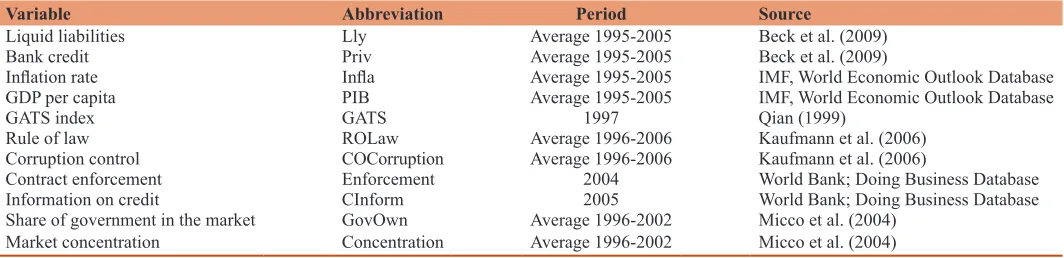
Based on the literature, several variables were choosing as determinants of financial development: The degree of financial market openness to foreign banks (index of GATS), level of financial development (bank credit to private sector, liquid liabilities), quality of institutions and legal system (rule of law, corruption control, contract enforcement, information on credit), level of economic development (gross domestic product [GDP] per capita), inflation (inflation rate) and share of assets possessed by government (Share of government in the market), and the degree of market concentration (Table 1).
We estimate two versions of the following equation:
Yi=α+β Fi+γ Xi+µi,
the matrix of explicative variables and µi is the error term.α, β and γ are the parameters that the model look to estimate. The model seeks to estimate the value of parameter β (the coefficient on the degree of openness to foreign banks). The model was applied two times. For each model, we vary the group of explicative variables to test the sensitivity of the coefficient that we are interested in. the models are:
1st model: Priv=α+β GATS+γ X i+µi;
2nd model: Liquid liabilities=α+β GATS+γ X i+µi;
For the first model, 8 regressions were conducted. For the first 7 regressions, additional explanatory variables were added, subsequently, to test the sensitivity of the results (Table 2). The value of R2 increased when adding new variables, which means that the explanatory variables fit in the model. In the last regression, two countries were deleted because they are considered as outliers for the Priv variable. In regression (7), the value of the parameter is negative and close to zero and it is not statistically significant. In regression (8), the value is positive and also close to zero and it is not statistically significant. Hence, the results form (Table 2) conclude no real effect form the level of commitments taking by developing countries under the GATS on the activity of the financial sector (financial development).
In the regression (8), we delete 2 countries that we consider outliers
for theliquid liabilities variable.
For the second model, 8 regressions were also conducted. As in the first model, for the first 7 regressions, additional explanatory variables were added, subsequently, to test the sensitivity of the results. The value of R2 increased when adding new variables, which means that the explanatory variables fit in the model. In the last regression, two countries were deleted because they are considered as outliers for the Lly variable. In regression (7), the value of the parameter is positive and close to zero and it is not statistically significant. In regression (8), the value is positive but it is not statistically significant. Hence, the results from (Table 3) conclude a marginal effect from the level of commitments taking by developing countries under the GATS on the size of the financial sector (financial development), but it is not statistically significant.
The second step, to test the indirect effect of financial liberalization on economic growth, is to examine the effect of financial development on economic growth for developing countries.
Empirical work on the relationship between financial development and economic growth began at the start of the 1990s, with King and Levine (1993). It shows a positive relationship between financial development and economic growth (Demetriades and Hussein, 1996; Odedokun, 1996; Rousseau and Wachtel, 1998; Beck and Levine, 2004; Rioja and Valev, 2004). Even though, some authors argue that there is no real effect of financial development on economic growth, for some group of countries, especially developing countries (Gregorio and Guidotti, 1995. for an empirical evidence for 12 countries in Latin America, and Naceur and Ghazouani, 2007. for 11 countries in the MENA region), they believe that the contradiction between their results and the literature is mainly due to weak infrastructure in those economies.
The study examines the effect of financial development on economic growth for a group of 47 developing countries who have GDP per capita less than 3.595$.
The variables used in the model are the same of the variables used in the endogenous economic growth model. The model takes the following form:
Growth=α+β Finance+γ (explanatory variables)+ε,
Five countries were deleted from the initial database because of lack of complete statistics for all the variables introduced in the model. The new database contains 42 developing countries. The explanatory variables used in the model may be divided into three groups: Simple series, political series and complete series. The simple series contains two indicators: Log of the initial and real GDP per capita to control the convergence and the average number of years of education as indicator of human capital stock in the economy. The political series contains the two indicators of the simple series plus four new variables: Inflation rate, government expense ratio as share of the GDP, sum of exportations and importations as share of the GDP and black market premium. The complete series contains all the variables of the political series plus measures of political stability. These measures are: Number of revolutions and number of assassination per 1000 habitants. We apply the regression two times. Each time, one of the indicators of financial development was introduced with all the other explanatory variables of the complete series.
The results obtained in (Table 4) are in conformity with the literature for the two indicators of financial development, and Table 1: Data description
Variable Abbreviation Period Source
Liquid liabilities Lly Average 1995-2005 Beck et al. (2009)
Bank credit Priv Average 1995-2005 Beck et al. (2009)
Inflation rate Infla Average 1995-2005 IMF, World Economic Outlook Database
GDP per capita PIB Average 1995-2005 IMF, World Economic Outlook Database
GATS index GATS 1997 Qian (1999)
Rule of law ROLaw Average 1996-2006 Kaufmann et al. (2006)
Corruption control COCorruption Average 1996-2006 Kaufmann et al. (2006)
Contract enforcement Enforcement 2004 World Bank; Doing Business Database
Information on credit CInform 2005 World Bank; Doing Business Database
Share of government in the market GovOwn Average 1996-2002 Micco et al. (2004)
Market concentration Concentration Average 1996-2002 Micco et al. (2004)
Table
2: Dependent variable is Priv
Regr ession (1) (2) (3) (4) (5) (6) (7) (8) Log GDP 0.516 (0.148)*** 0.380 (0.157)** 0.327 (0.148)** 0.409 (0.166)** 0.346 (0.203) 0.351 (0.21 1) 0.222 (0.218) 0.130 (0.130) GA TS 0.038 (0.184) 0.068 (0.175) 0.120 (0.164) 0.083 (0.167) −0.016 (0.175) −0.028 (0.195) −0.066 (0.187) 0.046 (0.1 17) Log Infla −0.240 (0.125)* −0.140 (0.125) −0.103 (0.129) −0.032 (0.133) −0.025 (0.142) −0.034 (0.136) −0.147 (0.082)* ROLaw 0.201 (0.095)** 0.418 (0.222)* 0. 583 (0 .22 4)* * 0.602 (0.256)** 0. 531 (0 .24 9)* * 0.109 (0.171) COCorruption −0.318 (0.295) −0.372 (0.285) −0.393 (0.320) −0.313 (0.310) −0.076 (0.200) Log Enforcement −0.537 (0.293)* −0.509 (0.344) −0.679 (0.345)* −0.259 (0.218) CInform 0.021 (0.029) 0.020 (0.031) 0.017 (0.030) 0.003 (0.018) GovOwn −0.043 (0.257) −0.069 (0.246) 0.074 (0.145) Concentration −0.447 (0.280) −0.368 (0.164)** Observations 26 26 26 26 25 25 25 23 R 2 0,38 0,47 0,56 0,58 0,69 0,69 0,74 0,71 *,**,***Represent, successively
, the level 0.1; 0.05; 0.01 of financial development variables statistical significance. Error type is between brackets. In the regression
(8), we delete 2 countries that we consider outliers for the Priv variable.
GDP:
Gross domestic product, GA
TS: General agreement on trade and services
Table
3: Dependent variable is liquid liabilities
Regr ession (1) (2) (3) (4) (5) (6) (7) (8) Log PIB 0.409 (0.142)*** 0.320 (0.156)* 0.249 (0.135)* 0.354 (0.147)** 0.415 (0.206)* 0.397 (0.21 1)* 0.321 (0.229) 0.261 (0.154) GA TS 0.049 (0.176) 0.069 (0.175) 0.137 (0.150) 0.090 (0.148) 0.018 (0.177) 0.065 (0.194) 0.043 (0.197) 0.101 (0.140) Log Infla −0.160 (0.124) −0.027 (0.1 14) 0.020 (0.1 15) 0.008 (0.135) −0.017 (0.142) −0.022 (0.144) −0.130 (0.097) ROLaw 0.266 (0.086)*** 0.542 (0.197)** 0.585 (0.227)** 0.512 (0.256)* 0.471 (0.262)* 0.127 (0.203) COCorruption −0.405 (0.262) −0.458 (0.289) −0.375 (0.320) −0.329 (0.327) −0.198 (0.239) Log Enforcement −0.187 (0.296) −0.295 (0.344) −0.395 (0.364) −0.036 (0.259) CInform −0.016 (0.029) −0.010 (0.031) −0.01 1 (0.031) −0.030 (0.021) GovOwn 0.168 (0.256) 0.153 (0.259) 0.288 (0.173) Concentration −0.260 (0.295) −0.189 (0.195) Observations 26 26 26 26 25 25 25 23 R 2 0.29 0.34 0.54 0.59 0.56 0.58 0.60 0.59 *,**,***Represent, successively
, the level 0.1; 0.05; 0.01 of financial development variables statistical significance. Error type is between brackets. GA
they are statistically and economically significant. For the first regression, the value of parameter of Lly is positive and it is statistically significant. For the second regression, the value of the parameter of Priv is also positive and it is statistically significant. In addition, the results for other explanatory variables are also in conformity with the literature and with the precedent empirical studies. For example, the literature predict a negative relationship between the initial level of GDP and the economic growth, and a positive relationship between average years of secondary and the economic growth, which is in conformity with our results. At this stage, the results conclude a positive and significant effect of the size and activity of the financial sector (financial development) economic growth for developing countries.
3. RESULTS AND CONCLUDING REMARKS
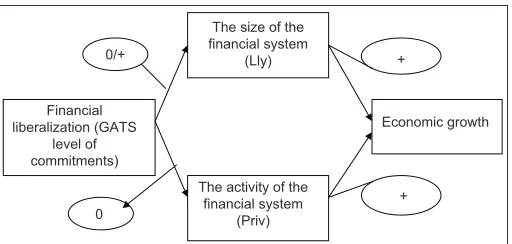
In this study, an ordinary least square model was developed to examine the effect of financial liberalization through the GATS on the level of economic growth in developing countries. The study examines this effect indirectly through the bias of financial development. A sample of 47 countries for the period 1970-2005 was used. As it is shown in Figure 1, the results of the empirical study conclude no real effect of financial liberalization commitments of developing countries at the GATS on economic growth throw its effect on the level of financial development. Even though the influence of financial development on economic growth is positive for these countries, the effect of financial liberalization through the commitments at GATS on financial development (size
and activity) was negligible and it is not statistically significant. In fact, the effect of financial liberalization on the size of financial sector was positive, but it was too small and not statistically significant. Hence, this study provides no compelling evidence that financial liberalization through the GATS is a good policy to increase economic growth in developing countries. In fact, Levine (1996), Levine (2001) and Bayraktar and Wang (2006) demonstrate that financial liberalization has positive effect on economic growth through its effect on financial development. The difference between the results of Levine and the results of the present study may be due to the period covered by this study. In fact, the period of 10 years, when testing the effect of financial liberalization on the size and activity of financial sector, may not be enough. Developing countries may need more time to realize the expected results from liberalization. Or maybe, it is because the adjustment costs were too high at the beginning and the benefits from financial liberalization were not enough to cover these costs. Furthermore, the difference in results may also be due the special case of developing countries. It is not a simple task for developing countries to convert their commitments taking at the GATS into a real financial liberalization. More work needs to be done to find out the real implication of financial liberalization, through the GATS, on the economies of developing countries.
REFERENCES
Acaravci, S., Ozturk, I., Acaravci, A. (2009), Financial development and
economic growth: Literature Survey and empirical evidence from Sub-Saharan African countries. South African Journal of Economic and Management Sciences, 12(1), 11-27.
Agenor, P.R. (2001), Benefits and costs of international financial
integration: Theory and facts. The Paper was Prepared for the
Conference on Financial Globalization: Issues and Challenges for
Small States. Washington, DC: The World Bank.
Arestis, P., Demetriades, P. (1996), Finance and growth: Institutional considerations and causality. UEL, Department of Economics Working Paper, No. 5.
Bayraktar, N., Wang, Y. (2004), Foreign bank entry, performance of domestic banks and the sequence of financial liberalization. China
Journal of Finance, 2(2), 1-39.
Bayraktar, N., Wang, Y. (2006), Banking Sector Openness and Economic Growth. World Bank Policy Research Working Paper, No. 4019. Beck, T.H., Levine, R. (2004), Stock markets, banks, and growth: Panel Table 4: Dependent variable is economic growth
Regressions (1) (2)
Intercept 15.56690 (4.71102)*** 16.04116 (4.68995)***
Initial GDP1 −0.77422 (0.57014) −1.08950 (0.58232)*
Schooling2 (average years of secondary) 2.21793 (2.67984) 2.93769 (2.50645)
Trade openess1 (IMP+EXP/GDP) −1.01146 (1.70883) −0.88679 (1.68792)
Inflation2 −1.07652 (1.25072) −0.84322 (1.27127)
Government expenses1 (per GDP) −5.47195 (2.51868)** −4.84686 (2.40122)*
Black market premium2 −0.21784 (0.69808) 0.46903 (0.71939)
Lly1 3.31177 (1.85136)*
Priv1 3.30144 (1.66916)*
Assassinat per 1000 habitants 0.32066 (0.46539) 0.16667 (0.46364)
Revolutions per year −1.84727 (1.04499)* −1.73219 (1.02551)
R2 0.3591 0.3718
Number of observations 42 42
1In the model, this variable is calculated as log of the (variable). 2In the model, this variable is calculated as log of the (1+variable). For each country, each variable represent the average of the period (1970-1995). *,**,***Represent, successively, 0.1; 0.05; 0.01 level of statistically significance. Type error is inside the brackets, GDP: Gross domestic product
0/+
The size of the financial system
(Lly) +
+ Financial
liberalization (GATS level of commitments)
Economic growth
The activity of the financial system
(Priv) 0
Figure 1: The influence of financial liberalization on economic growth
evidence. Journal of Banking and Finance, 28, 423-442.
Beck, T.H., Demirgüç-Kunt, A., Levine, R. (2009), Financial institutions
and markets across countries and over time: Data and analysis. World
Bank Policy Research Working Paper 4943, May.
Boyd, J.H., Levine, R., Smith, B.D. (2001), The impact of inflation on financial sector performance. Journal of Monetary Economics, 47,
221-248.
Claessens, S., Demirguc-Kunt, A., Huizinga, H. (2001), How does foreign
entry affect the domestic banking markets? Journal of Banking and Finance, 25, 891-911.
Demetriades, P., Andrianova, O. (2004), Finance and growth: What
we know and what we need to know. In: Goodhart, C.A.E.,
editor. Financial Development and Growth: Explaining the Links.
Basingstoke: Palgrave Macmillan. p38-65.
Demetriades, P.O., Hussein, K.A. (1996), Does financial development
cause economic growth? Time-series evidence from 16 countries. Journal of Development Economics, 51, 387-411.
Demirgüç-kunt, A., Levine, R., editors. (2004), Financial structure and
economic development: Perspectives and lessons. In: Financial Structure and Economic Development. The MIT Press.
Demirguc-Kunt, A., Levine, R., Min, H.G. (1998), Opening to foreign banks: Issues of stability, efficiency, and growth. In: Lee, S., editor. The Implications of Globalization of World Financial Markets. Seoul:
Bank of Korea. p83-115.
Demirgüç-kunt, A., Maksimovic, V. (1996), Institutions, Financial markets and Firm’s Choice of Debt Maturity. World Bank Policy
Research Working Paper No. 1686.
Focarelli, D., Pozzolo, A. (2000), The Determinants of Cross-Border
Shareholding: An Analysis with Bank Level Data form OECD
Countries. Paper Presented at the Federal Reserve Bank of Chicago
Bank Structure Conference, May.
Gregorio, J.D., Guidotti, P.E. (1995), Financial development and economic growth. World Development, 23(3), 433-448.
IMF. (2000), The role of foreign banks in emerging markets. In:
International Capital Markets: Development, Prospects, and Key Policy Issues. Washington, DC: IMF.
IMF. (2006), World Economic Outlook Database. Washington, DC: IMF. Kaufmann, D., Kraay, A., Mastruzzi, M. (2006), Governance Matters V:
Aggregate and Individual Governance Indicators for 1996-2005. World Bank Policy Research Working Paper No. 4012. Washington,
DC.
King, R.G., Levine, R. (1993), Finance and growth: Schumpeter might be right. Quarterly Journal of Economics, 108, 717-738.
La Porta, R., Lopez-de-Silanes, F., Shleifer, A. (2002), Government ownership of banks. The Journal of Finance, 57(1), 265-301. La Porta, R., Lopez-De-Silanes, F., Shleifer, A., Vishny, R.W. (1997),
Legal determinants of external finance. The Journal of Finance, 52(3), 1131-1150.
La Porta, R., Lopez-De-Silanes, F., Shleifer, A., Vishny, R.W. (1998), Law
and finance. The Journal of Political Economy, 106(6), 1113-1155. Levine, R. (1996), Foreign banks, financial development, and economic
growth. In: Barfield, C., editor. International Financial Markets: Harmonization Versus Competition. Washington, DC: AEI Press. Levine, R. (1998), The legal environment, banks and long-run economic
growth, Part 2. Journal of Money, Credit and Banking, 30(3),
596-613.
Levine, R. (1999), Law, finance and economic growth. Journal of
Financial Intermediation, 8, 8-35.
Levine, R. (2001), International financial liberalization and economic growth. Review of International Economics, 9(4), 688-702. Micco, A., Panizza, U., Yanez, M. (2004), Bank Ownership and
Performance. IDB-RES working Paper No. 518. Available from: http://www.iadb.org/res/files/data_app_mpy.xls.
Naceur, S.B., Ghazouani, S. (2007), Stock markets, banks, and economic growth: Empirical evidence from the MENA region. Research in
International Business and Finance, 21, 297-315.
Odedokun, M.O. (1996), Alternative econometric approaches for
analysing the role of the financial sector in economic growth:
Time-series evidence from LDCs. Journal of Development Economics,
50, 119-146.
Ozturk, I. (2008), Financial development and economic growth: Empirical
evidence from Turkey. Applied Econometrics and International Development, 8(1), 85-98.
Peek, J., Rosengren, E.S. (2000), Implications of the globalization of the banking sector: The Latin American Experience. Boston, New England: Federal Reserve Bank of Economic Review. p45-62. Qian, Y. (1999), Financial Liberalization and GATS: Analysis of the
Commitments under the General Agreement on Trade in Services
(GATS) at the World Trade Organization (WTO). Paper Presented at PECC Trade Policy Forum Meeting, Options for the WTO 2000
Negotiations. In Manila.
Rioja, F., Valev, N. (2004), Does one size fit all? A re-examination of the finance and growth relationship. Journal of Development Economics,
74, 429-447.
Rousseau, P.L., Wachtel, P. (1998), Financial intermediation and economic performance: Historical evidence from five industrialized countries. Journal of Money, Credit and Banking, 30(4), 657-678.
Rousseau, P.L., Wachtel, P. (2002), Inflation thresholds and the finance-growth nexus. Journal of International Money and Finance, 21,
777-793.
Tamirisa, N., Sorsa, P., Bannister, G., McDonald, B., Wieszorek, J. (2000), Trade Policy in Financial Services. IMF Working Paper, WP/00/31.
Washington, DC: International Monetary Fund.
World Bank. (2002), Global Development Finance, Financing the Poorest
Countries. Washington, DC: World Bank.
World Bank. (2009), Doing Business Database. Washington, DC. Available from: