1
Developing a Common Visual Literacy
Amongst First Year Chemistry Students
Hayden Dicksona, Christopher Thompsona, Paddy O’Tooleb Corresponding author: Hayden Dickson ([email protected]) aSchool of Chemistry, Monash University, Clayton Victoria 3168, Australia bFaculty of Education, Monash University, Clayton Victoria 3168, Australia
Keywords: chemistry, representation, student drawings, diagrams, alternative conceptions, misconceptions, submicro
International Journal of Innovation in Science and Mathematics Education, 25(1), 1-13, 2017.
Abstract
During the course of their studies, chemistry students are exposed to multiple, progressively more sophisticated models of submicro scale particles. In this paper we report on the introduction of submicro drawing questions into a first year university chemistry laboratory program with the aim of revealing alternative conceptions that may have gone undiagnosed using traditional teaching methods. Ultimately, such questions are beneficial as a learning tool incorporated into a learning process aimed at improving students’ conceptual understanding of fundamental chemistry concepts. Introducing submicro drawing questions involved developing a common visual literacy amongst students to enable comparable drawings to be produced for assessment purposes. This process included asking students to attempt three drawing tasks while following research informed guidelines worded to allow visual diagnosis of a range of commonly reported alternative conceptions.
Introduction
Although models are personal representations of reality constructed by people to make sense of the world around them (Akaygun & Jones, 2013), Coll and Treagust (2003) point out that through a process of social negotiation, individual mental models can become scientific models when widely accepted by the scientific community. These models in turn need to be appropriately modified when used in teaching so that the level of detail is comprehensible and clearly understood by the learner. Secondary and tertiary textbooks use a variety of visual representations to introduce fundamental chemistry concepts with a study by Noh and Scharmann (1997) concluding that instruction using submicro representations helped students construct more scientifically correct conceptions than traditional instruction. Chemistry teachers and educational researchers have recognised the importance of visualisation for the learning of chemistry (Wu & Shah, 2004) and therefore developing students’ visualisation skills is important for the learning of chemistry (Gilbert, 2005).
2
encouraged to generate their own visualizations to demonstrate understanding, science students mainly focus on interpreting models of how others visualize scientific concepts. Ainsworth, Prain, & Tytler(2011) argue that while being able to interpret the visual representations of others is critical for learning science, the ability to develop their own representational skills is required for students to become proficient. They argue that student drawings should be explicitly recognised alongside writing, reading, and talking as a key element in science education as they can be used to help students represent, reason and communicate in science as well as being used as a learning strategy and enhancing engagement.
Based on education research, De Vos and Verdonk (1996), suggest a dilemma is faced by curriculum developers when a topic such as bonding proves difficult to teach and learn. An adapted version can be more appreciated by students and perhaps also by instructors, however it can be criticized by experts as being incomplete or incorrect resulting in the need to find a compromise. However, it has been argued by Gomez and Martin (2003) that simplified teaching models are something scientists should appreciate, as many of the models of molecules, atoms and chemical bonds used within the chemical community are actually themselves much less sophisticated than the most precise models currently available.
Bonding is an important concept in chemistry and various bonding models are used by chemists to explain many properties of substances and the changes that occur during chemical reactions (Taber & Coll, 2003), however there are prevalent and consistent alternative conceptions in this area (Coll & Treagust, 2001). Students at the secondary level of education are commonly taught about chemical bonding as being dichotomous despite clear agreement in the scientific community that most bonds are polar (Levy Nahum, Mamlok‐Naaman, Hofstein, & Taber, 2010). This means that progression to an understanding of more sophisticated bonding models requires students to shift their thinking about bonding from being either ionic or covalent to instead understanding bonding as a ionic-covalent continuum with no pure ionic compounds known and nearly all bonds being understood as polar (Taber, 2011). The metallic bonding model is presented as being entirely different from the covalent one, however it can also be explained in terms of a continuum scale with a greater emphasis on the degree of electron delocalization (Nahum, Mamlok‐Naaman, Hofstein, & Krajcik, 2007). Although introducing bond types as either ionic or covalent can provide a conceptual basis for progression to a more sophisticated models Taber (1998) suggests that with most textbooks describing covalent and ionic bonds as ‘real’ chemical bonds, and hydrogen and van der Waals bonds as ‘just forces’, learning about bonding as a dichotomy can act as a learning impediment that interferes with later learning about bonding as a continuum. Hurst (2002) suggests that as all chemical bonds result from electrostatic forces they should be presented based on one central model, as presenting different ‘types’ of bonds is misleading. A study by Coll and Treagust (2003) put forward a number of recommendations in regards to bonding models that include:
they should be comprehensible to students and appropriate for their needs, especially considering that many students will not proceed past first year chemistry;
instructors need to be clear about the limitations of models, such as the ionic-covalent continuum and that specific alternative conceptions should be identified and addressed.
3
drawing questions can be tailored to diagnose a range of alternative conceptions concerning fundamental chemistry concepts and can be used as a useful assessment tool.
Context and Methods
The participants for this study were 824 first year general chemistry students at a large university in Victoria, Australia, who had reached varying levels of chemistry education ranging from year 10 sciences through to year 12 chemistry. Students were invited to attempt three non-assessed drawing questions during week one of semester 1, 2014 and watch a short video presentation during week 2. The participants were informed that the drawing questions and video were part of the preparation for assessable drawing questions they would be asked to attempt during the semester. This paper extends on previous research into visually diagnosing alternative conceptions held by chemistry students (Dickson, Thompson, & O’Toole 2016).
Results and Discussion
This section describes how students were introduced to attempting comparable submicro diagrams and the criteria which the drawings were assessed against. This is followed by examples of participants’ diagrams for water, solid sodium chloride and aqueous sodium chloride as well as references to relevant alternative conceptions from the literature.
Developing a common visualliteracy
For the implementation of drawing questions to be successful, students needed to be able to generate comparable drawings for assessment purposes. Students were invited to complete three drawing questions which involved representing water molecules, followed by solid sodium chloride and finally a sodium chloride solution. Students were asked to include a brief written explanation of the interactions between the particles on their diagrams and the questions were accompanied by the guidelines listed in Figure 1. The guidelines were worded based on preliminary researchto allow comparable drawings to be generated and a range of alternative conceptions to be visually diagnosed. However, it was left to the participants to express their understanding of concepts such as molecular geometry, relative sizes of atoms and ions and the interactions between the chemical entities in their diagrams.
Represent atoms and ions as circles
Identify each circle with a chemical symbol either on your diagram or on a legend
Indicate charged species with a plus or minus sign either on your diagram or a legend
Represent covalent bonding with overlapping circles and all other types of bonding with circles that are either touching or very close together
Figure 1: Guidelines for drawing questions
Video presentation
4
Figure 2: Solid sodium chloride representations associated with alternative conceptions
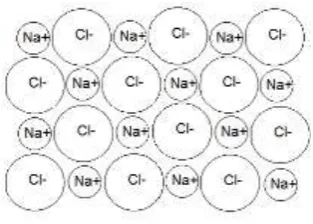
Although there are many ways to represent submicro particles that can reveal alternative conceptions there are also many ways of representing them that align with the commonly accepted scientific consensus. For example, an ionic solid could be represented three dimensionally (which might be better understood using connecting lines) or as a two dimensional slice through the crystal in which case connecting lines could be omitted with the diagram still able to be understood. Figure 3 was the example used in the video of one way that solid sodium chloride could be represented.
Figure 3: An example of one way solid sodium chloride can be represented
Participant drawings
The criteria for assessing participants’ drawings was developed using a grounded approach and are discussed later in this paper. There were numerous diagrams produced by participants during this study that would have been interpreted as alternative conceptions if a written description was not provided. However, there were also many diagrams that would have been considered scientifically acceptable until the written explanation was taken into account. For this reason, a response that included both a diagram and written explanation was only deemed to have met a particular criterion if both the diagram and written explanation were in agreement. The examples provided in this paper are all from different participants with Figures 4 to 6 inclusive provided as examples of responses where there was inconsistency between the diagram and the accompanying written explanation. All the written explanations that accompany diagrams are transcribed verbatim.
5
Ionic bonds between sodium and chloride atoms are present
Figure 4: A participant’s representation of solid sodium chloride containing atoms
Ionic bonds form creating a lattice structure, as the reactive sodium donates it’s electron to chlorine, making the
molecule stable.
Figure 5: A participant’s representation of solid sodium chloride containing molecules
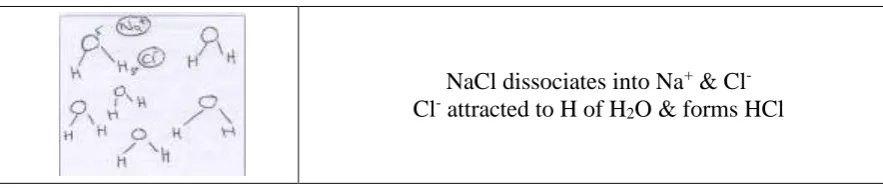
The diagram in Figure 6 indicates the participant has a sound understanding of the dissolution process of an ionic solid in water. The diagram shows a water molecule with a slightly negative charge on the oxygen, a slightly positive charge on one of the hydrogens and dissociated ions. The written description indicates that the participant understands that the ionic solid predominantly dissociates into it constituent ions when dissolved in water, however, the description then states that a chemical reaction follows to form hydrochloric acid.
NaCl dissociates into Na+ & Cl
-Cl- attracted to H of H2O & forms HCl
Figure 6: A participant’s representation of sodium chloride chemically reacting with water
Drawings for water
Alternative conceptions reported in the chemistry education literature relating to water include: hydrogen atoms are as large or larger than oxygen atoms in water molecules (Kelly & Jones, 2007; Nyachwaya et al., 2011); water molecules are linear in geometry (Kelly & Jones, 2007; Nyachwaya et al., 2011; Peterson & Treagust, 1989) and an incorrect formula for water (Kelly & Jones, 2007; Kern, Wood, Roehrig, & Nyachwaya, 2010; Nyachwaya et al., 2011).
6
Table 1: Responses for water not meeting one or more criterion
Criteria for water Responses not meeting criterion
Correct relative atomic sizes 25% Bent geometry 4% Correct connectivity 1% Correct formula 6%
Figure 7 is an example of a response that met all the criteria for water and demonstrated a sound conceptual understanding of the structure and properties of water molecules.
Within the water molecule there are covalent bonds between the 2 hydrogen atoms and the oxygen atom. Since
water is a polar molecule there is a slight negative charge associated with the oxygen atom that attracts the slightly
positive charge on the hydrogen atom. This attraction is between water molecules and is hydrogen bonding.
Figure 7: A participant’s representation that met all criteria for water
A response met the correct relative atomic sizes criterion if the hydrogen atom was shown as being smaller than the oxygen atom. A significant contributing factor for this criterion not being met was a number of responses not following the guidelines, instead drawing Lewis structures. A response met the bent geometry criterion if water molecules were drawn as being bent in shape and not linear. A response was considered to have met the correct connectivity criterion if both hydrogens were drawn as being covalently bonded to a single oxygen atom. A response met the correct formula criterion if a water molecule was depicted as being formed from two hydrogen atoms and one oxygen atom. Kern et al. (2010) and Nyachwaya et al. (2011) both use the term ‘dyslexic’ when referring to students diagrams that are drawn with the incorrect formula. Nyachwaya et al. (2011) suggest that this error may stem from students having difficulty expressing their understanding when moving between the symbolic and submicro levels of representation.
Drawings for solid sodium chloride
7
forces including dipole-dipole and van der Waals forces exist between sodium chloride molecules (Smith & Nakhleh, 2011) and ionic solids consist of ions that have an ionic bond to some counter ions and are attracted to others by ‘just forces’ (Taber, 1994).
The criteria used to assess participants’ responses are listed in Table 2. The guideline asking that charged species be identified with plus or minus signs allowed the alternative conception that ionic solids consist of atoms be diagnosed. Representing individual ions as circles allowed the alternative conception that ionic solids consist of ion pairs to be diagnosed. While asking participants to represent covalent bonding as overlapping circlesand all other types of bonding as circles that were either touching or very close together allowed the alternative conception that ionic solids consist of molecules to be diagnosed.
Table 2: Responses for NaCl (s) not meeting one or more criterion
Criteria for solid sodium chloride Responses not meeting criterion
Ionic lattice, not ion pairs 13% Ionic lattice, not molecules 29% Ionic lattice, not atoms 17%
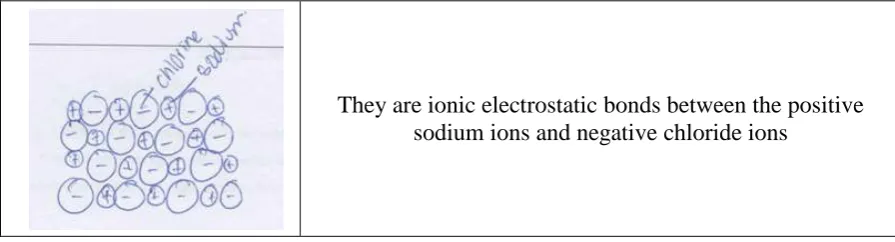
Figure 8 is an example of a response that met all the criteria and demonstrated a sound conceptual understanding of the structure and properties of solid sodium chloride.
They are ionic electrostatic bonds between the positive sodium ions and negative chloride ions
Figure 8: A participant’s representation that met all criteria for sodium chloride
A response met the ionic lattice, not ion pairs; ionic lattice, not atoms or ionic lattice, not molecules criterion if it indicated sodium and chloride ions existing in an ionic lattice with each ion sharing an ionic bond with all the counter ions immediately surrounding it and not as ion pairs, atoms or molecules respectively. A response not meeting the ionic lattice, not ion pairs
criterion is provided in Figure 9.
Sodium chloride intermolecular bond ionic bond. Sodium chloride units intramolecular
8
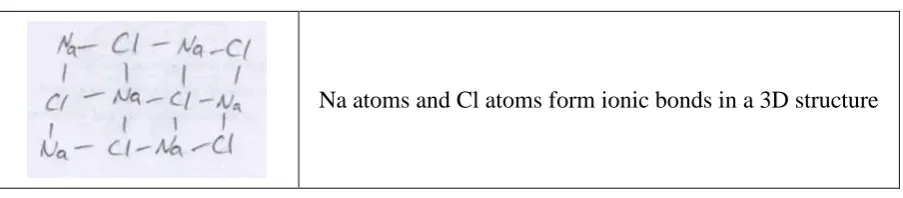
A response not meeting the ionic lattice, not atoms criterion is provided as an example in Figure 10.
Na atoms and Cl atoms form ionic bonds in a 3D structure
Figure 10: A participant’s representation of solid sodium chloride containing atoms
A response not meeting the ionic lattice, not molecules criterion is provided as examples in figure 11. This example highlights the difficulty some participants had in understanding this concept and/or the terminology used to describe the structure of ionic solids and the forces holding them together.
A sodium atom (Na) & a chloride atom (Cl) are ionically bonded together and the 6 molecules form a lattice
Figure 11: A participant’s representation of solid sodium chloride containing molecules
Ionic bonds involve electrostatic forces where an ion shares the same electrostatic attractions with all the surrounding counter ions; they do not contain atoms or molecules. However, many participants visually expressed an understanding that ionic solids contain atoms, molecules or that uni-directional bonds rather than an omnidirectional force of attraction exist resulting in the formation of ion pairs. A possible reason put forward by Taber (1998) as to why students identify ionic compounds as consisting of molecules or ion pairs is that students consider obtaining a stable octet configuration as the driving force behind atoms gaining or losing electrons. Therefore, rather than being used as a heuristic for identifying likely stable species, students commonly over-generalise the octet rule and use it as a general purpose explanation for why reactions occur.
Drawings for aqueous sodium chloride
9
Smith, 1987) and when ionic solids dissolve, covalent bonds, not ionic bonds are being broken (Smith & Nakhleh, 2011).
The criteria used to assess participants’ responses are listed in Table 3. The guideline for drawing questions asking that charged species are identified with plus or minus signs allowed the alternative conception that ionic solids dissolved as atoms to be diagnosed. Representing individual ions as circles allowed the alternative conception that ionic solids dissolved as ion pairs to be diagnosed. While asking participants to represent covalent bonding as overlapping circles and all other types of bonding as circles that were either touching or very close together
allowed the alternative conception that ionic solids dissolve as molecules to be diagnosed.
Table 3: Responses for NaCl (aq) not meeting one or more criterion
Criteria for aqueous sodium chloride Responses not meeting criterion
Dissociated ions, not ion pairs 13% Dissociated ions, not molecules 19% Dissociated ions, not atoms 3% No chemical reaction 5%
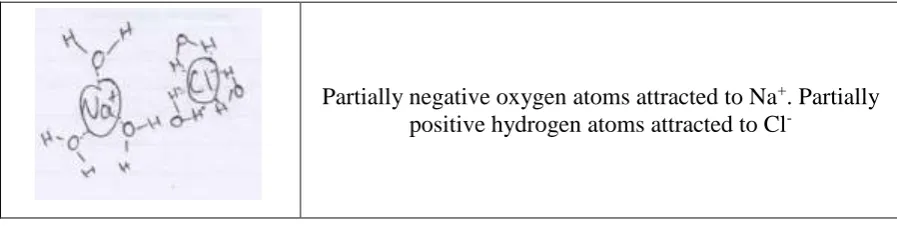
Figure 12 is an example of a response that met all the criteria and demonstrated a sound conceptual understanding of aqueous solutions.
Partially negative oxygen atoms attracted to Na+. Partially positive hydrogen atoms attracted to Cl
-Figure 12: A participant’s representation that met all criteria for aqueous sodium chloride
A response met the dissociated ions, not ion pairs; dissociated ions, not atoms and dissociated ions, not molecules criterion if sodium and chloride were depicted as ions separated from each other in a solution and not as ion pairs, atoms or molecules respectively. A response met the
no chemical reaction criterion if it was depicted that only water molecules and sodium and chloride ions were present in the solution and that no other species had been formed.
A response not meeting the dissociated ions, not ion pairs criterion is provided in Figure 13.
Na+ ion is attracted to slightly negative oxygen, and Cl- is attracted to slightly positive hydrogen (Vander Walls
attraction)
10
A response not meeting the dissociated ions, not atoms criterion is provided in Figure 14.
The water molecules cause the NaCl molecules to split up. The atoms which are made as a result are surrounded by
water molecules and the salt is said to be dissolved.
Figure 14: A participant’s representation of aqueous sodium chloride containing atoms
A response not meeting the dissociated ions, not molecules criterion is provided in Figure 15.
The water molecules are still attached via hydrogen bonding, the NaCl breaks down into separate molecules but
stay ionically bonded to each other.
Figure 15: A participant’s representation of a sodium chloride molecule hydrated by water
The nature of an aqueous solution is a concept that many students struggle to understand (Kelly & Jones, 2007). One reason may be that it can be unclear as to whether it involves a physical or chemical change (Naah & Sanger, 2012). A response that did not meet the no chemical reaction criterion is provided in Figures 16. Apart from this example all other responses not meeting this criterion indicated that sodium hydroxide and hydrochloric acid were being formed.
NaCl breaks apart and bonds with the oxygen in water. Breaks off hydrogen, which combines to produce H2 gas
Figure 16: A participant’s representation of sodium chloride dissolving resulting in the formation of hydrogen gas
11
conceptual and propositional knowledge statements required for students to understand the dissolution process. The list also provides a framework for assessing the appropriateness of student descriptions and particulate drawings.
Conclusion
This paper has reported on an investigation into preparing students to attempt assessable submicro drawing questions as part of a first year university chemistry laboratory program. The aim of introducing drawing questions was to visually diagnose students’ alternative conceptions, which could then be addressed, and to improve students’ conceptual understanding by engaging them at the submicro level of representation.
It may be argued as pointed out by Gabel, Samuel, and Hunn (1987) that poor drawings by students may be a result of being asked to represent submicro particles in a two dimensional rather that a three dimensional drawing, or that students would have drawn more accurate diagrams if they were given the criteria that the drawings were being assessed against. However, textbooks often only represent atoms and their derivatives using two dimensional drawings and limited guidelines force students to think more deeply about aspects of their drawings. The data reported in the paper have shown that drawing questions that are accompanied by research informed guidelines can be used to diagnose a range of alternative conceptions in relation to fundamental chemistry concepts and provide a basis for comparable drawings to be generated for assessment purposes.
References
Ainsworth, S., Prain, V., & Tytler, R. (2011). Drawing to learn in Science. Science, 333(6046), 1096-1097. Akaygun, S., & Jones, L. L. (2013). Words or Pictures: A comparison of written and pictorial explanations of
physical and chemical equilibria. International Journal of Science Education (ahead-of-print), 1-25.
Bodner, G. M. (1991). I have found you an argument: The conceptual knowledge of beginning chemistry graduate students. Journal of Chemical Education, 68(5), 385.
Boo, H. K. (1998). Students' understandings of chemical bonds and the energetics of chemical reactions. Journal of Research in Science Teaching, 35(5), 569-581.
Butts, B., & Smith, R. (1987). HSC chemistry students' understanding of the structure and properties of molecular and ionic compounds. Research in Science Education, 17(1), 192-201.
Coll, R., & Treagust, D. (2001). Learners' use of analogy and alternative conceptions for chemical bonding.
Australian Science Teachers Journal, 48(1), 24-32.
Coll, R. K., & Taylor, N. (2001). Alternative conceptions of chemical bonding held by upper secondary and tertiary students. Research in Science & Technological Education, 19(2), 171-191. doi: 10.1080/02635140120057713
Coll, R. K., & Treagust, D. (2003). Investigation of secondary school, undergraduate, and graduate learners' mental models of ionic bonding. Journal of Research in Science Teaching, 40(5), 464-486.
De Vos, W., & Verdonk, A. H. (1996). The particulate nature of matter in science education and in science.
Journal of Research in Science Teaching, 33(6), 657-664. doi: 10.1002/(SICI)1098-2736(199608)33:6<657::AID-TEA4>3.0.CO;2-N
Dickson, H., Thompson, C.D., & O’Toole, P. (2016). "A Picture is Worth a Thousand Words: Investigating First Year Chemistry Students’ Ability to Visually Express Their Understanding of Chemistry Concepts."
International Journal of Innovation in Science and Mathematics Education (formerly CAL-laborate International)24(1).
Gabel, D. L., Samuel, K., & Hunn, D. (1987). Understanding the particulate nature of matter. Journal of Chemical Education, 64(8), 695.
Gilbert, J. K. (2005). Visualization: A metacognitive skill in science and science education. Visualization in Science Education (pp. 9-27): Springer.
12
Hill, M., Sharma, M.D., O’Byrne, J., & Airey, J. (2014). Developing and evaluating a survey for representational fluency in science. International Journal of Innovation in Science and Mathematics Education (formerly CAL-laborate International) 22(6).
Hill, M., & Sharma, M. (2015). Research-based worksheets on using multiple representations in science classrooms. Teaching Science61(3): 37.
Hill, M., Sharma, D., & Johnston, H. (2015). How online learning modules can improve the representational fluency and conceptual understanding of university physics students. European Journal of Physics36(4): 045019.
Hoffmann, R., & Laszlo, P. (1991). Representation in chemistry. Angewandte Chemie International Edition in English, 30(1), 1-16.
Hurst, M. O. (2002). How we teach molecular structure to freshmen. Journal of Chemical Education, 79(6), 763. Kelly, R. M., & Jones, L. L. (2007). Exploring how different features of animations of sodium chloride dissolution
affect students’ explanations. Journal of Science Education and Technology, 16(5), 413-429.
Kern, A. L., Wood, N. B., Roehrig, G. H., & Nyachwaya, J. (2010). A qualitative report of the ways high school chemistry students attempt to represent a chemical reaction at the atomic/molecular level. Chemistry Education Research and Practice, 11(3), 165-172. doi: 10.1039/C005465H
Levy Nahum, T., Mamlok‐Naaman, R., Hofstein, A., & Taber, K. S. (2010). Teaching and learning the concept of chemical bonding. Studies in Science Education, 46(2), 179-207.
Naah, B. M., & Sanger, M. J. (2012). Student misconceptions in writing balanced equations for dissolving ionic compounds in water. Chemistry Education Research and Practice, 13(3), 186-194.
Nahum, T. L., Mamlok‐Naaman, R., Hofstein, A., & Krajcik, J. (2007). Developing a new teaching approach for the chemical bonding concept aligned with current scientific and pedagogical knowledge. Science Education, 91(4), 579-603.
Noh, T., & Scharmann, L. C. (1997). Instructional influence of a molecular‐level pictorial presentation of matter on students' conceptions and problem‐solving ability. Journal of Research in Science Teaching, 34(2), 199-217.
Nyachwaya, J. M., Mohamed, A.-R., Roehrig, G. H., Wood, N. B., Kern, A. L., & Schneider, J. L. (2011). The development of an open-ended drawing tool: An alternative diagnostic tool for assessing students' understanding of the particulate nature of matter. Chemistry Education Research and Practice, 12(2), 121-132. doi: 10.1039/C1RP90017J
Othman, J., Treagust, D. F., & Chandrasegaran, A. (2008). An investigation into the relationship between students’ conceptions of the particulate nature of matter and their understanding of chemical bonding.
International Journal of Science Education, 30(11), 1531-1550. doi: 10.1080/09500690701459897
Peterson, R. F., & Treagust, D. F. (1989). Grade-12 students' misconceptions of covalent bonding and structure.
Journal of Chemical Education, 66(6), 459.
Smith, C., & Nakhleh, M. B. (2011). University students' conceptions of bonding in melting and dissolving phenomena. Chemistry Education Research and Practice, 12(4), 398-408. doi: 10.1039/C1RP90048J Smith, K. J., & Metz, P. A. (1996). Evaluating student understanding of solution chemistry through microscopic
representations. Journal of Chemical Education, 73(3), 233. doi: 10.1021/ed073p233
Taber, K. (1998). An alternative conceptual framework from chemistry education. International Journal of Science Education, 20(5), 597-608. doi: 10.1080/0950069980200507
Taber, K., & Coll, R.K. (2003). Bonding. In Gilbert, J.K., De Jong, O., Justi, R., Treagust, D.F., & Van Driel, J.H. (Ed.), Chemical education towards research-based practice. Dordrecht: Kluwer.
Taber, K., Tsaparlis, G., & Nakiboğlu, C. (2012). Student conceptions of ionic bonding: Patterns of thinking across three European contexts. International Journal of Science Education, 34(18), 2843-2873. doi: 10.1080/09500693.2012.656150
Taber, K. S. (1994). Misunderstanding the ionic bond. Education in Chemistry, 31(4), 100-102.
Taber, K. S. (2011). Models, molecules and misconceptions: A commentary on secondary school students' misconceptions of covalent bonding. Journal of Turkish Science Education (TUSED), 8(1).
Tasker, R., & Dalton, R. (2006). Research into practice: Visualisation of the molecular world using animations.
Chemistry Education Research and Practice7(2): 141-159.
Tien, L. T., Teichert, M. A., & Rickey, D. (2007). Effectiveness of a MORE laboratory module in prompting students to revise their molecular-level ideas about solutions. Journal of Chemical Education, 84(1), 175. Wu, H. K., & Shah, P. (2004). Exploring visuospatial thinking in chemistry learning. Science Education, 88(3),