International Journal of Research Publications Volume 2 – Issue. 1, April 2018
* Gaur Sanjay B.C. Tel.: +919928390163.
E-mail address: [email protected].
The Fast Fake Currency Note Detector with Minimum Valid Features Gaur Sanjay B. C.1
, Kavita Soni2
1
JIET COE, Jiet Universe Mogra, Jodhpur(342001), Rajasthan, India
2
JIET COE, Jiet Universe Mogra, Jodhpur(342001), Rajasthan, India Abstract
This paper presents a fast and efficient approach for the fake currency note detection with minimum number of features. Typically, this approach evaluates the performance of the system for minimum number of features required to check the Indian Currency Note. This system first check the currency note by its content with minimum number of features then, validate it by some unique features from the guidelines issued by Reserve Bank of India (RBI). The use of minimum number of features, which are essential to check valid currency note, decreases the computing complexity of the system. The system has been tested for ten different denominations of valid and fake currency note both. Experimental results demonstrate the success rate of Fast Fake Currency Note Detector (FFCND) by including different types of features.
© 2018 Published by IJRP.ORG. Selection and/or peer-review under responsibility of International Journal of Research Publications (IJRP.ORG)
Keywords: Fake Currency Note; Indian Currency Features; FFCND; Image Segmentation; Feature extraction; Content Based Image Retrieval.
1.INTRODUCTION
Currency is thebackbone of the economy of any country. In the developing countries like India, currency matters a lot. The currency is used for every exchange of services, goods and things. Before the demonetization, the currency notes, which were in use were of INR. 10, 20, 50, 100, 500 and 1000. But after the demonetization the 1000 Rupee note is totally banned and RBI has issued some new currency notes viz. 2000, 500, 200, 50, etc. The neighbor countries and some organization always try to make imbalance of
International Journal of Research Publications
Volume-4, Issue-1,May 2018
Accepted and Published Manuscript
The Fast Fake Currency Note Detector with Minimum Valid Features
Gaur Sanjay B. C., Kavita Soni
PII : Gaur Sanjay B. C..1004152018136
DOI: 1004152018136
Web: http://ijrp.org/paper_detail/137
To appear in: International Journal of Research Publication (IJRP.ORG)
Received date: 07 May 2018
Accepted date: 13 May 2018
Published date: 19 May 2018
Please cite this article as: Gaur Sanjay B. C., Kavita Soni , The Fast Fake Currency Note Detector with
Minimum Valid Features , International Journal of Research Publication (Volume: 4, Issue: 1),
http://ijrp.org/paper_detail/137
International Journal of Research Publications
Volume 2 – Issue. 1, April 2018
The Fast Fake Currency Note Detector with Minimum Valid
Features
Gaur Sanjay B. C.
1, Kavita Soni
21JIET COE, Jiet Universe Mogra, Jodhpur(342001), Rajasthan, India
2JIET COE, Jiet Universe Mogra, Jodhpur(342001), Rajasthan, India
Abstract
This paper presents a fast and efficient approach for the fake currency note detection with minimum number of features. Typically, this approach evaluates the performance of the system for minimum number of features required to check the Indian Currency Note. This system first check the currency note by its content with minimum number of features then, validate it by some unique features from the guidelines issued by Reserve Bank of India (RBI). The use of minimum number of features, which are essential to check valid currency note, decreases the computing complexity of the system. The system has been tested for ten different denominations of valid and fake currency note both. Experimental results demonstrate the success rate of Fast Fake Currency Note Detector (FFCND) by including different types of features.
© 2018 Published by IJRP.ORG. Selection and/or peer-review under responsibility of International Journal of Research Publications (IJRP.ORG)
Keywords: Fake Currency Note; Indian Currency Features; FFCND; Image Segmentation; Feature extraction; Content Based Image Retrieval.
1.INTRODUCTION
Currency is the backbone of the economy of any country. In the developing countries like India, currency
economy in the country by circulating the fake currencies. The advanced techniques of color printing, scanning and duplication makes easy to print duplicate or fake notes, which makes easier to circulate the fake currency note in the market or society. The chances of currency duplication are increasing day by day. It is very necessary to stop the duplicate or fake notes in the market. The manual process requires 10 minutes to check and validate. It is time consuming and tedious task and sometimes, it is also not possible to identify all marks correctly by the human that is why some kind of automatic machine is required for this purpose. These days researcher are taking interest in developing the techniques to check the fake currency. The development of fast automatic detection methods are now necessity for our country to identify fake currency. The digital image processing is one of the approaches that can be used for developing such kind of machines to identify fake note or currency. RBI has set the rules and guidelines for Indian currency and also circulated the list of features of real note. One can easily recognize which currency note is duplicated by checking or comparing with standards given by them. These features comprises color, identification mark and security thread etc. The list of such features is mentioned in the next section.
2.RELATED WORK
The Fast Fake Currency Note Detector (FFCND) is similar to the Content Based Image Retrieval (CBIR) system. These days many researcher are working on designing of a fast fake currency detector algorithms. Some of the work has been investigated to find gap for this work.
The Hassanpour et al. has proposed a technique for paper currency recognition with three characteristics of paper currencies including size, color and texture. They proposed that by using image histogram, the plenitude of different colors in a paper currency, and the Markov chain concept to model texture of the paper currencies can be utilized for fake paper currency detection. They tested the efficiency of the model for currency of many countries and found suitable for those country currencies.
Hassanpour et al. have used only texture feature for a new denomination banknote. They proved that their
system can detect the fake note oriented in different directions. They have worked on the currency of USA, UAE, Europe, and Iran. They found that their system works equally well for paper currency of these countries.
Md. Sarfaraz has worked for finding the interesting features and correlation for recognizing Saudi Arabian paper currency. Their system uses a Radial Basis Function Network for classification. From the results they found that the method is quite reasonable in terms of accuracy. The system was also tested for the fourth series (1984–2007) of currency issued by Saudi Arabian Monetary Agency (SAMA).
Support Vector Machine has been proposed by Chang et al. for paper currency verification. They have used crucial features from banknotes by using some low-cost sensors for identifying fake paper currency. Furthermore, due to good classification ability of SVM, the proposed works better and it also needs low computing power due to the use of a linear kernel.
robust and fit for all above mentioned conditions. They have used US currency to check the efficiency of the proposed technique. Use of this technique for bind users is the main advantage of it.
Santhanam et al. have used an innovative method to identify the counterfeit currency. This method uses the polarization concept, Image processing technique, and Holographic Detection methods to detect counterfeit currency based on the physical properties of the currency. They have compared the optical light passing through the Holographic images available on paper currency. The results are more efficient than the chemical property based detector like magnetic ink detector and UV Ray detector.
A new image feature, the color correlogram is defined by J. Huang et al. for image indexing. This feature helps to distillate the spatial correlation of colors. It is both effective and inexpensive for content-based image retrieval. The author have experimented for different light condition, and viewing positions of the detector. The result proves that correlogram robustly tolerates large changes in appearance and shape caused by changes in viewing positions, camera zooms, etc. Hence, it can be used for additional feature for any fake currency detector.
H- and S-component color auto-correlograms and V-component BDIP block difference of inverse probabilities) and BVLC (block variation of local correlation coefficients) features have been proposed by Young et al., which effectively measure local brightness variations and local texture smoothness, respectively. The moments considered by them helps to increase the recall and precision parameter as well. He suggested that the approach can be used for identifying the equivalent images on the basis of similarity in colors and shapes.
Roy et al. have developed Automatic authentication system for Indian paper money. They have used Image processing and pattern recognition techniques for designing the system. They analyzed the ability of the embedded security for detecting fake currencies. The results have been analyzed for both accuracy and processing speed. They also highlighted the use of security features for improving the system accuracy.
3.UNIQUE FEATURES OF INDIAN CURRENCY
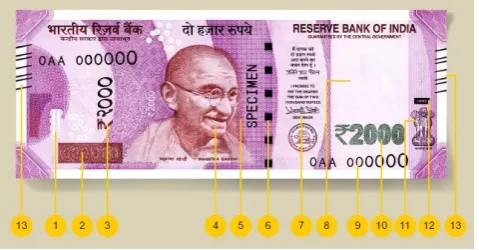
In addition to features used for CBIR many features highlighted by RBI can be used to identify the real or fake currency note. These unique features for front side of INR 2000 are shown in the figure 1.
1. If the currency note is placed against the light, the register with denominational numeral 2000 can be seen at location marked as 1.
2. Latent image with denominational 2000, can be seen, when the banknote is held at 45 degree angle at the eye level.
3. Devnagari font is used for Denominational numeral 2000.
4. Portrait of Mahatma Gandhi is marked in the middle. 5. Micro letters ‘RBI’ and ‘2000’.
6. Colour shift windowed security thread with inscriptions Bharat (in Hindi), RBI and 2000. Colour of thread changes from green to blue when the note is tilted.
7. In the right, Governor’s signature and RBI emblem are identification marks defined by RBI.
8. Mahatma Gandhi portrait and electrotype (2000)watermarks
9. Number panel with numerals growing from small to big on the top of the left side and bottom
right side
10. Denominational numeral of INR. 2000 in colour changing ink(green and blue) on bottom right 11. Ashoka pillar emblem on the right
12. Horizontal rectangle with INR. 2000 in raised print on the right 13. Seven angular bleed lines on left and right side in raised print
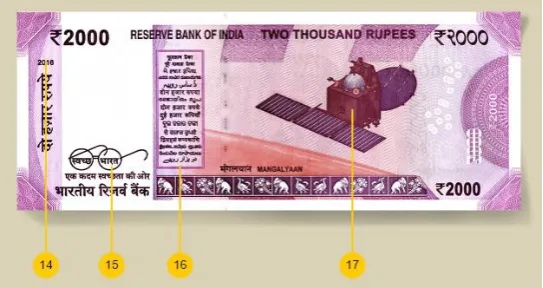
The unique features in backside of INR 2000 are shown in the figure 2.
Fig 2. Back side of Indian Currency note of INR. 2000.
14. Year of printing of the note 15. Swachh Bharat logo with slogan 16. Language panel towards the centre
17. Motif of Mangalayaan-reflecting country’s first venture in the interplanetary space is the seventeenth features of INR.
4. FAKE CURRENCY DETECTION SYSTEM
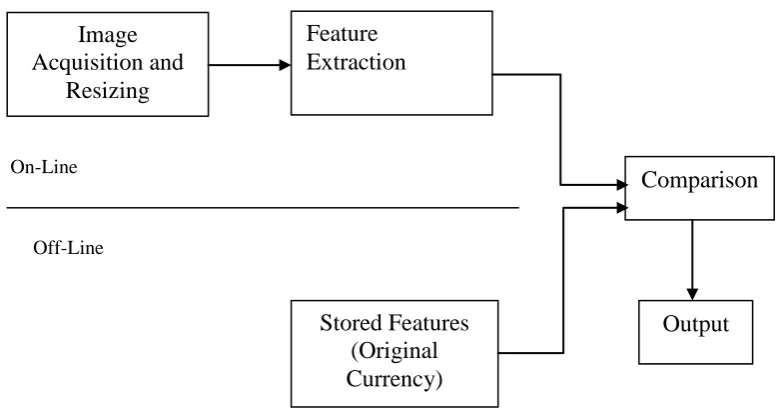
The Fake currency detection system is shown in figure 3. The process used to recognize the fake currency involve various steps as described below. The systematic comparison of currency note is divided into two sub-systems: On-line and Off-line sub-system. The off-line subsystem only provides the important information about the currency to check and validate it. But the on-line subsystem extracts the features of the acquired image of currency. The remaining working is described in the following sections. [Bhardwaj, Gaur]
Fig 3. Fake Currency Detection System
4.1.Image acquisition
In the online subsystem, the first step is to acquire the image of currency note with good sensor camera. Later it is resized for a particular dimension of 200x600 pixels. After resizing, the important Region of interest (ROI) now will at proper place. Now, these points will be at standard location, which will help the system to take correct decision.
4.2.Feature detection
Next step is to extract the features of testing currency note to compare it from the standard database of original currency note of the same price. Some of the unique features of RBI guideline and basic features of Content Based Image Retrieval (CBIR) viz. Color, Shape and Texture, are used to take decision for Fast Fake Currency Note Detector (FFCND), whether the currency is officially authorized or bogus. These features are described as follows:
Image
Acquisition and
Resizing
Feature
Extraction
Comparison
Output
Stored Features
(Original
Currency)
On-Line
4.2.1 Color features
The color is the prime feature to decide the expected currency value because all currency note has its own color e.g. if the color is pink, it means currency is of INR. 2000/- and if the color is green the currency is of INR 500/- etc. For any image the color is represented by some color model. For the proposed work in this paper, HSV (hue, saturation, value) color histogram have been taken for this purpose.
In color or HSV color histogram, the three color component Hue (H), saturation (S) and Intensity (V) are separated by the following formula. [Ryszard S. Chora´s,]
(1)
(2)
(3)
Color correlogram characterize the color distributions of pixels. It also shows the spatial correlation between the pairs of color. Let I be an image that comprises of pixel f(i, j). Each pixel intensity defines a certain color or gray level value. Let [G] be a set of G levels g1, g2, . . . , gG that can occur in the image. [Ryszard S.
Chora´s,] For a pixel f let I(f) denote its level g, and let Ig correspond to a pixel f, for which I(f) = g.
Histogram for level gx is defined as:
(4)
Second order statistical measures are correlogram and autocorrelogram. Let [D] denote a set of D fixed distances d1, d2, . . . , dD. Then the correlogram of the image I is defined for level pair (gx, gy) at a distance as
(5)
The equation 5, gives the probability of occurrence of a pixel f2 at a distance d, in a certain direction from
the given pixel f1 of level gx. Autocorrelogram captures the spatial correlation of identical levels only
(6)
4.2.2 Texture
Wavelet transform is the decomposition of a signal with a family of real orthogonal bases
obtained through translation and dilation of a kernel function known as mother wavelet which is given by,
(7)
Where m and n are integers. Due to orthogonal property, the wavelet coefficients of a signal can be easily computed by,
(8)
And the synthesis formula is
(9)
Can be recoverfrom its wavelet coefficients, which are nothing but features to compare texture of an image. Wavelet features are sufficient enough to compare texture of currency that is why other texture based features have not been taken. [Tianhorng Chang and C.-C. Jay Kuo]
4.2.3 Shape
In addition to the above two types of features, shape features are most powerful terms to measure similarity between any two images. For the comparison of the shape in the currency note Hu’s moments have been taken for this work.
The image shape feature plays a very fundamental role in image classification, so the effective and efficient shape descriptors are the key component of the image representation. Classical geometric moments mpq of an image Ixy are calculated with the following equation:
(10)
This allows computing the centre of mass of the image, and of a region in case of a binary mask. Centralized moment µpq are geometric moments of the image computed relatively to the centre of mass ( ,
):
(11)
(12)
(13)
Where, ,∀ p+q ≥ 2 [S. Conseil , S. Bourennane and L. Martin] Hu [M.-K. Hu] proposed a set of orthogonal moment invariants, which can be used for scale, position, and rotation invariant pattern identification. They are computed from normalized moments pq up to order three, with the following formulas: (14)
(15)
(16)
(17)
122+ 21 032 (18)
(19)
122 21+ 032 (20)
The above Hu invariants are calculated with the geometrical moments of the region of interest. The six descriptors, in the first six equations, encode a shape with invariance to translation, scale and rotation. The last descriptor ensures skew invariance. [S. Conseil , S. Bourennane and L. Martin]. Hu invariants provide a scale, orientation and position invariant representation of the shape of an object, which can also help in recognizing the unique identification marks given by RBI. L2 distance measure was used to find similarity measurement between the stored standard feature and the features of query image because it is simple and robust. The formula for l2 distance is as follows: (21)
where, d, N, fsn, fqn are the distance, total number of features, nth feature of standard currency note and nth
feature of query currency note respectively.
5.RESULTS AND DISCUSSION
Fig 4. Input Query Image
After resizing the currency note, colour histogram approach is applied. The resultant image is shown in fig 5
Fig 5 Histogram curve of currency notes of 2000 and 500
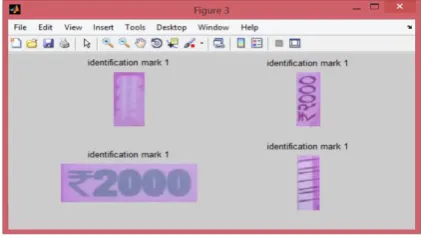
In addition to colour histogram other features viz. colour-auto-correlogram, wavelet coefficients and Hu’s moments were used to identify the fake currency note. The additional unique features to validate the currency note are shown in figure 6. The validation process was divided in to two steps: without ultra-violet light and with ultra-violet light. In the first step of validation, only four predefined part of currency note are compared for their uniqueness as shown in figure 6
In the second step of validation, the currency note was again scanned in the presence of Ultra-violet rays as shown in figure 7. The security thread is properly cropped and content of this thread is compared with standard list provided by the RBI.
Fig 7. Identification mark (validate stage –II)
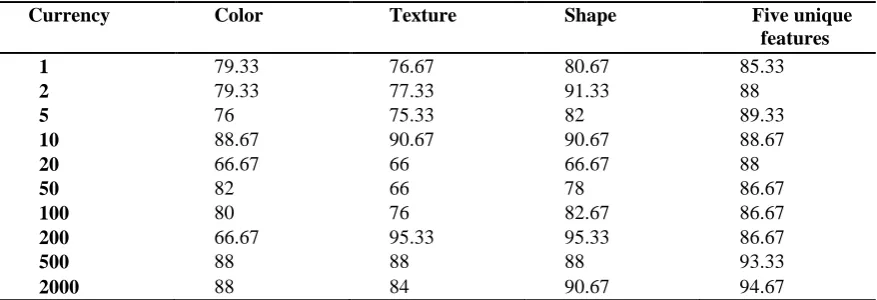
The result is summarized in the table I. One fifty individual currency note for ten different types as of currency have been taken for the experimentation and their results are compared for different types of features.
Table I. percentages of correct recognition
Currency Color Texture Shape Five unique
features
1 79.33 76.67 80.67 85.33
2 79.33 77.33 91.33 88
5 76 75.33 82 89.33
10 88.67 90.67 90.67 88.67
20 66.67 66 66.67 88
50 82 66 78 86.67
100 80 76 82.67 86.67
200 66.67 95.33 95.33 86.67
500 88 88 88 93.33
2000 88 84 90.67 94.67
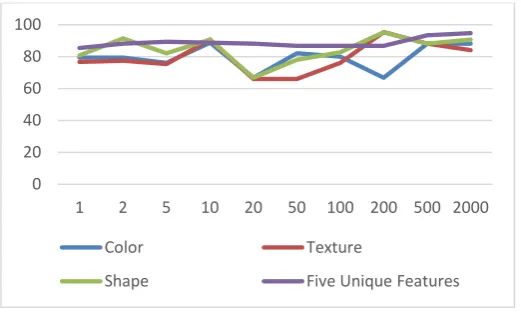
Fig. 8 Currency denomination versus efficiency
The acceptance of correct note and rejection of fake note is considered as correction recognition. The result shows that the recognition rate is higher for the unique features based identification.
6.CONCLUSION
This paper proposed a Fast Fake Currency Note Detector (FFCND) for checking the authenticity of the note for various types of features. The results for each individual type of features (color, texture, shape and unique feature from RBI guideline) were also tested as shown in table 1. Each row in the table shows the role of individual feature in the final decision. The first contribution of this experiment is to find efficiency of each feature. The second contribution was to demonstrate the use and importance of unique features for the final decision. Finally, the system was tested for hybrid features consists of three color, eight texture, seven shape moments and five unique features. The average system efficiency was increased almost up to 89%. It shows that system can be practically used for detection of fake currency note. Further, the accuracy can be increased by considering more number of features or by implementing fuzzy system for final decision. The FFCND can be used in currency counting machines for finding fake notes while counting
.
REFERENCES
Hassanpour, Hamid, A. Yaseri, and G. Ardeshiri. "Feature extraction for paper currency recognition." In Signal Processing and Its Applications, 2007. ISSPA 2007. 9th International Symposium on, pp. 1-4. IEEE, 2007.
Hassanpour, Hamid, and Payam M. Farahabadi. "Using Hidden Markov Models for paper currency recognition." Expert Systems with Applications 36, no. 6 (2009): 10105-10111.
Sarfraz, Muhammad, ed. Computer-aided intelligent recognition techniques and applications. John Wiley & Sons, 2005.
Chang, Chin-Chen, Tai-Xing Yu, and Hsuan-Yen Yen. "Paper currency verification with support vector machines." In Signal-Image
Technologies and Internet-Based System, 2007. SITIS'07. Third International IEEE Conference on, pp. 860-865. IEEE, 2007.
Hasanuzzaman, Faiz M., Xiaodong Yang, and YingLi Tian. "Robust and effective component-based banknote recognition for the blind." IEEE Transactions on Systems, Man, and Cybernetics, Part C (Applications and Reviews) 42(6), pp. 1021-1030, 2012.
Santhanam, Kamesh, Sairam Sekaran, Sriram Vaikundam, and Anbu Mani Kumarasamy. "Counterfeit currency detection technique using image processing, polarization principle and holographic technique." In Computational Intelligence, Modelling and Simulation (CIMSim), 2013 Fifth IEEE International Conference on, pp. 231-235, 2013.
J. Huang, S. R. Kumar, M. Mitra, W. J. Zhu, and R. Zabih, “Image indexing using color correlograms,” in Proc. IEEE Int. Conf. 0
20 40 60 80 100
1 2 5 10 20 50 100 200 500 2000
Color Texture
Computer Vision and Pattern Recognition, San Juan, Puerto Rico, pp.762–768, Jun. 1997,.
Young Deok Chun, Nam Chul Kim, “Content-Based Image Retrieval Using Multiresolution Color and Texture Features”, IEEE Trans. On Multimedia, 10(6), October 2008.
Roy, Ankush, Biswajit Halder, and Utpal Garain. "Authentication of Currency Notes through Printing Technique Verification."
In Proceedings of the Seventh Indian Conference on Computer Vision, Graphics and Image Processing, pp. 383-390, 2010.
Ryszard S. Chora´s, “Image Feature Extraction Techniques and Their Applications for CBIR and Biometrics Systems”, International Journal of Biology and Biomedical Engineering, Vol. 1(1), 2007
Tianhorng Chang and C.-C. Jay Kuo, “Texture Analysis and Classification with Tree- Structured Wavelet Transform”, IEEE trans. on Image processing, vol. 2(4), October 1993
S. Conseil , S. Bourennane and L. Martin, “Comparison Of Fourier Descriptors And Hu Moments For Hand Posture Recognition”, (EUSIPCO 2007), Poznan, Poland, September 3-7, 2007
M.-K. Hu, “Visual pattern recognition by moment invariants,” IEEE trans. on Information Theory, vol. 8, pp. 179–187, 1962.