DST SEMINAR ON
Application of Computers to Bibliographical Information Processing: Some Developments in India (Bangalore)(10-13 July 1978)
COMPUTERISED PERSONNEL INFORMATION SYSTEM.
RANJITA MAITRA. Documentation Research and Training Centre. Indian Statistical Institute. Bangalore 560 0 0 1 .
ABSTRACT
Describes a methodology for developing a computerised Personnel Information System. O u t l i n e s t h e input preparation. output design and ,data
manipulation for efficient information retrieval.
1 INTRODUCTION
Personnel management system is one of the vital components of the total system of management. It has a dual respcnsibility to develop manpower plans which
Ranjita Maitra
Computer based Personnel Information System can
significantly improve the effectiveness of personnel
management especially in case of a decentralized
or-ganization, having a rapid growth of employment and
with a continual demand for a wide variety and depth of
skills in many locations. It can help both the
organi-sation and the individual by providing upto date
career-oriented information at a single accessible
point on past, present, and potential employees. This
emphasises the need for developing a computer-based
data base with efiicient retrieval facilities.
2 SCOPE
This paper describes the software development for
a computer-based Personnel Information System. The
system is mainly developed for an educational
insti-tution. However, the suitability of the system has
been experimented in an industrial environment.
3 PURPOSE AND FUNCTION OF THE SYSTEM
The system performs the following functions:
1 Creation of a machine-readable data base;
2 Printing of data base in the required format;
3 Retrieval of Information through single data element search; and
A Retrieval of information through multiple data element search using Boolean search expression.
The user of the system is free to choose the items
Personnel Information System
The alumni profiles of DRTC are considered as sample
input in the present study.
U PROGRAM DESCRIPTION
Name of the . Personnel File Information Program : System
Acronym : PFIS
AUTHOR ; Ranjita Maitra
The program is written in COBOL language and
im-plemented on ICL-1901 — A computer with 16K words
memory size.
The program can be divided into four segments.-- The
first segment is used for creating a data base on
mag-netic tape. The second segment is used to obtain the
printout of tne data base in the desired format. The
third and fourth segments are used to retrieve the
re-quired information from the data base by single data
element and multiple data elements search respectively.
41 Creation of data base on magnetic tape
411 Input
4111 Collection of data
To prepare the input for the system, data are
Ranjita Maitra
1 INPUT WORKSHEET FOR DRTC ALUMNI DATA BASE
1 Course Tor which application is 1 being made;
1 Regular 2 Special
2 Year of joining DRTC 6 4
3 Year of completing the Course
4 Date of birth 3 2 0 6 0 1
5 State of Domicile A N D H R A
6 Sex
1 Male
2 Female
7 Marital status 1 Married 2 Unmarried
8 Candidate
1 Sponsored
2 Leave without Day 3 Immediately after
Uni-versity education 4 Resigned from the job
9 Categorization of the employer
1 C3IR Lab 2 Defence Lab 3 Industry
h University Library
5 College Library 6 Public Library
7 Department of Library Science
Personnel Information System
10 Designation
11 Number of publications . 1 Books
2 Articles in periodicals 3 Others, if any
12 File Reference
13 Academic Qualifications
L I B
W A N J A 6
SN — — -0 1 2 3 -• 5 6 7 8
E x a m i n a t i o n s P a s s e d
S u b j e c t s Maj Subsdy SSLC 0 M A T 15 JS + HS/PUC 1 M A T b b + I n t e r m e
-d i a t e
G r a d u a t e 3 P H Y M A T P o s t g r a
-d u a t e b l a s t e r Degree
B L i b Sc 6 L I B b b b C c r t i f i - 7 R U S b b b
c a t e Diploma
O t h e r 9 FRE b b b
Yr of P a s s g
4 9 5 1 -5 4 6 1 6 0 5 8
C l a s s
/Rank U n i v e r s i t y / I n s t u t i o n
+ B S E M A D R A 2 4 . 4 1 1 4 E 5 7
+ 4 4 2 5 4 G 1 8
2 U 2 5 U 1 6 + 4 4 2 5 4 G 1 3
Ranjita Maitra
14 E x p e r i e n c e / V i s i t to F o r e i g n Country
SN From To Institution/ Country
Catego-rized/ Insti-tution
Experience /Visit to Foreign country 1 5 5 0 9 6 2 1 0 4 4 2 5 4 G 1 8 4 1 2 6 2 1 0 b b b b 4 4 2 5 D R D L 2 1 3
4 5
15 Knowledge of F o r e i g n Language
1 F R E 2 R U S 3 b b b 1 6 Name, a d d r e s s and o t h e r p a r t i c u l a r s
V b A N J A N E Y U L U , L I E R A R I A N , S P A C E b S C I E N C E b T E C H N O L O G Y b C E N T R E . P B b N 0 b 4 8 b T R I V A N D R U M , 6 9
5 0 2 2 . b b b b b b b b b b b b b b b .
b b b b b.
Personnel Information System
•
Each data element and/or sub-data element is
identi-fied by the serial number (tag number) against each in
the worksheet. The data are recorded in the worksheet in
coded form to reduce the number of characters in the
input.
In the present experimental study the sample data
were collected from the admission form filled in by the
student.
A112 Input on punched cards
The data from the worksheets are directly
transfer-red on to the punch cards. Each data element'represents
one field. The fixed field, fixed record input format
is used. Each record contains 405 characters. The input
card design is given below.
Table 1: Input Card Design
SK
i
Number of C h a r a c t e r
C h a r a c t e r s P o s i t i o n D e s c r i p t i o n Remarks
"\ 76 1 - 7 6 Date Alpha-numeric
2 2 77-- 78 Code for each record
3 2 79 - 80 Serial number Numeric for tach card
within a re-cord
Ranjita Maitrfc
412 Output
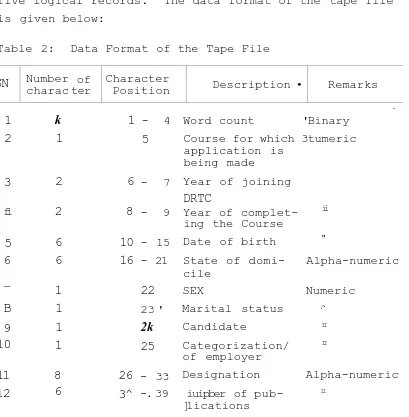
The output file is the magnetic tape file. A phy-sical record consists of a maximum of 2,048 characters (i.e. 512 words). The logical record contains 408 cha-racters. Therefore, each physical record consists of five logical records. The data format of the tape file is given below:
Table 2: Data Format of the Tape File SN 1 2 3 fi 5 6 — B 9 10 11 12 Number charac k 1 2 2 6 6 1 1 1 1 8 6 of ter Character Position 1 6 8 10 16 26 3^ - 4 5 - 7 - 9 - 15 - 21 22 23 ' 2k 25 - 33 -. 39 Description •
Word count ' Course for which 3
application is being made
Year of joining DRTC
Year of complet-ing the Course Date of birth
Remarks • Binary tumeric ii "
State of domi- Alpha-numeric cile SEX Numeric Marital status Candidate Categorization/ of employer ['• II II Designation Alpha-numeric ]
iuipber of pub-lications
Personnel Information System
3N Number of Character
Character
Position Description Remarks
13
14
15
16
17
8
180
72
9
10 0
40 - 47
48 -227
228-299
300-308
309-408
File reference
Academic quali-fications
Experience/Visit to foreign
countries
Knowledge of foreign language
Name, address, and other particu-lars
Alphanumeric
413 Procedure
The procedure for reading the cards, creating a
record in the memory and then writing it on the magnetic
tape is described in other papers ( 3, 4, 6, 8 ).
Each record contains six cards. Thus, a new record
starts from every seventh card. There 'is a record
identi-fication field in each card which helps to identify and
separate one record from the other. Each card within a
record contains a field indicating the sequence of the
card.
The program is capable oi identifying and separating
each record and check the sequential error of cards within
a record. 1 n esse of a sequential error, the error
Ranjita Maitra
message is displayed on the console typewriter (CT) and
the process of reading the cards proceeds without disturb
ing the system by just eliminating the error record.
On processing all the records from the punched cards
the message "Job Over" appears on the console typewriter.
The detailed flow chart is given elsewhere ( 3 ).
U2 Printout of Data base 421 Input
The data base on magnetic tape is one of the inputs.
The data format is given in Sec 412.
A print control card is also used as input. The card design is given below:
Table 3: Card Design of the Print Control Card
SN Number of Characters
Character
Position Description Remarks
1 34 1 - 3 4 Tags Numerical
2 5 3 5 - 3 9 Blank Alpha-numeric
3 41 40 - SO User's name
A maximum of 17 tags (each of two characters) can be
used. A user can give several print control cards to
ob-tain different print format. The sequence of tags
indi-cates the sequence of data required in the printout. The
last tag of each print contrcl card is "00". The other
Personal Information System.
A sample of input print control card is given in Appendix A1.
422 Output
The printout on on-line printer is the output. printout format is given below:
Table : Format for Heading Section
The
3N Number of Characters
Character
Position D2scription Remarks 1 2 3 4 5 6 7 8 Table 5 30 8 7 23 10 8 4 30 : Data 1 31 39 -46 69 79 87 91 -Format 30 38 45 68 78 86 90 120 Blank Date Blank "BIO-DATA OF DRTC ALUMNI" Blank
"PAGE NO" , . Number for Page
Number Blank alphanumeric Numeric Alphanumeric ti " " Numeric Alphanumeric
A sample of printout of data base is given in Appendix A2. SN 1 2 3 Number Characters 30 60 3C of era
C h a r a c t e r P o s i t i o n
1 - 3 0 31 - 90 91 -120
D e s c r i p t i Blank B i o - d a t a
Blank
on Remarks Alphanumeric
"
Ranjita Maitra
423 Procedure
The records from the input tape are read and the
data printed according to the print control card.
Each tag in the print control card is' read and the
corresponding data is picked up from the record of the
tape file and then printed on the printer, Each print
control card is processed against each record in the
tape file. After processing all print control cards
against all the records in the tape file, "Job Over"
message is displayed on the CT. Flow chart is given in
Appendix B1.
43 Single Data Element Search
431 Input
The following inputs are used:
a) Data base on magnetic tape." The data format is
given in Sec 412.
b) Query on punched cards.
i) Print control card. The card is given
in Sec 421.
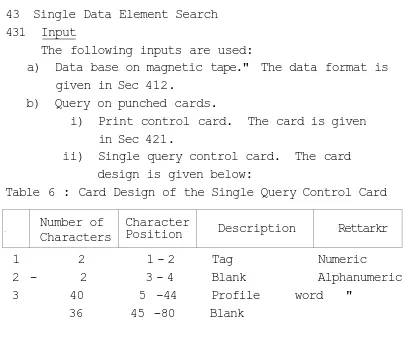
ii) Single query control card. The card
design is given below:
Table 6 : Card Design of the Single Query Control Card
SN
Number of Characters
Character
Position Description Rettarkr
1 2 1 - 2 Tag Numeric
2 - 2 3 - 4 Blank Alphanumeric
3 40 5 -44 Profile word "
Personnel Information System
A user can have several queries for a given print
control card. Also, the user can have several print
control cards for a single query. The schematic
repre-sentation of the sequence of query cards is illustrated
below.
Print Control Card
Simple Query Control Card
End Card for Simple Query Control Card
Print Control Card
Simple Query Control Card
Simple Query Control Card
End Card for Simple Query Control Card
End Card for Print Control Card
(indicates end of job)
Tags 2, 11/ 12, 14, 15 are not used in Simple Query
Control Card in single data element search. A sample
input query for single data element search is given in
Appendix A3.
432 Output
Printout on on-line printer is the output. The
answer of the query can be obtained in the following
three forms depending upon the . output control
instruc-tion given through CT.
a) Statistical form. For example, "Required
sta-tistics is 7".
Ranjita Maitra
b) Data from the records. Print format is given in Sec 422.
c) Combination of statistics and data from the record.
-A sample output of the single data element search is given in Appendix 4.
433 Procedure
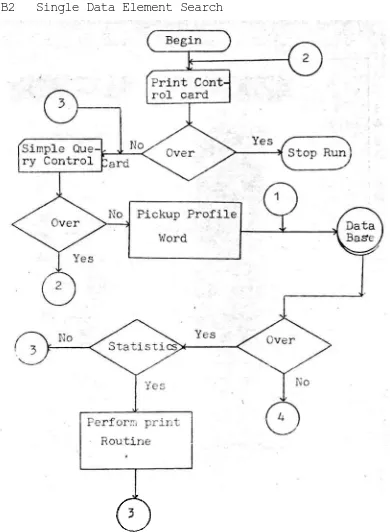
The procedure of reading the query card, reading data base on magnetic tape, matching profile word with data base and then printing the data on on-line printer according to the Print Control card and Output Control instruction is used.
The tag from the Simple Query Control (SQC) card is read. The tag is used to get the corresponding data element from the record in the tape file. The data is matched with the profile word given in the SQC card. If a match occurs the required information from the record is printed, if necessary, and statistics of the relevant record is increased by one. In case of a non-match, the next record is processed for matching. After processing all the records for a SQC card, the statis-tics of the relevant record is printed, if desired. After processing all the cards, the "Job over", message is displayed on the CT. Flow chart is given in Appen-dix B2.
44 Multiple Data Element Searcn 441 Input
input. The data format of the tape file is
given in Sec 412.
b) Query on punched cards.
i) Print Control Card. The card design is
given in See 421.
ii) Profile Word Card. It gives the following
information: l) Profile words; 2) Alpha
code for each profile word; 3) Tag;
4) Level Number (if necessary); 5)
Sub-level Number (if necessary); and 7)
Con-dition.
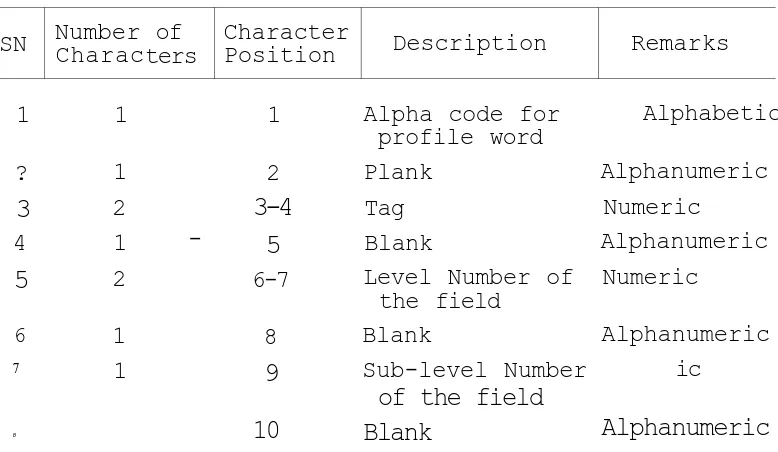
The card design of the Profile Word Card is given
below:
Table 7 : Card Design of the Profile Word Card
SN 1 ?
3
45
6 7 Number Charac 1 1 2 1 2 1 1 of ters -Character Position 1 2 3-45
6-7 89
Description Alpha code forprofile word Plank
Tag Blank
Level Number of the field Blank Sub-level Number Remarks Alphabetic Alphanumeric Numeric Alphanumeric Numeric Alphanumeric ic
8 10
of the field
Blank Alphanumeric
15
Ranjita Maitra
The Profile Word Card is prepared on the basis of
the useris query. It is helpful to use the following
work sheet in collecting user's query.
Name .
Addres.
USER PROFILE
(To be filled in by the User)
(Please fill in by typing)
Date ...
Profile No
Write your query in a natural language- Put a tick mark
against the required form of the output. Give the
de-sired sequence of information in the printout.
Query in natural language:
I want a list of all the alumni — male and female
— who were admitted to the DRTC Regular Course. Their SN
9
10
11
12
Number of Characters
1
1
40
2S
Character Position
11
12
13-52
53-80
Description
Search Condition
Blank
Profile word
Blank
Remarks
Numeric
Alphanumeric
"
Personnel Information System
state of domicile should be Tamil N a d u . I also want
to know the names of those whose date of birth is 1932
and who joined the course after 1971.
printout in required form:
Statistics only
Data base only
Both statistics and data base
Desired sequence of information:
Name and address, Date of joining DRTC,
Qualifi-cation, Experience
Profile word indicates the data in a standard form (as
used in the data base). A profile word must not exceed
40 characters. Maximum 26 profile words can be used
for a single query. For each profile word there would
be one Profile Control Card. Alpha code consists of an
alpha character representing the profile word and a
unique alpha code should be used for each profile word.
The search condition indicates whether the value
of the profile word is < or < or = or > or >
than the data element and each of the conditions indicated
by a numeric code 1, 2f 3, 4, 5 respectively.
iii) Search Expression Card. The search
expres-sion is formulated using logical connectors
Ranjita Maitra
on the basis of che user's query given in the
worksheet of user's profile. For this purpose,
the logical connectors AND (+), OR (*) and
NOT (-) are used. The detailed description
of these logical connectors is given
else-where ( 3 ). A user can give more than one
query. For each query a different search
expression card is used. The card design
is given below.
Table 8 : Card Design of the Search Expression Card
SN
_ — — ~ ~ — —~ ~— _ ^ _
Number of Characters
Character
Position Description Remarks
1 79 1 - 7 9 Search expression
Alpha-for query numeric 2 1 80 Hash
Hash mark indicates the end of a search expression.
The sequence of the input query cards is as follows:
Print control card
Profile word card
-do-End card for profile word card
Search expression card
Personnel Information
— Print Control card*
— Profile Word card
-do--
do-— End Card for Profile Word Card
Search Expression Card
-do-— End Card for Search Expression Card
End Card for Print Control Card
(indicates end of job)
A sample input query for multiple data element
search is given in Appendix A5.
442 Output
Printout with the required information is the
out-put. The output answer can be obtained in different
forms as given in Sec 432.
A sample output for multiple data element search is given in Appendix A6.
443 Procedure
The search expression is converted into Polish
Nota-tion. The detailed conversion process of search
expres-sion into Polish Notation is discussed elsewhere ( 1 , 2 ,
3 ).
Ranjita Maitra
The Polish Notation is then processed against each
of the records in the tape file with the help of the
information given in the profile word cards ( 3 ) If
the value of the expression — i.e. Polish Notation is
true, the record is printed according to the Print
Con-trol Card, if required, and the statistics of the
re-levant record is increased by one. After processing a
Polish Notation for a search expression against all the
records in the tape file, the total statistics is printe
if desired. After processing all the Search Expression
cards for a user the next user's query is processed .
following the above procedure. After processing all the
queries for all the users the message for "Job over" is
displayed on the CT. Flow chart is given in Appendix
B3.
5 OPERATING PROCEDURE
The program is compiled, loaded and executed. While
executing the following message is displayed on the CT
DISPLAY - ON 7, IF BOOLEAN SEARCH
DISPLAY - ON 1, IF DATA BASE ON PRINTER
DISPLAY - ON 2, IF SIMPLE RETRIEVAL
HALTED01
For creating data base on magnetic tape, GO is type
and ACCEPT key is pressed on the CT.
If printing of data base is required then CN1 is
typed followed by the pressing of ACCEPT key on the CT.
Personnel Information System
In case of single data element search 0N2 is typed
followed by the pressing of the ACCEPT key on the CT.
If multiple data clement search is required, then
CN7 is typed followed by the pressing of the ACCEPT
key on the CT.
Both in single data element search and multiple
data element search, the following message appear on
CT, for providing the required output control
instruc-tion to the computer.
DISPLAY - ON 3, IF STATISTICS ONLY
DISPLAY - OK 4, IF DATA BASE ONLY
HALTED u4.
If both statistics and printout of data base are
required, 0N3 4 is typed; otherwise ON 3 is typed for
statistics only and ON 4 is typed for data base
print-ing only.
There is provision to display error messages on
the CT ( 3 ) such as:
CARD SEQUENCE NO IS WRONG
QUERY TAG IS WRONG '
6 UPDATING
Updating of data base in a computerised system
involves amend::.i.nt of file and records,
Ranjita Maitra
File amendment is mainly required for
a) deletion of one or more records; and
b) addition of new records.
Both deletion and addition of records to the file
require a simple- updating procedure. The old master
file and the transaction file are merge to obtain a new
updated master file.
Record amendment involves mainly
a) deletion of data element;
b) addition of new data element;
c) changing of field length in a record; an*d
d) changing of data,
All the cases except the last one, require cnange
of the field length or record length as alsr the change
in data structure of the file, A simple procedure or
inverted file technique can be followed for addition of
new data element to a file.
7 IMPLEMENTATION OF PFIS IN DEVELOPING INDUSTRY PROFILE
A feasibility study of using PFIS for developing
industry profile and information retrieval system was
examined. For this purpose, a few amendments have been
incorporated in the program PFIS. The details of the
study are described elsewhere ( 5 ).
6 CONCLUSION
Personnel Information System
accjss to the data base. It is necessary to improve the
the system to work it in an on-line environment.
The system can be further improved by providing
random search facilities instead of searching the whole
file for a specific information. This may be done by
introducing inverted file techniques and using disc
system.
9 BIBLIOGRAPHICAL REFERENCES
1 Sec 443 DIJKKSTRA ( E W ) . Recursive programming.
(In ROSEN (Saul), Ed. Programming
sys-tems and languages. 1967. p 221-7).
2 Sec 443 GRI2CE (D). Computer construction for
digi-tal computers. 1971. P 277-6.
3 Sec 413, RANJITA MAITRA. Computer-based Personnel
441,443, information system. (Project submitted
5 in partial fulfilment of the
Associate-ship in Documentation and Information
Science.) 1976.
4 Sec 413 RAVICHANDRA R A O ( I K ) . Generalised approach to computer-based information storage,
retrieval and dissemination. (Project
sub-mitted in partial fulfillment of the
Associateship in Documentation and
Ranjita Maitra
5 Sec VENGAN (R). Information for Small Scale Industries : Case studies on its de-sign and development. (Project sub-mitted in partial fulfilment of the Associateship in Documentation and Information Science). 1976.
6 Sec 413 VEKKATARAMAN (3) and NEELAMEGHAN (A). Catalogue-on-tape. (Lib Sc. 5;1968; 317-30).
Personnel Information System
APPENDIX A : SAMPLE INPUT / OUTPUT
A1 Input Print Control Card
0102O30405O6O7080S1011121314151600 R M A I T R A 1615141312111O09O&070605O4O3O2O100 I K R RAO
010206091012161700 DRTC
05041600 R MAITRA
160406070809101113141500 I K R RAO
A2 Printout of Data Base
COURSE FOR t.'HICH APPLICATION IS BEING MADE : REGULAR
YEAR OF JOINING DRTC : 64
YEAR OF COMPLETING THE COURSE :
DATE OF BIRTH : 32-06-01
STATE OF DOMICILE : ANDHRA
SEX : MALE
MARITAL STATUS : UNMARRIED
CANDIDATE SPONSORED
CATEGORIZATION OF THE EMPLOYER : DEFENCE LAB
DESIGNATION : LIB
NO OF PUBLICATIONS
BOOK :
ARTICLES :
OTHERS :
FILE REFERENCE : WANJA 64
Ranjita Maitra
ACADEMIC QUALIFICATION EXAM
PASSED S S L C HS-PUC GRADUATE B LIB SC CERTIFICATE OTHER DIPLOMA EXPERIENCE/VISIT TO FROM SUBJECTS MAJ MAT MAT PHY LI3 RUS FRE JIT TO TO
55-09 ' 62--62-10 10 SUB Y>Y>+ W5+ MAT •
urn
bbb
YEAR PASS 49 51 54 61 60 bbb 58 - RANK FOREIGN COUNTRY IKS 4425 T/COUr 4G18 44254DRDL TRY +2
+ 2 + + i CAT UNIVE/ INST BSEMADRA 4411AE57 44254G18 44254G18 44254G18 4A254G18 EG CRY UNIVERSITY LIBRARY DEFENCELAP-KNOWLEDGE OF FOREIGN LANGUAGE : FRE, RUS V ANJANEYULU
LIBRARIAN
SPACE SCIENCE TECHNOLOGY CENTRE PB NO 48 TRIVANDRUM 695022.
Personnel Information System
A3 Input Query for Single Data Element Search
1600
01 SPECIAL DRTC
011600
06 MALE ASHALATHA
A4 Output of the Single Data Element Search
29/06/76 BIG-DATA OF DRTC ALUMNI PAGE NO 1
DRTC
IZZAT JEHAN BEGUM
AERONAUTICAL DEVELOPMENT ESTABLISHMENT DEFENCE RESEARCH
BANGALORE 1
REQUIRED STATISTICS IS 1.
A5 Input Query for Multiple Data Element Search
1600 RAKJITA
A 01 B 01 C 02 D 03 E 04 F 05 G 06 H 06
3
3
4
3
3
3
3
3
REGULAR SPECIAL 71
70 32 - 06 T NADU MALE FEMALE
Ranjita Maitra
A+F+(H*G) #
,
RAKJITA A B C D F G K
01 01 02 0 3 01 05 0 6 0 6
A6 Output of the Multiple Data Element search
29/06/76 BIC-DATA OF DRTC ALUMNI PAGE No 1
3 REGULAR 3 SPECIAL 3 71
3 70
3 3 2 - 0 6 - 0 1 3 T NADU
3 MALE 3 FEMALE
39/06/76 BIO-DATA OF DRTC ALUMNI PAGE NO
RANJITA
A + F + ( H * G)# K N AMBA
33 GIRi ROAD T NAGAR
TAMIL NADU
R VENGAN ERRAFPATTI PADI POST DHARMAPURI DT TAMIL M.iDU
Ranjita Maitra
B2 Single Data Element Search
personnel Information System
Ranjita Heitra
Personnel Information System