City, University of London Institutional Repository
Citation:
Coughlan, G. D., Blake, D. ORCID: 0000-0002-2453-2090, MacMinn, R., Cairns, A. J. G. and Dowd, K. (2013). Longevity Risk and Hedging Solutions. In: Dionne, G. (Ed.), Handbook of Insurance. (pp. 997-1035). New York, USA: Springer Science & Business Media. ISBN 978-1-4614-0154-4This is the accepted version of the paper.
This version of the publication may differ from the final published
version.
Permanent repository link:
https://openaccess.city.ac.uk/id/eprint/25327/Link to published version:
Copyright and reuse: City Research Online aims to make research
outputs of City, University of London available to a wider audience.
Copyright and Moral Rights remain with the author(s) and/or copyright
holders. URLs from City Research Online may be freely distributed and
linked to.
City Research Online: http://openaccess.city.ac.uk/ [email protected]
City Research Online
Page 1
Longevity Risk and Hedging Solutions
26 August 2012 Guy Coughlana) David Blake b) Richard McMinn c) Andrew J.G. Cairns d) Kevin Dowd e) ABSTRACT
Longevity risk – the risk of unanticipated increases in life expectancy – has only recently been recognized as a significant global risk that has materially raised the costs of providing pensions and annuities. We first discuss historical trends in the evolution of life expectancy and then analyze the hedging solutions that have been developed for managing longevity risk. One set of solutions has come directly from the insurance industry: pension buyouts, buy-ins and bulk annuity transfers. Another complementary set of solutions has come from the capital markets: longevity swaps and q-forwards. This has led to hybrid solutions such as synthetic buy-ins. We then review the evolution of the market for longevity risk transfer, which began in the UK in 2006 and is arguably the most important sector of the broader “life market”. An important theme in the development of the longevity market has been the innovation originating from the combined involvement of insurance, banking and private equity participants.
Chapter (X) in Georges Dionne (Ed.), Handbook of Insurance, second edition, Springer, New York; forthcoming in 2013. ISBN will be: 978-1-4614-0154-4.
a)
Pacific Global Advisors, 535 Madison Avenue, New York, NY, 10022-4214, USA. Corresponding author: email at [email protected]
b)
Pensions Institute, Cass Business School, 106 Bunhill Row, London, EC1Y 8TZ, United Kingdom.
c)
Katie School of Insurance, Illinois State University, Normal, IL, USA.
d)
Maxwell Institute for Mathematical Sciences, and Department of Actuarial Mathematics and Statistics, Heriot-Watt University, Edinburgh, EH14 4AS, United Kingdom.
e)
Pensions Institute, Cass Business School, 106 Bunhill Row, London, EC1Y 8TZ, United Kingdom. _______________________
Disclaimer:
Information herein is obtained from sources believed to be reliable but Pacific Global Advisors does not warrant its completeness or accuracy. Opinions and estimates constitute the judgment of the authors and are subject to change without notice. Past performance is not indicative of future results. This material is provided for informational purposes only and is not intended as a recommendation or an offer or solicitation for the purchase or sale of any security or financial instrument and should not serve as a primary basis for investment decisions.
Page 2
I. Introduction
The first decade of the twenty-first century saw the emergence of the “life market,” a new
institutional market in which assets and liabilities linked to longevity and mortality are traded. The life market has so far developed slowly, but has the potential to grow into a very large global market in the coming years, driven, in particular, by a widely-anticipated expansion in longevity risk
management. This expected expansion reflects the increasing recognition of the threat to the provision of retirement income posed by unanticipated advances in life expectancy. This so-called “longevity risk” means that the cost of providing pensions and annuities to retirees may be very much higher than expected, leading to significant financial losses for insurers, pension plans, corporations and governments.
Despite its slow initial growth, this market has witnessed impressive innovation, much of which has come from the interplay of the differing perspectives of the insurance, investment banking and private equity industries. This has led to the development of new capital markets solutions for transferring longevity risk alongside more traditional insurance solutions. It has also spurred significant innovation in the design and implementation of insurance solutions themselves.
This chapter is focused on the development and structure of the longevity market and surveys both insurance and capital markets channels for longevity risk transfer. It places particular emphasis on the different perspectives of the various market players and the role of innovation in market development.
In Section II, we discuss historical trends in the evolution of life expectancy and the problem
longevity risk poses for the retirement industry. In Section III, we define the market for longevity risk transfer, discuss its origins and development. We describe the key market participants and the role that the capital markets play in providing complementary solutions to traditional insurance
solutions. Section IV discusses the development of the longevity market since its birth in the UK which we argue dates from 2006. Section V presents a framework for evaluating the effectiveness of longevity hedges and illustrates this with a case study involving a US pension plan. Section VI reviews the innovations that have been a feature of this market, before Section VII presents our conclusions.
Page 3
II. Longevity risk
Trend vs. risk
Life expectancy has been rising in almost all the countries of the world for both males and females.1 Figure 1 shows the steady increases in period life expectancy over the past 50 years for 65-year-old males and females in England & Wales (EW) and in the US. This reflects the increasing length of time that both sexes spend in retirement in all developed countries. Furthermore, Figure 2 shows that the maximum life expectancy at birth for females across developed countries has been increasing almost linearly at the rate of nearly three months per year for more than 150 years.2
Figure 1: Period life expectancy at age 65 in the US and England & Wales 1961-2010.
10 12 14 16 18 20 22 1960 1970 1980 1990 2000 2010 65 EW Males 65 EW Females 65 US Male 65 US Female Source: LifeMetrics. 1
There are only a few exceptions: a current example is Zimbabwe, where life expectancy at birth has fallen to 37 for males and to 34 for females.
2 There is no sign of this trend abating according to a recent study: “Life expectancy in Europe is continuing to increase despite an obesity epidemic, with people in Britain reaching an older age than those living in the United States, according to study of trends over the last 40 years. In a report in the International Journal of Epidemiology, population health expert David Leon of the London School of Hygiene and Tropical Medicine said the findings counteract concerns that the rising life expectancy trend in wealthy nations may be coming to an end in the face of health problems caused by widespread levels of obesity. The report comes as news of the U.S. mortality rate fell to an all-time low in 2009, marking the 10th consecutive year of declines as death rates from heart disease and crime dropped. In total, rates declined significantly for 10 of the 15 leading causes of death, including cancer, diabetes and Alzheimer's disease” (Kelland, 2011).
Page 4
Figure 2: Record female life expectancy since 1840
Source: Oeppen and Vaupel (2002)
Although aggregate increases in life expectancy can place burdens on both public and private defined benefit (DB) pension systems, they would not necessarily do so if they were fully
anticipated. Indeed, governments and pension plan sponsors have begun to respond to increases in life expectancy by requiring individuals to pay higher pension contributions when they are in work and/or to work longer. Pension plan members do not relish either prospect, as has been
demonstrated through public statements by trade union officials, industrial action and protests in a number of countries. Despite this, separately or in combination, these measures can be used to maintain the viability of pension systems in both the public and corporate sectors. The UK
government, for example, is raising the state pension age (SPA) for women from 60 to 65 between 2010 and 2018 and then raising the SPA for both men and women to 66 by 2020, to 67 by 2026 and to 68 by 2046. It has also removed the default retirement age in private pension plans. In 2010, 8% of the UK workforce above age 65 was still in work.
So it is not the aggregate increase in life expectancy per se that is challenging the viability of pension systems almost everywhere. Rather, it is a combination of (i) uncertainty surrounding the trend increases in life expectancy and (ii) variations around this uncertain trend that is the real problem. This is what is meant by longevity risk and it arises as a result of unanticipated changes in mortality rates. It is only fairly recently that the stochastic nature of mortality rates has begun to be
recognized. Figure 3 shows that aggregate mortality rates (in this case those of 80-year-olds in the US and England & Wales) have been generally declining, but that changes have an unpredictable element, not only from one period to next, but also over the long run.
Page 5
A large number of products in the pension and life insurance industries count longevity as a key risk, DB pension plans and annuities being important examples. These products expose the providers to the risk of unanticipatedchanges in the mortality rates of the relevant reference populations over very long periods of time. In particular, the remarkable increases in survival at older ages since the second half of the twentieth century (see for example Kannisto (1994); Vaupel (1997)) represent a trend of growing concern to annuity providers and DB pension plan sponsors.
To be more specific, annuity providers are exposed to the risk that the mortality rates of annuitants will fall at a faster rate than accounted for in their pricing and reserving calculations. Annuities are commoditized products selling on the basis of price, and profit margins have to be kept low for competitive reasons. If the mortality assumption built into the price of annuities turns out to be a gross overestimate (and, as a result, the longevity prediction a gross underestimate), this will
reduce, or even eliminate, the profit margins of annuity providers. The impact on DB pension plans is similar. If the mortality assumption built into the budgeted cost of pension provision turns out to be a gross overestimate, then pension plan sponsors – public sector and corporate alike – will see funding deficits emerge, necessitating possibly significant additional contributions to fill the gap.
Figure 3: Mortality Rates for 80-year-olds in the US and England & Wales 1961-2010
4% 6% 8% 10% 12% 14% 1960 1970 1980 1990 2000 2010 80 EW Male 80 EW Female 80 US Male 80 US Female Source: LifeMetrics. Impact of longevity risk
As we have already noted, the cost of providing a pension or annuity depends on the expected long-term trend of future mortality rates. If the realized trend involves higher mortality improvements
Page 6
(i.e., lower mortality rates) than expected, then the cost of that pension or annuity can be
significantly higher than expected. So longevity risk is not only a “volatility” risk (as most investment risks are), but also a “trend” risk (unlike most investment risks). Moreover it is a slowly-building, cumulative trend risk. Mortality rates in future years depend on the cumulative mortality
improvements between now and then, which only become significant over long timescales. Table 1 shows the increase in the cost of providing a pension or an annuity if mortality rates fall by just 1% more than the expectations of pension plans and annuity providers.3 The impact can be very substantial, particularly for younger pre-retirement beneficiaries and particularly if the pension includes an adjustment for inflation or cost of living.
Table 1: Impact of an unexpected fall in future mortality rates of 1% per year below expectation 45-year-old
Pre-retirement
65-year-old Retiree (Pensioner) Impact on life expectancy +2.7 years +1.0 years Impact on cost of providing a fixed pension +7% +3% Impact on cost of providing an inflation-linked pension +11% +5% Source: Coughlan et al. (2008b).
3
The figure of 1% is taken to standardize the measurement of the sensitivity, or elasticity, of pension costs to changing mortality rates. As such, this sensitivity is analogous to the concept of duration in finance which measures the sensitivity to changes in interest rates. For this reason, it is often referred to as “mortality duration” or “q duration” (Coughlan et al., 2007a, 2008b).
Page 7
III. Longevity market structure
This section reviews the structure of the market for longevity risk transfer. It describes the different segments of the market, the various participants in the market and the range of products that have been used to transfer longevity risk.
Defining the longevity market
The market for longevity risk transfers is a part of the broader life market that encompasses transactions of different kinds, many of which have existed for a considerable time. These transactions include:
Pension buy-outs (also referred to as pension plan terminations), which transfer pension liabilities and all the associated risks and obligations to insurers. These are insurance solutions.
Pension buy-ins, which transfer a portion of the longevity risk and investment risk to insurers through the bulk purchase of annuities by the pension plan. These are insurance solutions.
Bulk annuity and reinsurance deals, which transfer annuity portfolios between insurers/reinsurers. These are also insurance solutions.
Longevity bonds, which transfer longevity risk from a pension plan or annuity portfolio to another party in the form of a security. These are capital markets solutions.
Longevity swaps, which transfer just longevity risk from a pension plan or annuity portfolio to another party. These can be either insurance or capital markets solutions.
Mortality catastrophe bonds and swaps, which transfer the risk of a devastating
(catastrophic) rise in mortality due, for example, to a pandemic or natural disaster, from a life insurer or reinsurer to other parties. These are capital markets solutions.
Life securitizations, which transfer the risks associated with a particular block of insurance business to the capital markets in the form of a security. These are capital markets solutions.
US life settlements transactions, which transfer small portfolios of US life assurance policies to investors. These are capital markets solutions.
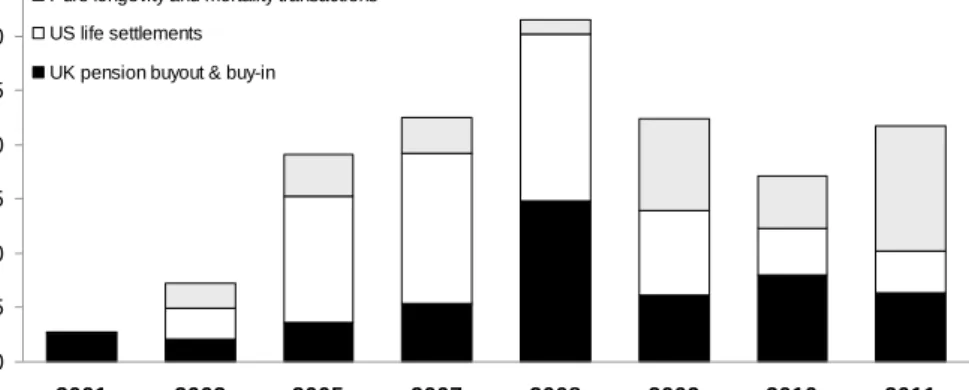
Figure 4 shows the development of public transaction values for selected life market segments from 2001 to 2011. Until 2009, a challenging year following the collapse of Lehman Brothers, the market had shown impressive growth, which only began to resume in 2011.
In this chapter, our focus is on the first five transaction types in the above list which are classified as “macro-longevity” transactions since they all involve a large pool of lives: pension buy-outs, pension buy-ins, bulk annuity transfers, longevity bonds and longevity swaps. These constitute the most important practical solutions for transferring the longevity risk linked to the provision of retirement income and define what we consider to be the “longevity market” for the purposes of this chapter. They are described in more detail below. We do not consider, in particular, the segments of the life market associated with (i) the hedging of mortality exposure by life insurers, (ii) life securitizations, or (iii) life settlements transactions (also called “micro-longevity” transactions)4.
4 A life settlement involves the sale of a life insurance policy to a third party for more than its cash surrender value, but less than its net death benefit. The third party takes on the obligation to pay the premiums on the policy and receives the eventual benefit payout. As such, the third party is exposed to the longevity risk of the insured life. The securitization of pools of life settlements began in 2004 and these pools have generally been small, typically containing the policies of at most a few hundred individuals – hence the term “micro
Page 8
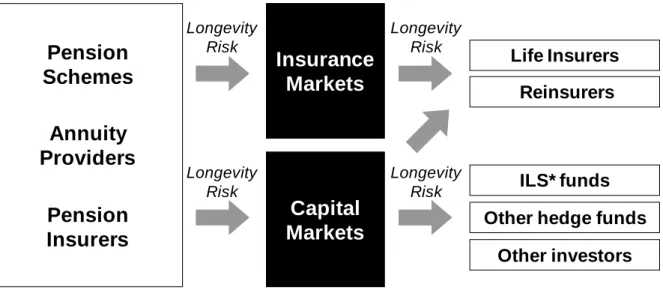
In defining the longevity risk transfer market it is important to include transactions executed in both capital markets and insurance formats. These are alternative but complementary channels for achieving the same goal. The market operates by transferring longevity risk from DB pension plans and insurers to end holders of the risk, often via an intermediary, as shown in Figure 5.
Longevity market participants
Three primary kinds of participants are usually involved in longevity transactions:
• Hedgers: These include insurers or annuity providers and pension plans that are naturally exposed to longevity risk and are seeking to reduce or eliminate it.
• Investors: These include insurers and reinsurers as well as capital markets investors. The latter include insurance linked securities (ILS) funds, hedge funds, sovereign wealth funds, family offices and endowments.
• Financial intermediaries: These include banks and other financial institutions that facilitate risk transfer and, in many cases, stand between hedgers and investors. Note that financial intermediaries such as banks are unlikely to be long-term holders of significant amounts of longevity risk, but they may temporarily warehouse the risk to facilitate liquidity provision. Capital markets investors are a new and important group of participants in the longevity market. While the number of investors that are in a position to invest directly in longevity risk is currently limited, a much larger number are in various stages of evaluating it as an asset class and developing the necessary skills and infrastructure. To them, longevity represents a new investment opportunity offering a positive risk premium and the benefit of diversification by virtue of having very low correlations with traditional asset classes.
Financial intermediaries can be useful for capital-markets-based longevity transactions for three reasons:
• Liquidity provision. By providing liquidity to both sides of the market, it is unnecessary for hedgers to wait for interested investors to enter the market before hedging and vice versa. Moreover, the hedge remains in place if an investor redeems its longevity investment. • Credit intermediation. By fulfilling the role of counterparty to both hedgers and investors,
credit counterparty exposure can be left with institutions, such as banks, that are best equipped to manage it.
• Repackaging. Many investors want to take longevity risk in different forms from that in which hedgers want to shed it. By standing in the middle, intermediaries can tranche exposures into different parcels to meet the specific needs of different investors and hedgers.
The capital markets as a channel for longevity risk transfer
We have already noted that the capital markets are a complementary channel for longevity risk transfer. The development of a vibrant channel for longevity risk transfers to the capital markets is widely seen as beneficial for the insurance industry in terms of facilitating the efficient management of capital and building additional insurance capacity. In particular, the capital markets bring a number of benefits including:
longevity”. The first life settlement securitization was a $63 million issue by Tarrytown Second LLC in 2004, which was backed by life policies with a face value of $195 million.
Page 9
Additional capacity for bearing longevity risk. The universe of end holders of longevity risk is expanded beyond insurers and reinsurers to include capital markets investors.
Greater diversity of counterparties. Hedgers are not restricted to transact just with insurers and reinsurers, but can also transact with investment banks, exchanges and other
intermediaries.
Liquidity. Appropriately designed capital markets contracts have the potential to be highly liquid, which is not the case with insurance contracts.
Fungibility. Longevity hedges or investments transacted with one institution have the potential to be unwound with another institution offering better pricing.
Counterparty credit exposure management. Longevity hedges transacted as capital market derivatives are required to be fully collateralized on an economic, or marked-to-market, basis to reduce counterparty credit exposure. In the past, this requirement has generally not been the case with insurance transactions, although it is now changing for longevity
transactions.
There are three main differences between capital markets and insurance-based longevity transactions:
The legal form of the contract (insurance contract vs. financial contract).
The counterparty facing the hedger, which for insurance-based hedges must be an insurer, while, for capital markets hedges there is no specific requirement.
The nature of the end holder of the risk is different. With insurance-based hedges, the risk will end up with insurers and/or reinsurers, whereas for capital markets hedges, the end holders of the risk can include capital markets investors.
Despite these differences, the two kinds of transactions, when appropriately structured, achieve a similar result in economic terms. The choice between the two comes down to relative pricing and the preferences of, and restrictions faced by, the counterparties.
Buyouts, buy-ins and bulk annuity transfers
The traditional solution for managing the longevity risk in a DB pension plan or an annuity portfolio is to transfer the liability, along with all its risks, to an insurer (or reinsurer) via a contract of
insurance (or a reinsurance treaty), using the insurance channel described above.
Buyouts are the endgame for DB pension plans in that they remove the pension liability from the balance sheet of the sponsor.5 This process typically involves transferring the assets and liabilities of the pension plan to an insurer, along with a top-up payment required to bring the assets up to the level of the so-called “buyout liability” (Figure 6). The buyout liability is typically larger than the accounting liability (under both IFRS and US GAAP), as it reflects what are typically higher and more realistic longevity assumptions, discounting based on the swap curve, expenses and a risk premium. According to one UK pension consultant, 2011 buyout pricing was approximately at a 15% premium to the accounting liability for pensioners and 25% for non-pensioners (LCP, 2011).
Buy-ins involve the bulk purchase of annuities by the pension plan to hedge the risks associated with a subset of the plan’s liabilities, typically associated with retired members. The annuities become an asset of the plan and reflect the mortality characteristics of the plan’s membership in terms of age and gender. Buy-ins are often used as a staging post on the road to full buyout. They can be thought
5 Buyouts are therefore only suitable for DB pension plans which have closed not only to new members but also to future accrual of pension entitlements by existing plan members.
Page 10
of as providing a “downsizing” of the pension plan in economic terms, but not necessarily in accounting or regulatory terms. They enable the plan to lock-in attractive annuity rates over time, without the risk of a spike in pricing at the time they decide to proceed directly to a full buyout. Buy-ins also offer the sponsor the advantage of full immunization of a portion of the pension liabilities for a much lower (or even zero) up-front cash payment relative to a full buyout. Since the annuity contract purchased in a buy-in is an asset of the pension plan, rather than an asset of the plan member, the pension liability remains on the balance sheet of the sponsor. A common type of buy-in in the UK has been the pensioner buy-in, in which the liabilities associated with retirees who are currently receiving their pensions are matched with an annuity (see Figure 7). Pensioner buy-ins are cost-effective because, for a given liability value, there is less risk associated with pensioners than with younger pre-retirement members of the plan.
“Synthetic buy-ins” are a relatively recent development, which provide essentially the same economic effects as a buy-in, but without annuity contracts. They are implemented using swaps: a longevity swap to remove longevity risk and interest rate and inflation swaps to remove the interest rate and inflation risks associated with the liabilities. They can also include an asset swap or a total return swap which is used to reduce funding costs (Figure 8).
So-called “non-insured buyouts” involve transferring pension liabilities to institutions that are not regulated insurance companies. This keeps the pension plan in the pension regulatory regime, rather than transferring it to the insurance regulatory regime. These transactions are effected by selling an entity containing the pension plan to another company which takes over responsibility for that plan. Non-insured buyouts offer the promise of being more affordable for the sponsor, but are subject to considerable scrutiny by regulators and plan fiduciaries. The detailed way in which these
transactions are structured can differ significantly from case to case. They first came to prominence in 2007 when there were four such deals executed in the UK, as discussed below. The endgame for the transferred pension fund is still likely to be a full buyout with an insurance company at a later date.
There are different ways in which an insurer or reinsurer can transfer the bundle of risks associated with annuity exposure. This can be done, for example, in full (analogous to pension plan buyouts) where the individual policies are transferred to a new insurer.
Alternatively, there are partial risk transfer solutions such as “quota share” reinsurance treaties in which the reinsurer accepts a stated percentage of each and every risk within a defined block of annuities on a pro rata basis. Participation in each risk is fixed and certain. In contrast to a pension buy-in which transfers 100% of the risk associated with a subgroup of individuals, a quota share transaction transfers a percentage of the risk associated with each individual’s policy.
Solutions for hedging pure longevity risk
The solutions currently available for hedging pure longevity risk can be classified broadly according to three characteristics:
Format: insurance versus capital markets.
Design: customized (or indemnity) versus index (or parametric).
Structure of instrument: swap versus forward, among others.
The “format” characteristic refers to the legal nature of the contract. Most longevity swaps executed so far have been in insurance format, although the first actively publicized longevity swaps were in capital markets format, as was the first swap with a pension plan. A mix of formats is even possible
Page 11
in the same deal. For example, hedging with a capital markets swap and then passing that risk onto a reinsurer in insurance format via a transformer entity.
The “design” characteristic reflects the nature of the longevity risk associated with the hedging instrument and can be broken down into two categories: customized and index hedges. A
customized hedge is one in which the performance of the hedging instrument is linked to the actual longevity experience of the individuals associated with the exposure that is being hedged. An example is the actual members of a pension plan or the actual annuitants in an annuity portfolio. By contrast, an index hedge is one in which the performance of the hedging instrument is linked to an index reflecting the longevity or mortality experience of what is typically a larger pool of lives, such as a national population. Customized hedges have the advantage of potentially providing a nearly perfect hedge, whereas index hedges will generally leave an element of residual risk, called basis risk, because the population associated with the exposure is different from the population associated with the hedging instrument.
Recent research has shown that when appropriately calibrated, index hedges can be 85% effective in reducing longevity risk (Coughlan et al., 2011). These hedges bring other advantages in terms of standardization, transparency, greater appeal to investors and the potential for higher liquidity. Index hedges are also extremely well suited to hedge the longevity risk associated with
(pre-retirement) deferred pension and deferred annuity benefits. For these individuals, longevity risk is all value risk not cash flow risk, and because indices reflect the longevity trend risk that is used in valuation and pricing, index-based hedges can provide effective hedges for this risk. Furthermore, pre-retirement pension members often have options in terms of taking a lump sum and the size of their spouse’s pension, so that the longevity risk is not well defined or easy to quantify and, as a consequence, a long-term customized hedge can be inappropriate and expensive. Furthermore, customized hedges are generally not available for deferreds, except if they are part of a pension plan which also has a large number of pensioners, or if they are older deferreds whose retirement is relatively close.
Another difference between these two types of hedges is that customized hedges are generally designed to hedge liability cash flows, whereas index hedges are generally designed to hedge the liability value, i.e., the present value of the liability cash flows. Customized hedges have, however, been used to hedge the liability value.
Labeling instruments as either customized or index hedges, however, is perhaps too simplistic an approach for classifying the types of instruments that are in the market. Even at this early stage of market development, hybrid hedges that combine some of the features of each have emerged. For example, hedges of pension liability value have been constructed using a specific bespoke index that is based on the realized mortality experience of the actual pension plan members.
The actual “structure” of the hedging instrument is the third characteristic of pure longevity risk transactions. The most common structure used to date has been the survivor longevity swap (frequently abbreviated to simply “longevity swap”). This, however, is far from being the simplest hedging instrument. For this reason, we begin our discussion with the mortality forward, or q-forward, instrument.
Mortality forward (q-forward)
A mortality forward rate contract is often referred to as a “q-forward” because the letter “q” is the standard actuarial symbol for mortality rates. It is the simplest type of instrument for transferring longevity (and mortality) risk (Coughlan et al. 2007b) and was the first type of capital markets
Page 12
longevity hedge to be executed. This was a deal between UK pension insurer Lucida and J.P. Morgan and is described in the next section.
The importance of q-forwards rests in the fact that they form basic building blocks from which other, more complex, life-related derivatives can be constructed. When appropriately designed, a portfolio of q-forwards can be used to replicate and to hedge the longevity exposure of an annuity or a pension liability, or to hedge the mortality exposure of a life assurance book.
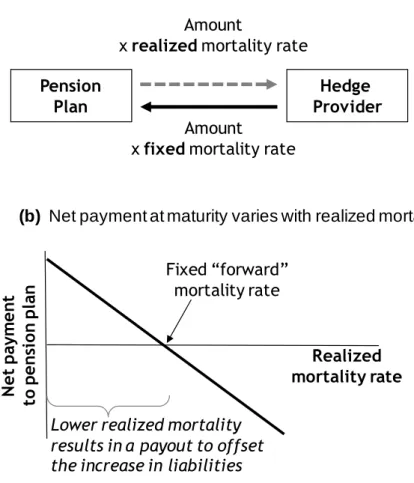
A q-forward is defined as an agreement between two parties in which they agree to exchange an amount proportional to the actual, realized mortality rate of a given population (or subpopulation), in return for an amount proportional to a fixed mortality rate that has been mutually agreed at inception to be payable at a future date (the maturity of the contract). In this sense, a q-forward is a swap that exchanges fixed mortality for the realized mortality at maturity, as illustrated in Figure 9(a). The variable used to settle the contract is the realized mortality rate for that population in a future period.
The fixed mortality rate at which the transaction takes place defines the “forward mortality rate” for the population in question. If the q-forward is fairly priced, no payment changes hands at the
inception of the trade, but at maturity, a net payment will be made by one of the two counterparties (unless the fixed and actual mortality rates happen to be the same). The settlement that takes place at maturity is based on the net amount payable and is proportional to the difference between the fixed mortality rate (the transacted forward rate) and the realized reference rate. Figure 9(b) shows the settlement for different potential outcomes for the realized reference rate. If the reference rate in the reference year is below the fixed rate (i.e., lower mortality), then the settlement is positive, and the pension plan receives the settlement payment to offset the increase in its liability value. If, on the other hand, the reference rate is above the fixed rate (i.e., higher mortality), then the settlement is negative and the pension plan makes the settlement payment to the hedge provider, which will be offset by the fall in the value of its liabilities. In this way, the net liability value is locked-in regardless of what happens to mortality rates. The plan is protected from unexpected changes in mortality rates.
Survivor forward (S-forward)
A survivor forward or “S-forward” is similar in concept to a q-forward, but instead uses survival rates rather than mortality rates. It is an arrangement between two parties in which they agree to
exchange an amount proportional to the actual, realized survival rate of a given population (or subpopulation), in return for an amount proportional to a fixed survival rate that has been mutually agreed at inception to be payable at the maturity of the contract. As such it involves the exchange of (i) a notional amount multiplied by a pre-agreed fixed survival rate in return for (ii) the same
notional amount multiplied by the realized survival rate for a specified cohort over a given period of time (Coughlan et al., 2008b; Dawson et al., 2010).
If the maturity of the contract is one year, then a survivor forward is the inverse of a mortality forward. But if the contract maturity is greater than a year, this simple relationship no longer exists, since survival rates over periods longer than a year are non-linear functions of the annual mortality rates. A survivor forward is therefore more complex than a q-forward, since it is a function of several mortality rates at different ages and different times. Nevertheless, it can be a useful building block in certain situations.
Page 13
Longevity swaps
A longevity swap can be either a capital markets derivative or an insurance contract. In either case, it is an instrument which involves exchanging actual pension payments for a series of pre-agreed fixed payments, as indicated in Figure 10 (Dowd et al., 2006). Each payment is based on an amount-weighted survival rate.
In any longevity swap, the hedger of longevity risk (e.g., a pension plan) receives from the longevity swap provider the actual payments it must pay to pensioners and, in return, makes a series of fixed payments to the hedge provider. In this way, if pensioners live longer than expected, the higher pension amounts that the pension plan must pay are offset by the higher payments received from the provider of the longevity swap. The swap therefore provides the pension plan with a long-maturity, customized cash flow hedge of its longevity risk. Figure 11 shows an example of the flow of longevity swap payments, which is based on the pioneering Canada Life-J.P. Morgan transaction of July 2008 (Trading Risk 2008; Life & Pensions 2008).
Variants on longevity swaps
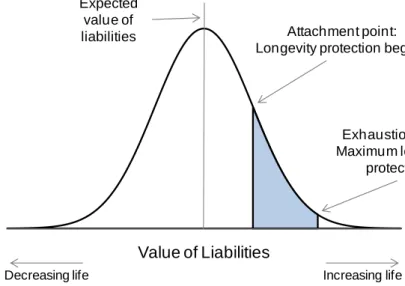
One variant on the standard longevity swap is the transaction executed by Aegon and Deutsche Bank in January 2012. This transaction was a so-called “out-of-the-money” longevity swap as it only transferred the longevity risk associated with a very large increase in life expectancy (or equivalently, a very large and sustained fall in mortality rates). The hedger (Aegon) receives no incremental payment for modest increases in life expectancy until a certain threshold, or “attachment point” is breached. Thereafter Aegon receives payments that increase with increasing life expectancy until a certain maximum level of protection is achieved when life expectancy rises to a very extreme level (the so-called “exhaustion point”). This swap is effectively a standard longevity swap except that the floating payments have caps and floors on them. See Figure 12.
Some of the other details of the transaction are summarized in Figure 13. It was a 20-year index-based swap in capital markets format, where the index corresponded to Netherlands national population data. Like the Aviva-RBS transaction, this swap also included a commutation payment at maturity designed to provide longevity protection for all liability cash flows occurring beyond the maturity date.
Longevity bonds
Since before the start of this market, there has been much talk about longevity bonds, as a means to hedge longevity risk. A longevity bond (or a survivor bond as it was originally called) is a bond that pays coupons that are proportional to the number of survivors still alive on the coupon payment date from a specified population cohort, say, the population of 65-year-old males alive on the issue date of the bond. (Blake and Burrows, 2001; Dowd, 2003; Blake et al., 2006a, 2006b). The cash flows of a plain vanilla longevity bond are identical to those on the floating leg of a longevity swap.
Recently, however, longevity bonds have been proposed with different structures. Figure 14 shows the potential range of cash flows on a deferred longevity bond as discussed in Blake et al. (2010). The bond’s cash flows are indexed to the mortality experience of 65-year old males from the national population of the UK. There is a 10-year deferral period before payments commence and there is a terminal commutation payment at age 105 to cover post-105-year age longevity risk. If more people survive to each age than expected, then the bond will pay out more; if fewer people survive, the bond will pay out less (similar to the floating leg of the RBS-Aviva longevity swap).
Page 14
Despite several attempts, no pure longevity bond has yet been issued. The Swiss Re Kortis bond which we shall discuss in more detail later was not a true longevity bond, because it involved transferring the risk associated with the spread between the longevity trends for two different groups of individuals, rather than the trend itself. Perhaps the most well known bond not to be issued was the EIB-BNP Paribas longevity bond (Azzopardi 2005) that was announced with much fanfare in 2004. It was unsuccessful for several reasons connected with its structure and the lack of education of its target market (Blake et al. 2006a).
In 2006, the World Bank engaged the insurance regulator in Chile, the Superintendencia de Valores y Seguros (SVS), on longevity hedging (Zelenko, 2011). The SVS showed a willingness to promote longevity risk management and to provide explicit regulatory capital relief to insurers who hedged the risk. An initial feasibility project was then conducted with the involvement of BNP Paribas in 2008, but the effort stalled due to the high cost of the proposed World Bank-issued longevity bond structure. Then the World Bank turned to the J.P. Morgan longevity team in 2009, who developed a more cost effective 25-year maturity longevity bond structure that was designed to provide an effective hedge, with minimal basis risk, for all Chilean insurers . The longevity bond was to be issued out of a collateralized SPV, with Munich Re providing the longevity hedge to the entity and J.P. Morgan managing the cash flow mismatch between the various payment streams (Coughlan, 2009; Life & Pension Risk, 2010).
This bond, like the others before it, faced a number of obstacles and was not successful. Some of the most significant included:
The separation between the investment and actuarial departments at Chilean insurers meant that there was no clear focus for decision-making responsibility.
The insurers perception of longevity risk was that it was not significant and, therefore, not in need of hedging. As a result they regarded the cost as relatively high, despite the capital relief, and despite the return on the bond being above government yields.
Basis risk was perceived as slightly too high, despite being minimized by indexing the bond to the universe of actual annuitants.
The potential role of governments in issuing longevity bonds
In principle, longevity bonds could be issued by private-sector organizations. Some argue that pharmaceutical companies would be natural issuers, since the longer people live, the more they will spend on medicines.6 While the theory may be correct, the scale of the demand for longevity bonds far exceeds conceivable supply from such companies. Further, significant credit risk would be associated with the private-sector issuance of an instrument intended to hedge an aggregate risk many years into the future.
Recently there have been calls for governments to issue longevity bonds in order to help catalyze the longevity market by providing a visible and transparent longevity pricing point (Blake and Burrows, 2001; Blake et al. 2010). The government may be better able to issue longevity bonds in the required volume and also has an interest in promoting an efficient and well-functioning annuity market, safeguarding the solvency of insurance companies, and facilitating the efficient spreading of longevity risk via the development of a capital market in longevity risk transfers. The International Monetary Fund has recognized government involvement in a longevity bond market as potentially useful, as have the authors of an OECD working paper and the World Economic Forum.7
6 See Dowd (2003). 7
Page 15
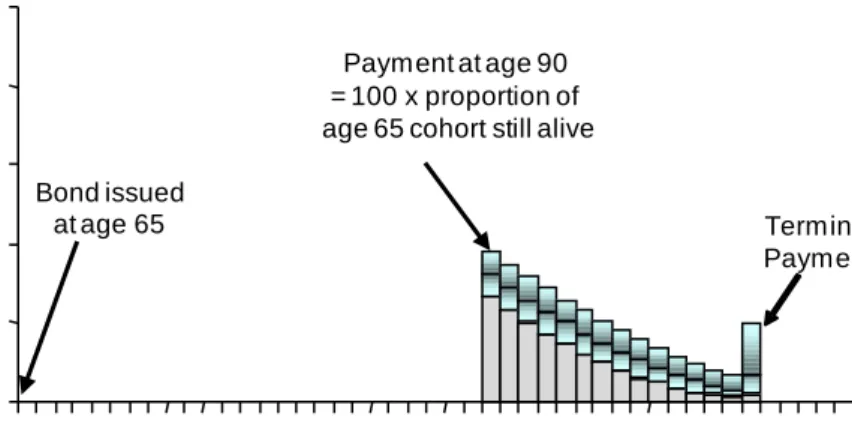
Although the government would play a key role in getting the market started, eventually its role could be limited to providing only tail risk protection. That is, once the market for longevity bonds has matured, in the sense of producing stable and reliable price points in the age range 65-90, the capital markets could take over responsibility for providing the necessary hedging capacity in this age range, in the form of, say, longevity swaps. All that might then be needed would be for the government to provide a continuous supply of deferred tail longevity bonds with payments starting at, say, age 90.8 Figure 15 illustrates the cash flows on such a bond. These bonds would allow for full hedging of longevity risk and also permit potential longevity investors to avoid assuming long-duration tail longevity risk, a risk for which they have no appetite.
Some contend that the government is not a natural issuer of longevity bonds because of its large existing exposure to longevity risk through the social security system and pensions for public employees. Here several considerations may be relevant. First, the government would receive a longevity risk premium from issuing the bonds, that is, the price at which the government will be able to sell the bond would exceed the expected present value of the coupons payable on the bond, discounted by the interest rate on government securities of comparable maturities; the reason is that insurance companies holding longevity bonds would need to hold less capital against the risk of mortality improvements being more rapid than expected. Second, the government could control the ultimate cost of the pensions by increasing the official retirement age should longevity increase dramatically.9 Third, the issuance of longevity bonds should result in a more efficient annuity market and hence higher incomes in retirement, perhaps reducing the need for means-tested retirement benefits. Fourth, the benefits to government finances would start to accrue immediately, whereas the tail risk protection provided by deferred tail longevity bonds would only start to be payable 25 years in the future when the first insured cohort turns 90. Finally, one could argue that the risk is consistent with the government’s role of facilitating intergenerational risk sharing. However, the reception from governments in several different countries has at best been luke warm so far. Figure 4: Value of publicly announced transactions in selected segments of the life market, 2001-11
Value of announced transactions in selected segments of the life market (US $ billions)
Source: Sanf ord Bernstein, ABI, Mercer OliverWyman, J.P. Morgan, Lif e Settlement Solutions, Inc., Fasano Associates, Swiss Re Capital Markets, Aite Group, Hymans Robertson, Artimis, J.P. Morgan
0 5 10 15 20 25 30 35 2001 2003 2005 2007 2008 2009 2010 2011
Pure longevity and mortality transactions* US life settlements
UK pension buyout & buy-in
* Includes longevity swaps (insurance and capital markets format) and mortality catastrophe transactions
8
Pension plans and annuity providers might still be willing to invest in government-issued longevity bonds covering the age range 65-90 if they are competitively priced compared with capital market hedges.
9 Governments throughout the world are beginning to do this in any case and will have to continue doing so if longevity continues to improve.
Page 16
Figure 5: The longevity risk transfer market.
*ILS = Insurance-Linked Securities
Pension
Schemes
Annuity
Providers
Pension
Insurers
Capital
Markets
Insurance
Markets
Life Insurers
Reinsurers
ILS* funds
Other hedge funds
Other investors
Longevity Risk Longevity Risk Longevity Risk Longevity RiskHedgers
Investors
Figure 6: The impact of a buyout on a DB pension plan. Note that the pension assets and liability are removed from the sponsor’s balance sheet.
Assets Buyout Liabilities
After Buyout
Top-up Payment Insurance Policy Buyout LiabilitiesBefore Buyout
V a lu ePage 17
Figure 7: The impact of a pensioner buy-in on a DB pension plan. Note that the buy-in liabilities and by-in assets remains on the sponsor’s balance sheet.
Assets Buyout Liabilities Assets Residual Buyout Liabilities Insurance Policies Pensioner Liabilities
After Buy-In
Before Buy-In
V a lu eFigure 8: A synthetic buy-in for a DB pension plan.
Other assets Collateral assets
for swaps
Pension plan assets
Other assets Collateral assets
for swaps
Buy-in provider assets
Longevity swap
Inflation and
interest rate swaps
Page 18
Figure 9: A q-forward involves (a) the exchange of cash flows at maturity, leading to a payout (b) that increases as realized mortality rates fall.
Pension Plan
Hedge Provider Amount
x realizedmortality rate
Amount x fixedmortality rate
(a) Exchange of payments at maturity
N e t p ay m e n t to p e n si o n p la n Realized mortality rate Fixed “forward” mortality rate
Lower realized mortality results in a payout to offset the increase in liabilities
Page 19
Figure 10: A longevity survivor swap involves the regular exchange of actual realized pension cash flows and pre-agreed fixed cash flows.
(400) (200) 0 200 400 2012 2014 2016 2018 2020 2022 2024 2026 2028 2030 2032 2034 2036 2038 2040 2042 2044 2046 2048 2050 Year C a s h p a y m e n t (£ m il li o n s )
Pension plan receives actual pension payments reflecting realized longevity
Pension plan makes fixed payments reflecting fixed longevity
Figure 11: The longevity survivor swap transaction between Canada Life and J.P. Morgan in July 2008.
Investor 1
Collateral margin requirements
Floating payments based on actual longevity experience Fixed payments based on fixed longevity experience Canada Life UK
(Hedger)
J.P. Morgan Collateral margin requirementsInvestor N
.
.
.
Page 20
Figure 12: Deutsche Bank-AEGON out-of-the-money longevity swap involves regular payments and a final commutation payment at maturity
Aegon (Hedger)
Deutsche Bank
Floating payments* linked to
realizedmortality rates
Fixed payments
(a) Regular payments over the 20-year life of the transaction
Aegon (Hedger)
Deutsche Bank
Floating cash settlement* at maturity linked to realizedmortality rates
* Note: Floating payments are capped and floored (a) Payment at maturity (after 20 years)
Figure 13: Deutsche Bank-AEGON out-of-the-money longevity swap provides protection only if life expectancy increases beyond a certain level.
Value of Liabilities Increasing life expectancy Decreasing life expectancy Expected value of
liabilities Attachment point:
Longevity protection begins
Exhaustion point: Maximum longevity
Page 21
Figure 14: A deferred longevity bond for a cohort of 65-year-old males. Bond payable from age 75 with a terminal payment at age 105 to cover post-105 longevity risk.
0 20 40 60 80 100 66 69 72 75 78 81 84 87 90 93 96 99 102 105 108 Terminal Payment B on d pa y m e nt
Expected value 90% confidence
Payment at age 75 = 100 x proportion of age 65 cohort still alive
Age Bond issued
at age 65
Figure 15: A deferred tail longevity bond for a cohort of 65-year-old males. Bond payable from age 90 with a terminal payment at age 105 to cover post-105 longevity risk.
0 20 40 60 80 100 66 69 72 75 78 81 84 87 90 93 96 99 102 105 108
Expected value 90% confidence
Terminal Payment Payment at age 90
= 100 x proportion of age 65 cohort still alive Bond issued at age 65 B o n d p a y m e n t Age
Page 22
IV. Evolution of the longevity market
The birth of the longevity market
Although transactions of the type listed above have been around for some time, we consider 2006 to mark the birth of the longevity market as we know it. The start of the market can be traced back to the establishment and authorization of Paternoster, a new monoline insurer set up specifically to acquire UK DB pension plans. Prior to this time, the buyout market in the UK comprised pension plans that were being wound up, often due to the insolvency of the sponsor. The market was characterized by a large number of small transactions typically totaling £1.5 – 2 billion a year, virtually all provided by two UK insurers: Legal & General and Prudential PLC (UK).10
Paternoster received regulatory authorization from the Financial Services Authority (FSA)11 in June of 2006 and was followed by the launch of a number of similar specialist insurers including Pension Insurance Corporation, Synesis (which was later acquired by Pension Insurance Corporation) and Lucida, all of which were backed by investment banks and private equity investors. In February 2007, Goldman Sachs established its own pension insurer, Rothesay Life.12 These new entrants shook up what was a very sleepy and low-volume market for pension buyouts, eventually galvanizing a number of mainstream life insurers and reinsurers from the UK and elsewhere to enter the UK longevity market and sharpen their tools.
Paternoster conducted its first pension buyout in November 2006 of the Cuthbert Heath Family Plan, a small plan with just 33 pensioners. It went on to dominate the buyout market in 2007 winning a 50% share of the £2.94 billion transacted from 21 deals. Legal & General, the long-standing
incumbent, achieved 40% of the market, but from 162 deals. An important transaction milestone in this new market took place in January 2007 when the first deal over £100 million (a pensioner buy-in) was completed for Hunting PLC, an energy services provider to oil and gas companies. By the end of that year, the market had begun to take off, with seven deals over £100 million closed and nearly £2 billion of transactions completed in the fourth quarter alone.
The following year, 2008, saw tremendous growth with buyout/buy-in volumes rising from £2.9 billion to £7.9 billion, with Legal & General and Pension Insurance Corporation dominating the market, accounting for a 46% market share between them. Prudential PLC (UK) won its first sizable deal in September with a £1.05 billion collateralized buy-in for Cable & Wireless. But it was a smaller transaction, the £360 million pensioner buy-in executed by Friends Provident with Aviva, which was the first insurance deal to include a collateral arrangement. Rothesay Life also won its first deal during the year with a £700 million buyout of the Rank pension plan. It was reported that Rothesay beat off competition from more than 10 other providers, including insurers such as Legal & General, Prudential, Paternoster and Synesis Life, as well as other investment banks offering longevity swap solutions. In November, another newcomer, US insurer MetLife, closed its first transaction, worth £130 million, with Vivendi.
In 2009, Pension Insurance Corporation eclipsed Legal & General to become the leading buyout/buy-in provider by volume, but overall volumes were down over 50% at just £3.7 billion. Followbuyout/buy-ing the Lehman Brothers collapse in September of the previous year, the established UK insurers had limited appetite for taking on risk, preferring to focus on capital management and cash generation. As a
10 Not to be confused with the US insurer of the same name.
11 The FSA has now been replaced by the Financial Conduct Authority and the Prudential Regulation Authority. 12
Page 23
result, the newer entrants, such as Lucida, MetLife and Rothesay Life, were able to increase market share. This year also saw the first pension plans implementing longevity swaps to hedge longevity risk. We defer our discussion of the longevity swap segment of the market until a little later, but it is significant to note that between June and December five different plans (three of them with the same sponsor) put on longevity swaps totaling £4.1 billion. So the overall volume of longevity risk transferred out of pension plans totaled £7.8 billion for the year.
By the end of 2010, nearly £30 billion of longevity transactions of various types (buyouts, buy-ins and longevity swaps) had been completed in the UK since 2006. The total volume transacted in 2010 was £8.3 billion which was a modest increase on 2009. The 2010 figure was dominated by three large transactions: British Airways £1.3 billion synthetic buy-in, GlaxoSmithKline’s £900 million buy-in and BMW (UK)’s £3 billion longevity swap. Rothesay Life had also now taken the lead position in terms of market share.
Up to the end of the third quarter of 2011, total buyout/buy-in volumes stood at £2.1 billion and longevity swap volumes at £1.8 billion. Since then, the Turner & Newall (T&N) Retirements Benefit Scheme completed the largest UK buyout to date, a £1.1 billion deal with Legal & General (Jones, 2011). T&N was a subsidiary of bankrupt US vehicle component manufacturer Federal Mogul, and the deal leaves members with reduced pensions. The transaction was structured initially as a buy-in with the insurance policy held as an asset of the plan, but will be converted to a buyout once the plan is wound up. Then the final two months of the year saw a £3 billion longevity swap completed by the Rolls-Royce Pension Fund, a second £1.3 billion longevity swap by British Airways, and a £1 billion longevity swap by Pilkington. This brought the total volume of longevity risk transfer to over £11 billion for the year.
Non-insured buyouts
In 2007, the UK market witnessed the execution of the first “non-insured” buyouts. It is notable that one of these transactions was executed by an investment bank, Citigroup, which acquired the closed pension plan of Thomson Regional Newspapers in August 2007, by buying the sponsoring company for £200 million. That same year, another US investment bank, J.P. Morgan, filed a Private Letter Ruling on a new approach to non-insured pension risk transfers with the US tax authorities.
Pension Corporation (the parent of Pension Insurance Corporation) was behind the other three deals to close in 2007. They were all in different industrial sectors: Thorn (engineering), Thresher (retail) and Telent (communications). The Thorn acquisition was completed in June 2007 and then some 18 months later in December 2008, Pension Insurance Corporation (PIC) effected a full insurance-based pension buyout that valued the liabilities at £1.1 billion.
Non-insured buyouts are not generally included in market size figures. Longevity swaps
At the same time as Paternoster and the other monoline insurers were getting organized, several investment banks began making plans to enter the market. Over the course of the next couple of years, two investment banks – J.P. Morgan and RBS – established themselves as pioneers and innovators in the market place, each developing and executing highly-innovative longevity risk transfer transactions. These transactions were the first capital markets longevity swaps and served as the prototypes for all the longevity swaps that have followed.
Page 24
Both the birth of the longevity swap market and the birth of capital market solutions for longevity risk can be traced back to these deals. Although a number of longevity swap transactions took place as early as the 1990s, these deals were private, non-publicized insurance transactions and not part of a concerted effort to develop a longevity market. It was not until 2008, when momentum to establish the market began to build across the insurance and banking industries, that we saw the first such transactions announced publicly and the disclosure of many of their key details. It was these transactions that truly launched the market for longevity swaps.
The first such swap was a longevity hedge executed as a derivative in capital markets format by Lucida PLC, a pension buy-out insurer, in January 2008 (Lucida, 2008; Symmons, 2008). The instrument was a q-forward linked to a longevity index based on England & Wales national male mortality for a range of different ages.13 The hedge was provided by J.P. Morgan and was novel not just because it involved a longevity index and a new kind of product, but also because it was
designed as a hedge of value rather than a hedge of cash flow. In other words, it hedged the value of the annuity liability, not the actual annuity payments.
Following swiftly on the heels of this deal, J.P. Morgan recorded a second publicly announced transaction in July 2008, this time with Canada Life in the UK (Trading Risk, 2008; Life & Pensions, 2008). The hedging instrument in this transaction was different from that used by Lucida. It was a 40-year maturity £500 million longevity swap that was linked not to an index, but to the actual mortality experience of the 125,000-plus annuitants in the annuity portfolio that was being hedged. It also differed in being a cash-flow hedge of longevity risk. But most significantly, this transaction brought capital markets investors into the longevity market for the very first time, as the longevity risk was passed from Canada Life to J.P. Morgan and then directly on to investors (see Figure 11). This has become the archetypal longevity swap upon which other transactions are based.
The third capital markets longevity swap to be completed was a hybrid of the first two, involving a hedge of both cash flow and value. It was a £475 million hedge provided in March 2009 by RBS for UK insurer Aviva, based on the actual mortality experience of annuitants. The longevity risk was also syndicated to a group of capital markets investors, but in this case with a reinsurer – Partner Re – playing the role of lead investor (Towers Perrin, 2009; Trading Risk, 2010).
June 2009 saw the execution of the first longevity swap implemented by a UK pension plan. Babcock International implemented a series of customized longevity swaps totaling some £1.2 billion to hedge the longevity risk in its three UK pension plans. These were capital markets swaps transacted with Credit Suisse. Although the structure of the swap was not new, being essentially the same as that of the Canada Life-J.P. Morgan swap, it was significant in that it demonstrated the practical relevance of longevity swaps for pension plans.
Continued product innovation soon blurred the distinction between longevity swaps and pension buy-ins. An example of this is a synthetic buy-in. The first synthetic buy-in was transacted in July 2009 by the pension plan of RSA Insurance Group. This was essentially an asset-swap-funded longevity swap executed in insurance format with Rothesay Life which also incorporated hedges of inflation risk and interest rate risk. An important component in this £1.9 billion transaction was a total return swap (TRS) – of UK government securities (gilts) for higher-yielding government-backed Network Rail bonds – whose cash flows were used to fund the longevity swap. The key to the successful completion of this synthetic buy-in was the effective combination of insurance and capital markets capabilities across Rothesay Life and its parent, Goldman Sachs (Tsentas, 2011).
13
Page 25
December of the same year marked another milestone when the Royal County of Berkshire Pension Fund implemented the first longevity swap by a public sector pension plan. This £750 million swap covered 43% of the pension liabilities and was provided by Swiss Re in insurance format.
Another insurance-based longevity swap followed shortly afterwards in February 2010, when BMW (UK) transacted with Deutsche Bank’s insurance subsidiary, Abbey Life (Stewart 2010). This time the swap was enormous, protecting nearly £3 billion of pension liabilities corresponding to some 60,000 pensioners, comprising both retirees and contingent pensions for spouses and dependants. In this transaction, Abbey Life also drew on the structuring expertise and longevity modeling experience of Paternoster, which at the time was also partly-owned by Deutsche Bank.
Then, in January 2011, the Pall (UK) Pension Fund completed an index hedge of the longevity risk associated with the deferred (i.e., pre-retirement) members of the plan (Davies, 2011; Mercer, 2011). Despite being just £70 million in size, this hedge was significant in two respects. It was the first hedge of the longevity risk of younger pre-retirement members and the first hedge by a pension plan to use a longevity index. It was transacted with J.P. Morgan and involved a portfolio of q-forwards linked to a longevity index of national male mortality rates for England & Wales,14 calibrated to hedge the value of the deferred pensioner liability over a 10-year horizon. August 2011 saw ITV PLC, a UK media company, announce the completion of a capital markets longevity swap between the ITV Pension Scheme and Credit Suisse (ITV 2011; Pensions World 2011). The £1.7 billion swap hedges the longevity risk associates with 12,000 pensioners (retirees and their dependants). In November 2011, Rolls-Royce announced an even larger £3 billion longevity swap that it transacted with Deutsche Bank to cover the longevity risk of the 37,000 pensioners in its DB pension plan (Stapleton, 2011; Deutsche Bank, 2011). Then in December, British Airways announced a second synthetic buy-in involving £1.3 billion of liabilities, provided by Rothesay Life (Artemis, 2011).
Transactions between insurers and reinsurers
Most of the attention in the longevity market has been focused on transactions – buyouts, buy-ins and longevity swaps – executed by pension plans. The pension consulting community, in particular, have largely ignored a sizable and important segment of the market, namely, that between different players in the insurance industry. Surprisingly, even the Longevity Chief Risk Officers (CRO) Briefing published by the CRO Forum in November 2010 focused almost exclusively on the pension segment. The insurance segment, however, is important because it deals with transactions between
counterparties for which longevity is their business and a core skill. It also currently provides the vast majority of risk-bearing capacity to the market through reinsurance transactions and is instrumental in determining the availability of hedges to pension plans and their pricing.
Transfer of longevity risk between insurers is one part of this market segment. For example, in February 2007 Equitable Life completed the transfer of £4.6 billion of non-profit UK pension annuities to Canada Life. Announced in May 2006, this deal was not completed until approval was obtained from the UK High Court to transfer the 130,000 individual policies to the new insurer. This was the same portfolio that Canada Life subsequently partially hedged with the capital markets longevity swap it executed with J.P. Morgan in July 2008. This latter deal reflects a second part of this market segment involving transactions between insurers and capital markets participants. Other examples of this include the J.P. Morgan-Lucida and RBS-Aviva longevity swaps and the Kortis bond issued by Swiss Re in 2010.
14
Page 26
It is worth commenting further on the Swiss Re Kortis bond as it was the first successful
securitization of longevity risk (Mortimer 2010). The bond is a small $50 million BB+ rated issue maturing in 2017 and bought by capital markets investors. It provides cover to Swiss Re in the event that there is a divergence in mortality improvements between males aged 75-85 in England & Wales and males aged 55-65 in the US, since Swiss Re has reinsured annuity business in the UK and life business in the US. So it really transfers the risk associated with the spread between longevity trends for different populations, rather than true longevity risk. Nonetheless, it has still been hailed as a highly innovative transaction and was awarded the 2011 Structured Finance Deal of the Year by the
Banker publication.
The other part of this segment involves reinsurance, whereby an insurer transfers part or all of its longevity risk to a reinsurer. An early example of this was the £1.7 billion transaction that Friends Provident signed with Swiss Re in April 2007. This deal was an insurance-based longevity swap which included a transfer of assets and was based on 78,000 pension annuity contracts written between July 2001 and December 2006. This was not the first insurance-based longevity swap executed, but some details about it, albeit very sketchy, started appearing in the market at a crucial time in its development. To this day, little is known about the structure of this deal, which was not subject to the same disclosure, publicity and transparency of the other longevity swaps we have discussed. As a result, its impact on the development of the market was minimal.
There are currently several reinsurers providing capacity to the UK longevity market, including Pacific Life Re, RGA, Swiss Re, Munich Re, Partner Re, SCOR and Hannover Re. Reinsurers are currently the end holders of a large proportion of the risk that insurers and investment banks take on in providing longevity swaps and buyout/buy-in solutions to pension plans. By way of example, for the massive £3 billion BMW longevity swap, Abbey Life had lined up a syndicate of reinsurers including Pacific Life Re, Hannover Re and Partner Re to immediately pass on part of the risk. In May 2011, Prudential (US) entered the UK market as a longevity reinsurer, providing £100 million of reinsurance to Rothesay Life. It has quickly emerged as a credible reinsurance competitor participating in three deals in a very short time.
Looking beyond the UK
The UK has led the way in the longevity derisking of pension plans, but certain other countries are showing some progress in this direction, in particular the US, Canada, the Netherlands and Australia. The US and Canada have fledgling buyout markets, but the level of awareness of, or concern about, longevity risk in the industry is still minimal. However, each of these markets received a boost in 2011. In May, Prudential (US) announced a $75 million buy-in – the first of its kind – that it provided to the pension plan of Hickory Springs Manufacturing Company. Second, also in May 2011, a new regulation was approved by the Ontario government to allow the members of Nortel’s pension plan to participate in Canada’s first pension buyout (Pichardo-Allison, 2011). Nortel had been Canada’s biggest company and had filed for bankruptcy in 2009, leaving its underfunded C$2.5 billion pension plan without a viable sponsor. This new kind of buyout for Canada was dubbed the “Financial Sponsorship Model”, although it is effectively just an insured pension plan buyout. It required new legislation because, up until that time, Ontario law had required pension funds that were wound-up to be annuitized, and the annuity market in Canada is not developed enough to take on a plan of this size. More recently, in 2012 Sun Life of Canada announced a $20 million buy-in for a Canadian DB pension plan.
In June 2012 General Motors Co. (GM) announced a huge deal to transfer up to $26 billion of pension obligations to the Prudential (US) (General Motors, 2012). This is by far the largest ever
Page 27
longevity risk transfer deal globally. The transaction is effectively a partial pension buyout involving the purchase of a group annuity contract for GM’s salaried retirees who retired before December 1, 2011 and refuse a lump sum offer in 2012. To the extent retirees accept a lump sum payment in lieu of future pension payments, the longevity risk is transferred directly to the retiree.15 The deal is a “partial buyout” rather than a buy-in because it involves settlement of the obligation. In other words, the portion of the liabilities associated with the annuity contract will no longer be GM’s obligation. Moreover, in contrast to a buy-in, the annuity contract will not be an asset of the pension plan, but instead an asset of the retirees.
Pension buyouts have been a feature of the industry in the Netherlands for a number of years, but have been typically small in size, EUR20 – 50 million. In November 2009, the Hero pension plan implemented the first buy-in in the Netherlands, a EUR44 million deal with Dutch insurer, AEGON. The pension plan was looking to execute a buyout, but being just 100% funded on a buyout basis was concerned that market volatility might push the buyout out of reach before the necessary consent from participants and the regulator could be obtained (AEGON, 2010). The buy-in ensured that the funding level was locked-in and provided time to get these approvals. Then the buyout followed in early 2010. AEGON also closed a larger buyout in early 2011, with a EUR270 million deal for the Nutreco pension plan (Cobley, 2010).
Then in February 2012, Deutsche