OCCUPATIONAL SAFETY AND ERGONOMICS 2001, VOL. 7, NO. 2, 223–237
A Method of Ergonomic Workplace Evaluation
for Assessing Occupational Risks
at Workplaces
Wiesław Grzybowski
Institute of Management Engineering, Poznan´ University
of Technology, Poznan´, Poland
The paper discusses new trends in developing and implementing methods of workplace analysis. It presents a sample method of ergonomic workplace evaluation developed at the Poznan´ University of Technology. The method is a response to the industrial sector’s demand for tools supporting occupa-tional risk assessment. The authors also present opportunities and benefits of applying the method in occupational safety management systems, which have gained increasing popularity in recent years.
method of ergonomic workplace evaluation occupational risks aggregate strenuousness index
1. INTRODUCTION
In view of the rapid growth in industrial production in the last decades, it has become necessary to approach issues of work organization, manage-ment, and working conditions in a comprehensive manner. Employers have begun to monitor closely all factors potentially impeding continued in-creases in productivity. Initially, advances were driven mainly by mechaniz-ation of the production process, which soon got out of control becoming a frequent cause of occupational injuries and diseases. The consequence was an increased role of the human factor as the main part of systems composed of man, machine, and the working environment.
Correspondence and requests for reprints should be sent to Wiesław Grzybowski, Institute of Management Engineering, Poznan´ University of Technology, ul. Strzelecka 11, 60-965 Poznan´, Poland. E-mail: <office–[email protected]>.
One of the engines behind the aforementioned developments has been the universal corporate pursuit of maximum benefits. The need to ensure a safe working environment is a prerequisite to providing high quality products and services. Occupational safety is one of the most important factors contributing to productivity increases, which consequently lead to more benefits from business activities. A comprehensive analysis of working conditions allows corporate managements to adjust employee pay for risks faced in a given workplace and define competences required in specific jobs.
Polish companies recognized the need to formulate the principles of occupational health and safety management systems following a sweeping introduction of the concepts of quality and environmental management and the related ISO 9000 and ISO 14000 standards (Szczepan´ska, 1998). Demand for such systems was also triggered by new trends in occupational health and safety management in Poland and the rest of Europe. The contemporary approach to such issues is to monitor working conditions and detect hazards early, before undesirable events arise. This, however, is not possible until failure-proof management systems are designed and installed. Such systems need to incorporate, among other things, clear policies, transparent procedures for occupational risk planning, implementation, evaluation and monitoring, and proper organization to ensure that monitor-ing and supervision leads to continued improvements (Stephens, 1999).
Aware of the need to improve working conditions, a research team of the Poznan´ University of Technology has developed a comprehensive method of ergonomic workplace evaluation. With the use of 14 evaluation criteria, specific working conditions can be evaluated against standards describing a number of minimal requirements to be met by employers (Grzybowski, 1997; Grzybowski & Michalak, 1987; Grzybowski et al., 1997–1999).
2. DESCRIPTION OF THE ERGONOMIC WORKPLACE
EVALUATION METHOD
The method of evaluating complex work systems relies on 14 criteria grouped into 4 strenuousness categories (Bierła & Zaja˛czkowski, 1983; Grzybowski et al., 1997–1999; Pacholski, 1975, 1977a, 1977b, 1979):
•
physical working environment factors (noise, vibration, microclimate, lighting, dust levels, toxicity, electromagnetic radiation);•
physical strain factors (energy consumption, static strain, repetitiveness of motion);•
psychological strain factors (information overload, monotony);•
technological and organizational factors (factors related to workplace organization and technical equipment).The aforementioned factors constitute a frame of reference for a compre-hensive description of systems comprising man and the working environment and provide a set of minimum requirements such systems should meet.
The factors translate into areas of focus such as the physical environ-ment, the quality of machines and equipenviron-ment, and the competences of employees entrusted with given levels of responsibility.
Each specific factor is evaluated on the basis of measurements of the corresponding parameters or in a purely subjective manner.
The key assumption in assessing the strenuousness of specific workplace factors is to evaluate the workplace itself rather than the employee. As some factors can be assessed either subjectively or objectively, whereas others can only be assessed subjectively, the following classification of evaluation criteria has emerged (Jasiak, 1981, 1987, 1993):
1. easily measurable criteria (criteria that can be measured physically in an unequivocal way and evaluated against a ‘‘solid’’ objective model (having a clearly specified anchor point and a multiplication factor scale). These include noise, vibration, the microclimate, lighting, dust level, toxicity, electromagnetic radiation, and energy consumption; 2. difficult-to-measure criteria (criteria that can be measured physically in
an unequivocal way but cannot be evaluated against a solid model; such criteria can be evaluated against an arbitrary model). These include motion repetitiveness, static strain, information overload, monotony, organizational and technological factors.
Parameters describing the aforementioned criteria and the related stand-ards are listed in Polish standstand-ards and applicable statues, decrees, regula-tions, collective agreements, company instrucregula-tions, and internal regulations. An ergonomic workplace evaluation must reflect the geographic territory in which specific standards, and consequently the method itself, apply (Poland was adopted for the purposes of this paper).
Yet, as in anticipation of Poland’s accession to the European Union (EU), Polish standards have been substantially harmonized with the laws of the 15 EU member states, the method applies to a largely extended area (Katalog Norm Europejskich, 1993).
The method is primarily a tool for studying manufacturing systems defined broadly as an organized system of machines, equipment, people, and the related internal interaction processes, all set in a specific environ-ment and designed to meet specific goals.
Such production systems can be described as a man–machine or man– work configuration. As a key element of such systems, the workplace becomes the focus of evaluation.
Workplaces are often homogenous in terms of the technology they employ, their environments, and so forth. Such workplaces are treated as identical and representative of an entire production system. It is critical for any survey to select a set of workplaces representative of a given system (Grzybowski, 1997; Grzybowski & Michalak, 1987; Hansen, 1970, 1983, 1988).
To that end one may conduct inspections and interview employees. Inspections should cover all workplaces in a company and provide insights into the production process, the technologies employed, and the existing working conditions, with a particular emphasis to be placed on workplaces from the selected set. Meanwhile, interviews should be conducted with tech-nical and administrative personnel (health and safety managers, supervisors) and with holders of specific jobs selected for the study. Such inspections and interviews may provide a big picture on the company’s shortcomings and help identify sources of work strenuousness.
To compare the impact of specific factors, parameters were converted to a single numerical scale from 0 to 1 (not expressed in units of measure; Kolman, 1973, 1993; Pacholski & Jasiak, 1984), where 0 stands for top quality
working conditions, whereas 1 denotes the poorest conditions. Here, number 1
•
is a natural opposite of zero,•
can be subdivided into decimal fractions that reflect partial imperfections,•
can be easily converted to a limit value expressed as a percentage. The authors assumed that values will be distributed over the scale in direct proportion to the intensity of specific parameters.It is only natural that factors will be expressed in different units of measure. Bringing them to a single scale from 0 to 1 required setting up a formula for converting all possible values of the measured parameters to the adopted scale. The program was divided into the following stages in which the authors 1. defined the ranges of variation for each specific parameter; end values for the ranges were ceiling and floor values stipulated in applicable standards or values determined through appropriate tests;
2. determined what parameter would represent a given factor (criterion) for the purposes of the study;
3. determined the extent to which to reduce the total range of possible values assumed by the measured parameters or the evaluated qualities; 4. conducted proper conversions, that is, computed parameters as the ratio of the part of the total range they covered to the parameters’ total value. Ultimately, qualitative factors were expressed as decimal fractions from the range of 0 to 1 proportionately to their absolute values. The method enabled the authors to account for the impacts of factors expressed in different units of measure.
The quality scale ranged from 0, which denoted the perfect condition, to 1, which stood for the ultimately imperfect condition. The two end points of the scale served as the limiting points.
As approximate quality ratios needed to be grouped into areas facilitat-ing the selection and classification of the evaluated objects by the value of approximate ratios, the author set up a system of quality classes.
The maximum acceptable and correct quality ratio was denoted as 0.7. The number is also the maximum desirable value. Hence, the correctness criterion is met by all values ranging from 0.0 to 0.7.
The choice of 0.7 as the maximum correct value can be explained as follows:
•
as abnormality is not an extreme (limiting) condition, the maximum value of an incorrect condition must be less than 1;•
in order to better differentiate between critical condition points (correctness and incorrectness), the neighboring limits (perfection and imperfection), and the node point that separates them, the critical condition points should be as high as possible; that condition is satisfied for 0.7.On the aforementioned assumptions, any measurable value, regardless of the unit of measure, can be expressed numerically on a uniform scale wherein the end values of the range correspond to the limits of the scale. With the use of a detailed segregation method, the author calculated criteria indices on a scale from 0.0 to 0.7 or 0.7 to 1.0 (within the adopted tolerance margin), and assumed arbitrary values for criteria exceeding the tolerance margin.
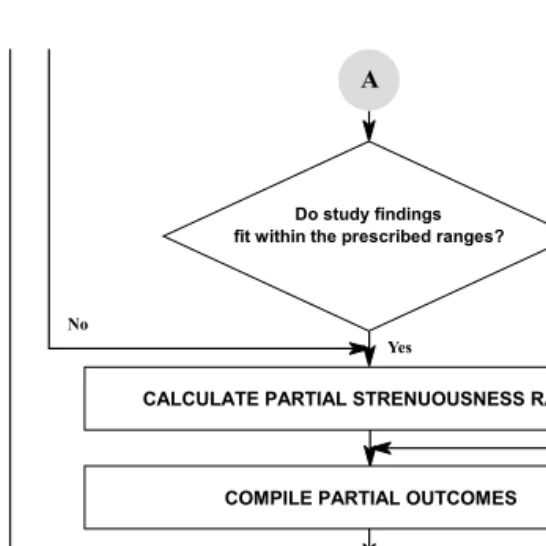
In effect, a set of 14 numerical indices of strenuousness for each factor was assigned to each workplace. The results were subsequently converted using a mathematical formula designed to express all partial outcomes as an overall strenuousness index also in the range from 0 to 1.
The steps taken in calculating the aggregate strenuousness index are presented in Figure 1.
Figure 1. Calculation of the aggregate workplace strenuousness index (Grzybowski et al., 1997–1999).
3. APPLICATIONS OF THE METHOD OF ERGONOMIC
WORKPLACE EVALUATION IN ASSESSING
OCCUPATIONAL RISK
In order to assess working conditions in manufacturing companies, selected representative production processes need to be diagnosed. Before data are collected, a uniform study approach should be developed. The resulting system must be designed to allow, among other things, for (Grzybowski, 1985)
•
the identification of hazards and assessment of occupational risk,•
the monitoring of working conditions,The most commonly used set of standards in safety management in Poland has been Standard No. BS 8800 (British Standards Institution, 1996b). Its intent was to enable companies to develop and implement effective occupational safety and health guidelines integrated with their overall management systems. The guidelines provide a framework for managing health and safety and two different ways of developing and integrating them with the overall management system. The standard forms a basis on which a company may formulate its customized management system compliant with Standard No. BS EN ISO 14001 standard for environmental management systems (British Standards Institution, 1996a). Both cases are presented in very general terms in two flowcharts (Figures 2 and 3). The centerpiece of these models are verification procedures designed for assessing workplace conditions and hazards faced by employees. The standard also provides a simple way of assessing risks on the basis of the probabilities of damage of a specified magnitude. It also suggests actions for specific levels of occupational risk.
Figure 2. The structure of health and safety management according to Standard No. BS 8800 (British Standards Institution, 1996b).
Figure 3. The structure of health and safety management system according to Standard No. BS 8800, (British Standards Institution, 1996b; compliant with Standard No. BS EN ISO 14001; British Standards Institution, 1996a).
For the purposes of the method of ergonomic workplace assessment, the pivotal steps in each model are preliminary and periodic inspections (marked in gray in Figures 2 and 3). It is at this stage that objective data on production systems need to be gathered and converted to probabilities of the occurrence of undesirable accidents.
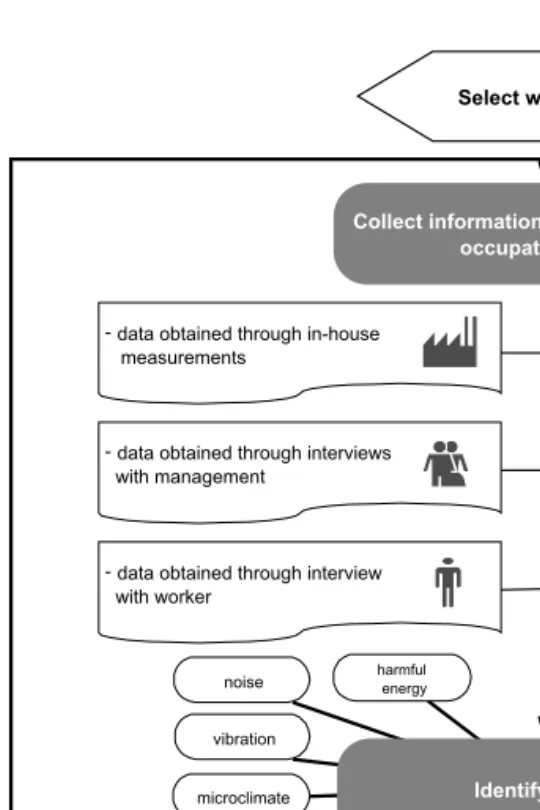
Currently in Poland, the Central Institute for Labour Protection (Warsaw) is developing a series of PN-N-18000 standards under the common heading of Occupational Health and Safety Management Systems. Guidelines for occupational risk assessment have been provided in the draft standard Pr PN-N-18002 (as cited in Podgo´rski, 1999b). These standards provide a very general framework for diagnosing workplaces without imposing any specific evaluation methods. In addition, the standards provide a general outline of steps to be taken in preparing corrective action. Aware of multiple applica-tions of the method of ergonomic workplace assessments in evaluating occupational risks, the author expanded on the general algorithm provided in the draft standard Pr PN-N-18002 by adding boxes representing specific data collection methods and criteria to be considered in describing work strenuousness when applying the method. The steps presented in Figure 1 and guidelines shown in a diagram included in the draft standard Pr PN-N-18002
Figure 4. Occupational risk assessment for a selected workplace. Notes. Based on Dahlke
suggest that the method of ergonomic workplace assessments can be used at initial stages of evaluating occupational risk (Figure 4). Information on the strenuousness of work obtained in the course of the study can be applied directly.
4. CONCLUSIONS. POSSIBLE APPLICATIONS AND
BENEFITS TO BE DERIVED FROM CONDUCTING
ERGONOMIC WORKPLACE ASSESSMENTS
According to the guidelines of the draft Polish Standard for occupational health and safety at workplaces and in companies (Pr PN-N-18002, as cited in Podgo´rski, 1999b), there is a range of requirements businesses should meet with respect to health and safety management. The key ones refer to developing and maintaining proper documentation to ensure that health and safety systems in organizations are functional (Podgo´rski, 1999a, 199b).
To identify risks that may potentially affect health and safety and to assess the related occupational hazards, an organization should develop and maintain hazard identification and occupational risk assessment procedures for workplaces.
Furthermore, organizations should formulate and periodically review general and detailed goals related to occupational health and safety for each level of management.
Workers performing tasks that involve a potential hazard to them or other workers should be adequately competent (have proper education, training, and experience).
An organization’s health and safety system should include procedures for internal communication among its various levels and units and among workers and representatives. It should also include health and safety procedures for communicating with concerned third parties.
A company should also identify those jobs and areas where serious hazards are most likely to occur. Through proper planning and actions, they should ensure that such tasks are performed in proper conditions.
In addition, an organization should develop and maintain procedures for monitoring the state of health and safety. Such procedures should include saving and storing monitoring records.
Any cases of incompliance with applicable laws and other regulations identified in the monitoring process should trigger appropriate corrective and preventative actions.
Each corrective and preventative action undertaken to eliminate the source of existing or potential shortcomings should be commensurate with the related occupational hazards and risks.
Besides the required compliance with standards, in-depth analyses of impact on employee health carries a number of other benefits. Such benefits help (Ociepa, 1999)
1. rationalize a company’s spending on health protection;
2. ensure availability of information on misguided purchases allowing for quick response (analysis of the frequency of use of personal protective clothing and adjustment of issue schedules should their usable lives be longer than previously anticipated);
3. optimize spending on protective clothing and other personal protection items by ensuring such items are properly selected—this can be achieved by means of costing simulations designed to compare cheaper and less durable items with items that are more expensive and have longer usable lives and by purchasing clothing suited for individual needs of holders of particular jobs and for specific environments;
4. support technical equipment decisions with studies on the cost of modernizing and repairing safety equipment and installations;
5. increase employee awareness by means of keeping records of accidents, near-accidents, and their costs and reporting such events in departmental meetings (attended by health and safety specialists) held to reduce accident rates;
6. demonstrate a company’s care for its employees by presenting its health and safety spending to personnel, social organizations, and work inspectors; 7. reduce future insurance premiums based on information on a company’s
occupational safety spending.
In order to ensure that accurate and complete information on occupa-tional health and safety is properly circulated, the company should develop a system of collecting data on the losses sustained as a result of job-related injuries and occupational diseases.
This may be well achieved (Studenski, 1996) by compiling such data in monthly reports submitted to management and technical supervisors. Infor-mation on injury and disease-related losses should also be presented to workers. Such reports should include information on (Studenski, 1996)
•
the total expense related to paid-out damages and compensation,•
a breakdown of expense items by real and lost opportunity costs,•
the total amount of losses,•
the average amount of losses per accident,•
the total cost of occupational diseases,•
the average cost per case.Difficult to predict as they are, studies on the costs of job-related injuries and diseases may significantly reduce a company’s overall operating expenses and give it a competitive advantage.
REFERENCES
Bierła, P., & Zaja˛czkowski, M. (1983). Koncepcja metody okres´lania ucia˛z˙liwos´ci pracy
w jednostkach produkcyjnych zakłado´w przemysłu maszynowego [A concept of a method
for determining work strenuousness in machine industry manufacturing companies] (Zeszyty Naukowe Politechniki Poznan´skiej, Series: Organizacja, No. 13; pp. 229–241). Poznan´, Poland: Wydawnictwo Politechniki Poznan´skiej.
British Standards Institution. (1996a). Environmental management systems. Specification with
guidance to use (Standard No. BS EN ISO 14001:1996). London, UK: Author.
British Standards Institution. (1996b). Guide to occupational health and safety management
systems (Standard No. BS 8800:1996). London, UK: Author.
Dahlke, G., & Grzybowski, W. (2000). Evaluation of occupational safety at workplaces
conducted in laboratory courses. In D. Podgo´rski & W. Karwowski (Eds.), Proceedings of the Second International Conference ERGON-AXIA 2000, Warsaw, Poland, 19–21 May, 2000 (pp. 281–284). Warsaw, Poland: Central Institute for Labour Protection.
Grzybowski, W. (1985). Problems of ergonomic analysis of strenuousness of work in industrial practice. In Proceedings of the Ninth Congress of the International
Ergonom-ics Association, 2–6 September 1985, Bournemouth, England (pp. 496–498). London,
UK: Taylor & Francis.
Grzybowski, W. (1997). A model for ergonomic assessments of the workplace—Advantages and economic effects of application in industrial plants. In P. Seppälä, T. Luopajärvi, C.-H. Nygård, & M. Mattila (Eds.), Proceedings of the 13th Triennial Congress of the
International Ergonomics Association, Tampere, Finland, 1997 (Vol. 2, pp. 616–618).
Helsinki, Finland: Finnish Institute of Occupational Health.
Grzybowski, W. (1997). Ergonomic assessments of workstands as the basic information for the work conditions management in plants. In Proceedings of the Seventh International
Conference on Human-Computer Interaction (HCI International ’97), San Francisco, California, USA, August 24–29, 1997 (Vol. 1, pp. 687–690). Amsterdam, the
Nether-lands: Elsevier.
Grzybowski, W., & Michalak, S. (1987). Ergonomiczna ucia˛z˙liwos´c´ pracy w praktyce przemysłowej—dorobek, kierunki rozwoju, aspekty utylitarne [Ergonomic strenuousness in industrial practice. State of the art, directions of development, utilitarian aspects]. In
Materials for the 4th International Conference on Ergonomics in COMECON Countries
(pp. 651–656). Cracow, Poland: Akademia Go´rniczo-Hutnicza.
Grzybowski, W., Pacholski, L., Jasiak, A, Andrzejczak, K, Dahlke, G., & Go´rny, A. (1997– 1999). Metodyka ergonomicznych ocen stanowisk roboczych w przedsie˛biorstwach
przemysłowych [A method of ergonomic workplace evaluations in industrial companies]
(Research paper No. 1 H02D 033 12). Poznan´, Poland: Poznan´ University of Technology. Hansen, A. (Ed.). (1970). Ergonomiczna analiza ucia˛z˙liwos´ci pracy [Ergonomic analysis of
work strenuousness]. Warsaw, Poland: Wydawnictwo Zwia˛zkowe CRZZ.
Hansen, A. (1983). Kompleksowa ocena poziomu ucia˛z˙liwos´ci [Total work strenousness analysis]. Warsaw, Poland: Instytut Wydawniczy Zwia˛zko´w Zawodowych.
Hansen, A. (1988). Kompleksowa ocena poziomu bezpieczen´stwa i higieny pracy [Total health and safety analysis]. Warsaw, Poland: Instytut Wydawniczy Zwia˛zko´w Zawodowych. Jasiak, A. (1981). Aspekt metodologiczny i aplikacyjny agregacji niejednorodnych ocen
s´rodowiska materialnego, determinuja˛cych sterowanie warunkami pracy w przedsie˛bior-stwie przemysłu maszynowego [Methodological and applied aspects of aggregating
non-uniform physical environment evaluations that determine working conditions manage-ment in machine industry companies]. Unpublished doctoral dissertation, Poznan´ Uni-versity of Technology, Poland.
Jasiak, A. (1987). Metody kompleksowych ocen ergonomicznych stanowisk roboczych— Dorobek, kierunki rozwoju, aspekty utylitarne [Total methods for ergonomic workplace evaluations. State of the art, directions of development, utilitarian aspects]. In Materials
for the 4th International Conference on Ergonomics in COMECON Countries (pp.
519–523). Cracow, Poland: Akademia Go´rniczo-Hutnicza.
Jasiak, A. (1993). Kryterium czynnika ludzkiego w projektowaniu systemo´w wytwarzania [The human factor criterion in designing manufacturing systems]. Poznan´, Poland: Wydawnictwo Politechniki Poznan´skiej.
Katalog norm europejskich i przewodniko´w ISO/IEC dotycza˛cych systemo´w jakos´ci [European
standards catalogue and ISO/IEC guides on quality systems] (Part 1). (1993). Warsaw, Poland: Urza˛d Rady Ministro´w.
Kolman, R. (1973). Ilos´ciowe okres´lenie jakos´ci [Quantitative determination of quality]. Warsaw, Poland: Pan´stwowe Wydawnictwo Ekonomiczne.
Kolman, R. (1993). Zastosowanie metod wartos´ciowania jakos´ci we wprowadzaniu i realizacji
TQM. Praktyczne aspekty realizacji strategii totalnej jakos´ci w polskich przedsie˛-biorstwach [Application of quality valuation methods in implementing and applying
TQM. Practical aspects of TQM in Polish companies] [Seminar Materials]. Błaz˙ejewko, Poland: Poznan´ University of Technology, Instytut Maszyn Roboczych.
Ociepa, A. (1999). Projekt analizy ekonomicznej bezpieczen´stwa pracy i ochrony zdrowia pracowniko´w w Hucie ‘‘Cze˛stochowa’’ [Proposed economic analysis of worker health and safety in the ‘‘Cze˛stochowa’’ metalworks]. In Konferencja Naukowo-Techniczna. Szkoła
Zarza˛dzania Bezpieczen´stwem, Ustron´ (pp. 193–195; Prace Naukowe Gło´wnego Instytutu
Go´rnictwa, Series: Konferencje, No. 27). Katowice, Poland: Gło´wny Instytut Go´rnictwa. Pacholski, L. (1975). Pro´ba opracowania metody ergonomicznego poste˛powania
diagnostycz-nego [An attempt to develop an ergonomic diagnosis procedure]. (Zeszyty Naukowe
Politechniki Poznan´skiej, Series: Ekonomika i Organizacja Przemysłu, No. 5; pp. 5–20). Poznan´, Poland: Wydawnictwo Politechniki Poznan´skiej.
Pacholski, L. (1977a). Metodologia diagnozowania ergonomicznego w przedsie˛biorstwie
przemysłu meblarskiego [A method of ergonomic diagnosis in the furniture industry].
(Rozprawy, No. 81). Poznan´, Poland: Wydawnictwo Politechniki Poznan´skiej. Pacholski, L. (1977b). Problemy kryterium oceny systemo´w ergonomicznych w zakresie
czynniko´w materialnego s´rodowiska pracy człowieka jako element teorii i praktycznych zastosowan´ ergonomii [Criterion of ergonomic evaluation of physical human working environment factors as an element of theoretical and applied ergonomics]. In Kryteria
i mierniki oceny systemo´w ergonomicznych (pp. 62–84). Wrocław, Poland: Towarzystwo
Naukowe Organizacji i Kierownictwa.
Pacholski, L. (1979). Ocena ergonomiczna proceso´w technologicznych—Aspekty metodolo-giczne. Metodyka oceny ergonomicznej maszyn i proceso´w technologicznych [Ergonomic evaluation of technological processes methodological aspects. Methods for ergonomic evaluation of machines and technological processes]. (Materiały do Studio´w i Badan´, No. 46; pp. 15–21). Warsaw, Poland: Centralny Instytut Ochrony Pracy.
Pacholski, L., & Jasiak, A. (1984). Metoda agregacji niejednorodnych ocen materialnego s´rodowiska pracy człowieka [A method of aggregating non-uniform evaluations of human physical working environment]. Ergonomia, 6(2), 225–228.
Podgo´rski, D. (1999a). Projekt polskiej normy okres´laja˛cej wymagania do systemo´w zarza˛dzania bezpieczen´stwem i higiena˛ pracy [A draft Polish standard governing occupational health and safety management systems requirements]. In Konferencja
Naukowo-Techniczna. Szkoła Zarza˛dzania Bezpieczen´stwem, Ustron´ (pp. 211–219; Prace
Naukowe Gło´wnego Instytutu Go´rnictwa, Series: Konferencje, No. 27). Katowice, Poland: Gło´wny Instytut Go´rnictwa.
Podgo´rski, D. (1999b). System zarza˛dzania bezpieczen´stwem i higiena˛ pracy w przedsie˛-biorstwie według normy PN-N-18001 i projekto´w norm PN-N-18002 i PN-N-18004 [A system of occupational health and safety management in companies in compliance with the standard PN-N-18001 and the draft standards PN-N-18002 and PN-N-18004]. In Zarza˛dzanie bezpieczen´stwem i higiena˛ pracy. II krajowa konferencja, Kielce, 3–4
listopada 1999 (pp. 9–31). Warsaw, Poland: Centralny Instytut Ochrony Pracy.
Stephens, K. (1999). System zarza˛dzania bezpieczen´stwem i higiena˛ pracy w Wielkiej Brytanii [A system of occupational health and safety management in Great Britain]. In
Zarza˛dzanie bezpieczen´stwem i higiena˛ pracy. II krajowa konferencja, Kielce, 3–4 listopada 1999 (pp. 159–164). Warsaw, Poland: Centralny Instytut Ochrony Pracy.
Studenski, R. (1996). Ekonomiczne aspekty zarza˛dzania bezpieczen´stwem [Economic aspects of safety management]. Atest—Ochrona pracy, 3, 13–15.
Szczepan´ska, K. (1998). Kompleksowe zarza˛dzanie jakos´cia˛ TQM [Total Quality Management]. Warsaw, Poland: Wydawnictwo Normalizacyjne Alfa-Wero.